What to Grow in a Raised Garden Bed: 15 Plants and Easy Tips
The best things to grow in a raised garden bed include lettuce, spinach, radishes, carrots, bush beans, tomatoes, peppers, cucumbers, herbs, and strawberries. These plants can grow successfully in raised beds because the loose soil, improved drainage, and convenient access help create favorable growing conditions. However, the right crops depend on your bed’s depth, sunlight, available space, and local growing season.
For beginners, leafy greens and radishes are especially practical because they grow relatively quickly and require limited space. Tomatoes, peppers, and cucumbers are excellent choices for sunny beds, although they need more root space and regular care.
The University of Maryland Extension identifies bush beans, tomatoes, cucumbers, peppers, lettuce, and leafy greens among the easiest vegetables for beginning gardeners. It also recommends starting with crops you enjoy eating.
In this article, I cover 15 vegetables, herbs, and fruits suitable for raised garden beds, including their growing requirements and space needs. You’ll learn what to plant in shallow or deep beds, which crops tolerate partial shade, how to organize a 4×4 or 4×8 bed, and how to plan spring, summer, and fall harvests.
What to Grow in a Raised Garden Bed: 15 Best Choices
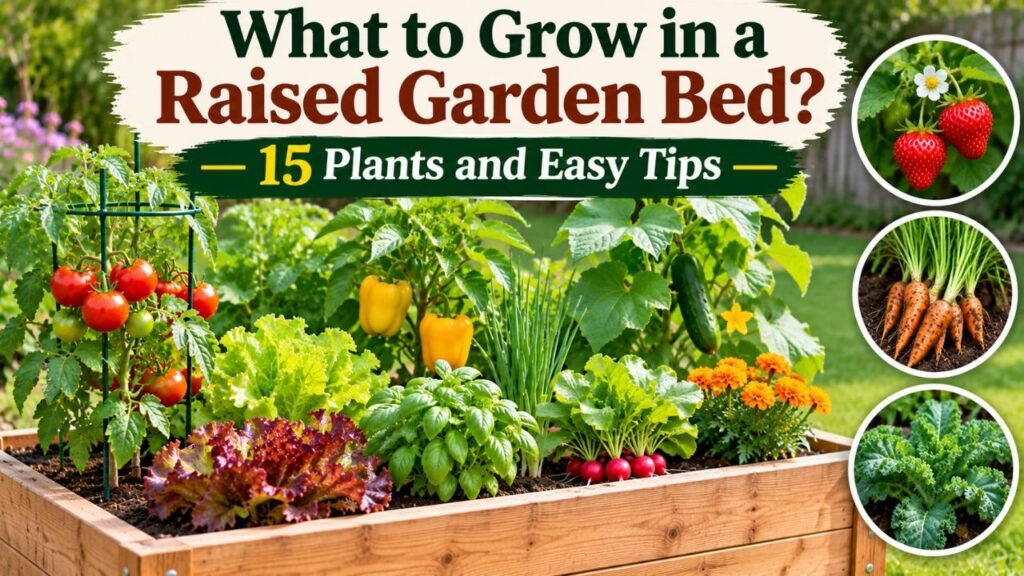
Raised beds can support a wide variety of edible plants, from compact salad greens to taller fruiting vegetables.
The most productive choices usually combine manageable plant sizes, suitable root space, and growing conditions that match the location.
Here are 15 practical crops to consider.
1. Lettuce
Lettuce is one of the easiest vegetables to grow in a raised garden bed.
Its relatively compact growth makes it suitable for small beds, and many varieties can be harvested before larger summer vegetables need the space.
Popular options include:
- Loose-leaf lettuce
- Romaine
- Butterhead
- Oakleaf lettuce
- Baby lettuce mixes
Loose-leaf varieties are especially useful because you can harvest individual outer leaves while allowing the center to continue growing.
Lettuce performs best during cooler weather.
In many U.S. regions, spring and fall provide favorable conditions.
During summer, hot temperatures can cause lettuce to bolt, producing a flowering stalk and often developing a bitter taste.
Best growing conditions: Cool weather, consistently moist soil, and full sun to partial shade.
Beginner Tip: Choose loose-leaf varieties and sow small batches every couple of weeks during suitable weather.
2. Radishes
Radishes are an excellent choice for gardeners who want a quick harvest.
Many small spring varieties mature in approximately 25–40 days, depending on the variety and growing conditions.
They occupy relatively little space and can be grown between larger vegetables before those plants reach full size.
Radishes need loose soil to develop properly shaped roots.
Avoid excessive nitrogen fertilizer, which may encourage leafy growth at the expense of the edible root.
Most radishes grow best in cool weather.
For a continuous harvest, sow small amounts repeatedly rather than planting the entire seed packet at once.
Best growing conditions: Full sun, cool temperatures, and loose, evenly moist soil.
Beginner Tip: Thin the seedlings to the spacing specified on the seed packet so the roots have enough room to develop.
3. Spinach
Spinach is a compact leafy vegetable that fits well into raised beds.
It grows best in cool conditions and can be harvested as baby leaves or allowed to develop larger foliage.
In many climates, spinach performs well during early spring and fall.
It often struggles during hot weather because increasing temperatures and long days can encourage bolting.
A raised bed can make spinach easier to protect with row covers during cool weather.
Keep the soil consistently moist, particularly while seeds are germinating.
Best growing conditions: Cool temperatures, fertile soil, and full sun to partial shade.
Beginner Tip: Plant spinach during cooler parts of the growing season rather than the hottest summer months.
4. Kale
Kale is a versatile leafy vegetable that can produce harvests over an extended period.
Unlike vegetables grown for one large fruit or head, kale allows gardeners to harvest individual leaves.
Common types include:
- Curly kale
- Lacinato kale
- Red Russian kale
- Dwarf kale varieties
Kale generally tolerates cool weather well.
Some varieties become more pleasant in flavor after exposure to cooler temperatures.
However, kale plants can become relatively large.
Give them adequate space and monitor for caterpillars and other pests commonly associated with cabbage-family vegetables.
Best growing conditions: Full sun to partial shade, fertile soil, and cooler growing temperatures.
Beginner Tip: Harvest the lower mature leaves while allowing the growing point to continue producing new foliage.
5. Swiss Chard
Swiss chard is an excellent raised-bed vegetable because it produces edible leaves throughout much of the growing season.
It is also visually attractive.
Some varieties have colorful stems in shades of red, orange, yellow, and white.
Swiss chard generally tolerates warmer temperatures better than spinach.
This makes it useful when spring greens begin to struggle with summer heat.
Harvest mature outer leaves as needed.
Leave the center intact so the plant can continue growing.
Best growing conditions: Full sun to partial shade, fertile soil, and consistent moisture.
Beginner Tip: Choose compact varieties if your raised bed is small.
6. Carrots
Carrots benefit from the loose, relatively stone-free soil often found in well-prepared raised beds.
Compacted soil, rocks, and other obstacles can cause roots to become misshapen or forked.
Raised beds allow you to create a more uniform growing environment.
However, carrot varieties differ considerably in root length.
Short types such as Parisian or Chantenay carrots are useful for shallower growing areas.
Long-rooted varieties need more unobstructed soil depth.
Carrots are generally direct-seeded because transplanting can disturb their developing taproots.
Keep the surface consistently moist during germination.
Best growing conditions: Full sun, loose soil, and adequate root depth.
Beginner Tip: Choose shorter-rooted carrot varieties if you are using a shallow bed with a solid bottom.
7. Beets
Beets are another useful root vegetable for raised beds.
Both their roots and tender leaves are edible.
They grow well in loose soil and can be planted relatively close together when properly thinned.
Beets generally prefer cooler temperatures.
In many U.S. regions, spring and fall are favorable planting periods.
The seed structures commonly sold as beet seeds may produce multiple seedlings, so thinning is often necessary.
Give developing roots enough space to reach their expected size.
Best growing conditions: Full sun, fertile soil, and consistent moisture.
Beginner Tip: Harvest some young beet greens during thinning if they are healthy and suitable for eating.
8. Bush Beans
Bush beans are among the easiest warm-season vegetables for raised beds.
Unlike pole beans, bush varieties generally grow in a compact form without requiring a tall trellis.
They are useful for gardeners who want productive plants without complicated support systems.
Snap bean varieties often begin producing a harvest approximately 50–60 days after direct sowing under favorable conditions.
Plant after the danger of frost has passed and the soil has warmed sufficiently.
Bush beans require good sunlight and consistent moisture, especially during flowering and pod development.
Best growing conditions: Full sun, warm soil, and good drainage.
Beginner Tip: Plant a new short row every two or three weeks during the appropriate season to extend the harvest.
9. Peas
Peas are well suited to raised beds during cool weather.
They can be planted in early spring in many regions, with fall planting possible where the growing season allows.
Common types include:
- Sugar snap peas
- Snow peas
- Shelling peas
Some pea varieties grow as compact bushes, while others need trellises.
Vertical supports allow taller pea varieties to use less ground area.
Peas generally perform poorly during prolonged hot weather.
For this reason, plant them early enough to mature before significant summer heat arrives.
Best growing conditions: Cool weather, full sun, and well-drained soil.
Beginner Tip: Place a trellis along the northern side of the bed when possible so taller vines do not shade smaller vegetables.
10. Cherry Tomatoes
Cherry tomatoes are a popular choice for raised-bed gardening.
They can produce numerous small fruits throughout the warm growing season.
However, not all cherry tomato varieties are compact.
Some indeterminate varieties grow into very large vines and require strong supports.
For smaller raised beds, choose varieties labeled:
- Determinate
- Bush
- Patio
- Dwarf
- Compact
The University of Maryland Extension recommends planting tomatoes after frost danger has passed and the soil has warmed.
Tomatoes generally need at least six hours of direct sunlight, with more sun often producing better results.
Best growing conditions: Full sun, warm temperatures, fertile soil, and adequate root space.
Beginner Tip: Install a cage, stake, or trellis when planting rather than waiting until the tomato becomes large.
11. Peppers
Both sweet and hot peppers can grow successfully in raised beds.
Compared with sprawling vegetables such as pumpkins, many pepper varieties have relatively manageable growth habits.
Good options include:
- Bell peppers
- Jalapeños
- Banana peppers
- Shishito peppers
- Compact sweet peppers
Peppers need warm conditions and consistent moisture.
Cold soil can slow their establishment.
Avoid transplanting them before local weather and soil conditions are suitable.
Pepper plants also benefit from adequate spacing and support when carrying a heavy fruit load.
Best growing conditions: Full sun, warm soil, good drainage, and sufficient nutrients.
Beginner Tip: Choose a compact pepper variety if your bed is narrow or already contains other large plants.
12. Cucumbers
Cucumbers are productive raised-bed vegetables when given enough space and support.
The main challenge is managing their vines.
Many cucumber varieties spread across a substantial area if left on the soil.
Growing them vertically can reduce the space occupied inside the bed.
A sturdy trellis also helps keep the fruit off the soil and makes harvesting easier.
The University of Maryland Extension’s cucumber guide notes that trellising can improve yields per square foot and reduce problems associated with fruit resting on wet soil.
For small gardens, choose compact or bush cucumber varieties.
Best growing conditions: Full sun, warm weather, consistent moisture, and suitable support.
Beginner Tip: Install the trellis before the plants begin producing long vines.
13. Basil
Basil is a practical herb to grow in a raised garden bed.
It does not need as much space as many fruiting vegetables and can be harvested repeatedly during warm weather.
Common choices include:
- Sweet basil
- Genovese basil
- Thai basil
- Lemon basil
- Compact bush basil
Basil prefers warm conditions and is sensitive to frost.
Pinching growing tips can encourage branching and help produce a bushier plant.
It can be grown near tomatoes, provided both crops have enough space, light, water, and nutrients.
However, growing basil beside tomatoes does not guarantee pest protection or higher yields.
Best growing conditions: Full sun, warm temperatures, and well-drained soil.
Beginner Tip: Harvest regularly and remove flower shoots when your priority is continued leaf production.
14. Parsley
Parsley is a useful culinary herb that works well in smaller raised beds.
It can be grown for its fresh leaves and harvested over an extended period.
Popular varieties include:
- Flat-leaf parsley
- Curly parsley
Parsley generally grows best in well-drained soil with sufficient moisture.
It tolerates cooler conditions better than basil.
However, germination can be relatively slow.
If you want a quick start, use healthy nursery transplants.
Give the plants enough space to develop a full leaf canopy.
Best growing conditions: Full sun to partial shade, fertile soil, and consistent moisture.
Beginner Tip: Harvest outer stems near the base while leaving the central growth intact.
15. Strawberries
Strawberries are an attractive option for raised beds, especially when you want a perennial fruit crop.
They have relatively shallow, fibrous roots and benefit from well-drained soil.
Raised beds can be particularly helpful where native soil drains poorly.
However, strawberries still need careful watering because their root systems are sensitive to both very dry and waterlogged conditions.
Choose a suitable strawberry type:
- June-bearing strawberries produce a concentrated seasonal harvest.
- Day-neutral strawberries can produce over a longer period when temperatures are favorable.
The University of Maryland Extension’s strawberry guide recommends full sun and explains how planting systems and runner management affect productivity.
Best growing conditions: Full sun, well-drained soil, regular moisture, and sufficient space for runners.
Beginner Tip: Consider dedicating a separate raised bed to strawberries because they remain in the growing area for multiple seasons.
Best Raised-Bed Plants at a Glance
Use this table to compare the 15 choices before planning your garden.
| Plant | Best season in many U.S. climates | Sunlight | Space requirement | Beginner suitability |
| Lettuce | Spring and fall | Full sun to partial shade | Low | Excellent |
| Radishes | Spring and fall | Full sun | Low | Excellent |
| Spinach | Spring and fall | Full sun to partial shade | Low | Very good |
| Kale | Spring and fall | Full sun to partial shade | Medium | Very good |
| Swiss chard | Spring through fall | Full sun to partial shade | Medium | Very good |
| Carrots | Cool to mild seasons | Full sun | Low to medium | Very good |
| Beets | Spring and fall | Full sun | Low to medium | Very good |
| Bush beans | Warm season | Full sun | Medium | Excellent |
| Peas | Cool season | Full sun | Medium; support may be needed | Very good |
| Cherry tomatoes | Warm season | Full sun | High unless compact | Good |
| Peppers | Warm season | Full sun | Medium | Good |
| Cucumbers | Warm season | Full sun | High unless trellised | Good |
| Basil | Warm season | Full sun | Low to medium | Excellent |
| Parsley | Spring through fall | Full sun to partial shade | Low | Very good |
| Strawberries | Perennial; harvest season varies | Full sun | Medium | Good |
Planting seasons differ across USDA hardiness zones and local climates. Use local frost dates and crop-specific recommendations rather than treating the table as a fixed national planting calendar.
What to Grow in a Raised Garden Bed Based on Soil Depth
Soil depth is one of the most important factors when selecting crops.
However, the height of the raised-bed walls is not necessarily the same as the total rooting depth.
A bottomless raised bed sitting on healthy, loosened garden soil allows roots to extend into the ground below.
A raised bed sitting on concrete or another impermeable surface does not.
Raised-Bed Soil Depth Guide
| Available growing depth | Suitable crops to consider | Important limitations |
| 6–8 inches | Leaf lettuce, radishes, scallions, baby greens, some herbs | Best for compact, relatively shallow-rooted crops |
| 8–12 inches | Spinach, bush beans, short carrots, beets, parsley, compact greens | Root size and water availability matter |
| 12–18 inches | Peppers, compact tomatoes, cucumbers, kale, strawberries | Large plants still need sufficient total soil volume |
| 18–24 inches | Tomatoes, squash, peppers, many larger vegetables | More rooting volume and moisture storage |
| More than 24 inches | A broad range of vegetables | Crop spacing and sunlight remain important |
These are practical selection ranges, not universal minimum root-depth requirements.
The University of Maryland Extension’s 2026 raised-bed gardening guidance recommends at least 8 inches of growing depth on hard surfaces for leafy greens, beans, and cucumbers, and approximately 12–24 inches for peppers, tomatoes, and squash.
What Can You Grow in a 6-Inch-Deep Raised Bed?
A shallow bed is most suitable for compact crops, especially if roots cannot grow into the ground beneath it.
Good options include leaf lettuce, radishes, small leafy greens, and scallions.
However, shallow soil dries quickly.
It is less forgiving of missed watering than deeper beds.
If the raised bed is open to healthy soil underneath, crops may have access to much greater rooting depth than the wall height suggests.
What Can You Grow in a 12-Inch-Deep Raised Bed?
A 12-inch bed offers more flexibility.
You can consider:
- Lettuce
- Kale
- Swiss chard
- Bush beans
- Peas
- Carrots
- Beets
- Herbs
- Compact peppers
- Some compact tomato and cucumber varieties
For large fruiting crops, total soil volume and the ability of roots to extend below the bed remain important.
What Can You Grow in an 18- to 24-Inch-Deep Raised Bed?
Deeper beds can provide greater rooting volume and moisture storage.
They are well suited to many fruiting vegetables, including tomatoes, peppers, cucumbers, and certain squash varieties.
However, additional depth does not eliminate the need for sufficient plant spacing.
One oversized plant can still dominate a small bed.
Key Takeaway: Shallow beds are easiest to manage with greens and small root crops. Deeper beds offer more flexibility for tomatoes, peppers, and other large plants, especially when the bed has a solid bottom.
What to Grow in Raised Beds With Full Sun
Most fruiting vegetables need substantial sunlight.
For tomatoes, peppers, cucumbers, and similar crops, aim for at least 6–8 hours of direct sun per day, with more often beneficial.
Good full-sun raised-bed crops include:
- Tomatoes
- Peppers
- Cucumbers
- Bush beans
- Peas during suitable cool seasons
- Basil
- Strawberries
- Carrots
- Beets
Sunlight requirements vary by crop, season, and climate.
In extremely hot regions, some vegetables may benefit from temporary afternoon shade during intense summer heat.
Why Fruiting Vegetables Need More Sun
Fruiting crops use sunlight to support vegetative growth, flowering, and fruit development.
Insufficient sunlight can cause weak growth and reduced production.
A tomato plant may survive in partial shade but produce fewer fruits than a similarly healthy plant receiving appropriate full sun.
Choose the sunniest suitable location when growing fruiting vegetables.
What to Grow in Raised Beds With Partial Shade
A raised bed receiving four to six hours of direct sunlight can still be productive.
However, the crop selection should favor plants that tolerate lower light conditions.
Good Partial-Shade Crops
Consider:
- Leaf lettuce
- Spinach
- Kale
- Swiss chard
- Parsley
- Scallions
- Radishes in suitable conditions
- Baby salad greens
Leafy vegetables generally tolerate partial shade better than crops that need to produce large amounts of fruit.
However, growth may be slower, especially during cooler seasons.
Can You Grow Vegetables With Less Than Four Hours of Sun?
Some leafy greens and microgreens may grow with limited direct sunlight, particularly when they receive bright indirect light.
However, productivity will usually be lower than in a more suitable growing location.
The University of Minnesota Extension’s raised-bed guide identifies lettuce, baby kale, scallions, microgreens, radishes, and beet greens as potential options for partially shaded beds.
If the location is heavily shaded throughout the day, consider relocating the bed or growing shade-tolerant ornamental plants instead.
Best Vegetables to Grow in Raised Beds by Season
Seasonal planning allows you to use the same raised bed for different crops throughout the year.
However, exact planting dates depend on local frost patterns and growing conditions.
Spring Vegetables
Spring is an excellent time for cool-season crops.
Consider growing:
- Lettuce
- Spinach
- Radishes
- Carrots
- Peas
- Kale
- Beets
- Parsley
These crops can often be planted before the weather becomes suitable for tomatoes and peppers.
Some may tolerate light frost, while others need protection during severe cold.
Summer Vegetables
Once frost danger has passed and the soil warms, switch to warm-season vegetables.
Good choices include:
- Tomatoes
- Peppers
- Cucumbers
- Bush beans
- Basil
- Summer squash, if space permits
- Eggplants in a sufficiently large bed
Avoid planting frost-sensitive crops too early.
The University of Maryland Extension recommends waiting until soil and weather conditions are suitable before transplanting tomatoes and peppers.
Fall Vegetables
As temperatures cool, raised beds can produce another harvest of leafy and root vegetables.
Consider:
- Spinach
- Kale
- Lettuce
- Radishes
- Turnips
- Carrots
- Beets
- Certain cabbage-family vegetables
Start long-maturing fall crops early enough to establish before cold weather slows growth.
Winter Vegetables
Winter gardening depends heavily on climate.
In mild regions, some vegetables can continue growing outdoors.
In colder regions, protection may be needed.
Potential winter crops include:
- Kale
- Spinach
- Certain cold-hardy lettuce varieties
- Scallions
- Some Asian greens
Row covers, low tunnels, and cold frames can help protect crops.
However, these structures do not provide unlimited frost protection.
Choose varieties suitable for local winter conditions and monitor temperatures inside covered beds.
What to Grow in a 4×4 Raised Garden Bed
A 4×4-foot raised bed provides 16 square feet of planting area.
This can be productive when crops are selected according to their mature size.
For beginners, compact leafy vegetables and herbs are usually easier to manage than several large fruiting plants.
Option 1: Beginner Salad Garden
A simple 4×4 bed can contain sections of:
- Loose-leaf lettuce
- Spinach
- Radishes
- Parsley
Divide the bed into manageable planting areas.
Follow each seed packet’s final spacing recommendations.
Harvest radishes and baby greens first, then replant the empty areas when the season permits.
This arrangement works particularly well in spring and fall.
Option 2: Tomato and Herb Garden
A compact or dwarf cherry tomato can serve as the main plant.
Use a suitable support.
Depending on the tomato’s mature size and the available space, you may be able to grow a small amount of basil or early lettuce nearby.
However, do not crowd a full-size indeterminate tomato with numerous additional plants.
The mature tomato canopy may occupy much of the bed.
Option 3: Root Vegetable Garden
Another option is to dedicate the bed to:
- Short carrots
- Beets
- Radishes
These crops can be grown in clearly defined sections.
Thin seedlings as they grow.
Loose soil and consistent moisture will help root development.
What to Grow in a 4×8 Raised Garden Bed
A 4×8-foot raised bed provides 32 square feet of growing area.
This offers more flexibility for combining leafy vegetables with compact fruiting crops.
Example Warm-Season Planting Plan
A practical starting arrangement might include:
- One supported compact tomato at one end
- One or two pepper plants, depending on mature size
- One trellised compact cucumber at the opposite end
- Basil or another small herb in an available area
This is an illustrative planting plan, not a fixed spacing formula.
Check the mature spread of each variety before planting.
Large indeterminate tomatoes and vigorous cucumbers can easily overcrowd this arrangement.
Example Cool-Season Planting Plan
Divide the growing area into sections for:
- Peas along a trellis
- Loose-leaf lettuce
- Radishes
- Carrots
- Spinach or kale
Position taller crops so they do not unnecessarily shade shorter ones.
In the Northern Hemisphere, placing tall crops along the northern edge is often helpful when the bed’s orientation permits it.
How to Increase Harvests Without Overcrowding
Use succession planting.
For example, a spring crop of lettuce may be harvested before a warm-season vegetable needs additional space.
After a summer crop finishes, plant suitable fall greens.
This can extend productivity without forcing too many mature plants into the bed at once.
How Far Apart Should You Plant Vegetables in Raised Beds?
Plant spacing affects light access, airflow, root competition, and disease pressure.
Raised beds may support intensive planting, but that does not mean every crop should be packed closely together.
Approximate Plant Spacing Guide
| Vegetable | General final spacing |
| Radishes | About 1–2 inches |
| Carrots | About 2–3 inches |
| Beets | About 3–4 inches |
| Leaf lettuce | About 4–10 inches, depending on harvest size |
| Spinach | About 3–6 inches |
| Bush beans | About 3–6 inches |
| Swiss chard | About 6–12 inches |
| Kale | About 12–18 inches |
| Peppers | About 18–24 inches |
| Trellised cucumbers | About 9–18 inches, depending on variety and method |
| Tomatoes | Often 18–36 inches or more, depending on growth habit |
These are approximate gardening ranges.
Always prioritize the spacing instructions for the specific variety and growing system.
For example, a dwarf tomato and a vigorous indeterminate tomato may have very different space requirements.
The University of Maryland Extension’s seed-sowing guidance explains that intensive planting can increase production per square foot but may also increase competition for water, nutrients, and light.
Why Overcrowding Causes Problems
Plants placed too closely together may develop:
- Reduced airflow
- Greater humidity around leaves
- Increased disease pressure
- Competition for nutrients
- Competition for water
- Smaller harvests
- Difficult access for pruning and harvesting
Compact growth is useful, but overcrowding is not the same as efficient gardening.
What Herbs Grow Best in Raised Garden Beds?
Herbs can be excellent companions to vegetable crops because many have relatively modest space requirements.
However, herbs differ in sunlight, moisture, and nutrient needs.
Best Herbs for Sunny Raised Beds
Consider:
- Basil
- Thyme
- Oregano
- Rosemary
- Sage
- Chives
Basil generally appreciates more consistent moisture than drought-tolerant Mediterranean herbs such as rosemary and thyme.
Avoid treating every herb as though it needs identical watering.
Best Herbs for Partial Shade
Parsley, cilantro, and chives may tolerate some partial shade, depending on the climate.
However, most culinary herbs still grow best with adequate light.
The University of Minnesota Extension’s herb-growing guide recommends well-drained soil and generally at least six hours of direct sunlight for strong herb growth.
Should You Plant Mint in a Raised Bed?
Mint can grow well in raised beds, but it spreads aggressively through underground stems.
It may eventually dominate the growing area.
For most small vegetable gardens, keeping mint in a separate container is easier to manage.
Make sure the container has suitable drainage.
Can You Grow Fruit in a Raised Garden Bed?
Yes. Some fruits grow well in raised beds.
However, fruit-producing plants vary widely in mature size and rooting needs.
Strawberries
Strawberries are one of the most practical fruit choices.
Their low-growing habit and relatively shallow roots suit many raised-bed designs.
However, they need regular moisture and good drainage.
Strawberries are perennial, so consider dedicating space to them rather than repeatedly disturbing their roots.
Dwarf Blueberries
Compact blueberry varieties can grow in suitable raised beds.
However, blueberries require strongly acidic soil.
Their preferred pH is substantially lower than that of many common vegetables.
For this reason, blueberries are often easier to manage in a dedicated bed or container with an appropriate acidic growing medium.
Melons
Compact melon varieties can be grown in raised beds with sufficient space, warm weather, and suitable root volume.
However, vines may spread far beyond the bed.
Trellising some small-fruited varieties can save space, but fruits may require support.
Large melons are usually more challenging in small raised beds.
What Flowers Can You Grow With Vegetables in Raised Beds?
Flowers can add color and help provide resources for beneficial insects.
However, they still compete with vegetables for space, water, and nutrients.
Marigolds
Marigolds are popular annual flowers.
Compact varieties can be planted near the edge of a raised bed.
They add color and may attract certain beneficial insects.
However, planting marigolds does not automatically prevent every vegetable pest.
Nasturtiums
Nasturtiums produce attractive flowers and foliage.
Many varieties have edible flowers and leaves when grown and handled appropriately.
They can spread, so give them enough space.
Choose a compact variety for a small raised bed.
Calendula
Calendula is another attractive annual flower that can work in vegetable gardens.
It often performs well in cooler weather.
Its flowers may attract pollinators and other insects.
Select a suitable location where it won’t shade young vegetables.
Sweet Alyssum
Sweet alyssum has small flowers that can attract certain beneficial insects.
It is useful along bed edges.
However, it still requires sunlight and enough growing space.
Avoid assuming any flowering plant guarantees pest control or pollination success.
What Should You Avoid Growing in a Small Raised Garden Bed?
Most vegetables can grow in raised beds under suitable conditions.
However, some crops are less practical when space is limited.
Large Pumpkins
Pumpkin vines can spread across a substantial area.
Large varieties may quickly overwhelm a small bed.
Compact or bush varieties are more manageable, but they still need space.
Full-Size Watermelons
Watermelons generally require considerable room and warm growing conditions.
Small-fruited varieties can be more practical, but they are still demanding crops for a compact bed.
Sweet Corn
Sweet corn is usually grown in blocks to improve wind pollination.
A few isolated plants in a small raised bed may produce poorly filled ears.
Unless you have adequate space for a suitable planting block, other vegetables may provide more reliable harvests.
Large Winter Squash
Many winter squash varieties produce long vines and substantial foliage.
Choose compact bush types or provide growing space outside the bed.
Asparagus
Asparagus can grow in raised beds, but it is a long-lived perennial.
It occupies growing space for many years.
A dedicated bed is more practical than combining asparagus with annually rotated vegetables.
Aggressively Spreading Perennials
Some herbs, particularly mint, may spread throughout the raised bed.
These are usually easier to control in separate containers.
How to Prepare a Raised Garden Bed Before Planting
Even easy vegetables need suitable soil, drainage, sunlight, and water.
Preparing the bed properly will help plants establish and develop healthy roots.
Step 1: Choose a Suitable Location
Most vegetable gardens need at least six hours of direct sunlight each day.
Fruit-producing vegetables often benefit from more.
Place the bed where it is easy to access water and where excess rainwater can drain.
Step 2: Check the Growing Depth
Measure the actual soil depth.
If the bed rests on healthy ground without an impermeable bottom, roots may extend below the raised-bed walls.
If the bed rests on concrete, the depth of the filled bed becomes especially important.
Step 3: Use a Suitable Soil Mix
For bottomless raised beds over native soil, a mixture of suitable topsoil and finished compost can work well.
The University of Minnesota Extension recommends approximately one-half to two-thirds topsoil combined with one-third to one-half plant-based compost for many raised beds.
However, raised beds on hard surfaces may need a different, lighter growing medium because drainage and total soil volume are different.
Avoid using unfinished compost or filling the bed entirely with dense clay soil.
Step 4: Check Soil Fertility
A laboratory soil test can identify pH and nutrient levels.
For many vegetables, a slightly acidic to near-neutral soil is suitable.
The University of Maryland Extension identifies approximately pH 6.2–6.8 as a useful target for many vegetables and herbs.
However, some crops have different requirements.
Blueberries, for example, need much more acidic conditions.
Step 5: Plan Plant Spacing
Decide how many mature plants the bed can accommodate.
Allow sufficient space for growth and harvesting.
Position taller plants where they are less likely to shade smaller crops.
Step 6: Install Supports Early
Tomatoes, pole beans, peas, and many cucumbers benefit from supports.
Install cages or trellises before extensive root growth develops.
Make sure the supports can withstand the mature plant’s weight and wind exposure.
Step 7: Water After Planting
Water seeds and transplants gently.
Maintain consistent moisture during establishment.
Avoid saturating the soil to the point where drainage becomes poor.
Step 8: Add Mulch When Appropriate
Mulch can reduce water evaporation and suppress weeds.
Use a material suitable for the crop and growing season.
Keep mulch away from plant stems when necessary.
How Often Should You Water Vegetables in Raised Beds?
Raised beds may dry out faster than ordinary in-ground gardens.
This is particularly true for tall beds, beds on pavement, and those exposed to intense sunlight or wind.
There is no universal daily watering schedule.
Water needs depend on:
- Soil composition
- Bed depth
- Temperature
- Rainfall
- Sunlight
- Plant size
- Growth stage
- Mulch coverage
- Drainage
Check Soil Moisture Before Watering
Insert a finger into the soil near the plant’s root zone.
If the soil feels dry beneath the surface, watering may be needed.
For deeper-rooted plants, check moisture farther down rather than judging only the top inch.
Water the Root Zone
Apply water slowly enough to soak into the soil.
Drip irrigation and soaker hoses can help deliver moisture near plant roots.
Avoid routinely wetting foliage late in the day when conditions favor disease development.
Watch for Overwatering
Too much water can reduce oxygen around roots.
Symptoms may include wilting, yellowing leaves, and poor growth.
These symptoms can also have other causes, so check soil moisture rather than assuming every wilted plant needs more water.
How to Get More Harvests From a Raised Garden Bed
A productive raised bed doesn’t have to contain every crop at the same time.
Seasonal planning is often more effective than crowding.
Use Succession Planting
Succession planting means growing a new crop after an earlier crop is harvested.
For example:
| Early crop | Following crop | Later crop if season allows |
| Spring lettuce | Bush beans | Fall spinach |
| Spring peas | Compact cucumbers | Fall kale |
| Spring radishes | Peppers | Fall greens |
| Spring spinach | Tomatoes | Cover crop after removal |
These are illustrative sequences.
Exact timing depends on climate, the crop’s maturity period, and the remaining frost-free season.
Harvest Leafy Vegetables Regularly
Many leaf crops can be harvested by removing mature outer leaves.
This can extend the usable harvest period.
However, avoid removing too much foliage at once.
The plant needs enough healthy leaves to continue growing.
Choose Compact Varieties
Look for seed descriptions such as:
- Dwarf
- Bush
- Patio
- Compact
- Determinate
- Short-vine
These varieties are often better suited to limited garden space.
However, always check mature dimensions.
Not every variety labeled bush is small enough for every raised bed.
Use Vertical Space
Trellises can help manage peas, cucumbers, and certain beans.
Supporting vines vertically can leave more ground area available for smaller vegetables.
However, avoid placing tall trellises where they will unnecessarily shade the bed.
Rotate Plant Families
When you have multiple beds, change crop families between growing areas over successive years.
For example, avoid repeatedly growing tomatoes, peppers, and eggplants in the same bed.
The University of Minnesota Extension recommends keeping crops from the same family out of a bed for approximately three to four years when practical.
Crop rotation can help manage some soilborne diseases, although it does not prevent every pest or disease problem.
Common Mistakes When Choosing Raised-Bed Plants
Several mistakes can reduce yields even when the soil is otherwise suitable.
| Mistake | Why it causes problems | Better approach |
| Planting too many large vegetables | Creates crowding and competition | Plan for mature plant size |
| Growing tomatoes in deep shade | Reduces fruiting performance | Choose a sunnier location |
| Planting warm-season crops before frost danger passes | Risks cold injury | Follow local planting dates |
| Growing long carrots in very shallow soil | Restricts root development | Choose shorter varieties or deeper soil |
| Using too much compost | May create nutrient imbalances | Follow soil test guidance |
| Growing sprawling vines without support or space | Overwhelms the bed | Trellis or select compact varieties |
| Ignoring moisture | Raised beds may dry quickly | Check root-zone moisture |
| Planting aggressive mint directly into a mixed bed | Can spread throughout the area | Use a separate container |
| Repeating related crops every year | May increase disease pressure | Rotate plant families |
| Choosing crops nobody eats | Wastes valuable garden space | Grow vegetables you regularly use |
The best raised-bed garden is not the one with the most different plants.
It is the one that provides the right growing conditions for crops you actually want to harvest.
Conclusion
Deciding what to grow in a raised garden bed begins with matching plants to the available sunlight, growing depth, and seasonal conditions.
For beginners, lettuce, radishes, spinach, bush beans, and herbs are practical starting choices. They are relatively manageable and can produce useful harvests without requiring a large garden.
Tomatoes, peppers, and cucumbers are excellent options for sunny beds with adequate soil volume and spacing. Carrots and beets benefit from loose soil, while strawberries are suitable for gardeners who want a longer-term fruit crop.
I recommend starting with three to five vegetables you regularly eat rather than planting too many varieties in the first season.
If you have a small bed, use compact plants and harvest quick-growing greens before larger warm-season crops need the space.
For larger beds, combine vertical supports, careful spacing, succession planting, and regular soil maintenance.
With appropriate planning, even a modest raised garden bed can provide fresh vegetables, herbs, and occasional fruit harvests across several parts of the growing season.
FAQs About What to Grow in a Raised Garden Bed
What Is the Easiest Thing to Grow in a Raised Garden Bed?
Leaf lettuce, radishes, bush beans, and many culinary herbs are among the easiest choices.
Radishes grow quickly, lettuce can provide repeated leaf harvests, and bush beans generally need little structural support.
Choose plants suited to your local season and available sunlight.
What Vegetables Grow Best in a 4×4 Raised Bed?
Lettuce, spinach, radishes, carrots, beets, herbs, and bush beans are practical choices.
You can also grow a compact tomato or pepper, provided the bed has adequate depth and space.
Avoid overcrowding the bed with several large fruiting plants.
What Should a Beginner Plant in a Raised Bed?
A beginner could start with loose-leaf lettuce, radishes, bush beans, basil, and a compact cherry tomato.
This provides a mix of leafy vegetables, quick root crops, herbs, and a warm-season fruiting crop.
Adjust the selections to the growing season.
What Can You Grow in a 12-Inch-Deep Raised Bed?
A 12-inch bed can support many greens, herbs, bush beans, carrots, beets, peas, and compact vegetables.
Larger plants such as tomatoes and peppers need sufficient total root volume.
If the bed is open to healthy soil below, their roots may extend beyond the bed’s 12-inch wall height.
Can You Grow Tomatoes and Cucumbers in the Same Raised Bed?
Yes, when the bed has adequate space, sunlight, soil volume, and supports.
Both crops can become large.
Use a trellis for cucumbers and suitable support for tomatoes.
Avoid planting them so closely that airflow and access become restricted.
What Grows Best in Raised Beds With Little Sun?
Lettuce, spinach, baby kale, scallions, parsley, and some other leafy vegetables may tolerate partial shade.
However, even shade-tolerant vegetables need enough light for healthy growth.
Tomatoes, peppers, and cucumbers generally require substantially more direct sunlight.
Can You Grow Strawberries in a Raised Garden Bed?
Yes. Strawberries can grow successfully in raised beds with full sun, good drainage, and consistent moisture.
They are perennial plants, so a dedicated growing area can simplify long-term care.
Manage runners to prevent overcrowding.
What Should You Not Plant in a Small Raised Bed?
Large pumpkins, full-size watermelons, sprawling winter squash, and sweet corn can be challenging because of their space or pollination requirements.
Aggressively spreading plants such as mint are also easier to manage in separate containers.
Compact varieties may make some larger crops more practical.
Can You Plant Flowers and Vegetables Together in a Raised Bed?
Yes. Compact flowers such as marigolds, calendula, nasturtiums, and sweet alyssum can share space with vegetables when conditions are suitable.
Allow enough room for all plants.
Flowers may provide resources for beneficial insects, but they do not guarantee pest control.
What Can You Grow in Raised Beds All Year?
Year-round production depends on your climate.
In mild regions, lettuce, kale, spinach, and other cool-season crops may grow during winter.
In colder climates, row covers or cold frames can extend the season, but winter growth is often slow.
Use local frost dates and crop-specific guidance when planning year-round harvests.

I’m Maya L. Greenwood, a lifelong plant lover who believes anyone can grow something beautiful with the right guidance. After years of testing soil mixes, pruning methods, irrigation tricks, and pest-safe solutions, I started EasyGardenTips.com to turn hard-won lessons into step-by-step advice. From seed starting and container gardens to composting and seasonal checklists, my goal is to make gardening simple, sustainable, and fun.