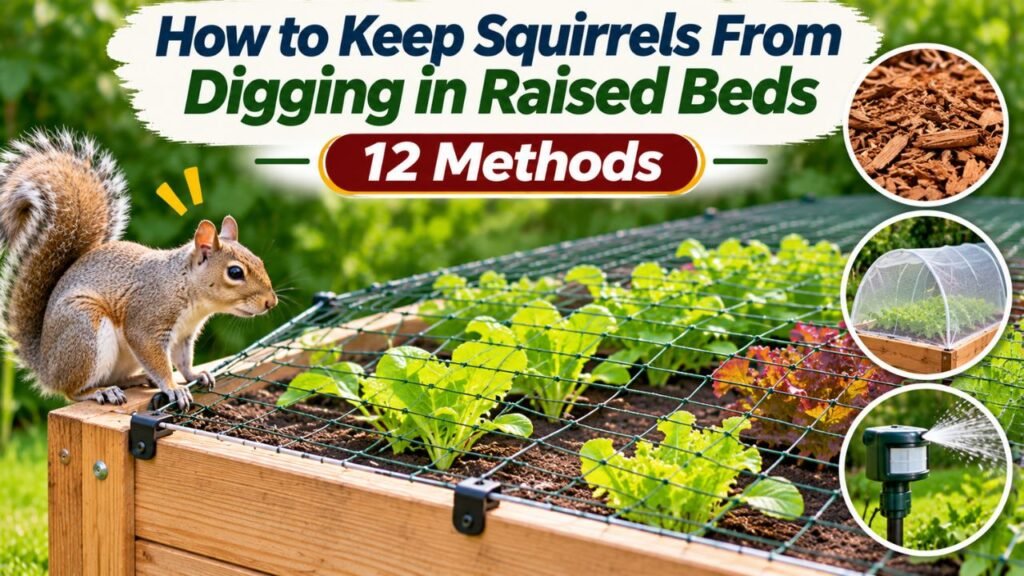
How to Keep Squirrels From Digging in Raised Beds: 12 Methods
The most reliable way to keep squirrels from digging in raised beds is to cover exposed soil with securely fastened wire mesh or a protective garden cage. A sturdy chicken-wire or hardware-cloth barrier prevents squirrels from reaching freshly planted seeds, disturbing seedlings, and burying nuts in loose garden soil.
Squirrels are naturally curious animals that frequently dig holes to store or retrieve food. Freshly cultivated raised-bed soil provides an easy place for them to bury acorns and other nuts. Unfortunately, their digging can uproot young vegetables, expose seeds, and damage delicate roots.
Although gardeners often try coffee grounds, cayenne pepper, fake owls, and strong-smelling sprays, these methods don’t provide consistent protection. Squirrels can become accustomed to unfamiliar smells and objects, especially when they regularly visit the same garden.
Physical barriers are generally more dependable because they prevent access rather than relying on frightening the animals.
In this article, I explain how to keep squirrels from digging in raised beds using wire covers, protective cages, mulch, and humane deterrents. You’ll also learn how to build a squirrel-resistant raised-bed cover, protect seeds and vegetables, identify common squirrel damage, and avoid ineffective or potentially harmful control methods.
Why Do Squirrels Dig in Raised Garden Beds?
Squirrels don’t always dig because they want to eat your vegetables.
In many cases, they’re simply following their natural food-storage behavior.
Understanding why they visit raised beds makes it easier to choose effective protection.
Squirrels Bury Nuts and Seeds
Tree squirrels frequently bury nuts, acorns, and other food items for later use.
This behavior is called food caching.
A squirrel may dig a small hole, deposit food, and cover it with soil.
It may return later to retrieve the stored item.
According to the University of California Integrated Pest Management Program’s tree squirrel guide, squirrels commonly dig holes in gardens and lawns while burying or retrieving nuts. This activity is especially noticeable during fall.
Unfortunately, a squirrel doesn’t recognize that the freshly worked soil contains carefully planted vegetable seeds.
It may dig directly through a planting row.
Loose Soil Is Easy to Dig
Raised beds often contain loose, well-aerated soil.
This makes them attractive places for squirrels to dig.
A newly prepared bed may have fewer roots and less vegetation holding the soil together.
The surface is relatively easy to disturb compared with compacted ground.
This explains why squirrels sometimes begin digging immediately after you add compost, loosen the soil, or prepare a bed for planting.
Squirrels Search for Food
Squirrels may also investigate beds while searching for edible materials.
Depending on local conditions, they may be interested in:
- Seeds
- Nuts
- Bulbs
- Tender shoots
- Ripe tomatoes
- Strawberries
- Other accessible garden produce
Not every squirrel visits for the same reason.
A squirrel digging a small hole may be storing food, while another chewing a ripe tomato is feeding directly on the crop.
Bird Feeders Attract Squirrels
Bird feeders can unintentionally encourage squirrels to visit a garden.
Fallen sunflower seeds, corn, peanuts, and other bird food may attract them.
Once squirrels become accustomed to visiting the yard, they may also investigate nearby raised beds.
Squirrels Return to Familiar Locations
Squirrels may revisit locations where they previously stored food.
A raised bed that has been used for caching can receive repeated digging activity.
This is why repairing holes without adding protection may not solve the problem.
Key Takeaway: Squirrels commonly dig in raised beds to bury or retrieve food. Loose soil makes the job easy, so covering vulnerable areas is generally more effective than trying to change their behavior with smells alone.
How to Keep Squirrels From Digging in Raised Beds: 12 Methods
Several humane methods can reduce squirrel damage.
Some physically prevent access to the soil, while others make the garden less attractive.
For persistent digging, start with a barrier and use additional deterrents only as needed.
1. Cover the Raised Bed With Chicken Wire
Chicken wire is one of the most practical materials for protecting raised beds.
It creates a physical barrier that allows sunlight and rain to reach the plants while preventing squirrels from easily reaching the soil.
The wire can be supported by a frame or positioned over a vulnerable planting area.
For a small raised bed, a removable chicken-wire lid is often convenient.
How to use it:
- Measure the raised bed.
- Build a lightweight wooden or suitable metal frame.
- Attach galvanized chicken wire securely.
- Position the frame over the bed.
- Fasten the cover so squirrels cannot lift it or squeeze underneath.
- Inspect the edges and remove any exposed sharp wire ends.
Chicken wire with approximately 1-inch hexagonal openings can help prevent adult squirrels from reaching planted rows.
However, larger openings may not exclude smaller animals, and the wire must be adequately supported.
The University of California IPM program specifically recommends cage-like freestanding chicken-wire covers for discouraging squirrels from digging up newly seeded or established crops.
Best for: Entire raised beds, newly planted vegetables, and areas experiencing repeated digging.
2. Use Hardware Cloth Over Exposed Soil
Hardware cloth is a rigid wire mesh with smaller openings than ordinary chicken wire.
Common sizes include ¼-inch and ½-inch mesh.
It is useful because squirrels cannot readily push aside properly secured metal mesh.
For raised beds, hardware cloth can be installed as a removable surface panel or part of an elevated protective cage.
How to use it:
- Measure the exposed soil area.
- Cut a suitable hardware-cloth panel.
- Fold or cover sharp cut edges.
- Place the panel over bare soil or support it slightly above emerging plants.
- Secure the panel so squirrels cannot move it.
- Remove or reposition it before growing stems become trapped.
If plants are already established, use a raised frame or carefully fitted panels that provide clearance around the stems.
Avoid fastening wire tightly around growing plants.
A June 2026 Ask Extension response on squirrel digging recommends chicken wire and hardware cloth as more dependable options than smell-based or ultrasonic repellents. The expert also notes that squirrels can chew through plastic netting.
Best for: Newly seeded areas, bare soil between plants, and small beds where a complete cage isn’t necessary.
3. Build a Squirrel-Proof Raised Bed Cage
A fully enclosed garden cage offers stronger protection than an uncovered fence.
Tree squirrels are excellent climbers and jumpers.
A simple fence around the sides of a raised bed may not stop them because they can climb over it.
A cage with a securely closed top provides more reliable exclusion.
What You’ll Need
Common materials include:
- Exterior-suitable wooden framing
- Galvanized hardware cloth or chicken wire
- Screws
- Suitable wire fasteners
- Hinges for an opening lid
- A latch or clips
- Measuring tape
- Wire cutters
- Protective gloves
Use a frame strong enough to support the mesh without sagging.
For a large bed, a cross brace can improve stability.
How to Build the Cage
- Measure the outside dimensions of the raised bed.
- Determine the height needed for the plants.
- Construct a frame that fits securely over the bed.
- Attach wire mesh to the sides and top.
- Add a removable or hinged access panel.
- Secure every mesh edge.
- Check for gaps around the base.
- Install a latch or fastening system.
- Test the cover to ensure it cannot be pushed out of place.
Make the access panel large enough for planting, watering, harvesting, and cleaning.
A cage should protect the plants without making ordinary garden maintenance unnecessarily difficult.
Important Design Considerations
The cage needs enough height for the crops.
Lettuce and young herbs may fit inside a relatively low enclosure.
Tomatoes, cucumbers, and other tall vegetables may require a much larger structure.
You must also account for pollination.
A tightly enclosed garden cover can reduce access for larger pollinating insects.
For crops that depend on insect pollination, use an appropriate opening strategy or hand-pollinate when necessary.
Best for: Gardeners dealing with frequent squirrel visits and repeated damage to multiple vegetables.
4. Protect Individual Plants With Wire Cloches
You don’t always need to cover the entire bed.
If squirrels repeatedly disturb only a few plants, individual wire cloches may be sufficient.
A cloche is a protective cover placed over a plant.
Wire cloches are particularly useful for young seedlings.
How to Use Wire Cloches
Choose a cloche large enough to provide space around the seedling.
Place it over the plant.
Press or anchor the base securely.
Make sure there are no exposed sharp wire ends.
Check the plant regularly as it grows.
Remove or replace the cover before the leaves and stems become crowded.
Which Plants Benefit Most?
Individual wire covers can protect:
- Newly transplanted lettuce
- Young peppers
- Small tomato seedlings
- Strawberry plants
- Emerging herbs
- Newly planted flowers
However, cloches may become impractical as plants grow larger.
For mature vegetables, a larger cage or row-cover system may be more useful.
Best for: A few valuable seedlings or plants growing in isolated spots.
5. Protect Newly Planted Seeds With Temporary Mesh
Freshly seeded raised beds are especially vulnerable to digging.
A squirrel can disturb a row before the seeds germinate.
Temporary mesh protection is useful during this early stage.
How to Protect Seeds
After planting:
- Water the soil gently.
- Position a wire-mesh panel above the planting area.
- Secure the panel along its edges.
- Leave enough clearance for seedlings to emerge.
- Monitor germination.
- Lift or adjust the mesh before the seedlings become entangled.
If you place wire directly on the soil surface, make sure the design allows seedlings to emerge without becoming trapped.
A slightly elevated cover is often easier to manage.
Why Temporary Covers Work
Squirrels generally prefer locations where they can dig freely.
A secure mesh barrier prevents them from reaching the soil with their paws.
Once the seedlings are established and the soil surface is less exposed, the digging pressure may decrease.
However, squirrels can return later, so remove protection only after evaluating the risk.
Best for: Carrots, radishes, lettuce, spinach, herbs, and other direct-sown crops.
6. Apply Mulch to Reduce Exposed Soil
Mulch can make the soil surface less inviting for digging.
However, mulch alone is not a reliable squirrel-proof barrier.
Some squirrels will push through loose straw or wood chips.
Mulch Options to Consider
Suitable materials may include:
- Shredded leaves
- Straw
- Wood chips around appropriate established crops
- Pine needles
- Coarse organic mulch
- Pine cones around selected planting areas
A mulch layer of approximately 2–3 inches can help conserve moisture and reduce exposed soil around many established plants.
However, the appropriate depth depends on the crop and material.
Keep mulch away from stems and crowns where excessive moisture could encourage problems.
Can Pine Cones Discourage Digging?
Pine cones can make an area less convenient to excavate.
They may be useful in small spaces between established plants.
However, squirrels may simply move them aside.
Don’t rely on pine cones as the only defense for newly planted seeds.
What About Gravel or Decorative Stones?
A carefully placed layer of coarse stones may discourage digging in small unplanted areas.
However, stones can affect soil temperature, drainage behavior, and future cultivation.
Avoid placing heavy stone layers directly around tender seedlings or shallow-rooted plants.
Best for: Supplementing wire barriers and reducing bare soil in established raised beds.
7. Install a Motion-Activated Sprinkler
A motion-activated sprinkler detects movement and releases a short burst of water.
It can startle animals that enter the protected area.
This approach avoids trapping or injuring squirrels.
However, results are inconsistent.
Squirrels are small and move quickly, so they may not always activate the sensor.
How to Position the Sprinkler
Place the sprinkler where it can detect movement near the raised beds.
Check the manufacturer’s detection range and spray direction.
Avoid spraying:
- Walkways used by neighbors
- Electrical equipment
- Open windows
- Outdoor furniture that shouldn’t become wet
Test the sprinkler during daylight.
Make sure the spray doesn’t damage delicate seedlings.
How Effective Are Motion Sprinklers?
Some gardeners find them useful as supplemental deterrents.
However, squirrels may adapt to a predictable device.
Changing its position occasionally may improve its short-term effectiveness.
A motion sprinkler is generally less dependable than a properly secured wire cage.
Best for: Supplemental protection around several beds when a full enclosure isn’t practical.
8. Move Bird Feeders Away From the Garden
Bird feeders can bring squirrels into the yard.
Once squirrels find a consistent food source, they may explore nearby planting areas.
Reducing access to spilled birdseed can help make the garden less attractive.
Steps to Reduce Bird Feeder Attraction
- Move feeders away from the raised beds when practical.
- Use squirrel-resistant feeder designs.
- Clean spilled seed from the ground.
- Avoid scattering birdseed near vegetables.
- Store extra seed in secure containers.
- Inspect damaged feeders for openings squirrels can enlarge.
Moving a feeder doesn’t guarantee that squirrels will stop visiting.
However, reducing easily available food may lower the frequency of visits.
Should You Feed Squirrels Somewhere Else?
Providing food elsewhere can sometimes distract individual squirrels temporarily.
However, supplemental feeding may also attract more squirrels and other wildlife.
For a persistent garden problem, removing food attractants is generally a more dependable strategy than creating another feeding station.
Best for: Gardens located near bird feeders or areas with frequent fallen seed.
9. Remove Accessible Food Sources
Squirrels are more likely to investigate areas where food is readily available.
Reducing obvious food sources can make a raised-bed garden less attractive.
Keep the Garden Clean
Remove:
- Fallen nuts near planting beds
- Discarded edible plant material
- Spilled birdseed
- Unsecured food scraps
- Overripe vegetables
- Fallen fruit
If you have a compost system, use a suitable setup that limits access to attractive food waste.
Avoid leaving kitchen scraps exposed near the garden.
Harvest Ripe Produce Promptly
Squirrels may eat tomatoes, strawberries, and other ripe produce.
Harvesting at the appropriate stage reduces the time these foods remain accessible.
For tomatoes, harvesting at a suitable color-break stage and allowing them to finish ripening indoors can sometimes reduce wildlife damage.
However, this won’t prevent squirrels from digging to bury nuts.
Use harvesting and garden sanitation as supporting measures rather than substitutes for physical barriers.
Best for: Gardens experiencing both soil digging and produce damage.
10. Use Row Covers and Supported Hoops
Garden hoops can support protective material over an entire planting row.
They are useful for protecting new seedlings and low-growing vegetables.
However, the cover material matters.
How to Install a Protective Hoop Cover
- Position hoops across the raised bed.
- Choose a cover that provides suitable protection.
- Attach the covering securely to the hoops.
- Fasten the edges to prevent squirrels from entering underneath.
- Inspect the cover regularly.
- Open it when necessary for plant care and pollination.
Lightweight fabric row covers may provide some protection, especially against incidental disturbance.
However, squirrels may chew or tear through fabric or plastic netting.
For persistent digging, supported metal mesh is more reliable.
Avoid Loose Netting
Loose, thin netting can entangle birds and other wildlife.
If netting is used, choose an appropriate wildlife-safe product, keep it taut, secure all edges, and inspect it frequently.
Rigid wire mesh generally provides a safer and more durable structure for a squirrel-exclusion cage.
Remember Pollination
Some vegetables need insect access during flowering.
Examples include:
- Cucumbers
- Squash
- Zucchini
- Melons
A restrictive cover may interfere with pollination.
Open it appropriately during flowering or use a suitable hand-pollination method.
Best for: Rows of young vegetables and beds that need temporary seasonal protection.
11. Try a Wildlife Repellent as a Secondary Measure
Some commercial repellents are marketed for squirrels and other garden wildlife.
They may contain strong-smelling substances or ingredients that create an unpleasant taste.
However, repellent performance varies.
Squirrels may ignore certain products or become accustomed to them.
Rainfall and irrigation can also reduce effectiveness.
How to Choose a Repellent
If you decide to use one:
- Check whether squirrels are included on the product label.
- Confirm that the product is permitted for the intended location.
- Verify whether it can be used around edible vegetables.
- Follow all application directions.
- Keep it away from children and pets as directed.
- Reapply only according to the label.
A repellent approved for ornamental plants isn’t automatically suitable for edible garden crops.
Do Pepper-Based Repellents Work?
Capsaicin is used in some wildlife-repellent products.
It may discourage certain feeding behaviors.
However, it is not a reliable physical barrier, and results vary.
Loose cayenne pepper scattered around the garden can irritate eyes and mucous membranes, including those of pets and wildlife.
For vegetable beds, choose only products specifically labeled for the intended use rather than applying homemade irritant mixtures.
Does Peppermint Oil Keep Squirrels Away?
There is limited dependable evidence that peppermint oil consistently prevents squirrels from digging in raised beds.
Strong odors may temporarily affect individual animals, but they don’t create a reliable exclusion system.
Essential oils can also damage plants or pose risks to pets when used improperly.
Don’t depend on peppermint oil to protect valuable seedlings.
Best for: Supplemental protection when an appropriately labeled product is available.
12. Protect the Bed Immediately After Planting
One of the simplest strategies is to install protection before squirrels begin disturbing the soil.
Newly cultivated beds often attract digging because the surface is loose and easy to excavate.
Protect the Most Vulnerable Stage
Pay particular attention after:
- Adding fresh soil
- Mixing in compost
- Direct-sowing seeds
- Transplanting seedlings
- Planting flower bulbs
- Removing old crops
- Loosening the soil for a new season
Cover exposed soil as soon as planting is complete.
Keep the barrier in place until the plants are established and the threat has decreased.
Use a Consistent Routine
After every planting session:
- Water the newly planted area.
- Remove spilled seeds.
- Add suitable mulch if appropriate.
- Install the wire cover.
- Secure all edges.
- Check the bed the following morning.
This reduces the chance of losing an entire planting before germination.
Best for: Preventing damage before it begins, especially during spring and fall planting.
Best Ways to Stop Squirrels From Digging: Comparison Table
Different strategies offer different levels of protection.
| Method | Expected Reliability | Best Application |
| Fully enclosed wire cage | High when securely built | Complete raised beds |
| Hardware-cloth cover | High for covered soil | Seeds and exposed areas |
| Chicken-wire lid | High when securely fastened | Small and medium beds |
| Individual wire cloche | High for enclosed plants | Seedlings |
| Supported row cover | Moderate; depends on material | Temporary crop protection |
| Coarse mulch | Limited to moderate | Established beds |
| Motion sprinkler | Variable | Supplemental deterrence |
| Moving bird feeders | Indirect benefit | Reducing attraction |
| Removing food scraps | Indirect benefit | General prevention |
| Commercial repellent | Variable | Supplemental use |
| Fake predator decorations | Generally unreliable over time | Short-term disturbance |
| Ultrasonic repeller | Unreliable | Not recommended as primary protection |
Physical exclusion usually provides the most predictable results.
Deterrents and changes to garden management can support a barrier, but they rarely replace one.
How to Build a Squirrel-Proof Cover for a 4×8 Raised Bed
A 4×8-foot raised bed is large enough to grow several vegetable crops but small enough for a removable mesh-cover system.
A framed cover can be reused across multiple planting seasons.
Materials Needed
For a basic cover, consider:
- Exterior-suitable 1×2 or 2×2 lumber
- Galvanized hardware cloth or chicken wire
- Exterior-rated screws
- Suitable heavy-duty wire staples or fasteners
- Corner braces if necessary
- Hinges
- Latches or clips
- Wire cutters
- Measuring tape
- Drill or screwdriver
- Protective gloves
Use materials appropriate for outdoor conditions.
The cover should be sturdy but light enough to open safely.
Step 1: Measure the Raised Bed
Measure the outside length and width.
Don’t assume the finished bed measures exactly 4×8 feet.
Actual dimensions vary according to board thickness and construction.
Check for uneven corners or raised posts that may affect the frame.
Step 2: Build a Supporting Frame
Construct a rectangular frame that fits over the bed.
For a full-length cover, additional cross braces may reduce sagging.
A large single lid can be heavy.
Two smaller hinged sections may be easier to open and maintain.
For example, a 4×8 bed could use two approximately 4×4-foot lid sections.
Adjust the dimensions to the actual structure.
Step 3: Attach the Wire Mesh
Cut wire mesh to fit the frame.
Wear protective gloves.
Fasten the wire securely using suitable staples or screws with washers.
Avoid leaving loose edges.
Fold, trim, or cover sharp wire ends to reduce the risk of cuts.
Step 4: Add Hinges
Attach the lid or lid sections to the raised-bed frame.
Choose hinges suitable for outdoor use.
Make sure the lid opens far enough for planting and harvesting.
For larger covers, consider a support mechanism that prevents accidental closing.
Step 5: Secure the Lid
Install a latch or another appropriate fastening method.
Squirrels should not be able to push the cover aside.
Check the gap where the lid meets the bed.
A cover that leaves large openings around the edges may allow animals to enter.
Step 6: Check Plant Clearance
Determine how tall the vegetables will grow.
A shallow lid may be suitable for emerging seedlings and low-growing crops.
Taller plants need an elevated enclosure.
Don’t allow growing stems to press against restrictive wire.
Step 7: Test the Cover
Close the lid.
Check that it sits evenly and cannot slide.
Inspect sharp edges and loose fasteners.
Make sure water and sunlight can reach the plants.
Open and close the cover several times to ensure it is safe and convenient.
Step 8: Inspect Regularly
Check the frame throughout the growing season.
Repair loose mesh and damaged fasteners.
Remove trapped leaves or other debris.
Adjust the enclosure as plants grow.
Key Takeaway: A secure, hinged mesh cover for a 4×8 raised bed can provide lasting squirrel protection while allowing easy access for planting, weeding, watering, and harvesting.
How to Stop Squirrels From Digging Up Newly Planted Seeds
New seeds are especially vulnerable because squirrels can disturb planting rows before any plants are visible.
Seed protection should begin immediately after sowing.
Cover the Soil With a Temporary Wire Panel
After planting, place a securely supported metal mesh cover over the seeded area.
Keep the cover in place until the seedlings are established.
If seedlings need to grow through or near the mesh, make sure the openings and clearance won’t damage them.
Avoid Leaving Seeds on the Surface
Plant seeds at their recommended depth.
Remove spilled seeds from the soil surface and nearby paths.
Squirrels and birds may investigate exposed food.
However, correct planting depth alone won’t prevent a squirrel from digging in the area.
Maintain Suitable Moisture
Water newly seeded soil gently.
Avoid creating deep holes with forceful water streams.
Proper moisture supports germination but doesn’t prevent wildlife digging.
Check Seedlings Daily
Inspect the planting area until germination is complete.
Look for:
- Disturbed soil
- Missing seeds
- Uprooted sprouts
- Loose protective mesh
- Evidence of animal entry
Fix openings promptly.
If damage continues despite the cover, consider a fully enclosed cage.
How to Protect Raised Bed Vegetables From Squirrels
The best protection changes as vegetables grow.
Young seedlings are vulnerable to digging, while mature crops may attract feeding.
Tomatoes
Squirrels may nibble ripe tomatoes, especially where water or other food is limited.
A wire cage with a closed top may help protect plants.
For larger tomato varieties, the enclosure needs enough height and airflow.
Harvest ripe tomatoes promptly.
Strawberries
Strawberries can attract squirrels when the fruits begin ripening.
A secure mesh cover helps prevent access.
Choose a structure that allows you to reach the fruit easily.
Inspect regularly for openings.
Lettuce
Lettuce is often planted in closely spaced rows.
A low wire-mesh tunnel or removable cage can protect young plants.
Remove or raise the cover as the crop grows.
Carrots and Radishes
Direct-sown root vegetables benefit from soil-surface protection during germination.
Use mesh that prevents digging without interfering with the emerging seedlings.
Check that the soil remains properly watered.
Cucumbers and Squash
These crops can grow rapidly and spread beyond small covers.
They may need larger cages or protective structures.
Because many varieties depend on insect pollination, make sure the enclosure doesn’t prevent pollinators from reaching flowers.
Herbs
Small herbs can be protected with individual wire cloches.
For larger established plants, mulch and localized mesh may be enough if the main problem is soil digging.
Avoid placing restrictive mesh tightly against woody stems or tender growth.
Does Putting Chicken Wire on the Ground Stop Squirrels?
Yes, a properly secured wire panel can discourage squirrels from digging into covered soil.
However, the installation method matters.
A loose panel can be lifted or moved.
Chicken Wire Directly on Soil
This approach is most useful in temporarily unplanted areas or where seeds and seedlings have sufficient clearance.
Secure the edges.
Don’t trap emerging plants beneath the wire.
Chicken Wire Above Soil
A wire panel supported slightly above the ground can protect seed rows while providing room for young shoots.
The frame must be firmly anchored.
Chicken Wire Around Plants
For established plants, a raised cage is generally more practical than flat mesh.
It provides room for leaves and stems to develop.
What Mesh Size Should You Choose?
For general squirrel exclusion, ½-inch hardware cloth is a useful choice.
One-inch chicken wire can also discourage adult tree squirrels when it is securely installed over planting rows.
However, the larger openings may allow smaller animals or pests to enter.
Choose the mesh based on the animals you need to exclude.
Do Coffee Grounds Keep Squirrels Out of Raised Beds?
Used coffee grounds are often recommended as a homemade squirrel deterrent.
However, there is insufficient dependable evidence that they consistently stop squirrels from digging in gardens.
Some squirrels may temporarily avoid an unfamiliar smell.
Others may ignore it.
Rain and irrigation can also reduce any scent effect.
Can You Sprinkle Coffee Grounds on Raised Bed Soil?
Small quantities of used coffee grounds can sometimes be incorporated into composting systems.
However, using thick layers of grounds as a soil-surface barrier isn’t a dependable squirrel-control strategy.
Heavy layers may also interfere with water movement or create undesirable surface conditions.
If your goal is to prevent digging, wire mesh is a more practical option.
Does Cayenne Pepper Stop Squirrels From Digging?
Cayenne pepper contains capsaicin, which can cause irritation.
Some gardeners apply it around plants hoping squirrels will avoid the area.
However, loose pepper powder doesn’t provide consistent protection.
It may wash away, become diluted, or be ignored.
It can also irritate the eyes and sensitive tissues of pets and other wildlife.
Is Cayenne Pepper Safe Around Vegetable Beds?
Avoid scattering large amounts of hot pepper powder around areas used by children, pets, or wildlife.
If you want to try a repellent, choose a commercially labeled product specifically suitable for the intended garden use.
Follow all label restrictions.
Don’t assume that a homemade pepper spray is safe for edible crops.
What Works Better Than Cayenne?
A securely installed mesh cover physically prevents access.
This makes it a more reliable primary measure.
Does Cinnamon Keep Squirrels Away From Raised Beds?
Cinnamon is another popular home remedy.
However, there is little reliable evidence that sprinkling cinnamon onto raised-bed soil consistently prevents squirrel digging.
A strong odor may affect an individual animal temporarily, but it doesn’t stop physical access.
Regular watering and rain may also reduce the scent.
Use cinnamon for its intended culinary purposes rather than relying on it as a garden barrier.
Do Fake Owls and Ultrasonic Repellers Work Against Squirrels?
Fake owls, plastic snakes, reflective ribbons, and ultrasonic devices are often marketed as wildlife deterrents.
Their effectiveness is inconsistent.
Fake Owls
A squirrel may initially react to an unfamiliar owl-shaped object.
However, it may eventually recognize that the object doesn’t move or pose an immediate threat.
Moving the decoy occasionally might temporarily improve its effect.
It still won’t provide dependable protection.
Reflective Tape
Reflective tape can create movement and flashing light.
Some animals may avoid it briefly.
However, squirrels can become accustomed to repeated disturbances.
Reflective tape also doesn’t physically protect seeds.
Ultrasonic Devices
Ultrasonic repellers produce high-frequency sounds that manufacturers claim discourage pests.
However, research and extension experience do not support treating these devices as dependable squirrel barriers.
Some squirrels may show a temporary response, but repeated exposure can reduce the effect.
Motion-Activated Sprinklers
Motion sprinklers may be more useful than stationary decoys because they produce an immediate physical disturbance.
Even so, they are less predictable than a secure cover.
Key Takeaway: Fake predators, reflective objects, and ultrasonic devices may produce temporary reactions, but none should replace physical exclusion when squirrel damage is persistent.
What Should You Avoid Using to Keep Squirrels Away?
Some commonly suggested methods can harm wildlife, contaminate the garden, or create unnecessary safety risks.
Mothballs
Don’t scatter mothballs around raised beds.
Mothballs are pesticide products intended for specific labeled uses.
They are not appropriate general-purpose garden wildlife repellents.
Their chemicals can pose health and environmental risks when misused.
Poison Baits
Avoid using rodenticides or other poisons against squirrels in vegetable beds.
Poisoning can harm non-target animals, pets, and wildlife.
Squirrel-control laws also vary by state and species.
Glue Traps
Glue traps can cause prolonged suffering and may catch unintended animals.
They aren’t an appropriate method for managing routine squirrel digging in a vegetable garden.
Fishing Line or Loose Netting
Thin, nearly invisible line and loose netting can entangle birds and other wildlife.
Use securely fastened, appropriately constructed barriers instead.
Sharp Objects
Don’t scatter nails, broken glass, exposed wire ends, or other dangerous materials around plants.
These can injure people, pets, and wildlife.
Chemical Household Products
Avoid pouring bleach, ammonia, gasoline, or other household chemicals into garden soil to deter animals.
These products can damage plants, create health hazards, and contaminate growing areas.
For an edible raised bed, physical exclusion is the preferable starting approach.
How to Tell Whether Squirrels Are Digging in Your Raised Beds
Not every hole in a raised bed is caused by a squirrel.
Identifying the animal helps you select the appropriate protection.
Signs of Tree Squirrel Digging
Common signs include:
- Small, shallow holes
- Disturbed loose soil
- Partially buried nuts
- Uprooted seedlings
- Repeated digging in different places
- Squirrel activity during daylight
Tree squirrels frequently climb fences, trees, and garden structures.
They generally don’t create the extensive underground burrow systems associated with ground squirrels.
Squirrels vs. Chipmunks
Chipmunks are smaller and often have visible body stripes.
They may dig and collect seeds.
Some chipmunks also create burrows.
Fine mesh and properly secured covers can help exclude both animals.
Squirrels vs. Rabbits
Rabbits may eat leaves and stems close to the ground.
They typically don’t make the same small food-caching holes as tree squirrels.
A rabbit barrier may need different fencing arrangements.
Squirrels vs. Ground Squirrels
Ground squirrels commonly use burrows and may damage roots or irrigation components.
Tree squirrels usually escape by climbing.
If large burrow entrances appear around the beds, investigate whether ground squirrels or another burrowing animal are responsible.
The best exclusion design may be different.
What if the Damage Happens at Night?
Tree squirrels are primarily active during the day.
If plants are being disturbed only at night, investigate other animals such as raccoons, skunks, or rodents.
A wildlife camera can help identify the visitor without disturbing it.
How to Keep Squirrels Out of Raised Beds Year-Round
Squirrel protection may need to change with the seasons.
Their food-storage and feeding behavior varies throughout the year.
Spring
Spring protection should focus on newly planted seeds and seedlings.
Install wire covers immediately after planting.
Check for damage frequently.
Summer
During summer, some squirrels may investigate ripe fruits and vegetables.
Protect vulnerable crops with suitable cages.
Harvest produce promptly and remove fallen fruit.
Fall
Fall can be a busy period for food caching.
Squirrels may dig repeatedly to bury nuts and acorns.
Avoid leaving freshly loosened raised-bed soil uncovered.
Use temporary mesh panels after clearing summer crops.
Winter
In many areas, tree squirrels remain active during winter.
Even an empty raised bed may attract food-caching activity.
A removable wire panel can protect the soil until the next planting season.
Don’t assume that freezing weather automatically eliminates squirrel visits.
What Is the Cheapest Effective Way to Protect a Raised Bed?
For a small garden, a removable wire-mesh panel is often a practical low-cost solution.
You don’t necessarily need to build a tall enclosure.
For an Empty or Newly Seeded Bed
Use a securely anchored panel of chicken wire or hardware cloth.
Make sure seedlings have enough room to emerge.
This protects the soil without requiring a large structure.
For a Few Seedlings
Use individual wire cloches.
You can protect only the vulnerable plants rather than covering the entire bed.
For an Established Vegetable Bed
A hinged wire cover or cage may provide better long-term value.
It can be reused through multiple growing seasons.
For Multiple Beds
Consider standardized removable frames.
Frames built to fit beds of the same dimensions can be moved between plantings as protection needs change.
The cheapest method isn’t always the least expensive over time.
A durable cover may be preferable to repeatedly buying deterrent sprays that provide inconsistent results.
A Simple 7-Day Plan to Stop Squirrels From Digging
If squirrels have already damaged your vegetables, begin with immediate protection.
Day 1: Identify the Damage
Inspect the bed.
Look for shallow holes, disturbed seeds, and uprooted seedlings.
Check whether squirrels are visiting during daylight.
Day 2: Remove Food Attractions
Clean fallen birdseed and accessible food scraps.
Harvest ripe produce.
Move or secure nearby feeders if necessary.
Day 3: Install a Wire Barrier
Place securely fastened mesh over exposed soil or install a complete cage.
Make sure the cover fits properly.
Day 4: Check Seedlings
Inspect new plants for damage.
Adjust the mesh before stems become trapped or crowded.
Day 5: Improve Mulch Coverage
Add suitable mulch around established plants.
Keep mulch away from tender stems and crowns.
Don’t rely on mulch instead of the wire barrier.
Day 6: Inspect the Cover
Look for loose fasteners, gaps, or bent wire.
Repair any openings.
Day 7: Review the Results
Check whether new holes have appeared.
If digging continues, determine whether squirrels are entering through uncovered sections.
Upgrade temporary panels to a fully enclosed cage when necessary.
Continue monitoring as crops develop.
Conclusion
Learning how to keep squirrels from digging in raised beds is primarily about preventing access to loose garden soil.
The most dependable methods use chicken wire, hardware cloth, protective cloches, or fully enclosed raised-bed cages. These barriers prevent squirrels from digging even when they return to investigate the garden.
Mulch, removing accessible food, and motion-activated sprinklers may provide additional protection, but they are generally less reliable on their own.
For newly planted seeds, cover the soil immediately after sowing. For established vegetables, choose a barrier that provides enough growing space and appropriate pollinator access.
Avoid relying on coffee grounds, cinnamon, fake owls, or ultrasonic devices as primary protection. Their effects are uncertain and may fade as squirrels become accustomed to them.
You should also avoid mothballs, poisons, sharp objects, and other potentially harmful methods.
For most home gardeners, a securely fastened removable wire cover offers a practical balance of effectiveness, safety, durability, and convenience.
FAQs About How to Keep Squirrels From Digging in Raised Beds
What Is the Best Way to Keep Squirrels From Digging in Raised Beds?
A securely installed wire-mesh cover or cage is generally the most reliable method.
Chicken wire and hardware cloth create physical barriers that prevent squirrels from reaching the soil.
Make sure the edges are fastened and the cover provides enough space for growing plants.
Does Chicken Wire Stop Squirrels From Digging?
Yes. Properly secured chicken wire can discourage squirrels from digging into protected soil.
A cage-like cover is especially useful because squirrels can climb over ordinary fences.
Use a frame and inspect the edges for openings.
Will Coffee Grounds Keep Squirrels Away From Raised Beds?
There is insufficient reliable evidence that coffee grounds consistently repel squirrels.
Some animals may temporarily avoid the odor, but others may ignore it.
A wire cover is generally a more dependable solution.
Does Cayenne Pepper Keep Squirrels From Digging?
Capsaicin may discourage certain wildlife behaviors, but sprinkling loose cayenne pepper isn’t a consistently effective solution.
It can also irritate pets and wildlife.
Use only appropriately labeled garden repellents when needed, and prioritize physical barriers.
What Can I Put on Top of Raised Bed Soil to Stop Squirrels?
You can use securely fastened chicken wire or hardware cloth over exposed soil.
For established plants, a raised mesh frame or individual wire cloches can provide protection.
Coarse mulch may help discourage some digging but is less dependable.
Why Do Squirrels Keep Digging in My Raised Garden Bed?
Squirrels often dig to bury or retrieve nuts and seeds.
Loose raised-bed soil is easy to excavate, especially after planting or adding compost.
They may also investigate the bed for edible seeds, bulbs, or produce.
Do Fake Owls Keep Squirrels Away From Raised Beds?
Fake owls may temporarily startle squirrels, but animals can become accustomed to stationary decoys.
They don’t provide reliable long-term protection.
A physical mesh barrier is generally a better choice.
Will Mulch Stop Squirrels From Digging?
Mulch may make digging less convenient, especially when the material is coarse.
However, squirrels can often push aside straw, leaves, or wood chips.
Use mulch as a supporting measure rather than the only protection.
Can Squirrels Climb Into Tall Raised Garden Beds?
Yes. Tree squirrels are strong climbers and jumpers.
Increasing the height of a raised bed doesn’t guarantee protection.
A securely covered top or fully enclosed cage is more reliable than height alone.
How Do You Protect Seeds From Squirrels?
Install a temporary wire-mesh cover immediately after planting.
Secure the edges and provide enough clearance for seedlings to emerge.
Remove or adjust the cover as plants grow so the mesh doesn’t damage stems and leaves.

I’m Maya L. Greenwood, a lifelong plant lover who believes anyone can grow something beautiful with the right guidance. After years of testing soil mixes, pruning methods, irrigation tricks, and pest-safe solutions, I started EasyGardenTips.com to turn hard-won lessons into step-by-step advice. From seed starting and container gardens to composting and seasonal checklists, my goal is to make gardening simple, sustainable, and fun.