How to Keep Chipmunks Out of Raised Garden Beds: Best Methods
The most reliable way to keep chipmunks out of raised garden beds is to install a physical barrier made from ¼-inch galvanized hardware cloth. A secure mesh cover prevents chipmunks from climbing into the bed, while a wire barrier underneath the soil helps stop them from burrowing up from below.
Chipmunks can damage vegetable gardens by digging up seeds, disturbing seedlings, and eating certain fruits and vegetables. Although raised beds provide a convenient growing environment, their elevated sides do not automatically protect plants from small rodents.
Chipmunks are capable climbers and skilled diggers. They can reach garden beds through open tops, gaps around protective fencing, and unprotected soil underneath raised-bed frames.
Fortunately, you can protect your vegetables without harming wildlife. Exclusion barriers, improved garden maintenance, and removing nearby food sources can significantly reduce recurring damage.
In this article, I explain how to keep chipmunks out of raised garden beds using hardware cloth, protective cages, and targeted barriers. I also cover practical deterrents, low-cost DIY solutions, ways to identify chipmunk damage, and how to protect existing beds without completely rebuilding them.
How to Keep Chipmunks Out of Raised Garden Beds: Best Solutions
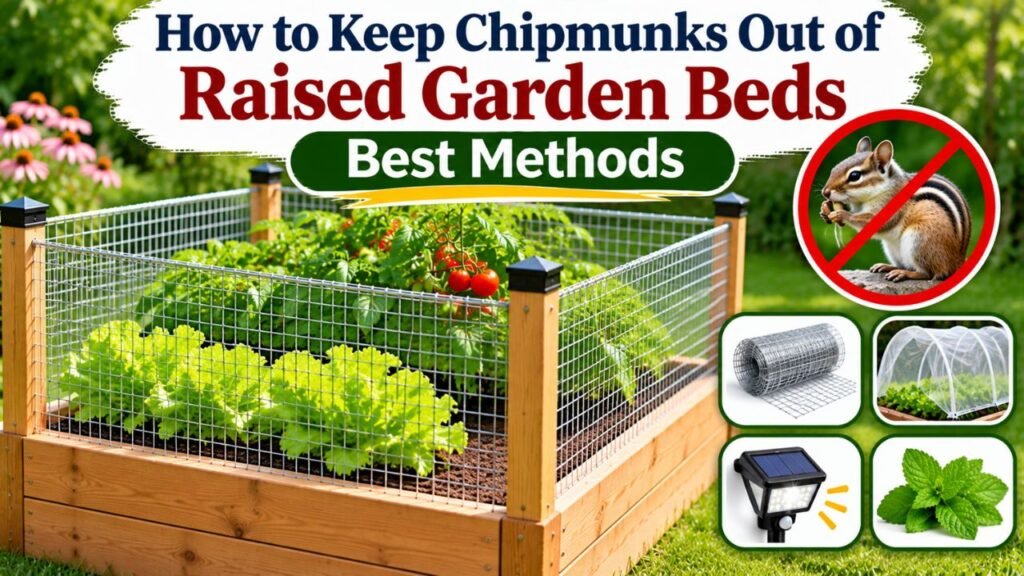
The most effective approach combines physical exclusion with removing conditions that attract chipmunks.
Physical barriers provide more dependable protection because they prevent access rather than relying on an animal’s reaction to a smell, sound, or unfamiliar object.
Best Chipmunk Prevention Methods Compared
| Method | Expected Effectiveness | Best Use |
| ¼-inch hardware cloth enclosure | High when fully secured | Protecting entire raised beds |
| Hardware cloth beneath the bed | High against entry from below | New raised-bed construction |
| Removable mesh lid | High when gaps are eliminated | Low-growing vegetables |
| Individual plant cages | High when fully enclosed | Tomatoes and vulnerable plants |
| Temporary seed guards | Good for protected planting areas | Seeds and seedlings |
| Removing birdseed and pet food | Helpful supporting measure | Reducing chipmunk attraction |
| Motion-activated sprinkler | Variable | Temporary deterrence |
| Commercial repellents | Variable and product-dependent | Supplemental protection |
| Coffee grounds or strong scents | Unreliable | Not a primary solution |
| Ultrasonic deterrents | Inconsistent evidence | Not recommended as the main defense |
For most vegetable gardeners, a secure hardware cloth enclosure is the best starting point.
It protects plants without requiring repeated applications of chemicals or constant monitoring.
However, the barrier must address both climbing and digging.
Why Do Chipmunks Get Into Raised Garden Beds?
Chipmunks are small, ground-dwelling rodents that spend much of their time searching for food and transporting it to underground storage areas.
Raised garden beds can provide several things they find attractive.
Seeds and Young Seedlings
Freshly planted seeds are vulnerable because chipmunks eat various seeds and nuts.
They may dig through loose soil while searching for food.
New seedlings can also be damaged or uprooted during digging.
This is particularly frustrating when growing vegetables such as:
- Peas.
- Beans.
- Sunflowers.
- Corn.
- Lettuce.
- Other directly seeded crops.
Not every disturbed seed is eaten, but digging alone can prevent successful germination.
Fruits and Vegetables
Chipmunks may feed on certain garden fruits and vegetables.
Potentially vulnerable crops include strawberries, tomatoes, and other accessible produce.
Damage can range from small bite marks to partially eaten fruit.
However, squirrels, birds, mice, and other wildlife can cause similar damage.
Identifying the animal is important before choosing a control method.
Loose Raised-Bed Soil
Raised-bed soil is commonly loose and easy to dig.
This makes it attractive for animals searching for seeds or burying food.
Chipmunks may create shallow digging holes within the bed even if they aren’t establishing a permanent burrow there.
Nearby Shelter
Chipmunks favor areas with places to hide.
Potential shelter includes:
- Woodpiles.
- Rock walls.
- Dense shrubs.
- Brush piles.
- Stacked garden materials.
- Areas beneath decks.
- Openings around outdoor structures.
A raised bed located close to these features may experience more frequent chipmunk visits.
Bird Feeders and Other Food Sources
Spilled birdseed can attract chipmunks into the garden.
Once they regularly visit the area, nearby vegetable beds may become another food source.
Outdoor pet food and unsecured seed containers can create similar problems.
Key Takeaway: Chipmunks visit raised beds for seeds, produce, and digging opportunities. Nearby shelter and spilled food may encourage them to return.
Use Hardware Cloth to Keep Chipmunks Out of Raised Beds
Hardware cloth is one of the most dependable materials for excluding chipmunks.
Despite its name, hardware cloth is a rigid or semi-rigid metal wire mesh rather than a fabric.
It is commonly sold in galvanized steel rolls or sheets.
What Size Hardware Cloth Keeps Chipmunks Out?
¼-inch mesh hardware cloth is an excellent choice for chipmunk exclusion.
The openings are small enough to prevent chipmunks from squeezing through when the surrounding structure is properly secured.
According to Kansas State University’s chipmunk prevention guidance, ¼-inch hardware cloth can be used to exclude chipmunks from gardens and protect seeds and bulbs.
Some exclusion designs use ½-inch mesh, but ¼-inch mesh offers a more conservative opening size for small rodents.
Avoid assuming ordinary chicken wire will provide equivalent protection.
Chicken wire commonly has larger openings and is not necessarily designed to exclude small rodents.
Is Galvanized Hardware Cloth Suitable for Raised Beds?
Galvanized steel hardware cloth is commonly used in garden exclusion projects.
The galvanized coating helps protect the steel against corrosion.
For a raised bed, choose a product intended for outdoor use.
Inspect the mesh for damaged coating, sharp edges, and broken wire.
Avoid using rusted or deteriorating material.
When installing it near edible crops, use suitable garden construction materials and avoid unidentified or previously contaminated metal mesh.
How Long Does Hardware Cloth Last?
Its lifespan depends on the coating, wire thickness, soil moisture, climate, and installation conditions.
Galvanized steel can eventually corrode, especially in persistently wet environments.
Inspect exposed sections regularly.
Replace mesh that becomes severely rusted, broken, or easy for an animal to push through.
Key Takeaway: Use durable ¼-inch galvanized hardware cloth for long-term protection. Secure edges and connections carefully because even strong mesh will fail if gaps remain.
How to Install Hardware Cloth Under a Raised Garden Bed
Installing metal mesh beneath a raised bed is particularly useful when chipmunks tunnel into the garden from below.
This approach is easiest before adding soil.
Materials Needed
- ¼-inch galvanized hardware cloth.
- Measuring tape.
- Metal snips.
- Work gloves.
- Exterior-rated staples or suitable fasteners.
- Raised-bed frame.
- Raised-bed soil.
The exact fasteners depend on whether the bed is made of wood, metal, or another material.
Step 1: Measure the Bottom of the Bed
Measure the bed’s length and width.
For example, a rectangular bed measuring 4 feet by 8 feet has a bottom area of:
4 × 8 = 32 square feet
Purchase enough hardware cloth to cover the entire opening.
Allow additional material for overlapping sections and securing the edges.
Step 2: Cut the Hardware Cloth
Cut the mesh to the required dimensions using suitable metal snips.
Wear work gloves because cut wire edges can be sharp.
If multiple pieces are necessary, overlap the sections by several inches.
Fasten the overlaps securely so animals cannot force their way between the pieces.
Step 3: Position the Mesh Beneath the Frame
Place the mesh across the bottom opening of the raised bed.
Keep it flat and eliminate gaps around the perimeter.
For wooden beds, the material can be secured using appropriate exterior-rated fasteners.
For metal beds, use a fastening method compatible with the manufacturer’s construction.
Avoid drilling unnecessary holes into protective metal coatings, which could encourage corrosion.
Step 4: Secure the Edges
Make sure the mesh cannot shift when the bed is filled.
Pay particular attention to:
- Corners.
- Frame joints.
- Mesh overlaps.
- Gaps around support posts.
- Areas where the bed meets uneven ground.
A chipmunk may exploit a small opening even when most of the bed is protected.
Step 5: Add the Raised-Bed Soil
Once the wire barrier is secured, add suitable raised-bed soil.
The mesh should allow water to drain.
Do not replace it with solid plastic, which can interfere with drainage.
The University of Minnesota Extension’s raised-bed gardening guide specifically identifies hardware cloth beneath raised beds as an option for reducing tunneling by mice and chipmunks.
However, the extension also explains that most raised beds do not need a bottom barrier under ordinary conditions and that barriers may restrict root growth.
Therefore, install hardware cloth when burrowing animals present an actual problem, and provide sufficient soil depth for the intended crops.
Will Hardware Cloth Stop All Chipmunk Damage?
No.
Bottom hardware cloth prevents chipmunks from entering through the underside.
It does not stop them from climbing over the sides.
For more complete protection, combine the bottom barrier with a fitted top enclosure.
Key Takeaway: Bottom hardware cloth helps prevent tunneling from below, but a separate top barrier is needed to stop chipmunks from climbing into the garden.
How to Build a Chipmunk-Proof Cover for Raised Garden Beds
A fitted mesh cover is one of the most effective solutions for an existing raised bed.
Unlike a bottom liner, it protects the plants from animals entering over the sides.
For low-growing vegetables, a removable flat cover may be sufficient.
For taller crops, build a raised enclosure with enough room for plant growth.
Materials for a DIY Mesh Cover
You may need:
- ¼-inch galvanized hardware cloth.
- Untreated or garden-appropriate wood framing.
- Exterior-rated screws.
- Hinges.
- Latches.
- Metal snips.
- Measuring tape.
- Drill or screwdriver.
- Exterior-rated staples with suitable holding strength.
- Work gloves.
A frame made from 2×2 lumber can be practical for a lightweight enclosure.
However, choose materials strong enough for the intended size and local wind conditions.
Step 1: Measure the Raised Bed
Measure the outside dimensions of the bed frame.
For a 4×8-foot bed, the cover must fit over the full planting area.
Decide whether you need a flat lid or a taller structure.
Low-growing lettuce may require only a relatively shallow enclosure.
Tomatoes and other tall vegetables need considerably more vertical clearance.
Step 2: Build the Cover Frame
Cut the lumber to create a rectangular frame.
Assemble the pieces using suitable exterior-rated screws.
For a larger cover, include cross supports to prevent the frame from twisting.
If the lid is too large or heavy to lift comfortably, divide it into smaller sections.
A two-piece hinged design may be easier to use than a single oversized lid.
Step 3: Attach Hardware Cloth
Stretch the hardware cloth across the frame.
Secure it using strong fasteners appropriate for the frame material.
Keep the mesh taut.
Avoid leaving loose corners or sections that can be pushed aside.
Fold, trim, or shield sharp wire edges to reduce injury risks during gardening.
Step 4: Add Hinges and Latches
Attach the cover to the raised-bed frame using suitable hinges.
Install a latch that holds the cover closed.
The cover should not lift easily in wind or when an animal pushes against it.
Check that there are no openings large enough for a chipmunk to enter.
Step 5: Test the Enclosure
Close the cover and inspect the entire perimeter.
Check for openings along:
- The sides.
- The corners.
- The hinge area.
- The latch area.
- Any connection between cover sections.
Make adjustments before leaving the garden unattended.
Step 6: Make Sure Plants Have Room to Grow
The cover should not crush seedlings or restrict mature plants.
For larger vegetables, use a taller enclosure rather than forcing the plants beneath a flat lid.
Allow sufficient space for airflow and maintenance.
Important: A fully enclosed mesh cage may limit access for pollinating insects. Crops that depend on insect pollination, such as squash and cucumbers, may require managed access or hand pollination.
Key Takeaway: A fitted hardware cloth cover can protect an existing raised bed without removing the soil. Include secure closures and enough growing space for the plants.
How to Protect an Existing Raised Bed From Chipmunks
You don’t necessarily need to rebuild a raised bed when chipmunks begin damaging crops.
The best solution depends on how the animals are entering.
If Chipmunks Climb Over the Sides
Install a removable mesh enclosure.
This directly blocks access from above.
A flat cover may work for young seedlings, lettuce, and other low-growing crops.
For taller vegetables, construct a wire cage.
If Chipmunks Burrow Under the Bed
First, confirm that the holes are being used by chipmunks rather than another animal.
Avoid sealing an active burrow in a way that traps animals inside.
If rebuilding is practical, install hardware cloth beneath the bed.
If rebuilding is not practical, an exterior buried barrier may help.
For example, a properly secured metal mesh skirt can extend below ground around the bed perimeter.
Guidance for chipmunk exclusion commonly describes burying wire approximately 6–8 inches deep around vulnerable areas.
However, an exterior barrier may be less reliable than a continuous bottom liner if animals can tunnel underneath it.
If Chipmunks Dig Through the Surface
Protect vulnerable planting areas with fitted wire guards.
For newly planted seeds, place a suitable removable barrier over the planting area.
Remove or adjust it before the growing plants become tangled or restricted.
If Only One Plant Is Being Damaged
An individual plant enclosure may be more economical than covering the entire bed.
Make sure the cage protects the top as well as the sides.
Chipmunks can climb over an open wire cylinder.
A plant cage also needs protection against digging beneath its edges.
How to Keep Chipmunks From Digging Up Seeds and Seedlings
Freshly planted seeds are particularly vulnerable.
Chipmunks may locate seeds while foraging or disturb them while burying food.
Use Temporary Seed Guards
Install a removable wire-mesh cover over freshly planted areas.
The barrier should prevent animals from reaching the soil.
Keep it secured so it cannot be lifted from the edges.
Check seedlings regularly.
Remove or raise the protection before plants outgrow the available space.
Protect Bulbs With Hardware Cloth
For flower bulbs, hardware cloth can be placed over the planted area and covered with a thin layer of soil.
The barrier should extend beyond the planting area so chipmunks cannot easily reach underneath it.
Kansas State University’s chipmunk guidance recommends extending protective mesh at least 1 foot beyond the margins of bulb and seed plantings in suitable applications.
However, permanent mesh over growing plants can interfere with stems, roots, and future gardening.
Plan for removal or adjustment as plants emerge.
Start Vulnerable Seeds Indoors
Starting suitable vegetables indoors may help reduce early losses.
Once seedlings are strong enough, transplant them into the raised bed and protect them with a cage or mesh enclosure.
This doesn’t prevent chipmunks from eating the mature plants.
It simply reduces the amount of time vulnerable seeds remain exposed.
Avoid Leaving Seeds on the Soil Surface
After planting, cover seeds to the depth recommended for the crop.
Clean up spilled seed.
Do not leave open seed packets or containers near the garden.
Correct planting depth improves germination and may make seeds less accessible, although it is not a reliable chipmunk barrier by itself.
How to Keep Chipmunks Away From Tomatoes and Strawberries
Chipmunks may eat certain garden fruits, especially when the produce is readily accessible.
A physical barrier is usually more dependable than repeatedly spraying plants with repellents.
Protecting Tomato Plants
Use a mesh enclosure with enough height and width for the mature plant.
The enclosure should surround the foliage and fruit without pressing tightly against them.
A standard tomato cage supports the plant but does not necessarily keep chipmunks out.
Chipmunks can pass through large openings or climb over uncovered cages.
For better protection, use small-mesh material and a secure top.
Protecting Strawberries
A low, removable hardware cloth cover can work well for strawberry beds.
Choose a design that leaves room for foliage and fruit.
Check the cover regularly as the plants grow.
Strawberries generally benefit from insect pollination, so a permanently enclosed cage may reduce pollinator access.
Consider a removable or managed-access design during flowering.
Harvest Ripe Produce Promptly
Pick ripe fruit regularly.
Do not leave damaged or fallen produce scattered around the raised beds.
Prompt harvesting reduces the amount of food available to visiting wildlife.
However, it does not replace physical protection.
Remove Food Sources That Attract Chipmunks
Exclusion works best when the surrounding garden is also less attractive to rodents.
Chipmunks may continue visiting if food is readily available nearby.
Move Bird Feeders Away From Raised Beds
Bird feeders can attract chipmunks because seeds fall onto the ground.
If the feeders are near the garden, chipmunks may repeatedly visit the area.
Move feeders away from valuable vegetable beds and clean up spilled seed.
Consider using a suitable seed-catching tray.
Remember that feeders can still attract rodents even when elevated.
Store Birdseed and Pet Food Securely
Use rodent-resistant storage containers.
Avoid leaving pet food outside overnight.
Clean up spilled feed.
Do not store open bags of seed near the raised beds.
Keep Compost Properly Managed
Compost can be beneficial for soil, but exposed kitchen scraps may attract wildlife.
Use a suitable composting system and cover food scraps with appropriate composting materials.
Avoid leaving food waste directly on the soil surface around the garden.
Remove Fallen Fruit and Vegetables
Check the garden regularly.
Collect fallen tomatoes, berries, and other produce.
Dispose of spoiled food appropriately.
This reduces accessible food sources.
Reduce Dense Hiding Places
Chipmunks often use brush piles, rock crevices, and other sheltered areas.
Consider removing unnecessary debris immediately around vulnerable raised beds.
However, you don’t need to remove every shrub or natural feature from the yard.
The goal is to reduce convenient hiding places directly beside the garden.
Key Takeaway: Removing spilled birdseed, pet food, exposed scraps, and nearby debris makes the raised-bed area less attractive, although it won’t guarantee that chipmunks disappear.
Do Natural Chipmunk Repellents Work in Raised Garden Beds?
Natural repellents are frequently recommended online, but their effectiveness varies.
Most are less dependable than physical barriers.
Some may provide temporary deterrence, while others lack convincing evidence.
Cayenne Pepper and Hot Pepper Sprays
Capsaicin is the compound responsible for the heat in chili peppers.
Some commercial wildlife repellents use capsaicin.
However, that doesn’t mean sprinkling kitchen cayenne pepper into raised-bed soil is an established or reliable solution.
Loose pepper can irritate eyes and sensitive tissues and may affect pets or other animals.
For edible gardens, use only products specifically labeled for the intended crop and application.
Follow all instructions, including restrictions involving edible plant parts.
Avoid homemade concentrated pepper sprays.
Coffee Grounds
Coffee grounds are sometimes recommended as a chipmunk deterrent.
However, there is limited reliable evidence that spreading them around raised beds consistently excludes chipmunks.
Adding excessive coffee grounds may also affect soil conditions.
Small amounts can be composted appropriately, but they should not be treated as a dependable wildlife barrier.
Garlic and Strong-Smelling Plants
Garlic, mint, and other aromatic plants are sometimes promoted as rodent repellents.
However, chipmunks may become accustomed to strong smells.
Planting these crops does not reliably prevent chipmunks from entering a raised bed.
Mint can also spread aggressively when planted directly in garden soil.
Predator Urine
Some commercial products contain predator urine or predator-associated scents.
These products may temporarily discourage certain animals.
However, effectiveness varies with conditions, product formulation, and animal behavior.
Rain and irrigation can reduce their persistence.
Choose only products labeled for the intended location and use.
Commercial Wildlife Repellents
Commercial repellents are sometimes helpful as supplemental measures.
Before purchasing, check:
- Which animals are listed on the label.
- Whether the product is suitable for vegetable gardens.
- Whether application to edible crops is permitted.
- How frequently it must be reapplied.
- Restrictions involving children and pets.
- Rain and irrigation requirements.
Do not assume that a product labeled for ornamental plants is appropriate for tomatoes, lettuce, or other edible crops.
Key Takeaway: Repellents may offer temporary help, but physical exclusion provides more consistent protection. Always follow the label when using products around food crops.
Do Motion-Activated Sprinklers Keep Chipmunks Away?
Motion-activated sprinklers can sometimes discourage wildlife by releasing a burst of water when movement is detected.
They may provide temporary protection in certain garden layouts.
However, chipmunks are small animals, so the sensor’s ability to detect them matters.
Advantages of Motion Sprinklers
Potential advantages include:
- No need to apply chemical repellents.
- Temporary deterrence without trapping.
- Adjustable positioning on some models.
- Coverage of garden pathways.
- Possible use against several visiting animal species.
Limitations
Motion sprinklers are not guaranteed to detect every chipmunk.
Small animals may pass through areas outside the sensor’s effective range.
Some wildlife may also become accustomed to repeated activation.
Other limitations include accidental spraying and unnecessary water use.
Best Placement
Position the sensor toward the likely approach path rather than directly at delicate seedlings.
Check its effective detection range and sensitivity.
Avoid directing unnecessary water into raised beds that are already adequately moist.
A motion sprinkler is best considered an additional deterrent rather than a replacement for secure mesh protection.
Do Ultrasonic Chipmunk Repellents Work?
Ultrasonic devices are marketed as a way to discourage rodents through high-frequency sound.
However, evidence supporting reliable long-term chipmunk control is limited.
Animals may ignore the sound or become accustomed to it.
Effectiveness can also depend on the environment, positioning, and device design.
For valuable raised-bed vegetables, ultrasonic repellents should not be your primary protection method.
Investing in a properly constructed physical barrier is generally more dependable.
What Should You Avoid Using to Keep Chipmunks Away?
Some home remedies can be unsafe, ineffective, or unsuitable for vegetable gardens.
Mothballs
Do not place mothballs in raised garden beds or around edible plants to repel chipmunks.
Mothballs are pesticide products intended for specific labeled uses, typically controlling clothes moths in enclosed storage conditions.
Using them outdoors as wildlife repellents can expose people, pets, and wildlife to harmful chemicals.
Such use may also violate pesticide labeling requirements.
Poison Baits
Do not place rodent poison in vegetable beds as a general chipmunk-control method.
Poison can threaten pets, other wildlife, and non-target animals.
Products must only be used for their specifically labeled pests and locations.
There is no reason to introduce rodenticides into a raised bed when physical barriers can protect the crops.
Glue Traps
Glue traps can cause prolonged suffering and may capture non-target animals.
They are not an appropriate first choice for managing chipmunks in a vegetable garden.
Flooding Burrows
Flooding a suspected burrow with water is not a dependable or humane approach.
It can damage surrounding soil, affect plant roots, and potentially endanger animals underground.
Sealing Active Burrows Without Checking
Do not immediately close a burrow if an animal may still be inside.
It may contain young or have multiple entrances.
If a burrow presents a structural concern, seek guidance from a qualified local wildlife professional.
Relocating Chipmunks Without Checking Regulations
Live trapping and relocation are regulated differently across states and local jurisdictions.
Relocating a trapped chipmunk may be unlawful and can expose the animal to stress, injury, or poor survival conditions.
If trapping appears necessary, contact the appropriate wildlife authority or licensed wildlife-control professional.
For routine crop protection, exclusion is usually preferable.
How to Tell if Chipmunks Are Damaging Your Raised Beds
Not every hole or damaged plant is caused by a chipmunk.
Several garden animals can produce similar signs.
Signs of Chipmunk Activity
Possible signs include:
- Small holes in loose soil.
- Disturbed seeds.
- Missing seedlings.
- Partially eaten fruit.
- Burrows around nearby structures.
- Small rodents running through the garden during daylight.
Chipmunks are generally active during the day, so observing the garden in the morning or afternoon may help identify them.
What Does a Chipmunk Burrow Look Like?
A typical eastern chipmunk burrow entrance is approximately 2 inches across.
It often appears relatively clean, with little loose soil piled around the opening.
Burrows may occur near shrubs, logs, stone walls, or buildings.
However, shallow digging holes in a raised bed don’t necessarily lead to permanent burrows.
Chipmunk vs. Other Garden Animals
| Animal | Common Clues |
| Chipmunk | Small, clean-looking burrow entrances; daytime activity |
| Tree squirrel | Shallow digging holes, buried nuts, damage to fruit |
| Vole | Surface runways, root damage, small tunnel openings |
| Rabbit | Browsed seedlings and clipped stems |
| Bird | Pecked fruit, disturbed seeds, visible bird activity |
| Mole | Raised tunnels and soil mounds; primarily feeds on soil invertebrates |
| Groundhog | Much larger burrow entrances and substantial plant damage |
These clues can help narrow the possibilities, but they are not definitive on their own.
Use a Camera to Identify the Visitor
A motion-activated garden camera can help determine which animal is entering the raised bed.
Position it toward the planting area without obstructing gardening activities.
Review the recordings before installing species-specific barriers.
For example, a problem caused mainly by rabbits may require a different fence design from one caused by chipmunks.
Key Takeaway: Confirm the animal responsible before spending money on deterrents. Small digging holes alone do not prove chipmunk activity.
How to Make a 4×8 Raised Bed Chipmunk-Proof
A 4×8-foot raised bed is common in home vegetable gardens.
A combination of bottom hardware cloth and a fitted top enclosure provides strong protection against both climbing and burrowing.
Materials for a 4×8-Foot Raised Bed
For a new bed, consider:
- Approximately 32 square feet of hardware cloth for the bottom, plus overlap and fastening allowance.
- Additional hardware cloth for the top and sides.
- Framing lumber or another suitable enclosure material.
- Exterior-rated fasteners.
- Hinges and latches.
- Metal snips.
- Work gloves.
- Measuring tape.
If building a cover with 2-foot-tall sides, the basic exposed mesh area is approximately:
Top:
4 × 8 = 32 square feet.
Sides:
Perimeter = 4 + 8 + 4 + 8 = 24 feet.
24 × 2 = 48 square feet.
Combined top and side coverage:
32 + 48 = 80 square feet
This is the approximate geometric mesh area before allowing for overlaps, framing, doors, and cutting waste.
If you are also installing bottom mesh, add approximately 32 square feet plus the fastening allowance.
Installation Plan
- Secure bottom hardware cloth beneath the empty bed.
- Assemble the raised-bed frame.
- Add the appropriate soil.
- Build a lightweight enclosure over the top.
- Attach ¼-inch hardware cloth to the top and sides.
- Install an accessible hinged or removable section.
- Secure the enclosure to the bed.
- Inspect all corners and gaps.
- Plant the vegetables.
- Adjust the enclosure as the crops grow.
Make the Cover Easy to Open
The cover should allow you to:
- Plant seeds.
- Transplant seedlings.
- Harvest vegetables.
- Weed the soil.
- Inspect plants for pests.
- Adjust irrigation lines.
A permanently sealed enclosure can make ordinary garden maintenance unnecessarily difficult.
A hinged lid or securely fastened removable section is usually more convenient.
Don’t Forget Pollination
Crops such as squash, cucumbers, and melons commonly rely on insect pollination.
A fully enclosed fine-mesh structure can limit pollinator access.
For these crops, plan for supervised opening, hand pollination, or another suitable pollination strategy.
Leafy greens and other crops harvested for vegetative growth are often easier to grow beneath continuous protective covers.
Key Takeaway: A 4×8-foot bed can be protected with a combination of bottom mesh and a fitted enclosure. Include convenient access and account for plant height and pollination.
How to Keep Chipmunks Out of Raised Beds Without Spending Much Money
If your budget is limited, you don’t necessarily need to build a large enclosure immediately.
Focus first on protecting the most vulnerable plants.
Protect Newly Planted Areas
Use small pieces of hardware cloth over seedling trays or direct-seeded sections.
Secure them so chipmunks cannot lift the edges.
Remove or raise the protection as plants grow.
Reuse Suitable Framing Materials
A removable cover can be built using leftover garden-appropriate lumber or compatible rigid framing materials.
However, avoid damaged or chemically contaminated materials.
Do not compromise the strength of the enclosure simply to reduce costs.
Protect Individual Plants
If chipmunks repeatedly damage one or two tomato plants, install secure individual cages.
Make sure the cages cover the tops and prevent access underneath.
This may use less material than enclosing the entire raised bed.
Reduce Food Sources First
Move spilled birdseed and outdoor pet food away from the garden.
Remove unnecessary debris near the beds.
Harvest ripe produce promptly.
These steps cost little and may reduce repeated visits.
Prioritize Long-Term Barriers
Repellents require ongoing purchases and reapplication.
A durable mesh enclosure involves more initial work but may provide protection for multiple growing seasons.
For recurring chipmunk problems, physical exclusion often offers better long-term value.
How to Maintain Chipmunk Protection Throughout the Growing Season
Even a well-built barrier needs occasional inspection.
Garden conditions change as plants grow and materials weather.
Inspect the Mesh Weekly
Check for:
- Rust.
- Broken wires.
- Loose staples.
- Open corners.
- Gaps around hinges.
- Damaged closures.
- Sections pushed away from the bed.
Repair damaged areas promptly.
Adjust the Cover as Plants Grow
Plants may become taller or spread beyond their original growing space.
Avoid allowing the cover to press tightly against foliage.
Expand or replace the enclosure if necessary.
Keep the Garden Clean
Remove fallen produce and spilled birdseed.
Maintain compost appropriately.
Reduce unnecessary piles of garden materials near the protected beds.
Watch for New Burrows
Inspect the soil near raised-bed edges.
If chipmunks begin digging beneath an unprotected area, address the entry route.
Avoid trapping animals underground.
Plan Before Replanting
When changing crops, consider whether the existing protective structure will still work.
For example, a shallow cover suitable for lettuce may not accommodate mature tomatoes.
Choose a barrier design that matches the crops you intend to grow.
Key Takeaway: Long-term chipmunk protection depends on maintaining the barrier, removing nearby attractants, and adjusting the enclosure as the plants grow.
Conclusion
Learning how to keep chipmunks out of raised garden beds starts with preventing access rather than relying on unreliable home remedies.
For the most dependable protection, use ¼-inch galvanized hardware cloth to build a secure enclosure around the growing area.
If you are constructing a new raised bed, installing wire mesh beneath the frame can help prevent chipmunks from tunneling into the soil from below.
For existing beds, a fitted mesh cover or individual plant cage is often the simplest solution.
Remove spilled birdseed, secure pet food, and reduce nearby hiding places to make the garden less attractive.
Natural scents, ultrasonic devices, and other deterrents may provide inconsistent results, while products such as mothballs should not be used as wildlife repellents around vegetable beds.
A well-secured physical barrier, combined with ordinary garden maintenance, offers a practical and humane way to protect seeds, seedlings, and vegetables throughout the growing season.
FAQs About How to Keep Chipmunks Out of Raised Garden Beds
What Is the Best Way to Keep Chipmunks Out of Raised Garden Beds?
A secure enclosure made from ¼-inch galvanized hardware cloth is one of the most effective methods.
It should cover the top and sides, with no accessible gaps.
If chipmunks are entering from underneath, add a suitable bottom barrier or buried exclusion system.
Will Chipmunks Climb Into Raised Garden Beds?
Yes. Chipmunks can climb raised-bed walls, fencing, and other structures.
A raised bed that is several feet tall is not automatically chipmunk-proof.
A fitted top cover is generally more reliable than relying on bed height alone.
Can Chipmunks Dig Through the Bottom of a Raised Bed?
Chipmunks can tunnel through soil and may enter an open-bottom raised bed from underneath.
Installing ¼-inch hardware cloth beneath a new raised bed can reduce this risk.
The barrier must cover the entire bottom and be secured without gaps.
Does Chicken Wire Keep Chipmunks Out?
Ordinary chicken wire may have openings large enough for chipmunks to pass through.
For more reliable exclusion, use ¼-inch hardware cloth.
The mesh must also be securely attached, including at corners and access doors.
Will Coffee Grounds Keep Chipmunks Away?
There is limited reliable evidence that coffee grounds consistently repel chipmunks.
They may not prevent animals from entering or digging in raised beds.
A physical mesh barrier is a more dependable solution.
Do Chipmunks Eat Tomatoes in Raised Beds?
Chipmunks may eat tomatoes and other accessible produce.
However, squirrels, birds, and other animals can cause similar damage.
Observe the garden or use a camera to confirm the responsible animal before selecting a deterrent.
Will Raised Garden Beds Keep Chipmunks Out Without a Cover?
Not reliably.
Chipmunks can climb into open raised beds and may tunnel underneath them.
A raised bed without an appropriate barrier offers little protection against a determined chipmunk.
Can You Keep Chipmunks Out Without Hurting Them?
Yes. Physical exclusion is a practical nonlethal method.
Use secure hardware cloth barriers, protect vulnerable plants, remove accessible food sources, and reduce nearby hiding places.
Avoid poison, glue traps, mothballs, and unregulated relocation.
A properly installed enclosure protects the garden without requiring the animals to be harmed.

I’m Maya L. Greenwood, a lifelong plant lover who believes anyone can grow something beautiful with the right guidance. After years of testing soil mixes, pruning methods, irrigation tricks, and pest-safe solutions, I started EasyGardenTips.com to turn hard-won lessons into step-by-step advice. From seed starting and container gardens to composting and seasonal checklists, my goal is to make gardening simple, sustainable, and fun.