What Mulch to Use in Raised Beds: Best Types and How to Apply
The best mulch for most raised vegetable beds is clean, seed-free straw or shredded dry leaves. Both materials help retain soil moisture, suppress weeds, regulate soil temperature, and gradually contribute organic matter as they decompose. Other useful options include untreated grass clippings, finished compost, and pine straw, depending on the plants and growing conditions.
Raised garden beds often dry out faster than in-ground gardens because their soil is elevated and exposed to air along the sides. During hot weather, this can increase watering needs and place additional stress on shallow-rooted vegetables.
Mulch helps protect the soil surface, but choosing the wrong material or applying it too thickly can create problems. Fresh wood chips, contaminated grass clippings, and heavy layers of wet leaves may be unsuitable for certain vegetable beds.
The right mulch also depends on whether you are growing tomatoes, leafy greens, root vegetables, herbs, or perennial plants.
In this article, I compare the most practical mulch materials for raised beds, explain which options suit different crops, and cover application depth, seasonal timing, soil moisture, and common mistakes to avoid.
What Mulch to Use in Raised Beds for Vegetables and Herbs
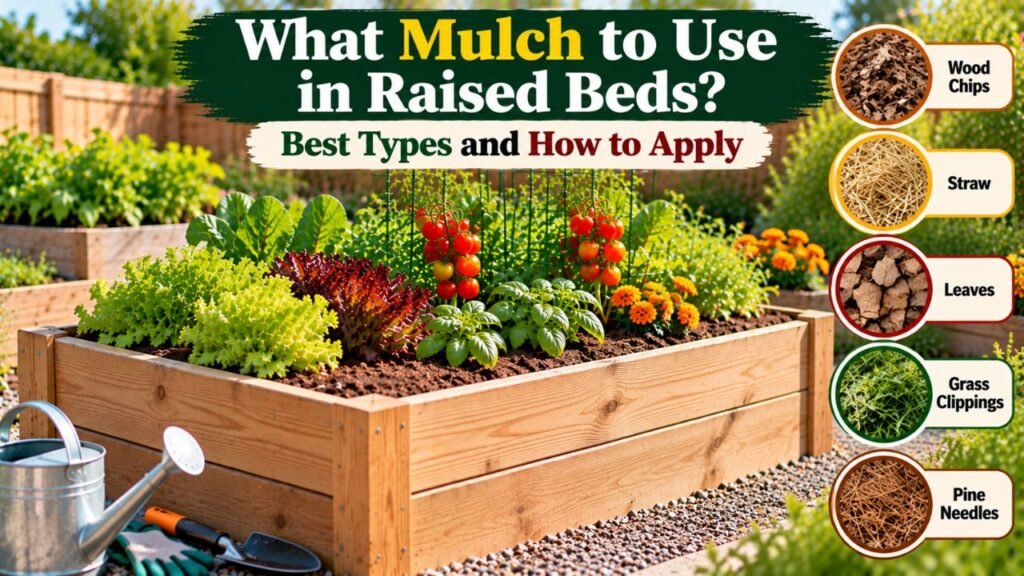
For most raised beds growing annual vegetables, organic mulch is the most practical choice because it protects the soil and gradually breaks down.
The best material depends on whether your priority is moisture retention, weed suppression, soil improvement, or easy planting.
| Mulch Type | Best Use in Raised Beds | Main Limitation |
| Clean straw | Tomatoes, peppers, squash, strawberries | May contain seeds or herbicide residues |
| Shredded leaves | Vegetables, flowers, mixed garden beds | Whole leaves can mat together |
| Dried grass clippings | Established vegetables and herbs | Thick layers may become slimy |
| Finished compost | Soil improvement and closely spaced crops | Less effective against weeds when applied thinly |
| Pine straw | Some herbs, berries, and perennial beds | Can shift or need frequent replenishment |
| Wood chips | Paths and established perennial plantings | Inconvenient for frequently replanted beds |
| Shredded bark | Permanent beds and garden pathways | Slow to decompose |
| Biodegradable paper mulch | Weed suppression in planted rows | Requires suitable installation and replacement |
According to the University of Minnesota Extension’s mulching guidance, organic mulches such as straw, compost, leaves, and grass clippings help conserve moisture, suppress weeds, moderate soil temperature, and improve soil conditions as they decompose.
For a typical home vegetable garden, clean straw is a dependable all-purpose option, while shredded leaves offer an economical alternative when suitable leaves are readily available.
Compost is especially useful when improving soil organic matter is more important than creating a thick weed-suppressing cover.
Best Organic Mulch Materials for Raised Garden Beds
Different organic materials behave differently after being spread over the soil.
Some remain loose and protective for much of the growing season, while others decompose quickly and need frequent replenishment.
1. Straw Mulch for Raised Vegetable Beds
Straw is one of the most widely used mulches for vegetable gardens.
It consists mainly of dried grain stalks left after harvesting crops such as wheat, oats, or barley.
A loose layer of straw helps shade the soil surface while allowing water and air to move through.
Best for:
- Tomatoes
- Peppers
- Cucumbers
- Squash
- Zucchini
- Strawberries
- Other established vegetable plants
Straw also helps keep low-growing vegetables and fruit from resting directly on bare soil.
One disadvantage is that some straw contains grain seeds that can germinate.
More importantly, certain agricultural herbicide residues may persist in straw. Ask suppliers about the material’s treatment history and whether it is suitable for vegetable gardens.
Avoid using straw from an unknown source if its contamination history cannot be established.
Recommended use: Begin with approximately 2–3 inches of loose, clean straw around established plants, adjusting the depth for crop size and growing conditions.
2. Shredded Leaves for Raised Beds
Shredded leaves are an inexpensive mulch for gardeners who have access to clean fallen leaves.
They cover the soil surface and contribute organic matter as they decompose.
Shredding is preferable to applying thick layers of whole leaves.
Large, wet leaves can stick together and form a dense layer that interferes with water and air movement.
Suitable leaves can be shredded using a lawn mower or another appropriate garden tool.
Best for:
- Lettuce and other established leafy greens
- Beans
- Tomatoes
- Flower beds
- Mixed vegetable beds
- Fall and winter soil protection
A layer of approximately 1–2 inches of shredded leaves is a reasonable starting point around smaller plants. More may be appropriate where the material remains loose and does not smother the crop.
Avoid leaves collected from roadsides or areas with possible chemical contamination.
Also avoid introducing leaves known to carry serious plant diseases that could affect susceptible crops.
Shredded leaves are especially useful for gardeners who want a low-cost, biodegradable mulch.
3. Dried Grass Clippings for Raised Beds
Grass clippings can provide free mulch when they come from a suitable untreated lawn.
They decompose relatively quickly and contribute organic matter to the soil.
However, fresh clippings contain considerable moisture.
When spread in a thick layer, they can become compacted, slimy, or unpleasant-smelling.
Allow clippings to dry before use, then apply them lightly.
Best for:
- Established vegetable plants
- Small raised beds
- Areas needing frequent light mulch additions
- Gardeners with a reliable source of untreated grass
Apply thin layers rather than piling several inches of fresh clippings at once.
Let each layer dry and settle before adding more.
Important: Never use grass clippings from lawns recently treated with herbicides unless the product label specifically permits that use and all restrictions have been satisfied.
Some herbicide residues can injure sensitive vegetable plants.
4. Finished Compost as Raised Bed Mulch
Finished compost can serve as a surface mulch while also supplying organic matter and some plant nutrients.
It is particularly useful in intensively planted raised beds where the soil surface remains partly shaded by crops.
Unlike straw, compost has a fine texture and settles close to the ground.
This makes it easy to spread around plants, but a thin compost layer may allow more weeds to emerge than a thicker layer of coarse organic mulch.
Best for:
- Leafy vegetables
- Herbs
- Closely spaced crops
- Beds needing organic matter replenishment
- Seasonal soil preparation
Use mature, stable compost that smells earthy rather than sour or strongly ammonia-like.
A modest surface application, often around ½–1 inch when appropriate, may be useful, but the amount should reflect soil conditions and existing nutrient levels.
Avoid repeatedly adding large quantities without checking soil fertility.
Compost is not a complete replacement for a suitable raised bed soil mixture.
5. Pine Straw for Raised Garden Beds
Pine straw consists of fallen pine needles collected for use as mulch.
The needles form a loose covering that can protect the soil surface while allowing water to pass through.
Pine straw decomposes more slowly than many soft leafy mulches.
It can be useful around established perennial plants and selected herbs.
Best for:
- Perennial herb beds
- Blueberries where soil conditions are appropriate
- Ornamental raised beds
- Some established vegetable plantings
Pine needles are sometimes said to make garden soil highly acidic.
In ordinary surface-mulching applications, they generally do not cause a large, rapid decrease in soil pH.
Do not rely on pine straw to correct soil acidity requirements for crops such as blueberries.
Use soil testing and appropriate amendments when pH adjustments are necessary.
6. Wood Chips for Raised Garden Beds
Wood chips are long-lasting organic mulch made from chipped branches or other woody material.
They work especially well in permanent garden areas where the soil is not disturbed frequently.
However, coarse wood chips are often less convenient in raised vegetable beds that are replanted several times each year.
They can interfere with making seed furrows and preparing planting holes.
Wood chips are generally more practical for:
- Paths between raised beds
- Established perennial beds
- Some berry plantings
- Areas surrounding larger garden structures
When used only on the soil surface, wood chips do not necessarily cause a significant nitrogen shortage throughout the plant root zone.
However, mixing large quantities of fresh woody material into the soil can temporarily tie up available nitrogen during decomposition.
For regularly replanted vegetable beds, straw or shredded leaves are usually easier to manage.
How Thick Should Mulch Be in a Raised Garden Bed?
The ideal mulch depth depends on the material’s texture, the size of the plants, and the condition of the soil.
Coarse, loose mulches can generally be applied more deeply than fine materials that readily mat together.
A general recommendation for many organic garden mulches is approximately 2–4 inches, but this should not be applied uniformly to every material or crop.
| Mulch Material | Practical Starting Depth |
| Loose straw | 2–3 inches |
| Shredded dry leaves | 1–2 inches |
| Dried grass clippings | Thin layers, roughly ½ inch or less at a time |
| Finished compost | Approximately ½–1 inch when needed |
| Pine straw | 2–3 inches |
| Wood chips around established perennials | Approximately 2–3 inches |
These are general starting points rather than fixed requirements.
For example, a small lettuce transplant needs more open space around its crown than a mature tomato plant.
If mulch becomes waterlogged or forms a dense mat, reduce its depth.
In a hot, dry climate, a somewhat deeper loose mulch may help conserve moisture. In a cool, persistently wet environment, lighter coverage may be more appropriate.
Can Too Much Mulch Harm Raised Bed Plants?
Yes. Excessively thick mulch can create unfavorable conditions around small plants.
Potential problems include:
- Restricted emergence of seedlings
- Excess moisture around plant crowns
- Greater shelter for slugs and certain pests
- Slower soil warming in spring
- Dense layers that interfere with air and water movement
Avoid piling mulch directly against stems.
The goal is to protect exposed soil without burying the plants.
How to Apply Mulch in Raised Beds Step by Step
Mulching is most effective when the soil has been prepared and plants have enough room to grow.
The following process works for many established vegetable beds.
Step 1: Remove Weeds From the Raised Bed
Pull existing weeds before applying mulch.
Remove the roots of persistent weeds where practical.
Mulch can suppress many newly germinating weeds, but it may not control established perennial weeds with extensive underground roots.
Starting with a clean soil surface improves the result.
Step 2: Check the Soil Moisture
Before adding mulch, check whether the soil is adequately moist.
If the bed is dry, water it so moisture reaches the root zone.
Mulch slows evaporation, but it does not supply water.
Avoid covering severely dry soil and assuming the mulch will correct the problem.
Step 3: Choose the Mulch Based on Your Crops
Use loose straw for established fruiting vegetables when moisture conservation and weed control are priorities.
Choose shredded leaves when you want a low-cost material that decomposes and contributes organic matter.
Use light grass-clipping applications only when their source is safe and known.
For closely spaced crops, a modest compost topdressing may be more manageable than coarse mulch.
Step 4: Spread the Mulch Evenly
Distribute the material across exposed soil rather than forming deep piles in isolated areas.
Keep the thickness reasonably consistent.
Avoid pressing loose straw or leaves into a dense layer.
Where drip irrigation is used, mulch can generally be placed above the irrigation line or tubing, provided the equipment remains accessible for inspection and maintenance.
Step 5: Leave Space Around Plant Stems
Keep mulch slightly away from the base of vegetable stems.
For larger transplants, leaving roughly 1–2 inches of open space around the stem is a practical starting point.
Small seedlings may need more space relative to their size.
This helps reduce persistent moisture directly against sensitive plant tissue.
For plants forming a crown near soil level, avoid covering the crown.
Step 6: Check Water Penetration
Water the bed gently after applying mulch.
Confirm that moisture passes through the mulch and reaches the soil below.
Some loose mulches initially shed water or redistribute it unevenly.
If necessary, move the material aside to inspect the soil.
Continue monitoring moisture at root depth rather than judging watering needs by the mulch’s surface appearance.
When Is the Best Time to Mulch Raised Beds?
Mulch can be useful throughout the year, but the timing matters.
Organic mulch changes how quickly the soil warms and cools, which may help or hinder certain crops.
Mulching Raised Beds in Spring
In early spring, bare raised bed soil often warms more quickly under sunlight than soil covered with thick organic mulch.
This can be helpful when preparing for heat-loving vegetables.
For tomatoes, peppers, and eggplants, consider waiting until the soil has warmed adequately before applying a thick layer of straw or leaves.
For cool-season crops, the decision depends on soil temperature, drainage, and planting conditions.
Avoid allowing mulch to cover seed rows before germination unless the crop and mulch method specifically call for it.
Mulching Raised Beds in Summer
Summer is often when organic mulch provides the greatest practical benefit.
Hot sunlight and wind can increase evaporation from the raised bed surface.
A suitable mulch layer helps retain moisture and limit rapid temperature changes.
Straw and shredded leaves are particularly useful during hot weather.
However, inspect the soil beneath the mulch before watering.
A mulched bed may need a different watering schedule from an uncovered bed.
Mulching Raised Beds in Fall
After removing spent crops, apply suitable organic mulch to protect the soil surface.
Shredded leaves are particularly convenient in fall because they are often available at little cost.
A protective layer can reduce soil erosion and surface crusting during rainfall.
It also supplies organic material as the mulch gradually decomposes.
If the bed will be planted with a fall or winter crop, keep the mulch clear of planting areas.
Mulching Raised Beds in Winter
Mulch can help moderate soil temperature fluctuations during winter.
This is especially useful around certain perennial plants exposed to repeated freezing and thawing.
A layer of clean straw or shredded leaves can also protect bare soil from erosion.
For perennial crown protection, apply winter mulch at the appropriate time for the crop and local climate.
Do not automatically bury perennial crowns beneath thick material before the soil has cooled.
In spring, adjust or remove heavy mulch where earlier soil warming is desirable.
Best Mulch for Different Vegetables in Raised Beds
Different crops have different growth habits and planting requirements.
Choosing a mulch that works with the crop makes maintenance easier.
Best Mulch for Tomatoes and Peppers
Clean straw is a strong choice for established tomatoes and peppers.
It helps cover the soil surface and reduce soil splash during irrigation or rain.
Shredded leaves are another option.
Wait until the soil is suitably warm, especially when planting in a cool spring climate.
Leave open space around the main stems and avoid excessive moisture around the crowns.
Best Mulch for Lettuce and Leafy Greens
Shredded leaves or a modest layer of finished compost can work well around established leafy vegetables.
Lettuce, spinach, and similar crops often grow close together.
A thick layer of coarse straw may be inconvenient around small plants.
Use lighter mulch where necessary and avoid covering the growing points.
As the crops develop, their own leaves may shade much of the soil.
Best Mulch for Cucumbers, Squash, and Zucchini
Straw is useful around sprawling vegetable plants because it keeps developing fruit separated from bare soil.
It can also reduce weed growth in the open spaces between vines.
Apply mulch after the soil has warmed adequately for the crop.
Check beneath the material for slugs or other pests, especially during persistently wet weather.
Best Mulch for Carrots, Radishes, and Root Vegetables
Direct-seeded root vegetables require particular care.
Carrot and radish seedlings can struggle to emerge through thick mulch.
Avoid covering newly planted seed rows with heavy straw or coarse leaves.
Wait until seedlings are established, then place light mulch between rows if needed.
Keep the material away from emerging foliage and crowns.
Best Mulch for Herbs
The ideal mulch depends on the herb.
Basil and parsley may benefit from light organic mulch that helps retain moisture.
Mediterranean herbs such as rosemary, thyme, and sage generally prefer well-drained growing conditions.
For these plants, avoid creating persistently damp conditions around their crowns.
A light mulch with adequate stem clearance may be more appropriate than thick, moisture-retentive coverage.
Best Mulch for Strawberries
Clean straw is a traditional and practical choice for strawberries.
It can help keep developing berries away from direct soil contact.
Apply it carefully around plants without burying their crowns.
The amount and timing depend on whether the mulch is being used for fruit protection or winter insulation.
Winter protection practices may differ from ordinary growing-season mulching.
What Mulch Should You Avoid in Raised Beds?
Some materials introduce unnecessary problems into vegetable-growing soil.
Others are suitable in particular settings but are poor choices for a frequently replanted raised bed.
Hay Containing Weed Seeds
Hay is harvested for animal feed and may contain mature grasses and other plants with seeds.
Using hay as mulch can introduce weeds into a raised bed.
Clean, seed-free straw is generally easier to manage.
Both materials should have a known source and appropriate treatment history.
Herbicide-Treated Grass Clippings
Avoid grass clippings from lawns treated with herbicides unless the specific product instructions permit their use as mulch and all required restrictions have been met.
The University of Maryland Extension’s vegetable gardening recommendations specifically identify dried grass clippings from lawns without herbicide treatment, fallen leaves, and straw-covered newspaper as useful mulching materials.
The same guidance recommends arborist wood chips for paths between garden beds.
If you do not know the treatment history of lawn clippings, choose another mulch.
Thick Layers of Wet Grass
Fresh grass clippings can form a dense mat when piled too deeply.
This may restrict air movement and create unpleasant decomposition conditions.
Spread dried clippings thinly and allow the previous layer to settle before adding more.
Unknown Dyed or Treated Wood Mulch
Not every colored wood mulch is hazardous.
However, the origin of the wood and the substances used in processing matter.
For edible raised beds, avoid unidentified recycled wood and products with uncertain treatment histories.
Use clean, known materials rather than assuming decorative landscaping mulch is suitable for vegetable soil.
Rubber Mulch
Rubber mulch is generally a poor choice for an edible raised bed.
It does not decompose into beneficial organic matter, and its material composition and long-term soil interactions differ from natural plant-based mulches.
Straw, leaves, and compost provide more direct benefits for routine vegetable gardening.
Gravel and Decorative Stones
Stone and gravel can be useful for pathways and certain landscape applications.
However, they do not contribute organic matter to the soil.
They can also increase surface heating under direct sunlight and make frequent vegetable replanting more difficult.
For typical annual vegetable beds, organic mulch is generally a better fit.
How Much Mulch Do You Need for a Raised Bed?
Calculate mulch quantity using the bed’s surface area and the intended mulch depth.
The basic formula is:
Mulch volume (cubic feet) = Bed length (feet) × Bed width (feet) × Mulch depth (inches) ÷ 12
For example, a 4-by-8-foot raised bed has a surface area of 32 square feet.
If you want a 2-inch layer:
32 × 2 ÷ 12 = 5.33 cubic feet
For a 3-inch layer:
32 × 3 ÷ 12 = 8 cubic feet
The table below shows approximate volumes for common rectangular bed sizes.
| Raised Bed Size | 2-Inch Mulch Layer | 3-Inch Mulch Layer |
| 2 × 4 feet | 1.33 cu ft | 2 cu ft |
| 3 × 6 feet | 3 cu ft | 4.5 cu ft |
| 4 × 4 feet | 2.67 cu ft | 4 cu ft |
| 4 × 8 feet | 5.33 cu ft | 8 cu ft |
| 4 × 10 feet | 6.67 cu ft | 10 cu ft |
These are geometric volume estimates.
Actual purchases may vary because loose straw, leaves, and other materials compress or settle differently.
You also need less material if substantial areas are occupied by plants or intentionally left uncovered.
For bagged mulch, divide the required cubic feet by the bag’s labeled volume.
For example, 8 cubic feet equals four 2-cubic-foot bags.
This calculation is useful for bagged shredded leaves, bark products, and other loose mulches sold by volume.
How to Keep Mulch Working Throughout the Growing Season
Organic mulch gradually breaks down, shifts, and becomes thinner.
Maintaining the right coverage is more useful than applying a very thick layer once and leaving it untouched.
Replenish Mulch as It Decomposes
Inspect the mulch periodically.
If bare soil becomes exposed and weeds begin appearing, add enough suitable material to restore coverage.
Different mulches break down at different rates.
Grass clippings may need frequent small additions, while straw and woody mulches generally remain visible longer.
Avoid adding more material when the existing layer is already excessively deep.
Monitor for Slugs and Other Pests
Mulch creates shelter for soil organisms, including many beneficial decomposers.
However, damp mulch can also provide hiding places for slugs and certain other pests.
This is more likely to become a problem in cool, wet conditions.
If slug damage increases:
- Check beneath mulch near affected plants.
- Reduce unnecessary moisture around plant crowns.
- Avoid overly thick mulch layers.
- Remove dense, decaying material where it creates persistent shelter.
- Use suitable pest-management methods when needed.
Mulch should support plant health without creating an excessively wet environment.
Keep Mulch Out of Plant Crowns
As plants grow, loose straw and leaves may shift toward stems.
Check that the crowns remain uncovered.
This is especially important for strawberries, lettuce, and smaller herb plants.
Move accumulated mulch away from vulnerable areas.
Avoid Mixing Large Amounts of Fresh Mulch Into Soil
Organic mulch is primarily intended to protect the soil surface.
It does not need to be dug into the root zone every time the bed is prepared.
Fresh straw, leaves, and woody material can temporarily influence nitrogen availability as they decompose, particularly when large amounts are incorporated.
Leave suitable mulch on the surface or remove it temporarily when preparing seed rows.
Finished compost can be used differently because it has already undergone substantial decomposition.
Common Raised Bed Mulching Mistakes to Avoid
Even a good mulch material can perform poorly when applied incorrectly.
The most common problems involve timing, thickness, and material quality.
- Mulching too early in cold spring soil: Thick organic mulch can slow warming needed by tomatoes, peppers, and other warm-season crops.
- Covering newly planted seeds: Heavy mulch may prevent small seedlings from emerging properly.
- Using untreated-looking material without knowing its history: Straw and clippings can carry unwanted seeds or herbicide residues.
- Piling mulch against stems: Persistent moisture around plant crowns may increase disease problems.
- Applying wet grass too thickly: Dense clippings can mat together and restrict movement of air and water.
- Ignoring the soil beneath mulch: A dry-looking mulch surface does not necessarily mean the root zone needs water.
- Using coarse wood chips in frequently replanted beds: Large chips can interfere with seed preparation and seasonal planting.
- Adding excessive compost every year: Repeated heavy applications can contribute to nutrient imbalances.
Choose the simplest mulch that meets the needs of your crops and climate.
For most vegetable raised beds, that means using a clean organic material, maintaining reasonable coverage, and checking the soil regularly.
Conclusion
Choosing what mulch to use in raised beds depends on your vegetables, soil conditions, climate, and maintenance preferences.
For most established vegetable gardens, clean straw is my first recommendation because it provides useful moisture conservation, weed suppression, and soil coverage without making planting and maintenance unnecessarily complicated.
Shredded leaves are an excellent low-cost alternative, while dried untreated grass clippings can work in thin layers. Finished compost is especially useful for improving soil organic matter but may provide less weed suppression than a thicker, coarse mulch.
Use approximately 2–3 inches of loose straw for many established crops, adjusting the amount for plant size and soil moisture. Keep mulch away from stems, avoid covering emerging seedlings, and delay heavy organic mulching until the soil has warmed where appropriate.
A suitable mulch layer protects the raised bed while making watering, weeding, and seasonal garden maintenance easier.
FAQs About What Mulch to Use in Raised Beds
Is Straw or Wood Mulch Better for Raised Vegetable Beds?
Straw is generally better for raised beds growing annual vegetables.
It is lightweight, relatively easy to move, and convenient when replanting crops.
Wood chips are usually better for pathways and permanent perennial plantings where frequent soil disturbance is unnecessary.
Can I Use Grass Clippings as Mulch in Raised Beds?
Yes. Dried grass clippings can be used as mulch if they come from a lawn free of incompatible herbicide treatments.
Apply them in thin layers to prevent matting.
Avoid using clippings that contain large quantities of weed seeds or have an unknown chemical treatment history.
Should I Put Mulch on Raised Beds Before Planting?
It depends on the crop.
For transplants, you can prepare the soil, plant the vegetables, and then spread mulch around them.
For direct-seeded vegetables, it is often better to keep seed rows uncovered until the seedlings are established.
Does Mulch Need to Be Removed Every Year?
No. Organic mulch does not automatically need to be removed at the end of each growing season.
Clean, suitable material can remain on the surface and gradually decompose.
Remove or relocate mulch if it becomes contaminated, excessively matted, or interferes with preparing the next crop.
Will Mulch Attract Bugs to Raised Garden Beds?
Mulch can provide habitat for insects and other soil organisms.
Many are beneficial decomposers, but some conditions may also encourage slugs and other pests.
Avoid overly wet, thick mulch and monitor plants for damage. The presence of soil organisms does not automatically indicate a problem.
Can You Use Compost and Straw Together in a Raised Bed?
Yes. Finished compost and straw can serve complementary purposes.
Apply an appropriate amount of compost to replenish organic matter, then spread straw over the soil surface for moisture retention and weed suppression.
Avoid adding excessive compost if soil nutrient levels are already high.
What Is the Cheapest Mulch for Raised Garden Beds?
Clean shredded leaves and suitable untreated grass clippings are often the least expensive options because they may be available from your own yard.
Straw can also be economical, depending on local availability.
Choose materials with a known, safe source rather than prioritizing cost alone.

I’m Maya L. Greenwood, a lifelong plant lover who believes anyone can grow something beautiful with the right guidance. After years of testing soil mixes, pruning methods, irrigation tricks, and pest-safe solutions, I started EasyGardenTips.com to turn hard-won lessons into step-by-step advice. From seed starting and container gardens to composting and seasonal checklists, my goal is to make gardening simple, sustainable, and fun.