
Not sure how much soil your raised garden bed needs? Use our free Raised Bed Soil Calculator to estimate the right amount before buying soil. Simply choose your garden bed shape, enter the inside measurements and desired soil depth, and calculate the total volume in liters, cubic feet, and cubic yards.
You can also customize the topsoil, compost, and other growing mix percentages to see exactly how much of each ingredient you need for your raised bed or elevated planter.
Raised Bed Soil Calculator
Choose your garden bed shape, enter the inside measurements, and get the total in liters plus a customizable soil mix—so shopping for soil is simpler.
How much soil do you need?
One raised garden bed
Use the liters shown here to choose the bag sizes you prefer.
Your soil mix breakdown
Suggested raised-bed mixSuggested starting mix: 70% topsoil and 30% finished compost. Change any dropdown to customize.
Percentages are measured by volume, not weight. The suggested mix is a starting point, not a requirement for every plant.
Measurement tip: Measure the inside growing area, not the outside frame. Liters measure volume, not kilograms. For L- and U-shaped beds, the diagram uses straight arms and a consistent fill depth.
How to Use the Raised Bed Soil Calculator
Our Raised Bed Soil Calculator helps you estimate how much soil you need to fill a raised garden bed, whether you’re building a small vegetable bed, a large backyard growing area, or an elevated planter.
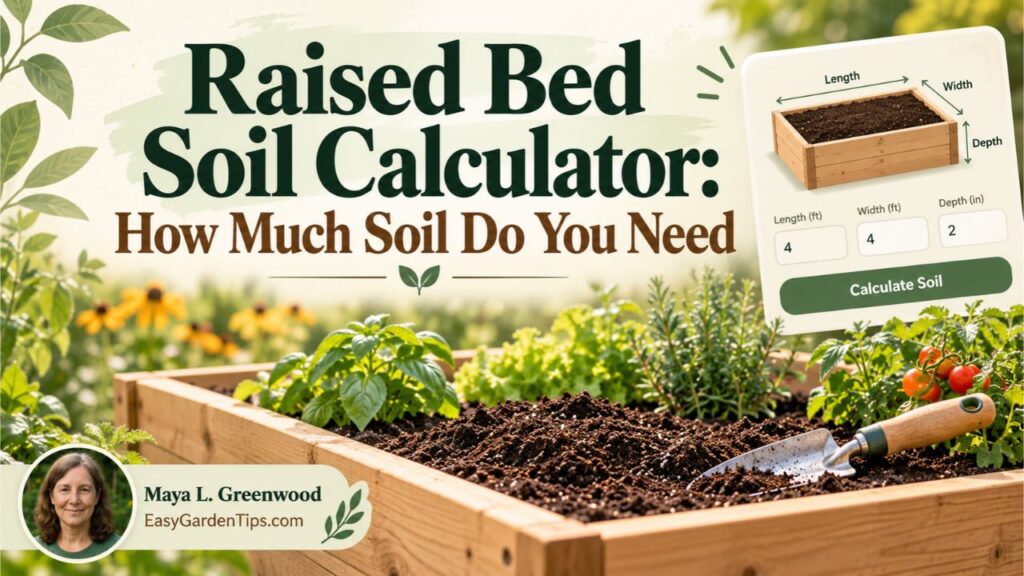
Instead of guessing how many bags of garden soil to buy, you can calculate the required volume using your garden bed’s measurements.
The calculator supports seven garden bed shapes, US and metric measurements, and customizable soil mix percentages. It also displays the total soil requirement in liters, cubic feet, and cubic yards, making it easier to compare different soil products.
Here’s how to use it.
Step 1: Choose Your Raised Bed or Planter Type
Start by selecting the growing setup you want to fill.
Raised Garden Bed: Choose this for a traditional raised bed used to grow vegetables, herbs, flowers, or other garden plants. In US measurement mode, the calculator uses feet for length and width and inches for soil depth.
Pot or Elevated Planter: Select this for a freestanding planter, large container, or elevated garden box. In US mode, dimensions are entered in inches.
If you switch to metric measurements, the calculator uses metric units appropriate to the selected growing setup.
Choose the option that matches your garden or planter rather than selecting based on size alone.
Step 2: Select Your Raised Garden Bed Shape
The calculator includes seven visual shape options:
- Square
- Rectangle
- Round
- Hexagon
- Octagon
- L-shape
- U-shape
Click the illustration that most closely matches your garden bed.
The measurement fields automatically change based on the selected shape.
For example, a rectangular bed requires its length and width, while a round raised bed requires a circular measurement. L-shaped and U-shaped beds need additional dimensions to account for their open sections.
If your bed has an irregular design that doesn’t match any available shape, calculate its rectangular or other regular sections separately and add the results.
Step 3: Enter Your Raised Bed Measurements
Measure the interior growing space of your raised bed.
Enter the requested dimensions using the units displayed beside each measurement field.
For a rectangular raised bed, you’ll typically need:
- Length: The inside distance from one end of the bed to the other.
- Width: The inside distance between the two longer sides.
- Soil Fill Depth: The actual depth of growing soil you intend to add.
For example, a raised bed might measure 8 feet long, 4 feet wide, and 12 inches deep.
If the bed is 18 inches tall but you plan to fill it with only 15 inches of soil, enter 15 inches as the soil depth.
That distinction matters because the calculator estimates the space occupied by soil, not necessarily the total height of the frame.
Always measure the inside dimensions rather than the outside edges of the raised bed.
Step 4: Calculate Your Raised Bed Soil Volume
After entering your measurements, click Calculate.
The calculator displays your estimated soil requirements in three measurements:
- Liters (L)
- Cubic feet (cu ft)
- Cubic yards (cu yd)
Liters appear as the primary result because they make it easier to plan purchases when soil products are sold in liter-sized bags.
Cubic feet are useful when purchasing bagged garden soil in the United States, while cubic yards are commonly used for larger bulk soil deliveries.
For example, if the calculator shows 20 liters, you know that one 20-liter bag or two 10-liter bags would provide approximately the same nominal volume.
Step 5: Customize Your Raised Bed Soil Mix
Below the total soil volume, you’ll find a soil mix breakdown.
The calculator starts with a suggested raised bed mixture of 70% topsoil and 30% compost, with optional potting mix set to 0%.
You can change the ingredient percentages using the dropdown menus.
When you adjust one percentage, the calculator automatically balances the others so the total remains 100%.
The ingredient quantities update to show how many liters of each material you need.
If you want to return to the original recommendation, select Use Suggested Mix.
These percentages are based on volume rather than weight.
Step 6: Plan Your Raised Bed Soil Purchase
Use the calculated quantities to decide how much soil, compost, or other growing media to buy.
For example, if the total result is 20 liters of premixed soil, you could purchase:
- One 20-liter bag
- Two 10-liter bags
- Four 5-liter bags
This example assumes you’re buying one premixed growing medium.
If you’re purchasing topsoil and compost separately, use their individual quantities from the soil mix breakdown instead.
You can also copy your soil estimate and keep it as a shopping reference.
For another raised bed, enter its measurements and calculate again.
How Does Our Raised Bed Soil Calculator Work?
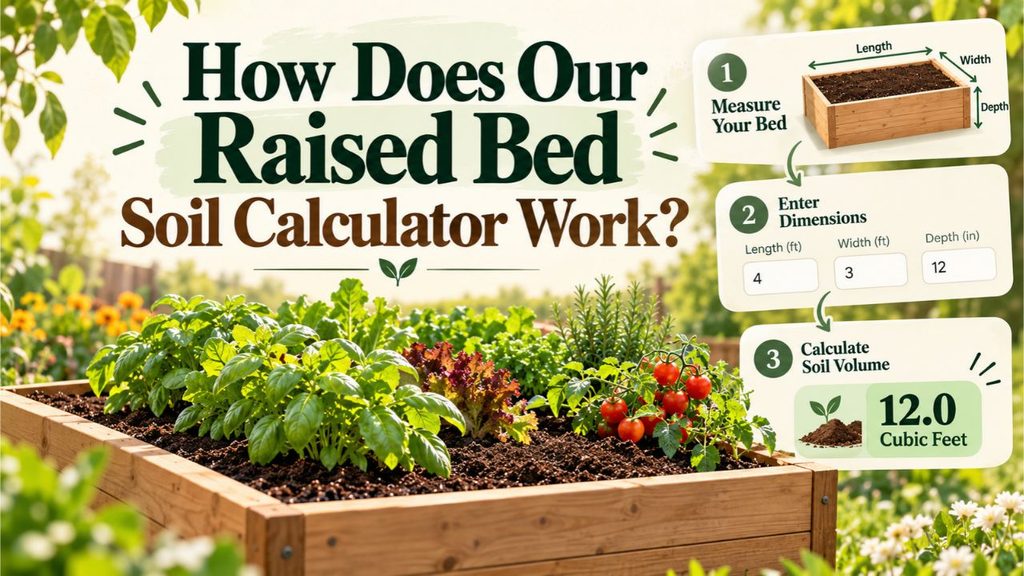
A raised bed soil calculator estimates the volume of growing medium required to fill a specific space.
Soil volume depends primarily on three factors: the growing area’s dimensions, the shape of the garden bed, and the depth of soil you plan to add.
For most rectangular raised beds, the calculation is straightforward.
Raised Bed Soil Volume = Length × Width × Soil Depth
All three measurements must use the same unit before multiplying.
For example, if length and width are measured in feet, soil depth must also be converted to feet.
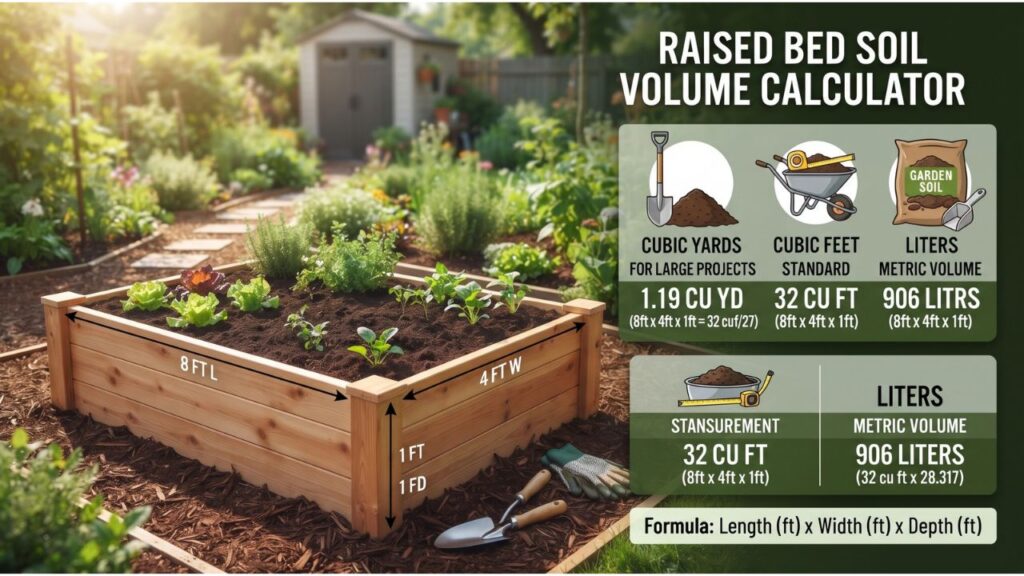
Raised Bed Soil Calculation Example: 4 × 8 Feet
Suppose you’re filling a raised vegetable garden bed with these dimensions:
| Measurement | Value |
|---|---|
| Raised bed length | 8 feet |
| Raised bed width | 4 feet |
| Soil fill depth | 12 inches |
| Depth in feet | 1 foot |
First, calculate the growing area:
8 × 4 = 32 square feet
Next, multiply by the soil depth:
32 × 1 = 32 cubic feet
Convert cubic feet into liters:
32 × 28.3168 = 906.14 liters
Final Raised Bed Soil Requirement:
| Unit | Amount |
|---|---|
| Liters | 906.14 L |
| Cubic feet | 32 cu ft |
| Cubic yards | 1.185 cu yd |
You would need approximately 906 liters of soil mix to fill this bed to the specified depth.
This is a geometric volume estimate. It doesn’t automatically include additional soil for settling, a separate mulch layer, or material lost during handling.
Raised Bed Soil Formulas for Different Garden Bed Shapes
Not every raised garden bed is rectangular.
Decorative raised beds, corner gardens, circular planters, and custom vegetable beds can have different shapes.
The calculator determines the growing area based on the selected shape and then multiplies that area by the soil depth.
| Raised Bed Shape | Soil Volume Formula |
|---|---|
| Square | Side × Side × Depth |
| Rectangle | Length × Width × Depth |
| Round | π × Radius² × Depth |
| Regular Hexagon | (3√3 ÷ 2) × Side² × Depth |
| Regular Octagon | 2(1 + √2) × Side² × Depth |
| L-shape | (Outer Area − Missing Corner Area) × Depth |
| U-shape | (Outer Area − Center Opening Area) × Depth |
These formulas assume the stated geometric shapes are regular and the soil depth is uniform.
All dimensions must use compatible units.
Square Raised Garden Bed Soil Calculation
For a square raised bed, all four sides have equal lengths.
Its soil volume is calculated by multiplying the side length by itself and then multiplying by the fill depth.
For example, a square bed measuring 4 feet on each side with 1 foot of soil depth requires:
4 × 4 × 1 = 16 cubic feet
That equals approximately 453 liters of soil mix.
Rectangular Raised Garden Bed Soil Calculation
A rectangular raised bed has two pairs of equal sides.
The required soil volume is:
Length × Width × Depth
For example, a rectangular bed measuring 6 feet long, 3 feet wide, and 1 foot deep requires:
6 × 3 × 1 = 18 cubic feet
That equals approximately 510 liters of soil mix.
Round Raised Garden Bed Soil Calculation
Round raised beds are commonly used for flower gardens, herbs, decorative plants, and compact growing spaces.
The growing area of a circle is calculated using:
π × Radius²
The radius is half the diameter.
Multiply the circular area by the soil depth to find the total volume.
For accurate results, measure the interior diameter of the bed.
Hexagonal Raised Garden Bed Soil Calculation
A regular hexagonal raised bed has six equal sides.
Its growing area is calculated using the side length and the standard area formula for a regular hexagon.
The calculator then multiplies that area by the desired soil depth.
Because irregular hexagonal beds have different areas, the regular hexagon formula should not be used when the sides or angles vary significantly.
Octagonal Raised Garden Bed Soil Calculation
An octagonal raised garden bed has eight sides.
For a regular octagon, all eight sides and angles are equal.
Its area can be calculated from the side length before multiplying by soil depth.
If your octagonal bed is irregular, divide the growing area into simpler shapes when possible.
L-Shaped Raised Bed Soil Calculation
An L-shaped raised garden bed contains two connected sections.
One way to determine its area is to calculate the entire outer rectangular footprint and subtract the missing corner.
The resulting growing area is then multiplied by soil depth.
This prevents the calculator from counting an empty section as soil-filled space.
Use the dimensions requested by the calculator and check that they correspond to the actual interior measurements of your L-shaped bed.
U-Shaped Raised Bed Soil Calculation
A U-shaped raised garden bed has two side arms connected by a base.
Its growing area can be determined by subtracting the center opening from the surrounding rectangular footprint.
The standard calculation assumes a consistent soil depth and a U-shaped layout matching the calculator’s measurement diagram.
For a custom U-shaped garden with unequal arms or varying soil depths, calculating the separate sections individually may provide a more accurate estimate.
Raised Bed Soil Volume: Liters vs. Cubic Feet vs. Cubic Yards
Understanding soil measurement units makes purchasing garden soil easier.
A raised bed soil calculator measures volume, not weight.
Volume describes how much space the soil occupies. Weight describes how heavy that material is.
These are different measurements.
Raised Bed Soil Volume in Liters
Liters are particularly convenient when purchasing packaged growing media.
For example, if your raised bed requires 40 liters, you might purchase two 20-liter bags.
You don’t need to calculate cubic yards to make that decision.
The calculator therefore displays liters as the main result.
Raised Bed Soil Volume in Cubic Feet
Cubic feet are commonly used to describe smaller bags of garden soil sold in the United States.
One cubic foot equals approximately 28.32 liters.
A 2-cubic-foot soil bag therefore contains approximately 56.63 liters by nominal volume.
Raised Bed Soil Volume in Cubic Yards
Cubic yards are frequently used for larger gardening projects and bulk soil deliveries.
One cubic yard equals 27 cubic feet, or approximately 764.55 liters.
For example, a raised bed requiring 1.5 cubic yards needs approximately 1,147 liters of growing medium.
Raised Bed Soil Conversion Chart
| Soil Volume | Equivalent |
|---|---|
| 1 cubic foot | 28.32 liters |
| 2 cubic feet | 56.63 liters |
| 1 cubic yard | 27 cubic feet |
| 1 cubic yard | 764.55 liters |
| 100 liters | 3.53 cubic feet |
| 1,000 liters | 1.31 cubic yards |
These conversions are based on the official volume conversion factors published in the NIST Guide to the SI: Conversion Factors by Quantity by the National Institute of Standards and Technology.
Using standardized volume conversions helps you compare soil products sold in different units without confusing cubic measurements with weight.
Does a Raised Bed Soil Calculator Tell You How Many Kilograms of Soil to Buy?
Not directly.
Liters, cubic feet, and cubic yards measure volume, whereas kilograms measure mass.
The weight of a given soil volume depends on the material’s density, composition, compaction, and moisture content.
For example, 20 liters of lightweight potting mix may weigh considerably less than 20 liters of moist mineral topsoil.
When purchasing soil, use the volume indicated on the product packaging rather than assuming a fixed kilogram-to-liter conversion.
How Much Soil Do You Need for Different Raised Bed Sizes?
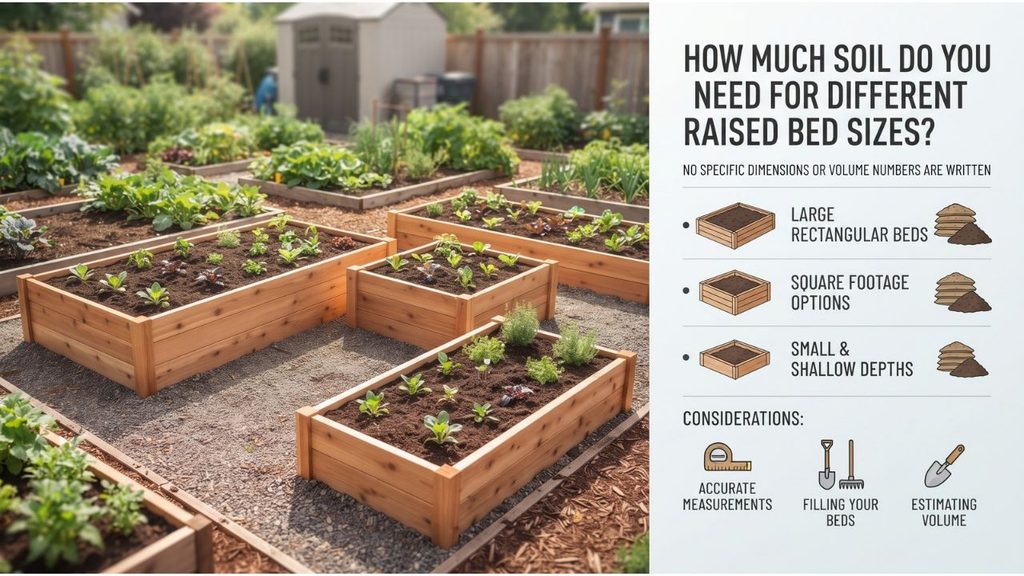
The amount of soil required for a raised garden bed increases with its length, width, and fill depth.
The following examples can help you estimate common raised bed sizes before using the calculator.
Raised Bed Soil Volume Chart
| Raised Bed Size | Soil Depth | Cubic Feet | Approx. Liters |
|---|---|---|---|
| 2 × 4 feet | 8 inches | 5.33 | 151 L |
| 3 × 6 feet | 10 inches | 15 | 425 L |
| 4 × 4 feet | 12 inches | 16 | 453 L |
| 3 × 8 feet | 6 inches | 12 | 340 L |
| 4 × 8 feet | 12 inches | 32 | 906 L |
| 4 × 8 feet | 18 inches | 48 | 1,359 L |
These estimates assume a rectangular bed with a consistent fill depth and no internal obstructions.
If you’re using a raised bed with unusual dimensions, calculate the actual interior measurements instead of relying on a standard size chart.
What Is the Best Soil Mix for a Raised Garden Bed?
A productive raised garden bed needs growing soil that supports root development, retains enough moisture, and allows excess water to drain.
The ideal composition depends on the existing soil, the plants you’re growing, drainage conditions, and the quality of available materials.
For many ground-connected raised garden beds, a mixture of mineral topsoil and finished compost provides a practical starting point.
The calculator’s suggested raised bed blend is:
70% Topsoil + 30% Compost
This recommendation is supported by Penn State Extension’s Soil Health in Raised Beds, which recommends a mixture containing 70% soil and 30% compost for raised bed gardening.
However, it should be treated as a suggested starting mixture rather than a universal formula.
Other Extension services recommend different proportions depending on soil conditions, the growing surface, and the type of material being used.
The quality of the ingredients matters as much as the percentage.
Why Topsoil Matters in Raised Beds
Topsoil forms the mineral-soil foundation of many raised garden beds.
Good-quality topsoil generally contains a mixture of sand, silt, clay, and organic matter.
Its functions include:
- Supporting plant roots
- Holding water and nutrients
- Providing mineral components
- Creating a stable growing environment
- Supporting beneficial soil organisms
Look for clean, crumbly loam or sandy loam from a reputable supplier.
Avoid excessively sticky clay, very sandy material, or soil with an unknown contamination history.
The University of Minnesota Extension’s guide to Raised Bed Gardens also recommends combining quality topsoil with plant-based compost. It emphasizes using good-quality loam or sandy loam and avoiding excessive compost, especially where moisture retention and nutrient buildup may become problems.
For many raised beds, choosing good-quality ingredients is more important than following an exact percentage.
Why Compost Matters in Raised Beds
Compost is decomposed organic material used to improve soil quality.
Properly finished compost can support soil structure, microbial activity, moisture management, and nutrient availability.
Compost may also improve the soil’s ability to hold water while contributing organic matter.
However, adding excessive compost is not necessarily better.
Some compost products contain high levels of soluble salts or nutrients.
Large amounts of certain manure-based composts can also contribute excessive phosphorus.
Use mature compost from a reliable source and consider a soil test before making major amendments.
Is Potting Mix Necessary for Raised Beds?
Not always.
Traditional raised garden beds connected to native soil generally benefit from a mineral-soil-based mixture.
Potting mixes are designed primarily for containers and may consist of peat, coir, composted bark, perlite, or other lightweight materials.
Some bagged potting mixes can dry out too quickly when used as the only filling material in a large ground-connected raised bed.
If your raised bed already contains a suitable topsoil-and-compost blend, adding potting mix may be unnecessary.
For contained elevated planters, however, a container-friendly growing medium is often more appropriate.
How to Customize Your Raised Bed Soil Mix Ratio
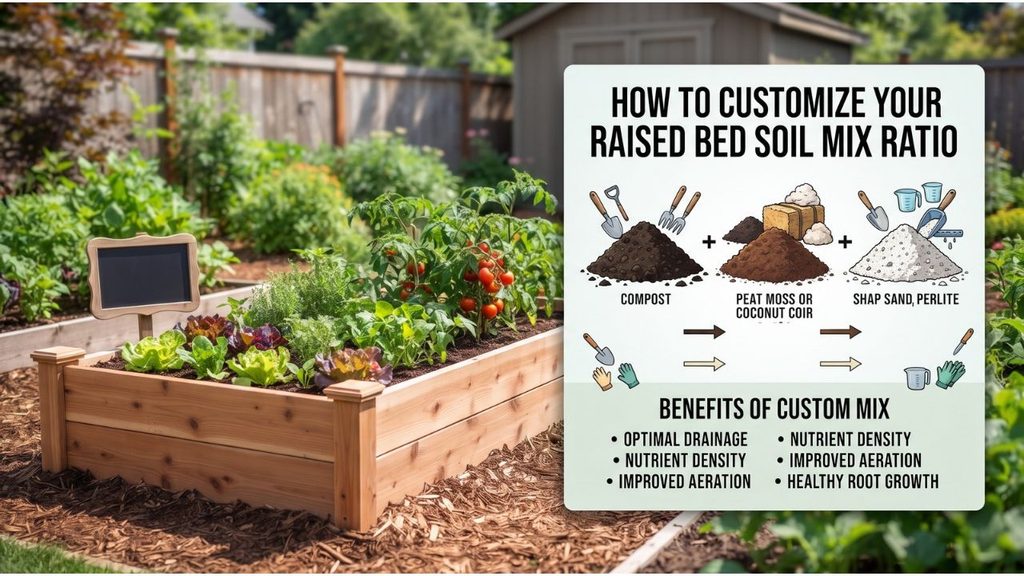
Different gardening situations call for different growing media.
You may want to adjust your raised bed soil composition based on the existing soil, drainage, plant requirements, or materials already available.
The calculator allows you to change the percentages using dropdown menus.
For raised garden beds, the available components are:
- Topsoil
- Compost
- Optional Potting Mix
All percentages represent portions of the total soil volume, not weight.
Raised Bed Soil Mix Example: 20 Liters
Suppose the calculator estimates that your raised bed needs 20 liters of growing medium.
Using the suggested 70/30 blend:
| Ingredient | Percentage | Required Volume |
|---|---|---|
| Topsoil | 70% | 14 L |
| Compost | 30% | 6 L |
| Optional Potting Mix | 0% | 0 L |
| Total | 100% | 20 L |
You would need 14 liters of topsoil and 6 liters of finished compost.
Raised Bed Soil Mix Example: Custom Percentages
Now suppose you choose a custom mixture of:
- 75% Topsoil
- 20% Compost
- 5% Potting Mix
For the same 20-liter total:
| Ingredient | Percentage | Required Volume |
|---|---|---|
| Topsoil | 75% | 15 L |
| Compost | 20% | 4 L |
| Potting Mix | 5% | 1 L |
| Total | 100% | 20 L |
This example demonstrates how the volume breakdown changes. It doesn’t mean that this particular blend is better for your plants.
The calculator keeps the total at 100%, so you can experiment with different proportions without manually recalculating every ingredient.
Keep in mind that ingredient volumes are planning estimates.
The final blended volume can vary slightly as different materials settle and occupy spaces between soil particles.
Raised Bed Soil vs. Elevated Planter Soil: What’s the Difference?
Although both growing setups are raised above ground level, a raised garden bed and an elevated planter may have different soil requirements.
The most important difference is whether plant roots can grow into the ground beneath the structure.
Raised Garden Beds on Natural Ground
A bottomless raised garden bed usually allows roots to grow into the underlying native soil.
This provides additional rooting space and may improve access to soil moisture.
For this type of bed, a quality topsoil-and-compost mixture is often appropriate.
Before filling the bed, check the condition of the underlying soil.
Compacted soil may benefit from gentle loosening, while contaminated soil requires special precautions.
Raised Beds on Concrete or Other Hard Surfaces
Raised beds installed over concrete, paving, or another impermeable surface cannot rely on the ground below for rooting space.
They need sufficient soil depth and a way for excess water to drain.
A lighter, well-draining growing medium may be more suitable than a heavy mineral-soil mix.
According to the University of Maryland Extension’s Growing Vegetables in Raised Beds guide, raised beds constructed on hard surfaces should have enough depth for the crops being grown. The guide recommends a 1:1 mixture of compost and soilless growing medium for these conditions, with limited topsoil added only in sufficiently deep beds.
Therefore, the calculator’s default 70/30 topsoil-and-compost blend should not automatically be used for every hard-surface bed.
Consider the growing environment before choosing the soil ingredients.
Elevated Garden Planters and Containers
Elevated planters typically have a contained soil compartment.
They require growing media suitable for restricted root space, reliable drainage, and consistent moisture management.
For the Pot or Elevated Planter option, the calculator provides an example blend of:
70% Potting Mix + 20% Compost + 10% Perlite or Pumice
For a 20-liter planter, that equals:
| Ingredient | Percentage | Volume |
|---|---|---|
| Potting Mix | 70% | 14 L |
| Compost | 20% | 4 L |
| Perlite / Pumice | 10% | 2 L |
| Total | 100% | 20 L |
This is an adjustable example rather than a requirement for every container plant.
Commercial potting mixes may already contain compost, perlite, pumice, or similar ingredients.
Read the product label before adding more.
How Deep Should Soil Be in a Raised Garden Bed?
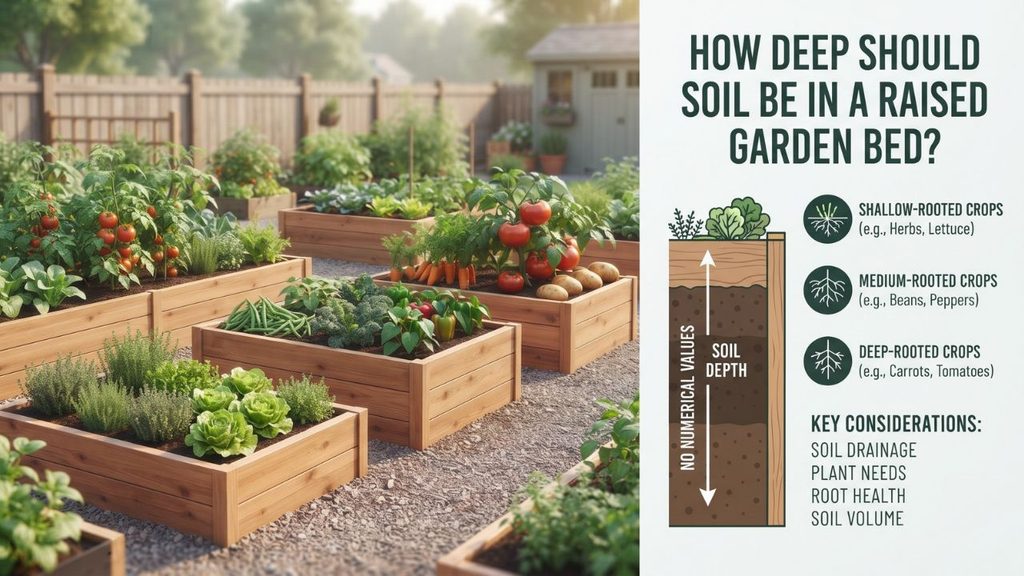
Choosing the correct soil depth is just as important as calculating the total soil volume.
A raised bed that’s too shallow may restrict root development, while filling a bed unnecessarily deep can increase material costs.
The appropriate depth depends on the crop and the growing surface beneath the bed.
Raised Beds Over Existing Garden Soil
When a raised bed is open at the bottom and positioned over healthy, loosened native soil, plant roots can extend below the frame.
In this situation, a relatively shallow raised layer can still support many crops.
However, the condition and depth of the existing soil matter.
If the underlying ground is severely compacted or poorly drained, increasing the raised layer alone may not solve the problem.
Raised Beds on Concrete or Paved Surfaces
Beds with a solid surface underneath need enough growing medium to support the entire root zone.
The following depths are general guidelines for raised beds placed over hard surfaces.
| Plant Type | Soil Depth Guidance |
|---|---|
| Lettuce and other leafy greens | At least 8 inches |
| Bush beans and cucumbers | At least 8 inches, with more depth often beneficial |
| Tomatoes | Approximately 12–24 inches |
| Peppers | Approximately 12–24 inches |
| Squash | Approximately 12–24 inches |
| Carrots and other root vegetables | Enough depth for the mature root length and additional rooting space |
These are general planning guidelines, not exact requirements for every variety.
Deep-rooted crops, large plants, and raised beds with limited access to underlying soil may benefit from greater depths.
Raised Bed Height vs. Soil Fill Depth
Don’t confuse the height of the raised bed frame with the depth of the soil.
A raised bed could have 20-inch walls but contain only 18 inches of soil.
If you’re intentionally leaving space for mulch or watering, calculate the soil volume using the actual fill depth.
For example:
- Total raised bed height: 20 inches
- Planned soil fill depth: 18 inches
- Remaining space: 2 inches
Enter 18 inches in the calculator.
This prevents overestimating the amount of soil needed.
How Many Bags of Soil Do You Need for a Raised Bed?
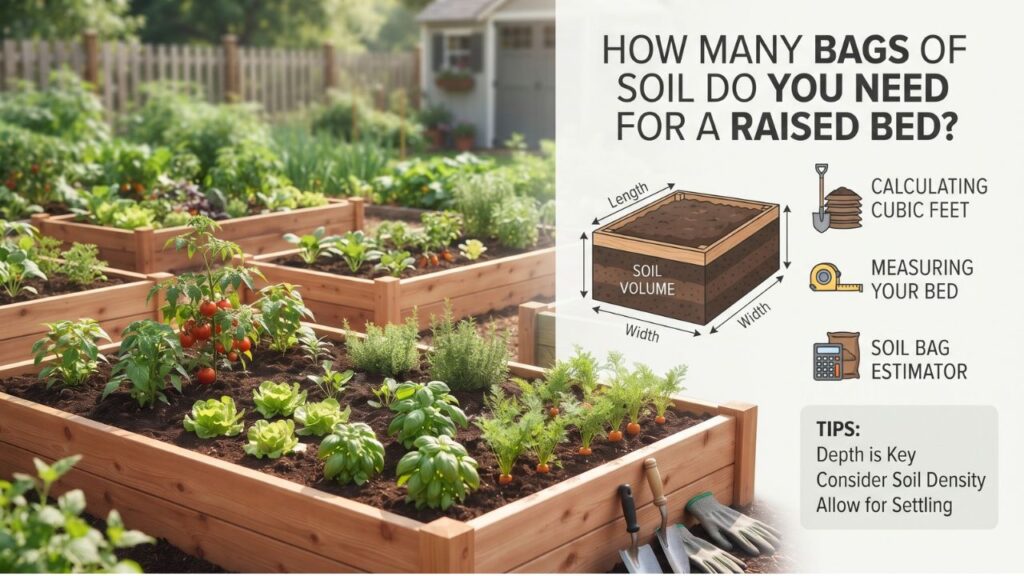
Once you know the total soil volume, you can choose the bag sizes that best fit your budget and transportation options.
The calculator reports the soil quantity in liters and cubic units, allowing you to compare products sold in different package sizes.
To calculate the number of bags:
Number of Bags = Total Required Soil Volume ÷ Volume per Bag
Round up to the next whole bag when necessary.
Example: Small Raised Bed Requiring 20 Liters
| Soil Bag Size | Number of Bags |
|---|---|
| 5 L | 4 |
| 10 L | 2 |
| 20 L | 1 |
This is particularly useful for small beds and planters.
Example: 4 × 8 Raised Bed With 12 Inches of Soil
A 4 × 8-foot bed filled 12 inches deep requires approximately 32 cubic feet of growing medium.
If you’re buying a premixed raised bed soil product in 2-cubic-foot bags:
32 ÷ 2 = 16 bags
You would need 16 bags of 2-cubic-foot soil mix, assuming the advertised bag volumes are accurate and the entire volume is filled with that material.
If you are making your own mixture, calculate the required topsoil and compost quantities separately.
Should You Buy Bagged Soil or Bulk Raised Bed Soil?
Bagged soil may be convenient for smaller projects, locations with limited access, or gardeners who want specific products.
Bulk soil is often more economical for large raised beds.
Local landscape suppliers commonly sell bulk growing media by the cubic yard.
Before ordering, check whether the product already contains compost or other amendments.
If you buy a premixed raised bed soil, don’t automatically add the calculator’s suggested compost quantity on top of it.
That could result in an unnecessarily high compost concentration.
Also consider delivery costs, minimum order quantities, unloading access, and the amount of soil you can comfortably handle.
How to Fill a Raised Garden Bed Properly
After estimating your soil requirements, the next step is filling the raised bed correctly.
Good preparation helps prevent drainage problems, uneven settling, and poor growing conditions.
1. Choose a Suitable Raised Bed Location
Position your raised bed where the intended plants will receive appropriate sunlight.
Most fruiting vegetables require substantial direct sunlight, while some leafy vegetables tolerate partial shade.
Choose a level area whenever possible.
Consider access to water, walking paths, and the ability to reach the center of the bed without stepping on the growing soil.
2. Prepare the Ground Beneath the Raised Bed
For a bottomless bed installed on natural ground, remove unwanted vegetation and assess the existing soil.
If the ground is compacted, gently loosen it with a garden fork where appropriate.
Avoid unnecessarily disturbing healthy soil.
If the site has a history of contamination or you’re uncertain about soil safety, test it before growing edible crops.
For raised beds over pavement, ensure that water has a suitable route to drain away.
3. Select Quality Raised Bed Soil Ingredients
Choose reliable suppliers for topsoil, finished compost, and any optional amendments.
Good raised bed soil should balance:
- Moisture retention
- Drainage
- Soil aeration
- Root support
- Organic matter
- Nutrient availability
Avoid unknown fill dirt, construction debris, contaminated soil, or poorly decomposed organic materials.
If you’re buying premixed raised bed soil, check the product’s listed ingredients.
4. Mix Your Raised Bed Soil Materials
If you’re preparing your own soil blend, measure the ingredients by volume.
For a 70/30 mix, use approximately seven equal-volume portions of topsoil for every three portions of finished compost.
Blend the materials as evenly as practical.
Avoid creating thick, sharply separated layers of different soil textures.
An even growing medium generally supports more consistent root development and moisture movement.
5. Fill the Raised Bed to the Planned Depth
Add the growing medium gradually.
Spread it into the corners and level the surface.
Avoid aggressively compressing the soil.
Light settling is normal, but excessive compaction reduces pore space that roots need for air and water movement.
Leave appropriate space below the rim if you plan to apply mulch.
6. Water the Raised Bed and Check for Settling
After filling, water the growing medium to help it settle naturally.
Check whether the soil level drops significantly.
If needed, add more of the same soil mix to reach your intended planting level.
Organic materials can continue decomposing, so some settling over time is expected.
7. Add Mulch and Begin Planting
Depending on your crops, climate, and growing season, a suitable organic mulch may help reduce evaporation, moderate soil temperature, and suppress weeds.
Keep mulch away from vulnerable plant stems and crowns.
Remember that mulch isn’t necessarily part of the calculated soil volume if you’re reserving a separate surface layer for it.
Once the raised bed is ready, plant according to the spacing and depth recommendations for your selected crops.
Important Things to Consider Before Buying Raised Bed Soil
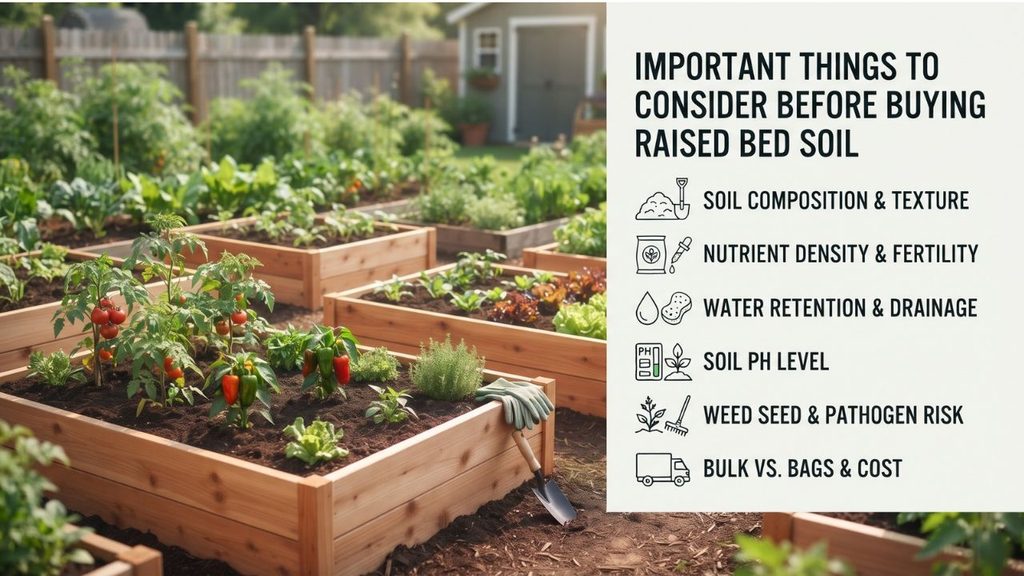
Accurate measurements are essential, but soil quantity isn’t the only factor worth considering.
Raised Bed Soil Settling
Freshly added soil and compost can settle after watering, and organic materials gradually decompose.
The amount of settling varies with the growing medium.
The Oregon State University Extension guide, How to Use Compost in Gardens and Landscapes, explains that newly filled raised beds can sink over time as compost continues decomposing. It recommends replenishing the soil mix as necessary.
For a new raised bed, you may choose to purchase a modest amount of extra soil if you expect significant settling or handling losses.
The calculator reports the measured fill volume rather than automatically adding an allowance.
Raised Bed Drainage
Poor drainage can damage roots even when the soil volume is correct.
Bottomless raised beds generally benefit from contact with well-draining ground.
For contained planters, drainage holes or another effective drainage system are essential.
Adding a layer of gravel to the bottom of a planter is not a substitute for proper drainage holes and an appropriate growing medium.
Raised Bed Soil Quality
Two soils with identical volumes may perform differently.
One might contain excessive clay, while another may be too sandy or poorly balanced.
Consider texture, organic matter, pH, nutrient levels, and potential contaminants.
A laboratory soil test can help identify appropriate amendments before planting.
Raised Bed Soil Mix Weight
Wet soil can be extremely heavy, especially when the mixture contains significant amounts of mineral topsoil.
This matters for elevated planters, decks, balconies, and structures with limited load capacity.
A volume calculator cannot determine the structural load without reliable information about the growing medium’s weight and water content.
For a raised bed on a deck or balcony, verify the structure’s load capacity before filling it.
Raised Bed Soil Fillers
Some gardeners use wood, branches, or other materials at the bottom of tall raised beds to reduce the amount of purchased soil.
These materials occupy volume that would otherwise be filled with growing medium.
However, buried organic fillers can decompose, settle unevenly, and temporarily influence nutrient availability.
For shallow raised beds, prioritizing sufficient high-quality root-zone soil is generally more useful than attempting to save a small amount of growing medium.
If you intentionally use a substantial filler layer, calculate only the remaining space that will actually contain soil.
Raised Bed Soil and Mulch Are Different
Soil mix provides the main rooting environment.
Mulch generally covers the surface to manage moisture, weeds, and temperature.
If your raised bed has a 12-inch interior height and you want 2 inches reserved for mulch and headspace, calculate the soil using the actual intended soil depth rather than automatically entering 12 inches.
Common Raised Bed Soil Calculation Mistakes to Avoid
Even a reliable raised bed soil calculator depends on accurate inputs.
Here are common mistakes that can produce misleading estimates.
Using Exterior Raised Bed Dimensions
The frame occupies some space.
Measure the interior growing area instead of relying solely on exterior measurements.
This is particularly important for thick wooden raised bed frames.
Entering the Wrong Soil Depth
A 12-inch fill depth and a 6-inch fill depth produce very different soil volume estimates.
Double-check whether you’re entering the total wall height or the actual soil depth.
Mixing Feet and Inches
If length and width are entered in feet, enter soil depth in the unit shown by the calculator.
Don’t enter 12 feet when you mean 12 inches.
The calculator handles the required unit conversions when measurements are entered correctly.
Selecting the Wrong Raised Bed Shape
A round bed and a square bed with the same overall width don’t have the same growing area.
Choose the correct shape before calculating.
For hexagonal and octagonal beds, make sure you’re using the exact measurement requested by the calculator rather than assuming that every width measurement refers to the same dimension.
Ignoring Raised Bed Openings
For L-shaped and U-shaped beds, the empty center or corner isn’t filled with soil.
Using a full rectangle for these layouts would overestimate the required volume.
Buying Ingredients Without Checking Premixed Soil Labels
A commercial raised bed soil blend may already contain compost.
Adding more compost without checking its ingredients can change the intended balance.
Use the calculator’s ingredient breakdown when you plan to buy and mix those components separately.
Confusing Raised Bed Soil Liters With Kilograms
A liter of soil doesn’t always weigh one kilogram.
Different products have different bulk densities.
Use volume to compare soil bags unless your supplier provides reliable weight-to-volume information for the specific product.
How to Maintain Healthy Soil in Raised Garden Beds
The soil in a raised bed changes throughout the growing season and from year to year.
Maintaining it helps support plant growth without repeatedly replacing the entire soil volume.
Check Raised Bed Soil Moisture
Raised beds may dry out faster than surrounding ground-level gardens.
Check moisture below the surface instead of watering according to a fixed schedule alone.
Weather, plant growth, mulch, and the soil mixture all influence watering needs.
Replenish Organic Matter in Raised Beds
Over time, organic matter decomposes.
You may need to replenish it using appropriate amounts of finished compost.
Avoid assuming every bed needs a large quantity of compost each year.
For an established raised bed, soil testing and crop performance can help guide your decisions.
Prevent Raised Bed Soil Compaction
Avoid walking or standing on the soil inside your raised bed.
Maintain access paths so you can plant, weed, and harvest without compacting the root zone.
Test Raised Bed Soil Periodically
A soil test can provide information about pH, nutrients, and amendment requirements.
This is especially useful for vegetable gardens that receive compost or fertilizer repeatedly.
Top Up Raised Bed Soil When Necessary
If the soil level drops after a growing season, measure how much additional depth is needed.
Use the calculator again to estimate the refill quantity.
For example, an existing rectangular bed measuring 4 feet by 8 feet that needs 2 additional inches of soil requires approximately 5.33 cubic feet, or 151 liters, of material to restore that layer.
You don’t need to calculate the entire bed volume again when you’re only adding a measured top-up layer.
Raised Bed Soil Calculator FAQs
How much soil do I need for a 4 × 8 raised bed?
A 4 × 8-foot raised bed filled 12 inches deep requires 32 cubic feet of soil, equivalent to approximately 906 liters or 1.19 cubic yards.
If you fill it to a different depth, the required volume changes proportionally.
How many bags of soil do I need for a 4 × 8 raised bed?
For a 4 × 8-foot bed filled 12 inches deep, you need approximately 16 bags if each bag contains 2 cubic feet of premixed soil.
Different bag sizes or fill depths will change the quantity required.
How much soil does a 4 × 4 raised garden bed need?
A 4 × 4-foot raised bed filled to a depth of 12 inches requires approximately 16 cubic feet, or 453 liters, of soil mix.
At 6 inches deep, the requirement decreases to approximately 8 cubic feet, or 227 liters.
What is a good raised bed soil mix ratio?
A combination of 70% quality topsoil and 30% finished compost is a useful starting point for many ground-connected raised garden beds.
The ideal mixture depends on your soil quality, growing conditions, plants, and drainage.
Can I fill a raised bed with only compost?
Filling a raised garden bed entirely with compost is generally not recommended.
Compost is an amendment, not a universal replacement for a balanced growing medium.
Excessive compost can contribute to moisture-management or nutrient-balance problems.
Can I use regular garden soil in a raised bed?
You can use suitable garden soil, but its quality matters.
Heavy clay, compacted soil, and contaminated material may cause problems.
Clean, well-structured mineral soil combined with appropriate organic matter is often more suitable than poor-quality garden soil used alone.
Do raised beds need perlite or pumice?
Not necessarily.
Perlite and pumice are primarily used to improve aeration and physical properties in certain growing media, particularly container mixes.
A well-balanced raised bed soil may not need either material.
For elevated planters, check the ingredients of your commercial potting mix before adding more.
Does a raised garden bed need drainage holes?
A bottomless raised bed positioned on well-draining ground generally doesn’t need manufactured drainage holes because water can move into the underlying soil.
A raised bed or elevated planter with a solid bottom needs an appropriate way to release excess water.
Should I fill my raised bed completely to the top?
Not necessarily.
Leaving a small amount of space below the rim can help accommodate watering and a mulch layer.
Calculate the volume using the intended soil fill depth rather than automatically using the full frame height.
Can I use this calculator for an elevated planter?
Yes.
Choose the Pot or Elevated Planter option.
Enter the requested dimensions and select the appropriate growing medium percentages.
For containers, prioritize a well-draining potting mix and adequate drainage.
How do I calculate soil for several raised beds?
Calculate each raised bed separately, especially when the sizes or shapes differ.
You can then add the resulting soil volumes together for a combined purchase.
If you’re using different soil mixes for different beds, keep the ingredient estimates separate.
Why is my raised bed soil estimate different from the amount I actually used?
Differences may result from inaccurate measurements, uneven bed dimensions, settling, internal obstructions, material compaction, or variations in packaged soil volume.
The calculator estimates the geometric soil volume based on the measurements entered.
It cannot account for every physical difference in a real garden bed.
How much extra soil should I buy for a raised bed?
There isn’t one correct extra allowance for every raised bed.
Freshly filled soil may settle, and some material can be lost during handling.
If you expect settling or want a small reserve for topping up, consider purchasing an additional amount appropriate for your project.
Avoid adding an arbitrary allowance when you’re working with an expensive or precisely measured growing medium.
Final Thoughts on Calculating Raised Bed Soil
Knowing how much soil your raised bed needs makes garden planning easier and helps prevent unnecessary purchases.
Start by measuring the interior dimensions of your raised garden bed and deciding how deep you want the growing soil to be.
Use the Raised Bed Soil Calculator above to estimate the total volume in liters, cubic feet, and cubic yards.
Then review the suggested soil mix or customize the ingredient percentages to suit your growing conditions.
Remember that accurate volume calculations are only one part of preparing a productive raised bed. Soil quality, drainage, root space, compost maturity, and ongoing maintenance are equally important.
With the right measurements and a suitable growing medium, you can fill your raised bed more confidently and create a healthy environment for your vegetables, herbs, or flowers.