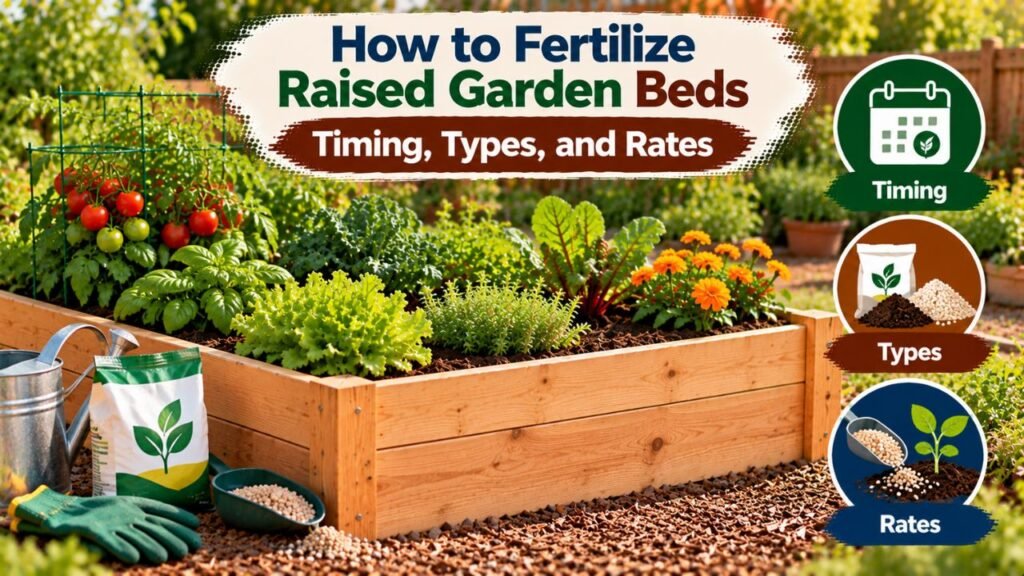
How to Fertilize Raised Garden Beds: Timing, Types, and Rates
To fertilize raised garden beds, test the soil, choose a fertilizer that supplies the nutrients your plants actually need, apply it at the recommended rate, and water it into the root zone. Some raised beds already contain enough nutrients from compost and fertile topsoil, so adding more fertilizer isn’t always necessary.
Raised beds can grow vegetables intensively in a limited area, making careful nutrient management important. Leafy greens, tomatoes, beans, and flowers don’t use nutrients in exactly the same amounts. Overfeeding can burn roots, produce excessive leafy growth, or allow nutrients to wash away.
Commercial raised bed mixes also vary widely. Some contain starter fertilizer, while others rely on compost or contain few readily available nutrients. A dark, rich-looking mixture doesn’t automatically need another application of balanced plant food.
In this article, I explain how to prepare and test raised bed soil, interpret fertilizer labels, calculate an appropriate dose, feed established plants, and adjust fertilizing schedules for different crops. I also cover compost, organic and synthetic fertilizers, and common mistakes that can damage plants or waste nutrients.
How to Fertilize Raised Garden Beds Step by Step
The best fertilizing method depends on whether you’re preparing a new raised bed or feeding plants that are already growing.
For most established vegetable beds, start with a soil test and apply nutrients only when they are needed.
Step 1: Test the Raised Bed Soil
Before purchasing fertilizer, determine which nutrients are already available.
A laboratory soil test can measure important soil properties, including:
- Soil pH.
- Phosphorus availability.
- Potassium availability.
- Calcium and magnesium, where included.
- Organic matter content, depending on the test.
- Other nutrients requested or included in the analysis.
Nitrogen is often handled differently because its available forms change rapidly in garden soil. Many routine soil tests provide nitrogen recommendations based on the crop and soil conditions rather than a direct measurement of all plant-available nitrogen.
Collect representative soil samples from several locations within the raised bed, following the testing laboratory’s instructions.
Avoid sampling directly from a recent fertilizer application or compost pile.
Combine the samples when the laboratory recommends a composite sample, and submit the required quantity.
The results help determine whether the bed needs additional fertilizer, lime, sulfur, or no amendment at all.
According to the University of Maryland Extension’s vegetable fertilizing guidance, fertilizer applications should reflect soil test results and plant needs. It also explains that different vegetable crops have different nutrient requirements.
Key Takeaway: Don’t choose a fertilizer solely because the raised bed looks dry, pale, or unproductive. Identify the actual nutrient needs first.
Step 2: Identify What You’re Growing
Different plants use different quantities of nutrients.
Leafy vegetables generally require enough nitrogen to support rapid leaf growth.
Tomatoes, peppers, and other fruiting vegetables need nutrients throughout establishment, flowering, and fruit development.
Beans and peas can obtain much of their nitrogen through relationships with nitrogen-fixing bacteria when suitable conditions exist.
Perennial flowers and herbs may need less fertilizer than heavily harvested vegetable crops.
Group plants with similar nutrient requirements where practical.
A raised bed filled with lettuce may need a different fertilizing approach than one containing mature tomato plants.
Step 3: Choose the Right Fertilizer
Select a product that matches the soil test and intended crops.
Common options include:
- Balanced granular fertilizer.
- Nitrogen-focused fertilizer.
- Slow-release fertilizer.
- Water-soluble fertilizer.
- Organic fertilizer blends.
- Finished compost.
If the soil already contains adequate phosphorus and potassium, adding more of those nutrients may be unnecessary.
In that situation, a nitrogen-only or nitrogen-focused product may be more appropriate.
If a soil test isn’t available, a complete vegetable fertilizer used according to its label can be a reasonable starting option. However, recently filled beds containing substantial compost may not need immediate feeding.
Step 4: Measure the Raised Bed’s Growing Area
Fertilizer directions often specify application quantities per 100 or 1,000 square feet.
Calculate the planting surface area before measuring fertilizer.
For a rectangular raised bed:
Area (square feet) = Length × Width
For example, a raised bed measuring 4 feet by 8 feet has:
4 × 8 = 32 square feet
Use the inside planting area rather than the outside dimensions of the frame.
If the bed has curved or irregular sides, divide it into manageable shapes and estimate the total growing area.
Step 5: Calculate the Correct Fertilizer Amount
Always begin with the application rate on the fertilizer label or the rate recommended by the soil-testing laboratory.
Use this formula when the label gives a rate per 100 square feet:
Fertilizer needed = Recommended amount × (Bed area ÷ 100)
For example, suppose a product label recommends 2 pounds of fertilizer per 100 square feet.
For a 4-by-8-foot raised bed:
2 × (32 ÷ 100) = 0.64 pounds
That equals approximately 10.2 ounces of fertilizer by weight.
This is a calculation example, not a recommendation to apply 2 pounds per 100 square feet to every raised bed.
The actual application amount depends on the fertilizer’s nutrient analysis, the crop, previous fertilization, and soil conditions.
Use a suitable scale when accurate measuring is required.
Don’t confuse fluid ounces, measuring-cup volume, and fertilizer weight.
Step 6: Apply Fertilizer Evenly
For an empty raised bed, distribute the measured fertilizer evenly across the intended planting area.
Gently incorporate granular fertilizer into the upper soil layer according to the product instructions.
For many conventional dry vegetable fertilizers, mixing into the top 2–4 inches of soil helps bring nutrients near the developing root zone.
Avoid disturbing the soil more deeply than necessary.
If the bed already contains established plants, use a suitable side-dressing method instead of digging through their root systems.
Step 7: Water After Fertilizing
Watering helps dissolve nutrients from soluble and granular fertilizers so they can move toward plant roots.
Apply water gently and evenly.
Avoid creating runoff or flooding the bed.
If fertilizer granules land on leaves, remove them according to the product instructions to help prevent damage.
Don’t fertilize severely drought-stressed plants until their water needs have been addressed.
After applying fertilizer, observe plant growth and soil moisture rather than automatically repeating the treatment.
What Is the Best Fertilizer for Raised Garden Beds?
There is no single fertilizer that works best for every raised bed.
The correct product depends on existing nutrients, plant requirements, soil composition, and the intended application method.
Balanced NPK Fertilizer
Balanced fertilizers provide nitrogen, phosphorus, and potassium in similar proportions.
Examples include:
- 5-5-5.
- 10-10-10.
- 4-4-4.
These numbers represent the fertilizer’s guaranteed nutrient analysis by weight.
A balanced product may be useful when the soil needs all three primary nutrients.
However, it isn’t automatically appropriate for a raised bed containing compost-rich soil.
If phosphorus and potassium levels are already high, repeatedly applying a balanced fertilizer can increase unnecessary nutrient accumulation.
Nitrogen-Focused Fertilizer
Nitrogen supports chlorophyll production and leafy plant growth.
A nitrogen-focused fertilizer may be appropriate when a soil test or crop-specific recommendation indicates a need for nitrogen but not additional phosphorus or potassium.
Possible sources include certain organic meals and mineral nitrogen fertilizers.
Their nutrient release rates differ.
Some products provide readily available nitrogen, while others rely on soil microorganisms to release nutrients over time.
Follow the selected product’s instructions and crop-specific recommendations.
Slow-Release Granular Fertilizer
Slow-release fertilizers supply nutrients gradually rather than delivering the entire available quantity immediately.
Some products use controlled-release coatings.
Others contain organic ingredients that release nutrients as they decompose.
These fertilizers can reduce the need for frequent applications when their release pattern matches plant requirements.
However, nutrient release varies with the product, temperature, moisture, and soil conditions.
Check whether the fertilizer is intended for a single application or repeated feeding.
Water-Soluble Fertilizer
Water-soluble fertilizer is mixed with water and applied according to the product label.
It can be useful for:
- Recently transplanted vegetables.
- Plants requiring a prompt nutrient supplement.
- Container-style elevated raised beds.
- Situations where measured liquid feeding is convenient.
Soluble fertilizers can supply nutrients quickly, but excessive concentrations may injure roots.
They may also require more frequent applications than some slow-release products.
Don’t assume liquid fertilizer is always better than granular fertilizer.
Organic vs. Synthetic Fertilizer for Raised Beds
Both organic and synthetic fertilizers can supply nutrients that plants absorb.
Their main differences involve nutrient concentration, release behavior, and the materials from which they are produced.
| Feature | Organic fertilizer | Synthetic fertilizer |
| Common sources | Plant meals, animal byproducts, and other organic materials | Manufactured or mined mineral nutrient sources |
| Nutrient concentration | Often lower | Often higher |
| Nutrient release | Frequently gradual and biologically influenced | May be rapid or controlled-release |
| Application quantity | May require larger product amounts | Often requires smaller amounts |
| Nutrient precision | Varies by formulation | Usually clearly specified |
| Risk of overapplication | Still possible | Still possible |
| Soil organic matter contribution | Some products add organic material | Usually limited |
When Organic Fertilizer Makes Sense
Organic fertilizers can be useful for gardeners who prefer plant-based or animal-derived nutrient sources.
They are commonly available as granular blends, meals, and liquid products.
However, organic doesn’t automatically mean safer for roots.
Concentrated organic fertilizers and manure-based products can contain enough salts or nutrients to damage plants when overapplied.
Their nutrient release may also be slower in cold soil.
When Synthetic Fertilizer Makes Sense
Synthetic fertilizers are useful when a specific nutrient amount is needed and the product’s guaranteed analysis matches the recommendation.
For example, a nitrogen fertilizer may help correct a documented shortage without adding unnecessary phosphorus.
The fertilizer should be measured carefully.
Applying a higher concentration doesn’t necessarily produce faster or healthier plant growth.
Key Takeaway: Choose fertilizer based on what the plants need, not solely on whether the package says organic or synthetic.
How to Fertilize Raised Beds With Compost
Finished compost is an important soil amendment, but it isn’t identical to a concentrated fertilizer.
It contributes organic matter, supports soil organisms, and can provide nutrients as it breaks down.
Its nutrient content depends on the ingredients and composting process.
How Much Compost Should You Add?
For an established vegetable bed, a modest annual compost application may help maintain soil organic matter.
According to Oregon State University Extension’s guide to using compost, approximately ¼–1 inch of compost annually is a general recommendation for existing vegetable garden beds.
However, that amount isn’t automatically needed when the raised bed already contains substantial compost.
Excessive compost applications can contribute unwanted salts or phosphorus.
Use soil test results and the growing medium’s existing composition to decide whether compost is necessary.
How to Apply Compost to an Established Raised Bed
For an empty or recently harvested raised bed:
- Remove weeds and spent plant material.
- Inspect the soil for compaction and drainage problems.
- Spread the appropriate amount of finished compost.
- Gently incorporate it when needed.
- Avoid excessively turning or pulverizing the soil.
- Water lightly to settle the surface.
- Plant the next crop or apply a suitable protective mulch.
If established vegetables are growing, apply compost around the plants without disturbing their roots.
Keep it away from direct contact with stems and crowns.
Soil organisms can gradually incorporate organic material into the upper soil layers.
Can Compost Replace Fertilizer?
Sometimes, but not always.
A well-maintained raised bed with suitable nutrient levels and adequate organic matter may support productive crops without additional commercial fertilizer.
However, compost doesn’t necessarily release enough nitrogen at the time fast-growing vegetables need it.
Its nutrient concentrations may also be unpredictable.
For that reason, compost is best treated as a soil amendment with some fertilizer value rather than a guaranteed replacement for every crop’s nutrient requirements.
Should You Use Manure in Raised Garden Beds?
Properly composted manure can contribute organic matter and nutrients.
However, manure-based compost may contain relatively high concentrations of phosphorus and soluble salts.
Raw or incompletely composted manure can also introduce food-safety concerns when used around edible crops.
Use properly processed materials from reliable sources.
For vegetable beds, follow relevant food-safety guidance concerning manure use and harvest intervals.
Avoid adding manure automatically to beds with high phosphorus levels.
When Should You Fertilize Raised Garden Beds?
The best timing depends on crop growth, existing soil fertility, fertilizer type, and weather.
Raised beds don’t all need fertilizer on the same schedule.
Before Planting in Spring
Before planting, test or assess the soil and identify the intended crops.
If fertilizer is needed, incorporate the recommended amount into the growing area before sowing or transplanting.
Avoid applying nutrients far in advance of plant demand, especially soluble nitrogen fertilizers.
Watering and rainfall can move certain nutrients beyond the root zone before plants use them.
If the bed already contains a nutrient-rich growing mix, additional fertilizer may be unnecessary.
After Transplanting
New transplants need appropriate moisture and healthy root development.
A diluted water-soluble fertilizer may be suitable when recommended for the crop and growing medium.
However, don’t automatically feed every transplant immediately.
Some seedlings have already received fertilizer in their nursery growing mix, while others are planted into fertile compost-amended soil.
Use the product’s label and the plant’s condition to guide the decision.
During Active Vegetable Growth
Some crops benefit from additional nutrients after they become established.
This is especially relevant for longer-season vegetables and crops with substantial nutrient demands.
Additional feeding is commonly called side-dressing.
The timing depends on the crop and its development stage.
Avoid applying fertilizer simply because several weeks have passed.
During Flowering and Fruiting
Fruiting vegetables continue using nutrients as they flower and produce crops.
However, adding excessive nitrogen at this stage can encourage leafy growth at the expense of reproductive development in some plants.
Use fertilizer based on crop recommendations and soil conditions.
Don’t assume every flowering plant needs a high-phosphorus fertilizer.
If the soil already contains adequate phosphorus, adding more generally won’t improve flowering.
After Harvesting
Once the crop is removed, assess the soil before planting again.
A new crop may have different nutrient requirements.
For example, following a heavy-feeding crop with a less demanding one may change the amount of fertilizer required.
Remove spent plant material and return suitable organic matter when needed.
Don’t automatically fertilize an empty bed at the end of the growing season.
Nutrients applied too early may be lost before the next crop can use them.
How Often Should You Fertilize Raised Garden Beds?
There is no universal interval that applies to every raised bed.
Application frequency depends on nutrient availability, plant type, fertilizer formulation, and the growing environment.
| Planting situation | Fertilizing approach |
| New bed containing nutrient-rich compost | Test or assess before adding fertilizer |
| Established leafy vegetables | Monitor nitrogen needs during active growth |
| Tomatoes and peppers | Follow crop-specific feeding recommendations |
| Beans and peas | Avoid unnecessary nitrogen applications |
| Long-season vegetable crops | Supplemental feeding may be needed |
| Perennial flowers | Fertilize only when soil and plant needs justify it |
| Elevated container-style beds | Monitor nutrients lost through watering |
| Bed after harvest | Reassess before the next planting |
Fertilizing Fast-Growing Vegetables
Leafy greens and other rapidly growing vegetables may need readily available nutrients throughout their short growing periods.
However, their requirements differ.
A short-season lettuce crop doesn’t necessarily need the same total fertilizer as a long-season tomato plant.
Apply the recommended amount for the particular crop.
Avoid adding concentrated fertilizer immediately beside seeds or tender roots.
Fertilizing Long-Season Vegetables
Tomatoes, peppers, eggplants, and other long-season crops remain in the bed for extended periods.
They may need additional feeding when existing nutrients become insufficient.
A slow-release product may provide nutrients over part of the season.
Alternatively, an appropriately measured side-dressing may be useful.
Base the timing on growth stage, soil conditions, and the fertilizer’s instructions.
Fertilizing Flower Beds and Herbs
Flower beds don’t automatically need frequent feeding.
Some flowering annuals benefit from regular nutrient availability, while many established perennials require relatively little supplemental fertilizer.
Excess fertilizer can also produce unwanted leafy growth in certain herbs.
Match the feeding plan to the species rather than using one vegetable fertilizer schedule for everything.
How to Side-Dress Fertilizer in Raised Garden Beds
Side-dressing means applying fertilizer beside established plants rather than distributing it through the entire bed before planting.
This method can provide supplemental nutrients during active growth.
Applying Granular Fertilizer Around Plants
Follow this procedure:
- Check the fertilizer label and crop-specific application rate.
- Measure the required amount.
- Move mulch away from the intended application area.
- Spread fertilizer along the row or around the plants at the recommended distance from stems.
- Gently work it into the soil surface when appropriate.
- Avoid disturbing shallow roots.
- Water the area according to the product instructions.
- Replace the mulch.
Avoid placing fertilizer directly against the plant stems.
Concentrated granules can injure plant tissues.
When a crop has extensive shallow roots, use an application method that doesn’t require deep cultivation.
Applying Liquid Fertilizer
For liquid feeding, mix the concentrate with water at the stated dilution rate.
Apply it to the intended root zone.
Avoid exceeding the maximum recommended concentration or frequency.
Some products are intended for soil application, while others are also labeled for foliar feeding.
Use the method specified on the label.
Don’t spray concentrated fertilizer onto leaves during intense heat unless the product expressly permits that application.
How Much Fertilizer Does a 4×8 Raised Bed Need?
A 4-by-8-foot raised bed has 32 square feet of planting area.
The correct fertilizer quantity depends on the product and soil recommendation, not the bed size alone.
Example Fertilizer Quantity by Label Rate
Suppose three different products provide the following hypothetical application rates.
| Label rate per 100 sq. ft. | Amount for a 4×8 bed |
| 1 lb. | 0.32 lb. (5.1 oz.) |
| 2 lbs. | 0.64 lb. (10.2 oz.) |
| 3 lbs. | 0.96 lb. (15.4 oz.) |
| 4 lbs. | 1.28 lbs. (20.5 oz.) |
These figures demonstrate how to convert application rates into amounts for a smaller bed.
They are not interchangeable fertilizer recommendations.
For example, 1 pound of 10-10-10 fertilizer contains a different quantity of nitrogen than 1 pound of 5-5-5 fertilizer.
The nutrient concentration must be considered before selecting the amount.
Understanding NPK Fertilizer Numbers
The three numbers on a fertilizer label represent:
- N — Nitrogen: Supports vegetative growth and chlorophyll production.
- P — Phosphorus: Supports energy transfer, root function, and reproductive processes.
- K — Potassium: Supports water regulation and numerous plant functions.
The label percentages are expressed by weight, with phosphorus and potassium reported in their conventional phosphate and potash equivalents.
For example, a 5-pound bag labeled 10-5-5 contains:
- 0.5 pounds of nitrogen.
- 0.25 pounds of available phosphate (P₂O₅).
- 0.25 pounds of soluble potash (K₂O).
The remaining product weight consists of other ingredients and materials.
Understanding the label helps prevent applying unnecessary nutrients.
How to Tell if Raised Garden Beds Need Fertilizer
Poor growth may result from a nutrient shortage, but other problems can create similar symptoms.
Don’t assume every yellow leaf means the bed needs fertilizer.
Pale Leaves and Slow Growth
Nitrogen deficiency commonly causes older leaves to become pale or yellow while growth slows.
However, similar symptoms can result from:
- Waterlogged soil.
- Drought stress.
- Root damage.
- Poor drainage.
- Inadequate sunlight.
- Low soil temperatures.
- Certain plant diseases.
Check the growing conditions before applying fertilizer.
A soil test and observations of the whole plant can help identify the problem.
Purple Leaves or Unusual Leaf Color
Certain nutrient deficiencies can produce unusual leaf coloration.
However, cool temperatures and plant genetics can also cause purple or reddish leaves.
For example, some seedlings develop purplish coloration when cold conditions restrict nutrient uptake.
Adding phosphorus won’t necessarily correct a problem caused by cold soil.
Investigate the growing environment before treating the symptoms.
Weak Flowering or Poor Fruit Production
Insufficient nutrients can reduce plant performance.
However, poor flowering or fruiting may also result from excessive nitrogen, heat stress, inadequate sunlight, poor pollination, or water problems.
Don’t automatically apply a bloom-booster fertilizer.
Check the plant’s overall growth and soil nutrient status first.
Signs of Too Much Fertilizer in Raised Beds
Overfertilization can be especially damaging in a limited growing area.
Concentrated nutrients can create excessive soluble salt levels around roots.
Leaf Burn and Brown Edges
Excess fertilizer salts can interfere with root water uptake.
Affected plants may develop:
- Brown leaf margins.
- Wilting despite moist soil.
- Stunted growth.
- Root injury.
- Sudden decline after fertilizing.
These symptoms aren’t unique to fertilizer damage.
If they appear shortly after applying an excessive dose, review the product quantity and irrigation conditions.
Excessive Leaf Growth
Too much nitrogen can encourage vigorous foliage development while reducing flowering or fruit production in some vegetables.
A tomato plant with abundant leaves but few flowers may have received excessive nitrogen.
However, temperature, plant maturity, and other conditions can also affect flowering.
Avoid adding more nitrogen without identifying the cause.
Excess Phosphorus and Potassium
Raised beds that receive large quantities of compost or balanced fertilizer for several years may accumulate phosphorus and potassium.
Adding more of these nutrients doesn’t automatically improve plant growth.
Excess nutrients can contribute to environmental pollution through runoff and may interfere with nutrient balance.
A soil test helps determine whether additional phosphorus or potassium is necessary.
What to Do After Overfertilizing
If too much fertilizer has been applied:
- Stop additional feeding.
- Remove visible excess granules when practical.
- Check soil moisture and drainage.
- Review the amount and type of fertilizer applied.
- Seek guidance from a local Cooperative Extension office when symptoms are severe.
- Avoid planting new crops until the soil conditions are suitable.
For a well-drained growing medium, carefully managed watering may help move some soluble salts out of the root zone.
However, excessive flushing can spread nutrients into surrounding soil or waterways and may not be suitable for every site.
Don’t attempt to correct an unknown nutrient imbalance by adding more amendments.
Common Raised Bed Fertilizing Mistakes to Avoid
Fertilizing Without Knowing the Soil Condition
Commercial raised bed soil may already contain compost or fertilizer.
Adding more nutrients immediately after filling the bed can be unnecessary.
Inspect the product information and use soil testing when appropriate.
Applying Fertilizer Directly to Seeds
Concentrated fertilizer placed directly against seeds can reduce germination or injure emerging roots.
Use the recommended preplant method and placement.
Follow any required separation distance for banded fertilizers.
Overusing Manure and Compost
Large annual additions of manure-based compost can increase phosphorus and salt concentrations.
More organic matter isn’t always beneficial.
Use compost thoughtfully and monitor soil fertility over time.
Fertilizing During Severe Drought Stress
Dry soil and concentrated fertilizer can increase the risk of root injury.
Restore suitable soil moisture before feeding stressed plants.
Avoid applying unnecessary nutrients when the plants cannot use them effectively.
Using the Same Fertilizer Schedule for Every Crop
Lettuce, beans, tomatoes, and perennial flowers have different nutrient requirements.
A single repeated feeding schedule may overfertilize some plants and underfeed others.
Adjust applications according to the crop and soil.
Ignoring Runoff and Drainage
Excess irrigation or heavy rainfall can move soluble nutrients away from the root zone.
Keep fertilizer out of garden pathways and drainage channels.
Water carefully and maintain healthy soil structure.
How to Maintain Raised Bed Soil Fertility Every Year
Maintaining fertility is easier when fertilizer applications are part of a consistent soil-management routine.
Test the Soil Periodically
Established mineral-soil raised beds can be tested every few years or sooner when major amendments, unusual growth problems, or substantial cropping changes occur.
Keep records of fertilizer and compost applications.
This helps identify trends and reduces unnecessary nutrient additions.
Add Compost According to Actual Soil Needs
Use mature compost to maintain organic matter when needed.
Avoid filling established beds with repeated thick layers of compost.
If the bed already contains abundant organic material, additional compost may provide little benefit.
Rotate Crops Where Practical
Crop rotation can help manage soil fertility and certain pest and disease problems.
For example, planting crops with different nutrient requirements in successive seasons can help organize fertilizing decisions.
However, rotating crops doesn’t eliminate the need for soil testing or appropriate nutrient management.
Keep the Soil Covered
Organic mulch helps reduce erosion and moisture loss.
It also limits the movement of soil particles during heavy rainfall.
Over time, decomposing organic materials can contribute to soil organic matter.
Avoid burying large amounts of undecomposed wood chips directly in the growing soil, where decomposition may temporarily tie up available nitrogen.
Avoid Soil Compaction
Don’t walk or kneel directly on the planting area.
Compacted soil can restrict root growth and interfere with water movement.
Maintain a loose, stable soil structure so roots can access available nutrients.
Fertilizer cannot correct structural problems caused by severely compacted or waterlogged soil.
Conclusion
Understanding how to fertilize raised garden beds begins with identifying what nutrients the soil already contains and what the plants actually need.
A laboratory soil test provides the best foundation for choosing fertilizer types and application rates. When fertilizer is necessary, measure the amount accurately, apply it in the correct location, and water appropriately.
Compost supports soil health and may supply some nutrients, but it doesn’t automatically replace every fertilizer requirement. Likewise, organic and synthetic products can both be useful when applied correctly.
For a new compost-rich raised bed, avoid adding fertilizer automatically. For established vegetable beds, monitor plant growth and provide supplemental nutrients when soil conditions and crop requirements justify them.
The goal is to maintain enough available nutrients for healthy roots, foliage, flowers, and harvests without wasting fertilizer or damaging the growing environment.
FAQs About How to Fertilize Raised Garden Beds
Should You Fertilize a New Raised Garden Bed Before Planting?
Not necessarily. A new bed containing quality topsoil, finished compost, or a commercial mix with starter nutrients may already have sufficient fertility.
Check the growing medium’s ingredients and use soil test recommendations before adding fertilizer.
Can You Use 10-10-10 Fertilizer in Raised Beds?
Yes, 10-10-10 can be used when the soil needs nitrogen, phosphorus, and potassium.
However, it isn’t appropriate for every raised bed. If phosphorus and potassium levels are already adequate or high, a nitrogen-focused fertilizer may be a better choice.
Is Compost Enough to Fertilize Raised Garden Beds?
Compost may provide enough nutrients for some established beds, especially those with fertile mineral soil and substantial organic matter.
However, heavily producing vegetable crops may require additional nitrogen or other nutrients during active growth.
How Often Should You Fertilize Tomatoes in a Raised Bed?
Tomato fertilizing frequency depends on the existing soil fertility, plant development, and fertilizer type.
Some plants need supplemental feeding during the growing season, while others perform well with nutrients already present in the bed. Follow soil test results and crop-specific recommendations rather than using a fixed weekly schedule.
Can You Fertilize Raised Beds With Coffee Grounds?
Used coffee grounds can contribute small amounts of organic material and nutrients, but they aren’t a complete or dependable fertilizer.
Avoid applying thick layers that may interfere with water movement. Composting the grounds with other suitable organic materials is generally a better approach.
Should You Fertilize Raised Beds in the Fall?
Fall fertilization is appropriate only when the soil and planned crops require it.
Avoid applying readily soluble nitrogen to empty beds long before planting, because nutrients may be lost before plants can use them. Soil testing and appropriate amendments can help prepare for the next season.
Is Liquid or Granular Fertilizer Better for Raised Beds?
Neither is universally better.
Liquid fertilizer can provide readily available nutrients, while granular products may offer convenient preplant or side-dress applications. Slow-release formulations can provide nutrients over a longer period.
Choose the product based on the plants, soil conditions, and the required nutrient application.

I’m Maya L. Greenwood, a lifelong plant lover who believes anyone can grow something beautiful with the right guidance. After years of testing soil mixes, pruning methods, irrigation tricks, and pest-safe solutions, I started EasyGardenTips.com to turn hard-won lessons into step-by-step advice. From seed starting and container gardens to composting and seasonal checklists, my goal is to make gardening simple, sustainable, and fun.