Are Bricks Safe for Raised Beds? Clay, Mortar, and Garden Use
Yes, clean, uncoated fired-clay bricks intended for outdoor construction are generally safe for raised garden beds, including those used to grow vegetables. They provide durable borders without the wood preservatives used in some treated lumber. However, reclaimed bricks with unknown histories, certain surface coatings, and poorly constructed masonry walls can introduce safety concerns.
Bricks are particularly useful for permanent vegetable and flower gardens because they resist rot, require relatively little maintenance, and can withstand regular contact with garden soil. Their weight also makes them suitable for creating solid garden borders.
The main concerns involve where the bricks came from, whether mortar or coatings can affect the surrounding soil, and whether the wall is stable enough to contain wet growing material.
New clay bricks are generally straightforward to evaluate, while salvaged bricks deserve closer inspection before being placed around edible crops.
In this article, I explain which types of bricks are suitable for raised beds, the risks associated with old bricks and mortar, how brick affects soil conditions, and the construction practices that help keep vegetable gardens safe.
Are Bricks Safe for Raised Beds Used for Vegetables?
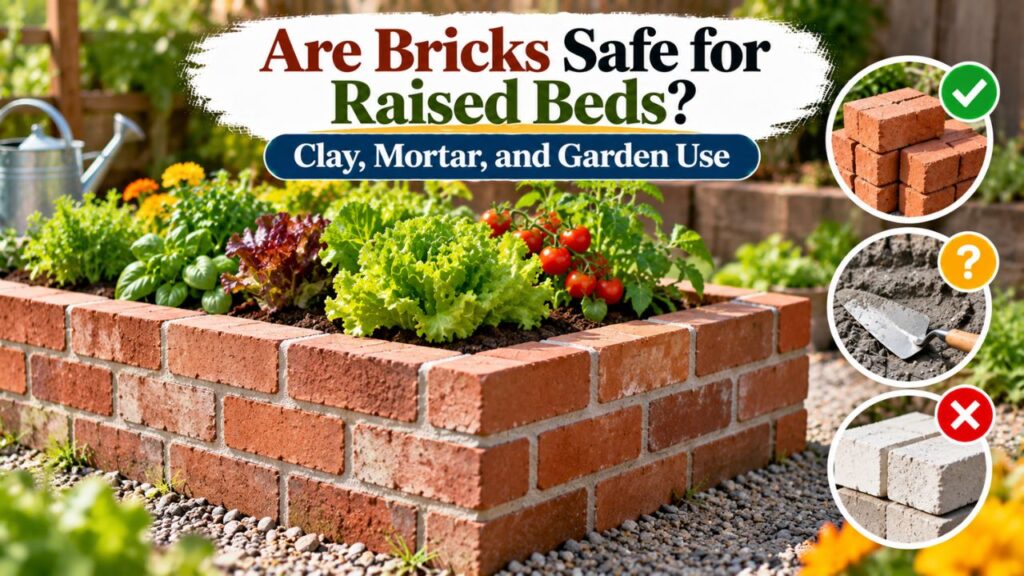
Ordinary fired-clay construction bricks are generally considered suitable for raised vegetable beds when they are clean, intact, and free from questionable coatings or chemical contamination.
Most traditional red clay bricks are manufactured by shaping and firing clay at high temperatures. This produces a hard masonry material that can be used for walls, paving, and landscaping.
Unlike some treated wooden materials, standard fired-clay bricks do not rely on added wood-preserving chemicals to resist biological decay.
The University of Maryland Extension’s guidance on safe raised bed materials specifically identifies bricks as a non-wood alternative for constructing raised garden beds.
This makes ordinary clay bricks a reasonable choice for growing:
- Tomatoes and peppers
- Lettuce and spinach
- Carrots and radishes
- Beans and peas
- Culinary herbs
- Strawberries
- Annual and perennial flowers
However, the suitability of the bricks does not automatically establish that the entire garden is safe.
The growing soil, previous land use, construction materials, drainage, and condition of the walls also matter.
For a new vegetable bed, clean bricks from a reputable masonry supplier are easier to evaluate than unidentified demolition materials.
Which Types of Bricks Are Safe for Raised Garden Beds?
Not every product described as a brick has the same composition.
Traditional fired-clay bricks, concrete pavers, reclaimed masonry, and decorative glazed bricks require different considerations.
New Fired-Clay Bricks
New, uncoated fired-clay bricks intended for outdoor construction are among the simplest choices for raised garden beds.
Their main ingredients are clay-based mineral materials, although the exact composition varies by manufacturer.
Once fired, the bricks form rigid masonry units that can withstand normal outdoor use when the correct grade is selected.
Advantages include:
- No need for wood-preserving treatments
- Resistance to fungal rot
- Long-term structural durability when installed correctly
- A natural appearance suitable for landscaping
- Compatibility with conventional masonry construction
- Availability in different colors, textures, and sizes
For a permanent vegetable garden, choose exterior-grade bricks designed for the local weather.
Bricks that are intended only for protected indoor use may not tolerate repeated freezing and thawing outdoors.
Reclaimed or Used Clay Bricks
Reclaimed bricks can be suitable for raised beds, but their previous use is important.
For example, clean bricks removed from a residential garden wall may be reasonable to reuse when their history and condition are known.
Bricks recovered from industrial buildings, contaminated sites, or unidentified demolition piles deserve greater caution.
Potential concerns include:
- Old paint residues
- Chemical spills or surface contamination
- Unknown sealers
- Industrial deposits
- Contaminated mortar or plaster
- Embedded construction debris
Cornell University’s Raised Beds guidance for urban farming warns that salvaged materials, including bricks, can introduce toxic substances into growing soil when their source and previous exposure are not evaluated.
The issue is not that every old brick is dangerous. The concern is that its previous exposure may be unknown.
If the bricks came from your own property and were previously used in an ordinary garden border, they are generally easier to assess than bricks recovered from an unfamiliar industrial site.
Concrete Bricks and Landscaping Pavers
Some bricks sold for landscaping are manufactured from concrete rather than fired clay.
Concrete products commonly contain cement, sand, aggregates, and other ingredients.
They can be used for raised garden borders when their composition and intended use are appropriate.
However, concrete-based materials may affect soil alkalinity under certain conditions.
This distinction matters because a product that resembles a traditional red brick may actually be a cement-based paving block.
Check the manufacturer’s description before purchasing.
Painted or Glazed Bricks
Decorative bricks may have paint, glaze, sealers, or other surface treatments.
These finishes are not automatically hazardous, but their compositions vary.
Some products are designed for ordinary exterior building use rather than direct contact with vegetable-growing soil.
For edible gardens, untreated fired-clay bricks are generally easier to assess.
If you want to use decorative coated bricks, confirm that the manufacturer considers the material suitable for the intended garden application.
Avoid using unidentified painted masonry, especially when the coating is peeling or deteriorating.
Industrial Firebricks and Specialty Masonry
Firebricks are designed for exposure to high temperatures and may contain different refractory materials from ordinary construction bricks.
New, appropriately specified products may be suitable for certain landscaping applications, but their heat-resistant properties offer no special advantage for ordinary raised beds.
Avoid using unidentified firebricks recovered from industrial furnaces, kilns, or other locations where they may have contacted hazardous substances.
A brick’s ability to withstand heat does not establish that it is suitable for growing food.
Are Bricks Safe From Chemical Leaching in Raised Bed Soil?
For clean, ordinary fired-clay bricks, chemical leaching is generally a less significant concern than the possibility of contamination from unknown coatings, previous uses, or surrounding soil.
However, it is misleading to claim that every brick is completely inert under all conditions.
The potential for substances to enter garden soil depends on the material’s composition, surface treatment, exposure history, and environmental conditions.
Do Red Clay Bricks Leach Harmful Chemicals?
Standard fired-clay bricks are not generally regarded as a major source of hazardous substances in ordinary vegetable garden use.
They are widely used in landscaping and raised bed construction.
However, bricks manufactured with unusual additives or exposed to industrial contaminants require individual evaluation.
Color alone cannot confirm composition.
A red brick may be a conventional fired-clay product, but its appearance does not prove that it is free from previous contamination.
For new raised beds, selecting identifiable, untreated masonry products provides greater confidence.
Can Old Bricks Contain Lead?
Old bricks are not necessarily made with lead, but contamination is possible.
For example, bricks recovered from older painted structures may carry lead-containing paint residue.
Bricks from former industrial sites may also have been exposed to substances unrelated to their original manufacture.
Lead exposure is particularly concerning in food gardens because contaminated soil and dust can contact edible crops.
If old bricks have visible paint, unknown coatings, or a questionable history, avoid using them around vegetables until their suitability can be established.
A standard home soil pH test cannot determine whether brick coatings contain lead.
Specialized material analysis or an appropriate laboratory assessment may be needed.
Should You Test Reclaimed Bricks Before Using Them?
Testing may be worthwhile when the material has an uncertain history and there is a specific contamination concern.
However, testing is not always straightforward.
Different contaminants require different analytical methods, and an ordinary garden soil test may not establish whether a brick is suitable.
Start by identifying the source.
If the bricks came from an old industrial property or contain unknown paint or chemical residues, purchasing new bricks may be simpler than attempting to investigate every possible contaminant.
For clean bricks with a known residential landscaping history, extensive testing may not be necessary.
Is Mortar Safe for Raised Garden Beds?
Ordinary masonry mortar can be used to construct raised garden beds, but its effect on soil chemistry and the strength of the finished wall should be considered.
Mortar commonly contains cement, sand, water, and sometimes lime or other ingredients.
Its main purpose is to bond masonry units together and distribute forces through the wall.
The primary gardening consideration is that cement-based materials are alkaline.
Can Brick Mortar Change Soil pH?
Yes, under some conditions.
Lime-containing and cement-based mortar can contribute alkalinity where it contacts moist soil.
The actual effect depends on the mortar composition, its age, soil properties, moisture conditions, and the amount of material exposed.
It does not mean that every mortared brick bed will develop excessively alkaline soil.
Most common vegetables grow well in slightly acidic to near-neutral soil, so small changes may not create a problem.
However, plants that require strongly acidic soil can be more sensitive to alkaline conditions.
Is Mortar a Problem for Tomatoes and Other Vegetables?
Not necessarily.
Tomatoes, peppers, lettuce, and many other common garden vegetables can grow successfully in properly constructed masonry raised beds.
The important consideration is the pH of the actual growing medium.
If plants grow poorly or nutrient deficiencies develop, a laboratory soil test can help determine whether pH is involved.
Do not automatically add sulfur or another acidifying product simply because the raised bed contains mortar.
Should You Line a Mortared Brick Raised Bed?
A sidewall liner may be useful when you want to limit direct soil contact with mortar.
It may be particularly relevant when growing acid-loving plants in a masonry bed.
For example, blueberries generally require much more acidic soil than ordinary vegetable crops.
However, lining a brick raised bed is not automatically necessary for tomatoes, beans, lettuce, or most other common vegetables.
If a liner is used:
- Choose a durable material suitable for the application.
- Install it against the inside walls.
- Avoid creating a sealed basin.
- Preserve drainage through the bottom of the bed.
- Make sure the liner does not interfere with the wall’s structural design.
A liner should not be treated as a guaranteed solution for bricks that may already contain hazardous contaminants.
When the source material is questionable, replacing it with known clean masonry is generally the more dependable choice.
Are Dry-Stacked Bricks Safe for Raised Beds?
Dry stacking means placing bricks without mortar.
This approach can work for low garden edging, but it becomes less suitable as the wall gets taller.
The safety issue is primarily structural.
A raised bed wall must resist outward pressure from the growing soil, especially when the soil becomes wet.
Single-Layer Brick Edging
A single, securely placed course of bricks can form a low garden border.
This is often suitable for:
- Small flower beds
- Shallow planting areas
- Decorative garden edges
- Borders around existing garden soil
- Low raised areas with limited soil pressure
The bricks should sit on a stable, properly prepared surface.
Uneven ground can cause movement, especially after heavy rainfall or repeated freezing and thawing.
Stacking Multiple Brick Courses Without Mortar
Stacking ordinary bricks several courses high without a designed retaining system increases the risk of movement.
Individual bricks may shift when soil pushes outward.
The wall may also become unstable if the foundation settles unevenly.
A narrow stack of ordinary building bricks should not be assumed capable of safely retaining a deep volume of wet soil.
For taller beds, use an appropriately designed mortared wall or a manufactured retaining-wall system intended for the load.
Do Brick Raised Beds Need a Foundation?
Low decorative edging may require only an appropriate prepared base.
Taller masonry walls generally need more substantial support.
Depending on the wall design and site conditions, this may include compacted foundation material, concrete footings, reinforcement, and proper drainage.
Foundation requirements depend on:
- Wall height
- Wall thickness
- Soil pressure
- Ground stability
- Frost depth
- Drainage conditions
- Local building requirements
A taller brick wall should be designed and constructed using appropriate masonry practices.
Do not assume that a wall is stable simply because the bricks are heavy.
How to Build a Safe Brick Raised Garden Bed
A properly constructed brick raised bed should have a suitable location, clean materials, stable walls, and adequate drainage.
For beginners, a low brick border is generally easier to build than a tall mortared structure.
The following steps explain the main planning and construction requirements.
Step 1: Choose a Suitable Garden Location
Select an area with enough sunlight for the intended crops.
Many fruiting vegetables grow best with approximately 6–8 hours of direct sunlight each day.
Leafy vegetables may tolerate less sunlight.
Look for ground that:
- Is reasonably level
- Drains adequately
- Has no known contamination concerns
- Allows access from the sides
- Does not collect persistent standing water
- Is away from locations where the wall could obstruct drainage
Avoid building directly against a house wall where irrigation water could accumulate near the foundation.
Step 2: Plan the Brick Bed Dimensions
Keep the growing area narrow enough to reach without stepping into the soil.
For most adults, a width of approximately 3–4 feet works well when both long sides are accessible.
For beds against fences or walls, approximately 2 feet is often more practical.
Common layouts include:
| Brick Raised Bed Size | Growing Area | Suitable Application |
| 2 × 4 feet | 8 sq. ft. | Small herbs and flowers |
| 3 × 4 feet | 12 sq. ft. | Compact vegetable garden |
| 3 × 6 feet | 18 sq. ft. | Mixed vegetable planting |
| 4 × 8 feet | 32 sq. ft. | Larger backyard vegetable bed |
The wall thickness affects the actual inside growing area.
Use inside dimensions when calculating soil requirements.
Step 3: Inspect the Bricks
Check each brick before construction.
Reject materials with:
- Unknown chemical residues
- Unidentified peeling coatings
- Severe cracks
- Extensive crumbling
- Significant structural damage
- Uncertain industrial origins
For outdoor construction, confirm that the bricks are suitable for the local climate.
In cold regions, choose masonry rated for freeze-thaw exposure.
Avoid assuming that all decorative or interior bricks are suitable for outdoor ground contact.
Step 4: Prepare a Stable Base
Remove loose debris and unwanted vegetation from the proposed wall location.
Mark the bed perimeter using stakes and string.
For low edging, prepare an even, stable base appropriate to the brick design.
For a taller mortared wall, follow a suitable foundation design.
Check the wall alignment and level before continuing.
Do not build a tall, soil-retaining brick wall on unstable ground or an improvised foundation.
Step 5: Build the Brick Walls
For a low decorative border, arrange the bricks securely according to the intended design.
For a permanent raised bed wall, use an appropriate masonry construction method.
Proper brickwork should maintain:
- Stable wall alignment
- Adequate support beneath the bricks
- Suitable bonding between courses
- Correctly prepared mortar where required
- Proper structural reinforcement when needed
- A design that resists outward soil pressure
If the bed is tall or built near a structure, a qualified mason or contractor should determine the appropriate wall construction and footing requirements.
Step 6: Maintain Proper Drainage
A brick raised bed should not trap water around plant roots.
For an open-bottom bed over suitable soil, water should be able to move downward into the ground.
Avoid installing an impermeable plastic layer across the bottom unless the bed has a separate drainage system.
When building on a paved or otherwise impermeable surface, the bed needs a designed route for excess water to escape.
Tall masonry retaining walls may also require specific drainage details to prevent water pressure from accumulating behind them.
Step 7: Fill the Bed With Suitable Growing Soil
For a traditional open-bottom raised bed, a practical starting mixture is:
- Two parts quality loamy topsoil
- One part finished plant-based compost
The mixture should provide suitable drainage, moisture retention, and nutrients.
Adjust it according to the existing soil and the plants being grown.
If the underlying soil is suitable for gardening, plant roots may extend beneath the raised bed.
For a bed with an enclosed bottom, provide enough contained growing depth for the selected crops.
Step 8: Water and Inspect the Finished Bed
Water the soil gently after filling.
Check the wall for movement, cracks, or unstable sections.
Inspect the base for erosion or water collecting along the outside.
Before planting, confirm that the structure remains stable and that excess water can drain as intended.
Do Bricks Affect Raised Bed Soil Temperature?
Bricks absorb and release heat, so they can influence temperatures near the walls of a raised bed.
However, the effect depends on sun exposure, brick color, soil moisture, bed dimensions, and local weather.
Brick Raised Beds in Hot Weather
Dark-colored masonry exposed to direct sunlight can become warm.
The soil near the wall may experience different temperatures from the soil in the center.
This does not mean brick beds are unsuitable for hot climates.
Maintaining appropriate moisture, applying mulch, and selecting a suitable location can help manage temperature fluctuations.
For heat-sensitive crops, consider exposure to intense afternoon sunlight.
Brick Raised Beds in Cold Weather
Bricks can store heat during sunny periods and release it as temperatures change.
However, a brick wall does not guarantee protection against freezing.
In colder climates, moisture absorbed into porous bricks may freeze and expand.
Repeated freezing and thawing can contribute to cracking or surface deterioration in unsuitable masonry.
Choose weather-resistant exterior bricks appropriate for the local climate.
Brick vs. Wood vs. Metal Raised Beds: Which Is Safer?
Brick, wood, and metal can all be suitable for vegetable gardening when their materials and construction are appropriate.
Their main differences involve durability, weight, maintenance, and construction requirements.
| Feature | Fired-Clay Brick | Untreated Cedar | Galvanized Steel |
| Suitable for vegetables | Generally yes | Yes | Generally yes |
| Requires wood preservatives | No | No | No |
| Resistance to wood rot | Not affected | Naturally resistant, but can decay | Not affected |
| Structural weight | Heavy | Relatively light | Relatively light |
| Easy to move | No | Often manageable | Depends on the kit |
| DIY construction | Masonry skills may be needed | Straightforward with woodworking tools | Often supplied as modular kits |
| Freeze-thaw considerations | Masonry grade matters | Weathering and moisture matter | Coating and installation matter |
| Common maintenance | Inspect joints and cracks | Inspect decay and fasteners | Inspect coating and connections |
Are Bricks Safer Than Pressure-Treated Wood?
Bricks eliminate concerns associated specifically with wood preservatives.
This can make clean fired-clay bricks appealing to gardeners who prefer untreated construction materials.
However, modern residential pressure-treated lumber differs from older arsenic-treated products, and its suitability should be evaluated according to the actual treatment.
Brick is not automatically safer in every respect.
Poorly constructed masonry introduces structural hazards that may not exist with a low, properly assembled wooden bed.
Are Bricks Better Than Concrete Blocks?
Bricks and concrete blocks can both be used to construct raised beds.
The differences include their composition, size, weight, and installation methods.
Fired-clay bricks generally require more individual units and joints to build a wall of the same dimensions.
Concrete blocks are larger and may allow faster construction.
Concrete-based products also have different soil-chemistry considerations from ordinary fired clay.
For a small decorative vegetable bed, bricks may provide a more refined appearance.
For a larger permanent structure, concrete blocks may be more practical depending on the design.
How Long Do Brick Raised Garden Beds Last?
A properly constructed brick raised bed can remain serviceable for many years.
However, there is no guaranteed lifespan that applies to every type of brick wall.
Durability depends on the brick grade, mortar, foundation, weather exposure, and construction quality.
What Causes Brick Raised Beds to Deteriorate?
Common causes include:
- Repeated freezing and thawing
- Excessive moisture exposure
- Poor wall drainage
- Foundation settlement
- Inadequate structural support
- Deteriorating mortar joints
- Movement caused by soil pressure
- Using bricks unsuitable for outdoor conditions
The wall should be inspected periodically, especially after heavy rain or winter weather.
Can Brick Walls Crack Over Time?
Yes.
Cracks may develop from ground movement, moisture-related deterioration, or excessive pressure from the soil.
Small surface imperfections are different from structural cracking.
Warning signs include:
- Bricks moving outward
- Long cracks crossing several courses
- Noticeable wall leaning
- Separated mortar joints
- Bulging sections
- Loose bricks near the top
A wall showing these symptoms should be assessed before the problem worsens.
Do not assume that adding mortar to a cracked joint will correct an underlying foundation or structural problem.
Do Brick Raised Beds Need Sealing?
Not necessarily.
Quality exterior masonry may not need a surface sealer for normal raised bed use.
Some sealers can reduce water absorption, but their suitability depends on the brick type and moisture conditions.
Incorrect products can interfere with moisture movement or create maintenance problems.
For vegetable beds, avoid applying unidentified coatings to surfaces that contact growing soil.
If a sealer is needed, use a product approved for the specific masonry and intended application.
When Should You Avoid Using Bricks for Raised Beds?
Bricks are useful for permanent gardens, but they are not appropriate for every situation.
When the Bricks Have an Unknown History
Avoid using bricks from sites with possible industrial contamination, unknown coatings, or chemical exposure.
Clean new materials are preferable when the safety of salvaged bricks cannot be established.
When the Bed Must Be Moved Frequently
Brick structures are heavy and difficult to relocate.
A modular metal bed or wooden frame is usually more practical for temporary gardens.
When Building on a Balcony or Elevated Deck
Brick walls and saturated growing soil can create substantial structural loads.
A balcony or rooftop should not be used for a heavy masonry raised bed without confirming the supporting structure’s load capacity.
Waterproofing and drainage systems must also be protected.
When the Site Has Unstable Ground
A tall brick wall placed on poorly prepared ground can settle, lean, or crack.
If the site is steeply sloped or the soil beneath the wall is unstable, use an appropriately engineered foundation and retaining design.
When the Budget Is Limited
Brick construction can require substantial material and labor.
Mortar, footing materials, drainage components, and professional masonry work can increase the total project cost.
For a simple beginner vegetable garden, a wooden frame or modular metal kit may be less expensive and easier to assemble.
Brick Raised Bed Safety Mistakes to Avoid
Even clean bricks can create problems if they are used incorrectly.
Using Painted Demolition Bricks Without Checking Their History
Unknown coatings may introduce contamination concerns.
Avoid sanding, grinding, or aggressively cleaning painted bricks before identifying the coating.
Building Tall Walls Without Proper Support
Brick walls must resist pressure from wet growing soil.
A tall, unsupported dry-stacked wall can move or collapse.
Use a structure designed for the required wall height and loading conditions.
Ignoring Drainage
A brick border does not automatically improve drainage.
Waterlogged soil can damage plant roots and increase moisture pressure around walls.
Provide an appropriate drainage path.
Using Interior Bricks Outdoors
Some decorative bricks are not intended for repeated exposure to rain or freezing temperatures.
Choose exterior-grade masonry suited to the climate.
Cutting Bricks Without Dust Protection
Cutting, grinding, or drilling brick can produce airborne crystalline silica dust.
This is a construction-related health hazard rather than a normal gardening hazard from intact bricks.
Use appropriate dust-control methods, such as a suitable wet-cutting system, along with protective equipment required for the task.
Avoid dry cutting that releases uncontrolled dust.
Assuming a Brick Bed Makes Contaminated Soil Safe
A brick wall does not prevent contaminants in the surrounding ground from entering the growing area.
If the native soil is potentially contaminated, a raised bed may need verified clean soil and an appropriately designed separation system.
The garden’s safety depends on the entire installation, not only the wall material.
Conclusion
So, are bricks safe for raised beds? Yes, clean, untreated fired-clay bricks made for outdoor construction are generally a safe and durable choice for vegetable and flower gardens.
They resist rot, do not require wood preservatives, and can create attractive permanent garden borders.
However, the source and condition of the bricks matter. Reclaimed bricks with unknown chemical exposure, peeling coatings, or industrial contamination histories should not automatically be used for growing food.
Mortared brick walls also require attention to soil pH, drainage, and structural stability. Taller beds need properly designed support rather than loosely stacked bricks.
For most homeowners planning a permanent garden, new exterior-grade fired-clay bricks are a practical choice when installed correctly.
If the budget allows and the garden layout is unlikely to change, a well-built brick raised bed can provide a long-lasting growing area without the regular replacement concerns associated with some wooden frames.
FAQs About Are Bricks Safe for Raised Beds
Are red bricks safe for vegetable gardens?
Yes, ordinary uncoated red fired-clay bricks are generally suitable for raised vegetable beds. Choose clean bricks intended for outdoor construction and avoid materials with unknown paint, chemical exposure, or industrial contamination.
Can I use old bricks for a raised garden bed?
Yes, if the bricks are structurally sound and their previous use does not raise contamination concerns. Reclaimed bricks from known residential landscaping may be reasonable to reuse. Avoid unidentified demolition bricks or materials recovered from potentially contaminated sites.
Do bricks leach harmful chemicals into garden soil?
Clean, conventional fired-clay bricks are not generally considered a major source of harmful chemical leaching in ordinary garden use. However, unusual additives, unknown coatings, and previous chemical exposure can change the risk. Cement-based mortar may also influence soil alkalinity near the wall.
Are bricks safe for growing tomatoes and other edible plants?
Yes. Properly constructed brick raised beds can support tomatoes, peppers, lettuce, carrots, herbs, and other edible crops. Use suitable growing soil, provide adequate drainage, and confirm that the bricks and any coatings are appropriate for a food garden.
Do brick raised beds need a plastic liner?
Not always. Clean fired-clay bricks generally do not require a liner for ordinary vegetable gardening. A sidewall liner may be useful when trying to limit soil contact with alkaline mortar, particularly for acid-loving plants. Never block drainage with an impermeable bottom layer.
Can I stack bricks without mortar for a raised bed?
A low, stable single-course brick border may work without mortar. However, ordinary bricks stacked several courses high can shift under soil pressure. Taller walls should use an appropriately designed masonry or retaining-wall system.
Are concrete bricks as safe as clay bricks for raised beds?
Both materials can be suitable, but their composition differs. Fired-clay bricks are made primarily from clay-based minerals, while concrete bricks contain cement and aggregates. Concrete-based products may affect soil alkalinity under some conditions, so choose identifiable products intended for outdoor landscaping.

I’m Maya L. Greenwood, a lifelong plant lover who believes anyone can grow something beautiful with the right guidance. After years of testing soil mixes, pruning methods, irrigation tricks, and pest-safe solutions, I started EasyGardenTips.com to turn hard-won lessons into step-by-step advice. From seed starting and container gardens to composting and seasonal checklists, my goal is to make gardening simple, sustainable, and fun.