Are Pallets Safe for Raised Beds? Stamps, Spills, and Safety
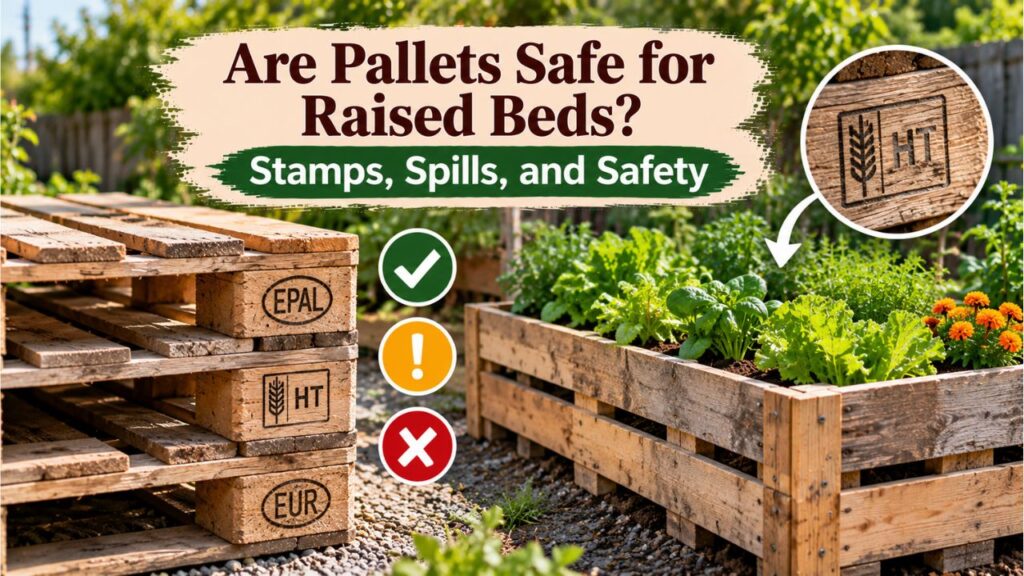
Yes, wooden pallets can be safe for raised garden beds if they are heat-treated, free from contamination, and made from structurally sound wood. However, not every pallet is suitable for growing vegetables. Pallets marked HT are generally preferable, while those marked MB, indicating methyl bromide fumigation, should be avoided.
Reusing shipping pallets is an affordable way to build raised garden beds, especially when suitable pallets are available locally. However, pallets are originally manufactured to transport goods, not to serve as gardening materials.
Some may have been exposed to chemical spills, pesticides, industrial products, or unknown substances during transportation and storage. Others contain damaged boards, protruding nails, or wood treatments that make them unsuitable for a vegetable garden.
Even an official heat-treatment stamp doesn’t guarantee that a used pallet has remained free from contamination.
Before building a garden bed, it’s important to understand the markings, inspect the wood, and consider what the pallet previously carried.
In this article, I explain which pallet stamps are acceptable, how to identify potentially unsafe wood, what risks used pallets present, and how to choose suitable materials for building vegetable and flower beds.
Are Pallets Safe for Raised Beds? What Makes One Suitable
Pallets can be appropriate for raised-bed construction when their treatment history and previous use are known.
The safest approach is to use clean, untreated or heat-treated wood from a reliable source.
However, heat treatment and contamination are two separate safety concerns.
A pallet might have been heat-treated during manufacturing but later exposed to hazardous substances while transporting goods.
Therefore, choosing a pallet based only on its treatment stamp is not enough.
Conditions That Make Pallet Wood Suitable
A wooden pallet is a better candidate for raised-bed construction when it meets these conditions:
- It has a verifiable heat-treatment marking or a reliably documented untreated history.
- Its previous cargo and storage conditions are known.
- It has not been exposed to chemical spills or hazardous materials.
- The wood is free from suspicious stains, unusual odors, and unknown coatings.
- The boards are structurally sound, without significant decay or insect damage.
- Nails, staples, and damaged sections can be removed safely.
- The pallet is obtained with permission from its owner.
Even when these conditions are satisfied, no visual inspection can guarantee that every contaminant is absent.
For vegetable gardening, traceable wood from a reliable supplier is generally preferable to discarded pallets of unknown origin.
Why Used Shipping Pallets Require Extra Caution
Shipping pallets may travel through warehouses, industrial facilities, shipping containers, and outdoor storage areas.
During their service life, they can be reused to carry different products.
Possible sources of contamination include:
- Chemical spills.
- Industrial oils and lubricants.
- Agricultural chemicals.
- Cleaning products.
- Leaking containers.
- Unknown chemical residues from earlier shipments.
Not every used pallet has been exposed to these materials.
The problem is that a gardener may have no reliable way to determine its complete history.
This uncertainty matters when the wood will remain in contact with soil used to grow edible plants.
How to Read Pallet Stamps Before Building Raised Beds
Many shipping pallets have markings that identify how their wood was treated for international transportation.
These stamps help identify pallets that were heat-treated or fumigated.
However, they are not certifications of food-growing safety.
Pallet Treatment Codes and Their Meanings
| Pallet Marking | Meaning | Raised Bed Recommendation |
| HT | Heat-treated | Preferred if the pallet is clean and its history is known |
| MB | Methyl bromide fumigation | Avoid for gardening |
| DB | Debarked wood | Not sufficient alone to establish safety |
| KD | Kiln-dried wood | Requires additional treatment and history checks |
| IPPC logo | International wood-packaging identification | Check the associated treatment code |
| No stamp | Treatment information unavailable | Avoid unless the wood’s history is verified |
The codes tell you something about the wood’s processing, but not necessarily what the pallet transported afterward.
HT: Heat-Treated Pallets
HT stands for heat-treated.
This means the pallet wood underwent a heating process designed to control pests.
According to the USDA Animal and Plant Health Inspection Service’s wood-packaging guidance, the official ISPM 15 marking identifies the country, production facility, and treatment type used for regulated wood packaging materials.
Heat treatment is a physical process rather than chemical fumigation.
For this reason, HT-marked pallets are generally the preferred type when considering reclaimed pallet wood for raised beds.
However, an HT marking only establishes the declared pest-treatment method.
It does not prove that the pallet:
- Was never exposed to hazardous cargo.
- Was never contaminated during storage.
- Contains no additional coatings.
- Has remained clean throughout its service life.
Key Takeaway: An HT stamp makes a pallet a better candidate, but known cargo history and clean wood are still necessary considerations.
MB: Methyl Bromide-Treated Pallets
MB stands for methyl bromide, a chemical fumigant used to control pests in wood packaging materials.
Pallets marked MB should not be used to construct vegetable raised beds.
Methyl bromide is a hazardous pesticide, and its use as a fumigant is fundamentally different from heat treatment.
Although an MB marking does not establish the amount of residue remaining in an old pallet, there is no practical reason to choose this material for a food-growing garden when safer alternatives are available.
Do not attempt to make an MB-marked pallet suitable by sanding, pressure washing, or applying paint.
Choose a different pallet or new lumber instead.
DB: Debarked Pallets
DB means the wood has been debarked.
This indicates that bark was removed during processing.
Debarking is not equivalent to heat treatment or chemical fumigation.
Therefore, a DB marking alone does not establish whether the wood received additional treatment.
Look for other markings and verify the pallet’s history before deciding to use it.
KD: Kiln-Dried Pallets
KD stands for kiln-dried.
Kiln drying reduces moisture in wood, helping prepare it for manufacturing or use.
However, kiln drying is not automatically equivalent to the heat-treatment requirements of international wood-packaging standards.
A KD marking by itself does not certify that a pallet was never chemically treated.
If the pallet also has an official HT marking, evaluate the heat-treatment information along with its previous use.
What if a Pallet Has No Stamp?
An unstamped pallet is not automatically chemically treated or unsafe.
Some pallets used only for domestic transportation may not require the international treatment markings.
However, without reliable documentation, you may not know how the wood was processed or what products it carried.
For vegetable raised beds, avoid unmarked pallets unless their source and treatment history can be confirmed.
A newly manufactured pallet made from documented untreated wood is different from an old discarded pallet with no identifiable history.
Can Heat-Treated Pallets Still Be Unsafe for Raised Beds?
Yes. Heat-treated pallets can still be unsuitable for gardening if they have been contaminated after manufacturing.
The HT stamp describes a pest-treatment process, not everything that happened to the pallet afterward.
Chemical Spills and Unknown Cargo
A pallet may have transported products that leaked or spilled onto the wood.
Liquid contaminants can sometimes penetrate porous wood, making them difficult to identify or remove completely.
The University of California Master Gardeners’ guidance on selecting pallets for raised beds recommends examining pallets for signs of spills, stains, and unusual odors.
The guidance also notes that some contaminants may be colorless or odorless.
For this reason, a pallet’s clean appearance should not be treated as proof of its complete safety.
Painted and Colored Pallets
Some shipping pallets are painted blue, red, or other colors.
Painted pallets may belong to commercial pallet-pooling or rental systems, and the paint itself does not tell you the complete treatment or cargo history.
Avoid using painted pallets of uncertain origin for vegetable beds.
Unknown coatings may complicate the safety assessment, and the pallets may remain the property of a rental company.
A painted pallet should not be considered safe simply because it also carries an HT stamp.
Stained or Unusually Smelly Wood
Reject pallets showing suspicious signs such as:
- Dark or oily patches of unknown origin.
- Chemical or solvent-like odors.
- Sticky residues.
- Unidentified powders or deposits.
- Unknown painted coatings.
- Evidence of chemical leakage.
Ordinary weathering and discoloration are not necessarily signs of hazardous contamination.
However, if you cannot confidently identify a suspicious substance, do not use the pallet for a vegetable garden.
Can You Wash Contaminated Pallets?
Washing may remove ordinary surface dirt, but it cannot reliably establish that contaminated wood is safe for growing food.
Sanding is also not a dependable method for removing substances that may have penetrated the wood.
Avoid using chemical cleaners or solvents in an attempt to prepare questionable pallets for garden use.
If contamination is suspected, reject the wood instead of trying to restore it.
Important: Painting or lining a pallet does not reliably make chemically contaminated wood suitable for a vegetable garden.
How to Check Whether a Pallet Is Safe for a Raised Garden Bed
Before using reclaimed pallets, inspect them systematically.
The goal is to identify treatment concerns, possible contamination, and structural problems before construction begins.
Step 1: Check the Pallet’s Source
Ask where the pallet came from and what it previously carried.
A pallet supplied directly by a business that can document its use is preferable to one found beside an unknown warehouse.
For example, a business may be able to confirm that a particular pallet was used only for clean, packaged dry goods.
That information is useful, although it is not an absolute guarantee of safety.
Avoid pallets from unknown industrial or chemical-handling environments.
Step 2: Find the Treatment Stamp
Inspect the sides, stringers, blocks, and other accessible wooden components.
Look for the official IPPC symbol and accompanying treatment code.
Confirm whether the marking identifies heat treatment or chemical fumigation.
If the stamp is damaged, illegible, or missing, do not assume the pallet is heat-treated.
A label printed on a shipping package is also not the same as an official wood-treatment stamp.
Step 3: Inspect for Possible Contamination
Examine all sides of the pallet.
Look between boards and around areas where liquids could have accumulated.
Check for unusual stains, sticky areas, unidentified powders, or suspicious odors.
Remember that the absence of visible contamination does not guarantee a clean history.
If the source cannot provide reliable information and you have concerns, choose another pallet.
Step 4: Check the Wood’s Structural Condition
Pallets are built to carry shipping loads, not necessarily to withstand constant contact with damp garden soil.
Inspect for:
- Rotting or soft wood.
- Deep cracks and major splits.
- Loose connections.
- Broken boards.
- Significant insect damage.
- Exposed nails and staples.
Avoid severely damaged pallets even if their treatment and cargo histories are acceptable.
The boards must be capable of supporting the raised bed’s intended construction.
Step 5: Confirm That the Pallet Is Available for Reuse
Do not assume that pallets stored behind stores, warehouses, or businesses are abandoned.
Some are reusable shipping equipment or property belonging to a pallet-pooling company.
Ask for permission before removing pallets.
A reliable supplier may also provide better information about their origin and treatment.
Step 6: Decide Whether the Wood Is Worth Using
After inspecting the pallet, consider whether its benefits justify the remaining uncertainty.
A clean, traceable HT pallet may be a reasonable low-cost choice.
An unmarked, badly damaged, or previously contaminated pallet is not worth using around edible plants.
For a bed intended to last many growing seasons, new untreated or appropriately selected lumber may be a better investment.
Can You Grow Vegetables in Raised Beds Made From Pallets?
Yes, vegetables can be grown in raised beds constructed from suitable pallet wood.
However, this depends on the wood being appropriately selected and the bed providing adequate soil depth, drainage, and structural support.
Are Pallet Raised Beds Safe for Edible Crops?
For vegetable gardening, use only pallet wood with a known, acceptable treatment and use history.
This applies to beds intended for:
- Tomatoes.
- Peppers.
- Lettuce.
- Spinach.
- Carrots.
- Radishes.
- Herbs.
- Other edible crops.
The type of vegetable does not eliminate the need to assess the wood.
A contaminated pallet is not made suitable simply by growing fruiting vegetables instead of root crops.
Contaminants may reach the garden through different pathways, including soil contact and contaminated particles.
Avoid questionable wood regardless of the crop.
Do You Need a Plastic Liner Inside a Pallet Raised Bed?
A liner is not automatically necessary when using suitable, clean wood.
Some gardeners use a sidewall liner to separate the growing medium from wooden boards or prevent soil from escaping through gaps.
However, a liner is not a reliable substitute for confirming that the wood is safe.
If using a liner, select a material intended for the application and maintain proper drainage.
For a traditional open-bottom raised bed, avoid sealing the entire bottom with impermeable plastic.
Water needs a suitable pathway out of the planting area.
Can You Use Whole Pallets as Raised Bed Walls?
Yes, but whole pallets require careful construction.
Their boards and internal supports were designed for shipping loads rather than continuous outward pressure from garden soil.
When using whole pallets as bed walls:
- Confirm the pallets are safe to reuse.
- Remove exposed nails and damaged sections.
- Join the sections with suitable structural connections.
- Brace the walls where necessary.
- Prevent soil from escaping through large gaps.
- Account for the weight of saturated soil.
A tall raised bed holds a substantial amount of material.
Do not rely on loose pallet sections or weak connections to support heavy soil loads.
For many small garden projects, dismantling suitable pallets and using selected boards in a reinforced frame produces a more manageable structure.
How to Build a Raised Garden Bed With Safe Pallet Wood
Once suitable wood has been selected, the next concern is building a structure that can safely hold soil.
Step 1: Prepare the Pallet Boards
Use appropriate tools to separate the boards without causing unnecessary damage.
Pallet wood may contain difficult-to-remove nails, staples, and concealed metal fasteners.
Wear work gloves and eye protection.
Use appropriate respiratory protection when cutting or sanding wood, and avoid generating dust from questionable or contaminated materials.
Never burn pallet wood to dispose of unwanted sections.
Step 2: Select Sound Boards
Set aside cracked, rotting, excessively warped, or structurally weak pieces.
Use the strongest suitable boards for the main frame.
Pallet boards can be relatively thin, so they may need additional support to withstand soil pressure.
Do not assume that every pallet provides lumber of equal thickness or strength.
Step 3: Build a Stable Frame
Arrange the boards into the intended raised-bed shape.
Connect them with suitable exterior-rated fasteners and appropriate corner supports.
For longer sides, add reinforcement where necessary to prevent bowing.
Keep sharp metal edges and protruding fasteners away from areas where people will work.
Step 4: Prepare the Ground
Place the bed on stable, well-drained ground.
Remove unwanted vegetation and assess the underlying soil.
If the bed has an open bottom, plant roots may extend into suitable native soil below.
Avoid building directly over areas where runoff collects or where soil contamination is suspected.
Step 5: Add a Suitable Growing Mix
Fill the bed with quality raised-bed growing medium appropriate for the intended plants.
For an open-bottom bed, a mixture of suitable topsoil and finished compost is often practical.
Do not fill the entire bed with uncomposted wood chips or raw organic materials and expect vegetables to grow successfully immediately.
Leave room for watering and mulch.
Step 6: Inspect the Structure Regularly
After filling, check the frame for movement or bowing.
Continue inspecting the boards throughout the growing season.
Replace deteriorating wood before the structure becomes unstable.
Pallet boards exposed to repeated wetting and drying may eventually lose strength.
How Long Does Pallet Wood Last in Raised Garden Beds?
The lifespan of pallet wood depends on its species, thickness, condition, climate, and exposure to moisture.
Untreated pallet wood may deteriorate faster than naturally decay-resistant lumber.
Why Pallet Raised Beds Can Rot
Wood in a raised garden bed is frequently exposed to moisture from:
- Irrigation.
- Rainfall.
- Damp soil.
- Mulch.
- Poor drainage.
- Humid weather.
These conditions can support fungal decay when susceptible wood remains damp.
Many pallet boards are relatively thin, which may reduce their useful service life when exposed to garden conditions.
However, there is no reliable universal lifespan for all pallet beds.
A structure made from sound hardwood boards may perform differently from one built from thin softwood boards.
Does Heat Treatment Prevent Wood Rot?
No. Heat treatment for pallet pest control is not the same as applying a long-lasting wood preservative.
HT-marked pallet wood can still absorb moisture, develop fungal decay, and deteriorate outdoors.
Heat treatment should not be treated as proof of weather resistance.
How to Make a Pallet Raised Bed Last Longer
Proper construction and moisture management can help reduce unnecessary deterioration.
Useful practices include:
- Keeping the frame stable and properly supported.
- Avoiding unnecessary standing water around the structure.
- Using suitable exterior-rated fasteners.
- Preventing soil and mulch from accumulating against exposed upper surfaces.
- Replacing damaged boards promptly.
- Avoiding constant contact between wooden components and poorly drained ground where practical.
Even with good maintenance, reclaimed pallet wood may require replacement sooner than more durable raised-bed materials.
Are Pallets Better Than New Wood for Raised Garden Beds?
Pallets can reduce material costs, but new wood generally provides greater confidence about the material’s origin and condition.
The better choice depends on the budget, available materials, and importance of long-term durability.
Pallet Wood vs. New Lumber
| Factor | Reclaimed Pallet Wood | New Suitable Lumber |
| Initial material cost | Often low or free | Usually requires purchase |
| Treatment history | May be uncertain | Easier to verify |
| Previous cargo exposure | Possible | Not applicable to new unused lumber |
| Board quality | Highly variable | More predictable |
| Preparation | Often requires dismantling | Usually easier to cut and assemble |
| Durability | Depends on wood and condition | Can be selected by species and grade |
| Vegetable garden suitability | Requires careful verification | Easier to assess before purchase |
| Maintenance | May require earlier repairs | Depends on material selection |
Reclaimed pallet wood can be useful for gardeners with access to clean, traceable materials.
However, a pallet bed is not necessarily cheaper once dismantling time, discarded boards, extra bracing, and repairs are considered.
When New Untreated Wood Is a Better Choice
New untreated lumber is often preferable when:
- You cannot verify pallet treatment history.
- You plan to grow vegetables for many years.
- You need thicker boards for a tall raised bed.
- The available pallets are heavily damaged.
- You want predictable dimensions and construction quality.
- You prefer to avoid uncertainty about previous cargo.
Naturally decay-resistant woods such as cedar or black locust are possible alternatives.
However, cost, availability, and durability vary by species and local conditions.
Other Materials for Raised Garden Beds
If suitable pallet wood is unavailable, consider:
- Cedar lumber: Naturally decay-resistant wood used for many outdoor garden structures.
- Galvanized steel: A durable option when the product is designed for gardening.
- Concrete blocks: Useful for modular raised-bed construction.
- Stone or brick: Suitable for more permanent garden borders.
- Purpose-built raised-bed kits: Convenient when you want materials selected for a specific structure.
Material quality, site drainage, construction, and maintenance all influence long-term performance.
When Should You Avoid Pallets for Raised Beds Completely?
Pallets are not the best choice for every garden.
Reject them when their condition or history creates uncertainty that cannot reasonably be resolved.
Avoid Pallets With Unknown Chemical Exposure
Do not use pallets that may have transported leaking pesticides, industrial chemicals, or other hazardous products.
An HT stamp does not eliminate this concern.
If the previous use is unknown and cannot be verified, new material is the more reliable option for edible gardening.
Avoid MB-Marked Pallets
Methyl bromide-treated pallets should not be repurposed for garden beds.
Do not attempt to remove the treatment by sanding, washing, or sealing the wood.
Choose suitable untreated or heat-treated wood with a traceable history instead.
Avoid Severely Damaged Pallets
Rotten, broken, or unstable boards may fail under the pressure of wet soil.
Also avoid pallets with numerous protruding nails or damaged metal fasteners that cannot be safely removed.
Physical safety matters just as much as chemical-treatment concerns.
Avoid Questionable Pallets for Children’s Gardens
Garden beds used by children require particular attention to exposed nails, splinters, stability, and material history.
Unknown coatings, contamination, and damaged wood are unnecessary risks.
For school gardens or projects involving frequent child contact, new, traceable materials are generally the more dependable choice.
Conclusion
So, are pallets safe for raised beds? Yes, some are suitable, but only when the wood’s treatment, previous use, and physical condition can be reasonably verified.
Heat-treated pallets marked HT are generally preferable to chemically fumigated pallets. Avoid those marked MB, and do not assume that an unstamped pallet is safe.
The greatest concern with reclaimed pallets is often their unknown history. A heat-treatment stamp does not prove that the wood has never been exposed to hazardous substances during shipping or storage.
For vegetable gardens, clean pallet wood from a reliable source can provide an affordable construction material. However, new untreated or appropriately selected decay-resistant lumber is a better choice when the pallet’s history is uncertain.
Prioritize reliable materials and a stable structure over saving a small amount on wood that may be unsuitable for contact with garden soil.
FAQs About Are Pallets Safe for Raised Beds
Are HT Pallets Safe for Growing Vegetables?
HT-marked pallets are generally better candidates because they have been heat-treated rather than fumigated under that treatment designation.
However, the stamp does not guarantee the pallet has never carried hazardous substances.
Use HT pallets for vegetables only when their previous use is known and the wood is clean and structurally sound.
Are Unmarked Wooden Pallets Safe for Garden Beds?
An unmarked pallet is not automatically unsafe, but its treatment history may be unknown.
Some domestic pallets do not require international shipping stamps.
For edible gardening, avoid unmarked pallets unless you can reliably confirm that the wood is suitable and has not been exposed to hazardous materials.
Are Blue Pallets Safe for Raised Garden Beds?
Blue paint does not establish whether a pallet is safe for vegetable gardening.
Some blue pallets are part of commercial rental or pooling systems and may not be available for private reuse.
If the treatment, coating, ownership, and previous cargo cannot be verified, choose another material.
Can You Use Pallet Wood for a Raised Bed Without a Liner?
Yes, suitable clean pallet wood can be used without a plastic sidewall liner.
A liner may help retain soil or separate the growing medium from the frame, but it is not a substitute for choosing safe wood.
An open-bottom raised bed should maintain a suitable drainage pathway.
Can You Use Pallets That Previously Carried Food?
Possibly. A pallet that carried clean, packaged food products may be a reasonable candidate if its treatment and complete use history are known.
However, transporting food does not automatically certify the pallet as safe for gardening.
Check for chemical treatment, previous reuse, spills, and structural damage before using it.
Can You Burn Old Pallets That Are Not Safe for Gardening?
Do not burn pallets with unknown treatments, coatings, or contamination.
Burning treated or contaminated wood can release hazardous substances into smoke and ash.
Dispose of or recycle unsuitable pallets through an appropriate local waste-management or wood-recycling service.

I’m Maya L. Greenwood, a lifelong plant lover who believes anyone can grow something beautiful with the right guidance. After years of testing soil mixes, pruning methods, irrigation tricks, and pest-safe solutions, I started EasyGardenTips.com to turn hard-won lessons into step-by-step advice. From seed starting and container gardens to composting and seasonal checklists, my goal is to make gardening simple, sustainable, and fun.