Are Concrete Blocks Safe for Raised Beds? Risks and Best Uses
Yes, concrete blocks are generally considered safe for raised garden beds, including beds used to grow vegetables, herbs, and fruits. New, intact concrete masonry blocks are commonly used as garden borders because they are durable, resist decay, and provide strong support for raised soil.
However, not every concrete block has the same composition. Some contain fly ash, a byproduct of coal combustion that can contain trace amounts of heavy metals. Although concerns exist about these substances entering garden soil, research has not established that ordinary concrete blocks consistently create harmful contamination in raised vegetable beds.
Concrete can also affect soil conditions. Its alkaline components may influence soil pH near the blocks, while the material’s ability to absorb and release heat can change moisture conditions around plants.
The source and condition of the blocks matter, particularly when using old or reclaimed building materials.
In this article, I explain whether concrete blocks are safe for growing food, how fly ash and chemical leaching affect their suitability, and when a liner may help. You’ll also learn how to choose safe blocks, build a stable raised bed, and avoid common drainage and soil problems.
Are Concrete Blocks Safe for Raised Beds Used for Vegetables?
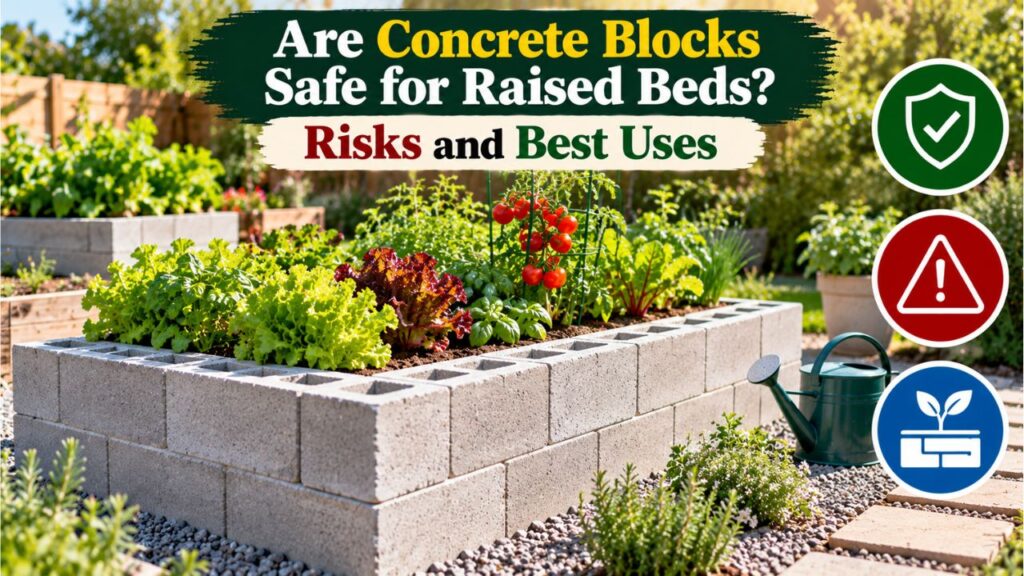
Concrete blocks are generally considered suitable for vegetable raised beds when they are intact, properly manufactured, and used for their intended purpose.
They provide a durable boundary that holds growing soil in place without the decay problems associated with untreated wooden frames.
Unlike wood, concrete doesn’t rot through ordinary exposure to soil moisture.
The main safety question involves the materials used in manufacturing and whether unwanted substances can migrate into the growing soil.
What University Research Says About Concrete Block Safety
The University of Maryland Extension’s guidance on growing vegetables in raised beds identifies concrete blocks as generally safe materials for food gardening when they remain intact.
The guidance also acknowledges that some blocks contain fly ash and that detailed information about their ingredients is not always available.
Although fly ash can contain heavy metals, the presence of these substances in a solid block does not automatically mean they will enter garden soil at harmful concentrations.
The amount that might move from a block into surrounding soil depends on factors such as its composition, chemical stability, environmental conditions, and exposure.
There is limited research directly evaluating the long-term transfer of potentially harmful substances from different concrete block products into vegetables.
Key Takeaway: Ordinary concrete blocks are not automatically unsafe for vegetable gardening. However, their exact composition and potential long-term leaching behavior are not always well documented.
Are New Concrete Blocks Safer Than Old Blocks?
New blocks from an established manufacturer are generally a more predictable choice than unidentified salvaged materials.
Their source is easier to verify, and the manufacturer may provide information about the ingredients and intended applications.
Old blocks may have an unknown history.
For example, salvaged blocks might come from:
- Industrial buildings
- Chemical storage areas
- Demolition sites
- Structures exposed to hazardous materials
- Locations with unknown spills or contamination
A block can appear structurally sound while carrying residues from its previous environment.
For edible gardens, avoid using salvaged blocks when their origin or previous use cannot be established.
Concrete Blocks vs. Cinder Blocks: Are They Equally Safe?
The terms concrete block and cinder block are often used interchangeably, but they can describe materials with different compositions.
Understanding the difference helps explain the concerns about coal ash and heavy metals.
What Are Concrete Blocks Made Of?
Standard concrete masonry units commonly contain:
- Portland cement or another suitable cementitious binder
- Sand
- Crushed stone or other mineral aggregates
- Water
- Additional manufacturing ingredients, depending on the product
The cement binds the aggregate particles together as the mixture hardens.
These blocks are used in building walls, landscaping structures, and garden borders.
Some modern concrete blocks also contain supplementary cementitious materials, including fly ash.
You cannot reliably identify every ingredient simply by looking at the finished block.
What Makes Cinder Blocks Different?
Historically, cinder blocks incorporated coal cinders or related combustion residues as aggregate.
These materials could make blocks lighter than some traditional stone-aggregate concrete products.
Today, however, the name “cinder block” is frequently used informally to describe hollow concrete masonry units, even when they are not made with coal cinders.
Therefore, the name alone does not establish whether a block contains fly ash or other combustion byproducts.
The manufacturer and product specifications are more useful than the terminology printed on a retailer’s shelf.
Does Fly Ash Make Concrete Blocks Unsafe?
Fly ash is a fine mineral residue produced when coal is burned.
It may contain naturally occurring trace elements, including substances that can be harmful at sufficient exposure levels.
However, fly ash incorporated into a cement-based product behaves differently from loose ash because it becomes part of a hardened material.
According to Virginia Cooperative Extension’s comparison of raised bed materials, concrete or cinder blocks containing fly ash raise potential concerns about heavy metals entering garden soil and plants. The publication also notes that conclusive research on the toxicity and leaching of these blocks in raised gardens is unavailable.
This distinction matters.
A possible exposure pathway is not the same as evidence that ordinary raised beds made from concrete blocks produce unsafe vegetables.
For gardeners who prefer to minimize uncertainty, choosing blocks with documented ingredients or using another suitable material is reasonable.
Can Concrete Blocks Leach Chemicals Into Raised Bed Soil?
Concrete contains mineral compounds that can interact with moisture and the surrounding soil.
The most relevant concerns are changes in soil pH and the possible release of trace substances from certain block ingredients.
The actual effects vary by material and growing conditions.
Can Concrete Blocks Raise Soil pH?
Concrete contains alkaline cement-based compounds.
Under some conditions, contact with moisture may allow alkaline substances to move into nearby soil.
This can increase soil pH, particularly close to the concrete surface.
However, the extent of the change depends on the concrete’s age, composition, exposure, and the soil’s buffering capacity.
A concrete block wall does not automatically make the entire raised bed excessively alkaline.
Many vegetables grow best in slightly acidic to near-neutral soil.
If soil pH becomes too high, the availability of certain nutrients, including iron and manganese, may decrease.
Possible symptoms include yellowing leaves while some leaf veins remain green, although similar symptoms can have other causes.
How to Check Whether Concrete Is Affecting Soil pH
A laboratory soil test is the most reliable way to assess the bed’s pH and nutrient condition.
If you’re concerned about the effects of concrete blocks, consider comparing samples from near the block wall and from the center of the growing area.
This can help identify whether a meaningful difference exists.
Avoid adding sulfur or other acidifying materials without knowing the soil’s current pH and the crops’ requirements.
Changing soil pH unnecessarily can create new nutrient problems.
Can Heavy Metals Enter Vegetables From Concrete Blocks?
The presence of a heavy metal in a construction material does not establish how much is released, how much enters the soil, or how much a particular vegetable absorbs.
These are separate processes.
Actual exposure depends on the chemical form of the element, soil conditions, concentration, and plant species.
Research specifically measuring these pathways for the wide range of commercially available concrete blocks is limited.
Therefore, it would be inaccurate to claim that all concrete blocks contaminate vegetables or that every possible block composition has been proven completely free of risk.
When the block composition is unknown and food safety is a major concern, choose a material with a more clearly documented source.
Which Concrete Blocks Should You Use for Raised Garden Beds?
The best blocks are new, intact masonry units made for appropriate outdoor construction or landscaping applications.
Material quality, structural stability, and the intended bed height should guide the selection.
Concrete Block Options for Raised Beds
| Block Type | Suitable for Raised Beds? | Main Consideration |
| New standard concrete masonry blocks | Generally yes | Verify product origin and condition |
| Hollow concrete blocks | Generally yes | Open cores can be used for small plants |
| Solid concrete blocks | Generally yes | Heavy and require stable support |
| Concrete retaining-wall blocks | Generally yes | Choose a system rated for the intended wall |
| Decorative concrete landscape blocks | Generally yes | Check product specifications and stability |
| Unknown reclaimed cinder blocks | Use caution | Ingredients and previous exposure may be unknown |
| Crumbling or severely damaged blocks | Not recommended | Poor structural condition and increased dust |
For a conventional vegetable bed, standard concrete masonry units or purpose-made retaining-wall blocks are practical choices.
A material sold specifically as a landscaping block may also provide an easier stacking system.
Are Hollow Concrete Blocks Good for Raised Beds?
Yes. Hollow concrete blocks are widely used because they can form stable borders when properly arranged.
Common nominal block dimensions include 8 × 8 × 16 inches.
The hollow openings can sometimes be filled with soil and planted with compact herbs or flowers.
However, small planting pockets dry out more quickly than the main raised bed.
They also contain less growing medium, limiting root development.
Choose plants that can tolerate the available soil volume and moisture conditions.
Should You Use Recycled Concrete Blocks?
Recycled blocks can reduce material waste, but their previous use should be known.
Blocks removed from a clean residential landscaping project may be more suitable than materials salvaged from an industrial demolition site.
Inspect for:
- Chemical stains
- Unknown coatings
- Oil or solvent residues
- Excessive cracking
- Crumbling surfaces
- Significant structural damage
Do not assume a block is safe for growing food simply because it has been washed.
If the source is uncertain, new blocks are a more predictable choice.
Do Concrete Block Raised Beds Need a Plastic Liner?
Most raised beds made from new, intact concrete blocks do not require a plastic liner.
However, a liner may be useful when the gardener wants an additional physical separation between the concrete and growing soil.
The decision depends on the reason for installing it.
When Lining the Concrete Sides Makes Sense
A suitable liner can separate the inner block surfaces from the growing medium.
This may be worth considering when:
- The block ingredients are uncertain.
- You want to limit direct soil contact with the concrete.
- You are concerned about possible localized changes in soil chemistry.
- The block manufacturer recommends a compatible barrier.
Use a durable material intended for the relevant soil-contact application.
Heavy-duty polyethylene is one option, but the specific product should be suitable for its intended use.
A liner can reduce direct contact. It does not guarantee protection against every possible contaminant.
If the blocks are known to be contaminated, replacing them is preferable to relying on an improvised plastic barrier.
Should You Put Plastic Under the Entire Raised Bed?
Generally, no.
A conventional concrete block raised bed placed over clean, healthy ground should usually remain open at the bottom.
This allows:
- Excess water to move into the native soil
- Roots to extend beneath the raised layer
- Soil organisms to move between growing areas
- Greater flexibility in managing rooting depth
A solid waterproof plastic bottom can restrict drainage and create waterlogged conditions.
If the underlying soil is contaminated, a specially designed separation system may be necessary.
That situation requires evaluating the native soil and ensuring the replacement growing medium remains properly isolated while water can still drain safely.
Can You Seal Concrete Blocks Instead of Using a Liner?
Some gardeners prefer applying a suitable coating to the interior surfaces.
A manufacturer-approved polymer coating may help reduce direct contact between the growing soil and the block.
However, not every masonry paint or sealer is appropriate for prolonged soil contact in a food garden.
Check the product’s technical information before applying it.
Avoid coatings with unknown ingredients or products not intended for this use.
Sealing is an optional precaution, not proof that a questionable building material has become safe.
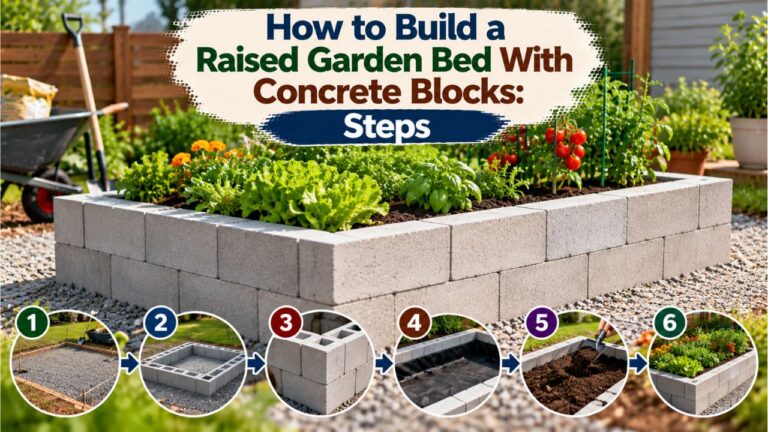
How to Build a Safe Concrete Block Raised Garden Bed
A well-constructed concrete block bed should have stable walls, adequate growing depth, proper drainage, and clean soil.
The blocks themselves must also be arranged to withstand the pressure exerted by the soil inside the bed.
Step 1: Choose a Suitable Location
Choose a reasonably level location that receives enough sunlight for your intended crops.
Most fruiting vegetables need substantial direct sunlight, while many leafy greens can tolerate somewhat less.
Check whether water collects in the proposed area after rainfall.
Avoid constructing the bed where runoff from roofs or surrounding surfaces regularly causes flooding.
Step 2: Prepare the Ground Beneath the Blocks
Remove persistent weeds, large roots, loose debris, and obstacles.
Level the area where the concrete blocks will rest.
For a low bed on firm, stable ground, careful surface preparation may be sufficient.
However, soft or uneven ground can allow the blocks to settle at different rates.
For permanent structures or locations with unstable soil, a properly prepared compacted aggregate foundation may be necessary.
The foundation design should match the wall height, block system, and site conditions.
Step 3: Position the First Row of Concrete Blocks
Place the blocks along the planned perimeter.
Use a level and string line to maintain straight, even walls.
Check corners carefully.
The first course provides the foundation for the remaining block arrangement.
Poorly positioned blocks can make the entire wall unstable or difficult to align.
For ordinary low raised beds, some approved block systems can be dry-stacked.
Follow the manufacturer’s installation requirements rather than assuming every type of concrete block can be stacked without reinforcement.
Step 4: Secure Additional Rows When Necessary
A taller concrete block wall must resist the outward pressure of the growing soil.
Dry-stacked blocks can shift if the wall is too high or the foundation is unstable.
For additional courses, use the appropriate retaining-wall design, compatible mortar or adhesive, or engineered reinforcement.
A conventional hollow masonry block and a purpose-made interlocking retaining-wall block are not interchangeable structural systems.
If you plan to build a tall bed, especially one intended to serve as seating, use a verified wall design.
Safety Note: Do not build a tall, unreinforced stack of loose concrete blocks and assume the weight of the blocks will keep it stable. Wall failure can cause serious injury.
Step 5: Leave the Bottom Open for Drainage
For beds built over clean natural soil, leave the central growing area open to the ground.
Avoid installing an impermeable bottom layer.
If the native soil is compacted, loosen it gently before filling.
This can help improve root access and water movement.
Do not place a thick layer of gravel beneath the entire growing medium merely to improve drainage. Gravel alone does not correct poor soil drainage.
Step 6: Fill the Bed With Suitable Growing Soil
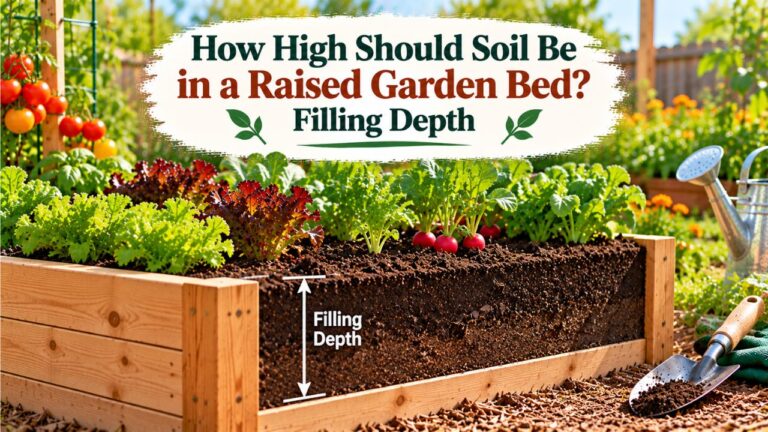
Use clean, suitable mineral topsoil and mature compost.
A practical starting mixture for a new bed is:
- Two parts good-quality topsoil
- One part finished compost
These proportions are measured by volume and are not necessary for soil that already contains adequate organic matter.
Avoid filling the bed entirely with compost or dense, compacted clay.
Water the mixture gently and check that excess moisture drains properly.
Do Concrete Blocks Make Raised Beds Too Hot?
Concrete can absorb solar energy during the day and release stored heat as surrounding temperatures change.
This thermal behavior may affect the soil near the block walls.
Whether the effect helps or harms plants depends on the season, climate, sunlight exposure, and bed design.
Concrete Block Raised Beds in Hot Weather
In warm climates, sun-exposed concrete blocks can become noticeably hot.
Dark-colored blocks may absorb more solar energy than light-colored materials under comparable conditions.
Small soil pockets inside hollow blocks can be especially vulnerable to drying.
During hot weather:
- Check soil moisture regularly.
- Apply suitable organic mulch.
- Avoid planting moisture-sensitive crops in tiny block openings.
- Consider the effect of reflected heat from nearby pavement.
- Water according to actual root-zone moisture.
Concrete block beds may require more attention in locations exposed to strong afternoon sunlight.
Can Concrete Help Warm the Soil in Spring?
Concrete’s thermal mass may moderate temperature changes near the bed walls.
Under certain conditions, it can absorb warmth during sunny periods and release some of that heat later.
However, this does not guarantee that concrete block beds will always warm faster than wooden or metal beds.
Soil depth, moisture, climate, and exposure influence the result.
Choose concrete primarily for its durability and structural qualities rather than expecting a specific temperature improvement.
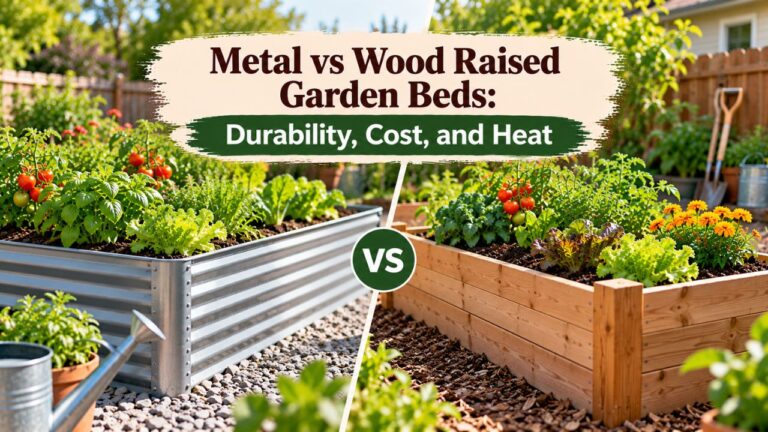
Concrete Blocks vs. Wood and Metal for Raised Beds
Concrete blocks are not the only practical material for building a vegetable garden.
Wood, galvanized metal, natural stone, and other products offer different advantages.
Raised Garden Bed Material Comparison
| Material | Main Advantage | Main Limitation |
| Concrete blocks | Durable and resistant to rot | Heavy, thick walls, ingredient uncertainty |
| Untreated cedar | Natural appearance and easy construction | Eventually deteriorates |
| Galvanized steel | Thin walls and relatively easy assembly | Can become hot in direct sunlight |
| Natural stone | Durable and attractive | Heavy and often expensive |
| Concrete retaining-wall blocks | Purpose-designed stacking options | May require a prepared foundation |
| Composite boards | Can resist some forms of decay | Performance varies by product |
When Concrete Blocks Are a Good Choice
Concrete blocks are particularly useful when you want:
- A permanent raised garden bed
- A rigid border that won’t rot like untreated wood
- A modular structure with straight edges
- A bed that doesn’t require frequent frame replacement
- A material that can tolerate ordinary outdoor moisture
Their main disadvantages are weight, wall thickness, and the effort involved in preparing a level foundation.
When Another Material May Be Better
Choose another material if you need a lightweight, portable, or easily dismantled bed.
Wood is generally easier to cut and customize.
Many prefabricated metal beds are quicker to assemble and provide more planting space within the same outside dimensions because their walls are thinner.
If you’re particularly concerned about unknown concrete ingredients and cannot verify a product’s composition, selecting a documented alternative is reasonable.
What if You Already Have a Raised Bed Made From Concrete Blocks?
You generally don’t need to dismantle a healthy raised bed simply because its walls are made from concrete blocks.
Start by evaluating the materials and the condition of the growing soil.
Check the Condition of the Blocks
Inspect the walls for cracking, movement, loose blocks, and significant deterioration.
Small surface blemishes are not necessarily a structural problem.
However, crumbling material, unstable stacks, or major cracks deserve attention.
Repair or replace unsafe components before continuing to use the bed.
Review the History of the Blocks
Try to identify whether the blocks were purchased new or salvaged from another structure.
If the blocks came from a known residential source and have remained intact, the situation differs from using unknown industrial demolition material.
When previous chemical exposure is suspected, seek appropriate assessment rather than relying on appearance alone.
Test the Raised Bed Soil
A laboratory soil test can help identify pH and nutrient conditions.
If heavy-metal contamination is a concern, ask the laboratory whether it offers the specific contaminant tests needed.
A routine fertility test does not automatically include heavy metals.
Testing can provide information about the current soil condition, although it cannot guarantee what will happen with every material over many years.
Continue Growing When Conditions Are Suitable
If the blocks are structurally sound, their origin presents no particular concern, and the soil is suitable for growing food, continued use is generally reasonable.
Maintain good drainage, avoid excessive soil compaction, and monitor plant growth.
There is no established requirement to replace soil annually simply because a raised bed is constructed from concrete blocks.
Common Mistakes to Avoid With Concrete Block Raised Beds
Several construction and material-selection errors can cause problems even when the blocks themselves are suitable for gardening.
Using Unknown Demolition Materials
Old blocks can carry contamination from previous use.
Avoid materials with an uncertain history when growing edible crops.
Assuming Every Cinder Block Contains Dangerous Amounts of Fly Ash
Block composition varies.
The presence of fly ash does not establish that hazardous concentrations will enter garden soil.
Verify product information rather than relying on the block’s appearance or name.
Ignoring Soil pH
Concrete may affect nearby soil chemistry under some conditions.
Test the soil if unexplained plant symptoms develop, especially when using new masonry or mortar.
Building Walls Without Adequate Support
Concrete blocks are heavy, but weight alone does not make a stacked wall secure.
Use a level base and a suitable structural arrangement for the intended height.
Cutting Blocks Without Dust Protection
Cutting, drilling, or grinding concrete can release respirable crystalline silica dust.
Avoid unnecessary dry cutting.
If modification is required, follow appropriate silica-dust control procedures, including suitable wet-cutting equipment, ventilation, and respiratory protection where required.
Using precut blocks or selecting a layout that doesn’t require cutting can reduce exposure.
Forgetting About Drainage
Concrete walls cannot compensate for unsuitable soil or a poorly drained location.
Keep conventional open-bottom beds connected to suitable ground and avoid sealing the bottom with waterproof materials.
Conclusion
So, are concrete blocks safe for raised beds? Generally, yes. New, intact concrete masonry blocks are widely used for vegetable gardens and are considered suitable by university extension guidance.
However, some blocks contain fly ash, and research on the long-term release of potentially harmful substances from different products remains limited.
For greater confidence, choose blocks from a known manufacturer, avoid questionable salvaged materials, and consider testing the growing soil when there is a specific concern.
A well-built concrete block raised bed should also have stable walls, sufficient soil depth, and proper drainage.
For gardeners who want a durable, permanent planting area, concrete blocks can be a practical choice. The safest approach is to use materials with a known origin and maintain healthy growing conditions rather than assuming every type of block has identical properties.
FAQs About Are Concrete Blocks Safe for Raised Beds
Can You Grow Tomatoes and Other Vegetables in Concrete Block Raised Beds?
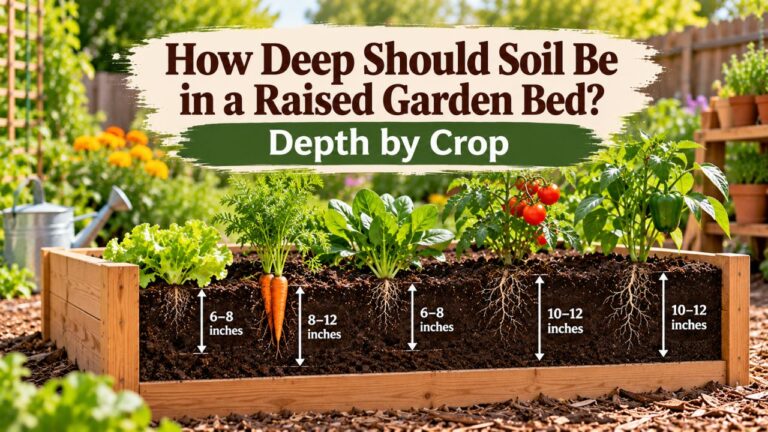
Yes. Tomatoes, peppers, lettuce, carrots, and many other vegetables can grow in concrete block raised beds. Use clean, suitable soil, provide enough rooting depth, and maintain appropriate watering and drainage. The blocks do not need to be removed simply because food crops are being grown.
Are Old Cinder Blocks Safe for a Vegetable Garden?
Their suitability depends on their composition, condition, and previous use. Older or salvaged blocks may have uncertain ingredients or contamination histories. If you cannot establish their origin, using new, documented materials is the more cautious choice.
Should I Seal Concrete Blocks Before Filling a Raised Bed?
Sealing is usually optional for new, intact concrete blocks. If you want an additional separation barrier, select a coating specifically suitable for the intended soil-contact application. Don’t assume an ordinary masonry paint makes contaminated blocks safe.
Can You Plant Strawberries or Herbs in Concrete Block Holes?
Yes, small plants can grow in the hollow openings of concrete blocks when the spaces contain suitable growing medium. However, these pockets have limited root volume and may dry quickly, especially in hot weather. Choose compact plants and monitor moisture carefully.
Will Concrete Blocks Make My Garden Soil Too Alkaline?
Not necessarily. Concrete can influence soil pH near its surface, but the effect depends on the material and soil conditions. If you suspect excessive alkalinity, use a laboratory soil test before adding amendments.
Do Concrete Block Raised Beds Need Mortar?
Not every low concrete block bed needs mortar. Some block systems are designed for dry stacking, while others require mortar, adhesive, or structural reinforcement. Follow the block manufacturer’s instructions and consider wall height, foundation stability, and soil pressure.
Can I Use Concrete Pavers Instead of Cinder Blocks?
Yes, suitable concrete pavers or retaining-wall blocks can be used for raised bed borders. Choose products designed for the intended application and install them on a stable base. Thin decorative pavers may not be appropriate for building tall, soil-retaining walls.

I’m Maya L. Greenwood, a lifelong plant lover who believes anyone can grow something beautiful with the right guidance. After years of testing soil mixes, pruning methods, irrigation tricks, and pest-safe solutions, I started EasyGardenTips.com to turn hard-won lessons into step-by-step advice. From seed starting and container gardens to composting and seasonal checklists, my goal is to make gardening simple, sustainable, and fun.