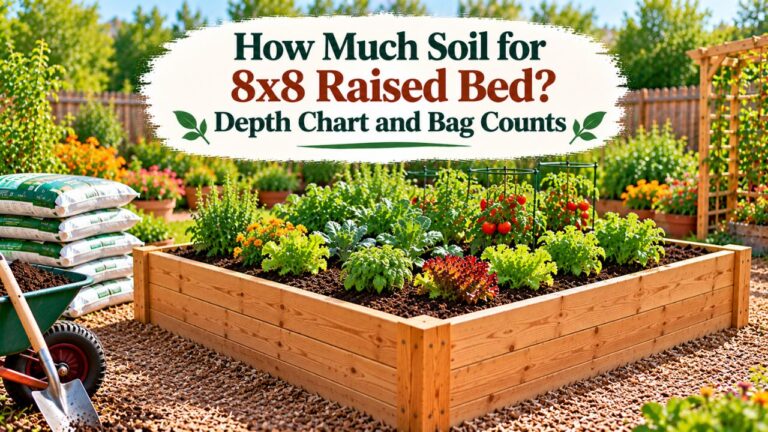
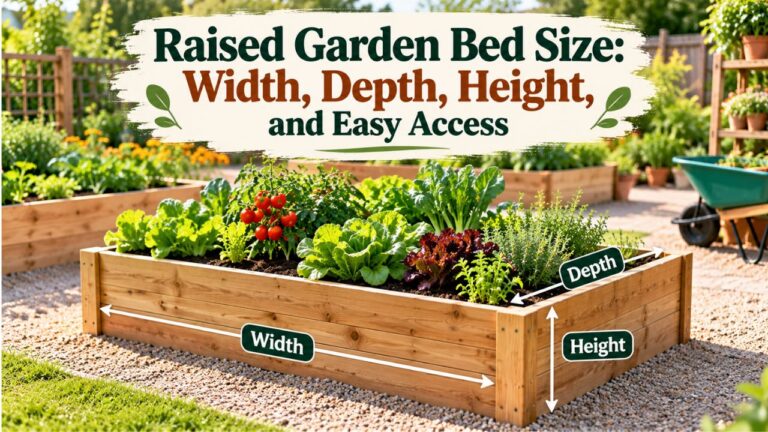
How High Should Soil Be in a Raised Garden Bed? Filling Depth
The soil in a raised garden bed should generally sit 1–2 inches below the top edge of the frame after settling. This leaves enough room for mulch, keeps loose soil from spilling over the sides, and makes watering more manageable. However, the ideal soil depth also depends on the vegetables being grown and whether the raised bed has an open or enclosed bottom.
A raised bed that is 12 inches tall, for example, can hold approximately 10–11 inches of soil when filled to the recommended level. That depth may be sufficient for many vegetables if their roots can continue growing into the natural ground underneath.
The situation changes with elevated planters and raised beds positioned on concrete. Because roots cannot extend into the ground below, these beds need enough internal growing depth to support the plants.
Filling a bed too high can cause soil and mulch to spill out, while leaving too much empty space can reduce available growing depth.
Understanding the difference between bed height, soil depth, and the space needed for mulch makes it easier to prepare a productive raised garden bed.
How High Should Soil Be in a Raised Garden Bed After Filling?
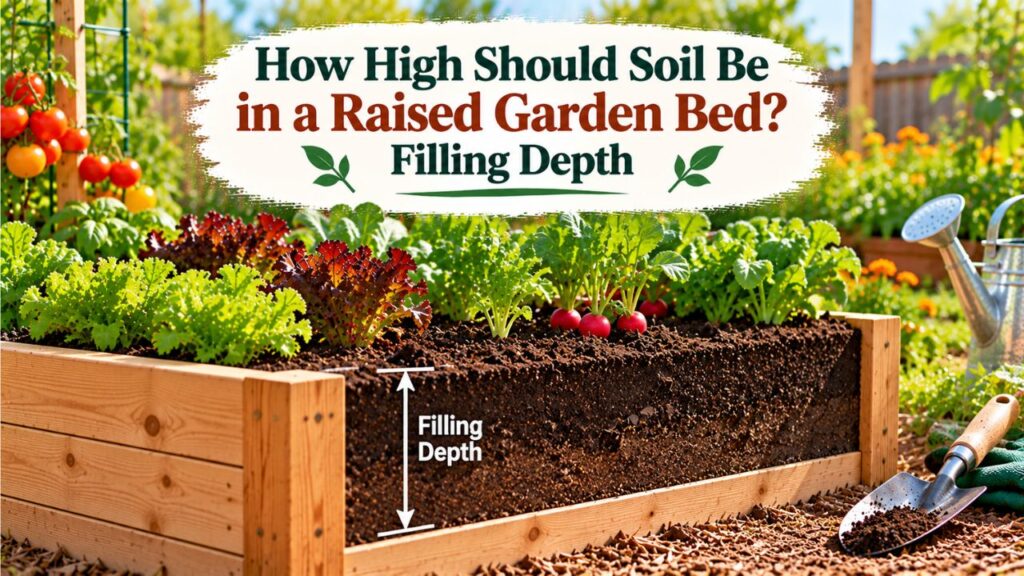
For most framed vegetable beds, the finished soil surface should sit approximately 1–2 inches below the upper rim.
This is a practical filling guideline rather than a strict requirement. The exact gap depends on the frame design, mulch thickness, and how much growing depth the plants need.
The following table shows typical finished soil heights based on a 1–2-inch gap.
| Raised bed height | Recommended soil height | Space below rim |
| 6 inches | 4–5 inches | 1–2 inches |
| 8 inches | 6–7 inches | 1–2 inches |
| 10 inches | 8–9 inches | 1–2 inches |
| 12 inches | 10–11 inches | 1–2 inches |
| 16 inches | 14–15 inches | 1–2 inches |
| 18 inches | 16–17 inches | 1–2 inches |
| 24 inches | 22–23 inches | 1–2 inches |
These measurements assume that the frame height is measured from the inside bottom or original ground surface to the upper edge.
A shallow bed may not provide enough soil for every crop, especially when it has a solid bottom.
Why Leave 1–2 Inches Below the Raised Bed Rim?
Leaving a small gap between the soil surface and the frame provides several practical advantages.
- Mulch containment: Straw, shredded leaves, and other mulches are less likely to spill onto surrounding paths.
- Easier watering: The frame helps contain water applied to the surface, particularly when using a watering can.
- Less soil loss: Heavy rain and overhead irrigation are less likely to wash loose growing medium over the sides.
- Room for settling: A modest gap makes it easier to recognize when the soil level has changed.
- Cleaner edges: Soil and mulch remain within the planting area during routine maintenance.
Iowa State University Extension’s raised bed construction guidance recommends allowing space for 1–2 inches of mulch above the soil. It also explains that soil commonly settles after filling, creating a lip that helps contain the mulch.
If the bed won’t receive mulch, a smaller gap may be sufficient.
Should You Fill a Raised Garden Bed All the Way to the Top?
A new raised bed can initially be filled close to the rim because loose soil often settles after watering.
However, the final soil level should generally remain slightly below the upper edge.
Freshly added growing media contain spaces between soil particles. As water moves through the mixture, some of these spaces become smaller, causing the soil surface to drop.
Instead of packing the soil tightly to prevent settling, water the newly filled bed and allow it to stabilize naturally.
Check the height again before planting and add more soil if necessary.
How Deep Should Soil Be for Raised Garden Bed Vegetables?
The appropriate soil depth depends on the type of crop, its root system, and the amount of soil available beneath the raised bed.
Shallow-rooted vegetables generally need less depth than large, fruiting plants.
| Vegetable | Practical soil depth for contained beds |
| Lettuce | 8–10 inches |
| Spinach | 8–10 inches |
| Radishes | 8–10 inches |
| Green onions | 8–12 inches |
| Bush beans | 8–12 inches |
| Carrots | 10–12 inches or more |
| Peppers | 12–18 inches |
| Tomatoes | 12–24 inches |
| Summer squash | 12–24 inches |
These are general planning ranges, not fixed minimums for every variety. Actual requirements depend on the plant, growing medium, available soil volume, and growing conditions.
The University of Maryland Extension’s raised bed vegetable guidance recommends a minimum growing depth of 8 inches for leafy greens, beans, and cucumbers in beds on hard surfaces, and 12–24 inches for peppers, tomatoes, and squash.
Soil Height for Leafy Greens and Small Vegetables
Lettuce, spinach, radishes, and many small herbs can grow successfully in relatively shallow raised beds.
For enclosed beds, approximately 8–10 inches of growing medium is a useful starting range for many of these crops.
These plants generally require less soil volume than large tomatoes or sprawling squash.
However, shallow beds can dry out quickly during hot weather because they contain less moisture-storing material.
Consistent watering becomes particularly important when the planter is elevated above the ground.
Soil Height for Carrots and Other Root Vegetables
Carrots, parsnips, and similar vegetables need enough loose soil for their edible roots to develop without obstruction.
A compact carrot variety may grow successfully in a relatively shallow bed, while longer varieties need more depth.
For carrots, approximately 10–12 inches of loose growing medium is a practical starting point for many varieties. Longer-rooted crops may require more.
Hard, compacted soil beneath the bed can interfere with root development.
If the raised bed is open-bottomed, loosening the underlying ground can provide additional growing depth without increasing the frame height.
Soil Height for Tomatoes, Peppers, and Squash
Larger vegetable plants benefit from more available root space.
Tomatoes, peppers, and squash need adequate soil volume for root development, water storage, and nutrient availability.
For contained raised beds, approximately 12–24 inches of growing depth provides more flexibility for these crops, depending on their size and variety.
A 12-inch-high open-bottom bed may still support a tomato plant when its roots can grow into suitable soil underneath.
The same frame placed over concrete provides much less total rooting space.
Key Takeaway: Choose the required growing depth according to the crop and whether roots can extend below the raised bed—not simply according to the height of the frame.
Does the Raised Bed Need to Be as Deep as the Plant’s Roots?
Not always. The answer depends mainly on what is beneath the raised bed.
An open-bottom garden bed functions differently from a completely enclosed planter.
Open-Bottom Raised Garden Beds
Open-bottom raised beds allow roots to grow into the natural soil below the frame.
For example, a raised bed containing 8 inches of added soil may provide considerably more than 8 inches of rooting depth if the underlying ground is loose and well-drained.
This makes relatively low raised beds practical for many vegetable gardens.
However, the original soil must allow roots to penetrate it.
Compacted clay, underground debris, and persistent waterlogging can restrict root growth even when the raised soil above is healthy.
When preparing a new bed, check the underlying soil before assuming that roots will have unrestricted growing space.
Raised Beds With Solid Bottoms
An elevated planter with a solid bottom depends entirely on the soil held inside its container.
The distance from the planter floor to the soil surface determines its usable growing depth.
For example, a planter may stand 30 inches above the ground but contain only 10 inches of soil because its floor is mounted near the top.
In this situation, the planter provides approximately 10 inches of rooting depth, not 30 inches.
Choose the planting depth based on the vegetable variety and ensure that the bottom contains suitable drainage openings.
Raised Garden Beds on Concrete
Raised beds installed on concrete, asphalt, or other hard surfaces cannot provide access to native soil beneath the frame.
They therefore require sufficient depth within the bed itself.
For shallow-rooted crops, an appropriately designed bed with at least 8 inches of growing medium may work.
For larger crops such as tomatoes and squash, a deeper bed is generally preferable.
Water also needs a clear drainage path. A deep raised bed cannot support healthy roots if excess moisture becomes trapped at its bottom.
How to Fill a Raised Garden Bed to the Proper Soil Level
Correct filling begins with measuring the available growing space and estimating how much soil the bed needs.
The following process works for common rectangular raised beds.
Step 1: Measure the Inside Height of the Raised Bed
Use a measuring tape to determine the vertical distance from the bottom of the planting area to the top edge of the frame.
For open-bottom beds, measure from the existing ground surface to the rim.
For enclosed planters, measure from the actual internal floor.
Avoid using the external height of an elevated planter, since its legs do not contribute to growing depth.
Step 2: Determine the Final Soil Height
Subtract the intended gap below the rim from the internal bed height.
For example:
- Raised bed height: 12 inches
- Space below rim: 2 inches
- Planned soil height: 10 inches
The finished growing medium should therefore reach approximately 10 inches above the base.
Make sure that this depth is suitable for the intended vegetables.
Step 3: Prepare an Appropriate Soil Mixture
For many open-bottom vegetable beds, a mixture of quality topsoil and finished compost provides a suitable growing medium.
A practical starting ratio is:
- 2 parts quality topsoil
- 1 part finished compost
This produces a mixture containing approximately two-thirds topsoil and one-third compost by volume.
The exact proportions may need adjustment depending on the properties of the materials.
A suitable raised bed mix should be loose, well-draining, and capable of retaining enough moisture for plant growth.
For elevated planters, choose a container-appropriate growing medium rather than assuming heavy garden soil will perform well.
Step 4: Add Soil Without Excessive Compaction
Fill the bed evenly, breaking apart large clumps as necessary.
Avoid walking on the soil or pressing it down heavily.
Excessive compaction reduces the pore spaces needed for water movement, root penetration, and air exchange.
Gently level the soil with a rake as the bed fills.
Step 5: Water the Soil and Allow It to Settle
Water the newly filled bed thoroughly but gently.
The goal is to moisten the growing medium without washing soil over the frame.
Allow excess water to drain, then inspect the surface.
Some settling is normal.
If the soil has dropped farther below the rim than intended, add more growing medium.
Step 6: Add Mulch After Planting
Once the bed is ready, plant the selected vegetables at their recommended spacing and planting depth.
Apply a suitable mulch layer where appropriate.
Mulch helps reduce surface evaporation, limits weed growth, and protects exposed soil from heavy rainfall.
Avoid piling mulch directly against plant crowns and stems.
How Much Soil Is Needed for the Correct Raised Bed Height?
Calculate soil volume using the bed’s internal length, width, and intended filling depth.
For rectangular beds:
Soil volume (cubic feet) = Length (feet) × Width (feet) × Soil depth (feet)
If the depth is measured in inches, divide it by 12 to convert it into feet.
Example: Soil for a 4×8 Raised Bed
Suppose a raised bed has these interior dimensions:
- Length: 8 feet
- Width: 4 feet
- Frame height: 12 inches
- Desired gap below rim: 2 inches
The planned soil depth is 10 inches, or approximately 0.833 feet.
Calculate the volume:
8 × 4 × 0.833 = 26.67 cubic feet
The raised bed therefore needs approximately 26.7 cubic feet of growing medium to reach the intended height.
To convert this amount to cubic yards:
26.67 ÷ 27 = 0.99 cubic yards
That is approximately 1 cubic yard.
The calculated amount does not include additional material for settlement, uneven ground, or variations in the actual frame dimensions.
Soil Volume for Common 4×8 Raised Beds
The following calculations assume exactly 4×8 feet of interior planting area and a finished soil surface 2 inches below the rim.
| Frame height | Soil depth | Soil required |
| 8 inches | 6 inches | 16 cubic feet |
| 10 inches | 8 inches | 21.3 cubic feet |
| 12 inches | 10 inches | 26.7 cubic feet |
| 16 inches | 14 inches | 37.3 cubic feet |
| 18 inches | 16 inches | 42.7 cubic feet |
| 24 inches | 22 inches | 58.7 cubic feet |
These values help estimate the initial fill volume. Soil may settle after watering, so a small additional quantity can be useful for topping off the bed.
Why Is the Soil Level Dropping in a Raised Garden Bed?
Raised bed soil often sinks over time because of settling, decomposition, and occasional material loss.
A falling soil level does not necessarily mean that the bed was filled incorrectly.
Natural Soil Settlement
Fresh soil contains loose spaces between its particles.
As irrigation water moves through the growing medium, the particles gradually settle into a more stable arrangement.
This process is especially noticeable shortly after filling a new raised bed.
The amount of settlement depends on the original mixture and how loosely it was installed.
Breakdown of Organic Materials
Compost and other organic materials continue to change as they decompose.
If a raised bed contains large amounts of partially decomposed organic material, the soil level may decline noticeably as the material breaks down.
Using finished compost rather than large amounts of raw plant debris can make settlement more predictable.
Soil Erosion and Material Loss
Heavy rainfall, strong winds, and excessive irrigation can gradually remove loose soil from a raised bed.
The problem may become more noticeable when the bed is overfilled.
Maintaining a suitable gap below the rim and protecting exposed soil with mulch can reduce material loss.
When Should You Add More Soil to an Existing Raised Bed?
Additional soil is useful when settlement has reduced the available rooting depth or created an impractically large gap below the frame.
However, not every small change in soil height requires correction.
Before the Planting Season
The period before planting is generally a convenient time to restore the soil level.
Check the existing depth and inspect the growing medium.
If the bed has settled significantly, add enough suitable raised bed mix to return the surface to the intended height.
Adding finished compost may also be appropriate when the soil needs organic matter, but it should not automatically replace proper soil testing and nutrient management.
During the Growing Season
Avoid adding large amounts of soil around established plants.
Burying stems or plant crowns can damage crops that do not tolerate deeper planting.
If the bed needs a substantial refill, it may be better to wait until the plants are harvested.
Small surface additions can be made carefully when they will not bury sensitive plant parts.
After Harvesting
The period between crops allows more flexibility for soil maintenance.
Remove unwanted plant debris, inspect the bed for settling, and add fresh growing medium where necessary.
Check that the soil remains loose and drains properly before planting the next crop.
What Happens if Raised Bed Soil Is Too High or Too Low?
Both conditions can create problems, although the effects depend on the bed design.
Problems With Soil Above the Rim
Overfilling a framed raised bed can allow soil and mulch to move outside the planting area.
Common problems include:
- Soil washing onto walkways during heavy rainfall
- Mulch spilling over the sides
- Difficulty watering without surface runoff
- Loss of growing medium around the frame
- Reduced space for future mulch applications
If the soil surface is noticeably above the rim, gently remove enough material to create a manageable gap.
Problems With Soil Far Below the Rim
Leaving excessive empty space can reduce the available rooting volume, particularly in enclosed beds.
For example, filling a 16-inch-deep planter with only 6 inches of soil provides just 6 inches of growing depth.
The tall surrounding walls may also shade small seedlings when the soil surface is deeply recessed.
Reduced soil volume can make watering and nutrient management more difficult.
When the bed is open to healthy ground, a shallow fill may still be suitable. When the bottom is enclosed, adequate internal soil depth becomes especially important.
Conclusion
Knowing how high should soil be in a raised garden bed helps determine the correct filling level and available growing depth.
For most framed vegetable beds, keeping the settled soil surface approximately 1–2 inches below the upper rim provides room for mulch and helps prevent material from spilling out.
The total growing depth should also match the vegetables being planted.
Open-bottom raised beds can provide additional rooting space through the natural ground underneath, while enclosed planters must contain enough soil for the entire root system.
For the best results, measure the internal height, choose a suitable growing medium, water it to allow settling, and adjust the final soil level before planting.
FAQs About How High Should Soil Be in a Raised Garden Bed
Can I Fill a Raised Bed Right Up to the Edge?
Yes, a newly filled bed can initially reach close to the edge because soil may settle after watering.
However, leaving approximately 1–2 inches below the rim after settling makes it easier to contain mulch and prevent soil from spilling over the frame.
Is 8 Inches of Soil Deep Enough for a Raised Garden Bed?
Eight inches of usable soil can support many leafy greens and some other vegetables, especially when the bed is open to suitable ground underneath.
Larger vegetables, including tomatoes and squash, generally benefit from more available rooting depth.
Is 12 Inches of Soil Enough for a Raised Bed?
Twelve inches of soil can be sufficient for many vegetables, particularly in open-bottom beds where roots can extend into the ground.
For enclosed raised beds, larger crops may perform better with additional soil depth and volume.
Should Raised Bed Soil Be Higher in the Middle?
A slight crown may help shed surface water in some bed designs, but a pronounced mound is generally unnecessary for a framed vegetable bed.
A relatively even planting surface simplifies watering, planting, and soil depth management. The entire bed should drain adequately without relying on a steep surface slope.
Does Raised Bed Soil Need to Be Replaced Every Year?
No. Healthy raised bed soil generally does not need complete replacement each year.
Add suitable growing medium when settlement reduces the soil level, and make amendments according to soil condition and crop needs.
How Much Soil Should I Leave Above the Mulch?
There is no fixed requirement to leave empty space above the mulch.
The goal is to keep soil and mulch contained inside the frame without creating an unnecessarily deep planting surface.
A finished mulch layer near the rim can be appropriate as long as it remains secure and does not bury sensitive plant crowns.
Can a Raised Garden Bed Be Too Deep?
A deep raised bed is not automatically harmful, but filling it requires more material and increases its weight and cost.
For open-bottom beds, extra depth may provide limited additional benefit when the underlying soil already supports healthy root growth.
For elevated planters, greater soil depth also increases the load on the structure, so the frame and supports must be designed to carry the weight of wet soil.

I’m Maya L. Greenwood, a lifelong plant lover who believes anyone can grow something beautiful with the right guidance. After years of testing soil mixes, pruning methods, irrigation tricks, and pest-safe solutions, I started EasyGardenTips.com to turn hard-won lessons into step-by-step advice. From seed starting and container gardens to composting and seasonal checklists, my goal is to make gardening simple, sustainable, and fun.