Metal vs Wood Raised Garden Beds: Durability, Cost, and Heat
Metal raised garden beds are generally better for long-term durability and low maintenance, while wood raised beds are often better for affordable DIY construction, easy customization, and natural appearance. Both materials can support healthy vegetables, flowers, and herbs when the beds have suitable soil, drainage, and growing conditions.
The main differences involve lifespan, upfront cost, heat transfer, installation, and maintenance. Galvanized steel resists decay and usually requires less routine upkeep. Wooden beds, especially those built from untreated pine, can cost less initially but gradually deteriorate when exposed to moisture and soil.
Temperature is another concern. Metal conducts heat more readily than wood, but that doesn’t automatically mean plants growing in metal beds will experience dangerously hot roots. Soil depth, sunlight, moisture, and bed design also influence root-zone temperatures.
The better material depends on your climate, budget, garden layout, and how long you expect the structure to remain in place.
Comparing these factors helps determine whether a galvanized metal raised bed or a wooden garden bed makes more sense for your growing space.
Metal vs Wood Raised Garden Beds: Side-by-Side Comparison
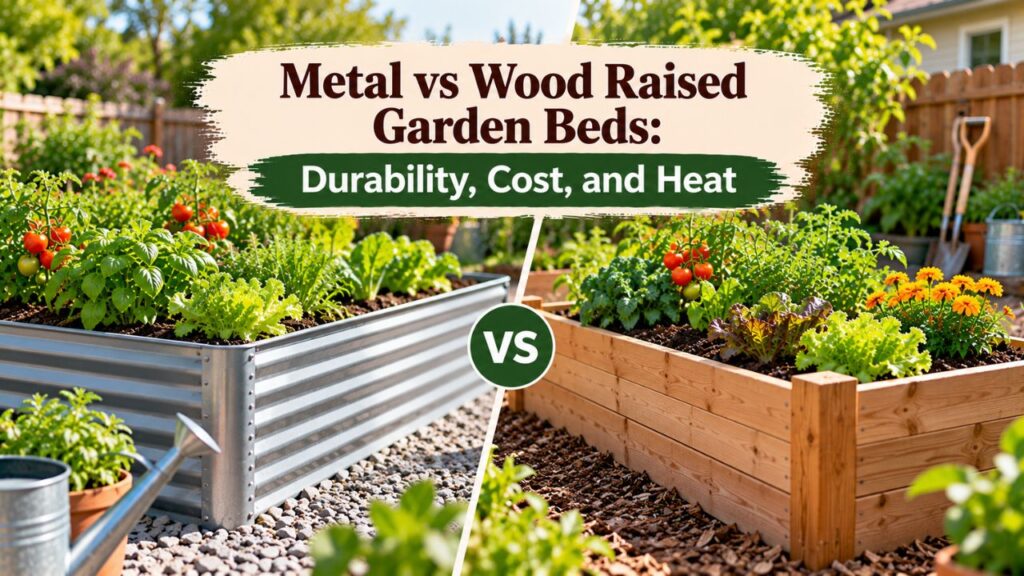
Metal and wood raised beds perform the same basic function: containing an elevated growing area while keeping foot traffic off the planting soil.
However, their construction materials affect long-term performance.
| Feature | Metal raised beds | Wood raised beds |
| Common materials | Galvanized or coated steel | Pine, cedar, redwood, and treated lumber |
| Durability | Generally high with quality corrosion protection | Depends on wood species and treatment |
| Rot resistance | Does not undergo biological wood decay | Susceptible to fungal decay |
| Rust risk | Possible if protective coatings deteriorate | No metal rust, although fasteners can corrode |
| Initial cost | Varies; quality kits may cost more | Basic untreated lumber is often inexpensive |
| Maintenance | Usually limited to inspecting coatings and hardware | May require board or fastener replacement |
| Heat transfer | Metal walls conduct heat readily | Wood provides greater thermal resistance |
| Customization | Limited by kit design unless fabricated | Easily cut and assembled into custom shapes |
| Appearance | Modern and structured | Natural, traditional, or rustic |
| Installation | Prefabricated kits often assemble with bolts | DIY construction requires measuring, cutting, and fastening |
| Long-term suitability | Good for permanent garden layouts | Good when repairability or customization matters |
Neither material automatically produces healthier plants.
Plant growth depends more directly on soil quality, growing depth, drainage, sunlight, watering, and appropriate crop management.
Metal Raised Garden Beds: Materials, Durability, and Performance
Metal raised beds commonly use galvanized steel panels connected with bolts, brackets, or reinforced corners.
Many prefabricated models feature rounded or rectangular shapes and come in several heights.
How Galvanized Steel Raised Beds Work
Galvanized steel has a protective zinc coating that helps reduce corrosion.
The coating forms a barrier and provides sacrificial protection to the underlying steel.
Some manufacturers use additional painted or alloy-based coatings for greater corrosion resistance.
Quality construction matters because not all metal garden beds use the same steel thickness, coating, or hardware.
The University of Minnesota Extension’s raised bed gardening guidance identifies galvanized steel as a durable alternative to wood and notes its resistance to rust.
However, corrosion resistance doesn’t mean a metal garden bed can never rust.
Scratched coatings, exposed cut edges, incompatible fasteners, and prolonged exposure to aggressive environments can affect its lifespan.
Advantages of Metal Raised Garden Beds
Long-term durability
Quality galvanized steel can remain structurally sound for many growing seasons.
Unlike wood, steel isn’t broken down by fungi or insects that cause wood decay.
Lower routine maintenance
Metal beds generally don’t require the same periodic board replacement associated with deteriorating wood.
Inspecting fasteners, joints, and damaged coatings is usually the main structural maintenance.
Convenient prefabricated designs
Many metal raised beds come as kits with predrilled panels and matching hardware.
This can reduce the need for cutting lumber or building a frame from individual boards.
Various heights and shapes
Metal kits are available in shallow and deep configurations, including models intended to reduce bending while gardening.
Rounded designs can also eliminate some sharp exterior corners associated with conventional rectangular frames.
Consistent appearance
Coated steel panels provide a clean, uniform appearance that suits modern garden layouts.
This can be appealing when installing several matching beds.
Limitations of Metal Raised Garden Beds
Metal raised beds also have practical limitations.
Higher potential purchase cost
Some quality galvanized steel kits cost more than a basic wooden bed made from inexpensive lumber.
However, premium cedar construction can cost as much as or more than certain metal kits.
Heat exposure
Metal walls can become hot under direct sunlight, especially when the finish is dark.
That doesn’t necessarily mean the entire root zone becomes excessively hot, but plants near exposed walls may experience different conditions than plants near the center.
Possible corrosion
Protective coatings can deteriorate over time.
Coastal salt exposure, persistent moisture, and mechanical damage may accelerate corrosion in susceptible products.
Limited structural modification
Prefabricated metal beds may be difficult to resize without cutting panels and dealing with exposed edges.
For unusual garden shapes, custom wooden construction may be easier.
Assembly considerations
Thin metal edges can be sharp before protective trim is installed.
Wear suitable gloves during assembly and ensure all exposed edges are properly finished.
Wood Raised Garden Beds: Materials, Durability, and Performance
Wood is a traditional material for raised garden beds because it’s widely available, easy to work with, and suitable for custom construction.
Wooden raised beds may be made from inexpensive softwood boards or more durable species.
The type of lumber strongly influences cost and lifespan.
Pine Raised Garden Beds
Untreated pine is commonly used for inexpensive DIY raised beds.
It is relatively easy to cut, drill, and assemble.
However, pine has limited natural resistance to decay when continuously exposed to damp soil.
In a wet environment, untreated pine boards may deteriorate after several growing seasons.
The actual lifespan depends on lumber quality, board thickness, climate, drainage, and moisture exposure.
Pine can still be a reasonable choice for gardeners who want a low-cost structure and don’t mind replacing boards eventually.
Cedar Raised Garden Beds
Cedar is popular because certain cedar species contain naturally occurring compounds that help resist decay.
It also offers an attractive appearance without requiring pressure treatment.
Compared with ordinary untreated pine, suitable decay-resistant cedar generally provides better longevity.
However, not all cedar products have identical durability.
Species, heartwood content, board quality, and moisture conditions matter.
Cedar usually costs more than basic construction-grade softwood.
Redwood and Other Decay-Resistant Lumber
Redwood, black locust, and certain other wood species can provide good natural decay resistance.
Availability and price vary considerably across the United States.
Black locust, for example, is naturally durable but may be harder to find in standard dimensional lumber.
Regardless of species, wood in prolonged soil contact eventually changes through weathering and biological activity.
Advantages of Wood Raised Garden Beds
Easy DIY construction
Wood can be cut to almost any practical length or configuration.
This allows beds to fit narrow yards, irregular garden layouts, and specific accessibility requirements.
Natural appearance
Wood blends well with lawns, traditional gardens, flower borders, and landscape plantings.
Convenient repair
Damaged boards can often be removed and replaced individually without rebuilding the entire frame.
Lower-cost starting options
Untreated pine or locally available lumber can make a basic raised bed affordable.
Greater thermal resistance
Wood conducts heat less readily than steel.
This can reduce rapid heat transfer through the bed walls, although soil temperature still depends heavily on weather and overall bed design.
Limitations of Wood Raised Garden Beds
The biggest limitation is moisture-related deterioration.
Wood remains in frequent contact with damp soil, encouraging decay over time.
Other considerations include:
- Boards may warp, twist, split, or bow outward.
- Untreated softwood may need replacement sooner than decay-resistant lumber.
- Some wood species are expensive or difficult to obtain locally.
- Long sides may require extra structural support.
- Poorly selected fasteners can corrode or loosen.
- Reclaimed lumber may contain unknown preservatives or coatings.
Wooden raised beds aren’t inherently difficult to maintain, but their condition should be checked periodically.
Which Lasts Longer: Metal or Wood Raised Garden Beds?
A well-manufactured galvanized steel raised bed will generally outlast a basic untreated softwood raised bed under comparable outdoor conditions.
However, there isn’t one reliable lifespan that applies to every metal or wooden product.
Metal Raised Bed Lifespan
Metal longevity depends on several factors:
- Steel thickness.
- Protective coating quality.
- Exposure to rainfall and irrigation.
- Soil acidity and moisture.
- Coastal salt exposure.
- Manufacturing quality.
- Condition of fasteners and joints.
A quality galvanized steel bed can last for decades in favorable conditions, but budget products with thin or damaged coatings may deteriorate much sooner.
Inspecting the lower edges is especially useful because those areas often remain exposed to moisture.
Wooden Raised Bed Lifespan
Wood durability varies substantially by species and treatment.
Untreated pine usually deteriorates sooner than suitable cedar, redwood, or properly treated lumber.
Board thickness also matters.
Thicker boards can retain structural strength longer even as some surface deterioration develops.
Keeping the frame well-drained and replacing damaged sections when needed can extend its usable life.
Practical takeaway: Choose quality galvanized metal when reducing future structural replacement is a priority. Choose naturally durable wood when appearance and repairability are equally important.
Do Metal Raised Beds Get Hotter Than Wood Raised Beds?
Metal conducts heat more readily than wood, so exposed metal surfaces can heat up quickly in direct sunlight.
However, the temperature of the metal wall isn’t the same as the temperature throughout the soil.
Soil has considerable thermal mass, and conditions vary between the bed’s edges and center.
How Metal Affects Soil Temperature
Sunlight can warm exposed metal panels.
Some of that heat moves toward the growing medium, particularly near the walls.
The actual effect depends on:
- Panel color and finish.
- Sun exposure.
- Soil moisture.
- Bed width and depth.
- Air temperature.
- Wind.
- Mulch coverage.
- Whether the bed sits on soil or pavement.
A light-colored metal bed may absorb less solar energy than a dark-colored one.
A deeper, wider bed also contains more soil, which can moderate temperature changes away from the edges.
It isn’t accurate to assume every metal raised bed becomes too hot for growing vegetables.
How Wood Affects Soil Temperature
Wood provides more resistance to heat flow through the walls.
This can reduce the speed of temperature changes directly through the frame.
However, wooden raised beds still warm during sunny weather.
Much of the soil’s heating comes directly from sunlight striking the soil surface.
Likewise, evaporation, air temperature, and soil moisture influence cooling.
A wooden bed without mulch may experience substantial soil temperature changes despite the insulating properties of its walls.
Which Material Is Better in Hot Climates?
Both materials can work in warm climates.
For metal beds exposed to intense summer sun, consider choosing a lighter exterior finish and providing sufficient growing depth.
Maintain appropriate soil moisture and use suitable mulch.
Position especially heat-sensitive crops where they receive the right amount of sunlight.
Drip irrigation can help maintain consistent moisture.
Wood may offer some thermal buffering through its walls, but proper watering and soil management are more important than relying on the frame material alone.
Are Metal or Wood Raised Garden Beds Safer for Vegetables?
Both metal and wood can be suitable for growing vegetables.
Safety depends on the specific materials, coatings, preservatives, and previous use of the product.
Neither material should be judged solely by its appearance.
Is Galvanized Steel Safe for Growing Food?
Galvanized steel is commonly used for raised vegetable beds.
Its protective coating contains zinc, a naturally occurring element that plants require in small quantities.
However, excessive zinc can be harmful.
Highly acidic soil can increase the potential for zinc to move from galvanized surfaces into the growing medium.
The University of Minnesota Extension notes that zinc release may be a concern in strongly acidic soil, particularly at a pH below approximately 5.
Most common vegetables grow best at a higher pH than this, although individual plant requirements vary.
Choose products with clearly identified materials and coatings from reputable manufacturers.
Avoid using unidentified scrap metal or old painted panels that may contain undesirable substances.
Is Pressure-Treated Wood Safe for Vegetable Beds?
Modern residential pressure-treated lumber often uses copper-based preservatives rather than older arsenic-containing treatments.
The specific preservative matters.
According to the University of Maryland Extension’s guidance on raised bed materials, modern micronized copper azole-treated lumber is considered relatively low in toxicity.
Its guidance also discusses research finding limited copper movement into nearby soil without a corresponding increase in copper measured in the vegetables studied.
However, older chromated copper arsenate (CCA) lumber and railroad ties treated with creosote should be avoided for vegetable garden construction.
If using pressure-treated lumber, verify that the product is approved for its intended residential application and rated for ground contact where required.
Gardeners who prefer to avoid wood preservatives can select suitable untreated cedar, redwood, or another naturally decay-resistant species.
Should Raised Garden Beds Have a Liner?
A liner isn’t universally necessary.
For untreated wood or appropriately manufactured galvanized steel beds, many gardeners use the structure without lining the sidewalls.
A liner may be considered when limiting direct soil contact with treated wood or a particular metal surface.
If you install one:
- Use a material appropriate for the intended growing application.
- Secure it to the sidewalls rather than unnecessarily sealing the bottom.
- Keep water drainage unobstructed.
- Avoid allowing water to collect between the liner and frame.
An open-bottom garden bed generally benefits from maintaining contact with suitable native soil beneath it.
If contamination is suspected in the underlying ground, the situation requires a separate assessment and appropriate barrier design.
Metal vs Wood Raised Garden Beds: Which Costs Less?
The most affordable option depends on the material quality, bed dimensions, labor, and expected lifespan.
A simple wooden bed made from untreated pine can have a lower upfront cost than a premium galvanized steel kit.
However, quality cedar lumber may cost more than an ordinary prefabricated metal bed.
Upfront Construction Costs
For wood raised beds, consider the cost of:
- Lumber.
- Screws and brackets.
- Corner supports.
- Cutting and assembly tools.
- Delivery, when applicable.
For metal raised beds, consider:
- The complete kit or individual panels.
- Fasteners and bracing.
- Edge protection.
- Shipping costs.
- Additional supports for long or tall structures.
A metal kit may include nearly everything needed for assembly.
Wood construction provides greater flexibility but may require additional materials and tools.
Long-Term Replacement Costs
A low-cost wooden raised bed may require occasional replacement of deteriorated boards.
A durable metal bed may avoid some of those recurring material costs.
However, it may also require replacement if corrosion seriously damages its frame.
For long-term value, compare the expected service life of the specific products rather than assuming every metal bed will outlast every wooden one.
Soil Costs Can Change the Comparison
The frame isn’t the only expense.
Taller beds require more growing medium.
For example, a 4-foot-wide, 8-foot-long raised bed filled to a depth of 12 inches requires approximately 32 cubic feet of soil.
Increasing the fill depth to 24 inches doubles that volume.
A tall metal kit may look economical until the required soil volume is included.
Compare total installed costs using the same bed dimensions and fill depth.
Which Raised Bed Is Easier to Build and Install?
Prefabricated metal kits can be convenient because the panels are usually cut and drilled before purchase.
Wood offers greater flexibility when building from scratch.
Assembling a Metal Raised Bed
A typical metal kit involves connecting the side panels, tightening fasteners, installing bracing, and applying protective edge trim where provided.
Follow the manufacturer’s assembly instructions.
Use gloves when handling exposed metal edges and inspect all hardware before filling the bed.
Long or tall metal beds may need internal bracing to prevent the walls from bowing outward under soil pressure.
Building a Wooden Raised Bed
Wooden beds generally require measuring, cutting, drilling, and fastening boards into a rigid frame.
For a basic rectangular bed:
- Choose the intended length, width, and height.
- Cut boards to the appropriate dimensions.
- Assemble the corners with suitable corrosion-resistant fasteners.
- Add bracing where needed to support long sides.
- Position the frame on prepared ground.
- Check that the structure is level and stable.
- Fill it with an appropriate growing medium.
Wood construction is especially useful when the available space requires unusual dimensions.
Use suitable eye protection and follow tool safety instructions when cutting or drilling lumber.
Which Material Works Better for Different Garden Sizes?
Bed size influences structural requirements, soil volume, and gardening comfort.
Small Raised Garden Beds
For a small backyard or patio garden, either material can be practical.
A wooden bed provides straightforward customization.
A prefabricated metal kit may be easier for gardeners who prefer not to cut lumber.
Consider the final growing depth rather than choosing based only on the outside dimensions.
Large and Deep Raised Garden Beds
Large beds place greater outward pressure on their sidewalls.
Both metal and wood require adequate structural support.
Wooden frames may need thicker boards, reinforced corners, or intermediate bracing.
Metal beds may require internal cross-braces or support rods.
Don’t assume that a thin metal panel or an unsupported long wooden board will resist soil pressure simply because it appears rigid when empty.
Raised Beds for Comfortable Gardening
Taller beds reduce the amount of bending required for planting and maintenance.
However, accessibility depends on more than height.
The bed’s width, pathway clearance, and ability to reach the center are also important.
For beds accessible from both sides, approximately 3–4 feet of width is commonly practical for adult gardeners.
A narrower width may be more suitable when access is available from only one side.
Both metal and wood can support accessible designs, although fully customized wooden construction may offer more dimensional flexibility.
Do Metal and Wood Raised Beds Need Different Soil?
No. Open-bottom metal and wood raised beds can generally use the same soil mixture.
The frame material doesn’t determine the basic nutritional requirements of vegetables or flowers.
For most traditional raised beds, a suitable growing mixture contains quality mineral topsoil and finished compost.
A practical starting mixture is approximately two parts loamy topsoil to one part mature compost.
Actual proportions should reflect the starting soil’s texture, organic matter, and fertility.
Drainage Matters More Than Frame Material
A metal bed won’t automatically drain better than a wooden bed.
Drainage depends mainly on the growing medium, the underlying ground, and whether water has a clear exit path.
An open-bottom raised bed allows excess moisture to move into suitable soil beneath it.
If the native ground is severely compacted or waterlogged, either material can experience drainage problems.
Prepare the site before filling the bed.
Watering Needs Can Differ With Bed Design
Taller or more exposed raised beds may lose moisture more quickly than lower beds.
The University of Minnesota Extension notes that raised bed soil can dry faster than the surrounding ground, making irrigation important.
Monitor moisture in the root zone rather than relying on a fixed watering schedule.
Mulch and drip irrigation can help maintain more consistent conditions in either construction material.
Metal vs Wood Raised Beds for Different Gardening Needs
Choosing the better material becomes easier when the main gardening priority is clear.
For Low Maintenance and Long-Term Use
Quality galvanized metal is usually a strong choice.
It resists biological decay and doesn’t require replacing wooden boards as they deteriorate.
Check the coating, steel quality, and structural design before purchasing.
For Budget-Friendly DIY Gardening
Untreated softwood is often a practical starting option.
It is easy to find, cut, assemble, and replace.
Accept that inexpensive lumber may require replacement sooner than more durable materials.
For Natural Garden Appearance
Cedar, redwood, or another suitable wood species may be preferable.
Wood provides a traditional appearance and can be customized for flower beds, vegetable beds, or decorative garden arrangements.
For Hot, Sunny Locations
Either material can work.
Wood offers greater resistance to heat transfer through its walls, while light-colored metal can reduce solar heat absorption compared with darker finishes.
Adequate soil volume, mulch, and irrigation remain important for both.
For Vegetable Gardens
Both properly selected materials can support vegetables.
Choose suitable food-gardening materials and avoid unidentified coatings, contaminated reclaimed lumber, and older hazardous wood treatments.
Soil conditions, drainage, and sunlight are more directly connected to crop performance than whether the frame is made from steel or wood.
Conclusion
The choice between metal vs wood raised garden beds depends on long-term durability, construction budget, maintenance preferences, climate, and appearance.
Quality galvanized metal is generally the better choice for gardeners who want a durable, low-maintenance structure with a consistent appearance.
Wood is often preferable for affordable DIY projects, custom dimensions, and a natural garden style. Decay-resistant species such as cedar can also provide good long-term performance.
Neither material guarantees better plant growth, and neither automatically prevents watering or drainage problems.
For a permanent garden where replacing the frame would be inconvenient, quality galvanized steel is a practical option. For a customized garden that can be easily repaired or modified, wood remains an excellent alternative.
The most important factors are choosing safe materials, constructing a stable frame, and providing healthy growing soil.
FAQs About Metal vs Wood Raised Garden Beds
Are Metal Raised Garden Beds Better Than Wood for Tomatoes?
Not necessarily. Tomatoes can grow successfully in either type of raised bed.
Suitable soil depth, sunlight, root-zone moisture, drainage, and plant support matter more than the frame material. Choose the bed that fits your available space and maintenance preferences.
Do Metal Raised Beds Rust Over Time?
Yes, metal raised beds can eventually rust if their protective coating deteriorates.
Quality galvanized steel resists corrosion, but scratches, damaged edges, and certain environmental conditions can shorten its lifespan.
Do Wooden Raised Beds Attract Termites?
Wooden raised beds may be vulnerable to termites in areas where termites are active, particularly when the wood remains damp.
Susceptibility depends on the wood species, soil contact, and local conditions. Naturally decay-resistant lumber may offer advantages, but it isn’t guaranteed to be termite-proof.
Are Metal Raised Beds Too Hot in Summer?
Not automatically. Metal surfaces can become hot in direct sunlight, but root-zone temperatures depend on soil depth, moisture, exposure, and overall bed design.
Use mulch, maintain appropriate irrigation, and consider a lighter exterior finish in particularly hot locations.
Can You Paint Metal Raised Garden Beds?
Yes, appropriately prepared metal panels can be painted with coatings compatible with the existing galvanized or factory-finished surface.
Follow the coating manufacturer’s preparation and application instructions. For food gardens, avoid unidentified paints or finishes that may contain hazardous substances.
Can You Combine Wood and Metal in One Raised Garden Bed?
Yes. Some raised bed designs combine galvanized metal side panels with wooden posts or corner supports.
This approach can offer structural flexibility and a distinctive appearance. Use compatible corrosion-resistant fasteners and account for the different ways wood and metal respond to moisture.
Which Is Easier to Move, Metal or Wood Raised Beds?
An empty prefabricated metal bed may be easier to disassemble and transport than a heavy wooden frame.
However, the actual difference depends on panel thickness, dimensions, construction, and hardware. Neither type should be moved while full of soil unless specifically designed for that purpose.

I’m Maya L. Greenwood, a lifelong plant lover who believes anyone can grow something beautiful with the right guidance. After years of testing soil mixes, pruning methods, irrigation tricks, and pest-safe solutions, I started EasyGardenTips.com to turn hard-won lessons into step-by-step advice. From seed starting and container gardens to composting and seasonal checklists, my goal is to make gardening simple, sustainable, and fun.