Is Pressure Treated Wood Safe for Raised Garden Beds? Evidence
Yes, modern pressure treated wood is generally considered suitable for raised garden beds, including those used to grow vegetables, when the lumber contains residential-approved copper-based preservatives and is rated for ground contact. However, older wood treated with arsenic-containing preservatives and lumber with unknown treatment histories should be avoided.
Pressure-treated lumber is popular because it resists rot, moisture-related decay, and insect damage better than untreated softwood. This can make raised beds last longer, especially in areas with frequent rain or humid soil conditions.
The main concern is whether preservatives can move from the wood into garden soil and eventually enter edible plants. Research shows that some copper can leach from modern treated lumber, but the amount and its effects depend on the preservative, soil conditions, and exposure.
Not every treated wood product has the same safety profile.
In this article, I cover the safety of modern and older pressure-treated lumber, research on copper leaching into soil and vegetables, and which treatments to avoid. You’ll also learn how to select suitable boards, whether a liner is necessary, and how treated wood compares with untreated alternatives.
Is Pressure Treated Wood Safe for Raised Garden Beds Used for Vegetables?
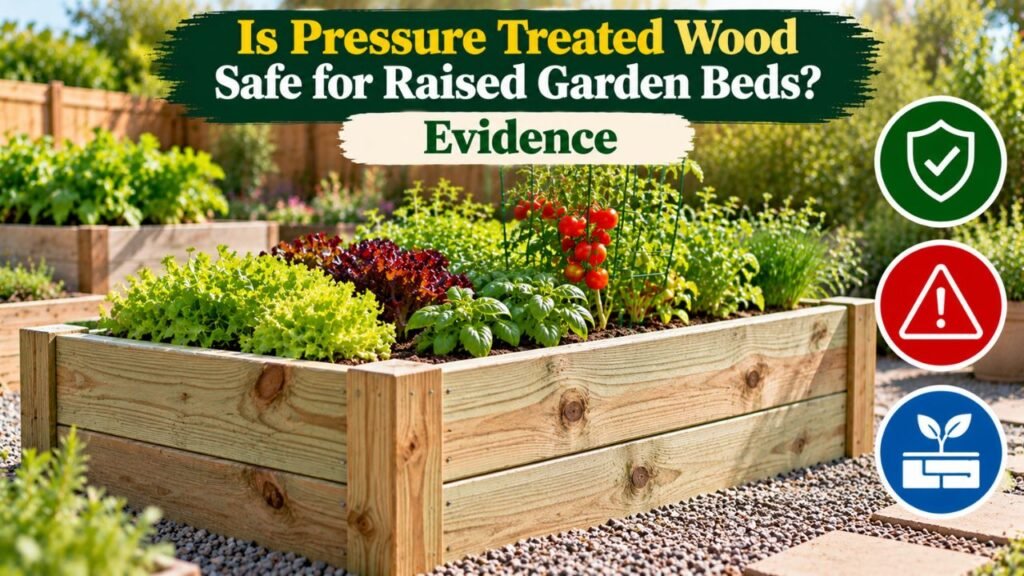
Modern pressure-treated lumber can be an appropriate material for constructing vegetable garden beds when it is specifically intended for residential outdoor use.
The most important factor is the wood preservative.
Many modern residential pressure-treated products use copper-based preservatives instead of older arsenic-containing treatments.
Copper helps protect lumber against fungal decay and wood-destroying insects.
However, copper is not completely immobile. Small amounts may move into nearby soil under certain conditions.
According to the University of Maryland Extension’s guidance on raised bed material safety, micronized copper azole (MCA), a common modern residential treatment, is considered low in toxicity. The guidance also discusses research that found limited copper movement into soil without increased copper concentrations in the tested vegetables.
For gardeners considering pressure-treated wood, the following conditions matter:
- Choose new lumber with a clearly identified preservative.
- Confirm that the product is approved for residential use.
- Select lumber rated for ground contact.
- Avoid older arsenic-treated wood.
- Avoid railroad ties and unidentified industrial lumber.
- Follow the manufacturer’s handling and installation instructions.
Key Takeaway: Modern residential pressure-treated wood and old arsenic-treated lumber should not be treated as equivalent materials. Their preservative formulations and intended applications differ significantly.
What Chemicals Are Used in Pressure Treated Wood?
Pressure-treated wood is manufactured by introducing preservatives into lumber using pressure and specialized treatment equipment.
These preservatives protect wood from organisms that cause decay and insect damage.
Different treatment formulations have been used over time.
Micronized Copper Azole (MCA)
Micronized Copper Azole is commonly used in residential pressure-treated lumber.
It contains copper-based preservative components but does not use the arsenic found in older CCA-treated lumber.
MCA-treated wood is used for outdoor construction applications such as decking, landscaping structures, and other approved uses.
For raised garden beds, choose a product rated for the expected soil contact and moisture exposure.
Although MCA is generally considered a lower-concern alternative to older arsenic-based treatment, it is still treated wood.
Follow the manufacturer’s directions rather than assuming that any MCA product is appropriate for every application.
Copper Azole (CA)
Copper azole is another modern wood preservative.
It uses copper along with additional ingredients that help protect wood against decay.
Different formulations may be identified by designations such as CA-C.
Copper azole-treated lumber can be suitable for raised bed construction when the product is approved for residential use and the intended exposure conditions.
The treatment concentration and use category matter.
A board intended for above-ground construction may not provide the same durability as lumber rated for continuous ground contact.
Alkaline Copper Quaternary (ACQ)
Alkaline Copper Quaternary is a preservative system that uses copper and quaternary ammonium compounds.
It does not contain the arsenic used in traditional CCA treatment.
ACQ-treated lumber is commonly used for outdoor structures where decay resistance is important.
The product’s intended use should still be verified before purchasing.
Copper-based preservatives can also contribute to corrosion of incompatible metal fasteners.
Use screws, brackets, and other connectors approved for the specific treated lumber.
Chromated Copper Arsenate (CCA)
CCA is an older wood preservative containing chromium, copper, and arsenic.
This treatment was widely used in outdoor residential structures before the early 2000s.
Manufacturers voluntarily discontinued CCA treatment for most residential applications at the end of 2003, with the transition taking effect in 2004.
CCA remains permitted for certain specialized industrial uses, so it has not disappeared completely.
Older decks, fencing, landscape timbers, and salvaged construction materials may still contain CCA-treated wood.
For a new edible garden, avoid using CCA-treated lumber.
The fact that an existing structure contains CCA does not automatically mean it presents an immediate emergency or must be removed. However, repurposing unknown or older treated lumber into a vegetable bed is an avoidable source of uncertainty.
Pressure-Treated Wood Preservative Comparison
| Wood Treatment | Contains Arsenic? | Raised Vegetable Bed Suitability |
| MCA | No | Generally suitable when residential-approved |
| CA-C | No | Suitable when properly rated and approved |
| ACQ | No | Generally suitable for appropriate residential use |
| CCA | Yes | Avoid for new vegetable beds |
| Creosote-treated wood | Not a copper-based residential treatment | Avoid |
| Pentachlorophenol-treated wood | Different industrial preservative | Avoid |
The treatment name alone isn’t enough to establish suitability. Always verify the product label and intended use.
Does Pressure Treated Wood Leach Chemicals Into Garden Soil?
Yes. Copper-based pressure-treated wood can release small amounts of copper into adjacent soil.
However, chemical movement into soil doesn’t automatically mean harmful amounts are entering edible crops.
The amount of copper released and its movement depend on several factors:
- Preservative formulation
- Wood treatment level
- Soil moisture
- Soil pH
- Soil organic matter
- Soil texture
- Time exposed to weather and irrigation
Copper naturally occurs in soils and is an essential plant micronutrient.
Plants require small quantities for normal development.
However, excessively high copper concentrations can affect plant growth and soil organisms.
The important question is whether treated lumber causes copper to accumulate at concerning levels in the growing medium or edible plants.
What Oregon State University Research Found
Researchers at Oregon State University studied raised beds constructed from copper azole-treated Douglas-fir lumber and compared them with beds made from untreated Douglas-fir.
Their research examined copper concentrations in the soil and in vegetables grown inside the beds.
According to Oregon State University’s April 2026 research update on pressure-treated raised beds, the study found:
- Copper concentrations increased in soil directly next to the treated lumber.
- The observed increases were confined to approximately 1 inch from the wood.
- Increases near the wood ranged from roughly 20–68 parts per million above comparison-bed levels across four growing seasons.
- Soil sampled farther inside the beds did not show increased copper concentrations.
- The vegetables and herbs tested did not show increased copper concentrations compared with those grown in untreated beds.
The crops studied included lettuce, carrots, beets, radishes, tomatoes, peppers, kale, and several other vegetables and herbs.
The researchers concluded that the observed copper movement did not result in increased copper concentrations in the tested edible crops under the study conditions.
These findings provide useful evidence supporting the use of properly rated copper azole-treated lumber.
What the Research Does Not Prove
The results do not establish that every pressure-treated product behaves identically.
The Oregon State study examined a particular copper azole formulation, specific soils, and defined growing conditions.
Different preservatives, soil chemistry, and exposure conditions may produce different results.
The research also should not be interpreted as evidence that all treated lumber is appropriate for vegetable gardening.
Older arsenic-based treatments and industrial preservatives require separate consideration.
Key Takeaway: Modern copper-treated lumber can release small amounts of copper into adjacent soil, but the cited study did not detect increased copper concentrations in the vegetables grown in the tested raised beds.
Is Old Pressure Treated Wood Safe for Raised Beds?
Old pressure-treated wood deserves greater caution than new lumber with a verified treatment label.
Before the 2004 transition away from CCA for most residential applications, arsenic-containing pressure-treated wood was common in outdoor construction.
Consequently, reclaimed lumber from older structures may have a different treatment history from lumber sold for residential use today.
Avoid Reusing Old CCA-Treated Lumber
If you know that boards were treated with CCA, don’t use them to build a new vegetable garden bed.
The same caution applies to lumber that may have received industrial wood preservatives.
When treatment information is unavailable, identifying the preservative by appearance alone is unreliable.
CCA-treated wood may have a greenish appearance, but some newer copper-based products can also look green.
Color is not a dependable chemical identification method.
Avoid Unknown Reclaimed Wood
Reclaimed lumber can reduce construction costs, but its history matters.
Be cautious with:
- Old landscape timbers
- Demolition lumber
- Industrial pallets
- Utility poles
- Railroad ties
- Wood with unknown coatings
- Lumber with chemical stains or odors
Even untreated wood may have been exposed to chemicals during its previous use.
For an edible garden, new lumber with a verified label provides greater certainty.
What if Your Existing Raised Bed Uses Old Treated Wood?
First, determine whether the wood is actually treated and whether its preservative can be identified.
Don’t assume every older wooden bed contains CCA.
If CCA is suspected, avoid unnecessary cutting, sanding, or handling that creates dust.
Consider contacting a local cooperative extension service or qualified environmental laboratory for guidance on identifying the material and testing soil where appropriate.
A soil test designed for ordinary fertility measurements may not include arsenic.
Ask specifically about testing for relevant contaminants.
If replacement is appropriate, use suitable materials and follow local disposal instructions.
How to Choose Safe Pressure Treated Wood for Raised Garden Beds
Selecting the right lumber is more useful than relying on broad claims that pressure-treated wood is either completely safe or always unsafe.
Check the Preservative Label
Look for the treatment information on the board’s end tag or manufacturer documentation.
The label may identify:
- Preservative formulation
- Intended application
- Treatment use category
- Ground-contact suitability
- Manufacturer
- Applicable installation instructions
Look for recognized residential copper-based treatment systems rather than unidentified treated lumber.
If the label is missing, ask the supplier for documentation.
Choose Ground-Contact-Rated Lumber
Raised bed walls remain in contact with moist soil for long periods.
That environment is more demanding than many above-ground outdoor applications.
Ground-contact-rated lumber is treated for greater exposure to moisture and decay.
Select the appropriate treatment category according to the manufacturer’s specifications.
A product suitable for ordinary above-ground decking may not provide the same service life when used against damp garden soil.
Inspect the Boards Before Purchasing
Choose boards that are reasonably straight and structurally sound.
Avoid pieces with:
- Severe cracks
- Major warping
- Extensive damage
- Rotten areas
- Large defects near fastener locations
Wood naturally changes dimensions as its moisture content changes.
Pressure-treated boards may also shrink as they dry.
Straight, sound lumber makes it easier to assemble a stable raised bed.
Use Compatible Screws and Brackets
Copper-based preservatives can increase corrosion problems with unsuitable metal connectors.
Use fasteners approved for contact with the specific treated lumber.
Depending on the product and application, suitable options may include specified corrosion-resistant coated fasteners or stainless steel.
Follow hardware manufacturer compatibility information.
Do not assume ordinary interior screws are suitable for long-term outdoor soil-contact construction.
Do You Need a Liner With Pressure Treated Wood Raised Beds?
No, a liner is not automatically required when using modern residential-approved pressure-treated wood. However, a suitable liner can provide an additional barrier between the treated boards and the growing medium.
Some gardeners prefer this precaution even when using modern copper-based preservatives.
Benefits of a Raised Bed Sidewall Liner
A liner can reduce direct contact between soil and treated wood.
This may be useful if you want additional separation from the preservative-treated surface.
A suitable liner may also help limit soil movement through small gaps between boards.
However, its effectiveness depends on the material and installation.
A liner does not automatically make unknown or unsuitable chemically treated lumber appropriate for edible gardening.
How to Install a Liner Correctly
For an ordinary open-bottom raised bed:
- Choose a durable liner intended for appropriate garden or outdoor applications.
- Cut it to fit the inside walls.
- Attach it securely without creating unnecessary punctures.
- Avoid large folds that trap water against the boards.
- Keep the bottom open when the bed sits over suitable native soil.
- Confirm that water can drain normally.
If the bed has a solid bottom, it needs a suitable drainage system.
Don’t install an impermeable liner across the base of an open-bottom raised bed simply to prevent soil contact with treated wood.
That can restrict root growth and interfere with drainage.
Can You Use Landscaping Fabric Instead?
Landscape fabric is generally more permeable than solid plastic sheeting.
It may reduce direct contact with some soil particles, but it isn’t equivalent to a continuous moisture or chemical barrier.
If the goal is to create separation from treated wood, choose a suitable barrier material rather than assuming ordinary weed-control fabric provides the same function.
How Long Does Pressure Treated Wood Last in Raised Garden Beds?
Pressure-treated wood generally resists decay longer than untreated softwood under comparable conditions.
However, there is no guaranteed lifespan for every treated raised bed.
Durability depends on:
- Wood species
- Treatment formulation
- Preservative retention
- Ground-contact rating
- Board thickness
- Local climate
- Drainage
- Construction quality
Pressure Treated Wood vs. Untreated Pine
Untreated pine can deteriorate relatively quickly in continuously moist soil.
Pressure treatment helps protect wood from the fungi and insects responsible for biological deterioration.
The difference can be substantial in wet climates.
In Oregon State University’s raised bed study, the untreated Douglas-fir beds showed serious lower-board decay by the sixth growing season, while the copper azole-treated beds remained mostly intact with comparatively minor deterioration.
That is a site-specific observation rather than a universal lifespan guarantee.
Pressure Treated Wood vs. Cedar
Certain cedar species contain naturally decay-resistant heartwood.
Cedar can be a practical alternative for gardeners who prefer wood without added pressure-treatment preservatives.
However, cedar generally costs more than common treated softwood, and not every cedar board has the same durability.
Pressure-treated lumber may offer a better initial cost-to-durability balance in some regions.
Cedar may be preferable when minimizing added preservatives is the priority.
Pressure Treated Wood vs. Redwood
Redwood heartwood also has natural resistance to decay.
It can make an attractive raised bed material but may be expensive or difficult to obtain in some parts of the United States.
Like cedar, actual durability depends on wood quality, exposure, and construction.
Redwood isn’t automatically permanent or immune to moisture damage.
Pressure Treated Wood vs. Untreated Wood for Raised Beds
Both treated and untreated lumber can be suitable options.
The better choice depends on budget, maintenance preferences, and how comfortable you are with the materials used.
| Feature | Modern Pressure-Treated Wood | Untreated Wood |
| Preservatives | Contains approved chemical preservatives | No added pressure-treatment preservatives |
| Decay resistance | Usually higher than untreated softwood | Depends strongly on species |
| Soil-contact suitability | Select ground-contact-rated boards | Durable species preferred |
| Initial cost | Often lower than premium cedar | Pine may be cheaper; cedar costs more |
| Maintenance | Periodic structural inspection | Periodic inspection and possible replacement |
| Vegetable garden use | Generally suitable with approved treatment | Suitable when wood source is appropriate |
| Main limitation | Requires checking treatment and intended use | May deteriorate faster |
When Pressure-Treated Wood Makes Sense
Modern treated lumber may be the practical choice when:
- You want a long-lasting raised bed on a moderate budget.
- Your garden receives frequent rainfall.
- The frame will remain in contact with damp soil.
- You can verify the preservative and ground-contact rating.
- You want to reduce how often boards need replacement.
When Untreated Wood Makes Sense
Untreated wood may be preferable when:
- You want to avoid added wood preservatives.
- You prefer natural cedar or redwood.
- You are comfortable replacing boards when necessary.
- You are constructing a temporary garden bed.
- A suitable naturally durable species is affordable locally.
The decision is partly about practical durability and partly about personal preferences concerning treated materials.
How to Build a Raised Garden Bed With Pressure Treated Wood
Once you’ve selected suitable lumber, construction details help determine how reliably the bed performs.
Step 1: Plan the Raised Bed Dimensions
Choose a width that allows you to reach the center without stepping inside.
A width of approximately 3–4 feet is practical for many gardeners when the bed is accessible from both sides.
Determine the desired soil depth based on the intended crops.
A 12-inch-high open-bottom bed can work well over healthy native soil, while beds with solid bottoms may need additional depth.
Step 2: Choose the Correct Lumber
Select new, ground-contact-rated residential pressure-treated lumber.
Verify the preservative and intended use.
Choose boards thick enough for the planned frame dimensions and soil load.
Long or tall beds require additional structural reinforcement to prevent the sides from bowing outward.
Step 3: Cut the Boards Safely
Use appropriate eye protection and respiratory protection when cutting treated lumber.
Work outdoors or in a properly controlled work area to reduce dust exposure.
Avoid creating unnecessary sawdust.
Follow the product’s handling instructions and use suitable equipment for the cutting operation.
Don’t use treated wood sawdust as garden mulch or compost.
Step 4: Protect Cut Ends When Required
Cutting treated lumber can expose interior wood that has received less preservative.
Some manufacturers recommend applying an appropriate cut-end treatment.
Use only a product permitted for the intended application and follow its label instructions.
Don’t apply unidentified preservatives or household chemicals to the wood.
Step 5: Assemble the Frame
Fasten the boards using compatible exterior-rated hardware.
Install appropriate corner supports and reinforcement where necessary.
Check that the structure is square and reasonably level.
A raised bed must resist the outward pressure of moist soil.
Don’t rely on thin unsupported boards for a tall or unusually long frame.
Step 6: Add an Optional Sidewall Liner
If you want additional separation between the soil and treated lumber, install a suitable barrier along the inside walls.
Keep drainage and root access in mind.
For a bed installed directly over suitable garden soil, leaving the bottom open is generally useful.
Step 7: Fill the Bed With Suitable Soil
Use a growing medium that provides moisture retention, drainage, and adequate root space.
A mixture of suitable topsoil and finished compost can work well in open-bottom beds.
Avoid filling the entire structure with pure compost or poorly draining fill material.
Water gently after filling to help the soil settle.
How to Handle and Maintain Pressure Treated Raised Bed Lumber Safely
Proper handling matters even when the lumber uses modern residential preservatives.
Wear Protection When Cutting or Drilling
Wood dust can irritate the respiratory system, eyes, and skin.
Use appropriate respiratory and eye protection when cutting treated wood.
Follow power tool safety instructions.
Wash your hands after handling treated lumber, especially before eating or preparing food.
Never Burn Pressure-Treated Wood
Burning preservative-treated lumber can release hazardous substances into smoke and ash.
Don’t burn pressure-treated scraps in:
- Fire pits
- Wood stoves
- Fireplaces
- Campfires
- Garden burn piles
Dispose of treated wood according to local waste-management rules.
Avoid Using Treated Wood Scraps as Mulch
Don’t shred pressure-treated lumber for use around vegetables.
Wood chips or sawdust from treated boards should not be incorporated into garden soil.
Use clean, suitable organic mulch materials instead.
Inspect the Raised Bed Periodically
Check for loose fasteners, splitting, bowing, and deterioration.
Pay particular attention to corners and sections exposed to persistent moisture.
Repair structural problems before the frame becomes unstable.
A properly constructed treated wood bed may require fewer decay-related repairs than untreated pine, but it still needs occasional inspection.
Are There Safer Alternatives to Pressure Treated Wood?
If you prefer not to use pressure-treated lumber, several other materials can provide durable garden structures.
Cedar
Cedar is a popular untreated wood choice for vegetable gardens.
Certain cedar heartwoods naturally resist decay, making them useful for soil-contact applications.
It offers a traditional appearance and is easy to work with.
However, cost and durability vary with species and board quality.
Redwood
Suitable redwood heartwood offers natural decay resistance.
It can be an attractive material for raised bed construction.
However, regional availability and price may limit its practicality.
Black Locust
Black locust is another naturally decay-resistant wood.
It can be highly durable in outdoor applications.
However, suitable lumber may be difficult to source, and the dense wood can be harder to cut and fasten.
Galvanized Steel
Galvanized steel raised beds don’t require wood preservatives.
They are available as prefabricated kits in various shapes and sizes.
Choose a product manufactured for gardening and inspect the structure for appropriate edge protection and drainage.
Stone or Brick
Stone and brick provide durable alternatives that don’t rely on wood preservatives.
However, they are heavy and may require more installation work.
Larger structures need proper foundation preparation and support.
Recycled Plastic Lumber
Some plastic lumber products offer resistance to moisture-related decay.
However, composition and manufacturing quality vary.
Choose materials specifically intended for outdoor gardening, particularly when growing edible crops.
Common Mistakes When Using Pressure Treated Wood for Raised Beds
Several mistakes can undermine the benefits of treated lumber.
Assuming Every Pressure-Treated Board Is the Same
Residential copper-based preservatives and older arsenic-containing treatments are different materials.
The label and intended use determine whether a product is appropriate.
Avoid buying unidentified treated lumber solely because it is inexpensive.
Using Above-Ground Lumber Against Wet Soil
A raised bed frame experiences extended moisture exposure.
Boards treated only for less demanding above-ground conditions may deteriorate sooner than expected.
Choose lumber with an appropriate ground-contact rating.
Reusing Unknown Older Lumber
Old boards can have an uncertain treatment and contamination history.
A low purchase price doesn’t justify introducing questionable material into a food-growing area.
Using Incompatible Metal Fasteners
Certain treated wood preservatives can accelerate corrosion of unsuitable fasteners.
Choose hardware approved for contact with treated lumber.
Structural failure may occur at weakened connections even when the boards remain sound.
Installing a Waterproof Bottom Without Drainage
A plastic liner covering the entire bed bottom can restrict water movement.
Use an appropriate drainage design, particularly for contained beds on concrete.
For ordinary open-bottom raised beds, a full waterproof bottom is generally unnecessary.
Assuming Treated Lumber Guarantees Healthy Soil
The frame material is only one part of a raised bed garden.
Healthy vegetables still require suitable soil, water, drainage, nutrients, and sunlight.
Pressure-treated lumber improves decay resistance; it doesn’t correct poor soil conditions.
Conclusion
Is pressure treated wood safe for raised garden beds? Yes, modern residential pressure-treated lumber is generally considered an acceptable choice when it uses suitable copper-based preservatives and is rated for ground contact.
Research from Oregon State University found limited copper movement into soil directly beside treated boards without increased copper concentrations in the vegetables examined under the study conditions.
However, older CCA-treated wood, creosote-treated railroad ties, and lumber with unknown treatment histories should be avoided for new edible garden beds.
For gardeners seeking a durable, reasonably priced wooden frame, properly selected modern pressure-treated lumber can be practical.
If you prefer to avoid wood preservatives entirely, cedar, redwood, black locust, stone, and other suitable materials offer alternatives.
The most important recommendation is to identify the treatment, confirm the intended use, and build the bed with appropriate materials rather than assuming every pressure-treated board is equally suitable.
FAQs About Is Pressure Treated Wood Safe for Raised Garden Beds
Can I Grow Vegetables Directly Against Pressure-Treated Wood?
Yes, vegetables can be grown in beds constructed from suitable modern residential copper-treated lumber.
Research on copper azole-treated raised beds found no increased copper concentrations in the tested vegetables, although a small increase occurred in soil directly next to the boards.
Gardeners who want additional separation can install an appropriate liner along the inside walls.
Is Pressure-Treated Pine Safe for Raised Garden Beds?
Modern pressure-treated pine can be suitable for raised garden beds when it uses residential-approved preservatives and carries the appropriate ground-contact rating.
The preservative formulation and use category matter more than the pine species alone.
Is Pressure-Treated Wood Safe for Organic Vegetable Gardening?
For an ordinary home garden managed with organic methods, the decision depends on the specific lumber and your material preferences.
However, certified organic production has additional material requirements. Don’t assume pressure-treated lumber is permitted merely because it is approved for residential use.
If certification is involved, consult your certifying organization before constructing the bed.
Do I Need to Seal Pressure-Treated Wood Before Using It in a Raised Bed?
Not necessarily. Modern pressure-treated lumber is already treated to resist decay.
An appropriate exterior coating or sidewall liner may provide additional separation or weather protection, but it isn’t automatically required.
Follow the manufacturer’s recommendations, particularly for cut ends.
Does Pressure-Treated Wood Contaminate Raised Bed Soil?
Modern copper-treated lumber can release small amounts of copper into nearby soil.
However, the Oregon State University study found the measured increases were concentrated near the wood and did not produce increased copper concentrations in the tested vegetables.
Those findings do not apply automatically to every preservative or soil condition.
Is Cedar Safer Than Pressure-Treated Wood for Raised Beds?
Untreated cedar avoids the added preservatives found in pressure-treated lumber.
That makes it appealing to gardeners who want to minimize preservative exposure.
However, appropriately rated modern copper-treated lumber is also considered a suitable option for many residential vegetable beds. Cedar generally costs more, and its durability depends on the species and heartwood content.
Can I Use Old Pressure-Treated Deck Boards for a Raised Garden Bed?
It’s best to avoid old treated deck boards unless their preservative and use history can be reliably established.
Boards from structures built before 2004 may contain CCA, and reclaimed lumber can have other unknown exposures.
New, clearly labeled material is a more dependable choice for an edible garden.

I’m Maya L. Greenwood, a lifelong plant lover who believes anyone can grow something beautiful with the right guidance. After years of testing soil mixes, pruning methods, irrigation tricks, and pest-safe solutions, I started EasyGardenTips.com to turn hard-won lessons into step-by-step advice. From seed starting and container gardens to composting and seasonal checklists, my goal is to make gardening simple, sustainable, and fun.