How Long Will Pressure Treated Wood Last in Raised Beds? By Type
Ground-contact-rated pressure-treated wood can last for decades in raised garden beds, with some properly treated lumber remaining serviceable for 30 years or longer. However, the actual lifespan depends on the wood species, preservative treatment, moisture exposure, climate, and construction quality. Some raised bed frames deteriorate considerably sooner, especially when the lumber is not rated for continuous soil contact.
Pressure treatment protects wood against fungal decay and certain wood-destroying insects, but it does not make lumber completely resistant to damage. Constantly wet soil, poor drainage, exposed cut ends, and inadequate structural support can shorten the life of a raised garden bed.
The type of treated wood matters as much as the treatment itself. Lumber designed for outdoor use above ground may not perform as well when pressed against damp garden soil throughout the year.
In this article, I cover how long different pressure-treated woods typically last, the factors that influence decay, ground-contact ratings, comparisons with cedar and untreated pine, vegetable gardening safety, and practical maintenance methods. You’ll also learn how to identify rotting boards and decide when repair or replacement is necessary.
How Long Will Pressure Treated Wood Last in Raised Beds?
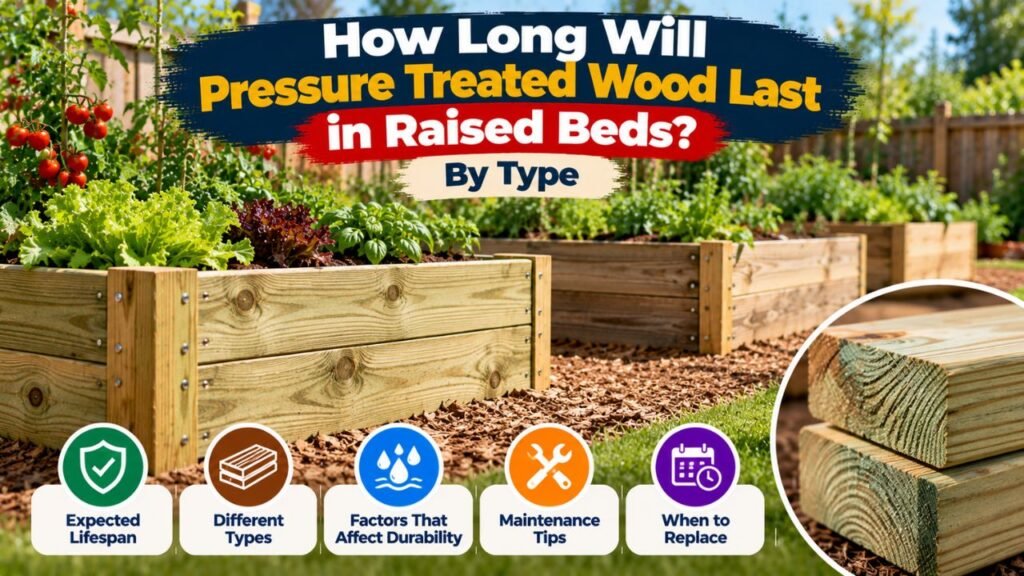
Properly treated lumber rated for continuous ground contact can remain usable for decades, but there is no guaranteed replacement schedule.
For planning purposes, a service life of 15–30 years or longer is possible with suitable pressure-treated lumber. Actual results may be shorter in particularly demanding conditions.
According to South Dakota State University Extension’s raised-bed gardening guide, pressure-treated wood can last 30 years or more, while naturally decay-resistant species such as cedar, redwood, and juniper may last approximately 15–30 years.
These are broad service-life estimates, not guarantees for every wood product or climate.
A properly constructed bed using ground-contact-rated lumber may remain structurally sound for many growing seasons. However, moisture conditions, preservative penetration, and the quality of the original construction influence how long that happens.
Expected Lifespan by Wood Type
Different lumber materials offer different levels of natural or chemical decay resistance.
| Raised bed wood material | General lifespan expectation | Main consideration |
| Ground-contact pressure-treated lumber | Can last 30 years or longer | Requires appropriate treatment and conditions |
| Above-ground-rated treated lumber | Variable; less suitable for continuous soil contact | May decay prematurely in raised beds |
| Untreated pine or fir | Often several years | Susceptible to moisture-related decay |
| Untreated cedar | Can last many years; 15–30 years is possible for suitable material | Natural resistance varies by species and wood quality |
| Untreated redwood | Can last many years; 15–30 years is possible for suitable material | Heartwood generally performs better |
| Untreated juniper | Can last many years; 15–30 years is possible for suitable material | Durability depends on wood characteristics |
These ranges and descriptions reflect broad material performance rather than controlled predictions for identical raised beds.
For pressure-treated lumber, the most important distinction is whether the preservative treatment is appropriate for direct soil contact.
Does Pressure-Treated Wood Last Longer Than Untreated Wood?
Yes. Pressure-treated lumber generally lasts longer than untreated lumber of the same species and comparable dimensions when both are exposed to damp soil.
Untreated pine and fir contain relatively little natural resistance to decay.
Fungi can gradually break down the wood when moisture and temperature conditions are favorable.
Pressure treatment introduces preservatives that help resist this biological deterioration.
However, a pressure-treated board can still split, warp, or fail at a poorly designed connection.
Key Takeaway: Properly rated pressure-treated wood offers a longer potential service life than ordinary untreated softwood, but the frame still requires suitable construction and periodic inspection.
Why Does Pressure-Treated Wood Last Longer in Raised Beds?
Pressure-treated wood receives chemical preservatives through an industrial treatment process.
The process generally uses vacuum and pressure to help preservative chemicals penetrate the wood.
These preservatives reduce the ability of certain fungi and insects to damage the material.
How Pressure Treatment Protects Against Rot
Wood decay occurs when suitable fungi break down the material’s structural components.
Moisture is a major factor in this process.
Raised garden beds expose lumber to conditions that encourage decay because the inner surfaces remain close to damp soil.
Pressure-treated wood contains preservatives that interfere with the biological processes responsible for deterioration.
This slows the breakdown of the wood.
However, treatment does not make the wood waterproof.
It can still absorb and release moisture as environmental conditions change.
Common Pressure-Treated Wood Preservatives
Modern residential pressure-treated lumber commonly uses copper-based preservative systems.
Examples include:
- Alkaline Copper Quaternary (ACQ): A copper-based preservative formulation used to protect wood against decay and insects.
- Copper Azole (CA): A preservative system combining copper with additional protective ingredients.
- Micronized Copper Azole (MCA): A treatment using micronized copper particles and complementary preservative components.
The exact formulation varies by manufacturer, wood species, and intended application.
Different treatments also have specific loading and exposure requirements.
A product’s durability cannot be determined from the preservative name alone.
Check the treatment rating and product instructions before purchasing lumber for a raised garden bed.
Ground-Contact vs. Above-Ground Pressure-Treated Wood
Not all pressure-treated lumber is designed for the same environment.
This distinction is especially important for raised garden beds because the lumber remains exposed to moist soil.
Ground-Contact-Rated Lumber
Ground-contact-rated lumber is intended for demanding environments where wood touches soil or experiences prolonged moisture exposure.
Under the American Wood Protection Association (AWPA) Use Category System, UC4A generally covers ordinary ground-contact applications.
Some more demanding applications require higher treatment categories.
For typical residential raised garden beds, properly labeled UC4A lumber is a common choice, subject to the manufacturer’s intended-use instructions.
The product’s end tag should identify the applicable treatment category.
Do not assume all pressure-treated boards meet this requirement.
Above-Ground-Rated Lumber
Above-ground-rated pressure-treated lumber is generally intended for outdoor applications that do not involve continuous contact with soil.
For example, some decking, fencing, and exterior trim products may use treatments intended primarily for above-ground exposure.
Using this material directly against moist garden soil can expose it to more demanding conditions than its treatment was designed to withstand.
The result may be premature decay.
Even if the lumber looks similar to ground-contact-rated wood, its treatment level may be different.
Which Treatment Rating Is Best for Raised Beds?
For raised beds in contact with natural soil, choose a residential-use preservative-treated product specifically labeled for ground contact.
Check the label for:
- AWPA use category or another recognized applicable treatment standard
- Preservative type
- Intended application
- Manufacturer identification
- Any use restrictions
- Instructions for treating field-cut ends
If the intended-use category is unclear, ask the lumber supplier or manufacturer before installation.
Important: Ground-contact suitability describes decay-resistance performance. It does not by itself establish whether a particular preservative formulation is appropriate for edible gardening.
What Research Shows About Pressure-Treated Wood Durability
Research comparing treated and untreated raised garden beds provides useful evidence about how these materials perform under real growing conditions.
However, short-term testing cannot establish the final lifespan of a bed expected to remain in service for several decades.
Oregon State University’s Raised Bed Durability Study
Researchers at Oregon State University established raised beds using treated and untreated Douglas-fir lumber.
The treated boards contained copper azole preservatives intended for ground-contact applications.
At the beginning of the sixth growing season, the researchers observed extensive decay in the lower portions of the untreated wood beds.
Some untreated boards had lost more than half their cross-sectional material to deterioration in affected areas.
By comparison, the treated beds remained mostly intact, showing only minor fungal decay and some surface abrasion.
These observations are documented in Oregon State University’s pressure-treated wood raised-bed research.
The findings demonstrate a meaningful durability advantage for the tested pressure-treated material.
However, they do not prove that every pressure-treated raised bed will last for a particular number of years.
What the Findings Mean for Home Gardeners
The difference between treated and untreated lumber can become substantial after several growing seasons.
This is particularly relevant for beds that remain damp throughout much of the year.
However, the tested material, preservative, local climate, soil conditions, and irrigation methods all influence the results.
A raised bed installed in a different climate may deteriorate at a different rate.
The research supports choosing appropriately treated lumber when longer service life is a priority, while still considering the specific product and site conditions.
What Affects How Long Pressure-Treated Wood Lasts in Raised Beds?
Several environmental and construction factors influence the useful life of treated lumber.
Some can be controlled during construction, while others depend on the location and climate.
1. Constant Soil Moisture
Moisture exposure is one of the main conditions affecting raised bed lumber.
The inside surfaces of wooden beds frequently touch damp soil.
The lower edges may also remain wet from irrigation, rainfall, or poorly drained surrounding ground.
Even treated wood can deteriorate over time under prolonged moisture exposure.
The risk increases when water collects around structural connections or remains trapped between adjoining boards.
Maintaining suitable drainage helps reduce unnecessary exposure.
2. Local Climate and Rainfall
A raised bed in a warm, humid region may experience more demanding decay conditions than one in a relatively dry climate.
Frequent rain, warm temperatures, and high humidity can create favorable conditions for wood-decay fungi.
However, moisture exposure remains important even in dry regions because irrigation repeatedly wets the interior walls.
In colder climates, freezing and thawing may contribute to movement, checking, and stress on structural connections.
3. Lumber Thickness
Board thickness affects structural durability.
A thick board generally has more material available to resist bending and gradual deterioration than a much thinner board of similar quality.
For example, standard nominal 2-inch lumber is approximately 1.5 inches thick.
This is commonly used for raised bed frames.
Thinner boards may bow outward more easily under the pressure of wet soil, especially along long unsupported spans.
However, thicker lumber does not compensate for an inadequate preservative treatment.
4. Wood Species and Treatment Penetration
Different wood species absorb preservatives differently.
Some species require mechanical incising or other treatment procedures to help chemicals penetrate the wood.
The effectiveness of pressure treatment depends partly on preservative penetration and retention.
For that reason, two pieces of treated lumber with similar dimensions may perform differently.
Choose material that meets appropriate treatment standards instead of relying only on its color or weight.
5. Exposed Cut Ends
Cutting pressure-treated lumber can expose interior wood that may not have received the same degree of preservative penetration as the outer portions.
These fresh surfaces may be more vulnerable to moisture and decay.
This is especially relevant where cut ends contact soil or remain wet.
Field-cut ends should receive an appropriate preservative treatment when required by the product instructions.
Choose a treatment compatible with the lumber and its intended garden use.
6. Structural Support and Fasteners
A raised bed can become unusable before the wood has completely rotted.
Long sidewalls may bow outward, corner fasteners may loosen, or support posts may shift.
Wet soil exerts pressure on the frame.
Taller beds and longer unsupported walls require more substantial structural support.
Use fasteners approved for the particular preservative-treated lumber.
Some copper-based treatments can accelerate corrosion of incompatible metal fasteners.
Hot-dip galvanized or suitable stainless steel fasteners are commonly used, but their specific corrosion ratings must match the application.
How to Make Pressure-Treated Wood Last Longer in Raised Beds
Good construction and maintenance can help a treated wooden raised bed remain structurally sound for more growing seasons.
The goal is to reduce unnecessary moisture exposure, protect vulnerable areas, and prevent structural movement.
1. Buy Lumber Rated for Ground Contact
Begin with material intended for the expected exposure.
Check the treatment label before purchasing.
Do not choose above-ground-only lumber simply because it costs less.
The initial savings may disappear if the boards deteriorate prematurely.
Use products whose preservative formulation and intended application are suitable for the planned garden.
2. Protect Freshly Cut Wood Ends
Cut treated boards to the intended length before assembly.
Inspect the cut surfaces for exposed wood.
Apply an appropriate field-cut preservative according to the lumber manufacturer’s instructions.
Wear suitable protective equipment and follow the treatment product’s label.
Do not use an unidentified exterior pesticide or wood preservative near vegetable-growing soil.
Allow any applied product to cure as directed before bringing it into contact with the growing area.
3. Improve Drainage Around the Bed
Build the raised bed on stable ground that drains adequately.
Avoid placing the frame in a low area where water collects after rainfall.
For an open-bottom bed, suitable soil beneath the frame allows excess water to move downward.
If the location has persistent drainage problems, correct them before constructing the bed.
A raised bed should not serve as a substitute for proper landscape drainage where standing water regularly affects the site.
4. Avoid Excessive Irrigation Against the Walls
Keep the growing medium adequately moist for plants without repeatedly saturating it.
Drip irrigation and soaker hoses can distribute water more precisely than some overhead systems.
Position the irrigation components according to plant needs.
Do not sacrifice proper watering just to keep the lumber dry.
The objective is to prevent unnecessary waterlogging while maintaining healthy root conditions.
5. Keep Exterior Mulch Away From the Lower Boards
Mulch is useful for controlling weeds and conserving soil moisture.
However, thick piles of continuously wet mulch against the outside of wooden walls may increase moisture exposure.
Maintain an appropriate pathway surface without burying the lower boards under excessive mulch or soil.
Allow rainwater to drain away from the frame.
6. Reinforce Long Raised Bed Walls
Long, unsupported boards can gradually bow under soil pressure.
Add appropriate corner posts, midspan supports, or cross-bracing based on the bed design.
For example, an 8-foot-long raised bed wall may need additional support, particularly when the frame is tall.
Use structural components compatible with the treated lumber.
Reinforcement should be installed before the growing medium causes significant deformation.
7. Inspect the Frame Every Growing Season
Check the wood before planting and after periods of heavy rainfall.
Look for:
- Soft or crumbling wood
- Loose corner joints
- Severely rusted fasteners
- Bowed sidewalls
- Cracked or damaged supports
- Rotting lower edges
- Gaps between boards
- Soil leaking through damaged areas
Early repairs can prevent larger structural failures.
Key Takeaway: The most effective way to extend raised bed life is to combine properly rated treated lumber with sound construction, suitable drainage, and regular maintenance.
Should You Line Pressure-Treated Wood Raised Beds?
A liner can separate the growing soil from the treated wood.
However, lining a raised bed is mainly a soil-contact management decision, not a guaranteed way to extend lumber lifespan.
Using a Plastic Barrier Along the Sides
Some gardeners install a suitable heavy-duty plastic barrier against the inside surfaces of treated wooden walls.
The barrier can reduce direct contact between the soil and wood.
However, it must be installed carefully.
Avoid creating folds or enclosed spaces that trap water against the boards.
The lining should also be compatible with its intended use.
Do not assume that every plastic sheet is appropriate for food-growing applications.
Should the Bottom Be Covered With Plastic?
For an open-bottom raised bed built directly on natural ground, avoid installing a continuous waterproof plastic barrier across the bottom.
Such a barrier can prevent water from draining into the soil underneath.
It can also restrict root growth.
If a liner is used along the walls, the lower growing area should retain an appropriate drainage path.
Raised planters built over concrete or with solid bottoms require a different drainage design.
Does a Liner Make Treated Lumber Last Longer?
A properly installed side barrier may reduce direct exposure to wet soil.
However, its effect on actual lumber lifespan depends on how moisture moves around the wood.
Water can still enter from rainfall, exterior soil contact, joints, and exposed board edges.
A liner should not be treated as a substitute for appropriate wood treatment or drainage.
Is Pressure-Treated Wood Safe for Raised Vegetable Beds?
Modern pressure-treated lumber differs substantially from older products containing arsenic-based preservatives.
Many current residential products use copper-based treatments, including copper azole and micronized copper azole.
However, safety depends on the specific preservative formulation and intended application.
Modern Copper-Based Treatments
Modern residential pressure-treated lumber is commonly available with copper-based preservatives.
Research from Oregon State University found that copper concentrations increased in soil directly next to treated boards, but the increase was localized.
The study did not find increased copper concentrations in the sampled vegetables and herbs compared with those grown in untreated beds during the analyzed growing seasons.
These results are encouraging for the tested copper azole product under the study conditions.
They do not establish that every preservative formulation, soil type, or exposure scenario carries identical risks.
Gardeners should review the manufacturer’s product information before using treated lumber in edible raised beds.
Avoid Old CCA-Treated Wood
Older pressure-treated lumber may contain chromated copper arsenate (CCA), a preservative containing arsenic, chromium, and copper.
CCA-treated wood was phased out for most residential consumer applications in the United States by the end of 2003.
Avoid reusing old treated lumber of uncertain origin for vegetable gardens.
This is particularly important when the wood comes from demolished decks, fences, or other older outdoor structures.
Also avoid creosote-treated railroad ties and wood treated for industrial applications.
What if You Prefer Untreated Materials?
Gardeners who want to avoid preservative-treated wood can choose naturally decay-resistant materials.
Options include:
- Cedar
- Redwood
- Juniper
- Black locust
- Certain durable hardwoods
- Stone
- Concrete blocks
- Suitable metal raised bed systems
These materials have different costs, service lives, and maintenance requirements.
For a vegetable garden where avoiding chemical wood preservatives is a priority, naturally decay-resistant untreated lumber is a practical alternative.
Pressure-Treated Wood vs. Cedar for Raised Bed Longevity
Both pressure-treated lumber and cedar can be used to construct long-lasting raised beds.
However, they resist decay through different mechanisms.
Pressure-treated wood relies primarily on added preservatives.
Cedar obtains much of its natural decay resistance from compounds present in its heartwood.
| Feature | Pressure-treated lumber | Untreated cedar |
| Decay protection | Chemical preservative treatment | Natural heartwood resistance |
| Potential lifespan | Several decades with suitable treatment | Many years; depends on species and heartwood quality |
| Ground-contact suitability | Requires proper treatment rating | Depends on wood grade and exposure |
| Initial cost | Often relatively affordable | Frequently more expensive |
| Treatment chemicals | Contains preservative compounds | No added pressure-treatment preservatives |
| Maintenance | Periodic structural and corrosion checks | Periodic structural and decay checks |
| Best application | Cost-conscious, longer-life garden frames | Gardens prioritizing untreated materials |
Which Wood Lasts Longer?
Properly ground-contact-treated lumber can outlast many untreated cedar boards.
However, differences in species, heartwood content, board thickness, and growing conditions can change the result.
A high-quality cedar heartwood board may remain sound longer than poorly treated or incorrectly installed lumber.
Neither material has a guaranteed lifespan.
Which Is More Cost-Effective?
Pressure-treated lumber is often less expensive initially than premium cedar.
When appropriately rated material lasts for many growing seasons, its cost per year of use can be relatively low.
However, the total project cost also includes fasteners, supports, installation, and eventual disposal.
Cedar may appeal to gardeners who prefer untreated wood and accept the higher purchase price.
Compare actual local lumber prices rather than assuming either material is always the cheaper lifetime choice.
How to Tell if Pressure-Treated Raised Bed Wood Is Rotting
Treated wood can eventually deteriorate.
The important distinction is between ordinary cosmetic weathering and damage that reduces structural strength.
Surface Discoloration
Pressure-treated wood often changes color as it weathers.
Greenish or brown treatment colors may fade toward gray.
This is not necessarily a sign of rot.
A gray board can remain structurally sound for years.
Inspect the wood’s firmness and connections rather than relying only on color.
Soft or Spongy Wood
Soft wood that crumbles or breaks apart easily may indicate advanced decay.
The lower inside edges of a raised bed are particularly vulnerable because they remain close to damp soil.
Inspect accessible areas carefully.
Avoid applying excessive force to a visibly unstable wall.
Bowed or Bulging Sidewalls
Bowing can indicate structural stress, weakened support, or deteriorating boards.
The condition may develop even when the wood is not heavily decayed.
A significantly bulging wall should be addressed before it fails.
Do not attempt to straighten a heavily loaded wall by forcing it inward.
Loose Screws and Corner Connections
Fasteners may loosen when surrounding wood deteriorates.
Corrosion can also weaken screws, brackets, and other structural components.
If fasteners no longer hold securely, inspect the adjacent wood before attempting repairs.
Simply installing longer screws into decayed material may not restore adequate strength.
Fungal Growth and Cracking
Visible fungal growth can indicate damp conditions, but not every surface stain is evidence of structural decay.
Likewise, small surface checks and weathering cracks do not automatically mean a board needs replacement.
Deeper splitting, extensive softness, and loss of structural material are more serious concerns.
Evaluate the overall condition rather than treating every visual change as failure.
When Should You Replace Pressure-Treated Raised Bed Boards?
Replace boards when they can no longer safely retain the growing medium or support the frame.
Age alone is not a reliable replacement indicator.
A 15-year-old frame may remain serviceable, while a newer bed may need repairs because of poor construction or prolonged waterlogging.
Replace Boards Showing Structural Decay
Consider replacement when:
- Large sections of wood have become soft.
- The board has lost substantial thickness.
- Screws no longer hold securely.
- A wall is bowing dangerously.
- Corners have become unstable.
- Soil is escaping through deteriorated sections.
- The frame can no longer support the growing medium safely.
A board with cosmetic discoloration but sound structural condition may not require replacement.
Can You Replace One Board Without Rebuilding the Bed?
Yes. Individual boards can sometimes be replaced while keeping the rest of the raised bed.
However, the growing soil must be supported safely during the repair.
Wet garden soil is heavy.
Removing a weakened board from a full raised bed can release soil suddenly or destabilize adjoining walls.
For a small bed, it may be practical to remove some soil before replacing the damaged board.
For larger or taller beds, additional bracing or partial disassembly may be necessary.
Should You Replace All the Lumber at Once?
Not necessarily.
If only one board has deteriorated and the remaining frame is structurally sound, a localized repair may be sufficient.
However, inspect the corners and lower boards carefully.
When several sections show advanced decay, rebuilding the frame may be more reliable than repeatedly repairing individual pieces.
What Should You Do With Old Pressure-Treated Raised Bed Wood?
Treated wood requires appropriate disposal because it contains preservatives.
Do not burn pressure-treated lumber in fireplaces, outdoor fire pits, or garden bonfires.
Burning treated wood can release hazardous substances into smoke and ash.
Also avoid:
- Chipping treated lumber into garden mulch
- Adding treated wood to compost
- Burying deteriorated boards in vegetable-growing soil
- Reusing unidentified treated lumber for food-contact applications
Remove fasteners where practical and handle damaged boards with suitable protective equipment.
Follow local waste-management rules for disposal.
Some facilities accept residential treated wood as construction debris, while others have specific restrictions.
Is Pressure-Treated Lumber Worth Using for Raised Beds?
Pressure-treated lumber can be a practical choice when the goal is to build a durable raised bed without the cost of premium naturally decay-resistant wood.
Its main advantages are:
- Long potential service life
- Resistance to fungal decay
- Protection against certain wood-destroying insects
- Wide availability
- Often lower initial cost than premium cedar
- Familiar woodworking and framing methods
However, it also has limitations.
The wood contains preservatives, treatment ratings must be verified, and poorly constructed frames may fail even when the boards resist decay.
For edible gardening, choose products specifically intended for suitable residential applications and consider your comfort level with preservative-treated materials.
If avoiding chemical treatments is more important than maximizing service life, cedar, redwood, or suitable non-wood materials may be preferable.
For gardeners prioritizing cost and long-term durability, properly rated modern pressure-treated lumber is a reasonable option.
Conclusion
So, how long will pressure treated wood last in raised beds? Properly ground-contact-rated lumber can remain serviceable for decades, and some products may last 30 years or longer under suitable conditions.
The actual lifespan depends on treatment quality, lumber thickness, moisture exposure, climate, and structural maintenance.
Choosing the correct ground-contact rating is particularly important because raised bed walls spend much of their service life against damp soil.
For a durable wooden raised bed, select appropriate residential-use treated lumber, protect vulnerable cut ends, provide adequate drainage, and reinforce long walls.
Inspect the frame regularly and replace boards when structural deterioration develops rather than relying on age alone.
When installed correctly and maintained appropriately, pressure-treated wood can provide a long-lasting and economical frame for a vegetable or flower garden.
FAQs About How Long Will Pressure Treated Wood Last in Raised Beds
Can Pressure-Treated Wood Last 20 Years in a Raised Bed?
Yes. Properly rated and installed pressure-treated lumber can remain serviceable for 20 years or longer.
However, actual results depend on the preservative treatment, climate, moisture exposure, and frame construction.
Some appropriately treated materials may last 30 years or more.
Does Pressure-Treated Wood Rot When Buried in Soil?
Yes, it can eventually rot.
Pressure treatment slows fungal decay but does not make wood permanently immune to deterioration.
Using lumber rated for ground contact helps improve performance where wood remains exposed to damp soil.
How Long Does Untreated Pine Last Compared With Pressure-Treated Pine?
Untreated pine exposed to damp soil may begin deteriorating within a few years.
Properly pressure-treated pine can remain serviceable much longer, potentially for decades when the product and conditions are suitable.
The difference depends on the quality of the lumber and preservative treatment.
Is Ground-Contact Pressure-Treated Wood Better for Raised Beds?
Yes. Lumber rated for ground contact is generally better suited to raised beds because the boards remain in contact with moist soil.
Above-ground-rated treated lumber may not provide sufficient resistance under these conditions.
Check the treatment category and manufacturer instructions before purchasing.
Should You Seal Pressure-Treated Wood for Raised Beds?
Sealing or finishing may help manage moisture exposure, but it does not replace the need for properly rated lumber.
Choose a finish compatible with the treatment and intended garden application.
Freshly cut ends may require a specific field-cut preservative according to manufacturer instructions.
Will a Plastic Liner Make Pressure-Treated Wood Last Longer?
A properly installed side liner may reduce direct contact between wet soil and wood.
However, it does not guarantee a longer service life because moisture can still reach the boards from other directions.
Avoid lining the entire bottom of an open-bottom bed with waterproof plastic, which can restrict drainage.
Can You Use Old Pressure-Treated Wood for Vegetable Raised Beds?
Avoid reusing older pressure-treated lumber when its preservative treatment is unknown.
Wood treated with chromated copper arsenate was formerly common in residential construction, and this preservative contains arsenic.
Choose identifiable modern materials intended for suitable residential applications instead.
How Often Should You Inspect a Pressure-Treated Raised Bed?
Inspect the frame at least once each growing season and after significant storms or unusual ground movement.
Look for soft wood, loose fasteners, bulging walls, and unstable corner connections.
Replace or repair damaged components before the frame becomes unsafe.

I’m Maya L. Greenwood, a lifelong plant lover who believes anyone can grow something beautiful with the right guidance. After years of testing soil mixes, pruning methods, irrigation tricks, and pest-safe solutions, I started EasyGardenTips.com to turn hard-won lessons into step-by-step advice. From seed starting and container gardens to composting and seasonal checklists, my goal is to make gardening simple, sustainable, and fun.