How Long Does Raised Bed Soil Last? When and How to Refresh It
Raised bed soil can last for many years, and a well-maintained mineral-soil mixture can remain usable indefinitely. You don’t need to replace all the soil every spring. Instead, replenish organic matter when needed, correct nutrient shortages based on soil testing, and top up the bed as its contents settle.
What changes over time isn’t usually the mineral soil itself. Compost breaks down, vegetables use nutrients, and watering can shift loose materials into tighter layers. These changes may lower the soil surface or affect how well roots receive air and moisture.
A raised bed containing quality topsoil and mature compost often maintains its structure longer than one filled primarily with lightweight, organic potting mix.
Poor plant growth alone doesn’t prove the soil has worn out. Weather, watering, pests, and disease can produce similar symptoms, so replacing the entire bed without identifying the cause may waste money.
This guide explains how long different raised-bed soil mixtures remain useful, when to refresh them, how to recognize declining soil conditions, and when complete replacement may actually be necessary.
How Long Does Raised Bed Soil Last With Proper Care?

Raised bed soil does not have a fixed expiration date. A properly maintained mixture of mineral topsoil and finished compost can support plants for decades because the mineral components do not disappear through normal gardening.
However, the organic materials and nutrient supply change over time.
A garden bed that starts with good soil can remain productive through many planting seasons when you replenish organic matter appropriately and correct nutrient deficiencies.
The University of Minnesota Extension’s raised-bed gardening guidance recommends testing established raised-bed soil every two to three years and applying compost or fertilizer according to the results.
This approach treats raised-bed soil as a permanent growing resource that needs maintenance rather than routine replacement.
How Long Different Raised-Bed Soil Mixtures Remain Useful
| Soil type | Expected usability | Maintenance needs |
| Topsoil and finished compost | Many years or indefinitely | Periodic organic matter and nutrient replenishment |
| Commercial raised-bed soil | Many growing seasons when suitable | Monitor settling, moisture, and nutrients |
| Mostly soilless potting mix | Reusable, but structure changes over time | More attention to settling, aeration, and feeding |
| Soil with logs and leaves underneath | Reusable for many years | Additional filling as buried materials decompose |
| Contaminated soil | Depends on the contaminant and test results | Professional assessment and possible removal |
These are general expectations, not guaranteed replacement schedules.
The actual condition of a raised bed depends on the ingredients, drainage, climate, crop selection, and gardening practices.
Key Takeaway: A properly maintained raised bed usually needs occasional amendments and topping up, not a complete soil replacement every few years.
Does Raised Bed Soil Wear Out After Several Growing Seasons?
Not in the same way that a disposable product wears out.
Mineral soil contains sand, silt, and clay particles that remain in the bed unless they are physically removed or lost through erosion.
Organic matter behaves differently. Microorganisms gradually decompose compost, roots, and other plant residues.
As that material changes, some nutrients become available to plants, while part of the organic matter is lost through decomposition.
The soil may need additional organic material to maintain suitable growing conditions.
This process does not mean the entire growing medium has become unusable.
Why Does Raised Bed Soil Change Over Time?
Raised-bed soil is biologically active. Plant roots, microorganisms, moisture, and temperature all influence its condition.
Understanding these changes makes it easier to determine what needs improvement rather than replacing perfectly usable soil.
Compost and Organic Matter Gradually Decompose
Compost contains decomposed organic material that continues changing after being mixed into garden soil.
Microorganisms break down some of this material, gradually releasing nutrients and altering soil structure.
As decomposition continues, the volume of organic components may decrease.
This is one reason the soil surface in a newly filled raised bed often becomes lower after several months.
The effect may be particularly noticeable in beds containing large amounts of leaves, wood chips, branches, or other bulky organic materials.
A mineral-soil mixture generally maintains its volume more consistently than a bed filled mainly with decomposable materials.
Vegetables Use Nutrients From the Soil
Vegetables absorb nitrogen, phosphorus, potassium, and other nutrients as they develop.
When crops are harvested and plant material is removed, some of those nutrients leave the bed.
However, nutrient depletion doesn’t mean the soil itself has expired.
Different nutrients behave differently. Nitrogen can be lost through several processes, while phosphorus and potassium may remain available or accumulate depending on the soil and amendments.
Adding fertilizer or compost without checking existing nutrient levels may create imbalances.
A soil test provides more useful information than assuming every poorly performing raised bed needs additional fertilizer.
Soil Compaction Changes Drainage and Aeration
Raised beds are usually filled with loose growing mixtures that provide spaces for air and water movement.
Over time, these spaces may become smaller due to settling, foot traffic, or repeated handling.
Compacted soil can restrict root development and slow the movement of water.
Common warning signs include:
- Water pooling on the surface after normal watering.
- Soil becoming difficult to penetrate with a hand trowel.
- Dense clumps that remain hard after drying.
- Reduced root development despite suitable growing conditions.
Compaction is a physical soil problem, not proof that the growing medium needs complete replacement.
In many cases, avoiding foot traffic and carefully loosening affected areas can help restore suitable conditions.
How Do You Know When Raised Bed Soil Needs Refreshing?
The best way to judge raised-bed soil is to examine its physical condition, soil level, and plant performance.
A bed may need attention after one growing season, while another may remain in good condition for several seasons with relatively little amendment.
The Soil Level Has Dropped Noticeably
A falling soil surface is one of the clearest reasons to add more growing medium.
This commonly happens when:
- Loose soil settles after initial watering.
- Compost and other organic materials decompose.
- Soil is removed during harvesting or maintenance.
- Water causes erosion or washes soil through openings.
A small amount of settling is normal.
If the soil level has dropped enough to reduce useful rooting depth, top it up with an appropriate mixture.
For an open-bottom raised bed, adding quality topsoil blended with finished compost is often more practical than repeatedly filling the space with pure compost.
Plants Show Possible Nutrient Deficiencies
Weak growth, unusually pale leaves, and reduced vegetable production can indicate nutrient problems.
However, these symptoms are not specific to depleted soil.
Yellow leaves may also result from overwatering, insufficient sunlight, pests, root damage, or disease.
Before adding fertilizer, check the plants’ growing conditions and consider laboratory soil testing.
Important: Excess fertilizer can damage plant roots and cause nutrient imbalances. Adding more nutrients is not always the correct response to unhealthy plants.
Water Drains Too Slowly or Too Quickly
Healthy raised-bed soil should retain enough moisture for roots while allowing excess water to move away.
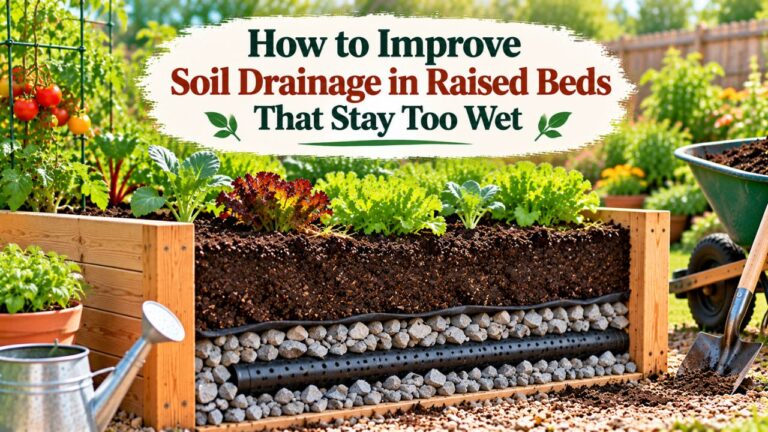
If the growing medium stays saturated for extended periods, investigate compaction, soil texture, and the drainage conditions underneath the bed.
If it dries unusually quickly, check whether the mixture contains excessive coarse organic material or has become difficult to rewet.
A raised bed on concrete also needs adequate drainage outlets.
These problems may require changes to watering or soil structure rather than complete replacement.
The Soil Surface Becomes Hard and Crusted
A hard surface crust may form after repeated watering or heavy rainfall, particularly in soils containing substantial fine mineral particles.
This can interfere with seed emergence and water infiltration.
Carefully breaking the surface crust and protecting the soil with suitable organic mulch may help.
Avoid digging or tilling the soil when it is extremely wet because working wet soil can worsen compaction.
How Often Should You Refresh Raised Bed Soil?
Inspect raised-bed soil before each major planting season, but add amendments according to its actual condition.
A soil refresh does not necessarily mean adding several inches of compost or replacing the top layer.
Sometimes removing old plant debris, gently loosening the surface, and applying suitable mulch are enough.
A Practical Raised-Bed Soil Maintenance Schedule
| When | Recommended soil care |
| Before each planting season | Check soil level, texture, drainage, and previous crop performance |
| During the growing season | Monitor moisture, mulch, and correct identified nutrient problems |
| After harvesting | Remove diseased debris, assess settling, and protect exposed soil |
| Every 2–3 years | Test established soil for pH and nutrient levels |
| When significant settling occurs | Add a compatible soil mixture to restore growing depth |
| When contamination is suspected | Arrange appropriate testing before growing edible crops |
This schedule is a maintenance framework rather than a requirement to apply amendments on every occasion.
A productive raised bed with good soil structure may need very little adjustment between growing seasons.
How to Refresh Raised Bed Soil Without Replacing It
Refreshing an established bed is usually simpler and less expensive than removing its entire contents.
The objective is to preserve the existing mineral soil while improving any deficiencies in structure, organic matter, or nutrients.
Step 1: Remove Spent Plants and Unwanted Debris
After harvesting, remove dead annual plants, large unwanted roots, and weeds.
Healthy plant residues can be composted when appropriate.
For plants showing significant disease symptoms, follow disease-specific disposal recommendations rather than automatically adding them to a home compost pile.
It is not necessary to remove every small root from the soil.
Fine roots naturally decompose and contribute organic material as microorganisms break them down.
Step 2: Check Soil Texture and Moisture
Take a handful of slightly moist soil.
A suitable loamy growing medium generally forms a loose clump when squeezed and breaks apart with gentle pressure.
Extremely sticky soil may contain excessive clay or be too wet to handle.
A mixture that falls apart immediately and resists absorbing water may need closer attention to moisture retention.
Examine several spots rather than judging the entire bed from one handful.
Also check whether water moves through the growing medium at a reasonable rate.
Step 3: Test the Soil Before Making Major Amendments
Soil testing helps identify nutrient shortages, excessive nutrient levels, and unsuitable pH.
For established raised beds, testing every two to three years is a useful schedule.
A standard garden soil test commonly provides information about:
- Soil pH.
- Phosphorus and potassium levels.
- Organic matter content.
- Soil texture or related characteristics, depending on the laboratory.
- Fertilizer and amendment recommendations.
Some laboratories offer additional testing for soluble salts, heavy metals, or other concerns.
Collect representative soil samples according to the laboratory’s instructions.
Use the results to decide whether compost, fertilizer, lime, or another amendment is necessary.
Step 4: Add Finished Compost When Needed
A modest amount of finished compost can help maintain organic matter and improve soil structure.
The Oregon State University Extension’s compost application guidance recommends approximately ¼–1 inch of compost annually for existing vegetable garden beds, with other amendments guided by soil testing.
This is a general application range, not a requirement to add the maximum amount every year.
If the raised bed already contains substantial organic matter or elevated phosphorus, reduce or skip compost additions according to the soil test.
Choose finished compost that smells earthy and contains no obvious uncomposted food scraps or other unwanted materials.
Avoid large, repeated applications of manure-based compost without checking nutrient levels because these materials can contribute phosphorus and soluble salts.
Step 5: Restore the Soil Level if Necessary
If decomposition or settling has lowered the soil surface significantly, add an appropriate growing mixture.
For an open-bottom raised bed, suitable topsoil blended with finished compost is a useful option.
Spread the material evenly and gently blend it into the upper layer if necessary.
Avoid adding large amounts of fresh wood chips or uncomposted material directly into the root zone.
Leave approximately 1–2 inches below the top of the frame for watering and mulching.
The amount required depends on how much the original soil surface has dropped.
Step 6: Loosen Compacted Areas Carefully
If the soil has become compacted, use a garden fork or hand cultivator to gently loosen affected areas.
Avoid repeatedly turning the entire bed upside down.
Established raised beds generally benefit from minimal soil disturbance because excessive tillage can disrupt soil structure and bring buried weed seeds to the surface.
Do not step inside the raised bed while working.
For beds that remain waterlogged despite surface loosening, inspect the drainage conditions underneath before adding more materials.
Step 7: Protect the Refreshed Soil
After preparing the bed, cover exposed soil with an appropriate organic mulch or grow a suitable cover crop.
Mulch can help reduce evaporation, erosion, and surface crusting.
Shredded leaves, clean straw, and other suitable plant materials may be used.
Keep mulch away from newly planted seeds when it could interfere with germination.
Water the soil as needed, allowing excess moisture to drain.
The bed can then be replanted when growing conditions are suitable.
How Much Compost Do You Need to Refresh Raised Bed Soil?
The amount of compost required depends on the bed’s surface area and the intended application depth.
A light topdressing generally requires much less material than filling a new raised bed.
Use the formula:
Compost volume (cubic feet) = Length (feet) × Width (feet) × Compost depth (inches) ÷ 12
For example, a 4-by-8-foot raised bed has a surface area of 32 square feet.
Applying ½ inch of compost requires:
4 × 8 × (0.5 ÷ 12) = approximately 1.33 cubic feet.
Compost Amounts for Common Raised-Bed Sizes
| Raised-bed size | ¼-inch layer | ½-inch layer | 1-inch layer |
| 3 × 3 feet | 0.19 cu. ft. | 0.38 cu. ft. | 0.75 cu. ft. |
| 3 × 6 feet | 0.38 cu. ft. | 0.75 cu. ft. | 1.50 cu. ft. |
| 4 × 4 feet | 0.33 cu. ft. | 0.67 cu. ft. | 1.33 cu. ft. |
| 4 × 8 feet | 0.67 cu. ft. | 1.33 cu. ft. | 2.67 cu. ft. |
These calculations show how much material is needed for a uniform surface layer.
The appropriate application depth still depends on existing organic matter, compost quality, and soil test results.
Keep in Mind: Adding compost and replacing lost soil volume are different tasks. If the bed needs several inches of additional growing medium, using only compost may create an excessively organic-rich mixture.
When Should You Completely Replace Raised Bed Soil?
Complete soil replacement is usually unnecessary. Most ordinary fertility and drainage problems can be corrected without discarding the existing growing medium.
However, certain circumstances may justify removing some or all of the soil.
The Soil Contains Confirmed Contaminants
Contamination is one of the strongest reasons to reconsider using existing soil for food gardening.
Potential concerns include:
- Elevated lead or other harmful heavy metals.
- Certain herbicide residues.
- Industrial or construction-related chemical contamination.
- Unknown materials mixed into imported soil.
If contamination is suspected, arrange appropriate laboratory testing.
A basic fertility test does not automatically screen for heavy metals, herbicides, or other chemical contaminants. Request testing specific to the concern.
Do not assume that adding clean soil or compost makes contaminated material safe for edible crops.
If replacement is necessary, consider whether the underlying ground can recontaminate the new growing medium.
Seek guidance from a local extension service or qualified environmental professional regarding remediation and safe disposal.
Persistent Soilborne Diseases Affect Repeated Plantings
Some plant pathogens can survive in soil or infected plant debris between growing seasons.
If the same disease repeatedly damages crops, identify the actual cause before replacing the soil.
Crop rotation, resistant varieties, sanitation, improved drainage, and changes in irrigation may reduce future problems.
Replacing soil is not a guaranteed cure, particularly when the bed has an open bottom and pathogens remain in the ground beneath it.
For persistent, confirmed soilborne disease problems, a local extension plant diagnostic service can help determine whether soil removal is appropriate.
Severe Salt or Chemical Problems Cannot Be Corrected
Excess soluble salts can interfere with water uptake and damage plant roots.
Possible contributors include repeated overfertilization, certain composts, poor drainage, or saline irrigation water.
A specialized soil test can help identify salt accumulation.
Mild problems may respond to correcting fertilizer practices and improving drainage, but severe conditions can require more extensive remediation.
Replacement may be worth considering if testing confirms that the soil cannot be restored economically or safely.
The Growing Medium Has Become Physically Unsuitable
A raised bed containing mostly decomposed bark, lightweight potting mix, or other organic materials may undergo substantial structural changes.
If the mixture becomes extremely compacted, unstable, or difficult to manage despite appropriate amendments, partial replacement may help.
However, mineral garden soil that is simply dense or low in organic matter usually deserves improvement before disposal.
Does Raised Bed Soil Last Through Winter?
Yes. Raised bed soil can remain in place throughout winter, including in areas that experience freezing temperatures.
Cold weather does not automatically ruin soil or remove its nutrients.
However, exposed beds can experience erosion, surface crusting, and moisture-related structural problems.
Heavy rain may carry fine soil particles away, while uncovered beds can lose organic material through wind and water movement.
How to Protect Raised Bed Soil During Winter
After the final harvest, remove unwanted weeds and diseased plant debris.
Then consider the following measures:
- Cover exposed soil with clean straw, shredded leaves, or another suitable organic mulch.
- Grow an appropriate winter cover crop where climate and planting schedules permit.
- Avoid walking on or heavily working saturated soil.
- Make sure water can drain away rather than remaining trapped in the bed.
- Check the structure for erosion or soil loss after severe weather.
A mulch layer can protect the surface and reduce weed growth.
In spring, move aside excessive mulch where it might delay soil warming or interfere with seed germination.
Important: Freezing weather does not reliably eliminate every plant pathogen, weed seed, or soil-dwelling pest. Winter exposure should not be considered a method of sterilizing contaminated soil.
How to Make Raised Bed Soil Last Longer
Long-term soil quality depends more on regular care than on replacing growing materials.
Several gardening habits can help preserve soil structure and maintain a productive growing environment.
Avoid Walking on the Soil
Raised beds are designed so plants can be reached from the surrounding paths.
Walking inside compresses soil particles and reduces the spaces available for air and water.
Keep planting beds narrow enough to work from the sides.
Use a garden fork carefully when loosening becomes necessary rather than relying on frequent deep cultivation.
Maintain Consistent Moisture
Extremely dry soil can become difficult to rewet, especially when the growing medium contains large amounts of certain organic materials.
Excessive watering can also create problems by keeping the root zone saturated.
Check soil moisture below the surface and water according to plant needs.
Drip irrigation or soaker hoses can help distribute moisture without repeatedly soaking foliage.
A suitable mulch layer can reduce moisture fluctuations.
Rotate Crops When Possible
Growing the same crop family in one bed repeatedly can increase the risk of certain soilborne diseases and pests.
Where space allows, rotate crop families between different beds.
For example, tomatoes, peppers, eggplants, and potatoes belong to the same plant family.
Moving between those crops does not provide the same disease-management benefit as rotating to an unrelated crop family.
In a small garden with only one raised bed, rotation may be limited. Good sanitation, disease-resistant varieties, and proper watering become particularly important.
Crop rotation supports long-term soil management, but it does not replace nutrient testing.
Avoid Excessive Fertilizer and Compost
More fertilizer does not always produce healthier plants.
Repeated applications without testing can raise nutrient concentrations beyond what plants require.
Certain composts, particularly manure-based products, may contribute substantial phosphorus and soluble salts.
Choose amendments based on soil condition and plant requirements.
This approach helps maintain fertility while reducing the risk of nutrient imbalances.
Maintain the Right Soil Depth
Monitor the soil level from season to season.
If the bed gradually loses volume, replenish it with an appropriate growing mixture before the rooting depth becomes too shallow.
Avoid filling deep beds with large quantities of uncomposted materials directly beneath vegetable roots.
Those materials may decompose unevenly and cause significant settling.
For permanent open-bottom raised beds, a mineral-soil-based mixture generally provides a more stable foundation.
Conclusion
So, how long does raised bed soil last? A properly maintained topsoil-based raised bed can remain usable for many years, potentially indefinitely, without complete soil replacement.
The mineral soil itself does not expire. What changes are the organic matter, nutrient availability, structure, and growing conditions.
Inspect your bed before each planting season, refresh organic matter when appropriate, and use soil testing to guide fertilizer decisions. Refill settled areas with suitable growing medium rather than automatically adding large quantities of compost.
Complete replacement is mainly worth considering when confirmed contamination, persistent disease, or severe physical or chemical problems make continued use unsuitable.
For most gardeners, maintaining the existing soil is safer, simpler, and more economical than replacing it every year.
FAQs About How Long Does Raised Bed Soil Last
Do You Need to Replace Raised Bed Soil Every Year?
No. Raised bed soil generally does not need annual replacement.
Most established beds can continue producing vegetables for many years with proper watering, appropriate nutrient management, and occasional additions of organic matter.
Full replacement is usually reserved for specific problems such as contamination or other conditions that cannot be adequately corrected.
How Often Should You Add Compost to Raised Bed Soil?
Check the soil before each growing season.
A light application of finished compost may be beneficial annually, but the correct amount depends on existing soil fertility and organic matter.
For established vegetable beds, approximately ¼–1 inch is a general compost application range. Soil test results should guide whether that amount is appropriate.
Can You Reuse Raised Bed Soil From Last Year?
Yes. Soil from a previous growing season can usually be reused if it is free from significant contamination and remains suitable for plant growth.
Remove unwanted plant debris, check the texture and soil level, and make amendments as needed.
There is generally no reason to discard healthy soil simply because vegetables grew in it last year.
Does Raised Bed Soil Lose Nutrients Every Year?
Vegetables remove nutrients during growth and harvesting, but that doesn’t mean every nutrient becomes depleted annually.
Some nutrients may remain available, while others can be lost or accumulate.
Soil testing helps identify which nutrients actually need replenishment.
Avoid applying the same fertilizer mixture each year without considering existing nutrient levels.
Why Is My Raised Bed Soil Level Getting Lower?
The soil level commonly drops because loose materials settle and organic ingredients gradually decompose.
Beds containing substantial compost, bark, leaves, or buried wood may experience more noticeable changes.
If the growing depth becomes insufficient, add a compatible soil mixture to restore the level.
A lower surface does not automatically mean the remaining soil is unhealthy.
Can Old Raised Bed Soil Cause Plant Diseases?
Yes, soil can contain pathogens that affect susceptible plants.
However, the age of the soil alone does not determine disease risk.
Problems depend on the presence of particular organisms, crop history, drainage, and growing conditions.
Identify suspected diseases before replacing soil. Crop rotation, sanitation, resistant varieties, and improved watering practices may be more effective.
Does Raised Bed Soil Go Bad if You Don’t Use It for a Year?
Not necessarily. Soil can remain usable after a year without planting, provided it has not become contaminated or developed serious structural problems.
Unplanted beds may need weeding, moisture management, and protection against erosion.
Before planting again, inspect the soil, check its depth and condition, and make amendments according to its actual needs.

I’m Maya L. Greenwood, a lifelong plant lover who believes anyone can grow something beautiful with the right guidance. After years of testing soil mixes, pruning methods, irrigation tricks, and pest-safe solutions, I started EasyGardenTips.com to turn hard-won lessons into step-by-step advice. From seed starting and container gardens to composting and seasonal checklists, my goal is to make gardening simple, sustainable, and fun.