How to Improve Soil Drainage in Raised Beds That Stay Too Wet
To improve soil drainage in raised beds, loosen compacted soil, add suitable organic matter, and make sure excess water has a clear path out of the bed. A well-draining soil mix should hold enough moisture for plant roots without remaining waterlogged after rain or irrigation.
Raised garden beds usually drain better than traditional in-ground gardens because their elevated soil provides additional space for water movement. However, poor drainage can still develop when the soil contains too much clay, becomes compacted, or sits above an impermeable surface.
Excess moisture creates several problems for vegetable plants. Water fills the spaces between soil particles, limiting the oxygen available to roots. Plants may develop yellow leaves, slow growth, or root problems even when the soil contains plenty of nutrients.
Improving drainage doesn’t always require replacing all the soil. Sometimes, correcting irrigation habits, loosening the underlying ground, or clearing blocked drainage openings is enough.
The most effective solution depends on the raised bed’s construction, existing soil texture, drainage conditions, and the amount of water entering the growing area.
How to Identify Poor Soil Drainage in Raised Beds
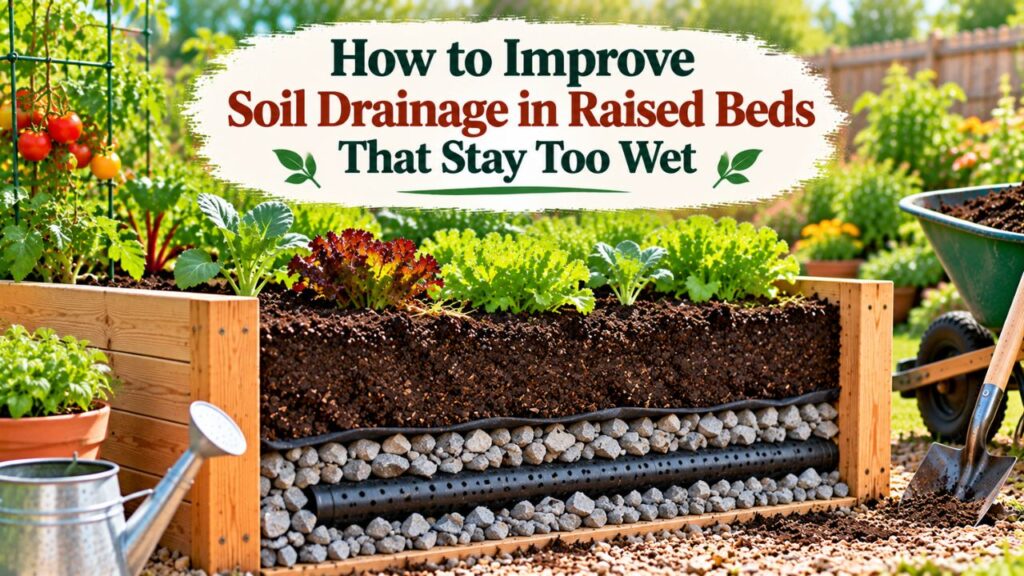
Before changing the soil, determine whether the problem comes from excess watering, compacted soil, or an obstruction beneath the raised bed.
Healthy raised bed soil should feel moist after watering while still allowing excess water to move downward. Soil that remains saturated for extended periods can restrict root growth.
Signs Your Raised Bed Soil Is Not Draining Properly
Several visible conditions can indicate poor drainage:
- Water collects on the soil surface and disappears unusually slowly.
- Soil remains muddy or sticky long after normal watering.
- A sour or unpleasant smell develops in persistently wet soil.
- Plants show yellowing leaves despite adequate moisture.
- Roots appear dark, soft, or unhealthy.
- Soil forms dense, hard clumps when it eventually dries.
- Moss or algae repeatedly develops on constantly wet surfaces.
Yellow leaves and slow growth can have several causes, including nutrient deficiencies and disease. Check soil moisture before assuming poor drainage is responsible.
Test the Moisture Below the Soil Surface
A simple hand inspection can help determine whether the soil is retaining too much water.
- Wait until the surface water from recent irrigation or rainfall has disappeared.
- Insert a finger or hand trowel approximately 3–4 inches into the soil.
- Remove a small amount of soil and gently squeeze it.
- Observe whether it crumbles, holds together loosely, or remains sticky and saturated.
- Check another location near the center of the bed to compare conditions.
Moist soil may hold its shape briefly before breaking apart. Very wet soil can feel sticky or release water when squeezed.
Clay-rich soil naturally behaves differently from sandy or loamy soil, so texture alone does not confirm a drainage problem.
Important: Avoid evaluating drainage immediately after unusually heavy rainfall. Even healthy soil can become temporarily saturated when rain falls faster than water can move through the ground.
How to Improve Soil Drainage in Raised Beds
The best approach is to correct the condition preventing excess water from leaving the growing area.
For raised beds built directly on natural ground, the underlying soil is especially important. Elevated planters with solid bottoms require a different approach because their drainage depends on openings in the container.
1. Loosen Compacted Soil Beneath the Raised Bed
Compacted ground is a common reason raised beds drain slowly, particularly when the garden sits above heavy clay.
Water may move through the loose raised bed soil but slow down considerably when it reaches the dense ground beneath it.
This can create prolonged saturation near the bottom of the root zone.
For a new raised bed, prepare the ground before adding the growing mix:
- Remove weeds, debris, and unwanted surface vegetation.
- Insert a garden fork into the underlying soil.
- Gently rock the fork backward and forward to loosen compacted areas.
- Repeat across the bed footprint without turning over large sections of soil.
- Add the prepared raised bed growing mix above the loosened ground.
The University of Maryland Extension’s raised-bed growing guidance recommends gently loosening compacted subsoil with a garden fork or spade to improve drainage and aeration.
This preparation creates a better connection between the raised bed soil and the natural ground beneath it.
Avoid working clay soil while it is extremely wet. Disturbing saturated clay can damage its structure and create additional compaction.
For established raised beds, perform substantial loosening between growing seasons rather than disturbing the roots of actively growing vegetables.
2. Provide Drainage Openings in Elevated Raised Beds
Not every raised bed has an open bottom.
Elevated wooden planters, raised beds with built-in floors, and some metal garden containers hold soil above the ground. These structures need an outlet for excess water.
Without adequate drainage openings, water may collect inside the container regardless of the soil mix.
Check the following:
- Drainage holes or slots are present in solid-bottom planters.
- Existing openings are not blocked by soil, roots, or debris.
- Plastic liners do not seal the bottom of the container.
- Water can escape underneath the planter rather than collecting against the base.
- Any drainage screen allows water to pass through.
An elevated planter may need additional drainage openings if the manufacturer permits modifications.
The University of Maryland Extension’s vegetable container drainage recommendations explain that drainage openings allow excess water to escape and help prevent oxygen deprivation around plant roots.
For a raised bed built directly on garden soil, a separate bottom is generally unnecessary. Keeping the base open allows roots and water to move into the underlying soil.
3. Improve the Raised Bed Soil Mix
A dense growing mix can slow drainage even when the bed has an open bottom.
This often happens when raised beds are filled entirely with heavy garden soil or low-quality topsoil containing substantial clay.
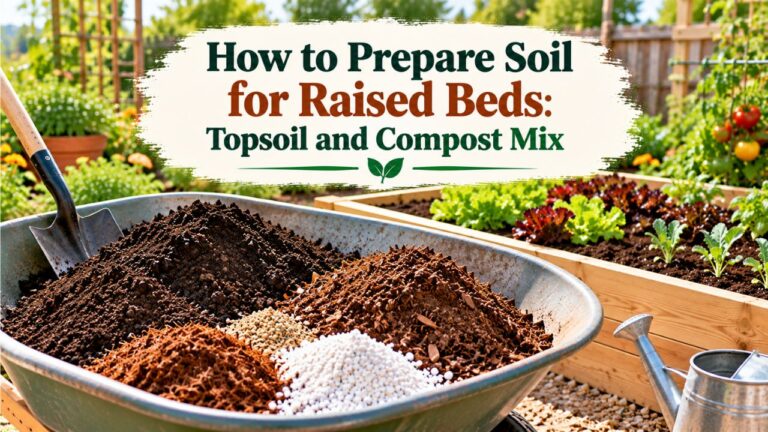
A better approach is to create a growing medium with a balanced mixture of mineral soil and finished compost.
For many open-bottom vegetable beds, a practical starting blend is:
- 2 parts quality topsoil
- 1 part finished compost
This mixture provides mineral soil for structure and nutrients while incorporating organic matter that improves soil aggregation.
The exact proportions can vary with the quality and texture of the original materials.
Choose topsoil with a loose, crumbly texture rather than dense clay or extremely fine sand. Finished compost should be dark, reasonably uniform, and free from obvious undecomposed food waste.
If the existing soil is severely compacted, blending in suitable replacement material may be more effective than adding a thin amendment layer to the surface.
For elevated planters with limited soil depth, use a suitable container growing mix rather than relying on heavy native garden soil.
Key Takeaway: Good raised bed soil needs a balance of air spaces, moisture retention, and structural stability. Drainage should improve without making the growing medium excessively dry.
4. Add Finished Compost to Improve Soil Structure
Organic matter can improve drainage in mineral soils by encouraging the formation of stable soil aggregates.
These aggregates create spaces through which water and air can move.
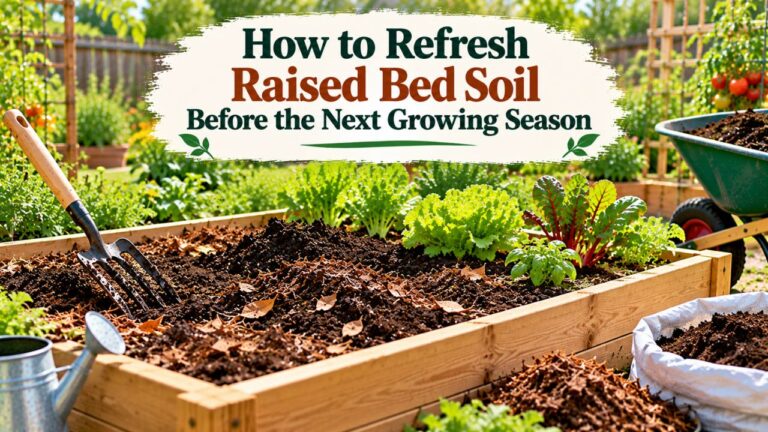
Finished compost is particularly useful when raised bed soil has become dense after repeated watering and seasonal settling.
For an existing bed:
- Remove weeds and loose surface debris.
- Spread a modest layer of finished compost over the soil.
- Gently incorporate it into the upper soil when the bed is not actively planted, or leave it as a surface amendment.
- Avoid damaging established roots.
- Maintain the bed with periodic organic matter additions as needed.
Compost improves soil structure gradually rather than immediately eliminating serious drainage obstructions.
Adding excessive compost is not automatically beneficial. Very organic mixes can settle, behave differently when dry, and create difficulties with moisture management.
Use compost as one component of a balanced growing medium rather than treating it as a complete replacement for soil in every raised bed.
5. Prevent Excess Surface Water From Entering the Bed
Sometimes, the raised bed soil isn’t the main problem.
Water may be entering the garden faster than it can drain because of the surrounding landscape.
Common sources include:
- Roof downspouts discharging near the garden
- Irrigation sprinklers watering the same bed repeatedly
- Sloped yards directing runoff toward the raised bed
- Nearby paved areas sending rainwater into the garden
- Low-lying locations that collect water during storms
Observe the garden during rainfall to determine where water is moving.
If runoff enters the bed from surrounding ground, redirect it through appropriate grading or surface drainage improvements.
Position new raised beds away from persistent puddles and concentrated runoff whenever possible.
Avoid directing garden drainage toward building foundations or neighboring properties.
If the entire garden area remains saturated because of a high water table or severe drainage problems, improving the soil mix alone may not solve the issue.
6. Adjust Watering to Match Soil Moisture
Overwatering can make properly constructed raised beds appear to have drainage problems.
A loose growing mix still needs time to release excess moisture and regain air spaces after irrigation.
Watering on a rigid daily schedule can keep the root zone wetter than necessary, especially during cool or rainy weather.
Instead, check the moisture around the active root zone before watering.
For many established vegetable crops, checking the upper few inches of soil provides a useful starting point. Moisture needs will vary with plant type, rooting depth, temperature, and soil composition.
Watering adjustments that help:
- Skip irrigation when rainfall has already supplied sufficient moisture.
- Use drip irrigation or soaker hoses for more controlled watering.
- Reduce watering duration if the root zone remains saturated.
- Apply water slowly enough that it can soak into the soil without excessive surface runoff.
- Check moisture in more than one part of a large bed.
The goal is to keep roots supplied with water while allowing air to return to the spaces between soil particles.
7. Protect Raised Bed Soil From Compaction
Even a properly prepared raised bed can gradually develop dense soil if it is repeatedly compressed.
Walking inside raised beds, storing heavy objects on the soil, or working the ground while wet can reduce pore space.
Less pore space means water may move more slowly and roots can struggle to obtain oxygen.
To prevent this:
- Avoid stepping directly onto raised bed soil.
- Use permanent pathways between garden beds.
- Choose a bed width that allows comfortable access from the sides.
- Avoid repeatedly pressing down the soil when planting.
- Maintain organic matter and living roots where practical.
- Minimize unnecessary digging and soil disturbance.
A well-designed raised bed should allow the gardener to reach plants without standing on the growing area.
Which Soil Amendments Improve Raised Bed Drainage?
Different amendments affect soil structure and water movement in different ways.
Some improve dense mineral soil, while others work better in lightweight container growing mixes.
| Material | Effect on drainage | Best application |
| Finished compost | Improves aggregation and pore space in mineral soil | Clay-heavy or compacted soil |
| Quality loamy topsoil | Helps create a balanced mineral soil structure | Replacing unsuitable raised bed fill |
| Perlite | Adds coarse pore space to suitable growing mixes | Elevated planters and soilless mixes |
| Pumice | Provides durable, porous particles | Container-style growing media |
| Coarse bark fines | Adds structure to formulated growing mixes | Soilless container blends |
| Sand | Effect depends heavily on particle size and proportion | Only when creating a properly formulated soil mix |
| Gravel at the bottom | Does not reliably improve drainage through fine growing media | Not recommended as a container drainage fix |
Is Perlite Good for Raised Bed Drainage?
Perlite is a lightweight, porous material frequently included in potting mixes.
Its coarse particles help maintain air spaces within suitable growing media.
It can be useful in elevated raised beds containing soilless mixes, especially when the existing medium has become too fine or dense.
However, perlite does not repair compacted subsoil beneath an open-bottom raised bed or unblock a sealed planter base.
Adding large amounts to a full-sized garden bed can also be expensive and unnecessary when suitable topsoil and compost are available.
Should You Add Sand to Clay Soil?
Adding a small amount of sand to dense clay soil is usually not an effective drainage solution.
Clay contains very small particles. Adding insufficient sand may leave the mixture dense because the fine clay particles continue filling spaces between larger particles.
Meaningful changes to soil texture often require much larger proportions of appropriately sized mineral material than gardeners expect.
For most raised beds, using suitable topsoil and finished compost is a more practical approach than trying to correct heavy clay with a small quantity of sand.
Does Gravel Improve Drainage at the Bottom of a Raised Bed?
A gravel layer beneath a contained growing mix does not necessarily help water drain faster.
In a planter, water can remain in the finer soil above the gravel because of differences in pore size between the materials.
This effect is related to a perched water table, where moisture remains suspended in the growing medium rather than moving immediately into the coarse layer below.
Gravel also occupies space that could otherwise support plant roots.
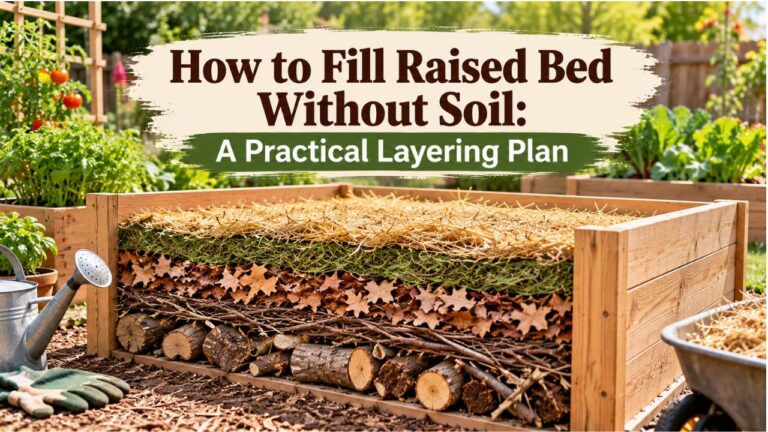
For solid-bottom raised planters, prioritize proper drainage openings and suitable growing media instead of adding stones beneath the soil.
For open-bottom raised beds, address compacted ground directly rather than using gravel to hide the underlying problem.
How to Fix Waterlogged Raised Beds Without Removing Plants
Poor drainage is more difficult to correct when vegetables are already growing because extensive digging can damage their roots.
However, several measures can reduce excess moisture without rebuilding the entire bed.
Correct the Immediate Moisture Problem
Start with the least disruptive changes.
- Pause irrigation. Allow the growing medium to lose some excess moisture before adding more water.
- Check visible drainage outlets. Clear blocked openings in elevated planters where they are safely accessible.
- Redirect incoming runoff. Prevent rainwater from surrounding paths or nearby structures from entering the bed.
- Inspect the soil surface. Remove debris that prevents water from entering the soil evenly or blocks drainage outlets.
- Monitor plant condition. Watch for continued wilting, discoloration, or deterioration while moisture levels change.
Avoid aggressively digging around plant roots while the soil is saturated.
Once conditions improve, a light application of finished compost can support longer-term soil structure.
If the growing medium remains severely compacted, plan more substantial improvements after harvesting.
When Should You Replace the Soil?
Full replacement is not necessary for every drainage problem.
Consider replacing part of the raised bed fill when the existing material is persistently dense, poorly structured, contaminated, or unsuitable for the crops being grown.
Replacing the mix may also be appropriate when the bed contains mostly heavy clay that cannot be improved conveniently without significant disturbance.
Before adding fresh soil, check whether drainage is being restricted below the bed. Otherwise, the new growing medium may develop the same waterlogging problem.
How to Check Whether Raised Bed Drainage Has Improved
After making changes, observe how the bed behaves during normal irrigation and rainfall.
A successful drainage improvement should allow excess water to move out of the active root zone while retaining sufficient moisture for plant growth.
Look for these improvements:
- Surface puddles disappear more readily after ordinary watering.
- The soil feels moist rather than persistently saturated.
- Water moves into the bed without prolonged pooling.
- Soil remains loose enough for roots to develop.
- Plants produce healthy new growth when other growing conditions are suitable.
Plant recovery may take time, especially if roots were previously damaged.
Avoid judging drainage improvement only by how quickly the upper inch of soil dries. Surface dryness does not always reflect moisture conditions deeper in the bed.
Avoid Making the Raised Bed Soil Too Fast-Draining
Improving drainage does not mean removing as much moisture as possible.
A growing medium that drains excessively quickly may require frequent irrigation and can leave shallow-rooted vegetables vulnerable to drought stress.
For example, a very coarse mix may work differently from balanced loamy soil during hot summer weather.
Adding suitable organic matter and maintaining a surface mulch can help conserve moisture without intentionally blocking drainage.
The ideal result is well-aerated soil that remains evenly moist but not continuously saturated.
Conclusion
Understanding how to improve soil drainage in raised beds begins with identifying why water is staying in the growing area.
For open-bottom beds, loosening compacted ground and using a balanced topsoil-and-compost mixture often provides an effective foundation. Elevated planters also need clear drainage outlets and appropriate growing media.
Adjusting irrigation, managing runoff, and preventing soil compaction can help maintain those improvements throughout the growing season.
The most practical approach is to correct the actual drainage restriction rather than adding gravel, sand, or unnecessary amendments without examining the underlying problem.
FAQs About How to Improve Soil Drainage in Raised Beds
How Long Should Raised Bed Soil Stay Wet After Rain?
Raised bed soil may remain moist for several days after rainfall, depending on its texture, temperature, drainage, and the amount of rain received.
Moist soil is normal. Persistent saturation, standing water, or a lack of air in the root zone suggests that drainage or watering conditions need attention.
Can You Improve Raised Bed Drainage Without Replacing the Soil?
Yes. Many drainage problems can be improved by loosening compacted ground, adding suitable organic matter, clearing drainage openings, or reducing excess irrigation.
Soil replacement becomes more useful when the original growing medium is severely compacted or unsuitable for healthy root development.
Do Raised Garden Beds Need Drainage Holes?
Open-bottom raised beds placed directly on permeable ground generally do not need separate drainage holes because water can move into the underlying soil.
Elevated planters and raised beds with solid bottoms need drainage openings or an appropriately designed overflow system to release excess water.
Does Adding More Compost Always Improve Soil Drainage?
No. Finished compost can improve the structure of mineral soils, but excessive organic matter does not guarantee better drainage.
The growing medium still needs suitable mineral particles, adequate air spaces, and an unobstructed drainage path.
Can Cardboard Under a Raised Bed Cause Drainage Problems?
Plain cardboard placed beneath an open-bottom raised bed usually breaks down over time and does not act as a permanent waterproof barrier.
However, overlapping cardboard may temporarily slow water movement, particularly before it becomes thoroughly wet and decomposes.
Solid plastic sheets or impermeable liners are more likely to create lasting drainage restrictions when placed across the bottom without outlets.
Will Making a Raised Bed Taller Improve Drainage?
A taller raised bed can provide additional growing depth above poorly drained native soil.
However, increasing bed height does not automatically eliminate waterlogging if the surrounding ground remains saturated or water has no suitable escape path.
The best solution depends on the soil beneath the bed, local water conditions, and the crops being grown.

I’m Maya L. Greenwood, a lifelong plant lover who believes anyone can grow something beautiful with the right guidance. After years of testing soil mixes, pruning methods, irrigation tricks, and pest-safe solutions, I started EasyGardenTips.com to turn hard-won lessons into step-by-step advice. From seed starting and container gardens to composting and seasonal checklists, my goal is to make gardening simple, sustainable, and fun.