Plastic vs Wood Raised Garden Bed: Durability and Cost Compared
Wood raised garden beds are generally better for affordability, natural appearance, and customization, while quality plastic raised beds are better for rot resistance, low maintenance, and long-term convenience. Neither material is automatically better for growing vegetables. The right choice depends on construction quality, weather exposure, budget, and gardening preferences.
Wooden raised beds are popular because they’re easy to build, available in different sizes, and fit naturally into outdoor landscapes. However, wood gradually deteriorates when exposed to moisture, soil contact, and changing weather conditions.
Plastic raised beds avoid traditional wood rot and are often sold as lightweight, easy-to-assemble kits. Their durability varies considerably, though. Thin plastic panels may bend or crack, while thicker, UV-stabilized materials can provide years of service.
Food-growing safety is another consideration, particularly when comparing recycled plastics with treated or untreated lumber.
Understanding these differences helps prevent buying a bed that needs early replacement or doesn’t suit your garden.
This comparison covers durability, cost, safety, temperature, structural strength, maintenance, and which material makes the most sense for different growing conditions.
Plastic vs Wood Raised Garden Bed: Key Differences
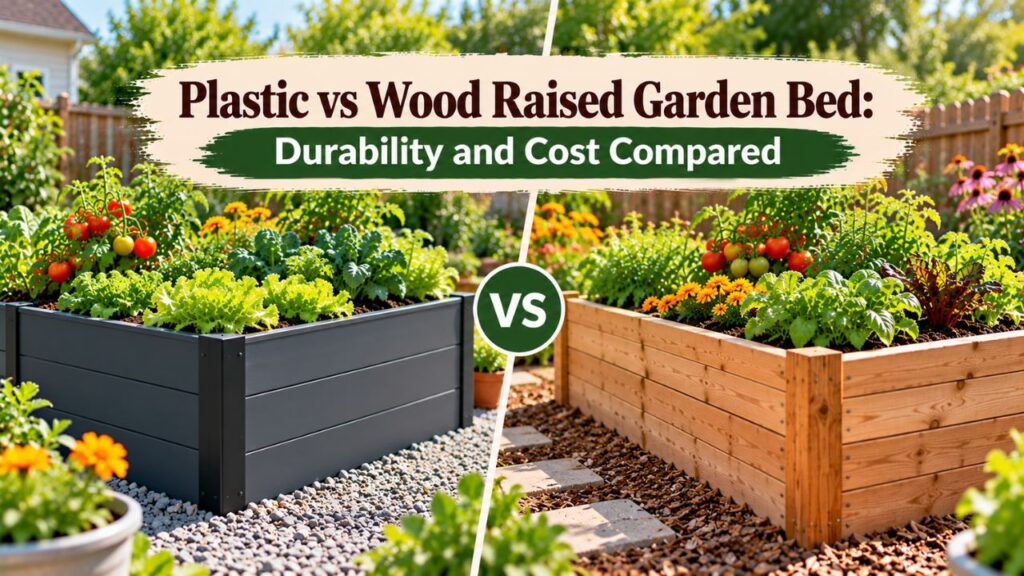
The main difference between plastic and wood raised garden beds is how each material responds to outdoor conditions.
Wood is a natural building material that offers strength and easy customization but gradually decomposes. Plastic resists biological decay, although sunlight, temperature changes, and soil pressure can affect its performance.
The table below summarizes their practical differences.
| Feature | Plastic Raised Garden Bed | Wood Raised Garden Bed |
| Material | HDPE, polypropylene, or other plastics and composites | Pine, cedar, redwood, and other lumber |
| Durability | Rot-resistant; quality depends on formulation and construction | Depends on wood species, treatment, and exposure |
| Initial cost | Varies from inexpensive kits to costly plastic lumber | Often affordable with basic lumber; cedar costs more |
| Maintenance | Usually minimal cleaning and inspection | May need repairs, sealing, or board replacement |
| Moisture resistance | Doesn’t rot from moisture | Can decay with prolonged moisture exposure |
| Sun exposure | Poor-quality plastics may fade, crack, or become brittle | Can weather, split, and gradually deteriorate |
| Structural strength | Depends on panel thickness and reinforcement | Thick lumber generally provides good rigidity |
| Customization | Often limited with prefabricated kits | Easy to cut, resize, and modify |
| Appearance | Modern, uniform, or wood-look finish | Natural, rustic, and traditional |
| Environmental considerations | Long-lasting but persistent material; recycling options vary | Renewable when responsibly sourced, but may require replacement |
For a small vegetable garden, either material can work well.
The more important questions are how long the frame will remain structurally sound, whether its materials are suitable for edible gardening, and how easily it can be maintained.
What Are Plastic Raised Garden Beds Made Of?
Not every plastic raised bed uses the same type of material.
The differences between molded plastic kits, solid plastic lumber, and wood-plastic composites can be substantial.
High-Density Polyethylene (HDPE)
HDPE is a commonly used material for durable plastic lumber and some raised garden bed systems.
It resists moisture-related decay and can be manufactured using recycled plastic.
Thick HDPE boards are often used as alternatives to traditional lumber.
However, HDPE isn’t as stiff as some wood products of similar dimensions, so long panels may require additional reinforcement.
A well-designed HDPE raised bed can be a useful long-term option when the manufacturer provides suitable structural supports.
Polypropylene and Molded Plastic Panels
Some prefabricated raised garden beds use molded polypropylene or other rigid plastics.
These kits may feature interlocking corners, lightweight panels, and simple assembly systems.
They can be convenient for beginners because they often require fewer tools.
However, panel thickness, UV protection, and connection quality vary.
A thin molded panel is not directly comparable to a thick HDPE board or a substantial wooden plank.
Recycled Plastic and Composite Lumber
Recycled plastic lumber and wood-plastic composite lumber are different products.
Solid recycled plastic lumber primarily contains plastic.
Wood-plastic composites combine plastic with wood fibers and sometimes other additives.
The wood component can affect moisture resistance and long-term durability, while the composition influences strength and flexibility.
Composite decking boards are not automatically suitable for raised garden bed construction.
Some are designed for deck surfaces rather than continuous soil contact or unsupported sidewalls.
Check the manufacturer’s intended applications before using decking materials to build a vegetable bed.
What Types of Wood Are Best for Raised Garden Beds?
Wooden raised beds can be built from several lumber species.
Their cost, durability, and resistance to decay are not identical.
Cedar Raised Garden Beds
Cedar is a popular choice because certain cedar species contain naturally decay-resistant heartwood.
It also has a traditional appearance that works well in vegetable gardens.
However, cedar’s durability depends on the species, whether the boards contain heartwood or sapwood, and growing conditions.
Cedar generally costs more than basic untreated pine.
For gardeners who prefer untreated natural lumber, suitable cedar boards are often worth considering.
Pine Raised Garden Beds
Pine is commonly available and relatively easy to cut and assemble.
Untreated pine can be an affordable choice for a new raised bed.
However, it is less resistant to decay than naturally durable woods.
Continuous soil contact, wet conditions, and poor drainage can shorten its useful life.
A pine frame may be practical when low initial cost matters more than long-term durability.
Redwood and Other Rot-Resistant Lumber
Redwood and certain other wood species offer natural resistance to decay.
Their suitability depends on local availability, material quality, and price.
Black locust and some oak species may also be used for durable garden structures.
However, very dense woods can be more difficult to cut and assemble.
The best species is not necessarily the most expensive one. Consider local supply, wood quality, and how long you expect to use the raised bed.
Pressure-Treated Wood
Modern pressure-treated lumber uses preservatives designed to slow decay and insect damage.
Some homeowners prefer untreated wood for edible gardens because they want to avoid added preservatives.
Others choose modern treated lumber for improved durability.
The safety differences between older and newer treatments are important and are discussed below.
Which Lasts Longer: Plastic or Wood Raised Garden Beds?
A well-constructed plastic raised bed can outlast untreated softwood, but durability depends heavily on the plastic type, thickness, UV protection, and structural design.
Wood durability also varies significantly between species and treatments.
How Long Do Wooden Raised Beds Last?
Wood gradually deteriorates when fungi and moisture create favorable conditions for decay.
Untreated pine may begin deteriorating within a few years, particularly in warm, wet climates.
Cedar and other naturally resistant woods may last longer.
Actual service life depends on:
- Wood species and heartwood content
- Board thickness
- Soil contact and moisture exposure
- Local temperature and rainfall
- Drainage around the frame
- Construction quality
- Protective treatments and maintenance
A properly constructed wooden bed in a dry climate may last considerably longer than the same design in persistently damp conditions.
Avoid relying on fixed lifespan claims without considering these variables.
How Long Do Plastic Raised Beds Last?
Plastic doesn’t rot like wood, but it can deteriorate through other processes.
Repeated sunlight exposure may cause discoloration, embrittlement, or surface damage in materials without adequate UV protection.
Temperature changes can also affect dimensional stability.
Well-manufactured, UV-stabilized plastic lumber is generally more suitable for long-term outdoor use than thin plastic products intended only for temporary applications.
The Virginia Tech Extension comparison of raised bed materials identifies HDPE plastic lumber as resistant to degradation while noting structural limitations with some composite lumber products.
A manufacturer warranty can help evaluate a product, but warranty coverage is not the same as a verified lifespan.
Which Material Resists Rain and Moisture Better?
Plastic generally has an advantage in resisting moisture-related decay.
Wood can absorb moisture and gradually deteriorate, particularly around joints and the lower edges that remain in contact with soil.
Plastic panels don’t experience fungal wood rot.
However, moisture-resistant walls do not guarantee good drainage inside the raised bed.
Both materials require a suitable growing medium and a way for excess water to escape.
Plastic vs Wood Raised Garden Bed Cost Comparison
Cost is one of the biggest practical differences between these materials.
Wooden raised beds are often less expensive when built using basic untreated lumber.
Plastic beds vary widely, from inexpensive molded kits to premium recycled plastic lumber systems.
Initial Cost of Wooden Raised Beds
A simple wood frame can be constructed with:
- Lumber boards
- Corner posts or brackets
- Exterior-rated screws
- Optional reinforcement for long sides
Basic untreated pine is often an economical option.
Cedar, redwood, and other naturally durable woods usually increase material costs.
Custom woodworking, additional height, and decorative finishes can also make a wooden bed more expensive.
Initial Cost of Plastic Raised Beds
Plastic pricing depends on the product type.
A lightweight molded kit may be relatively inexpensive, while thick HDPE lumber can cost considerably more than standard wood boards.
In Virginia Tech Extension’s comparison using 2022 material prices, a 4 × 8-foot raised bed with a 12-inch height was estimated at approximately $188 using untreated wood, compared with approximately $472 using HDPE plastic lumber. Those historical examples included soil and construction materials.
They illustrate the potential price difference between specific construction methods, not current retail pricing for all products.
When comparing options, use current local quotes and account for the complete frame system.
Long-Term Replacement Costs
The lowest purchase price isn’t always the lowest lifetime cost.
A wooden bed may need individual boards replaced as they deteriorate.
A quality plastic bed may need fewer repairs related to decay, but damaged proprietary panels or connectors can be difficult to replace if the manufacturer no longer sells them.
Consider:
- Initial frame cost
- Expected durability in your climate
- Availability of replacement parts
- Maintenance expenses
- Installation labor
- Cost of eventual replacement
Practical Takeaway: For a short-term or budget garden, wood may offer better value. For a long-term installation with minimal maintenance, a quality plastic system may justify a higher initial price.
Are Plastic or Wood Raised Garden Beds Safer for Vegetables?
Both plastic and wood raised beds can be suitable for growing edible crops.
However, safety depends on the specific materials and any additives or treatments used during manufacturing.
Is Plastic Safe for Growing Vegetables?
Plastic raised beds can be appropriate for vegetables when made from materials intended for that use.
HDPE and polypropylene are used in many products, but a material name alone doesn’t guarantee that every manufactured item is suitable for prolonged garden-soil contact.
Colorants, stabilizers, recycled feedstocks, and other additives may differ by manufacturer.
Before purchasing a plastic bed, look for:
- Clear identification of the material
- Manufacturer confirmation that it is intended for vegetable gardening
- Appropriate outdoor UV resistance
- Information about recycled content
- Any applicable material testing or certification
Avoid using unknown industrial containers, discarded chemical storage bins, or unidentified scrap plastic as vegetable planters.
A recycling symbol identifies a general plastic category. It doesn’t independently verify the finished product’s suitability for growing food.
Is Untreated Wood Safe for Vegetable Gardens?
Untreated lumber from a suitable source is generally a straightforward option for edible gardening.
Cedar, pine, and other suitable untreated woods don’t contain added pressure-treatment preservatives.
However, avoid reclaimed lumber with an unknown history.
Old boards may have been painted, chemically treated, or exposed to contaminants.
Unknown pallets, demolition lumber, and old railroad ties are poor choices for vegetable beds.
Is Pressure-Treated Wood Safe for Raised Beds?
The type and age of the treatment matter.
Older pressure-treated lumber sometimes contained chromated copper arsenate (CCA), a preservative containing arsenic.
CCA-treated wood was phased out for most residential uses in the United States by the end of 2003.
Modern residential pressure-treated lumber commonly uses copper-based preservatives rather than CCA.
The University of Maryland Extension’s raised bed guidance explains that micronized copper azole is considered low in toxicity and summarizes research finding limited increases in nearby soil copper without increased copper levels in the tested plants.
Gardeners who prefer to minimize contact with treated materials can use untreated decay-resistant wood, a suitable barrier along the inside walls, or another bed material.
If installing a liner, preserve drainage and avoid unintentionally creating a waterproof basin.
Safety Note: Never use old railroad ties treated with creosote or unidentified chemically treated lumber to construct vegetable-growing beds.
Do Plastic Raised Beds Get Hotter Than Wooden Raised Beds?
Plastic and wood can both become warm in direct sunlight.
However, material type alone doesn’t determine the soil temperature.
Color, wall thickness, insulation, sunlight exposure, and the amount of soil inside the bed all influence heating.
Heat Behavior of Plastic Raised Beds
Dark plastic surfaces can absorb substantial solar energy.
Thin plastic walls may also allow temperature changes to affect nearby soil relatively quickly.
However, some plastic beds have double-wall or hollow-panel designs that provide insulating air spaces.
A thick, light-colored plastic planter may behave differently from a thin black plastic bed.
Therefore, it’s inaccurate to assume every plastic raised bed becomes hotter than wood.
Heat Behavior of Wooden Raised Beds
Wood is a relatively poor conductor of heat compared with metals.
Thick wooden boards can reduce rapid heat transfer through the bed walls.
However, wood still absorbs solar energy, and darker finishes can increase surface heating.
The soil inside a wooden bed can become hot when exposed to prolonged sunshine, particularly if the bed is shallow.
Wood is not a guarantee against excessive root-zone temperatures.
Which Material Is Better for Hot Climates?
In hot climates, prioritize the overall growing environment rather than selecting a material solely based on assumed heat performance.
Useful considerations include:
- Lighter-colored bed surfaces
- Adequate soil depth
- Suitable mulching
- Consistent irrigation
- Enough growing-medium volume
- Protection from reflected heat near pavement
For locations with intense summer sunlight, choose a plastic system designed for prolonged UV exposure or a suitable weather-resistant wooden frame.
Check soil moisture more frequently during hot, dry weather regardless of the material.
Which Raised Garden Bed Is Stronger: Plastic or Wood?
Structural strength becomes particularly important in tall or long raised beds.
Moist soil is heavy, and the sidewalls must resist continuous outward pressure.
Structural Strength of Wooden Raised Beds
Thick lumber generally provides good stiffness for raised bed construction.
Wood is also easy to reinforce using corner posts, brackets, and cross braces.
For a large rectangular bed, additional supports can help prevent the long sides from bowing outward.
Board thickness and joint quality affect the frame’s performance.
Thin boards may warp or bend even when the wood itself is structurally sound.
Structural Strength of Plastic Raised Beds
Plastic frames vary much more in construction.
A thick HDPE board behaves differently from a thin molded panel.
Some plastic materials flex under sustained loads.
Long plastic sidewalls may require additional vertical posts or cross supports.
Certain molded kits include reinforced corners and molded ribs that improve their shape retention.
Check the manufacturer’s maximum recommended bed dimensions and filling height.
Avoid assuming that a plastic kit designed for a shallow bed can safely be stacked into a much taller structure.
Which Is Better for Tall Raised Beds?
For tall DIY raised beds, substantial lumber with proper reinforcement is often easier to engineer and repair.
Plastic can also work, but the system must be designed to support the intended soil height and weight.
A tall raised bed needs more than moisture-resistant panels.
The connections, corner posts, and long sidewalls must remain stable after repeated watering and seasonal changes.
Maintenance Differences Between Plastic and Wood Raised Beds
Maintenance requirements can influence which material is more convenient over several growing seasons.
Maintaining Wooden Raised Garden Beds
Wooden beds should be inspected periodically for:
- Decaying boards
- Loose fasteners
- Split corners
- Bulging sidewalls
- Deterioration near the soil line
Remove soil and debris trapped against exterior surfaces where practical.
If applying a protective finish, choose a product appropriate for outdoor garden use and follow the manufacturer’s instructions.
Avoid treatments that are not intended for the conditions in which the wood will be used.
Individual wooden boards can often be repaired or replaced without rebuilding the entire frame.
Maintaining Plastic Raised Garden Beds
Plastic beds generally require less maintenance related to decay.
Routine care may include:
- Cleaning dirt and algae from exterior surfaces
- Checking for cracks or brittleness
- Tightening loose connectors
- Inspecting panel joints
- Checking for outward bowing
- Replacing damaged components when available
Clean plastic surfaces using mild soap and water unless the manufacturer recommends another method.
Avoid unnecessary harsh solvents or abrasive cleaning tools that could damage the surface.
A plastic frame may require little routine maintenance, but it still needs periodic inspection.
Which Is Easier to Assemble: Plastic or Wood Raised Beds?
Plastic raised bed kits are often designed for quick assembly.
Some feature interlocking panels that fit together with minimal tools.
Wood requires more planning when building from individual boards.
However, prefabricated wooden raised bed kits can also be straightforward to install.
Plastic Raised Bed Assembly
A typical prefabricated plastic kit may require:
- Selecting a level garden location.
- Connecting the side panels.
- Securing the corner joints.
- Installing braces or posts supplied with the kit.
- Checking the frame before filling.
- Adding suitable soil.
Some systems allow multiple configurations, while others have fixed dimensions.
Follow the manufacturer’s instructions, particularly when stacking panels or adding reinforcement.
Wooden Raised Bed Assembly
A basic wooden frame usually requires measuring, cutting if necessary, and fastening the boards.
Common tools include a measuring tape, drill, saw, square, and level.
Wood is easier to modify when you need a custom width or length.
It also allows you to add trellises, protective hoops, corner posts, or other accessories using common hardware.
For gardeners who enjoy DIY construction, wood provides considerable flexibility.
Which Is More Environmentally Friendly: Plastic or Wood?
The environmental impact of a raised bed depends on more than the material name.
Consider where the material comes from, how long it lasts, whether it contains additives, and what happens when it reaches the end of its useful life.
Environmental Considerations for Wooden Beds
Wood is a renewable material when sourced from responsibly managed forests.
Untreated wood can also decompose naturally over time.
However, growing, harvesting, processing, transporting, and replacing lumber all require resources.
A bed that needs frequent replacement may consume more material than a durable frame maintained over many seasons.
Protective treatments and coatings can also affect disposal options.
Environmental Considerations for Plastic Beds
Recycled plastic lumber can provide another use for existing plastic material.
Its resistance to decay may reduce how frequently a raised bed frame needs replacement.
However, plastic remains persistent in the environment, and not all plastic lumber products are accepted by local recycling programs.
Some composite materials are especially difficult to recycle because they contain multiple components.
UV degradation and physical wear may also cause some plastic products to release small particles over time.
The magnitude of that issue depends on the specific material and exposure conditions.
Neither material should automatically be described as the environmentally superior choice in every situation.
A durable product that can be maintained, repaired, and responsibly handled at the end of its life is generally preferable to a poorly constructed disposable alternative.
Which Raised Garden Bed Is Better for Different Gardening Needs?
The best option becomes clearer when you match the material to your location, budget, and expected use.
Best for Budget-Conscious Gardeners
Choose a basic wooden raised bed.
Untreated pine or another suitable, affordable lumber may provide a lower initial cost than premium plastic lumber.
It is also relatively easy to build using common tools.
Plan for eventual maintenance or replacement, especially in wet climates.
Best for Low-Maintenance Gardening
Choose a well-built plastic raised bed.
A UV-resistant plastic system avoids wood rot and may require less maintenance.
Look for sturdy sidewalls, reliable connectors, and available replacement components.
Avoid choosing a thin plastic kit simply because it has an attractive finish.
Best for a Natural Garden Appearance
Choose wood, particularly cedar or another suitable rot-resistant species.
Wood blends easily with traditional landscapes and offers flexibility in appearance.
It can be left unfinished or treated with an appropriate exterior coating.
Best for Custom Sizes and Shapes
Choose wood for most DIY projects.
It is generally easier to cut and modify than prefabricated plastic panels.
This is helpful when fitting a raised bed into an irregular space or adding specialized features.
Modular plastic systems can also work, but only within their supported configurations.
Best for Wet or Humid Conditions
Consider quality plastic if minimizing decay-related maintenance is the priority.
Plastic does not experience fungal wood rot.
Naturally decay-resistant wood can also perform well, although constant moisture exposure will eventually affect it.
Proper drainage remains necessary for both materials.
Best for Tall Raised Garden Beds
Choose a structurally reinforced design rather than selecting solely by material.
Thick wooden boards are often convenient for custom tall beds.
Plastic systems can be suitable when their engineering, supports, and manufacturer specifications account for the intended soil load.
For elevated beds supported on legs, also verify the load-bearing capacity of the entire structure.
What to Check Before Buying a Plastic or Wood Raised Garden Bed
Regardless of material, several design details deserve attention.
Check the Frame Dimensions
For a bed accessible from both sides, a width of approximately 3–4 feet is practical for many gardeners.
Longer beds may need additional sidewall reinforcement.
Choose a height that provides enough usable growing depth for the plants.
Check Drainage and Bottom Construction
Most conventional raised beds placed directly on suitable ground benefit from an open bottom.
This allows roots to grow into native soil and excess water to move downward.
Contained beds on patios or other hard surfaces need an appropriate drainage system.
A solid, unvented bottom can create waterlogged conditions.
Check Hardware and Connections
Plastic connectors should fit securely without excessive movement.
Wooden corners should use suitable exterior-rated fasteners and supports.
Poor connections can cause either material to fail prematurely.
Check Material Quality
For plastic, verify the resin type, UV protection, wall thickness, and intended use.
For wood, check the species, board thickness, treatment history, and visible defects.
Avoid badly warped wood or plastic panels with obvious cracking.
Check Replacement Options
A bed becomes more practical to maintain when individual parts can be replaced.
For wooden beds, replacement boards are generally available from lumber suppliers.
For plastic kits, confirm whether the manufacturer sells compatible panels and connectors separately.
A proprietary system without replacement parts can become difficult to repair after several years.
Conclusion
The plastic vs wood raised garden bed decision comes down to durability, maintenance, appearance, cost, and construction quality.
Wood is generally the better choice for gardeners who want an affordable, customizable frame with a natural appearance. Cedar and other decay-resistant woods are particularly useful when untreated lumber is preferred.
Plastic is a strong option for gardeners who want to avoid wood rot and reduce routine maintenance. However, the best results come from choosing sturdy, UV-resistant materials rather than assuming every plastic bed will last longer than wood.
For a budget DIY garden, suitable lumber is often the practical choice. For a long-term, low-maintenance garden, quality HDPE or another well-designed plastic system can be worth considering.
Neither material automatically produces healthier plants. The soil, drainage, sunlight, watering, and available rooting space have a greater influence on vegetable growth than the frame material alone.
FAQs About Plastic vs Wood Raised Garden Bed
Do Plastic Raised Garden Beds Crack in Winter?
Some plastic raised beds can crack in cold weather, particularly when the material becomes brittle or has already deteriorated from UV exposure.
However, not all plastics behave the same way. Choose products rated for outdoor conditions in your climate and follow the manufacturer’s recommendations.
Can Plastic Raised Beds Be Used for Organic Gardening?
Plastic raised beds can be suitable for home gardens managed with organic methods.
However, whether a particular material is acceptable under a formal organic certification program depends on the applicable production standards and product details.
The label “recycled plastic” alone does not establish certified-organic suitability.
Do Wooden Raised Beds Need a Plastic Liner?
No. Untreated wooden raised beds generally don’t require a plastic liner.
A liner may be considered to reduce soil contact with certain treated wood products or to protect parts of the frame, but it must not block necessary drainage.
For an open-bottom raised bed, lining only the sidewalls can preserve the connection between the growing medium and native soil.
Will Plastic Raised Beds Fade in Sunlight?
Some plastic raised beds fade or discolor after prolonged sunlight exposure.
UV stabilizers can reduce deterioration, but performance depends on the material formulation, pigmentation, and environmental conditions.
Choose products designed for outdoor use rather than ordinary household plastic containers.
Are Cedar Raised Beds Better Than Plastic?
Cedar can be a better choice when natural appearance, customization, and untreated materials are priorities.
Quality plastic may be preferable when resistance to decay and low maintenance matter more.
The better option depends on the specific cedar quality and plastic construction rather than the material category alone.
Can Plastic Raised Beds Be Recycled?
Some plastic raised bed components may be recyclable, but acceptance depends on resin type, additives, construction, and available recycling facilities.
Composite lumber and products containing multiple bonded materials can be more difficult to process.
Check the manufacturer’s end-of-life instructions and local recycling requirements.
Do Vegetables Grow Better in Wood or Plastic Raised Beds?
Vegetables can grow successfully in either material.
The bed frame primarily contains the growing medium. Plant performance depends more directly on soil quality, drainage, water availability, sunlight, nutrients, and root space.
A well-maintained wooden bed and a properly designed plastic bed can provide similarly suitable growing conditions.

I’m Maya L. Greenwood, a lifelong plant lover who believes anyone can grow something beautiful with the right guidance. After years of testing soil mixes, pruning methods, irrigation tricks, and pest-safe solutions, I started EasyGardenTips.com to turn hard-won lessons into step-by-step advice. From seed starting and container gardens to composting and seasonal checklists, my goal is to make gardening simple, sustainable, and fun.