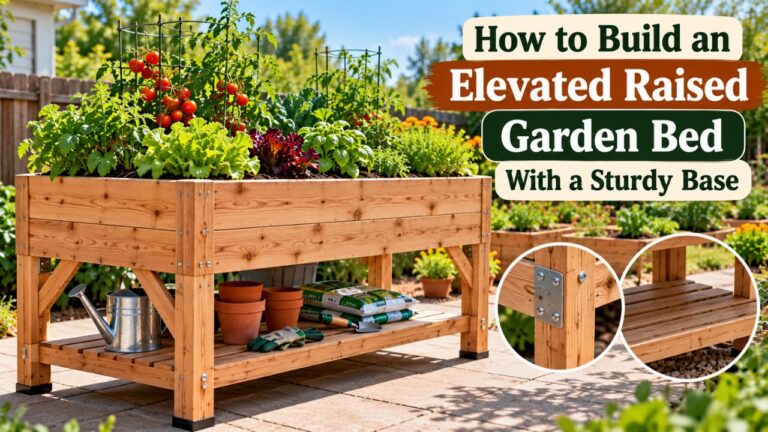
Is Redwood or Cedar Better for Raised Beds? Durability and Cost
Cedar is generally the better choice for most raised garden beds because it offers natural rot resistance, good durability, and relatively easy availability. However, high-quality redwood is equally suitable and may be a better purchase when it is locally available at a competitive price. Both woods are excellent untreated materials for growing vegetables, herbs, and flowers.
The biggest differences involve lumber quality, regional availability, cost, and long-term performance. Redwood is often associated with exceptional durability, but not every redwood board has the same resistance to decay. Similarly, cedar heartwood can withstand prolonged outdoor exposure better than the less durable sapwood.
Raised bed frames remain in contact with moist soil, making wood selection particularly important. Using low-quality boards or insufficient structural supports can shorten a bed’s lifespan regardless of the species.
In this article, I compare redwood and cedar for raised beds based on rot resistance, expected lifespan, cost, strength, food safety, and maintenance. I also explain which lumber grades to choose, how to build a durable frame, and when one material makes more sense than the other.
Is Redwood or Cedar Better for Raised Beds? Key Differences
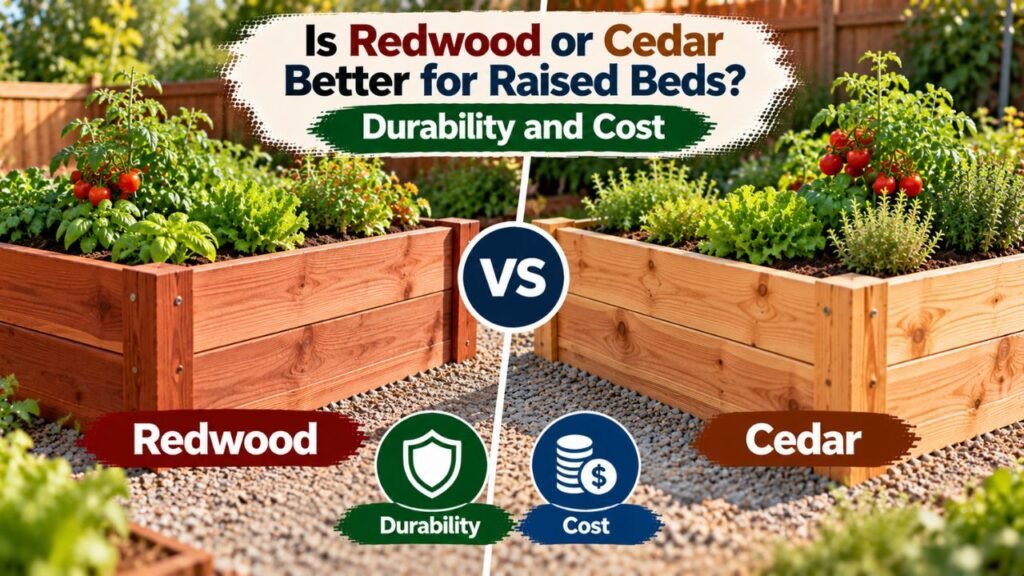
Redwood and cedar are both naturally decay-resistant softwoods commonly used for outdoor construction.
Neither requires pressure treatment to provide its natural resistance to fungal decay, making both attractive choices for vegetable-growing structures.
However, their properties are not identical.
| Feature | Redwood | Cedar |
| Natural rot resistance | High in quality heartwood; varies with wood age | High in suitable heartwood |
| Expected durability | Long-lasting with suitable material | Long-lasting with suitable material |
| Typical cost | Often higher outside producing regions | Often more accessible and economical |
| Weight | Generally heavier than western red cedar | Western red cedar is relatively lightweight |
| Workability | Easy to cut and drill | Easy to cut and assemble |
| Structural strength | Depends on species and grade | Depends on species and grade |
| Vegetable garden safety | Suitable when untreated and uncontaminated | Suitable when untreated and uncontaminated |
| Appearance | Reddish-brown to deeper red | Light brown, reddish-brown, or tan |
| Maintenance | Periodic inspection and replacement of damaged boards | Similar maintenance requirements |
| Best use | Premium beds where good-quality redwood is available | General backyard vegetable beds |
These comparisons assume untreated lumber of suitable quality.
The heartwood content, board thickness, and growing conditions can affect performance more than small differences between the wood species.
Why Cedar Is Usually the Better Overall Choice
Cedar offers a practical balance of natural decay resistance, availability, and ease of construction.
Western red cedar, in particular, is commonly sold for outdoor projects such as fences, garden structures, and landscaping.
Its relatively light weight makes handling long boards easier.
Cedar also has a consistent reputation for resisting fungal decay when the lumber contains substantial durable heartwood.
For an ordinary 4×8 vegetable bed, quality cedar boards are a dependable choice.
When Redwood Is the Better Choice
Redwood becomes especially attractive when high-quality heartwood is locally available.
Gardeners in parts of California and nearby regions may have better access to redwood lumber than gardeners elsewhere in the United States.
If redwood and cedar have comparable board dimensions, similar grades, and competitive prices, redwood can be an excellent alternative.
However, do not assume that every redwood product is more durable than cedar simply because it carries the redwood name.
Redwood vs. Cedar Raised Beds: Which Lasts Longer?
Both materials can last many years when used in properly constructed raised garden beds.
However, there is no universal lifespan that applies to every cedar or redwood frame.
Wood deterioration depends on moisture exposure, climate, board quality, and construction.
Expected Lifespan of Redwood Raised Beds
Redwood is known for its natural resistance to decay.
High-quality heartwood from mature trees can provide excellent durability in outdoor applications.
However, redwood durability varies considerably.
The USDA Forest Service’s research on redwood explains that decay resistance differs among trees and within individual trees. Its discussion of research findings reports that highly decay-resistant wood was substantially more common in old-growth redwood than in younger trees.
This distinction matters because much commercially available redwood comes from second-growth forests.
Second-growth redwood may still be suitable for raised beds, but its natural decay resistance should not automatically be considered equivalent to premium old-growth heartwood.
Choose the actual lumber quality rather than relying only on the species name.
Expected Lifespan of Cedar Raised Beds
Cedar heartwood also contains naturally occurring compounds that help resist decay.
Western red cedar is particularly valued for its outdoor durability and relatively low shrinkage.
However, cedar boards containing substantial sapwood may deteriorate faster than boards made primarily from heartwood.
The quality of the lumber matters.
A thick, well-constructed cedar raised bed may outlast a poorly built redwood frame containing less durable wood.
The reverse can also be true.
How Many Years Can Cedar and Redwood Beds Last?
The University of New Hampshire Extension’s raised-bed gardening guidance states that cedar and redwood raised beds can last 10 years or more, while ordinary untreated wooden beds may last approximately three to five years.
These figures are useful planning estimates rather than guarantees.
Actual durability depends on several conditions:
- Amount of naturally durable heartwood
- Board thickness and structural support
- Climate and annual rainfall
- Soil moisture and drainage
- Exposure to fungal decay
- Installation quality and maintenance
In a warm, consistently damp environment, wood may deteriorate faster than it would in a relatively dry location.
Verdict: Neither species is guaranteed to last longer. High-quality heartwood and suitable construction matter more than the wood name alone.
Is Cedar or Redwood More Resistant to Rot?
Both woods are naturally resistant to fungal decay, but resistance varies among boards.
Understanding the difference between heartwood and sapwood is especially important when purchasing either material.
Redwood Heartwood and Rot Resistance
Redwood heartwood is the darker, inner portion of the tree.
It contains naturally occurring compounds that help protect the wood against decay.
Older, higher-quality heartwood can be particularly durable.
However, the lighter sapwood does not offer the same level of natural protection.
When selecting redwood for soil-contact garden structures, look for boards with substantial heartwood content.
Avoid assuming that an attractive reddish surface guarantees the entire board has high decay resistance.
Cedar Heartwood and Rot Resistance
Cedar heartwood also contains natural compounds associated with decay resistance.
Western red cedar heartwood typically has a reddish-brown appearance, while its sapwood is considerably lighter.
Because sapwood is generally less decay-resistant, boards containing large amounts of it may deteriorate sooner in wet conditions.
Cedar products also differ by species.
For example, western red cedar and eastern red cedar are not the same botanical species, even though both are sold under the cedar name.
Check the actual species when comparing lumber.
Does Constant Moisture Damage Both Woods?
Yes. Natural rot resistance does not make wood waterproof or immune to decay.
Raised bed walls regularly contact moist soil, which can support wood-decaying fungi when other environmental conditions are favorable.
Poor drainage, standing water, and continuously damp joints can accelerate deterioration.
Even premium redwood or cedar may eventually develop soft areas, cracks, or weakened connections.
Key Takeaway: A raised bed made from quality heartwood and installed in a well-drained location has a better chance of lasting longer than one built with lower-quality wood exposed to persistent moisture.
Redwood vs. Cedar for Vegetable Garden Safety
Both untreated redwood and untreated cedar are appropriate materials for ordinary vegetable garden frames when the wood is clean and uncontaminated.
Their suitability is one reason gardeners frequently choose these woods instead of unfamiliar reclaimed or industrially treated lumber.
Is Redwood Safe for Raised Vegetable Beds?
Yes. Untreated, uncontaminated redwood can be used for raised beds growing vegetables, herbs, and edible flowers.
Redwood’s natural durability does not depend on adding a chemical preservative during manufacturing.
However, reclaimed redwood should be inspected carefully.
Avoid using boards with unknown coatings, industrial treatments, chemical stains, or uncertain contamination histories.
Is Cedar Safe for Raised Vegetable Beds?
Yes. Untreated cedar is also suitable for vegetable-growing structures.
Its naturally decay-resistant heartwood is widely used in outdoor garden applications.
Like redwood, cedar should come from a reliable source.
A board that has previously been painted or chemically treated is not automatically suitable simply because the underlying wood is cedar.
Does Cedar or Redwood Affect Soil pH?
Neither cedar nor redwood framing should be considered a reliable method of changing garden soil pH.
Although wood contains natural organic compounds, ordinary solid raised bed boards are not intended to function as soil amendments.
The pH of the growing medium depends primarily on its ingredients, existing soil chemistry, and amendments.
If you are growing vegetables that require a particular soil pH, use soil testing rather than choosing cedar or redwood to influence acidity.
Should You Line Cedar or Redwood Raised Beds?
A liner is not always necessary.
Both woods are commonly used as untreated raised bed walls.
A suitable liner may reduce direct soil contact with the boards, but it does not guarantee protection against decay.
Moisture can still reach the wood through rain, irrigation, and frame joints.
For an open-bottom raised bed placed on natural ground, avoid installing an impermeable sheet across the bottom.
Roots and excess water should be able to move into suitable underlying soil.
Is Redwood More Expensive Than Cedar for Raised Beds?
Redwood often costs more than cedar in markets where it must be transported a considerable distance.
However, prices vary by region, grade, board size, and supplier.
A gardener in California may find redwood competitively priced, while someone in the Midwest or Northeast may have easier access to cedar.
There is no reliable nationwide price difference that applies to every purchase.
Compare Equivalent Lumber Sizes
When comparing prices, use boards with similar dimensions and grades.
For example, compare:
- Cedar 2×10 lumber with redwood 2×10 lumber
- Similar board lengths
- Comparable heartwood content
- Similar moisture and surface condition
- Equivalent structural suitability
A cheaper board is not necessarily better value if it contains substantial sapwood, defects, or insufficient thickness.
Calculate the Lumber Needed for a 4×8 Bed
Consider a raised bed with outside dimensions of approximately 4 feet by 8 feet.
A basic single-course frame using nominal 2×12 boards may require two long boards and two shorter end boards.
If the long sides overlap the end boards, the end pieces must be cut shorter to account for the thickness of the longer boards.
For example, nominal 2-inch lumber is typically around 1½ inches thick.
With two overlapping long boards, the end boards for a 48-inch outside width would measure:
48 − 1.5 − 1.5 = 45 inches
The exact cutting dimensions depend on the chosen corner design.
The 8-foot walls may also need intermediate reinforcement to resist soil pressure.
Compare the complete material cost, including lumber, fasteners, and supports, rather than comparing the price of one board.
Which Wood Offers Better Long-Term Value?
Cedar often provides better value when it is readily available and costs noticeably less than comparable redwood.
Redwood may offer equal or better value when high-quality boards are competitively priced.
A useful way to compare costs is:
Estimated Annual Frame Cost = Total Frame Cost ÷ Expected Service Life
For example, consider two hypothetical raised beds:
| Material | Initial Frame Cost | Assumed Service Life | Annualized Cost |
| Cedar | $160 | 10 years | $16 |
| Redwood | $220 | 12 years | $18.33 |
These figures illustrate the calculation only. They are not current lumber prices or verified lifespan predictions.
Because actual service life is uncertain, avoid paying a large premium based on an unsupported promise that one species will last a specific number of years longer.
Which Is Stronger for Raised Garden Bed Construction?
Both cedar and redwood are suitable for constructing ordinary low-sided raised beds.
However, structural performance depends on board dimensions, grade, fasteners, and support spacing.
Strength and Workability of Cedar
Western red cedar is relatively lightweight and easy to cut or drill.
This makes it convenient for DIY projects.
However, it is also a comparatively soft wood.
Thin cedar boards may bow outward under the pressure of moist soil, particularly along long, unsupported walls.
Use suitable board thickness and reinforce the frame.
For ordinary rectangular raised beds, nominal 2-inch-thick boards are generally more substantial than nominal 1-inch-thick boards.
Strength and Workability of Redwood
Redwood is also relatively easy to cut, drill, and assemble.
Depending on the lumber, it may offer greater stiffness than western red cedar, but individual product grades and dimensions matter.
Redwood can split around fasteners, especially near board ends.
Pre-drilling helps reduce the risk of splitting.
As with cedar, longer walls should have suitable intermediate supports.
Which Is Better for Tall Raised Beds?
Neither wood should be selected for a tall frame based only on natural rot resistance.
A tall raised bed contains substantial soil weight and produces lateral pressure against the walls.
For beds around 24 inches high or taller, consider:
- Substantial wall boards
- Reinforced corner posts
- Intermediate supports
- Cross-bracing where required
- Suitable exterior-rated fasteners
The exact design should account for frame dimensions and soil pressure.
A properly supported cedar frame may perform better than an inadequately reinforced redwood frame, even if the redwood boards have excellent natural durability.
Redwood vs. Cedar Raised Beds: Appearance and Weathering
Both materials have attractive natural colors that suit backyard vegetable gardens.
However, their initial appearance changes after exposure to sunlight and weather.
Natural Appearance of Redwood
Redwood often has a reddish-brown to deeper red color.
Its relatively straight grain creates a uniform appearance in many boards.
Gardeners who prefer a deeper red-toned frame may favor redwood.
However, color varies by grade and individual board.
Redwood gradually changes appearance as the surface weathers outdoors.
Natural Appearance of Cedar
Western red cedar commonly ranges from light brown to reddish-brown.
Some boards contain noticeable color variation between heartwood and sapwood.
Cedar can complement both rustic and modern garden designs.
It also gradually develops a gray surface when left unfinished outdoors.
Does Weathering Mean the Wood Is Rotting?
Not necessarily.
Exposure to sunlight and moisture can change the surface color of both woods without causing immediate structural failure.
Gray weathered wood may still be sound.
Actual deterioration is more concerning when the wood becomes soft, crumbly, deeply cracked, or unable to hold fasteners securely.
Inspect structural condition rather than judging the wood by color alone.
How to Make Redwood and Cedar Raised Beds Last Longer
Both woods benefit from thoughtful construction and regular maintenance.
Because they naturally resist decay, extensive chemical treatment is not always necessary.
Choose Suitable Heartwood Boards
Inspect the lumber before purchasing it.
Look for reasonably straight, sound boards without severe cracks or extensive damage.
If natural longevity is the priority, choose boards containing substantial heartwood.
Ask the supplier about the species and grade.
A higher purchase price does not automatically mean greater decay resistance.
Use Thicker Boards for Long Walls
A long raised bed wall must hold the pressure of soil, particularly after watering.
For a conventional 4×8 bed, nominal 2-inch-thick boards provide a substantial starting point.
Add appropriate intermediate supports to long walls.
The corner connections should also be strong enough to resist movement.
Thin boards may be suitable for small, shallow beds but can require more reinforcement.
Use Corrosion-Resistant Screws
Outdoor garden structures are exposed to moisture.
Ordinary indoor fasteners may corrode or lose strength.
Choose appropriate exterior-rated screws, hot-dip galvanized hardware, or stainless steel fasteners where suitable.
Check that the hardware is compatible with the wood and any coatings.
Pre-drill near board ends when necessary to reduce splitting.
Avoid Standing Water Around the Frame
Place the bed where water can drain away.
Repeated water accumulation around the lower boards can encourage deterioration.
Avoid directing roof runoff toward the frame.
Keep the bed’s bottom open when it sits over suitable garden soil, unless a specific design requires a contained base with drainage openings.
Should Cedar or Redwood Be Sealed?
Neither wood necessarily requires sealing to function as a raised bed frame.
An appropriate exterior finish may help maintain appearance or reduce moisture absorption on exposed surfaces.
However, a coating will not completely prevent decay.
For vegetable-growing beds, use only products suitable for the intended application and follow the manufacturer’s instructions.
Avoid unknown stains, wood preservatives, or coatings on soil-contact surfaces.
Inspect the Beds Every Growing Season
Check for soft spots, cracks, loose connections, and outward bowing.
Pay special attention to the lower inside surfaces, where the wood remains in contact with damp soil.
Replace weakened boards before the structure becomes unstable.
Routine maintenance can help either material remain functional longer.
Should You Choose Redwood or Cedar Based on Your Climate?
Climate affects wood durability because temperature and moisture influence fungal decay.
However, both materials can be used in different regions of the United States.
For Wet and Humid Climates
Choose high-quality heartwood with suitable decay resistance.
Pay particular attention to drainage and moisture exposure.
In humid environments, neither cedar nor redwood should be expected to remain unaffected by continuous dampness.
Well-supported, thicker boards may provide a more useful improvement than paying extra for a different species of similar quality.
For Dry and Hot Climates
Both woods can perform well in relatively dry conditions.
However, sunlight and repeated wetting and drying can contribute to surface checking, shrinkage, and changes in appearance.
Use sound lumber and appropriate fasteners.
Regularly inspect the frame for splitting or loose connections.
Do not assume that either wood will eliminate soil moisture loss during hot weather. Irrigation requirements depend primarily on the growing medium and environmental conditions.
For Cold and Snowy Regions
Cedar and redwood can both be used in regions experiencing freezing temperatures and snow.
The main concerns include persistent moisture, seasonal movement, and frame stability.
Choose suitable construction details and keep the surrounding area reasonably well drained.
Avoid allowing heavy snow removal equipment to strike or damage the raised bed walls.
How to Choose Between Redwood and Cedar Before Buying
The best purchase depends on the quality and price of lumber actually available to you.
Use the following factors to make the decision.
Choose Cedar If You Want:
- A dependable untreated material for vegetable beds
- Naturally decay-resistant heartwood
- Relatively lightweight boards
- Easy cutting and assembly
- Good availability in your local market
- A practical balance between durability and cost
For many backyard gardeners, cedar is the more straightforward choice.
Choose Redwood If You Want:
- A natural reddish appearance
- Untreated wood with good decay resistance
- Access to high-quality redwood heartwood
- A locally competitive lumber price
- A premium outdoor garden frame
- A suitable alternative to cedar without chemical pressure treatment
Redwood is particularly attractive when its quality and price compare favorably with available cedar.
What if Redwood and Cedar Cost the Same?
If both materials have equivalent dimensions, similar grades, and comparable heartwood content, either can be a good choice.
Compare board straightness, visible defects, and how much reinforcement the finished frame will need.
If the redwood contains substantial low-durability sapwood while the cedar consists mainly of suitable heartwood, cedar may offer better value.
The opposite may apply when the redwood is higher quality.
My recommendation: For most typical backyard vegetable beds, choose suitable untreated cedar unless comparable redwood is more affordable or offers clearly better lumber quality.
Conclusion
So, is redwood or cedar better for raised beds? Cedar is generally the better all-around choice for most gardeners because it offers natural decay resistance, is relatively easy to work with, and is often more accessible.
Redwood is equally suitable for raised garden beds, particularly when high-quality heartwood is available at a competitive price.
Neither species is guaranteed to outlast the other. Actual durability depends on lumber grade, heartwood content, climate, moisture exposure, and construction.
Both untreated woods are appropriate choices for growing vegetables, herbs, and flowers when purchased from reliable sources and free from contamination.
For a typical backyard raised bed, I recommend comparing local prices for equivalent cedar and redwood boards, then choosing the better-quality material. Proper board thickness, sturdy connections, and good drainage will have a major influence on how long the frame remains usable.
FAQs About Is Redwood or Cedar Better for Raised Beds
Does Redwood Last Longer Than Cedar in Raised Beds?
Not necessarily. Both woods can provide long service life when the boards contain naturally durable heartwood. Redwood durability varies with the age and quality of the wood, while cedar also differs according to species and heartwood content. Construction and moisture exposure influence the final lifespan.
Is Redwood Safer Than Cedar for Vegetable Gardens?
No meaningful safety advantage has been established for clean, untreated redwood over clean, untreated cedar in ordinary raised vegetable beds. Both are suitable choices. Avoid reclaimed boards containing unknown chemicals, paint, or industrial preservatives, regardless of the species.
Is Cedar Cheaper Than Redwood for Raised Garden Beds?
Cedar is often more economical in markets where it is readily available, but the price difference varies by region. Redwood can be competitively priced in areas close to its lumber supply. Compare equivalent board sizes and grades before purchasing.
Do Redwood and Cedar Raised Beds Need a Plastic Liner?
Not necessarily. Both woods naturally resist decay and can be used without a sidewall liner. A suitable liner may reduce direct soil contact, but it does not make the boards waterproof. Avoid blocking drainage beneath an open-bottom raised bed.
Can You Mix Redwood and Cedar in the Same Raised Bed?
Yes. You can construct a raised bed using both untreated redwood and untreated cedar if the boards are structurally suitable and securely joined. Different boards may weather at different rates, creating some variation in appearance. The main concern is proper construction rather than combining the species.
What Thickness of Cedar or Redwood Is Best for a Raised Bed?
Nominal 2-inch-thick lumber, usually around 1½ inches thick after surfacing, is a practical choice for many conventional raised bed walls. Thinner boards can work in smaller beds with suitable reinforcement. Taller or longer frames require additional structural support.
Is Western Red Cedar Better Than Redwood for Raised Beds?
Western red cedar is a strong general-purpose choice because its heartwood offers good natural decay resistance and the lumber is relatively lightweight. High-quality redwood can perform equally well. The better option depends on the grade, heartwood content, cost, and availability of the particular boards.

I’m Maya L. Greenwood, a lifelong plant lover who believes anyone can grow something beautiful with the right guidance. After years of testing soil mixes, pruning methods, irrigation tricks, and pest-safe solutions, I started EasyGardenTips.com to turn hard-won lessons into step-by-step advice. From seed starting and container gardens to composting and seasonal checklists, my goal is to make gardening simple, sustainable, and fun.