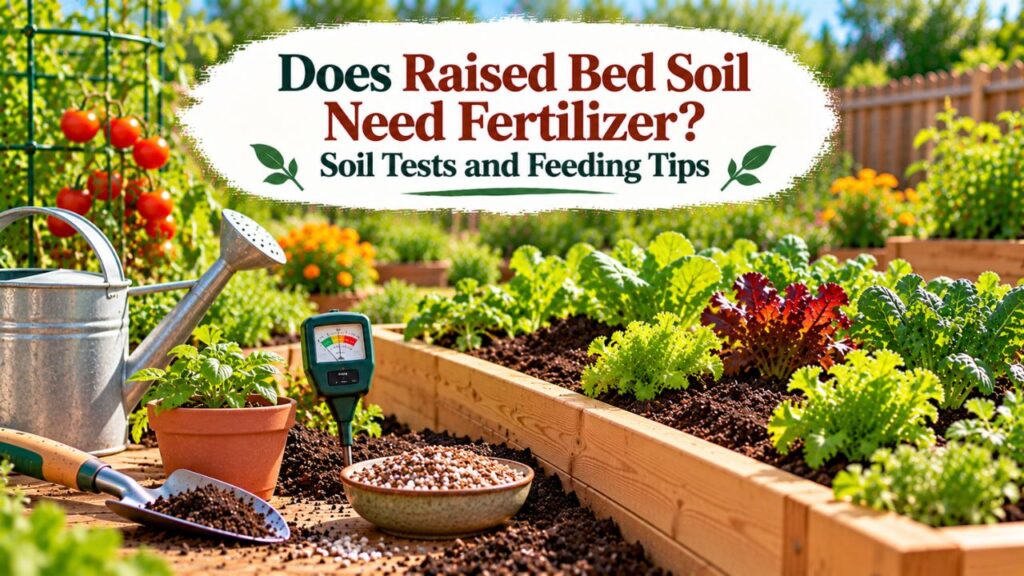
Does Raised Bed Soil Need Fertilizer? Soil Tests and Feeding Tips
Raised bed soil does not always need fertilizer, especially when it already contains sufficient nutrients from quality topsoil and finished compost. However, additional fertilizer may become necessary as vegetables grow, absorb nutrients, and produce new leaves, flowers, and fruit. The right decision depends on soil fertility, crop requirements, and the nutrients already present.
New raised beds can be particularly confusing. A bag labeled “raised bed soil” may contain compost, added fertilizer, or both. Adding another fertilizer without checking the ingredients could supply more nutrients than your plants need.
Established raised beds present a different situation. Repeated harvests remove nutrients, while watering and heavy rainfall can carry certain nutrients below the active root zone.
The goal is not to fertilize on a fixed schedule regardless of soil conditions. It is to supply the nutrients plants actually need without creating imbalances.
Understanding soil testing, fertilizer labels, nutrient requirements, and application timing helps determine whether your raised bed needs feeding and how to handle it correctly.
Does Raised Bed Soil Need Fertilizer Before Planting?
A newly prepared raised bed may or may not need fertilizer before planting.
The answer depends primarily on the ingredients used to fill the bed and whether those materials already supply adequate plant nutrients.
Newly Filled Raised Beds With Topsoil and Compost
A raised bed containing quality topsoil and finished compost may already provide substantial nutrients for early plant growth.
Topsoil contains mineral particles that hold and release nutrients, while compost contributes organic matter and nutrients as decomposition continues.
However, compost does not release every nutrient at the same rate. Nitrogen availability, in particular, can change with soil temperature, moisture, and microbial activity.
A soil mixture that supports seedlings initially may still require supplemental nitrogen later in the growing season.
If the bed contains freshly purchased materials, the most reliable approach is to check the supplier’s information and have the completed growing medium tested when practical.
Do not assume that adding more fertilizer will automatically improve an already fertile mixture.
Raised Beds Filled With Commercial Soil Mix
Bagged raised bed soil products vary considerably.
Some contain topsoil and compost, while others include peat-based ingredients, coir, or other components. Certain products also contain starter nutrients or slow-release fertilizers.
Read the package information carefully.
Look for statements such as:
- Contains added fertilizer
- Provides nutrients for an indicated period
- Includes compost or other organic amendments
- Requires supplemental plant food
- Designed specifically for vegetables or raised beds
If the product already contains fertilizer, additional feeding immediately after planting may be unnecessary.
Follow the manufacturer’s instructions instead of applying a second fertilizer automatically.
Established Raised Beds Used for Multiple Seasons
An established raised bed may need supplemental nutrients because vegetables remove nutrients as they grow.
Harvesting crops takes some of those nutrients out of the garden system.
Nitrogen can also be lost through leaching, especially where soil receives frequent irrigation or substantial rainfall.
However, nutrient depletion does not occur at the same rate in every garden.
A bed receiving suitable compost amendments may maintain adequate fertility for an extended period, while heavily cropped or sandy beds may require more frequent nutritional adjustments.
The best way to evaluate an established bed is through soil testing and crop-specific nutrient requirements.
How to Tell If Raised Bed Soil Needs Fertilizer
Plant appearance can provide clues about nutrient deficiencies, but it cannot reliably identify every soil problem.
A laboratory soil test offers a more dependable starting point.
Test the Raised Bed Soil for Nutrient Levels
Soil testing measures important fertility characteristics and helps determine which amendments are appropriate.
A standard garden soil test commonly reports:
- Soil pH
- Phosphorus availability
- Potassium availability
- Calcium and magnesium, depending on the laboratory
- Organic matter content, when included
- Fertilizer and amendment recommendations
Routine soil tests do not always provide a direct measurement of available nitrogen because nitrogen levels can change rapidly.
Nitrogen recommendations may instead depend on crop requirements, soil organic matter, and local growing conditions.
According to the University of Minnesota Extension’s raised-bed gardening guidance, established raised beds should generally be soil-tested every two to three years, with fertilizer and compost applied according to the results.
For a new bed containing an unfamiliar soil mixture, testing before planting can establish a useful fertility baseline.
Important: If the bed contains mostly soilless growing media rather than mineral topsoil, ask the laboratory whether a soilless growing media analysis is more appropriate.
Watch for Possible Nutrient Deficiency Symptoms
Plants sometimes show visible changes when nutrients become insufficient.
Common signs include:
| Plant Symptom | Possible Nutrient Concern |
| Older leaves turning pale yellow | Nitrogen deficiency |
| Stunted growth with unusually dark foliage | Possible phosphorus deficiency |
| Yellowing or browning along older leaf edges | Possible potassium deficiency |
| Yellowing between veins on newer leaves | Possible iron or other micronutrient availability problem |
| Slow growth and poor crop development | Several possible nutrient deficiencies |
These symptoms are not definitive diagnoses.
Excessive watering, dry soil, poor drainage, root damage, unsuitable temperatures, and pest problems can produce similar changes.
For example, a tomato plant with yellow leaves may have a nitrogen deficiency, but it could also be suffering from saturated soil that prevents normal root function.
Adding fertilizer will not solve a drainage problem.
Check Watering and Soil Conditions First
Before deciding that a struggling raised bed needs fertilizer, examine the growing conditions.
Check whether:
- The soil is consistently too wet or too dry.
- Plants receive enough sunlight for their species.
- Roots are growing in compacted or poorly drained soil.
- Leaves or stems show evidence of pests or disease.
- Soil pH may be restricting nutrient availability.
If these conditions appear suitable and the plants still show signs of poor nutrition, use soil testing and crop-specific guidance to determine the next step.
What Nutrients Does Raised Bed Soil Need From Fertilizer?
Plants require several nutrients, but the three primary nutrients listed on most fertilizer packages are nitrogen, phosphorus, and potassium.
Their availability determines whether a particular fertilizer is appropriate.
Nitrogen Supports Leaf and Stem Growth
Nitrogen (N) is needed for producing chlorophyll, proteins, and new plant tissue.
Leafy vegetables such as lettuce, kale, and spinach depend on an adequate nitrogen supply to produce healthy foliage.
Tomatoes, peppers, and other fruiting vegetables also require nitrogen, especially during active vegetative growth.
However, excessive nitrogen can encourage abundant foliage without a corresponding improvement in flowering or fruit production.
Nitrogen is relatively mobile in many soils, so its availability may change during the growing season.
A raised bed with adequate phosphorus and potassium may need only supplemental nitrogen rather than a complete fertilizer.
Phosphorus Supports Root and Reproductive Development
Phosphorus (P) contributes to energy transfer, root development, and reproductive processes within plants.
Young plants need phosphorus, but adding more does not necessarily promote better root growth when the soil already contains enough.
Phosphorus can accumulate in raised beds receiving repeated applications of manure-based compost or phosphorus-rich fertilizer.
If a soil test indicates adequate or excessive phosphorus, choose a fertilizer with little or no additional phosphorus.
Potassium Supports Water Regulation and Plant Function
Potassium (K) contributes to enzyme activity, water regulation, and several processes involved in plant growth.
It supports the normal functioning of vegetables throughout their development.
However, excessive potassium applications can interfere with the uptake of other nutrients in some soil conditions.
Like phosphorus, potassium should be added according to actual soil requirements rather than automatically increasing its concentration.
Understanding Fertilizer N-P-K Numbers
Fertilizer packages usually display three numbers, such as 5-5-5, 10-10-10, or 10-2-8.
These represent the fertilizer’s nutrient analysis by weight.
| Fertilizer Label | Nitrogen | Phosphate (P₂O₅) | Potash (K₂O) |
| 5-5-5 | 5% | 5% | 5% |
| 10-10-10 | 10% | 10% | 10% |
| 10-2-8 | 10% | 2% | 8% |
| 12-0-0 | 12% | 0% | 0% |
These numbers describe nutrient concentration, not the exact amount a raised bed should receive.
For example, a fertilizer labeled 10-10-10 contains more nitrogen per pound than a 5-5-5 product.
That does not make it universally better.
Choose the fertilizer according to the soil’s nutrient needs and calculate the application amount using the product instructions.
What Type of Fertilizer Is Best for Raised Bed Soil?
The best fertilizer is one that supplies nutrients currently lacking in the raised bed.
Organic and synthetic products can both support healthy plant growth when used correctly.
Their main differences involve nutrient concentration, release characteristics, and application methods.
Organic Fertilizers for Raised Beds
Organic fertilizers commonly come from plant, animal, or other naturally derived materials.
Examples include:
- Blood meal
- Feather meal
- Fish meal
- Certain plant-based meals
- Commercial blended organic vegetable fertilizers
Many organic products release nutrients gradually as microorganisms break down the materials.
However, the release rate depends on the ingredients and growing conditions.
Some organic fertilizers also contain readily available nutrients.
An organic fertilizer is not automatically safer at high application rates. Excessive amounts can still damage plants or contribute to nutrient buildup.
Synthetic Fertilizers for Raised Beds
Synthetic fertilizers contain mineral nutrients in specific concentrations.
They may be available as granular products, water-soluble powders, or controlled-release formulations.
Water-soluble fertilizers generally supply nutrients quickly, making them useful when plants need an available nutrient source.
Controlled-release products provide nutrients over an extended period according to their formulation and environmental conditions.
Synthetic fertilizers are not inherently harmful when used at appropriate rates.
The main concern is applying more fertilizer than plants need or using a formulation that does not match the soil’s nutrient requirements.
Is Granular or Liquid Fertilizer Better?
Both can be useful, but they serve somewhat different purposes.
| Fertilizer Type | Main Characteristic | Suitable Situation |
| Granular fertilizer | Applied dry to soil | Preplant fertilizing or established crops |
| Water-soluble fertilizer | Mixed with water | Supplying readily available nutrients |
| Controlled-release fertilizer | Releases nutrients gradually | Situations where extended feeding is appropriate |
| Organic granular fertilizer | Nutrient release varies with formulation | Gradual nutrient supplementation |
Water-soluble products can act more quickly, but their nutrients may also move out of the root zone through excessive watering.
Granular fertilizers vary widely, so do not assume every granular product is slow-release.
For ordinary raised bed vegetables, either form may work when its analysis and application rate are appropriate.
When Should You Fertilize Raised Bed Soil?
Fertilizer timing depends on plant development, growing conditions, and existing soil fertility.
There is no single schedule that suits every raised bed.
Before Planting Seeds or Transplants
If a soil test indicates a nutrient deficiency, fertilizer can be incorporated into the prepared soil before planting.
This allows nutrients to be distributed through the intended growing area.
Some fertilizers require time before their nutrients become readily available, while others supply nutrients more quickly.
Follow the product label and soil test recommendations.
Avoid placing concentrated fertilizer directly in contact with germinating seeds unless the product is specifically intended for that application.
For newly purchased soil containing added fertilizer, check whether additional preplant feeding is necessary.
After Seedlings Become Established
Young vegetables need nutrients, but their small root systems can be sensitive to excessive fertilizer concentrations.
If supplemental feeding is needed, apply an appropriate fertilizer at the manufacturer’s recommended rate.
Some water-soluble products are formulated for young plants, but dilution and application frequency vary.
Avoid using strong fertilizer solutions simply because seedlings appear small.
Poor seedling growth can also result from insufficient light, inappropriate temperatures, or excess water.
During Active Vegetable Growth
Many vegetable crops require substantial nutrients while producing leaves, stems, and developing reproductive structures.
The University of Maryland Extension’s vegetable fertilizing guidance explains that nutrient needs differ among crops and that supplemental fertilizer should be based on soil testing and plant requirements.
For example, leafy greens generally have different nitrogen requirements from beans.
Tomatoes and broccoli are examples of crops that can require substantial nitrogen during their growth.
A side-dressing application may be appropriate when additional nutrients are needed after plants become established.
However, the timing and quantity should follow the crop’s requirements rather than an automatic weekly feeding routine.
During Flowering and Fruit Production
Fruiting vegetables continue to need adequate nutrients during flowering and fruit development.
However, applying a large amount of nitrogen during this stage is not necessarily beneficial.
Excessive nitrogen may favor leafy growth at the expense of fruit production.
If the soil already contains sufficient phosphorus and potassium, adding a high-phosphorus bloom fertilizer may provide no benefit.
Use soil-test information and plant-specific fertilizer guidance to decide whether additional feeding is appropriate.
After Harvesting a Vegetable Crop
When one crop is removed and another is planted in the same raised bed, nutrient requirements may change.
A bed that supported a heavy-feeding vegetable may need additional nitrogen before the next crop.
However, complete fertilizer is not automatically necessary after every harvest.
Consider the previous crop, the next crop, and the soil’s existing nutrient levels before applying amendments.
How to Fertilize Raised Bed Soil Correctly
Proper application helps deliver nutrients to the roots while reducing the risk of fertilizer injury.
Use the following process whenever supplemental fertilizer is justified.
Step 1: Determine What Nutrients Are Needed
Review the soil test results or reliable crop-specific fertilizer recommendations.
If phosphorus and potassium levels are already adequate, select a product that does not unnecessarily increase them.
For beds containing high levels of those nutrients, a nitrogen-only fertilizer may be appropriate when nitrogen supplementation is needed.
Step 2: Measure the Growing Area
Most garden fertilizer application rates are based on surface area rather than the total cubic feet of soil.
To calculate the raised bed area:
Area (Square Feet) = Length × Width
For a 4×8 raised bed:
4 × 8 = 32 square feet
For a 5×5 raised bed:
5 × 5 = 25 square feet
These measurements help convert an area-based fertilizer recommendation into the appropriate quantity.
Do not multiply the fertilizer rate by the depth of the raised bed unless the product specifically instructs you to do so.
Step 3: Calculate the Fertilizer Quantity
Suppose a product label recommends applying 1 pound of fertilizer per 100 square feet.
For a 4×8 bed covering 32 square feet:
32 ÷ 100 × 1 = 0.32 pounds
That equals approximately 5.1 ounces of fertilizer by weight.
This is only an example of how to scale a labeled rate, not a universal fertilizer recommendation.
The correct quantity depends on the product’s nutrient concentration, the soil’s fertility, and the plants being grown.
Use a suitable scale when accurate measurement is needed.
Step 4: Apply Fertilizer Near the Root Zone
For preplant applications, evenly distribute the recommended fertilizer and incorporate it according to the label.
For established plants, side-dressing is often more appropriate.
Move mulch aside and spread the fertilizer in the designated growing area, keeping concentrated granules away from stems and leaves.
Avoid deep cultivation around established plants because it can damage their roots.
Some products require light incorporation into the upper soil, while others are intended for surface application.
Follow the instructions for the specific formulation.
Step 5: Water the Soil After Fertilizing
Many granular fertilizers should be watered into the soil after application.
Water helps dissolve applicable nutrients and move them toward the root zone.
Avoid excessive irrigation immediately afterward because it may move soluble nutrients below the roots.
For liquid fertilizer, follow the recommended dilution and application instructions.
Do not apply concentrated fertilizer directly to dry, stressed roots unless the label specifically permits that use.
Does Compost Replace the Need for Raised Bed Fertilizer?
Compost can reduce fertilizer requirements, but it does not always eliminate them.
Finished compost contributes organic matter and releases nutrients as decomposition continues.
It also helps maintain soil structure and supports biological activity.
However, compost nutrient content varies according to its ingredients and processing.
When Compost May Provide Enough Nutrients
A raised bed containing nutrient-rich topsoil and suitable compost may supply enough fertility for some crops without additional fertilizer.
This is especially possible in established beds with good organic matter levels and moderate nutrient demand.
A soil test can help confirm whether phosphorus and potassium are adequate.
Nitrogen availability may still vary during the growing season, so crop needs remain important.
Why Too Much Compost Can Be a Problem
Repeated heavy compost applications can increase nutrient concentrations beyond plant requirements.
Manure-based composts may contain substantial phosphorus.
Excessive compost additions can also contribute soluble salts, which can interfere with plant water uptake and damage sensitive roots.
Adding another thick layer of compost every season is not automatically beneficial.
Use soil testing to determine whether the bed needs additional organic matter or whether a targeted fertilizer would be more appropriate.
Can Homemade Compost Fertilize Raised Bed Soil?
Yes, properly finished homemade compost can contribute nutrients and organic matter.
However, it is difficult to know exactly how much nitrogen, phosphorus, and potassium it supplies without analysis.
Compost made mainly from leaves and plant residues may have different nutrient characteristics from compost containing substantial manure.
Use mature compost and consider the existing soil’s nutrient levels.
If the bed already has high phosphorus and potassium, additional compost may not be the best way to address a nitrogen shortage.
How Often Does Raised Bed Soil Need Fertilizer?
Raised bed soil does not need fertilizer at one universal interval.
Some gardens require supplemental feeding during the growing season, while others maintain sufficient fertility with compost and appropriate soil management.
The frequency depends on several factors.
Type of Vegetables Being Grown
Different vegetables have different nutrient demands.
For example:
- Leafy greens: Need adequate nitrogen for foliage development.
- Tomatoes and peppers: Require balanced fertility through vegetative growth and fruit production.
- Broccoli and cabbage: Can have relatively high nutrient requirements.
- Beans and peas: Can obtain some nitrogen through biological nitrogen fixation when suitable conditions and compatible root bacteria are present.
- Root vegetables: Need balanced nutrition without excessive nitrogen that encourages foliage at the expense of roots.
These differences help explain why one feeding schedule cannot suit every vegetable in a mixed raised bed.
Soil Composition and Organic Matter
A mineral-soil-based raised bed containing adequate organic matter may retain nutrients differently from an elevated planter filled mostly with soilless growing media.
Lightweight container-style growing mixes often require more deliberate nutrient management.
The original ingredients, amount of compost, and existing fertilizer all influence how long nutrients remain available.
Watering and Rainfall
Excessive irrigation can move soluble nutrients, particularly nitrate nitrogen, below the active root zone.
This can be more noticeable in freely draining growing media.
However, nutrients do not all move through soil at the same rate.
Maintaining suitable moisture helps plants absorb nutrients efficiently and can reduce unnecessary losses.
Number of Crops Grown Each Season
A raised bed used for one short crop may have different fertilizer requirements from a bed planted repeatedly throughout spring, summer, and fall.
Successive crops remove nutrients through harvesting.
The amount removed depends on the crops and their productivity.
Review soil fertility and crop requirements when starting another planting rather than assuming each new crop needs the same amount of fertilizer.
Fertilizer Mistakes That Can Damage Raised Bed Soil
Applying fertilizer incorrectly can create problems even when the product is intended for vegetables.
Adding Fertilizer Without Checking Existing Nutrients
A raised bed may already contain adequate phosphorus and potassium.
Applying a complete fertilizer unnecessarily can increase these nutrients without improving plant growth.
This is particularly common in gardens receiving repeated compost or manure applications.
Use testing to identify deficiencies before choosing a fertilizer ratio.
Using Too Much Nitrogen
Excess nitrogen may produce rapid leafy growth, but it can also reduce fruiting performance in some crops.
High fertilizer concentrations may damage roots or leaves.
Use the recommended rate and avoid repeating applications simply because plants are growing slowly.
Fertilizing Plants That Are Stressed by Water
Wilting plants do not necessarily need fertilizer.
Dry soil, poor drainage, and root problems can interfere with water and nutrient uptake.
Correct the moisture problem before adding fertilizer unless a specific nutrient deficiency has been identified.
Applying Fertilizer Directly Against Stems
Concentrated fertilizer placed against stems or plant tissues can cause injury.
Apply granular fertilizer at the recommended distance and incorporate or water it as directed.
Keep dry granules off leaves unless the product is formulated for foliar application.
Assuming Organic Fertilizer Cannot Harm Plants
Organic fertilizer can still contain concentrated nutrients.
Applying excessive amounts may produce soluble salt problems or nutrient imbalances.
Organic ingredients do not make a product safe at unlimited application rates.
Follow the label just as carefully as you would for a synthetic fertilizer.
How to Maintain Raised Bed Fertility Without Overfertilizing
Long-term soil fertility depends on balancing nutrient inputs with plant needs.
A few consistent practices can help maintain productive soil.
Test the Soil Periodically
Soil testing provides information about changes in nutrient levels and pH.
Test established mineral-soil raised beds approximately every two to three years, or more often when nutrient problems are suspected.
Use the results to guide fertilizer and compost applications.
Use Finished Compost Appropriately
Compost can help maintain organic matter and soil structure.
However, the amount needed depends on the soil’s condition.
Avoid applying large quantities automatically each season.
If organic matter and phosphorus levels are already high, a different nutrient management approach may be more suitable.
Rotate Crops When Practical
Growing different crop families in a bed over successive seasons can help manage some pest and disease problems.
Crop rotation may also change nutrient demand, but it does not automatically replenish nutrients removed by harvests.
Continue monitoring fertility regardless of the rotation plan.
Protect the Soil From Nutrient Loss
Maintain suitable drainage and avoid overwatering.
Use organic mulch where appropriate to reduce surface evaporation and protect the soil.
Healthy soil structure supports root growth, helping plants use available nutrients effectively.
Avoid walking on raised bed soil because compaction can restrict root development and water movement.
Conclusion
So, does raised bed soil need fertilizer? Sometimes, but not automatically.
A newly filled raised bed containing fertile topsoil and finished compost may already supply enough nutrients for early growth. Established beds may need additional feeding as vegetables develop and nutrients are removed through harvesting or lost from the root zone.
The best approach is to evaluate soil fertility, identify the crops being grown, and select fertilizer according to their actual needs.
Use soil-test recommendations whenever possible, follow fertilizer labels, and avoid adding unnecessary nutrients.
Healthy raised bed soil depends on balanced fertility, suitable moisture, good structure, and appropriate nutrient management rather than frequent fertilizer applications alone.
FAQs About Does Raised Bed Soil Need Fertilizer
Should I Add Fertilizer to New Raised Bed Soil?
Not necessarily. New raised bed soil may already contain enough nutrients from topsoil, compost, or added fertilizer. Check the product ingredients and consider soil testing before applying additional nutrients.
Can Vegetables Grow in Raised Beds Without Fertilizer?
Yes. Vegetables can grow without supplemental fertilizer when the soil already provides sufficient nutrients. However, nutrient availability varies with soil composition, crop demand, and growing conditions. Some beds require additional nitrogen or other nutrients during the season.
Is 10-10-10 Fertilizer Good for Raised Beds?
A 10-10-10 fertilizer can be suitable when the soil needs nitrogen, phosphorus, and potassium. However, it may be inappropriate when phosphorus and potassium are already sufficient. Use soil-test recommendations to determine whether a balanced fertilizer or a more targeted product is appropriate.
Can I Fertilize Raised Beds Every Week?
Weekly fertilizing is not necessary for every raised bed. Some products are intended for frequent diluted applications, while others supply nutrients over longer periods. Follow the product instructions and the needs of the plants rather than applying fertilizer automatically each week.
Do Tomatoes in Raised Beds Need Extra Fertilizer?
Tomatoes may need supplemental fertilizer, particularly nitrogen, during active growth if the soil cannot supply enough nutrients. However, excessive nitrogen may encourage foliage instead of fruit production. Check soil fertility and follow tomato-specific feeding recommendations.
Can Too Much Fertilizer Ruin Raised Bed Soil?
Excessive fertilizer can create high soluble salt concentrations, nutrient imbalances, and plant injury. Repeated unnecessary applications may also cause certain nutrients to accumulate. Mild problems can sometimes be corrected through improved nutrient management, but severely affected soil may require testing and more extensive correction.

I’m Maya L. Greenwood, a lifelong plant lover who believes anyone can grow something beautiful with the right guidance. After years of testing soil mixes, pruning methods, irrigation tricks, and pest-safe solutions, I started EasyGardenTips.com to turn hard-won lessons into step-by-step advice. From seed starting and container gardens to composting and seasonal checklists, my goal is to make gardening simple, sustainable, and fun.