How Much Soil for 3×6 Raised Bed? Bag Counts and Depth Guide
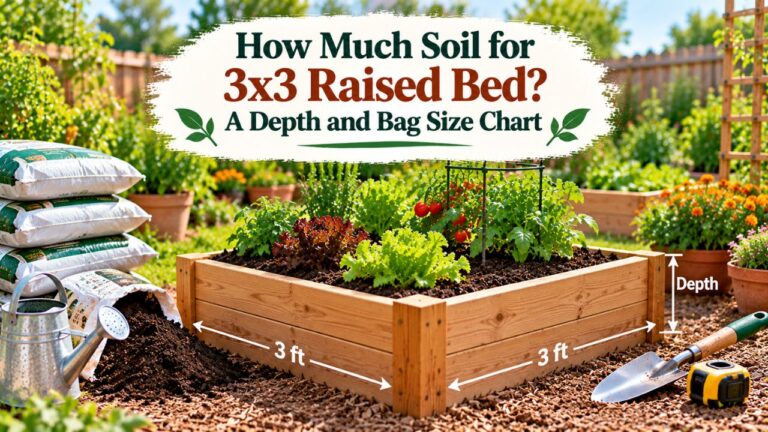
A 3×6 raised bed needs 18 cubic feet (0.67 cubic yards) of soil when filled to a depth of 12 inches. If you leave 2 inches of space below the rim, the required amount drops to 15 cubic feet (0.56 cubic yards). That’s approximately nine or eight 2-cubic-foot bags, respectively.
The exact soil requirement depends on your raised bed’s height, actual interior dimensions, and intended filling depth. A 3×6 garden bed provides 18 square feet of planting space, so even a small change in depth can affect how much soil you need to purchase.
Buying too little soil can leave insufficient space for certain plants to develop healthy roots. Purchasing more than necessary increases gardening expenses, especially when using premium raised-bed mixtures.
Soil quality also matters. A suitable combination of topsoil and compost provides a better growing environment than simply filling the bed with whatever material is cheapest.
This guide covers soil volume calculations, bag quantities, recommended filling depths, suitable soil mixtures, and practical ways to prepare a 3×6 raised garden bed without wasting materials.
How Much Soil for 3×6 Raised Bed at Different Depths?
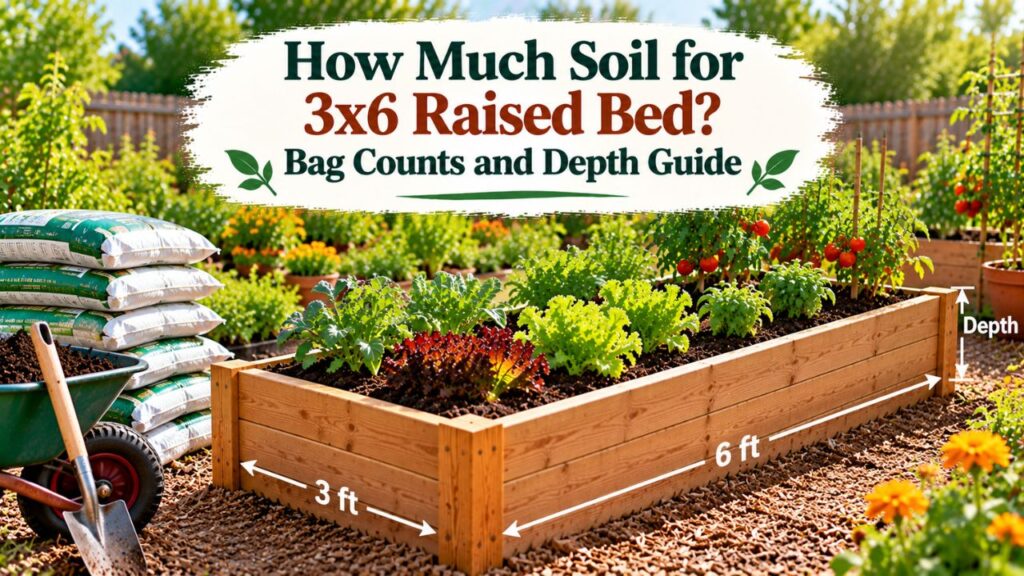
The amount of soil required for a 3×6 raised garden bed depends on how many inches of growing medium you want inside the frame.
A bed filled 6 inches deep needs 9 cubic feet, while the same bed filled 24 inches deep requires 36 cubic feet.
3×6 Raised Bed Soil Volume Chart
| Soil depth | Cubic feet | Cubic yards | 2-cu.-ft. bags |
| 6 inches | 9 | 0.33 | 5 |
| 8 inches | 12 | 0.44 | 6 |
| 10 inches | 15 | 0.56 | 8 |
| 11 inches | 16.5 | 0.61 | 9 |
| 12 inches | 18 | 0.67 | 9 |
| 16 inches | 24 | 0.89 | 12 |
| 18 inches | 27 | 1.00 | 14 |
| 22 inches | 33 | 1.22 | 17 |
| 24 inches | 36 | 1.33 | 18 |
These calculations assume the bed’s interior dimensions are exactly 3 feet by 6 feet. Bag quantities are rounded up to the nearest whole bag.
The chart also assumes the entire specified soil depth is filled without accounting for materials occupying space underneath.
Key Takeaway: For a typical 3×6 raised bed with 12-inch-high walls, approximately 15–18 cubic feet of soil is sufficient, depending on how much space you leave below the top edge.
Soil Needed for a 3x6x1 Raised Bed
A 3x6x1 raised bed measures 3 feet wide, 6 feet long, and 1 foot high.
Its full capacity is:
3 × 6 × 1 = 18 cubic feet
This equals:
- 0.67 cubic yards
- Approximately 510 liters
- Nine 2-cubic-foot bags
- Twelve 1.5-cubic-foot bags
- Eighteen 1-cubic-foot bags
These quantities fill the entire 12-inch depth.
However, leaving approximately 1–2 inches of space below the rim is often more convenient for watering and mulching.
With a 10-inch soil depth, the same bed needs only 15 cubic feet.
Soil Needed for a 3x6x2 Raised Bed
A 3x6x2 raised bed is 24 inches tall.
If you fill it completely, the calculation becomes:
3 × 6 × 2 = 36 cubic feet
That equals 1.33 cubic yards or eighteen 2-cubic-foot bags.
Leaving 2 inches below the rim reduces the soil depth to 22 inches and the required volume to 33 cubic feet.
A 24-inch-tall bed offers more space for roots, but filling the entire structure with purchased soil can become expensive.
Whether you need that much growing medium depends partly on the surface underneath the raised bed and the crops you intend to grow.
How to Calculate Soil Volume for a 3×6 Raised Bed
Calculating the required soil volume is straightforward when you know the bed’s inside dimensions and desired soil depth.
For rectangular raised beds, use:
Soil volume (cubic feet) = Length (feet) × Width (feet) × Soil depth (feet)
All three measurements must use feet.
Calculate Soil for a 12-Inch-Deep Bed
For a 3×6 bed filled 12 inches deep:
- Multiply the length by the width: 3 × 6 = 18 square feet.
- Convert the depth into feet: 12 ÷ 12 = 1 foot.
- Multiply the growing area by the depth: 18 × 1 = 18 cubic feet.
- Convert cubic feet to cubic yards: 18 ÷ 27 = 0.67 cubic yards.
The result is 18 cubic feet, or approximately two-thirds of a cubic yard.
Use This Shortcut for Any 3×6 Raised Bed
Because a 3×6 raised bed has an area of 18 square feet, each additional inch of depth requires 1.5 cubic feet of soil.
The simplified formula is:
Soil volume (cubic feet) = Soil depth (inches) × 1.5
For example:
- 8-inch depth: 8 × 1.5 = 12 cubic feet.
- 10-inch depth: 10 × 1.5 = 15 cubic feet.
- 12-inch depth: 12 × 1.5 = 18 cubic feet.
- 20-inch depth: 20 × 1.5 = 30 cubic feet.
This shortcut is especially useful when comparing soil requirements for different bed heights.
Important: Measure the inside dimensions of your raised bed before ordering. Thick wooden boards or rounded corners can reduce the actual capacity compared with the advertised outside measurements.
How Many Bags of Soil for a 3×6 Raised Bed?
The number of bags depends on the total required volume and the amount of soil in each package.
Garden centers commonly sell soil in bags labeled by cubic feet. Some products use quarts or provide both measurements.
Check the package’s stated volume rather than estimating from its weight.
3×6 Raised Bed Soil Bag Chart
| Soil depth | 1-cu.-ft. bags | 1.5-cu.-ft. bags | 2-cu.-ft. bags |
| 6 inches | 9 | 6 | 5 |
| 8 inches | 12 | 8 | 6 |
| 10 inches | 15 | 10 | 8 |
| 12 inches | 18 | 12 | 9 |
| 18 inches | 27 | 18 | 14 |
| 24 inches | 36 | 24 | 18 |
All bag counts are rounded up to whole bags.
For a 12-inch-deep 3×6 bed, nine 2-cubic-foot bags provide exactly 18 cubic feet.
For a 10-inch depth, eight 2-cubic-foot bags provide 16 cubic feet, leaving approximately 1 cubic foot beyond the calculated requirement.
How to Calculate the Number of Soil Bags
Use the formula:
Number of bags = Total soil volume ÷ Volume per bag
Suppose your raised bed requires 18 cubic feet and the store sells bags containing 1.5 cubic feet each.
18 ÷ 1.5 = 12 bags.
If the calculation produces a fraction, round up to the next whole bag.
For example, 15 cubic feet divided by 2 cubic feet per bag equals 7.5 bags, so you would purchase eight.
Should You Buy Bagged or Bulk Soil?
Bagged soil is convenient for a single 3×6 raised bed, particularly if you need only 12–18 cubic feet.
It allows you to purchase measured quantities, transport the materials easily, and choose a ready-to-use raised-bed mixture.
Bulk soil can be more economical when filling multiple beds or one particularly deep planter.
For example, filling three 3×6 raised beds to a depth of 12 inches requires:
18 × 3 = 54 cubic feet, or 2 cubic yards.
At that quantity, purchasing bulk topsoil and compost may reduce packaging costs.
Ask your supplier about minimum delivery quantities, soil quality, and transportation charges before ordering.
What Is the Best Soil Mix for a 3×6 Raised Bed?
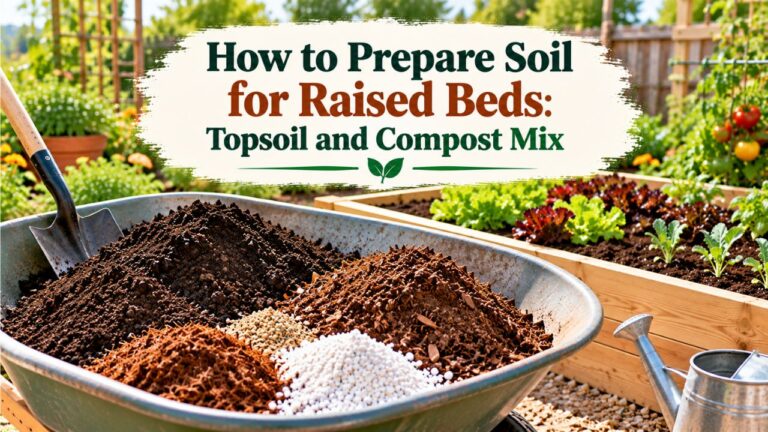
For an open-bottom raised bed installed over suitable garden ground, a mixture of approximately two parts quality topsoil and one part finished compost is a practical starting point.
This provides a combination of mineral soil and organic matter without relying entirely on compost.
The University of Minnesota Extension’s raised-bed gardening guidance describes an appropriate mixture as approximately one-half to two-thirds topsoil and one-third to one-half plant-based compost.
The exact proportions may vary depending on existing soil conditions and the materials available.
Topsoil and Compost Quantities for a 3×6 Bed
Using a two-to-one topsoil-to-compost ratio:
| Soil depth | Topsoil | Compost | Total mixture |
| 8 inches | 8 cu. ft. | 4 cu. ft. | 12 cu. ft. |
| 10 inches | 10 cu. ft. | 5 cu. ft. | 15 cu. ft. |
| 12 inches | 12 cu. ft. | 6 cu. ft. | 18 cu. ft. |
| 18 inches | 18 cu. ft. | 9 cu. ft. | 27 cu. ft. |
| 24 inches | 24 cu. ft. | 12 cu. ft. | 36 cu. ft. |
For a standard 12-inch fill, combining 12 cubic feet of topsoil with 6 cubic feet of mature compost produces the required 18 cubic feet of mixture, assuming the component volumes remain approximately additive.
Topsoil contributes mineral particles and structure, while finished compost adds organic matter and helps create a favorable environment for root development.
Avoid using unfinished compost, unknown construction fill, or dense clay as the primary growing medium.
Can You Use Bagged Raised-Bed Soil Instead?
Yes. Commercial raised-bed soil can be used if the product is intended as a complete growing medium.
These mixtures may contain topsoil, compost, aged bark, and other ingredients that help balance moisture retention and drainage.
If the product already includes substantial compost, additional compost may be unnecessary.
Check the label for its intended application and follow the manufacturer’s instructions.
For an open-bottom bed, a well-balanced mineral-soil mixture is often preferable to filling the entire space with lightweight potting mix.
How Deep Should Soil Be in a 3×6 Raised Garden Bed?
A useful soil depth depends on which plants you intend to grow and whether their roots can reach the ground below.
The bed’s frame height does not always determine the total space available for root growth.
Soil Depth for a 3×6 Bed on Garden Ground
For a raised bed positioned directly over healthy garden ground, approximately 8–12 inches of suitable growing medium is a useful starting depth.
Because the bottom is open, roots can continue growing into the underlying soil when it is sufficiently loose, well-drained, and free from restrictive barriers.
An 8-inch-deep bed may work well for leafy greens, radishes, and other crops that can access additional soil beneath the frame.
Carrots, parsnips, tomatoes, and other plants requiring more root space benefit from a deeper, loose rooting zone.
If the underlying ground is heavily compacted, loosen it before filling the raised bed.
Adding more soil on top does not automatically correct poor drainage or severe compaction below.
Soil Depth for a 3×6 Bed on Concrete
A raised bed installed on concrete or pavement needs sufficient growing medium to support the plant roots inside the structure.
The University of Maryland Extension’s raised-bed vegetable guidance recommends at least 8 inches of depth for crops such as leafy greens, beans, and cucumbers on hard surfaces, with 12–24 inches for tomatoes, peppers, and squash.
For a 3×6 raised bed, that means:
- 8 inches deep: 12 cubic feet.
- 12 inches deep: 18 cubic feet.
- 18 inches deep: 27 cubic feet.
- 24 inches deep: 36 cubic feet.
For these hard-surface beds, the same guidance recommends combining compost with a soilless growing medium in a 1:1 ratio. Limited topsoil can be incorporated into beds at least 16 inches deep.
Ensure that the bed has a suitable drainage outlet. A solid, undrained base can trap water around plant roots.
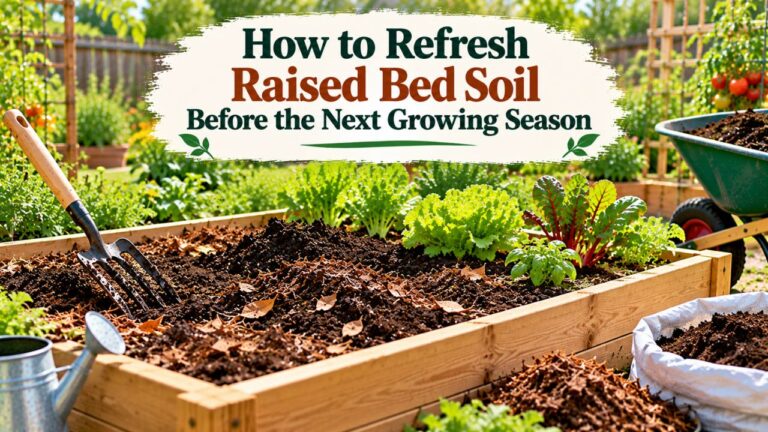
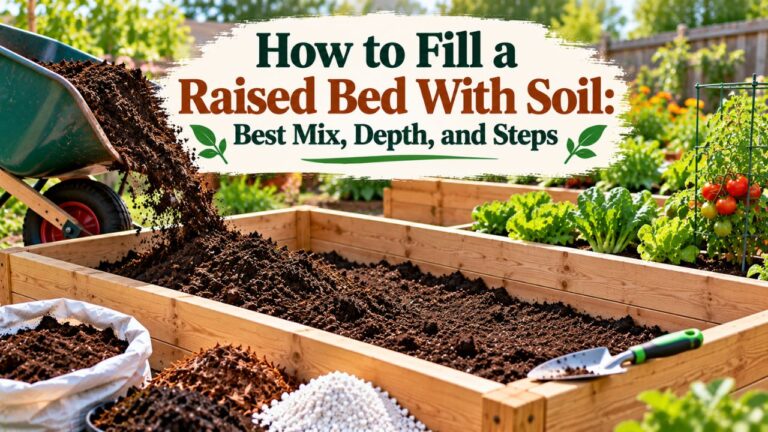
How to Fill a 3×6 Raised Bed With Soil
After calculating the soil quantity, prepare the bed and add the growing mixture carefully.
Following a consistent filling process helps maintain even soil depth and prevents unnecessary compaction.
Step 1: Prepare the Raised-Bed Base
Remove unwanted vegetation, trash, and large stones from the area beneath the bed.
If the frame sits directly on garden ground, gently loosen any heavily compacted surface with a garden fork.
Avoid placing an impermeable plastic sheet under an open-bottom bed because it can restrict drainage and root growth.
Plain cardboard can temporarily suppress grass when installing a bed over a lawn, but it is not necessary on already prepared ground.
Step 2: Measure and Prepare the Soil Mixture
Decide how much space to leave below the rim.
For a 12-inch-tall bed with a 10-inch fill, prepare approximately 15 cubic feet of soil mixture.
If using the two-to-one topsoil and compost combination, measure approximately:
- 10 cubic feet of topsoil.
- 5 cubic feet of finished compost.
Mix the materials until the compost is reasonably evenly distributed.
For a complete commercially prepared raised-bed mix, follow the product directions instead.
Step 3: Add Soil Without Compacting It
Transfer the soil into the raised bed using a shovel, bucket, or wheelbarrow.
Spread the growing medium evenly across the entire 3×6-foot area.
Break apart large clumps and distribute the soil gently with a rake.
Avoid walking inside the bed or repeatedly pressing the soil downward.
Compacted soil contains less air space, which can interfere with water movement and root growth.
Step 4: Water and Check for Settling
After filling the bed, water the growing medium slowly and evenly.
The soil should become moist without developing persistent puddles.
Some settling is normal as loose materials shift and air pockets collapse.
Check the surface level after watering.
If necessary, add more prepared growing mixture to restore the intended depth.
Step 5: Leave Space for Mulching and Watering
Keep the finished soil surface approximately 1–2 inches below the top of the frame.
This allows room for watering without washing loose soil over the sides.
It also provides space for a thin layer of organic mulch around established plants.
The bed is ready for planting once the soil is suitably moist and the growing conditions are appropriate for your chosen crops.
How Much Extra Soil Should You Purchase for Settling?
A calculated soil volume represents the space available inside the bed. The amount required during filling may vary slightly because of the materials’ texture, moisture, and settling behavior.
For example, a 3×6 raised bed requiring 15 cubic feet can be filled using eight 2-cubic-foot bags.
Those bags provide 16 cubic feet, leaving approximately 1 cubic foot beyond the calculated volume.
That small remainder may be enough to adjust the soil level after watering.
For an 18-cubic-foot requirement, nine 2-cubic-foot bags provide exactly the theoretical volume. Purchasing a small additional bag can be convenient if the growing medium is particularly loose.
However, an extra allowance is not mandatory. Some mixes settle very little, while others containing large amounts of undecomposed organic material may settle more noticeably.
Pro Tip: Keep a small quantity of your original soil mixture available for topping up low areas after the first thorough watering.
Conclusion
Knowing how much soil for 3×6 raised bed installations require makes planning easier and helps prevent unnecessary purchases.
For a bed measuring 3 feet by 6 feet, the soil requirement is 18 cubic feet at a 12-inch depth, 15 cubic feet at 10 inches, and 36 cubic feet at 24 inches.
For most standard 12-inch-tall raised beds, approximately 15–18 cubic feet of growing medium is a practical quantity, depending on the intended fill level.
Choose a suitable soil blend, measure the interior dimensions, and account for the plants’ rooting needs before purchasing materials.
A properly prepared 3×6 raised bed should provide sufficient soil depth, reliable drainage, and a loose growing environment without requiring more soil than necessary.
FAQs About How Much Soil for 3×6 Raised Bed
How Many 2-Cubic-Foot Bags Fill a 3×6 Raised Bed?
A 3×6 raised bed requires nine 2-cubic-foot bags when filled 12 inches deep.
For a 10-inch depth, eight bags provide enough soil. A 24-inch-deep bed requires eighteen bags.
The exact quantity depends on the actual interior dimensions and intended filling depth.
How Much Soil for a 3×6 Raised Bed That’s 8 Inches Deep?
A 3×6 raised bed filled 8 inches deep requires 12 cubic feet of soil.
That equals approximately 0.44 cubic yards or six 2-cubic-foot bags.
This depth may be suitable for many vegetables when the bed is open to healthy garden soil underneath.
How Much Compost Do I Need for a 3×6 Raised Bed?
For a 12-inch-deep 3×6 raised bed using a two-to-one topsoil-to-compost mixture, you need approximately 6 cubic feet of finished compost.
The remaining 12 cubic feet should be suitable topsoil.
For a 10-inch fill, the mixture requires approximately 5 cubic feet of compost and 10 cubic feet of topsoil.
Can I Fill a 3×6 Raised Bed With Only Potting Soil?
A complete potting mix can support plants in a raised planter, but filling a large open-bottom bed entirely with lightweight potting mix is not always the most suitable or economical approach.
For a ground-level raised bed, a balanced mixture of mineral topsoil and finished compost is generally a practical choice.
For enclosed planters on hard surfaces, a suitable soilless growing medium may be more appropriate.
How Much Soil Do I Need for Two 3×6 Raised Beds?
Two 3×6 raised beds filled 12 inches deep require a combined 36 cubic feet of soil.
That equals approximately 1.33 cubic yards or eighteen 2-cubic-foot bags.
For two beds filled 10 inches deep, the combined requirement is 30 cubic feet, or fifteen 2-cubic-foot bags.
How Much Does the Soil Depth Change the Total Volume?
For a 3×6 raised garden bed, every additional inch of soil depth increases the required volume by 1.5 cubic feet.
For example, increasing the fill depth from 10 inches to 12 inches adds 3 cubic feet.
This makes it easy to adjust your soil order when changing the filling depth or leaving additional space below the rim.

I’m Maya L. Greenwood, a lifelong plant lover who believes anyone can grow something beautiful with the right guidance. After years of testing soil mixes, pruning methods, irrigation tricks, and pest-safe solutions, I started EasyGardenTips.com to turn hard-won lessons into step-by-step advice. From seed starting and container gardens to composting and seasonal checklists, my goal is to make gardening simple, sustainable, and fun.