How to Keep Deer Out of Raised Garden Beds: Fences and Covers
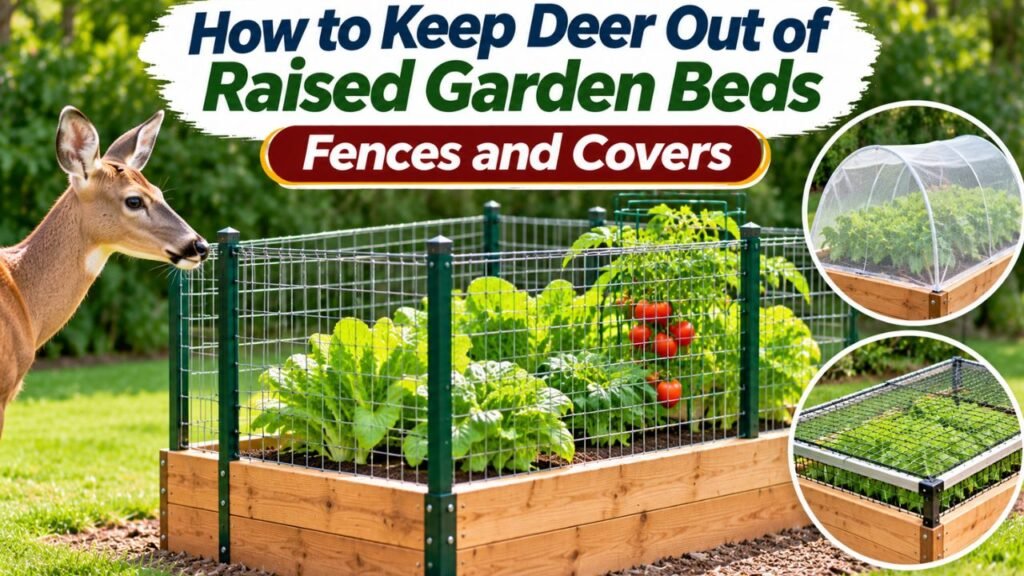
The most reliable way to keep deer out of raised garden beds is to install a physical barrier, such as an 8-foot-tall garden fence or a fully enclosed wire-mesh cage over each bed. Raised-bed walls alone will not stop deer from eating vegetables. Even a bed that stands 2–3 feet above the ground may leave lettuce, beans, tomatoes, and other plants within easy reach.
Deer are capable jumpers, and a short decorative fence may not provide dependable protection. However, you do not necessarily need to fence your entire backyard. A smaller enclosure around several raised beds or an individual cage with a secure top can protect vulnerable crops while preserving access for watering, pruning, and harvesting.
Repellent sprays, motion-activated sprinklers, and less-preferred plants can provide additional deterrence, but their results are less predictable than properly installed fencing.
In this article, I explain how to keep deer away from raised beds using permanent fences, removable mesh covers, and simple DIY enclosures. I also cover recommended fence heights, materials, repellents, vegetable protection, installation steps, and common mistakes that allow deer into gardens.
How to Keep Deer Out of Raised Garden Beds: Best Methods
Several approaches can reduce deer damage, but they differ in effectiveness, cost, and maintenance.
Physical exclusion is generally the most dependable option because it prevents deer from reaching the plants rather than relying on the animals to avoid them voluntarily.
| Deer Protection Method | Reliability | Best Application |
| 8–10-foot perimeter fence | Very high when properly built | Multiple raised beds |
| Fully enclosed wire-mesh cage | Very high when properly secured | Individual raised beds |
| Tall deer netting on posts | High when strong and maintained | Seasonal garden fencing |
| Short fence with secure overhead cover | High for fully enclosed beds | Small raised beds |
| Two-tier deer fence | Can be effective | Gardens with perimeter space |
| Electric deer fence | Effective when professionally designed and maintained | Larger properties |
| Deer repellent spray | Variable | Supplemental protection |
| Motion-activated sprinkler | Temporary or variable | Small gardens |
| Deer-resistant plants | Limited | Landscape borders |
| Scare devices and reflective objects | Generally unreliable alone | Short-term deterrence |
A single method may be sufficient in a garden with occasional deer visits.
However, areas with frequent browsing usually need a substantial barrier.
Which Method Works Best for One Raised Bed?
For one small raised bed, I recommend a rigid mesh enclosure with a removable or hinged top.
This approach protects vegetables without requiring a tall fence around the entire yard.
It can also help exclude rabbits and certain other animals when properly constructed.
Which Method Works Best for Several Raised Beds?
For several beds, one tall perimeter fence is often more convenient than building individual cages.
A shared enclosure allows you to move between beds, install trellises, and harvest without repeatedly removing protective covers.
An approximately 8-foot-high fence is a dependable starting specification for many deer-prone gardens.
Can You Protect Raised Beds Without a Fence?
You can reduce deer damage with repellents, sprinklers, and other deterrents.
However, these methods do not consistently prevent browsing.
Deer may eventually ignore smells, sounds, or movement when food is attractive or scarce.
For valuable vegetable crops, combine temporary deterrents with physical barriers whenever possible.
How Tall Should a Fence Be to Keep Deer Out of Raised Beds?
A perimeter deer fence should generally be approximately 8 feet tall, with 8–10 feet providing greater reliability where deer pressure is substantial.
Deer can jump higher than ordinary backyard fences.
A 4-foot fence may stop some animals in certain situations, but it should not be considered a dependable deer barrier.
The University of Maryland Extension’s 2026 guide to managing deer damage identifies 8–10-foot woven or welded wire fencing as the most reliable option for long-term exclusion.
Is a 4-Foot Fence Tall Enough?
Usually not for an open-top garden.
A deer may be able to step toward, lean across, or jump over a short fence.
A 4-foot barrier can work differently when it forms part of a fully enclosed cage with a secure roof.
In that case, deer cannot simply jump over the sides into the vegetables.
The protection comes from closing off access, not from the sidewall height alone.
Will a 6-Foot Fence Keep Deer Out?
A 6-foot fence may discourage deer in certain small or confined garden layouts.
For example, deer may hesitate to jump into an enclosed area where there is little clear landing space.
However, it is not a universally reliable barrier.
Determined deer can jump over it.
For an open-top perimeter fence in an area with repeated deer damage, an approximately 8-foot fence is a safer design choice.
Does Raised Bed Height Reduce the Fence Height Needed?
Not necessarily.
A raised bed 18–24 inches tall makes the planting area higher above ground, but that does not automatically improve protection.
Deer can reach over the bed walls to eat exposed plants.
They may also jump into the surrounding garden if the perimeter barrier is too low.
A tall raised-bed wall should not be counted as a substitute for a properly designed deer fence.
Why Can a Shorter Enclosed Cage Work?
A fully enclosed cage blocks entry from the sides and above.
Unlike an open-top garden, it does not offer an obvious place for deer to jump inside.
For example, a 4-foot-high cage with secure mesh walls and a mesh roof can protect low-growing vegetables, provided the plants remain inside the enclosure.
However, taller plants may outgrow the structure.
Key Takeaway: For an open-top garden, aim for an approximately 8-foot perimeter fence. For an individual raised bed, a shorter cage can work if the sides and top are completely enclosed.
How to Build a Deer-Proof Cage Around a Raised Garden Bed
A protective cage is one of the most practical solutions for small raised-bed gardens.
It allows sunlight and rain to reach the vegetables while physically separating them from deer.
The following design works particularly well for a standard 4 × 8-foot raised bed containing low- to medium-height crops.
Materials Needed
- Exterior-rated lumber or suitable metal framing
- Corrosion-resistant wire mesh or durable deer-exclusion mesh
- Weather-resistant screws or structural connectors
- Suitable posts or support brackets
- Hinges for an access panel
- A secure latch
- Heavy-duty fencing staples, screws with washers, or appropriate mesh fasteners
- Measuring tape
- Saw and drill, as needed
- Gloves and eye protection
Choose materials appropriate for the expected wind, snow, and weather conditions.
A lightweight structure that collapses in wind will not protect the garden reliably.
Step 1: Measure the Raised Bed
Measure the outside length and width of the bed.
For a nominal 4 × 8-foot raised bed, the exterior dimensions may differ slightly depending on the wall thickness and construction.
Measure the actual finished bed rather than assuming the advertised size is exact.
Decide whether the cage will attach directly to the bed frame or stand independently around it.
An independent frame may be preferable for thin metal raised beds that are not designed to support additional structural loads.
Step 2: Determine the Cage Height
Choose a height that accommodates the plants at maturity.
For example:
| Crops | Example Cage Height |
| Lettuce and spinach | 2–3 feet above the soil |
| Carrots and radishes | 2–3 feet above the soil |
| Bush beans | 3–4 feet above the soil |
| Peppers | 4–5 feet above the soil |
| Compact tomatoes | Depends on mature variety and support |
| Tall indeterminate tomatoes | Often requires a taller enclosure |
These heights are planning examples rather than strict crop requirements.
Allow additional room for plant supports and normal growth.
The enclosure should also prevent leaves and fruit from pushing through the mesh where deer could reach them.
Step 3: Install the Support Frame
Place structural supports at the corners.
For larger cages, add intermediate supports to prevent sagging.
Secure the frame according to the expected load and wind conditions.
Do not rely on loose soil alone to hold tall, lightweight posts in place.
If fastening to wooden bed walls, use suitable exterior hardware and confirm that the wood can support the attachment.
For metal beds, use appropriate brackets or a freestanding support system rather than drilling holes that could weaken thin panels.
Step 4: Attach the Side Mesh
Cut the mesh to fit each side of the frame.
Attach it securely.
Keep the material reasonably taut.
Avoid large openings around:
- Corners
- Support posts
- Hinges
- The bed frame
- Access panels
- The bottom edge
Deer can push against loose barriers or reach through accessible gaps.
Choose mesh openings that prevent a deer’s muzzle from reaching valuable plant growth.
For rigid cages, ½-inch or 1-inch hardware cloth may be practical, although the finer material is heavier and more expensive.
Step 5: Install the Roof
The roof is essential when using a cage shorter than a conventional deer fence.
Attach a secure mesh top.
The roof can be:
- Fixed in place
- Hinged for access
- Removable in sections
A hinged roof is convenient for smaller beds.
However, a large roof panel may become heavy or difficult to open.
For a 4 × 8-foot enclosure, consider dividing the top into two manageable sections.
Support the roof adequately so it does not collapse or sag onto the vegetables.
Step 6: Add a Secure Opening
Install a hinged door or access panel.
Choose an opening large enough for watering, pruning, and harvesting.
Use a latch that remains closed during wind and normal garden activity.
Do not leave large gaps around the door.
If the cage is tall, a side door may be easier to use than lifting the entire roof.
Step 7: Inspect the Finished Cage
After construction, check that:
- All sides are covered.
- The roof is secure.
- The latch closes properly.
- Mesh edges cannot injure people or animals.
- The frame is stable.
- Plants have adequate growing room.
- The enclosure can be opened safely for maintenance.
Check the structure after storms and throughout the growing season.
Key Takeaway: A strong frame, securely attached mesh, an enclosed top, and a convenient access door are the main features of an effective deer-resistant raised-bed cage.
How to Fence Several Raised Garden Beds Against Deer
If you have multiple raised beds, enclosing the entire growing area may be more practical than building separate cages.
A perimeter fence also allows vegetables to grow vertically without being restricted by low overhead covers.
Choose the Garden Boundary
Measure the area containing your raised beds.
Include enough room for:
- Walking paths
- Watering equipment
- Wheelbarrow access
- Plant maintenance
- Harvesting
- Compost or supply storage, if desired
Avoid placing the fence directly against tall plants where deer could browse through the mesh.
Leave sufficient clearance between the fence and vegetation.
Install Sturdy Fence Posts
For an approximately 8-foot finished fence, select posts long enough to provide the required above-ground height while maintaining suitable anchoring.
The appropriate post length and installation depth depend on soil conditions, wind exposure, frost requirements, and fence materials.
Use stronger posts at corners and gate openings.
A temporary net fence may require different supports from a permanent welded-wire fence.
Attach Deer Fencing or Mesh
Suitable materials include:
- Welded-wire fencing
- Woven-wire fencing
- Durable polypropylene deer netting
- Other purpose-designed deer-exclusion mesh
Woven or welded wire generally offers greater long-term durability than lightweight plastic netting.
Plastic deer mesh can be economical, but it should be inspected regularly for tears, weather damage, and loose sections.
Secure the Bottom Edge
Do not leave openings beneath the fence.
Deer may attempt to push underneath loose netting.
Secure the lower edge close to the ground with appropriate fasteners or a tensioned bottom wire.
If rabbits or groundhogs are also a problem, consider a separate lower section of suitable small-mesh fencing.
Buried fencing or an outward-facing underground apron can help exclude digging animals when designed correctly.
Build a Reliable Gate
A fence with an open or poorly fitted gate offers little protection.
Use a gate that is:
- Tall enough to match the protection level
- Supported by sturdy posts
- Easy to close
- Equipped with a reliable latch
- Free from large gaps
Check the gate after storms and seasonal ground movement.
Check Local Fence Regulations
Before installing a tall permanent fence, review local zoning rules, permit requirements, and any homeowners association restrictions.
Fence heights may be limited in certain residential areas.
Also have underground utilities located before digging post holes.
In the United States, contact the appropriate 811 utility-location service before excavation.
Can You Use Deer Netting Over Raised Garden Beds?
Yes. Deer netting can protect raised beds when it is supported by a suitable frame and properly secured.
However, it should not simply be draped loosely over the plants.
Why Loose Netting Is a Problem
Loose netting may:
- Collapse onto plants
- Tear during wind
- Create gaps
- Catch on stems and supports
- Entangle wildlife
- Make harvesting difficult
Instead, suspend the netting over a rigid frame.
The material should remain separated from the plant canopy.
How to Install Netting Over One Raised Bed
A simple installation may involve:
- Installing a frame or hoop supports.
- Creating enough height for mature plants.
- Covering the supports with durable netting.
- Securing the netting along the sides.
- Closing openings at the ends.
- Providing an access flap or removable section.
- Inspecting the mesh for damage.
If the structure is low, make sure the top is completely enclosed.
For tall plants, a higher framed enclosure may be required.
What Kind of Netting Is Best?
Choose a durable, purpose-designed deer-exclusion mesh with openings small enough to prevent deer from reaching through.
UV-resistant materials are useful for outdoor exposure.
Rigid welded-wire mesh can be more durable but also heavier and more expensive.
Avoid very loose, fine bird netting that can entangle birds, snakes, and other wildlife.
Install mesh tightly and inspect it regularly.
Will Deer Eat Through Netting?
Some deer may push against, tear, or damage weak netting.
A strong barrier with properly supported posts is more dependable than thin material stretched loosely over a garden.
Check the netting after deer activity.
Replace damaged sections promptly.
Does Netting Block Pollinators?
It can.
The effect depends on the mesh size and design.
Vegetables such as tomatoes and peppers can often set fruit without insects entering the enclosure, although pollination requirements vary.
Cucumbers, squash, pumpkins, and many other crops depend heavily on pollinating insects.
Fine mesh may restrict their access.
For crops that require insect pollination, use a design that permits suitable pollinator access without leaving the bed vulnerable to deer, or hand-pollinate when appropriate.
Can You Make a Raised Bed Deer Fence With PVC Hoops?
Yes. PVC hoops can support a cover over a raised bed.
However, the structure must be tall enough for the plants and strong enough for the chosen covering.
PVC Hoop Cover Design
A typical setup involves:
- PVC hoops spanning the bed
- Secure hoop anchors
- A longitudinal support when necessary
- Suitable mesh stretched across the frame
- Closable openings at the ends
This arrangement can work for lettuce, spinach, and other relatively low-growing crops.
However, thin PVC hoops may bend under snow, strong wind, or heavy netting.
A more rigid structure may be needed for long-term protection.
How Tall Should the Hoops Be?
For low-growing vegetables, approximately 2–3 feet above the soil may provide enough growing space.
Bush beans or taller crops may need more clearance.
Remember that a low hoop structure must be fully enclosed to exclude deer.
A few hoops with open ends do not provide dependable protection.
Should You Use Row Cover Fabric?
Spunbonded row cover can protect crops from some insects and weather conditions.
However, lightweight fabric is not usually the best primary barrier against deer.
Deer may push through or damage loosely supported fabric.
For deer exclusion, use stronger mesh or a suitable fence structure.
You may use row cover for a separate purpose when appropriate, but do not assume it replaces durable deer fencing.
Do Deer Repellents Work for Raised Garden Beds?
Deer repellents can reduce browsing, but their effectiveness varies.
They generally work by creating an unpleasant smell, taste, or sensory experience.
Some products discourage deer from approaching an area.
Others are applied to plants to make feeding less appealing.
Types of Deer Repellents
Common commercial repellent ingredients include:
- Putrescent egg solids
- Garlic-based compounds
- Certain pepper-derived ingredients
- Other odor- or taste-based deterrents
Products differ in formulation and approved uses.
Some are intended for ornamental plants rather than edible vegetables.
Can You Spray Deer Repellent on Vegetables?
Only when the product label explicitly permits its use on the edible crop or application site.
Check:
- Approved plants
- Application locations
- Directions for use
- Reapplication requirements
- Harvest restrictions
- Warnings concerning people, pets, and wildlife
Never assume a repellent is suitable for vegetables because it is marketed as natural or organic.
The University of Maryland Extension’s vegetable garden deer guidance advises checking product labels before applying repellents to plants intended for human consumption.
How Often Should You Reapply Deer Repellent?
Follow the product label.
Many repellents require reapplication after substantial rainfall, irrigation, or the development of new plant growth.
The timing depends on the formulation.
A single application should not be expected to protect an entire growing season.
Are Homemade Deer Repellents Reliable?
Homemade repellents may temporarily discourage browsing, but results are inconsistent.
Common suggestions include soap, garlic, pepper, human hair, or egg-based mixtures.
Some odor-based formulations have been studied, but that does not mean every homemade recipe is effective or suitable for edible crops.
Avoid spraying raw-egg mixtures or improvised chemical solutions directly onto food crops without reliable food-safety guidance.
For an edible raised-bed garden, a physical barrier is a more dependable starting point.
Should You Use Repellent Without Fencing?
Repellent may be reasonable when deer visits are occasional or while a permanent barrier is being installed.
However, hungry or habituated deer may continue feeding despite the smell or taste.
Use repellents as supplemental protection rather than the only defense for valuable vegetables.
Do Motion-Activated Sprinklers Keep Deer Away?
Motion-activated sprinklers may temporarily discourage deer from entering a garden.
These devices detect movement and release a short burst of water.
The sudden motion and spray can startle an approaching animal.
Advantages of Motion-Activated Sprinklers
Potential benefits include:
- No physical contact with deer
- Automatic operation
- Relatively simple installation
- Useful temporary deterrence
- Ability to protect an open area
However, the effectiveness depends on deer behavior, detection range, and placement.
Why Motion Sprinklers Sometimes Fail
Deer can become accustomed to recurring disturbances.
The sprinkler may also fail to detect animals approaching outside its sensor range.
Other limitations include:
- Accidental activation by people or pets
- Water use
- Hose leaks
- Sensor obstruction
- Freezing weather
- Limited coverage around large gardens
The device should be considered a secondary deterrent rather than a substitute for a reliable fence.
Where Should You Place the Sprinkler?
Position the sensor toward known deer approach routes.
Avoid aiming it toward public sidewalks, neighboring property, or commonly used paths.
Follow the manufacturer’s installation instructions.
Do not create persistent wet areas that could damage garden structures or encourage disease.
Will Deer-Resistant Plants Protect Raised Garden Beds?
Some plants are less attractive to deer than others.
However, no vegetable or herb is guaranteed to remain untouched.
Plant preference changes according to season, availability of other food, and local deer pressure.
Vegetables Deer Commonly Damage
Deer may browse:
- Lettuce
- Spinach
- Kale
- Swiss chard
- Beans
- Peas
- Beet greens
- Carrot tops
- Strawberry plants
- Tender tomato growth
- Other leafy vegetables
Young seedlings can be particularly vulnerable because their stems and leaves are tender.
Deer may eat enough of a small plant to severely limit recovery.
Are Any Vegetables Deer-Resistant?
Some crops are generally less appealing than tender leafy greens.
Examples may include:
- Garlic
- Onions
- Certain strongly flavored herbs
- Plants with coarse or aromatic foliage
However, deer may still sample these plants when food is scarce.
Do not treat plant selection as a replacement for fencing.
Can You Plant Lavender or Rosemary Around Raised Beds?
Lavender, rosemary, thyme, and certain other aromatic herbs may be less attractive to deer.
They can contribute to a diverse garden.
However, planting them along the border does not create a reliable protective barrier.
Deer may walk past them to reach lettuce, beans, or other preferred vegetables.
Use these plants for their culinary, ornamental, or ecological value rather than expecting them to deer-proof the garden.
How to Protect a 4 × 8 Raised Garden Bed From Deer
A 4 × 8-foot bed is a common backyard size.
It is large enough for several vegetables but small enough to protect with a dedicated enclosure.
Option 1: Full Mesh Cage
Build a rigid frame around the bed.
Cover the sides and top with suitable mesh.
Include a hinged access panel.
This option works well for low-growing vegetables and compact plants.
The cage height should allow for mature plant growth.
Option 2: Freestanding Deer Netting
Install posts around the bed and support a properly secured barrier.
If the structure is open at the top, it must provide sufficient height and other design features to deter deer.
A short open-top fence is not a dependable substitute for a full deer enclosure.
Option 3: Enclose Multiple Beds Together
If you plan to add more raised beds, consider installing one perimeter fence.
This may be more convenient over the long term.
It also allows you to grow taller vegetables without individual cage height restrictions.
Which Option Is Best?
For a single 4 × 8-foot bed, a mesh cage with a secure top is usually the most practical choice.
For three or more beds, a shared perimeter fence may offer better access and simpler maintenance.
However, compare material requirements and site layout before deciding.
How to Keep Deer Out of Metal Raised Garden Beds
Metal raised beds can be protected using the same general barrier methods as wooden beds.
However, attaching a cage requires special attention to the bed’s construction.
Do Not Assume Thin Metal Walls Can Support Heavy Frames
Some metal beds use relatively thin panels.
They may not be designed to carry the load of tall posts, gates, or roof structures.
Attaching a heavy enclosure directly to the panels could cause bending or damage.
Use independent posts or suitable structural brackets when necessary.
Use a Freestanding Cage
A freestanding enclosure can surround the metal bed without relying on the bed walls for support.
This is particularly useful for tall mesh cages.
The structure should be anchored against wind and accidental movement.
Protect Exposed Metal Edges
Cut mesh and metal framing can leave sharp edges.
Fold, cap, or otherwise protect them.
Wear suitable gloves during installation.
Keep sharp wire ends away from the harvesting area.
Allow Access for Watering and Harvesting
Metal raised beds are often installed to improve gardening comfort and accessibility.
Make sure the deer barrier does not make the bed unnecessarily difficult to use.
A removable panel or properly sized door may be preferable to a large roof that must be lifted repeatedly.
How to Keep Deer Out of Raised Beds Without Blocking Sunlight
Plants still need suitable light, airflow, water, and space to grow.
A deer enclosure should protect them without interfering unnecessarily with these requirements.
Choose Open Mesh Materials
Wire mesh and purpose-designed deer netting generally allow substantial light and airflow through their openings.
They are often more appropriate than solid walls around a vegetable bed.
Avoid Heavy Shading
Dark mesh may slightly affect light transmission, depending on its thickness and coverage.
However, most open fencing materials do not shade plants as heavily as solid barriers.
Avoid adding unnecessary solid panels that block sunlight during important growing hours.
Provide Adequate Airflow
A fully enclosed mesh cage generally permits more airflow than a tightly sealed plastic greenhouse cover.
Good airflow helps prevent excessively humid conditions around foliage.
Do not confuse deer-exclusion mesh with plastic sheeting.
Allow Room for Plant Growth
Keep the enclosure away from large leaves and fruit whenever possible.
If foliage grows through the mesh, deer may still browse the exposed portions.
Plants can also become tangled in the barrier.
Monitor growth and adjust the enclosure when necessary.
How to Keep Deer Away From Raised Beds at Night
Deer frequently feed during the evening, night, and early morning.
A garden that looks undisturbed during the day may experience damage overnight.
Keep Protective Gates Closed
A tall fence only works when its entrances are secure.
Close and latch gates after every garden visit.
Inspect them before nightfall if deer activity is common.
Check Loose Netting
Wind may create openings in lightweight mesh.
Inspect the edges, corners, and fasteners.
Repair damaged sections promptly.
Remove Attractive Garden Waste
Collect fallen produce and avoid leaving piles of edible garden waste beside the beds.
This may reduce opportunities for wildlife to feed near the garden.
However, cleaning alone does not reliably deter deer from healthy growing vegetables.
Use Temporary Deterrents as Backup
Motion sprinklers or approved repellents may provide additional protection.
However, their effectiveness may decline as deer become accustomed to them.
Do not rely on lights, reflective tape, or noise alone.
Common Mistakes When Keeping Deer Out of Raised Beds
Many deer-control failures happen because the barrier is incomplete or poorly maintained.
Assuming Raised Beds Are Naturally Deer-Proof
Raised beds improve soil management and accessibility.
They do not automatically exclude deer.
A 2-foot bed wall still leaves vegetables exposed.
Building a Fence That Is Too Short
An ordinary 3- or 4-foot garden fence may be easy for deer to jump over or reach across.
For an open-top garden, use appropriate deer-exclusion height.
For a shorter individual cage, enclose the top.
Leaving Gaps at the Bottom
Deer may push beneath loose mesh.
Secure the lower edge.
Also inspect gaps near gates, corners, and uneven ground.
Leaving Plants Against the Fence
If lettuce or other vegetables grow directly through the mesh, deer may eat the exposed leaves.
Leave clearance between the plants and the barrier.
Using Loose Bird Netting
Loose netting can become tangled around wildlife.
It may also tear or collapse onto vegetables.
Choose an appropriate, securely tensioned material.
Inspect it regularly and remove damaged sections.
Forgetting Pollination
A fine mesh cage may prevent bees and other pollinators from reaching some flowers.
Consider the needs of cucumbers, squash, and other insect-pollinated crops.
Provide suitable pollinator access or hand-pollinate when necessary.
Using Repellents Incorrectly
Some repellent products are not approved for edible plants.
Never apply them to vegetables unless the label permits it.
Follow application intervals and harvest restrictions.
Assuming Deer Will Stay Away Permanently
Deer behavior changes with food availability, season, and familiarity with the garden.
A method that works for several weeks may become less effective.
Inspect barriers and monitor new damage throughout the growing season.
Best Deer Protection Setup by Raised Bed Size
Different garden layouts benefit from different protection systems.
| Raised Bed Setup | Recommended Starting Approach |
| One 2 × 4-foot bed | Compact rigid mesh enclosure |
| One 3 × 6-foot bed | Removable or hinged mesh cage |
| One 4 × 8-foot bed | Full cage with secure top |
| Two nearby raised beds | Shared cage or perimeter enclosure |
| Three to six raised beds | Tall perimeter deer fence |
| Large raised-bed vegetable garden | Approximately 8-foot or taller perimeter fence |
| Raised beds with tall tomatoes | Tall cage or fenced growing area |
| Raised beds near woodland | Strong perimeter barrier and regular inspection |
| Small patio or deck garden | Fully enclosed individual bed if deer can access the location |
These are practical design recommendations, not mandatory construction specifications.
Local deer behavior, vegetation, space, and budget should influence the final choice.
What Should You Do if Deer Are Already Eating Your Raised Bed Plants?
If deer have already discovered your vegetables, act quickly.
Repeated feeding can severely damage young plants and reduce the harvest.
Step 1: Identify the Damage
Deer damage often includes:
- Ragged or torn stems
- Leaves missing from reachable plant growth
- Browsed shoot tips
- Trampled vegetation
- Hoofprints nearby
- Droppings around the garden
Deer have lower incisors but no upper incisors, so their browsing often leaves a torn appearance rather than the clean cut associated with some smaller animals.
However, deer are not the only wildlife that damages vegetables.
Check for rabbits, groundhogs, and other possible causes.
Step 2: Install a Temporary Physical Barrier
Protect the remaining plants immediately with a secure mesh enclosure or appropriate temporary fence.
Avoid waiting for repellents to work while deer continue browsing.
For a small bed, a temporary rigid cage may be the fastest option.
Step 3: Assess Plant Recovery
Inspect the damaged vegetables.
Some plants can produce new leaves or shoots after limited browsing.
Others may not recover if the main growing point or essential stem has been removed.
Tomatoes, beans, lettuce, and other vegetables respond differently depending on growth stage and damage severity.
Remove plants that cannot recover and replace them when the season allows.
Step 4: Improve the Permanent Protection
If deer repeatedly enter the garden, consider upgrading to a taller or stronger fence.
Look for the specific point of entry.
Check whether the problem is:
- Insufficient height
- An open gate
- Loose lower mesh
- Broken supports
- A torn section
- Plant growth extending beyond the fence
Correct the weakness instead of simply adding more deterrent sprays.
Step 5: Continue Monitoring
Inspect the garden after storms and periodically during the growing season.
Check for fresh browsing and physical damage to the enclosure.
A well-maintained fence can provide long-term protection, but it still requires occasional attention.
Conclusion
Learning how to keep deer out of raised garden beds starts with recognizing that raised-bed height alone does not prevent browsing.
For a single bed, I recommend building a sturdy mesh cage with secure sides, a closed top, and a convenient access panel. This provides direct protection without requiring a tall fence around the entire property.
For multiple raised beds, an approximately 8-foot-tall perimeter fence is generally the more practical long-term solution. Strong wire fencing or properly supported deer netting can prevent deer from reaching valuable vegetables when installed correctly.
Repellents, motion-activated sprinklers, and less-preferred plants may provide additional deterrence, but their effectiveness varies and they should not replace a reliable barrier.
Keep mesh tight, close gates, eliminate large openings, and make sure plants do not grow through the fence.
The most dependable approach is a complete physical enclosure designed for your bed size, plant height, and local deer pressure. Protecting the garden before deer establish a feeding habit can also make long-term management easier.
FAQs About How to Keep Deer Out of Raised Garden Beds
Will Deer Eat Vegetables in Raised Garden Beds?
Yes. Deer can easily reach vegetables growing in most raised beds. They may browse lettuce, beans, peas, kale, beet greens, strawberries, and other crops. A raised bed that is 2 feet tall is not automatically deer-resistant.
How High Should a Raised Bed Fence Be to Keep Deer Out?
For an open-top perimeter fence, approximately 8 feet is a dependable starting height, with 8–10 feet providing strong protection in areas with frequent deer activity. Shorter cages can work when the sides and top are fully enclosed and securely fastened.
Will Chicken Wire Keep Deer Out of Raised Beds?
Chicken wire can form part of a rigid protective cage, especially when supported by a sturdy frame and covered overhead. However, a short open-top chicken-wire fence is not a dependable deer barrier. The overall enclosure design matters more than the wire material alone.
Can Deer Jump Into a Raised Garden Bed?
Yes. Deer can jump into areas containing raised beds if the surrounding barrier is low enough and there is room to land. Raised beds do not automatically prevent jumping. A tall perimeter fence or secure overhead cage is more reliable.
What Smell Keeps Deer Away From Vegetable Gardens?
Some commercial repellents use odors associated with putrescent eggs, garlic, and other ingredients to discourage deer. Results vary, and deer may ignore the smells. Use only products labeled for the intended application, particularly around edible crops.
Do Motion-Activated Sprinklers Keep Deer Out of Raised Beds?
Motion-activated sprinklers can temporarily discourage deer by releasing a sudden burst of water. However, deer may become accustomed to them, and sensor coverage can be limited. They work best as a supplemental deterrent rather than the primary protection method.
What Is the Cheapest Way to Keep Deer Out of Raised Beds?
For one small raised bed, a simple framed enclosure covered with durable mesh may be more economical than fencing an entire yard. For several beds, a shared deer-netting perimeter may reduce the amount of fencing required. Costs depend on materials, height, hardware, and local conditions.

I’m Maya L. Greenwood, a lifelong plant lover who believes anyone can grow something beautiful with the right guidance. After years of testing soil mixes, pruning methods, irrigation tricks, and pest-safe solutions, I started EasyGardenTips.com to turn hard-won lessons into step-by-step advice. From seed starting and container gardens to composting and seasonal checklists, my goal is to make gardening simple, sustainable, and fun.