How to Fence in Raised Garden Bed: DIY Steps to Keep Pests Out
To fence in a raised garden bed, install sturdy posts around the bed, attach wire mesh or garden fencing, secure the bottom to prevent animals from entering, and add a gate or removable section for easy access. For rabbits, a fence approximately 2 feet high with openings no larger than 1 inch is a useful starting point. For squirrels, birds, and climbing animals, a fully enclosed garden cage with a protective top is generally more effective.
Raised garden beds make growing vegetables easier, but their elevated design doesn’t automatically protect crops from wildlife. Rabbits can reach tender leaves, squirrels may dig in the soil, deer can browse tall plants, and birds may eat ripening strawberries or other fruit.
The right fence depends on which animals visit your garden, how tall your vegetables grow, and whether you need access for watering, harvesting, and maintenance.
In this article, I explain how to fence in raised garden bed areas using simple wire fencing, wooden frames, removable cages, and hinged covers. I also cover suitable fence heights, mesh sizes, materials, installation methods, protection against different animals, and practical ways to keep vegetables accessible without damaging the raised bed.
Best Ways to Fence in a Raised Garden Bed
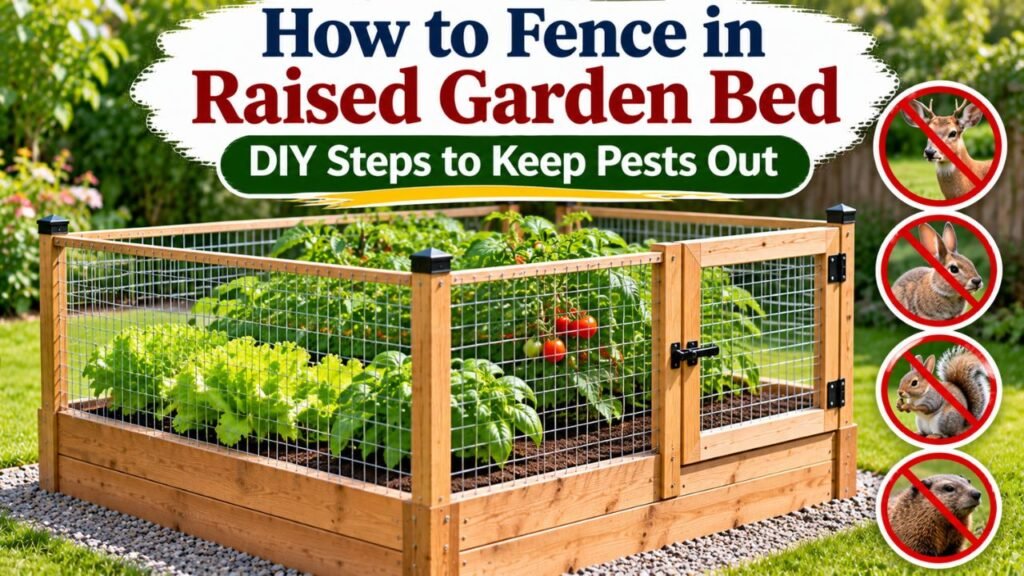
There are several ways to protect a raised garden bed, depending on its size and the animals you want to keep out.
The two most practical options are installing a fence around the bed or constructing an enclosure that covers the top.
1. Wire Fence Around the Raised Bed
A simple wire fence can protect vegetables from rabbits and some other ground-level animals.
It consists of stakes or posts supporting chicken wire, welded wire, or another suitable mesh.
You can install the fence around the outside of the raised bed or attach a smaller framed barrier to its sides.
This is often the easiest DIY method.
However, an open-top fence may not stop animals that climb or jump into the bed.
2. Removable Wire Mesh Cage
A removable cage surrounds the sides and top of the bed.
It can protect against more types of animals, including birds and squirrels.
The cage can be made from a wooden or metal frame covered with wire mesh.
A removable roof or hinged lid makes watering, weeding, and harvesting easier.
This option is useful for strawberries, lettuce, and other crops frequently damaged by wildlife.
3. Hinged Raised Bed Fence
A hinged fence or protective lid can be opened when you need access.
It may be especially convenient for smaller beds.
For example, a rectangular wooden frame can be covered with hardware cloth and attached to one side of a wooden raised bed using appropriately rated hinges.
However, the frame must be securely supported when open.
4. Tall Fence Around Multiple Raised Beds
If deer regularly enter your garden, a full perimeter fence may be more effective than small fences around individual beds.
A sturdy deer-exclusion fence commonly needs to be approximately 6–8 feet tall, with 8 feet a more dependable target where deer pressure is high.
This requires stronger posts and more extensive construction than a small raised-bed cage.
Raised Garden Bed Fencing Methods Compared
| Fencing Method | Best For | Main Limitation |
| Low chicken wire fence | Rabbits and some small animals | Doesn’t stop climbing or flying pests |
| Welded wire fence | Durable rabbit and pet protection | Larger openings may admit rodents |
| Hardware cloth enclosure | Small rodents and climbing pests | More expensive and heavier |
| Removable mesh cage | Squirrels, birds, and rabbits | Requires overhead space |
| Hinged protective cover | Small raised beds and strawberries | Can limit tall plant growth |
| Tall perimeter fence | Deer and larger garden areas | Requires strong posts and more space |
Key Takeaway: A low wire fence may be sufficient for rabbits, but a fully enclosed cage is generally more versatile when squirrels, birds, and climbing animals are the problem.
How to Fence in Raised Garden Bed Step by Step
The following method creates a simple protective fence around an existing raised garden bed.
It’s particularly suitable for wooden raised beds and can be adapted for metal or other raised-bed materials.
Step 1: Identify Which Animals Are Damaging Your Plants
Before buying fencing materials, determine which animals are entering the bed.
Look for signs such as:
- Leaves or stems cut close to the ground.
- Small digging holes.
- Disturbed soil.
- Missing fruit.
- Chewed vegetables.
- Tracks or droppings.
- Damage occurring overnight.
Different animals require different barriers.
For example, a 2-foot wire fence may keep most rabbits out but won’t reliably stop squirrels from climbing over it.
Likewise, bird netting may protect berries from birds but won’t prevent rodents from tunneling into the bed.
If the animal is uncertain, consider a motion-activated wildlife camera or contact a local Cooperative Extension office for identification.
Step 2: Measure Your Raised Garden Bed
Measure the length and width of the raised bed.
Record the height of the frame and the expected mature height of your vegetables.
For a rectangular bed, calculate the perimeter using:
Fence perimeter = 2 × (Length + Width)
For example, a 4×8-foot raised bed has a perimeter of:
2 × (4 + 8) = 24 linear feet
A fence positioned directly around the bed would require approximately 24 linear feet of material before adding allowances for a gate, overlapping connections, or installation waste.
If the fence will stand several inches away from the bed, measure that larger footprint instead.
Step 3: Choose the Fence Height
Select the height based on the animals you need to exclude.
For rabbits, a barrier approximately 24 inches high above the surrounding ground can work when its bottom is secured.
If you’re installing fencing on top of the raised-bed walls, account for the bed’s height and any ledges that animals could use to reach the fence.
A taller enclosure may be appropriate if rabbits can approach from elevated soil or nearby objects.
For deer, a short fence isn’t sufficient.
A fully enclosed cage over an individual bed may be more practical than a tall fence attached to the bed itself.
Step 4: Gather the Materials
For a basic wire fence, you’ll typically need:
- Chicken wire, welded wire, or hardware cloth.
- Wooden posts or suitable metal stakes.
- Exterior-rated screws or other appropriate fasteners.
- Fence staples, clips, or wire ties.
- Wire cutters.
- Drill or screwdriver if necessary.
- Tape measure.
- Level.
- Work gloves.
- Safety glasses.
- Gate hardware or removable fasteners if access is needed.
Choose fasteners compatible with the fencing and frame materials.
Cut wire edges can be extremely sharp, so wear protective gloves while handling mesh.
Step 5: Position the Fence Posts
Place posts at the corners of the enclosure.
For longer raised beds, add intermediate supports where needed to prevent the fencing from sagging.
If the posts are independent of the raised bed, anchor them firmly in the surrounding ground.
Check for underground utilities before digging postholes or driving long stakes.
If you’re attaching the fence to a wooden raised bed, verify that the frame is strong enough for the additional load.
Avoid attaching heavy or tall structures to thin, weakened, or deteriorating bed walls.
Step 6: Attach the Wire Mesh
Unroll the fencing material on a flat surface.
Measure and cut sections to fit each side.
Attach the mesh to the posts or frame using suitable fasteners.
Keep the wire reasonably taut without overstressing the supports.
Overlap adjoining sections enough to prevent animals from pushing through gaps.
For rabbit protection, use mesh openings no larger than approximately 1 inch.
For mice and smaller rodents, a much smaller opening is required.
Step 7: Secure the Bottom Edge
The bottom is one of the most important parts of the fence.
Rabbits and other animals may push beneath a loose edge.
If the fence is installed in the ground around the bed, bury the mesh or install an outward-facing underground apron.
For example, you can extend the fencing 6–10 inches below the surface where appropriate.
If digging isn’t practical, anchor the bottom securely with suitable ground staples, though this may be less dependable against persistent digging.
For a fence attached directly to a solid raised-bed wall, secure the mesh tightly to the frame without leaving openings between the wire and wood.
Step 8: Add a Gate or Removable Section
A garden fence should prevent animal access without making gardening inconvenient.
For a single raised bed, a removable panel may be simpler than a permanent gate.
For larger enclosures, install a properly sized gate.
Make sure the opening accommodates your watering can, hose, tools, and harvesting containers.
Keep the latch easy for the gardener to operate but secure against animals.
Step 9: Inspect the Entire Fence
Walk around the enclosure and check for:
- Loose mesh.
- Sharp exposed wire.
- Unsecured corners.
- Gaps along the bottom.
- Openings near posts.
- Weak supports.
- A gate that doesn’t close properly.
Repair any problem before relying on the fence.
Step 10: Test Gardening Access
Before considering the project complete, confirm that you can comfortably water, weed, fertilize, and harvest the plants.
If the fence makes routine maintenance difficult, modify the access system.
A protective fence is most useful when it can be opened and closed without excessive effort.
Key Takeaway: Measure carefully, select a pest-appropriate mesh, secure the bottom, and make the enclosure easy to open for routine gardening.
How Tall Should a Fence Around a Raised Garden Bed Be?
Fence height depends on the animal you’re trying to exclude.
A barrier that works for rabbits may be ineffective against deer.
Recommended Fence Heights by Animal
| Animal | General Fence Recommendation | Additional Protection |
| Rabbits | About 2 feet above accessible ground | Small mesh and secured or buried bottom |
| Hares or larger rabbits | Approximately 30–36 inches may be useful | Secure lower edge |
| Dogs | Around 3 feet may deter some dogs | Strong posts and dig-resistant base |
| Cats | A low fence is unreliable | Covered cage is more dependable |
| Squirrels | No reliable low open-top height | Fully enclosed cage |
| Birds | Height isn’t the main factor | Supported overhead netting or mesh |
| Deer | Generally 6–8 feet; 8 feet preferred for strong exclusion | Secure bottom and sturdy posts |
| Mice or voles | Height alone is insufficient | Fine mesh and protection underneath |
These values are starting points, not guarantees.
Animal behavior, surrounding structures, snow accumulation, and available jumping surfaces can affect performance.
How High Should a Rabbit Fence Be?
The Oregon State University Extension guidance on rabbit exclusion recommends approximately 2-foot fencing with small openings and buried wire to discourage digging.
The guidance also describes an outward-facing underground apron for additional protection.
For a raised bed, consider the complete route an animal might use.
If a rabbit can stand on nearby steps, a retaining wall, or another elevated surface, measure the barrier from that accessible surface.
How Tall Should a Deer Fence Be?
Deer can jump much higher than rabbits.
The University of Georgia Cooperative Extension garden fencing guide recommends considering a deer fence approximately 6–8 feet tall.
Where deer pressure is high, an 8-foot, well-supported fence is often the more dependable approach.
Short decorative fencing may discourage occasional browsing but shouldn’t be considered reliable deer exclusion.
What Is the Best Fencing Material for Raised Garden Beds?
The best material depends on the type of pest, desired lifespan, and enclosure design.
Chicken Wire
Chicken wire is a common, affordable option for rabbit fencing.
It is lightweight and relatively easy to cut.
For rabbit exclusion, choose openings no larger than 1 inch.
However, chicken wire isn’t particularly rigid.
It may sag if poorly supported and is less suitable for persistent larger animals or rodents that can squeeze through small gaps.
Welded Wire Fencing
Welded wire is generally more rigid than chicken wire.
It can be useful for permanent raised-bed enclosures.
Choose a mesh size appropriate for the target animal.
Large-grid welded wire may keep some pets out but won’t reliably exclude rabbits or smaller rodents.
Hardware Cloth
Hardware cloth is a rigid metal mesh available with small openings.
Common sizes include:
- ¼ inch.
- ½ inch.
- 1 inch.
For protecting raised beds against small rodents, ¼-inch hardware cloth provides a finer barrier than conventional chicken wire.
It’s particularly useful for the bottoms of beds and enclosed cage panels.
However, it can be more expensive, heavier, and harder to cut than lightweight fencing.
Plastic Garden Mesh
Plastic mesh can be lightweight and easy to install.
It may be useful as a temporary barrier for certain pests.
However, animals may chew through some plastic products, and material durability varies.
Choose a product intended for outdoor garden protection.
Don’t assume ordinary lightweight plastic mesh provides the same protection as welded metal wire.
Bird Netting
Bird netting can protect ripening berries and other crops.
It generally needs a supporting frame to keep the netting away from the plants.
Loose netting can entangle wildlife, so choose an appropriate design and keep it securely tensioned.
Fencing Material Comparison
| Material | Durability | Best Application |
| Chicken wire | Moderate, depending on coating | Simple rabbit fencing |
| Welded wire | Generally good | Durable perimeter fencing |
| ¼-inch hardware cloth | Generally good | Rodents and enclosed cages |
| Plastic garden mesh | Varies | Temporary lightweight barriers |
| Bird netting | Varies | Protecting ripening fruit from birds |
| Rigid framed mesh panels | Depends on frame | Removable or hinged covers |
For a simple rabbit fence, chicken wire or welded wire with suitable openings is usually sufficient.
For a full enclosure against smaller animals, hardware cloth is often the stronger choice.
How to Build a Removable Raised Garden Bed Fence
A removable fence is convenient for smaller raised beds because it allows easier access to plants.
You can construct several lightweight panels that fit around the bed.
Step 1: Measure Each Side
Measure the length and width of the bed’s outer frame.
Decide how much height is needed above the planting surface.
Include room for mature plant growth.
Step 2: Build Lightweight Frames
Use suitable outdoor-rated lumber or another appropriate framing material.
Cut frame pieces to size.
Join them securely using exterior-rated fasteners.
Make sure the assembled frames remain reasonably square.
Step 3: Attach Wire Mesh
Cut mesh panels to match the frame dimensions.
Attach them using compatible staples, screws with washers, or another secure fastening method.
Avoid leaving sharp wire ends exposed.
Step 4: Connect the Panels
Arrange the framed sections around the bed.
Use removable connectors, latches, or brackets suited to the frame.
The connections should prevent animals from pushing panels apart.
Step 5: Add a Removable Top if Needed
For birds or squirrels, consider adding a lightweight framed roof.
The top should be secure enough to resist animals and ordinary weather.
However, keep the structure within the safe capacity of its supports.
Step 6: Test Removal and Reinstallation
Make sure you can remove the panels without damaging plants.
The panels should return to their original positions and fasten securely.
A removable design is especially useful for seasonal crops that require frequent harvesting.
How to Build a Hinged Fence Cover for a Raised Garden Bed
A hinged mesh lid can provide effective protection for compact raised beds.
It works particularly well for low-growing vegetables and strawberries.
Step 1: Build a Rectangular Frame
Measure the raised bed.
Construct a frame that covers the planting area while leaving appropriate clearance for plants.
Use sturdy but manageable materials.
Step 2: Cover the Frame With Mesh
Attach hardware cloth or another suitable mesh to the frame.
Secure the edges carefully.
Remove or cover sharp wire ends.
Step 3: Attach the Hinges
If the bed is made from sound wood, use exterior-rated hinges and compatible fasteners.
Mount them to structurally suitable locations rather than thin decorative trim.
For metal beds, use manufacturer-approved brackets or separate supports.
Avoid drilling through thin metal panels without verifying that the modification is appropriate.
Step 4: Add an Opening Support
Install a suitable lid stay, support arm, or other restraint.
The lid shouldn’t fall unexpectedly while you’re weeding or harvesting.
For larger covers, the weight may make a full-width hinged lid impractical.
Consider dividing the top into smaller sections.
Step 5: Install a Latch
Use a secure latch to prevent animals and wind from opening the cover.
Make sure it can be operated easily during routine gardening.
Step 6: Test the Cover
Open and close the lid several times.
Check that it clears the plants.
Make sure the hinges remain stable and the opening support functions correctly.
Important: Lightweight lids can catch wind, while heavy lids can create crushing hazards. Build the cover with appropriate supports and avoid allowing children to play with it.
How to Fence a Raised Garden Bed Against Rabbits
Rabbits are among the most common animals damaging vegetable gardens.
They frequently feed on tender leaves and seedlings.
A correctly installed wire fence is one of the more dependable ways to protect crops.
Choose Small Mesh
Use chicken wire or welded wire with openings no larger than 1 inch.
Smaller openings can provide additional protection against young rabbits.
Provide Enough Height
A fence approximately 2 feet high can work for many rabbit situations.
However, taller fencing may be appropriate where animals have access to elevated ground or the bed itself creates a stepping surface.
Stop Digging Beneath the Fence
Rabbits may push beneath unsecured wire.
The University of California Integrated Pest Management rabbit guide recommends burying the bottom of rabbit fencing approximately 6–10 inches and bending a portion outward to discourage digging.
For an existing raised bed, another approach is securely attaching the wire directly to the solid bed walls.
That can eliminate the exposed gap between the fence and the raised-bed frame.
However, if animals can tunnel beneath the entire bed, a separate bottom barrier may be necessary.
Keep Gates Secure
A loose gate can make an otherwise effective fence useless.
Check the bottom and sides of the entrance.
Rabbits may use gaps created by uneven ground or poorly fitted panels.
How to Fence Raised Garden Beds Against Deer
Deer require a different approach because they can reach over low barriers and jump over ordinary garden fencing.
Use a Tall Perimeter Fence
For a garden containing several raised beds, consider a sturdy perimeter fence.
Where practical and permitted, a fence around 8 feet tall can provide stronger protection.
The posts must be properly anchored.
Don’t attach an 8-foot deer fence directly to a lightweight raised-bed wall without a structurally appropriate support design.
Consider a Fully Enclosed Single-Bed Cage
For one small raised bed, a cage with a secure top may be more practical than a tall perimeter fence.
However, it needs adequate height for the crops.
A cage suitable for lettuce may be too short for tomatoes or trellised cucumbers.
Leave Room for Maintenance
Tall perimeter fences need an entrance wide enough for tools and materials.
Consider whether you’ll need to bring in compost, soil, a wheelbarrow, or other equipment.
The West Virginia University Extension guide to wildlife pest fencing emphasizes planning for garden access and maintenance before constructing a fence.
Consider Local Rules
Tall fences may be subject to local zoning requirements, property setbacks, or homeowners association restrictions.
Check applicable rules before building a permanent structure.
How to Keep Squirrels Out of Raised Garden Beds With Fencing
Squirrels can climb ordinary wire fencing.
A low open-top fence usually won’t provide reliable protection.
Use a Fully Enclosed Cage
A cage should protect the sides and top.
Choose mesh strong enough to resist repeated contact.
Secure all joints and access points.
Avoid Large Openings
Squirrels may squeeze through surprisingly small gaps or exploit weak connections.
The appropriate opening depends on the species and local conditions.
Smaller, rigid mesh is generally more secure than large-grid fencing.
Protect the Top
A roof is essential when animals can climb the sides.
A removable framed top makes the bed easier to access.
However, the enclosure must be tall enough for the mature plants.
Protect Newly Planted Seeds
Squirrels may dig in recently planted soil.
A secure cover can reduce digging damage while seedlings establish.
Check that the barrier doesn’t crush emerging plants.
How to Protect Raised Beds From Birds
Birds may eat berries, seedlings, and ripening fruit.
A side fence alone won’t prevent birds from entering.
Use an Overhead Barrier
Install a framed top or supported netting over the plants.
Keep the barrier elevated above fruiting branches.
Birds may still reach fruit through netting placed directly against the plants.
Secure the Netting Carefully
Loose bird netting can entangle birds and other wildlife.
Use a properly supported, tensioned barrier with secured edges.
Inspect it regularly for damage or trapped animals.
If netting is not securely installed, rigid mesh panels may be a more manageable option.
Consider Pollination
Some vegetables and fruits require visits from insect pollinators.
Fine mesh covers may prevent bees and other beneficial insects from reaching flowers.
The University of Maine Cooperative Extension’s guidance on protecting strawberries in raised beds describes using supported bird netting with openings that allow pollinators to pass.
However, openings large enough for pollinators may also admit smaller pests.
Choose the barrier based on the crop and animal problem.
For flowering crops such as cucumbers and squash, plan for pollinator access or an appropriate alternative pollination method.
Key Takeaway: A roof or supported netting helps keep birds out, but enclosure design must also account for wildlife safety and crop pollination.
How to Protect Raised Beds From Mice, Voles, and Gophers
Small rodents require finer mesh and greater attention to gaps.
They may enter through the ground rather than climbing over the fence.
Install Hardware Cloth Beneath the Bed
If you’re building a new open-bottom raised bed in an area with burrowing pests, consider installing hardware cloth before adding soil.
For small animals such as voles, ¼-inch mesh is a useful choice.
A 2025 University of Minnesota Extension response recommends hardware cloth with openings no larger than ¼ inch beneath raised beds affected by voles.
The mesh should cover the entire footprint without gaps.
Secure the Edges
Fasten the mesh firmly to the bed frame.
Bring it slightly up the sides where appropriate.
Overlap adjoining sections to eliminate openings.
Check that sharp edges are properly secured.
Maintain Drainage
Hardware cloth allows water to pass through.
However, the bed still needs suitable drainage.
Don’t install an impermeable plastic bottom beneath soil-filled raised beds unless the planter is specifically designed with an adequate drainage system.
What if the Bed Already Contains Soil?
Installing bottom mesh in an existing raised bed may require removing substantial amounts of soil.
This can disturb established plants.
For a heavily infested bed, it may be more practical to install the barrier between growing seasons.
Alternatively, investigate whether a perimeter barrier or another pest-management approach would be more suitable.
Key Takeaway: Fine hardware cloth beneath the bed is often more important than a tall side fence when the main problem is burrowing rodents.
How to Fence a Metal Raised Garden Bed
Metal raised beds can be fenced, but attaching hardware requires extra care.
Many metal garden beds have relatively thin side panels.
These panels aren’t necessarily designed to support heavy fence posts or tall structures.
Use Freestanding Posts
One option is to install posts in the ground outside the raised bed.
Attach the wire fence to those posts.
This avoids drilling through the metal walls.
Use Manufacturer-Approved Attachments
Some metal raised-bed systems offer compatible brackets, covers, or trellis accessories.
These may provide an easier installation method.
Check the manufacturer’s recommendations.
Avoid Unsupported Drilling
Drilling through metal panels can damage protective coatings and may reduce corrosion resistance.
Poorly placed holes can also weaken thin material.
Use compatible mounting hardware and protect cut edges if modifications are permitted.
Keep the Fence Stable
A tall fence catches more wind than a low enclosure.
Make sure the posts are adequately supported.
Don’t rely on thin sheet-metal walls to resist significant wind or animal loads.
How to Fence a Wooden Raised Garden Bed
Wooden raised beds are convenient because suitable accessories can often be attached directly to the frame.
However, the wood must be in good condition.
Inspect the Frame
Check for:
- Rot.
- Cracks.
- Loose joints.
- Splitting.
- Damaged corners.
- Weak or deteriorated boards.
Repair structural problems before attaching a fence.
Use Appropriate Exterior Fasteners
Use screws, staples, or brackets suitable for outdoor use and compatible with the wood and wire.
Pre-drill where necessary to reduce splitting.
For treated lumber, choose corrosion-resistant fasteners recommended for the treatment type.
Avoid Overloading the Bed Walls
A short wire frame may be supported by a sound wooden bed.
However, tall fence posts, heavy gates, or large hinged covers can impose significant additional loads.
Use independent posts or additional bracing when needed.
Protect the Wood
Avoid unnecessary water trapping around attachments.
If installing new lumber near edible crops, choose materials appropriate for vegetable gardening.
For guidance on raised-bed materials, see the University of Maryland Extension’s raised-bed material safety resource.
How Much Fencing Do You Need for a 4×8 Raised Garden Bed?
A 4×8 raised bed is a common size, making it a useful example for planning materials.
Calculate the Perimeter
For a bed measuring 4 feet by 8 feet:
Perimeter = 2 × (4 + 8)
Perimeter = 24 feet
This represents the basic linear distance around the bed.
Estimate Wire Mesh for the Sides
If your fence extends 2 feet vertically:
24 feet × 2 feet = 48 square feet
This is the nominal side coverage.
You also need additional material for overlaps, connections, gate details, and cutting waste.
If the fence is freestanding and its bottom must be buried, include the buried portion when determining the wire height.
Add Mesh for a Top Cover
A flat top covering a 4×8-foot bed has an area of:
4 × 8 = 32 square feet
Therefore, a simple enclosure with 2-foot-tall sides and a flat roof has a nominal mesh coverage of:
48 + 32 = 80 square feet
This excludes overlaps, reinforcement, door openings, and other construction allowances.
Account for Actual Roll Dimensions
Wire fencing is sold in different widths and lengths.
A roll’s total area isn’t the only consideration.
For example, a 24-inch-wide roll may be suitable for certain side panels but inconvenient for a roof spanning 4 feet.
Plan the cutting layout before purchasing.
Plan for Plant Height
A 2-foot-tall cage above the soil may be suitable for lettuce or strawberries.
However, it may be too short for tomatoes, tall peppers, or trellised crops.
Choose the enclosure height based on the expected mature plants rather than only the bed dimensions.
How to Make Raised Bed Fencing Easy to Open
Easy access is essential for watering, weeding, harvesting, and adding compost.
A fence that is difficult to open may eventually become inconvenient to maintain.
Removable Front Panel
A removable front section is useful for smaller raised beds.
It can be secured with clips or latches.
Choose hardware that holds firmly but can be released without special tools.
Hinged Side Gate
For an enclosure tall enough to stand beside or enter, a hinged gate is convenient.
Leave adequate clearance for opening.
Check that the gate doesn’t sag or drag across the ground.
Hinged Top Cover
A hinged lid works well on compact cages.
Use a support mechanism that holds it safely open.
For large beds, divide the lid into smaller sections to reduce weight.
Lift-Off Cage
A lightweight cage can sometimes be lifted off the bed.
However, this may become impractical once plants grow tall or begin attaching themselves to the mesh.
Use a lift-off design only when you can remove it without damaging crops.
Irrigation Access
Plan how water will enter the bed.
A drip irrigation line can run beneath the fence if the opening is properly sealed against animals.
A watering can may require a removable section.
Make sure the design doesn’t force you to leave the enclosure open for long periods.
How Much Does It Cost to Fence a Raised Garden Bed?
The cost depends on the enclosure size, materials, and construction method.
A basic chicken wire fence is generally less expensive than a full framed cage with rigid hardware cloth.
Main Cost Factors
| Component | Effect on Cost |
| Chicken wire | Usually a lower-cost mesh option |
| Welded wire | More durable, often higher material cost |
| Hardware cloth | Fine mesh may cost more |
| Wooden framing | Adds lumber and fastening costs |
| Metal posts | Adds support and installation costs |
| Hinges and latches | Required for opening sections |
| Overhead cover | Increases material and labor |
| Tall deer fence | Requires stronger posts and substantially more fencing |
Local prices vary by material, coating, size, and retailer.
For an accurate budget, measure the complete enclosure and price the required mesh, posts, fasteners, and access hardware.
Cheapest Practical Option
For rabbits, a simple wire fence supported by stakes is often the most economical design.
Best Value for Multiple Pests
A properly constructed, reusable framed cage may cost more initially.
However, it can provide better protection against animals that climb or approach from above.
When a Perimeter Fence Is More Economical
If you have several raised beds, building one fence around the entire garden may be more convenient than creating separate cages for every bed.
However, deer-resistant perimeter fencing requires adequate height and strong construction.
Common Mistakes When Fencing Raised Garden Beds
Choosing the Wrong Mesh Size
Large openings may allow rabbits or rodents to pass through.
Choose mesh based on the smallest animal you need to exclude.
Leaving Gaps at Ground Level
Animals may push or dig beneath unsecured fencing.
Bury, anchor, or otherwise secure the bottom appropriately.
Building a Fence Too Short
A short decorative fence won’t reliably stop deer.
Squirrels may climb over low barriers.
Match the height and enclosure design to the animal.
Forgetting the Top Cover
An open-top fence won’t prevent birds from flying into the garden.
Climbing animals may also enter.
Use a securely fitted top where needed.
Attaching Heavy Posts to Weak Bed Walls
Thin metal panels and deteriorating wooden frames may not safely support tall fencing.
Use independently anchored posts when necessary.
Making Access Too Difficult
A tightly enclosed bed without an appropriate opening can be inconvenient to water and harvest.
Plan access before construction.
Forgetting About Pollinators
Fine mesh can block bees and other beneficial insects from reaching flowers.
Consider pollination requirements when choosing the covering and when it will be installed.
Allowing Loose Netting
Poorly supported netting can entangle wildlife.
Use appropriately secured barriers and inspect them regularly.
Building Around Immature Plant Height
A cage that fits seedlings may become too short as plants grow.
Measure the expected mature height before building.
Ignoring Wind and Weather
Lightweight frames can shift or topple during storms.
Secure posts and covers appropriately.
Remove or reinforce seasonal structures according to their design and local conditions.
How to Maintain a Raised Garden Bed Fence
A fence requires occasional inspection to remain effective.
Weather, plant growth, and animal activity may loosen components.
Check the Mesh
Look for holes, damaged connections, or torn netting.
Repair gaps promptly.
Inspect the Posts
Make sure posts remain upright and stable.
Tighten loose fasteners.
Replace rotten wood or damaged metal components.
Maintain Gates and Hinges
Check that gates close securely.
Lubricate appropriate hardware when recommended.
Make sure removable sections return to their correct positions.
Remove Plant Growth From Mesh Carefully
Vining vegetables may grow through or around fencing.
Avoid pulling tangled stems aggressively.
If you intend to use the fence only temporarily, keep plants from becoming permanently attached to it.
Inspect After Storms
High winds and heavy rain can loosen fencing.
Check the structure after severe weather.
Repair any instability before allowing children or pets nearby.
Clean and Store Seasonal Covers
At the end of the growing season, remove debris.
Dry removable materials before storage.
Inspect for sharp edges and damage before using them again.
Conclusion
Learning how to fence in raised garden bed areas starts with choosing a barrier that matches the animals damaging your crops.
For rabbits, a small wire fence with openings no larger than 1 inch and a properly secured bottom is often sufficient. For squirrels and birds, a covered enclosure with mesh sides and a protective roof provides more complete protection.
If deer are the main problem, consider a sturdy, tall perimeter fence or a properly designed individual cage rather than relying on a short decorative barrier.
For wooden raised beds, you may be able to attach lightweight framed panels directly to a sound structure. For thin metal beds or larger fences, independently supported posts are often a better choice.
I recommend starting with the simplest design that addresses your specific pest problem, then adding a removable panel, gate, or hinged cover for convenient access. Make sure the fencing accommodates mature plant growth, allows necessary pollination, and remains secure through changing weather.
A properly planned fence can protect your vegetables while keeping the raised bed easy to maintain throughout the growing season.
FAQs About How to Fence in Raised Garden Bed
How Do You Put a Fence Around a Raised Garden Bed?
Measure the bed, install suitable posts, attach wire mesh, and secure the bottom edge.
Choose the fence height and mesh openings based on the animals you want to exclude.
Add a removable section or gate for watering and harvesting.
How High Should a Raised Garden Bed Fence Be?
For rabbits, approximately 2 feet of effective fence height is a useful starting point.
Larger rabbits or nearby elevated surfaces may require a taller barrier.
For deer, a well-supported fence around 8 feet high is generally more dependable.
What Is the Best Fence for Keeping Rabbits Out of Raised Beds?
Chicken wire or welded wire with openings no larger than 1 inch works well for many rabbit problems.
Secure the lower edge tightly.
Where rabbits can dig beneath the fence, bury the mesh or use an outward-facing underground apron.
Can You Attach a Fence Directly to a Raised Garden Bed?
Yes, some lightweight fences can be attached to sturdy wooden raised-bed frames.
However, don’t assume thin metal walls or deteriorating wooden boards can support heavy posts or tall fencing.
Use independent supports when necessary.
How Do You Keep Squirrels Out of a Raised Garden Bed?
A fully enclosed wire cage is generally more effective than a low, open-top fence.
Use secure mesh on the sides and top.
Check for gaps around joints and access panels.
Can Chicken Wire Protect Raised Garden Beds From Deer?
Chicken wire may work as part of a larger, properly designed barrier, but a short chicken wire fence won’t reliably stop deer.
For serious deer pressure, consider a sturdy fence approximately 8 feet tall or a securely covered cage around an individual bed.
Should I Put Hardware Cloth Under My Raised Garden Bed?
If voles, gophers, or other burrowing pests are a problem, hardware cloth can provide useful protection.
Fine ¼-inch mesh is appropriate for excluding some small rodents.
Install it securely across the bottom before adding soil when practical.
How Do You Make a Removable Fence for Raised Beds?
Build lightweight frames, cover them with suitable mesh, and connect them using removable clips or latches.
Make sure the panels remain secure against animals.
Choose a design you can remove without damaging plants.
Can You Cover a Raised Garden Bed With Bird Netting?
Yes, but support the netting above the plants rather than laying it loosely over the foliage.
Secure the edges and inspect it regularly to reduce wildlife entanglement risks.
Also consider pollinator access for flowering crops.
Is It Better to Fence Each Raised Bed or the Entire Garden?
For one or two small beds, individual wire cages or fences may be practical.
For several beds, a single perimeter fence can simplify access and provide broader protection.
The best option depends on the pest, garden layout, available space, and required fence height.

I’m Maya L. Greenwood, a lifelong plant lover who believes anyone can grow something beautiful with the right guidance. After years of testing soil mixes, pruning methods, irrigation tricks, and pest-safe solutions, I started EasyGardenTips.com to turn hard-won lessons into step-by-step advice. From seed starting and container gardens to composting and seasonal checklists, my goal is to make gardening simple, sustainable, and fun.