How Much Soil for 5×5 Raised Bed? Volume, Depth, and Bag Counts
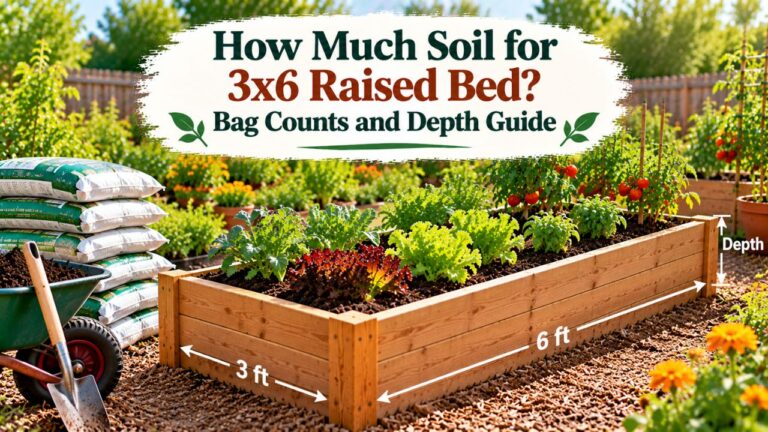
A 5×5 raised bed needs 25 cubic feet of soil when filled to a depth of 12 inches. This equals approximately 0.93 cubic yards or 13 bags of soil containing 2 cubic feet each. If the bed is only 6 inches deep, you’ll need 12.5 cubic feet. A 24-inch-deep bed requires 50 cubic feet.
The length and width alone don’t determine how much soil to purchase. The actual fill depth, interior dimensions, and space left below the top edge all affect the final quantity. Even a difference of a few inches can change how many bags you need.
Another consideration is whether you’re buying ready-made raised bed soil or mixing topsoil and compost separately. The total volume remains the same, but the quantities of individual ingredients will differ.
For a 5×5 garden bed, calculating these amounts before shopping can help you avoid buying too much material or running short during filling.
This guide covers soil quantities for different bed depths, bag counts, cubic-yard conversions, recommended soil mixtures, and practical ways to calculate the amount for your specific raised bed.
How Much Soil for 5×5 Raised Bed at Different Depths?
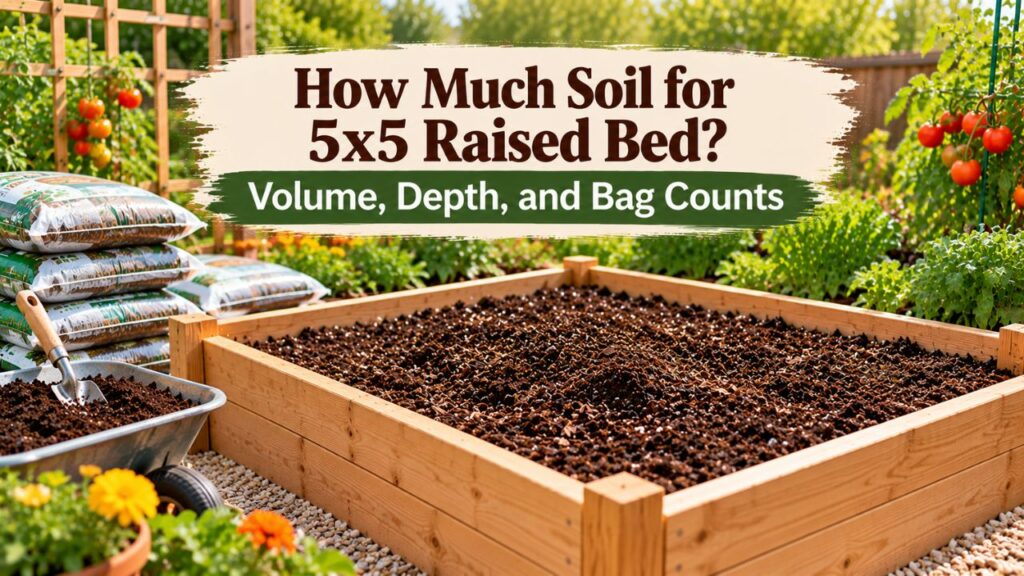
A 5×5 raised garden bed covers 25 square feet. The amount of soil needed depends on how deep you fill that space.
A shallow bed requires much less soil than a tall raised planter, even though both have the same length and width.
The following table shows soil requirements for common fill depths.
| Soil Depth | Cubic Feet | Cubic Yards | 2 Cu. Ft. Bags |
| 6 inches | 12.50 | 0.46 | 7 |
| 8 inches | 16.67 | 0.62 | 9 |
| 10 inches | 20.83 | 0.77 | 11 |
| 12 inches | 25.00 | 0.93 | 13 |
| 15 inches | 31.25 | 1.16 | 16 |
| 18 inches | 37.50 | 1.39 | 19 |
| 24 inches | 50.00 | 1.85 | 25 |
All bag quantities are rounded up to whole bags. The calculations assume an interior growing area measuring exactly 5 feet by 5 feet and do not include extra material for settling.
How Much Soil for a 5x5x6 Raised Bed?
A 5×5 raised bed filled to 6 inches requires 12.5 cubic feet of soil, equivalent to approximately 0.46 cubic yards.
You can fill it using seven 2-cubic-foot bags or thirteen 1-cubic-foot bags.
A 6-inch soil layer may support shallow-rooted vegetables when the bed has an open bottom and sits over suitable garden soil. Plant roots can extend below the frame into the native ground.
However, this depth may be insufficient for some crops if the underlying soil is heavily compacted or inaccessible.
How Much Soil for a 5x5x8 Raised Bed?
An 8-inch-deep 5×5 raised bed requires 16.67 cubic feet of soil, or approximately 0.62 cubic yards.
This amount can be supplied by nine 2-cubic-foot bags.
An 8-inch layer provides more prepared growing space than a 6-inch bed without requiring a large increase in soil volume.
For open-bottom beds, the condition of the ground beneath the frame remains important because roots may grow beyond the prepared layer.
How Much Soil for a 5x5x12 Raised Bed?
A 5×5 raised bed filled to 12 inches needs 25 cubic feet of soil.
That equals:
- Approximately 0.93 cubic yards
- 25 bags containing 1 cubic foot each
- 17 bags containing 1.5 cubic feet each
- 13 bags containing 2 cubic feet each
This depth offers a substantial growing layer for vegetables while requiring considerably less material than a 24-inch-deep bed.
If purchasing soil in bulk, one cubic yard provides 27 cubic feet, which is enough to fill the bed with approximately 2 cubic feet remaining.
How Much Soil for a 5x5x18 Raised Bed?
An 18-inch-deep 5×5 bed requires 37.5 cubic feet of soil, or approximately 1.39 cubic yards.
You would need nineteen 2-cubic-foot bags.
An 18-inch frame can provide additional rooting space and may be more comfortable to work in than a shallow bed, depending on its overall height.
However, taller beds also require more soil and may need additional attention to moisture management.
How Much Soil for a 5x5x24 Raised Bed?
A 5×5 raised bed filled to a depth of 24 inches needs 50 cubic feet of soil, equivalent to approximately 1.85 cubic yards.
That equals twenty-five 2-cubic-foot bags.
If purchasing bulk soil in whole cubic yards, two cubic yards provides 54 cubic feet, leaving approximately 4 cubic feet unused.
A 24-inch bed holds twice as much soil as a 12-inch bed with the same footprint. This difference can substantially increase material and delivery costs.
How to Calculate Soil Volume for a 5×5 Raised Bed
Calculating soil volume is straightforward once you know the interior length, width, and desired fill depth.
For a rectangular raised bed, use this formula:
Soil Volume (Cubic Feet) = Length (Feet) × Width (Feet) × Fill Depth (Feet)
If your depth measurement is in inches, divide it by 12 to convert it into feet.
Step 1: Measure the Interior Length and Width
Measure the usable growing space inside the frame.
For a bed with interior dimensions of exactly 5 feet by 5 feet:
5 × 5 = 25 square feet
This is the area that will hold the growing medium.
If the bed has thick wooden boards, the interior measurements may be smaller than the advertised exterior dimensions.
For example, a frame measuring 60 inches across externally with 1.5-inch-thick boards on both sides has an interior width of 57 inches.
At a 12-inch fill depth, an interior area measuring 57 by 57 inches requires approximately 22.56 cubic feet, rather than 25 cubic feet.
Step 2: Convert Soil Depth Into Feet
Raised bed heights are usually listed in inches, while soil quantities are commonly sold in cubic feet.
Convert the planned soil depth using:
Depth in Feet = Depth in Inches ÷ 12
For example:
- 6 inches = 0.5 feet
- 8 inches = 0.667 feet
- 10 inches = 0.833 feet
- 12 inches = 1 foot
- 18 inches = 1.5 feet
- 24 inches = 2 feet
Use the actual soil depth, not necessarily the full height of the frame.
Step 3: Multiply the Dimensions
Suppose your raised bed measures 5 feet long, 5 feet wide, and will contain 10 inches of soil.
The calculation is:
5 × 5 × (10 ÷ 12) = 20.83 cubic feet
This is the volume needed to fill the bed to the planned depth.
The formula works for any rectangular raised bed, including those with unusual dimensions.
Step 4: Convert Cubic Feet Into Cubic Yards
Bulk soil suppliers commonly sell material by the cubic yard.
One cubic yard equals 27 cubic feet.
To convert:
Cubic Yards = Cubic Feet ÷ 27
For a 5×5 bed with 12 inches of soil:
25 ÷ 27 = 0.93 cubic yards
For a 24-inch-deep bed:
50 ÷ 27 = 1.85 cubic yards
If the supplier has a minimum delivery quantity, compare the price of bulk material against the amount you would spend on individual bags.
How Many Bags of Soil for a 5×5 Raised Bed?
The number of soil bags depends on the volume printed on each package.
Raised bed soil, garden soil, and other growing media are sold in different bag sizes. Common options include 1, 1.5, and 2 cubic feet.
To calculate the quantity:
Number of Bags = Total Soil Volume ÷ Volume per Bag
Always round up to the next whole bag.
Soil Bag Count Comparison
| Soil Depth | 1 Cu. Ft. Bags | 1.5 Cu. Ft. Bags | 2 Cu. Ft. Bags |
| 6 inches | 13 | 9 | 7 |
| 8 inches | 17 | 12 | 9 |
| 10 inches | 21 | 14 | 11 |
| 12 inches | 25 | 17 | 13 |
| 18 inches | 38 | 25 | 19 |
| 24 inches | 50 | 34 | 25 |
These quantities provide at least the calculated volume, assuming the bags contain the stated amount of material.
For example, a 12-inch-deep bed requires 25 cubic feet. Thirteen 2-cubic-foot bags supply 26 cubic feet, leaving approximately 1 cubic foot unused.
Should You Buy 1-Cubic-Foot or 2-Cubic-Foot Bags?
Larger bags reduce the number of packages you need to handle, but they aren’t automatically cheaper.
Compare the price per cubic foot.
For example, if a 1-cubic-foot bag costs $5 and a 2-cubic-foot bag costs $8, the larger bag costs $4 per cubic foot.
Under those hypothetical prices, thirteen larger bags would cost $104 and provide enough soil for a 12-inch-deep 5×5 bed.
Transportation and handling also matter. A large bag of moist, mineral-based soil can be difficult to lift, even when its labeled volume is modest.
Choose packaging that fits your budget and can be handled safely.
Is Bulk Soil Better for a 5×5 Raised Bed?
Bulk soil can be economical when filling a deep raised bed, especially if you need one cubic yard or more.
A 12-inch-deep 5×5 bed requires almost exactly one cubic yard, making bulk delivery a practical option.
Before purchasing, ask whether the material is screened topsoil, compost, or a prepared raised-bed mixture.
The name alone doesn’t establish quality. Poorly screened material may contain stones, roots, or debris, while an unsuitable mixture may drain poorly or contain excessive organic matter.
How Much Soil for 5×5 Raised Bed When Leaving Space at the Top?
A raised bed does not always need to be filled flush with its upper edge.
Leaving approximately 1–2 inches below the rim creates room for mulch and helps prevent soil from washing over the sides during watering.
The space you leave changes the required soil volume.
Example: A 12-Inch-High Bed Filled to 10 Inches
Suppose you have a 5×5 frame with 12-inch sides but want to leave 2 inches of space.
The actual soil depth is 10 inches.
Calculate the volume:
5 × 5 × (10 ÷ 12) = 20.83 cubic feet
You would need eleven 2-cubic-foot bags instead of thirteen.
That reduces the purchase requirement by two bags.
Example: An 18-Inch-High Bed Filled to 16 Inches
An 18-inch frame with 2 inches of headspace has a fill depth of 16 inches.
The calculation becomes:
5 × 5 × (16 ÷ 12) = 33.33 cubic feet
That requires seventeen 2-cubic-foot bags.
By comparison, filling the same frame to the full 18 inches would require nineteen bags.
Important: Calculate the volume using the intended final soil depth, then determine whether an additional allowance for settling is necessary.
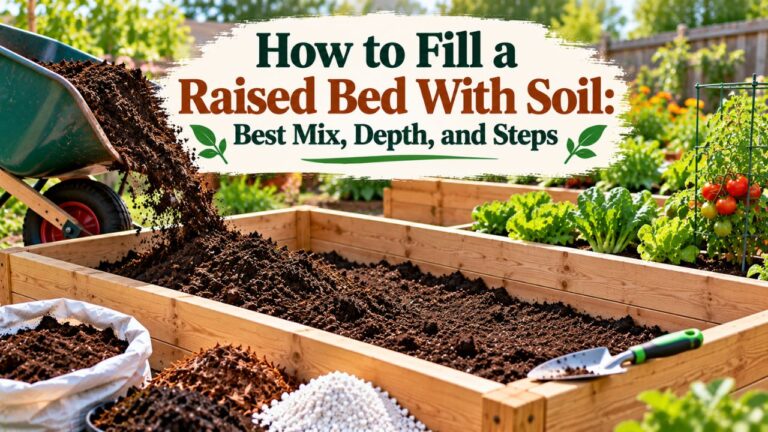
What Is the Best Soil Mix for a 5×5 Raised Bed?
Soil quantity is only part of filling a raised garden bed. The growing medium also needs suitable structure, drainage, moisture retention, and nutrients.
For an ordinary open-bottom vegetable bed, a practical starting point is:
- Two parts quality loamy topsoil
- One part finished plant-based compost
This produces a mixture containing approximately 67% topsoil and 33% compost by volume.
The University of Minnesota Extension’s raised-bed gardening guidance recommends approximately one-half to two-thirds topsoil and one-third to one-half plant-based compost.
It also explains that excessive compost can cause moisture-management problems and that repeated heavy applications may increase phosphorus and soluble salt levels.
The exact mixture should reflect the quality of the purchased materials and the needs of the plants.
Topsoil and Compost Amounts for a 5×5 Bed
Using a mixture of two-thirds topsoil and one-third compost, the approximate quantities are:
| Soil Depth | Topsoil | Compost | Total |
| 8 inches | 11.11 cu. ft. | 5.56 cu. ft. | 16.67 cu. ft. |
| 12 inches | 16.67 cu. ft. | 8.33 cu. ft. | 25.00 cu. ft. |
| 18 inches | 25.00 cu. ft. | 12.50 cu. ft. | 37.50 cu. ft. |
| 24 inches | 33.33 cu. ft. | 16.67 cu. ft. | 50.00 cu. ft. |
For a 12-inch-deep bed, you would mix approximately 16.7 cubic feet of topsoil with 8.3 cubic feet of finished compost.
If purchasing the ingredients in separate bags, round each material’s quantity up independently.
For example, nine 2-cubic-foot bags of topsoil and five 2-cubic-foot bags of compost would provide enough material, with some remaining after mixing.
Can You Use Only Garden Soil?
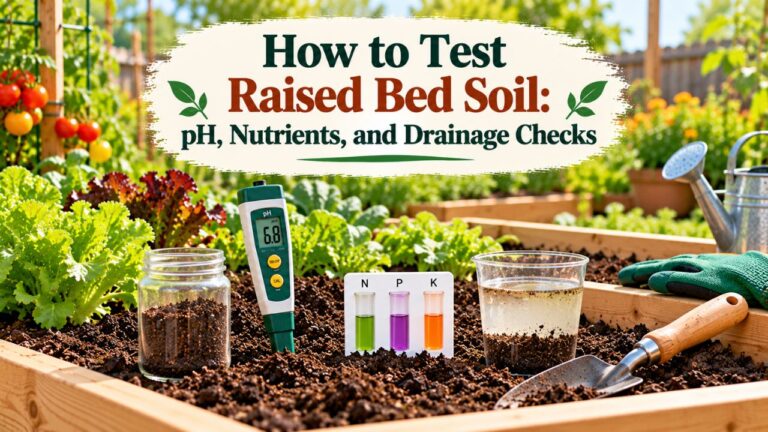
Garden soil can be used in a raised bed when it has suitable texture, drainage, fertility, and a safe source.
However, dense clay-rich soil may become compacted and drain poorly, while excessively sandy soil may not retain enough water.
Mixing appropriate topsoil with finished compost helps improve the physical properties of the growing medium.
Avoid filling a raised bed with unknown excavated soil, particularly when contamination is possible.
Can You Use Only Potting Mix?
Potting mix can be useful in certain elevated planters and container-style raised beds.
However, ordinary open-bottom beds typically benefit from mineral soil blended with compost.
Many lightweight potting mixes are designed for containers and may dry faster than suitable topsoil-based mixtures.
For enclosed beds, the manufacturer’s drainage design and recommended growing medium should guide your choice.
What Soil Depth Should You Choose for a 5×5 Raised Bed?
The depth of the raised bed affects how much soil you purchase and how much rooting space is available.
A bed placed on natural ground can provide additional rooting depth below the frame. A bed installed on concrete cannot.
Soil Depth for a Bed on Natural Ground
For open-bottom raised beds, an 8–12-inch prepared soil layer is a useful starting point for many vegetable gardens.
Plant roots can continue growing into the existing ground if the underlying soil is suitable.
This means a shallow raised frame can still support plants that develop deeper root systems.
Before filling, check whether the ground beneath the bed is compacted, poorly drained, or contaminated.
Loosening compacted soil and removing persistent weeds can improve growing conditions without requiring an unnecessarily tall frame.
Soil Depth for a Bed on Concrete
A raised bed on concrete or another hard surface needs sufficient soil depth because roots cannot grow into the native ground.
The University of Maryland Extension’s raised-bed vegetable guidance recommends at least 8 inches for crops such as leafy greens, beans, and cucumbers, and 12–24 inches for crops such as tomatoes, peppers, and squash when growing on hard surfaces.
For these beds, the extension recommends a 1:1 mixture of compost and soilless growing medium. It also allows up to 20% topsoil by volume in beds at least 16 inches deep.
Proper drainage is essential. A raised bed on an impermeable surface must have a way for excess water to leave the growing medium.
Is a 5×5 Raised Bed Too Wide?
A 5-foot-wide raised bed may be difficult to reach into, depending on the gardener’s height and mobility.
With access from both sides, the center sits 2.5 feet from either edge.
If you have limited reach, a narrower bed may be easier to plant, weed, and harvest without stepping onto the soil.
Standing on raised bed soil repeatedly can compact the growing medium and reduce the pore spaces needed for air and water movement.
Should You Purchase Extra Soil for Settling?
Newly filled raised beds often settle after watering, particularly when the material is loose or contains substantial organic matter.
The amount of settling varies with the mixture and how it was handled.
A modest extra allowance can be useful, but it shouldn’t be treated as a fixed requirement.
For planning purposes, consider what purchasing approximately 5–10% more soil would mean for a 12-inch-deep 5×5 bed.
| Quantity | Soil Volume |
| Calculated fill | 25.00 cu. ft. |
| With 5% extra | 26.25 cu. ft. |
| With 10% extra | 27.50 cu. ft. |
Thirteen 2-cubic-foot bags provide 26 cubic feet.
Fourteen bags provide 28 cubic feet, enough for the calculated volume plus a 10% allowance.
If purchasing bulk soil, a full cubic yard provides 27 cubic feet, already giving a small amount beyond the basic requirement.
Does Mulch Count Toward Soil Volume?
Mulch occupies space near the top of a raised bed, but it should not automatically be counted as a replacement for the prepared rooting medium.
For example, a bed containing 10 inches of growing soil and 2 inches of loose organic mulch does not provide the same rooting environment as 12 inches of prepared soil.
Calculate the required growing depth first.
Then allow appropriate space for mulch if you intend to use it.
How to Fill a 5×5 Raised Bed With the Calculated Soil
Once you know how much soil to buy, filling the bed correctly helps preserve its structure and minimize unnecessary settling.
Step 1: Prepare the Ground
For an open-bottom bed, remove persistent weeds, large debris, and materials that might restrict root growth.
Loosen compacted ground when necessary.
Avoid placing impermeable plastic directly underneath an ordinary raised bed because it can interfere with drainage and root penetration.
Step 2: Mix the Soil Ingredients
If you purchased topsoil and compost separately, blend them before filling or mix them in manageable batches.
Aim for a reasonably uniform growing medium.
Avoid leaving thick, sharply separated layers of compost and topsoil.
Step 3: Spread the Mixture Evenly
Shovel the material into the bed and spread it using a garden rake.
Break apart large clumps without pressing the growing medium down heavily.
There is no need to place a thick layer of rocks or gravel at the bottom. Gravel reduces available rooting space and does not correct poor drainage in the material above it.
Step 4: Water and Check for Settling
Water the growing medium gradually so moisture can penetrate below the surface.
Allow the material to settle naturally.
If the soil level falls noticeably, add more of the prepared mixture until it reaches the desired depth.
Step 5: Confirm the Final Fill Depth
Use a ruler or measuring tape to check the actual growing depth.
Check several locations because the soil surface may not be perfectly level.
Leave enough space at the top for watering and mulch without sacrificing the rooting depth needed by your intended crops.
Conclusion
The question how much soil for 5×5 raised bed has a straightforward answer once the fill depth is known.
A 12-inch-deep bed needs 25 cubic feet of soil, or approximately 0.93 cubic yards. That equals thirteen 2-cubic-foot bags. An 8-inch-deep bed needs about 16.67 cubic feet, while a 24-inch-deep bed requires 50 cubic feet.
Measure the interior dimensions and calculate the planned soil depth before purchasing materials.
For an open-bottom raised garden bed, a mixture of suitable topsoil and finished compost is a practical starting point. Adjust the growing medium according to the existing ground, drainage conditions, and intended crops.
Choosing the correct volume and soil mixture helps control costs while providing a suitable growing environment.
FAQs About How Much Soil for 5×5 Raised Bed
How Many Liters of Soil Does a 5×5 Raised Bed Need?
A 5×5 raised bed filled to 12 inches requires approximately 708 liters of soil. At 6 inches, it needs about 354 liters, while an 8-inch depth requires around 472 liters. A 24-inch-deep bed needs approximately 1,416 liters.
Will One Cubic Yard of Soil Fill a 5×5 Raised Bed?
Yes, one cubic yard can fill a 5×5 raised bed to a depth of 12 inches. One cubic yard contains 27 cubic feet, while the bed requires 25 cubic feet. The remaining 2 cubic feet provides a small allowance for settling or topping up.
How Much Soil Is Needed to Add 2 Inches to a 5×5 Raised Bed?
Adding 2 inches of soil across a 5×5 bed requires approximately 4.17 cubic feet. Three 2-cubic-foot bags provide enough material, with some left over. This assumes the existing soil surface is level.
Can I Use Logs to Reduce the Soil Needed for a Deep 5×5 Bed?
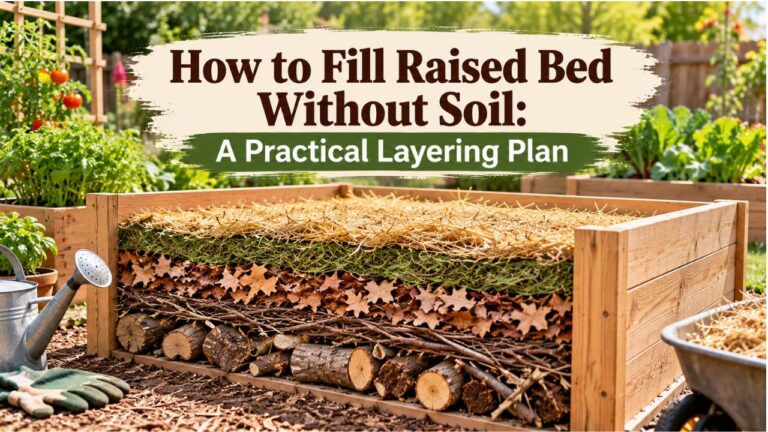
Logs and other untreated woody materials are sometimes used in deep raised beds to reduce purchased soil quantities. However, they decompose and can cause substantial settling. Their decomposition can also temporarily affect nitrogen availability, so sufficient suitable growing soil should remain above the woody material.
How Much Compost Is Needed for a 5×5 Raised Bed?
For a 5×5 raised bed filled to 12 inches, a mixture containing one-third compost requires approximately 8.33 cubic feet of finished compost. The remaining 16.67 cubic feet would be topsoil. The appropriate proportion may differ if the purchased soil already contains substantial organic matter.
Do I Need to Replace All the Soil Every Year?
No. Most raised garden beds do not need complete soil replacement each year. Maintain the existing growing medium by managing compaction, replenishing organic matter when appropriate, and correcting nutrient deficiencies based on soil testing. Complete replacement is generally reserved for situations involving unsuitable or contaminated soil.

I’m Maya L. Greenwood, a lifelong plant lover who believes anyone can grow something beautiful with the right guidance. After years of testing soil mixes, pruning methods, irrigation tricks, and pest-safe solutions, I started EasyGardenTips.com to turn hard-won lessons into step-by-step advice. From seed starting and container gardens to composting and seasonal checklists, my goal is to make gardening simple, sustainable, and fun.