Can I Put Grass Clippings in My Raised Garden Bed? Safe Uses
Yes, you can put grass clippings in a raised garden bed as mulch or add them to compost, provided they come from an untreated, weed-free lawn. Spread fresh clippings in thin layers and let each layer dry before adding another. Never pile wet grass thickly around vegetables: it can mat, smell sour, restrict water movement, and potentially damage tender plants.
Grass clippings are a source of organic matter. Used carefully on the soil surface, they help conserve moisture, reduce weeds, and gradually return nutrients as they decompose. But they are not a replacement for raised-bed soil, and a large mass of fresh clippings is unsuitable for filling the bottom of a bed.
The biggest concern is lawn treatment. Some weed killers can injure tomatoes, beans, and other broadleaf vegetables even after clippings have decomposed. When the treatment history is unknown, it is safer to choose a different mulch.
In this article, I explain when fresh or dried grass clippings are suitable, how thickly to spread them, and how to compost them first. You’ll also learn which lawn treatments to avoid, how to prevent clumps and weed seeds, and what to use instead when grass clippings aren’t safe.
Can I Put Grass Clippings in My Raised Garden Bed?
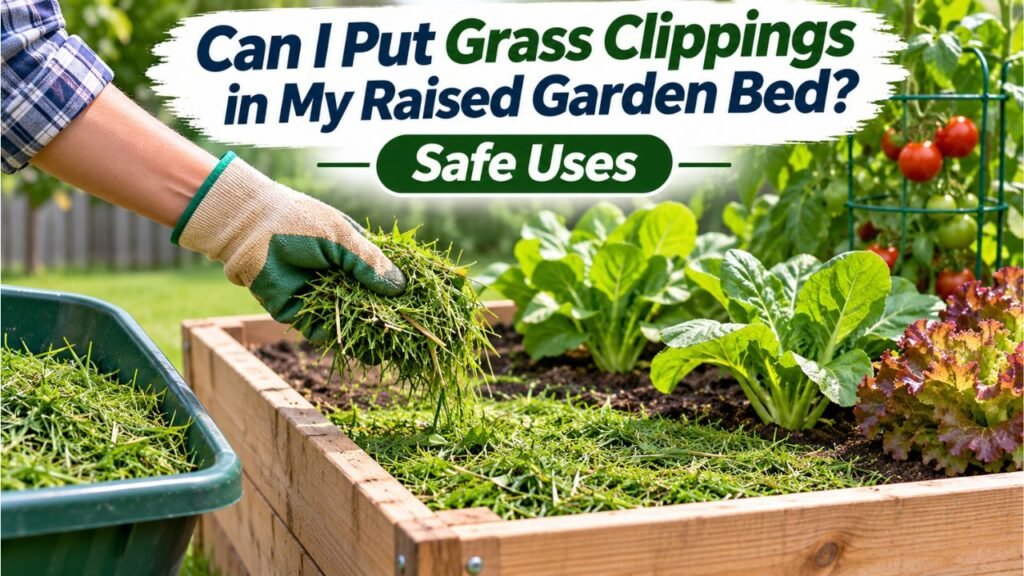
Yes. Grass clippings can be useful in raised vegetable beds when handled correctly.
There are three main ways to use them:
- As mulch: Spread a thin layer over the soil surface to conserve moisture and reduce weeds.
- As a compost ingredient: Mix clippings with dry leaves, straw, or other carbon-rich materials and allow them to decompose.
- As organic matter: Add properly finished grass-based compost to improve the soil over time.
The best method depends on whether the grass is fresh, dried, or composted.
Best Ways to Use Grass Clippings
| Method | Suitable for raised beds? | Important conditions |
| Fresh clippings as thin mulch | Yes | Apply thinly and allow drying |
| Dried clippings as mulch | Yes | Spread loosely and avoid thick mats |
| Fully composted clippings | Yes | Use properly finished, uncontaminated compost |
| Fresh clippings mixed into soil | Use cautiously | Avoid large quantities and planting immediately into decomposing material |
| Thick piles of wet clippings | No | Can become compacted, smelly, and poorly aerated |
| Grass treated with unsuitable herbicides | No | May injure vegetable plants |
| Grass containing mature weed seeds | Not recommended | May introduce new weeds |
| Large amounts used as raised-bed filler | Not recommended | Decomposition causes settling and other problems |
For most vegetable gardeners, using clean grass clippings as a thin surface mulch is the simplest approach.
Composting is another useful option, particularly when you have large amounts of lawn clippings.
Benefits of Grass Clippings in Raised Garden Beds
Grass clippings offer several gardening benefits when applied correctly.
They are inexpensive, widely available, and break down faster than many coarse mulching materials.
1. Help Retain Soil Moisture
Grass clippings can reduce evaporation from the soil surface.
This helps raised beds retain moisture between watering sessions.
Raised beds may dry more quickly than surrounding ground soil because their sides are exposed to air and sunlight.
A suitable mulch layer can reduce moisture loss during hot weather.
However, grass mulch should remain loose enough for irrigation and rainwater to reach the soil.
A thick, compacted layer may interfere with water penetration.
2. Reduce Weed Growth
A properly maintained mulch layer can reduce the amount of sunlight reaching weed seeds.
This may limit weed germination near vegetables.
Grass clippings are especially useful between established plants where there is exposed soil.
However, grass mulch does not eliminate every weed.
Persistent weeds may grow through the layer.
Any weeds that appear should be removed before they become established.
3. Add Organic Matter to the Soil
Grass clippings are biodegradable.
As they decompose, soil organisms break down their plant material.
Over time, this contributes organic matter to the garden.
Organic matter supports soil structure, water retention, and biological activity.
However, a thin layer of clippings will not transform poor raised-bed soil overnight.
Improving soil quality requires continued management and appropriate amendments.
4. Recycle Plant Nutrients
Grass contains nutrients that were originally absorbed from the soil.
As the clippings decompose, some of those nutrients return to the garden system.
Grass clippings are particularly valued as a nitrogen-rich compost ingredient.
However, their nutrient content varies with the grass species, lawn management, and decomposition conditions.
Do not treat grass mulch as a precisely measured fertilizer application.
A soil test is a better way to determine whether your vegetable bed needs additional nutrients.
5. Help Moderate Soil Temperature
A mulch layer reduces direct exposure of the soil to sunlight.
This can help limit excessive surface heating during summer.
It may be particularly useful around established vegetables during hot weather.
However, mulch can also slow spring soil warming.
For crops that prefer warm soil, such as tomatoes and peppers, wait until the soil has warmed adequately before applying a substantial mulch layer.
6. Reduce Soil Splashing
Rainfall and overhead irrigation can splash bare soil onto vegetable leaves.
A mulch layer provides some protection against this.
This can help keep lower foliage cleaner.
However, avoid piling clippings directly against plant stems or edible leaves.
Wet grass sticking to lettuce or other leafy vegetables can make harvesting and cleaning more difficult.
Key Takeaway: Grass clippings can help retain moisture, reduce weeds, moderate soil temperature, and add organic matter. Their benefits depend on using clean clippings in thin, loose layers.
How to Use Grass Clippings as Mulch in a Raised Garden Bed
The safest way to use grass clippings is to apply them gradually.
Do not dump an entire mower bag into one section of the garden.
Follow these steps to reduce clumping and moisture problems.
Step 1: Check the Lawn Treatment History
Before collecting clippings, determine whether the grass has been treated with herbicides or other pesticides.
If the lawn has received a weed-and-feed product, broadleaf weed killer, or another pesticide, check the product label.
Some treatments restrict using clippings for mulch or compost.
If the grass comes from another person’s yard, ask about lawn treatments.
When the treatment history is uncertain, avoid using those clippings around edible crops.
Step 2: Collect Grass Before It Produces Seeds
Mow the lawn while the grass is actively growing and before seed heads become mature.
Avoid collecting clippings that contain:
- Mature grass seed heads.
- Flowering weeds.
- Mature weed seeds.
- Large quantities of unwanted plant debris.
This reduces the chance of introducing weeds into the raised bed.
Weed-free clippings are particularly important when mulching around small vegetables.
Step 3: Allow Wet Clippings to Dry
Grass cut during wet conditions tends to clump together.
Freshly cut grass also contains substantial moisture.
If the clippings are very wet, spread them loosely on a clean surface and allow some moisture to evaporate.
Turn them occasionally if necessary.
Do not leave large wet piles sitting for an extended period.
They can begin decomposing without enough oxygen and develop unpleasant odors.
Step 4: Prepare the Soil Surface
Remove existing weeds from the raised bed.
Water the soil if it is dry.
Mulch works best when it helps conserve moisture already present in the soil.
For newly planted vegetables, allow seedlings to become sufficiently established before adding mulch close to their bases.
Make sure the soil temperature is appropriate for the crop.
Step 5: Spread a Very Thin Layer
Distribute the grass evenly across exposed soil.
For fresh clippings, begin with a layer approximately ¼ inch thick.
This is a conservative method recommended by Colorado State University Extension.
According to Colorado State University Extension’s vegetable mulching guidance, fresh grass clippings can be applied in layers up to ¼ inch thick, allowing each layer to dry before adding another.
This helps prevent matting and poor water movement.
Avoid dumping clippings into piles.
Step 6: Keep Grass Away From Plant Stems
Leave a small open space around the stems and crowns of vegetables.
For many established plants, approximately 1–2 inches of clearance is a practical starting point.
Adjust the spacing according to plant size.
The goal is to prevent damp grass from remaining pressed against tender stems.
Take particular care around young seedlings.
Do not bury their growing points beneath clippings.
Step 7: Allow the Layer to Dry Before Adding More
Wait until the applied clippings dry and settle.
Then add another thin layer if additional mulch is needed.
Do not repeatedly cover wet grass with more fresh clippings.
The drying period depends on:
- Temperature.
- Humidity.
- Rainfall.
- Air circulation.
- Grass thickness.
Check the condition of the mulch before adding more.
Step 8: Monitor the Mulch Throughout the Season
Inspect the grass regularly.
Look for:
- Dense mats.
- Sour odors.
- Water running off the mulch.
- Persistent wetness.
- New weed seedlings.
- Grass pressed against plant stems.
If the mulch becomes compacted, gently loosen it.
Remove any thick, slimy, or foul-smelling material.
Replace it with a thinner layer or another suitable mulch.
Key Takeaway: Start with approximately ¼ inch of fresh clippings, let them dry, and build up coverage gradually. Never create a thick, wet blanket over the raised-bed soil.
Should You Use Fresh or Dried Grass Clippings?
Both fresh and dried grass clippings can be used.
However, dried clippings are often easier to manage.
Fresh grass contains more moisture and is more likely to mat when applied thickly.
Fresh Grass Clippings
Fresh clippings can be used immediately after mowing if they come from a suitable untreated lawn.
However, keep the layer very thin.
Fresh grass is rich in moisture and decomposes rapidly.
Large piles may heat up, lose oxygen, and produce unpleasant odors.
Advantages include quick availability and rapid decomposition.
The main limitation is the need for careful application.
Dried Grass Clippings
Dried clippings contain less moisture.
They are generally easier to distribute without forming wet clumps.
A loose layer of dried grass can provide temporary soil coverage.
However, even dried clippings may compact when exposed to repeated rainfall or heavy irrigation.
Inspect the layer regularly.
Fresh vs. Dried Grass Clippings
| Feature | Fresh clippings | Dried clippings |
| Moisture content | High | Lower |
| Risk of matting | Higher | Generally lower |
| Decomposition | Often rapid | May be more gradual |
| Ease of spreading | Requires very thin layers | Usually easier |
| Odor risk in thick piles | Higher | Lower when kept loose |
| Best approach | Apply gradually | Spread as a loose surface mulch |
How Thick Should Dried Grass Mulch Be?
A loose layer of dried clippings around 1 inch deep is a reasonable starting point.
Some extension recommendations allow thicker applications under suitable conditions.
However, grass texture and local moisture conditions matter.
Unlike coarse straw or wood chips, grass can pack into a dense layer.
Avoid treating grass clippings as though they behave exactly like other mulches.
If water stops soaking through easily, reduce or loosen the layer.
Can You Mix Grass Clippings Into Raised Garden Bed Soil?
Yes, but composting them first is generally more predictable.
Mixing large amounts of fresh grass directly into vegetable soil can create temporary problems.
What Happens When Fresh Grass Is Buried?
Microorganisms begin breaking down the buried clippings.
During this process, they consume oxygen and release nutrients as the organic material decomposes.
Fresh grass decomposes relatively quickly because it contains substantial moisture and nitrogen.
However, large buried masses may become poorly aerated.
This can produce unpleasant conditions close to plant roots.
The material also loses volume as it decomposes.
Can Fresh Grass Damage Plant Roots?
Large concentrations of decomposing grass can create unfavorable growing conditions.
Problems may include:
- Poor air movement.
- Excessive moisture retention.
- Localized heating during rapid decomposition.
- Unpleasant anaerobic decomposition.
- Uneven soil settling.
These concerns are greater when thick masses of grass are buried together.
Small amounts mixed into well-aerated organic material are less likely to create the same problems.
Is It Better to Compost Grass First?
Usually, yes.
Finished compost provides a more stable amendment.
Proper composting allows much of the rapid decomposition to occur before the material enters the growing bed.
This helps reduce the problems associated with burying fresh grass.
Compost also contributes organic matter without leaving large, recognizable grass clumps in the root zone.
How to Add Finished Grass Compost
Once the compost is mature:
- Remove weeds from the raised bed.
- Spread a suitable layer of finished compost.
- Gently incorporate it into the upper soil if appropriate for your gardening method.
- Water as needed.
- Plant or mulch according to crop requirements.
Use compost as one part of a balanced raised-bed soil management plan.
Avoid filling the bed with compost alone.
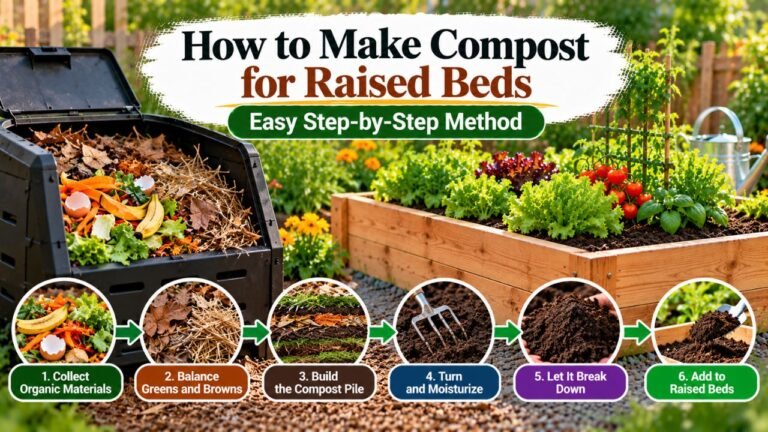
How to Compost Grass Clippings for Raised Beds
Grass clippings are useful compost ingredients because they provide nitrogen-rich green material.
However, a compost pile made entirely from fresh clippings may become dense and smelly.
Mix Grass With Brown Materials
Combine grass clippings with carbon-rich materials such as:
- Dry leaves.
- Shredded cardboard without unsuitable coatings.
- Straw.
- Small amounts of untreated wood shavings.
- Other appropriate dry plant materials.
The brown ingredients create structure and improve airflow.
They also provide carbon for decomposition.
Use a Balanced Compost Mix
A practical starting approach is to mix approximately equal volumes of fresh grass clippings and loose dry leaves.
This is a starting point rather than a fixed composting formula.
Actual proportions depend on moisture, particle size, and the materials being used.
If the pile is wet and smells unpleasant, add more dry brown material and improve aeration.
If it is very dry and decomposes slowly, check moisture and green-material balance.
Keep the Compost Aerated
Turn or mix the pile as needed.
This helps prevent thick grass layers from restricting airflow.
Composting works best when decomposing organisms have suitable oxygen and moisture.
Avoid compressing fresh grass into a dense pile.
Allow the Compost to Mature
Composting time varies with:
- Weather.
- Temperature.
- Moisture.
- Material size.
- Turning frequency.
- Compost pile volume.
Finished compost is generally dark and crumbly, with an earthy smell.
The original grass should no longer be recognizable as a dense mass of fresh clippings.
Do not use unfinished compost as the primary growing medium for young seedlings.
Can Composting Remove Lawn Herbicides?
Not reliably.
Some herbicides break down during composting, while others can persist long enough to damage sensitive plants.
Composting is not a guaranteed solution for contaminated clippings.
The safest approach is to prevent unsuitable treated grass from entering the compost pile.
Can You Fill the Bottom of a Raised Bed With Grass Clippings?
Using a large, compacted layer of fresh grass as raised-bed filler is not recommended.
Although grass is organic material, it decomposes much faster than stable soil components.
Why Thick Grass Layers Are a Problem
A deep layer of fresh grass may:
- Compress under the weight of soil.
- Decompose unevenly.
- Produce unpleasant odors.
- Develop poorly aerated conditions.
- Cause significant settling.
- Temporarily interfere with root-zone conditions.
For example, placing several inches of wet grass beneath a shallow soil layer can lead to an unstable planting environment.
The soil surface may settle as the organic material decomposes.
Is Grass Suitable for Hugelkultur-Style Raised Beds?
Grass can be included in small amounts as part of a varied organic-material mix.
However, it should not form a thick, compressed layer.
Hugelkultur-style beds commonly use larger woody materials and other organic matter that decompose at different rates.
Fresh grass behaves differently from branches and logs.
It is better treated as a green compost ingredient rather than the main structural filling.
What Should You Use Instead?
For a conventional raised vegetable bed, use an appropriate soil blend with:
- Mineral soil or a suitable raised-bed soil component.
- Mature compost.
- Other amendments suited to the soil and crops.
For deep beds where bulk filling is desired, select materials and construction methods that account for settling, decomposition, and drainage.
Do not replace most of the growing depth with fresh grass.
Key Takeaway: Grass clippings are useful for mulch and compost, but they are not a substitute for stable raised-bed soil or a suitable bulk-filling material.
Are Grass Clippings Safe for Vegetable Gardens?
Grass clippings can be safe around edible plants when they are clean, untreated, and correctly applied.
The main concerns are pesticide residues, weed seeds, and excessive moisture.
Grass Clippings From Herbicide-Treated Lawns
This is the most important safety issue.
Lawn herbicides are designed to control unwanted plants.
Some products target broadleaf weeds, which means residues may also harm broadleaf vegetables.
Potentially sensitive crops include:
- Tomatoes.
- Peppers.
- Beans.
- Peas.
- Potatoes.
- Lettuce.
Symptoms of herbicide injury may include distorted growth, curled leaves, and stunting.
The severity depends on the chemical, exposure, and plant species.
How Long Should You Wait After Lawn Treatment?
There is no single waiting period that applies to every herbicide.
Some product labels restrict clipping use for a specified number of mowings or days.
Others involve chemicals that can persist considerably longer.
For example, Colorado State University Extension cautions against using clippings from lawns treated with herbicides or other pesticides in the previous month, while also noting that certain herbicides can carry over much longer.
Always follow the specific pesticide label.
Do not assume that waiting one week, mowing twice, or composting the grass automatically makes it safe.
Persistent Herbicides in Grass and Compost
Certain herbicides can survive normal decomposition and injure sensitive garden plants.
Examples include:
- Clopyralid.
- Aminopyralid.
- Picloram.
According to the National Pesticide Information Center’s guidance on herbicide-contaminated compost, residues from some herbicides can enter compost through grass clippings, hay, or manure.
These chemicals may remain active long enough to cause plant damage.
If you suspect contamination, avoid adding the material to vegetable beds.
Contact your local cooperative extension office for guidance.
What About Grass Treated With Fertilizer?
Ordinary lawn fertilizer is different from herbicide.
However, some lawn products combine fertilizer with weed-control chemicals.
These are often sold as weed-and-feed products.
Read the full product label rather than relying on the word fertilizer.
If you cannot confirm what was applied, avoid using the clippings around edible plants.
Are Grass Clippings From Public Lawns Safe?
Not necessarily.
Grass from parks, roadsides, commercial properties, and other unfamiliar areas may have unknown treatment histories.
It may also contain unwanted debris or contaminants.
For raised vegetable beds, clippings from a lawn you manage and understand are generally the more reliable choice.
Can You Use Grass Clippings Around Tomatoes, Peppers, and Other Vegetables?
Yes, provided the clippings are suitable and applied correctly.
However, the best timing and placement depend on the crop.
Tomatoes
Grass clippings can help conserve moisture around established tomato plants.
Apply them after the soil has warmed.
Keep mulch away from the stem and avoid burying lower leaves.
Use only untreated clippings because tomatoes can be sensitive to certain broadleaf herbicide residues.
Peppers
Peppers prefer warm growing conditions.
Wait until the soil has warmed before adding mulch.
Spread the clippings around established plants without covering their stems.
Avoid thick layers that remain wet for long periods.
Cucumbers and Squash
Grass mulch can help reduce exposed soil around sprawling vegetables.
However, keep the mulch loose.
Do not pile wet clippings against plant crowns or developing fruits.
Monitor soil moisture beneath the mulch.
Lettuce and Leafy Greens
Use extra care around leafy vegetables.
Grass clippings can stick to wet leaves and create harvesting and cleaning difficulties.
Place mulch carefully between established plants rather than directly over the foliage.
Avoid covering small seedlings.
Beans and Peas
Use a thin mulch layer around established plants.
Avoid covering young stems or newly emerging seedlings.
Beans and peas are also among the crops that may be damaged by persistent herbicide residues.
Only use clippings with a known, suitable treatment history.
Strawberries
Grass clippings may be used cautiously around strawberries, but a clean, loose mulch is important.
Avoid thick, wet grass in direct contact with developing berries.
Straw is often a more convenient choice because it helps separate fruit from the soil and is less likely to form dense mats.
Can Grass Clippings Cause Mold, Bad Smells, or Slugs?
Yes. Problems are more likely when fresh clippings are applied too thickly or remain persistently wet.
Why Grass Clippings Smell Bad
Fresh grass contains moisture and decomposes quickly.
When clippings are packed into thick piles, oxygen movement becomes restricted.
Microorganisms that thrive in low-oxygen conditions may then produce unpleasant odors.
The grass may smell sour or rotten.
This is a sign that the mulch needs attention.
Can Grass Mulch Grow Mold?
Decomposing organic materials can support fungal growth.
Some fungal activity is part of normal decomposition.
However, dense, persistently wet mats are undesirable in a vegetable bed.
If the grass becomes slimy, foul-smelling, or heavily compacted, remove the affected material.
Use a thinner, better-aerated layer instead.
Does Grass Mulch Attract Slugs?
Moist mulch can provide shelter for slugs and other moisture-loving organisms.
This may be more noticeable in damp climates or shaded beds.
Check under mulch near susceptible seedlings.
If slugs become a problem:
- Reduce excessive moisture.
- Remove dense grass clumps.
- Keep mulch slightly away from tender stems.
- Monitor plants regularly.
- Use appropriate slug-management methods when needed.
Can Grass Clippings Burn Plants?
A thick mass of fresh grass can heat up during rapid decomposition.
This is one reason large piles should not be pressed against tender plants.
Very dense, fermenting material may create conditions that damage nearby tissues.
A thin, loose mulch layer is much less likely to create this problem.
How to Fix a Matted Grass Layer
If the grass forms a dense mat:
- Inspect the soil underneath.
- Remove thick or slimy sections.
- Loosen the remaining grass if suitable.
- Check whether water can penetrate.
- Allow the surface to dry as appropriate.
- Replace with a thinner layer or another mulch.
Do not cover an existing wet mat with more fresh grass.
How Much Grass Should You Put in a Raised Garden Bed?
The amount depends on whether the clippings are fresh or dry.
It also depends on the season, soil moisture, and plant size.
Recommended Grass Mulch Depth
| Grass condition | Practical starting depth | Notes |
| Fresh green clippings | Up to ¼ inch per application | Allow drying before adding another layer |
| Dried clippings | Around 1 inch, loosely spread | Inspect for matting after watering |
| Fully composted grass material | Follow compost application guidance | Treat as finished compost |
| Thick wet clumps | Avoid | May restrict water and airflow |
| Deep buried grass layers | Avoid | Can cause settling and decomposition problems |
Do not build grass mulch to a fixed thickness without considering how it behaves.
If clippings mat together, reduce the amount.
Should You Keep Adding Clippings Every Week?
You can add small amounts as the previous layer dries and breaks down.
However, weekly additions are not always necessary.
If the raised bed already has suitable soil coverage, adding more grass may create excessive thickness.
Check the mulch before each application.
How Do You Know the Layer Is Too Thick?
Warning signs include:
- Water collecting on top.
- Dense mats forming after rainfall.
- Sour smells.
- Slippery or slimy grass.
- Soil staying excessively wet.
- Grass pressing against stems.
If these appear, remove or thin the mulch.
Grass Clippings vs. Other Mulches for Raised Garden Beds
Grass clippings are one of several organic materials suitable for vegetable gardens.
Other mulches may be easier to manage or remain effective longer.
Grass Clippings vs. Straw
Straw is often easier to spread around vegetable plants.
It tends to provide more open structure than compacted grass.
Grass clippings generally decompose faster.
Choose clean, seed-free straw from a reliable source, and check for possible herbicide residue risks.
Grass Clippings vs. Shredded Leaves
Shredded leaves are a useful carbon-rich mulch.
They can provide seasonal soil coverage and gradually add organic matter.
Leaves may still mat if applied too thickly, especially when wet.
Grass clippings tend to be richer in nitrogen and break down relatively quickly.
Combining a modest amount of grass with loose shredded leaves may help improve structure.
Grass Clippings vs. Finished Compost
Finished compost is more stable than fresh grass.
It can be used as a soil amendment or surface mulch.
However, compost is not always as effective as a thicker, coarser mulch at suppressing weeds.
Use mature, uncontaminated compost from a reliable source.
Grass Clippings vs. Wood Chips
Wood chips generally last longer than grass clippings.
They are particularly useful for pathways between raised beds.
Fine grass mulch is often easier to incorporate into a regularly replanted vegetable bed.
Coarse wood chips may be less convenient when preparing fine seedbeds.
Mulch Comparison Table
| Mulch material | Main advantage | Main limitation |
| Grass clippings | Free, fast decomposition, nutrient recycling | Mats easily when wet |
| Straw | Loose structure, useful around vegetables | May contain weed seeds or herbicide residues |
| Shredded leaves | Adds organic matter, often readily available | Can compact when wet |
| Finished compost | Stable soil amendment | May provide less persistent weed suppression |
| Wood chips | Long-lasting surface coverage | Less convenient for frequent seedbed preparation |
Key Takeaway: Grass clippings are useful when you already have a safe supply. Straw, shredded leaves, and finished compost may be better choices when you want easier maintenance or longer-lasting coverage.
When Should You Add Grass Clippings to Raised Beds?
Timing affects how well grass mulch supports vegetable growth.
The best time depends on the crop and local growing conditions.
Spring
In spring, allow the soil to warm before applying much mulch around heat-loving crops.
For example, tomatoes and peppers grow better when soil temperatures are suitable for their development.
Applying a dense mulch too early may slow warming.
Use thin coverage once the plants are established.
Summer
Summer is often a practical time to use grass clippings.
A suitable mulch layer can help reduce moisture evaporation and limit exposed soil heating.
Check the mulch regularly after irrigation or rainfall.
Add new clippings only after the previous layer has dried sufficiently.
Fall
Grass clippings can be used in fall composting.
Combine them with fallen leaves and other brown materials.
This is often a convenient way to recycle both seasonal lawn clippings and leaf litter.
Finished compost can then be used in the garden when appropriate.
Winter
There is usually less need to apply fresh grass clippings during winter.
For empty beds, a suitable organic mulch can help protect the soil surface.
However, use materials that will remain reasonably loose and manageable through wet weather.
Shredded leaves or straw may be more convenient than fresh grass for extended winter coverage.
Common Mistakes When Using Grass Clippings in Raised Beds
Avoid these problems to get better results.
Using Herbicide-Treated Grass
Some lawn chemicals can damage vegetables.
Never assume composting removes every pesticide residue.
Check the product label and treatment history before using clippings.
Applying a Thick Layer All at Once
Fresh clippings can become compacted and restrict water movement.
Apply them gradually.
Using Wet Grass in Large Clumps
Wet grass is more likely to mat.
Spread it thinly and allow it to dry.
Placing Grass Against Plant Stems
Constant moisture against stems can create unfavorable conditions.
Maintain a small gap around plant bases.
Using Grass Full of Weed Seeds
Clippings containing mature weed seeds can introduce new weeds.
Collect grass before seed heads mature.
Filling a Bed Mostly With Fresh Grass
Fresh grass decomposes and loses volume.
It is not a suitable substitute for stable raised-bed soil.
Ignoring Signs of Poor Drainage
If water cannot soak through the mulch, remove or loosen the matted layer.
Treating Grass as a Complete Fertilizer
Grass clippings return nutrients gradually, but their nutrient content is variable.
Do not use them as a substitute for soil testing and appropriate fertilization.
Adding More Clippings Before the Previous Layer Dries
Repeatedly covering wet grass with new clippings can create a dense mat.
Allow drying and decomposition between applications.
Conclusion
So, can I put grass clippings in my raised garden bed? Yes, grass clippings can be a useful mulch or compost ingredient when they come from a suitable untreated lawn.
They help conserve moisture, reduce some weed growth, and gradually add organic matter as they decompose.
For fresh clippings, begin with a thin layer around ¼ inch deep and let it dry before adding more.
Dried clippings can be spread more loosely, but they still require monitoring to prevent matting.
Avoid clippings from lawns treated with unsuitable herbicides, and don’t use thick piles of fresh grass to fill raised beds.
My recommendation is to use clean grass clippings as a thin surface mulch and compost larger quantities with dry leaves or other brown materials.
This approach makes use of lawn waste while reducing the risks of odors, compaction, weed introduction, and damage to vegetable plants.
FAQs About Can I Put Grass Clippings in My Raised Garden Bed
Can I Put Fresh Grass Clippings Directly Around Vegetables?
Yes, if the grass is untreated and free from mature weed seeds. Apply fresh clippings in layers up to approximately ¼ inch thick and allow each layer to dry before adding more. Keep the grass away from tender stems.
Are Grass Clippings Good for Raised Garden Bed Soil?
Yes. Grass clippings add organic matter as they decompose and recycle plant nutrients. However, they are not a complete fertilizer or a replacement for a balanced raised-bed soil mix.
How Thick Should Grass Clippings Be in a Raised Bed?
Start with approximately ¼ inch of fresh clippings per application. For dried clippings, a loose layer around 1 inch is a practical starting point. Avoid thick mats that block water and airflow.
Can I Use Grass Clippings Around Tomato Plants?
Yes, provided the grass comes from a suitable untreated lawn. Apply thin layers around established tomatoes after the soil has warmed, and keep mulch away from the stems. Avoid clippings with unknown herbicide exposure because tomatoes can be sensitive to certain residues.
Can Grass Clippings Cause Weeds in Raised Beds?
Yes. Grass clippings containing mature grass or weed seeds may introduce unwanted plants. Mow before seed heads develop and avoid using clippings from weedy areas that have gone to seed.
Can I Use Grass Clippings to Fill the Bottom of My Raised Garden Bed?
A large layer of fresh grass is not recommended. It can compact, decompose rapidly, cause settling, and create poorly aerated conditions. Use a suitable raised-bed soil blend, and compost extra clippings separately.
Can I Use Grass Clippings After Spraying Weed Killer?
Not automatically. Safety depends on the exact herbicide and its label restrictions. Some products can leave residues that persist through composting and damage vegetables. If the treatment history is uncertain, do not use the clippings in an edible garden.

I’m Maya L. Greenwood, a lifelong plant lover who believes anyone can grow something beautiful with the right guidance. After years of testing soil mixes, pruning methods, irrigation tricks, and pest-safe solutions, I started EasyGardenTips.com to turn hard-won lessons into step-by-step advice. From seed starting and container gardens to composting and seasonal checklists, my goal is to make gardening simple, sustainable, and fun.