Is Cedar Mulch Good for Raised Garden Beds? Safety and Use Guide
Yes, untreated cedar mulch can be good for raised garden beds, especially around established vegetables, herbs, and perennial plants. It helps retain soil moisture, suppress weeds, moderate soil temperature, and protect the soil surface from heavy rain. However, cedar mulch is not always the best choice for vegetable beds that require frequent direct seeding or soil preparation.
Cedar mulch breaks down more slowly than straw, shredded leaves, or compost. This makes it useful for long-lasting weed control, but it also means larger wood pieces can remain in the bed for several growing seasons.
Some gardeners worry that cedar mulch releases harmful chemicals, makes soil acidic, or removes nitrogen needed by vegetables. University extension research shows that these concerns are often overstated when clean cedar chips are applied correctly on the soil surface. Problems are more likely when woody material is mixed into the soil or used improperly around seedlings.
The type of mulch, application depth, and crops you grow all influence the results.
In this article, I explain the benefits and limitations of cedar mulch for raised garden beds, including vegetable safety, soil nitrogen, pH, and pest concerns. I also cover how thick to apply cedar chips, when to mulch, and how cedar compares with straw, compost, and other materials.
Is Cedar Mulch Good for Raised Garden Beds?
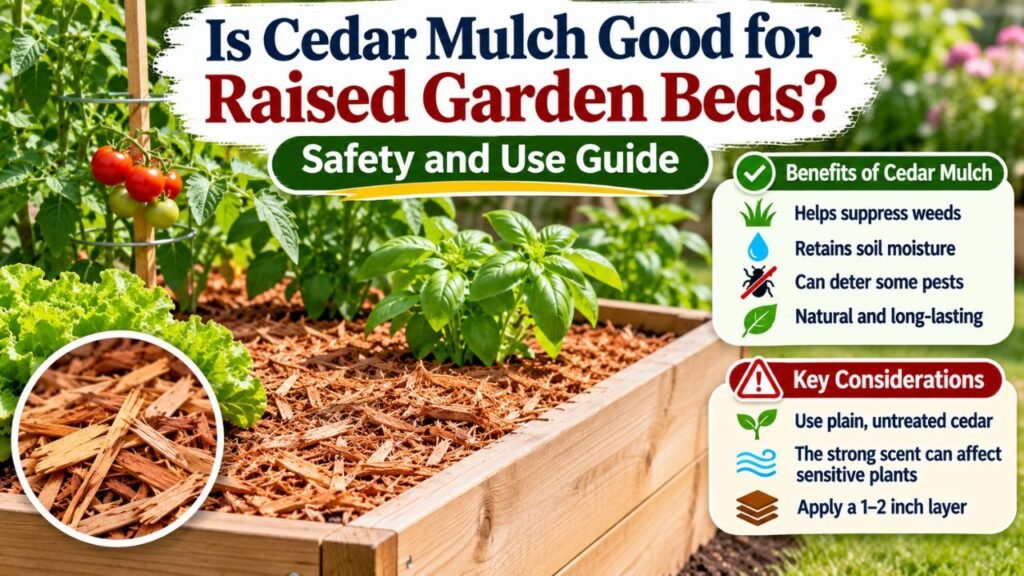
Cedar mulch is a suitable surface mulch for many established raised-bed plants, but faster-decomposing materials are often more convenient for frequently replanted vegetable beds.
The distinction is important because being safe for vegetables does not necessarily make cedar the most practical mulch for every gardening system.
Cedar chips are most useful when you want a relatively long-lasting protective layer and do not need to disturb the soil frequently.
When Cedar Mulch Is a Good Choice
Cedar mulch works particularly well for:
- Established tomato plants
- Established pepper plants
- Eggplants
- Mature squash and zucchini plants
- Perennial herbs
- Established berry bushes
- Raised flower beds
- Permanent planting areas
- Walkways between raised beds
These situations allow the mulch to remain on the soil surface without interfering with repeated planting.
When Cedar Mulch May Be Less Suitable
Cedar chips can be inconvenient for:
- Direct-seeded carrots
- Radishes
- Lettuce planted in successive batches
- Small seedlings
- Beds that are frequently cultivated
- Raised beds that are completely replanted each season
- Gardens where rapid organic matter decomposition is a priority
Large wood chips can make it difficult to create a smooth seedbed.
They also need to be moved aside before sowing small seeds.
What University Extensions Recommend
The University of Maine Cooperative Extension explains that cedar shavings can be used around vegetables such as squash and tomatoes, provided the material is not excessively fine and is kept on the soil surface.
However, Colorado State University Extension recommends avoiding wood and bark chips in actively cultivated vegetable growing beds because they can interfere with future seedbed preparation. It recommends wood chips for the pathways between raised beds instead.
These recommendations are not necessarily contradictory.
Cedar can be safe around established vegetables while still being less convenient than straw or compost in an intensive annual garden.
Quick Suitability Comparison
| Raised-Bed Situation | Cedar Mulch Suitability |
| Established tomato plants | Good |
| Established peppers | Good |
| Mature squash plants | Good |
| Perennial herbs | Good, when moisture needs are considered |
| Raised flower beds | Good |
| Permanent berry plantings | Good |
| Newly seeded carrots | Less suitable |
| Newly seeded lettuce | Less suitable |
| Frequently cultivated beds | Less convenient |
| Walkways between raised beds | Excellent |
Key Takeaway: Cedar mulch is useful around established plants and in permanent garden areas. Straw, compost, or shredded leaves may be easier to manage in raised beds used for frequent vegetable planting.
Benefits of Cedar Mulch for Raised Garden Beds
Cedar mulch provides many of the same benefits as other organic wood mulches.
Its main advantage is its ability to protect the soil surface for an extended period.
1. Helps Retain Soil Moisture
Raised garden beds can dry out relatively quickly, particularly during hot or windy weather.
Their exposed sides may contribute to heat and moisture loss, depending on construction materials and climate.
Cedar mulch creates a protective surface layer that slows evaporation.
This can help:
- Reduce moisture fluctuations
- Protect shallow roots from excessive drying
- Make irrigation more efficient
- Reduce the frequency of watering under some conditions
However, mulch does not eliminate the need to water vegetables.
Deep-rooted plants still need adequate moisture throughout the root zone.
2. Suppresses Weed Growth
Cedar chips block some sunlight from reaching the soil.
This reduces the germination and growth of many annual weeds.
A sufficiently deep, reasonably continuous layer generally provides better weed suppression than a very thin, patchy layer.
However, mulch is not a complete weed-control solution.
Perennial weeds and aggressive grasses may still grow through it.
Remove established weeds before spreading cedar chips.
3. Moderates Soil Temperature
Organic mulch reduces direct exposure of the soil to sunlight.
During hot weather, this can help prevent extreme heating of the upper soil layers.
It also reduces rapid temperature fluctuations.
However, mulch can slow soil warming in spring.
This is important for warm-season vegetables such as tomatoes and peppers.
In cool climates, wait until the soil has warmed adequately before applying a thick mulch layer around these crops.
4. Reduces Soil Splash
Heavy rain and overhead watering can splash soil onto lower leaves and fruit.
A mulch layer reduces direct contact between falling water and bare soil.
This can help keep produce cleaner and reduce some pathways through which soilborne plant pathogens reach foliage.
However, mulch does not prevent every plant disease.
Crop spacing, airflow, watering methods, and sanitation remain important.
5. Protects the Soil Surface
Bare garden soil is exposed to rainfall, wind, and temperature changes.
Mulch helps protect soil aggregates from the direct impact of rain.
It can reduce crusting and surface erosion.
This is particularly useful in raised beds containing light or loose soil mixtures.
6. Lasts Longer Than Many Other Organic Mulches
Cedar contains naturally occurring compounds associated with resistance to decay.
As a result, cedar mulch often breaks down more slowly than straw or shredded leaves.
This means less frequent replenishment may be necessary.
However, the exact lifespan varies with:
- Chip size
- Climate
- Rainfall
- Soil moisture
- Temperature
- Microbial activity
Cedar mulch should not be considered permanent.
It gradually decomposes and becomes incorporated into the upper soil environment over time.
7. Gives Raised Beds a Neat Appearance
Cedar mulch provides a consistent surface covering.
Natural cedar colors range from reddish-brown to tan, depending on the wood species and processing.
The appearance can complement wooden, metal, or composite raised beds.
However, color should be a secondary consideration to the mulch’s source, texture, and suitability for edible gardening.
Key Takeaway: Cedar mulch conserves moisture, suppresses weeds, protects soil, and lasts relatively long. Its benefits are greatest when it can remain undisturbed around established plants.
Is Cedar Mulch Safe for Vegetable Gardens?
Yes, clean, untreated cedar mulch is generally considered safe to use on the soil surface around established vegetables.
There is no strong evidence that ordinary cedar wood chips release substances that routinely poison vegetable plants when used as a surface mulch.
However, the source of the wood matters.
Does Cedar Mulch Contain Natural Chemicals?
Yes.
Cedar and cedar-like trees contain naturally occurring compounds that contribute to their fragrance and decay resistance.
Different trees sold under the name cedar have different chemical compositions.
For example, western red cedar belongs to the genus Thuja, while eastern red cedar belongs to Juniperus.
These natural compounds have contributed to concerns about possible effects on neighboring plants.
However, the presence of a chemical in wood does not automatically mean that a normal mulch layer will harm vegetables.
Does Cedar Mulch Poison Vegetable Plants?
University extension research does not support the general claim that ordinary cedar mulch is toxic to established garden plants.
Washington State University Extension’s publication on wood-chip mulch specifically discusses concerns about cedar allelopathy.
It reports that Thuja species have not demonstrated the type of harmful allelopathic effect commonly attributed to cedar wood-chip mulches.
This does not mean every possible wood product is safe.
Contamination, treatments, and inappropriate application methods remain separate concerns.
Is Cedar Mulch Safe Around Tomatoes and Peppers?
Yes, untreated cedar chips can be used around established tomatoes and peppers.
Leave space around the stems.
Avoid mixing the chips into the root-zone soil.
For warm-season crops, wait until the soil has warmed sufficiently before applying a substantial mulch layer.
Is Cedar Mulch Safe Around Leafy Greens?
It can be used around established leafy vegetables.
However, beds used for repeated sowings of lettuce, spinach, arugula, and other greens are often easier to manage with compost or finer, quicker-decomposing mulch.
Keep mulch away from the seed rows and young plants.
What Type of Cedar Mulch Is Safest?
Choose mulch that is:
- Made from clean, untreated wood
- Intended for garden or landscape use
- Free of herbicide treatments
- Free of unknown chemical preservatives
- Free of painted construction debris
- Free of foreign materials
- Appropriately sized for the plants
A reliable supplier should be able to explain the mulch’s source.
Key Takeaway: Clean cedar mulch is generally safe around established vegetables. The main concerns are contaminated or treated wood, excessive mulch depth, and interference with seedling growth.
Does Cedar Mulch Remove Nitrogen From Raised-Bed Soil?
Cedar mulch can contribute to temporary nitrogen immobilization near the soil surface as it decomposes, but a surface layer does not usually cause widespread nitrogen depletion throughout the root zone.
The biggest risk occurs when woody mulch is mixed into the soil.
Why Is Nitrogen Important?
Nitrogen is an essential plant nutrient.
Vegetables need it for:
- Leaf growth
- Chlorophyll production
- Protein formation
- General plant development
When nitrogen availability becomes too low, plants may develop pale or yellowing leaves and reduced growth.
However, similar symptoms can have other causes.
How Does Wood Decomposition Affect Nitrogen?
Wood contains a large proportion of carbon relative to nitrogen.
Microorganisms decomposing wood need nitrogen to grow.
If fresh wood chips are incorporated into garden soil, microorganisms may use some of the soil’s available nitrogen while breaking down the wood.
This process is called nitrogen immobilization.
It can temporarily reduce the nitrogen available to plant roots.
Is Surface Mulching Different?
Yes.
When cedar chips remain on top of the soil, most decomposition occurs within the mulch and at the soil-mulch boundary.
The effect is much more localized.
Washington State University Extension explains that the temporary nitrogen deficiency associated with wood-chip mulch is concentrated at this boundary and generally does not produce nitrogen deficiencies in established plants.
This is one reason surface application is preferable to mixing fresh cedar chips throughout raised-bed soil.
Should You Add Extra Nitrogen Before Mulching?
Not automatically.
A surface layer of cedar does not justify applying additional fertilizer without considering plant needs.
Excess nitrogen can create problems, including excessive leafy growth at the expense of some crops’ fruit production.
If plants show symptoms consistent with nutrient deficiency:
- Check irrigation and soil moisture.
- Review the fertilization schedule.
- Consider soil testing.
- Evaluate whether chips have been mixed into the root zone.
- Apply an appropriate fertilizer only when needed.
Should You Mix Cedar Mulch Into the Soil?
Avoid incorporating fresh cedar chips into soil used for vegetables.
Large pieces decompose slowly and can interfere with seedbed preparation.
If the goal is to improve soil organic matter, finished compost is usually a more practical choice.
Key Takeaway: Cedar mulch is much less likely to create meaningful nitrogen problems when kept on the surface. Avoid mixing fresh wood chips into raised-bed soil.
Does Cedar Mulch Make Raised-Bed Soil Acidic?
Cedar mulch does not usually cause a substantial change in the pH of the underlying garden soil when used as a surface layer.
This is a common gardening misconception.
Why Do Gardeners Worry About Soil Acidity?
Many conifers contain acidic compounds.
Some gardeners assume that mulching with cedar or other conifer materials will steadily acidify the soil.
However, the chemistry of fresh wood is not the same as the long-term chemistry of the soil underneath it.
What Does Research Show?
Washington State University Extension explains that wood-chip mulch generally does not significantly alter the pH of the underlying soil.
Temporary pH changes may occur within the decomposing mulch layer itself.
However, these changes do not necessarily extend into the soil below.
Soil pH is influenced by many factors, including:
- Parent soil material
- Soil buffering capacity
- Irrigation water
- Fertilizer practices
- Rainfall
- Amendments
A cedar mulch layer is not a reliable way to correct a soil pH problem.
Is Cedar Mulch Good for Acid-Loving Plants?
Cedar may be useful for moisture control and weed suppression around established acid-loving plants.
However, it should not be used as the primary method of lowering soil pH.
For crops such as blueberries, measure the soil pH and follow crop-specific recommendations.
If the soil needs acidification, use an appropriate amendment based on a soil test.
Will Cedar Mulch Hurt Tomatoes Because of Acidity?
Ordinary surface-applied cedar mulch is not expected to make the soil beneath tomatoes excessively acidic.
If tomato plants show poor growth, investigate soil pH, fertility, drainage, and other growing conditions rather than assuming the cedar is responsible.
Key Takeaway: Cedar mulch is not a dependable soil acidifier. Use soil testing to evaluate pH instead of relying on assumptions about woody mulch.
Does Cedar Mulch Repel Insects and Garden Pests?
Cedar contains naturally occurring aromatic compounds, some of which have demonstrated insect-repellent properties.
However, cedar mulch should not be relied upon as a pest-control treatment for raised garden beds.
Can Cedar Repel Certain Insects?
Some cedar compounds have been studied for their effects on insects.
These properties contribute to cedar’s reputation for insect resistance.
However, there is an important difference between a concentrated compound tested under controlled conditions and ordinary cedar mulch spread outdoors.
Mulch may weather, lose fragrance, and vary in chemical composition.
It does not provide a predictable protective barrier against garden pests.
Does Cedar Mulch Repel Mosquitoes?
There is insufficient reliable evidence to treat ordinary cedar mulch as an effective mosquito-control method.
Mosquito management should focus primarily on eliminating standing water and using proven protective measures.
Do not spread cedar mulch expecting it to control mosquitoes around the garden.
Does Cedar Mulch Repel Slugs and Snails?
Not reliably.
Organic mulch can provide cool, moist hiding places for some garden pests, including slugs and snails.
In damp conditions, monitor plants for damage.
Avoid excessive mulch accumulation around tender stems.
Does Cedar Mulch Attract Termites?
Wood-based mulches can provide habitat or moisture conditions suitable for insects.
However, that does not mean cedar mulch automatically attracts termites to a property.
Iowa State University Extension explains that wood-chip mulch has not been shown to attract termites that were not already present in the area.
It recommends keeping mulch away from house foundations and avoiding conditions that provide concealed access to buildings.
Does Cedar Harm Beneficial Insects?
Concerns have been raised that cedar’s aromatic compounds could repel pollinators or other useful insects.
However, the University of Maine notes that experimental evidence has not supported the broad claim that ordinary cedar mulch around vegetables reduces pollinator activity.
The larger ecological effects of mulching depend on plant selection, soil conditions, mulch depth, and the surrounding habitat.
Key Takeaway: Cedar has natural aromatic compounds, but mulch is not a reliable pesticide. Do not depend on it to control mosquitoes, slugs, termites, or other garden pests.
How Thick Should Cedar Mulch Be in Raised Garden Beds?
For established plants, a 2- to 3-inch layer of coarse organic mulch is a commonly recommended starting point.
However, small seedlings may need a much thinner layer or no mulch immediately around them.
The ideal depth depends on plant size, mulch texture, and soil conditions.
Cedar Mulch Depth Guide
| Situation | Suggested Approach |
| Newly sown seeds | Keep seed rows clear |
| Newly emerged seedlings | No mulch immediately around stems; use a very thin layer only where appropriate |
| Small established seedlings | Approximately 1 inch or less near the plants |
| Established vegetables | Approximately 2–3 inches of coarse mulch |
| Established perennial plants | Approximately 2–3 inches, adjusted to plant needs |
| Walkways between raised beds | Approximately 3–4 inches for weed control |
These are general guidelines.
The University of Florida IFAS Extension recommends approximately 2–3 inches of mulch around established plants but no more than about 1 inch around small vegetables and seedlings.
It also advises keeping mulch away from stems and trunks.
Why Is Excessive Mulch Depth a Problem?
Too much mulch may:
- Interfere with water reaching the soil
- Keep the stem base excessively moist
- Create hiding places for certain pests
- Delay spring soil warming
- Reduce air movement at the soil surface
- Make planting and cultivation more difficult
More mulch does not always produce better weed control.
How Much Space Should You Leave Around Stems?
Keep the immediate stem base clear.
For small vegetables, leaving roughly 1–2 inches of exposed space around the stem is a practical starting point, adjusted to the size of the plant.
Avoid piling cedar chips against tomato, pepper, or squash stems.
For larger woody plants, more clearance may be appropriate.
Should You Apply Cedar Mulch to the Edge of the Bed?
You can spread mulch across much of the soil surface.
However, avoid excessive buildup against wooden bed frames or other areas where trapped moisture may be undesirable.
If your raised bed uses a drainage system, do not allow mulch to block its openings.
Key Takeaway: Use roughly 2–3 inches of cedar mulch around established plants, keep stems clear, and apply much less around small seedlings.
How to Apply Cedar Mulch to Raised Garden Beds Step by Step
Proper application helps you get the benefits of cedar without interfering with plant growth.
Step 1: Check the Condition of the Soil
Before adding mulch, inspect the raised-bed soil.
Check for:
- Excessive dryness
- Standing water
- Compaction
- Heavy weed growth
- Existing plant problems
Mulch cannot fix a drainage problem or replace proper soil preparation.
If the bed is waterlogged, address drainage before applying another moisture-retaining layer.
Step 2: Remove Existing Weeds
Pull established weeds, including their roots where practical.
Cedar mulch can suppress new weed growth but may not stop mature weeds.
Remove invasive perennial weeds before applying the mulch.
Step 3: Water the Soil if Necessary
If the soil is dry, water it before mulching.
The goal is to establish adequate moisture in the root zone.
Avoid saturating soil that already drains poorly.
Step 4: Choose Coarse, Clean Cedar Mulch
Use untreated cedar chips or reasonably coarse shavings.
Avoid sawdust-like material.
Fine wood particles can become compacted or matted, potentially restricting water movement.
Coarse mulch generally allows better water and air exchange.
Step 5: Spread the Mulch Evenly
Distribute the cedar across the exposed soil surface.
For established vegetables, aim for a layer around 2 inches deep initially.
Adjust as needed based on plant size and growing conditions.
Do not mix the fresh cedar into the soil.
Step 6: Keep Mulch Away From Stems
Pull the chips back from the base of each plant.
This helps prevent persistent moisture buildup around tender stems.
Avoid creating a mound around the plant.
Step 7: Keep Seed Rows Clear
If the bed contains direct-seeded crops, leave the planting rows uncovered until the seedlings are established.
Do not bury freshly planted small seeds beneath a thick layer of cedar chips.
Step 8: Water and Check Penetration
After applying mulch, water as needed.
Move a small section of mulch aside and check whether moisture is reaching the soil underneath.
If the mulch is matted or preventing water penetration, loosen or redistribute it.
Step 9: Monitor the Bed
Over the following weeks, check:
- Soil moisture
- Weed growth
- Mulch depth
- Stem health
- Pest activity
- Soil temperature when relevant
Adjust the mulch layer instead of leaving it unchanged regardless of conditions.
Key Takeaway: Apply cedar mulch after preparing the soil, keep it on the surface, leave stems and seed rows clear, and check that irrigation still reaches the root zone.
When Should You Apply Cedar Mulch to Raised Beds?
Timing affects how mulch influences soil temperature and seedling development.
Spring Mulching
For warm-season vegetables, wait until the soil has warmed sufficiently.
Cedar mulch can insulate cool spring soil and slow further warming.
This matters for heat-loving crops such as:
- Tomatoes
- Peppers
- Eggplants
- Squash
- Melons
If you apply mulch immediately after planting in a cool climate, it may keep the soil cooler than desired.
Allow the plants to establish and the soil to warm before spreading a substantial layer.
Summer Mulching
Summer is often a useful time for cedar mulch.
The protective layer can reduce evaporation during hot weather.
It can also limit some weed growth when plants are established.
However, continue checking soil moisture beneath the mulch.
Do not assume that the soil is moist simply because the surface looks covered.
Fall Mulching
Cedar mulch can be useful in perennial raised beds during fall.
It may help moderate soil temperature changes and protect the surface from erosion.
However, annual vegetable beds that will be replanted in spring may be easier to manage with compost, leaves, or another faster-decomposing material.
Winter Mulching
In some climates, mulch helps protect perennial roots and soil from temperature fluctuations.
However, winter mulch needs vary by crop, region, and drainage conditions.
Avoid keeping tender stems excessively wet.
Do not automatically apply a thick cedar layer to every raised bed before winter.
Key Takeaway: Apply cedar mulch after warm-season crops and soil have established in spring. Summer is often a useful time for moisture conservation, while fall and winter use depends on the planting system.
Cedar Mulch vs. Straw for Raised Garden Beds
Straw is one of the most common alternatives to cedar in vegetable gardens.
Both materials can suppress weeds and reduce evaporation, but they differ in decomposition and ease of seasonal cultivation.
Cedar Mulch
Cedar is relatively durable.
It can remain in place for multiple seasons.
However, its slow breakdown means chips may interfere with soil preparation when you want to sow new crops.
Straw Mulch
Straw generally breaks down more quickly.
It is easier to move aside and incorporate into a vegetable gardening system.
Weed-free straw is widely recommended by university extensions.
However, straw may blow away in windy locations and require more frequent replenishment.
Comparison Table
| Feature | Cedar Mulch | Straw Mulch |
| Weed suppression | Good when applied correctly | Good when applied correctly |
| Moisture conservation | Good | Good |
| Decomposition | Relatively slow | Faster |
| Frequent replanting | Less convenient | More convenient |
| Direct seeding | Can interfere | Easier to move aside |
| Soil organic matter contribution | Gradual | Faster |
| Appearance | Wood-chip texture | Straw-like texture |
| Replacement frequency | Usually less frequent | Usually more frequent |
| Best application | Established plants and permanent areas | Annual vegetable growing beds |
Which Is Better for Tomatoes?
Both materials can work around established tomato plants.
Cedar is useful when you want a long-lasting surface layer.
Straw may be more practical if the bed is replanted or cultivated frequently.
Which Is Better for Lettuce and Carrots?
Straw or compost is generally easier to manage.
Small seeds need suitable contact with the soil.
Coarse cedar chips can make sowing more difficult.
Key Takeaway: Cedar is more durable, while straw is often better suited to annual vegetable beds and frequent replanting.
Cedar Mulch vs. Compost for Raised Garden Beds
Cedar and compost serve different primary purposes.
Cedar is mainly a protective surface mulch.
Finished compost also contributes organic matter and nutrients to the growing soil.
Cedar Mulch Benefits
Cedar provides:
- Weed suppression
- Moisture conservation
- Surface protection
- Slow decomposition
It is not a replacement for a balanced fertility program.
Compost Benefits
Finished compost can:
- Add organic matter
- Improve soil structure
- Support biological activity
- Contribute some plant nutrients
- Be easier to integrate into seasonal soil preparation
However, compost composition varies.
It is not automatically a complete fertilizer.
Can You Use Cedar Mulch Over Compost?
Yes.
A practical approach is to apply finished compost to the soil according to crop needs and then place cedar mulch on top.
For example:
- Prepare the planting bed.
- Add an appropriate amount of finished compost.
- Plant vegetables.
- Water the bed.
- Allow plants to establish.
- Apply cedar mulch around the plants.
Keep the cedar separate from the soil rather than incorporating the wood chips.
This combines compost’s soil-improvement role with cedar’s surface-protection benefits.
Which Is Better for Improving Soil?
Finished compost is generally more useful when your main goal is improving soil structure and organic matter.
Cedar chips eventually contribute organic material as they break down, but they do so slowly.
Key Takeaway: Compost is better for direct soil improvement, while cedar is useful for longer-lasting surface coverage. The two materials can be used together.
Cedar Mulch vs. Shredded Leaves and Other Wood Chips
Other organic mulches may offer similar benefits at different costs and decomposition rates.
Cedar vs. Shredded Leaves
Shredded leaves are often inexpensive or free.
They break down faster than cedar and can improve soil organic matter.
However, large amounts of whole leaves may form mats.
Shredding them before application helps create a more manageable layer.
For frequently replanted beds, shredded leaves are often more convenient than coarse cedar chips.
Cedar vs. Pine Bark
Pine bark is another relatively slow-decomposing organic mulch.
It can provide attractive surface coverage.
However, large bark nuggets may be awkward around closely spaced vegetables.
Finer bark products may be easier to use, depending on their texture.
Neither cedar nor pine bark should be relied upon to make large, predictable changes to soil pH.
Cedar vs. Hardwood Mulch
Hardwood mulch varies considerably by wood species and particle size.
Some hardwood products decompose faster than cedar.
Others may mat or become difficult to work around.
Clean, coarse wood chips are useful for permanent walkways.
When buying any wood mulch for edible gardening, verify the source and avoid contaminated material.
Mulch Comparison for Raised Beds
| Mulch Type | Decomposition Rate | Best Use |
| Cedar chips | Slow | Established plants and permanent areas |
| Weed-free straw | Relatively fast | Annual vegetable beds |
| Finished compost | Already substantially decomposed | Soil improvement and surface covering |
| Shredded leaves | Moderate to relatively fast | Seasonal vegetable beds |
| Pine bark | Slow | Established plants and landscape beds |
| Hardwood chips | Variable | Permanent areas and walkways |
| Untreated dried grass clippings | Relatively fast | Thin layers around vegetables |
Key Takeaway: Choose cedar when longevity matters. Choose straw, leaves, or compost when easier planting and faster organic matter breakdown are higher priorities.
Can You Use Fresh Cedar Wood Chips in Raised Beds?
Fresh cedar chips can be used as surface mulch when they come from clean, untreated wood.
However, several precautions matter.
Fresh Chips vs. Aged Chips
Fresh chips contain wood that has not undergone much decomposition.
Aged chips have already begun breaking down.
Both can function as surface mulch.
Aged material may have a softer texture, but it can still contain large, slow-decomposing pieces.
Is Fresh Cedar Toxic to Plants?
Ordinary clean cedar chips are not generally considered toxic to established vegetables.
However, do not mix fresh woody material into the root-zone soil.
The nitrogen immobilization concern becomes more significant when fresh chips are incorporated.
Should You Compost Cedar Chips First?
It is not always necessary for surface use.
However, allowing coarse chips to weather or compost can reduce their freshness and begin decomposition.
Because cedar is relatively decay-resistant, composting may take longer than with many other organic materials.
If you want an amendment that is ready to mix into soil, use properly finished compost rather than partially decomposed cedar chips.
Can You Use Cedar Sawdust?
Fine cedar sawdust is generally less suitable than coarse chips.
Very fine material can compact or form a dense layer.
It may reduce water infiltration and create more extensive contact with the soil.
The University of Maine advises using cedar shavings that are recognizable wood pieces rather than powdery, sawdust-like material.
Key Takeaway: Fresh cedar chips can be suitable as surface mulch, but coarse, clean material is preferable to fine sawdust. Avoid incorporating fresh wood into the soil.
Is Dyed Cedar Mulch Safe for Vegetable Raised Beds?
The safety of commercial dyed mulch depends on the wood source and any treatments, not simply its color.
Are Mulch Dyes Always Harmful?
No.
It is inaccurate to assume that every mulch dye is inherently dangerous.
However, dyed mulch may be manufactured from different sources, including recycled wood.
The key concern is whether the wood contains contaminants.
Why Does the Wood Source Matter?
Some recycled wood may originate from:
- Treated construction lumber
- Painted materials
- Demolition debris
- Industrial wood products
- Other materials with unknown chemical histories
If these materials contain preservatives or contaminants, they may not be appropriate for vegetable gardens.
Clemson Cooperative Extension’s treated-wood guidance notes that some dyed mulches use recycled wood and warns against using contaminated products in edible gardens.
It distinguishes the risk from the dyes themselves from the risk of contaminants in the original wood.
What Should You Look for When Buying Cedar Mulch?
Choose products with clear information about:
- Wood type
- Untreated source material
- Absence of construction debris
- Absence of pesticide or herbicide treatment
- Intended garden or landscape use
If the source is unclear, ask the supplier before applying it to edible crops.
Is Natural Cedar Mulch Better?
For raised vegetable beds, clean, untreated, natural-colored cedar is a straightforward choice.
Its source may be easier to evaluate than an unidentified recycled or dyed product.
However, natural color alone does not prove that wood is contaminant-free.
Key Takeaway: Choose clean, untreated cedar from a reliable source. Avoid wood mulch made from unknown treated or contaminated materials, particularly in edible gardening beds.
How Much Cedar Mulch Do You Need for a Raised Garden Bed?
The amount depends on the raised bed’s length, width, and desired mulch depth.
You can estimate the required volume before buying bagged or bulk mulch.
Cedar Mulch Volume Formula
For rectangular raised beds measured in feet:
Mulch Volume (Cubic Feet) = Length × Width × Mulch Depth (Inches) ÷ 12
This converts the mulch thickness from inches to feet.
Example: 4 × 8 Raised Garden Bed
Suppose your raised bed measures:
- Length: 8 feet
- Width: 4 feet
- Mulch depth: 2 inches
The calculation is:
8 × 4 × (2 ÷ 12) = 5.33 cubic feet
You would need approximately 5.3 cubic feet of mulch to cover the entire soil surface evenly to a 2-inch depth.
If the mulch is sold in 2-cubic-foot bags:
5.33 ÷ 2 = 2.67 bags
Round up to 3 bags.
If you want a 3-inch layer:
8 × 4 × (3 ÷ 12) = 8 cubic feet
That equals 4 bags containing 2 cubic feet each.
Estimated Cedar Mulch for Common Raised-Bed Sizes
| Raised-Bed Size | 2-Inch Depth | 3-Inch Depth |
| 2 × 4 ft | 1.3 cu. ft. | 2 cu. ft. |
| 3 × 6 ft | 3 cu. ft. | 4.5 cu. ft. |
| 4 × 4 ft | 2.7 cu. ft. | 4 cu. ft. |
| 4 × 6 ft | 4 cu. ft. | 6 cu. ft. |
| 4 × 8 ft | 5.3 cu. ft. | 8 cu. ft. |
| 4 × 10 ft | 6.7 cu. ft. | 10 cu. ft. |
These estimates assume that the entire bed surface is covered uniformly.
Actual requirements may be lower if large plant crowns, open seed rows, or other areas are excluded.
How Often Should You Add More Cedar?
Inspect the mulch periodically.
Add more only when the layer has thinned below the desired depth.
Avoid automatically adding another full 2- or 3-inch layer on top of existing mulch.
Too much buildup can interfere with water movement and create excessive moisture around plants.
Key Takeaway: A 4 × 8-foot raised bed needs approximately 5.3 cubic feet of cedar mulch for a 2-inch layer or 8 cubic feet for a 3-inch layer.
Should You Use Cedar Mulch Inside or Between Raised Garden Beds?
Cedar is useful in both locations, but the benefits and limitations differ.
Using Cedar Inside Raised Beds
Inside the bed, cedar helps protect soil around established plants.
However, it can interfere with frequent sowing or cultivation.
It is most convenient when the planting arrangement remains relatively stable throughout the season.
Using Cedar Between Raised Beds
Cedar is particularly well suited to pathways.
A layer of wood chips can:
- Reduce weed growth
- Cover exposed soil
- Reduce muddy walking surfaces
- Help limit soil compaction from foot traffic
- Improve the appearance of garden pathways
Colorado State University Extension recommends wood or bark chips between raised-bed boxes and suggests a depth of approximately 3–4 inches for weed control.
Why Are Pathways a Better Long-Term Use?
Garden paths are not usually cultivated or replanted.
That allows cedar chips to remain in place while gradually decomposing.
The slow decomposition becomes an advantage rather than a complication.
Can You Use Cedar in Both Places?
Yes.
A practical combination is:
- Cedar chips in permanent walkways
- Cedar mulch around established perennial crops
- Straw or compost in frequently replanted vegetable beds
This arrangement uses each material where it is most convenient.
Key Takeaway: Cedar is especially useful between raised beds because it suppresses weeds without interfering with seedbed preparation. Inside the growing bed, use it selectively around established plants.
Does Cedar Mulch Affect Raised-Bed Drainage?
Cedar mulch can influence how water moves across the soil surface, but it does not replace a properly draining soil mixture.
Can Cedar Mulch Improve Drainage?
A coarse mulch layer can protect the surface from crusting and heavy rainfall.
However, it does not directly correct compacted soil, a blocked drainage outlet, or a poorly designed raised-bed base.
If water collects inside the bed, address the underlying drainage problem.
Can Cedar Hold Too Much Moisture?
Mulch helps retain moisture, which is generally beneficial in dry conditions.
However, excessive mulch thickness can keep the surface environment too damp.
This may be undesirable around tender stems or plants susceptible to crown rot.
In wet climates, use a suitable layer and leave the plant bases clear.
How Can You Tell if Water Is Reaching the Soil?
After watering:
- Move a small section of mulch aside.
- Check the soil beneath it.
- Determine whether moisture has penetrated the root zone.
- Adjust watering if necessary.
- Loosen matted mulch if water is running off.
Do not judge soil moisture only by the appearance of the cedar chips.
Is Drip Irrigation Compatible With Cedar Mulch?
Yes.
Drip irrigation can work well beneath a mulch layer.
Position the irrigation tubing according to the system’s installation instructions.
The mulch can help reduce evaporation from the watered soil.
Inspect the emitters periodically to ensure water is reaching the intended root zones.
Key Takeaway: Cedar mulch helps reduce evaporation but does not fix poor drainage. Check soil moisture beneath the chips and avoid excessive buildup.
Common Mistakes When Using Cedar Mulch in Raised Beds
Most cedar mulch problems result from inappropriate placement, depth, or material selection.
1. Mixing Fresh Cedar Chips Into the Soil
This can increase the area where microbes immobilize nitrogen.
Keep the chips on the surface.
Use finished compost when you need a soil amendment.
2. Applying Mulch Before the Soil Warms
A thick mulch layer may slow spring warming.
This is particularly relevant for tomatoes, peppers, and other warm-season crops.
Wait until the soil reaches a suitable planting temperature.
3. Covering Freshly Sown Seeds
Small seeds may struggle to emerge through thick wood chips.
Keep seed rows clear.
Apply mulch around seedlings only after they are sufficiently established.
4. Piling Mulch Against Plant Stems
Mulch in direct contact with stems can keep them excessively moist.
Leave a small gap around the plant base.
5. Using Too Much Mulch
Deep layers can interfere with water movement and make planting difficult.
Use an appropriate depth for the crop.
6. Choosing Fine Cedar Sawdust
Sawdust-like material may form a dense, compacted layer.
Coarser wood chips are generally more suitable for surface mulching.
7. Buying Mulch From an Unknown Source
Avoid treated construction wood, contaminated recycled material, or products with unclear herbicide treatment.
Choose clean garden-grade mulch.
8. Expecting Cedar to Repel Every Pest
Cedar is not a substitute for appropriate pest management.
Monitor for slugs, insects, and other garden problems.
9. Expecting Cedar to Fertilize the Bed Quickly
Cedar decomposes slowly.
Do not rely on it for immediate nutrient supply.
Use appropriate compost and fertilization practices.
10. Adding New Mulch Without Checking the Old Layer
Repeatedly adding thick layers can create excessive buildup.
Measure the existing depth before replenishing.
Key Takeaway: Keep cedar on the surface, avoid burying seedlings or stems, use clean coarse material, and maintain an appropriate mulch depth.
How to Maintain Cedar Mulch Throughout the Growing Season
Cedar mulch requires less frequent replacement than many faster-decomposing materials, but it still needs occasional inspection.
Check Soil Moisture
Move the mulch aside periodically to check the underlying soil.
Water according to crop needs.
Do not rely on surface appearance alone.
Remove Emerging Weeds
Some weeds will still appear.
Pull them while they are small.
Avoid allowing mature weeds to produce seeds within the mulch.
Loosen Matted Areas
If fine material forms a dense layer, gently loosen it.
This can help improve water penetration.
Avoid disturbing nearby roots.
Watch for Stem Problems
Inspect the bases of plants for signs of excess moisture or decay.
Pull mulch away from affected stems.
Address irrigation and drainage issues as necessary.
Replenish Only When Needed
As cedar decomposes and settles, the layer may become thinner.
Add enough material to restore the desired depth.
Do not apply an entire new thick layer automatically.
Prepare for the Next Planting Season
If the bed will be replanted, move the cedar chips aside before preparing the soil.
Add finished compost or other amendments according to soil conditions.
Plant the new crop.
Return the mulch only after seedlings are established and the timing is appropriate.
If the bed requires frequent cultivation, consider replacing the cedar with a more convenient seasonal mulch.
Key Takeaway: Monitor moisture, weed growth, and mulch thickness. Move cedar aside when preparing new seedbeds instead of mixing fresh chips into the soil.
When Is Cedar Mulch the Best Choice for a Raised Garden Bed?
Cedar is not the best mulch for every crop, but it can be an excellent option in the right situation.
Choose Cedar When You Want Long-Lasting Weed Control
Cedar’s slow decomposition makes it attractive for stable planting areas.
You may need fewer complete mulch replacements than with straw or leaves.
Choose Cedar for Established, Widely Spaced Vegetables
Tomatoes, peppers, eggplants, and mature squash often leave enough space between plants for a manageable mulch layer.
Cedar can protect that exposed soil.
Choose Cedar for Perennial Raised Beds
Cedar is especially convenient where plants remain in place for several years.
However, individual plants may require different mulch depths and moisture conditions.
Choose Cedar for Garden Walkways
This is one of its strongest applications.
Wood chips help suppress weeds in paths and reduce muddy conditions.
Choose Straw or Compost for Frequent Seeding
For carrots, radishes, leafy greens, and succession planting, faster-decomposing mulch may be more convenient.
The goal is to preserve a manageable planting surface.
Choose Compost When Soil Improvement Is the Priority
If your raised-bed soil needs more organic matter or better structure, finished compost is usually a more direct solution.
Cedar can be added afterward as a protective surface layer.
Final Decision Table
| Your Gardening Goal | Recommended Mulch |
| Long-lasting mulch around mature tomatoes | Cedar or another suitable coarse organic mulch |
| Easy seasonal replanting | Straw or shredded leaves |
| Direct-seeded carrots and lettuce | Compost or carefully managed seasonal mulch |
| Soil organic matter improvement | Finished compost |
| Weed control between raised beds | Cedar or other coarse wood chips |
| Mulch for established perennial crops | Cedar, pine bark, or other suitable organic mulch |
| Fast decomposition | Shredded leaves or straw |
| Moisture conservation around established plants | Cedar, straw, leaves, or compost, chosen to suit the crop |
Key Takeaway: Cedar is strongest as a long-lasting mulch for established plants and pathways. For intensive annual vegetable gardening, straw, shredded leaves, and compost are often more practical.
Conclusion
Cedar mulch is good for raised garden beds when it is clean, untreated, and applied correctly around established plants. It helps conserve moisture, suppress weeds, moderate soil temperature, and protect the soil surface from rainfall and erosion.
Cedar does not normally poison established vegetables or substantially acidify the underlying soil. Nitrogen immobilization is primarily a concern when fresh woody material is mixed into the soil, rather than left on the surface.
However, cedar breaks down slowly. That makes it less convenient for raised beds used for frequent direct seeding or soil cultivation.
For mature vegetables, a layer around 2–3 inches is a useful starting point, while small seedlings require much less mulch and clear space around their stems.
If you want a long-lasting covering for tomatoes, peppers, perennial herbs, or pathways between raised beds, cedar is a reasonable choice.
For beds where you frequently sow carrots, lettuce, radishes, and other annual vegetables, I would generally favor weed-free straw, shredded leaves, or finished compost.
The best mulch is the one that protects the soil while fitting the crops and planting schedule.
FAQs About Is Cedar Mulch Good for Raised Garden Beds
Is cedar mulch safe for raised vegetable beds?
Yes. Clean, untreated cedar mulch is generally safe around established vegetable plants when used on the soil surface. Avoid contaminated or chemically treated wood, keep mulch away from stems, and do not mix fresh cedar chips into the root-zone soil.
Does cedar mulch prevent vegetables from growing?
Cedar mulch does not normally prevent established vegetables from growing. However, a thick layer can interfere with small seedlings or direct-seeded crops. Keep seed rows clear and wait until plants are established before applying substantial mulch.
Does cedar mulch steal nitrogen from the soil?
Cedar decomposition can temporarily immobilize nitrogen near the boundary between mulch and soil. However, surface-applied chips generally do not create widespread nitrogen deficiency. Mixing fresh cedar into the soil increases the potential for nitrogen competition.
Does cedar mulch make raised-bed soil acidic?
Ordinary surface-applied cedar mulch is unlikely to significantly change the pH of the underlying soil. If you need to adjust soil acidity, use a soil test and appropriate amendments rather than relying on cedar mulch.
How deep should cedar mulch be in a raised garden bed?
Approximately 2–3 inches is a common recommendation for established plants. Newly planted seeds should remain uncovered, and small seedlings may need no more than about 1 inch of mulch nearby. Keep the immediate stem bases clear.
Is cedar mulch better than straw for raised garden beds?
Cedar is more durable and useful for permanent planting areas. Straw generally decomposes faster and is easier to manage when vegetable beds are frequently replanted. Neither is universally better; the choice depends on the crops and gardening schedule.
Can I use cedar mulch around tomato and pepper plants?
Yes. Untreated cedar chips can be used around established tomatoes and peppers. Wait until the soil has warmed sufficiently, apply a suitable surface layer, and leave space around the stems. Avoid burying the chips in the soil.

I’m Maya L. Greenwood, a lifelong plant lover who believes anyone can grow something beautiful with the right guidance. After years of testing soil mixes, pruning methods, irrigation tricks, and pest-safe solutions, I started EasyGardenTips.com to turn hard-won lessons into step-by-step advice. From seed starting and container gardens to composting and seasonal checklists, my goal is to make gardening simple, sustainable, and fun.