How Long to Run Drip Irrigation for Raised Beds: Timing Guide
For a raised garden bed with closely spaced 0.5-gallon-per-hour drip emitters, running the system for approximately 20–40 minutes per watering, two to four times per week, can be a useful starting point. However, some low-flow drip tape systems need several hours to deliver the same amount of water, so there is no universal run time for every raised bed.
Most established vegetable gardens need approximately 1–2 inches of water per week, depending on the crops, weather, and growing conditions. That water may come from rainfall, irrigation, or both.
The correct watering duration depends on the number of emitters, their flow rates, line spacing, soil texture, and rooting depth. For example, a 4×8-foot raised bed equipped with 32 half-gallon-per-hour emitters needs approximately 75 minutes of total irrigation to deliver the equivalent of 1 inch of water across the bed.
In this article, I explain how long to run drip irrigation for raised beds, how to calculate watering time from emitter flow rates, and how often to irrigate different soils and vegetables. You’ll also learn how to build a watering schedule, check soil moisture, account for rainfall, and prevent overwatering.
How Long to Run Drip Irrigation for Raised Beds?
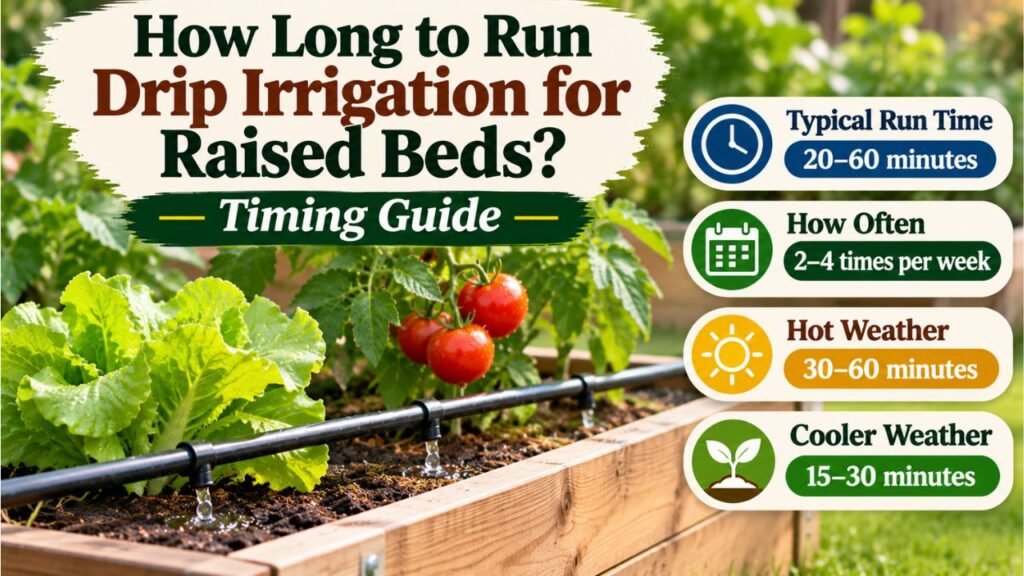
The best run time depends on how quickly your irrigation system delivers water and how much moisture the plants need.
For a typical home vegetable garden using closely spaced dripline, a starting session of 20–40 minutes may work well. However, that estimate is not appropriate for every system.
Some high-flow drip systems deliver water much faster, while low-flow drip tape may require considerably longer sessions.
General Drip Irrigation Timing Guide
| Irrigation System | Possible Starting Run Time | Important Consideration |
| High-flow, closely spaced dripline | 15–30 minutes | Water accumulates quickly |
| Medium-flow, closely spaced dripline | 20–45 minutes | Common starting range for small beds |
| Low-flow inline drip tubing | 45–120 minutes | Slower water delivery |
| Low-flow drip tape | 1–3 hours or more | Depends heavily on tape specifications |
| Individual point-source emitters | 20–90 minutes | Depends on emitters per plant |
| Soaker hose | 20–60 minutes or longer | Flow varies substantially by product |
These ranges are illustrative starting points, not prescribed schedules. Some systems will fall well outside them.
The Utah State University Extension vegetable irrigation guide demonstrates why flow rate matters: depending on emitter output and spacing, applying half an inch of water can take from around 19 minutes to more than three hours.
The actual time also depends on how much soil area the drip lines are expected to irrigate.
Why There Is No Single Correct Watering Time
Consider two raised beds with identical dimensions.
One uses 0.5-gallon-per-hour emitters spaced every 12 inches.
The other uses 1-gallon-per-hour emitters at the same spacing.
If both have the same number of emitters and receive the specified flow, the second system delivers twice as much water per hour.
Its required run time for the same water volume is approximately half as long.
That difference exists even though the beds contain identical plants.
Key Takeaway: Don’t select a drip irrigation schedule based only on bed dimensions. Emitter flow rate, number of emitters, soil conditions, and plant needs determine how long the system should operate.
How Much Water Do Raised Garden Beds Need Per Week?
Many established vegetables require approximately 1–2 inches of water per week.
However, actual requirements vary with climate, plant size, soil conditions, and crop development.
Young seedlings generally use less total water than mature fruiting plants, although their shallow roots may require more frequent attention.
What Does One Inch of Water Mean?
One inch of water means enough water to cover a surface with a layer 1 inch deep.
For every square foot of garden area, that equals approximately 0.623 gallons.
The conversion is:
1 inch of water = approximately 0.623 gallons per square foot
This allows you to estimate the total water volume required for a raised bed.
Water Needed for Common Raised Bed Sizes
| Raised Bed Size | Surface Area | Water for 1 Inch | Water for 2 Inches |
| 2×4 ft | 8 sq. ft. | 5.0 gallons | 10.0 gallons |
| 2×8 ft | 16 sq. ft. | 10.0 gallons | 19.9 gallons |
| 3×6 ft | 18 sq. ft. | 11.2 gallons | 22.4 gallons |
| 3×8 ft | 24 sq. ft. | 15.0 gallons | 29.9 gallons |
| 4×4 ft | 16 sq. ft. | 10.0 gallons | 19.9 gallons |
| 4×8 ft | 32 sq. ft. | 19.9 gallons | 39.9 gallons |
| 4×10 ft | 40 sq. ft. | 24.9 gallons | 49.9 gallons |
| 4×12 ft | 48 sq. ft. | 29.9 gallons | 59.8 gallons |
These numbers represent equivalent water depths over the entire bed surface.
They don’t mean every bed must receive exactly that volume through its drip system each week.
Rainfall, soil moisture already present, the actual wetted area, and the crop’s root zone all affect how much supplemental irrigation is necessary.
Is One Inch Per Week Enough?
It can be enough during moderate weather for many established vegetables.
However, crops may need more water during:
- Extended hot weather
- Strong winds
- Fruiting and flowering periods
- Dry conditions
- Rapid vegetative growth
- Periods with little rainfall
Some crops also have distinct watering requirements.
For example, cucumbers and squash may need more consistent moisture during active fruit production.
A weekly target should be adjusted based on the plants and actual soil conditions.
How to Calculate Drip Irrigation Run Time for Raised Beds
The most reliable starting calculation uses the water volume you want to apply and the total flow rate of the irrigation system.
You don’t need specialized software to make this estimate.
Step 1: Measure the Raised Bed Area
Multiply the bed length by its width.
Bed area = Length × Width
For a 4×8-foot raised bed:
4 × 8 = 32 square feet
Step 2: Calculate the Target Water Volume
Multiply the bed area by 0.623 and the desired water depth in inches.
Water needed (gallons) = Bed area (sq. ft.) × 0.623 × Water depth (inches)
For one inch of water:
32 × 0.623 × 1 = 19.94 gallons
This is the estimated amount of water needed to apply the equivalent of one inch across the bed.
Step 3: Count the Drip Emitters
Determine how many emitters deliver water to the bed.
Suppose the bed contains four 8-foot drip lines.
Each line has approximately eight emitters spaced 12 inches apart.
The total is:
4 × 8 = 32 emitters
Check the actual number of emitting outlets rather than relying solely on estimated spacing.
Step 4: Find the Flow Rate of Each Emitter
Emitter flow is commonly expressed in gallons per hour (GPH).
Examples include:
- 0.5 GPH
- 0.6 GPH
- 0.9 GPH
- 1.0 GPH
- 2.0 GPH
For this example, assume the emitters deliver 0.5 GPH each at the system’s operating pressure.
Step 5: Calculate Total System Flow
Use this formula:
Total flow (GPH) = Number of emitters × Flow per emitter (GPH)
For 32 emitters rated at 0.5 GPH:
32 × 0.5 = 16 gallons per hour
Step 6: Calculate the Required Run Time
Divide the required water volume by the total hourly flow.
Then multiply by 60 to convert hours into minutes.
Run time (minutes) = Water needed (gallons) ÷ Total flow (GPH) × 60
For the 4×8 raised bed:
19.94 ÷ 16 × 60 = approximately 75 minutes
That is the estimated total run time required to deliver the equivalent of one inch of water.
Step 7: Divide the Time Across the Week
You don’t need to apply the entire week’s water in one session.
If the bed needs one inch per week and you’re watering three times:
75 ÷ 3 = 25 minutes per session
A sample schedule would be:
- Monday: 25 minutes
- Wednesday: 25 minutes
- Saturday: 25 minutes
This schedule assumes no meaningful rainfall, a uniform distribution of water, and established plants whose soil can hold the applied moisture.
Check the actual soil before repeating the schedule.
Drip Irrigation Run Time Formula
For quick reference:
Run time (minutes) = (Bed area × 0.623 × Target water depth ÷ Total emitter GPH) × 60
This calculation estimates the amount of water delivered.
It doesn’t guarantee that water reaches all roots evenly or that the soil can retain the entire application.
If the emitters only wet a small part of the bed, the calculated whole-bed water depth may not describe the actual root-zone distribution.
Key Takeaway: Calculate total gallons from bed area and target water depth, then divide by total emitter flow. Confirm the result by checking how deeply and evenly the soil becomes moist.
Drip Irrigation Run Time for a 4×8 Raised Bed
A 4×8 raised bed is a common home gardening size.
Its 32-square-foot surface provides a convenient example for comparing emitter flow rates.
Example Dripline Setup
Assume the bed contains:
- Four parallel drip lines
- Eight feet of tubing per line
- Twelve-inch emitter spacing
- Thirty-two functioning emitters total
- Correct system pressure
- Approximately uniform water delivery
The weekly target is one inch of water, equivalent to approximately 19.9 gallons.
How Flow Rate Changes Watering Time
| Emitter Flow | Number of Emitters | Total Flow | Time for 1 Inch |
| 0.25 GPH | 32 | 8 GPH | 150 minutes |
| 0.5 GPH | 32 | 16 GPH | 75 minutes |
| 0.6 GPH | 32 | 19.2 GPH | 62 minutes |
| 0.9 GPH | 32 | 28.8 GPH | 42 minutes |
| 1.0 GPH | 32 | 32 GPH | 37 minutes |
These calculations assume the emitters deliver their rated flow.
Actual delivery may differ if pressure is incorrect, emitters are clogged, or the tubing is poorly designed.
Example Weekly Schedules
For the 0.5-GPH system with 32 emitters:
| Weekly Target | Total Weekly Runtime | Runtime for 3 Sessions |
| 0.5 inch | 37 minutes | About 12–13 minutes each |
| 1 inch | 75 minutes | 25 minutes each |
| 1.5 inches | 112 minutes | About 37 minutes each |
| 2 inches | 150 minutes | 50 minutes each |
These times illustrate how the same equipment can be adjusted as plant water demand changes.
If the soil becomes waterlogged, shorten the sessions or increase the interval between them.
If the root zone dries too quickly, you may need to apply more water or irrigate more frequently.
How Often Should You Run Drip Irrigation in Raised Beds?
Frequency is as important as run time.
For established vegetables in typical conditions, watering two to four times per week may be an appropriate starting point.
However, sandy growing media, hot weather, and young seedlings may require more frequent irrigation.
Should You Run Drip Irrigation Every Day?
Not necessarily.
Daily irrigation can be appropriate in some situations, especially when:
- The soil drains very quickly.
- Temperatures are extremely high.
- Plants are establishing.
- The bed contains shallow-rooted vegetables.
- The bed has limited water-holding capacity.
However, running the system every day when the soil is already moist can lead to overwatering.
A timer should respond to the plants’ needs rather than operate without adjustment throughout the season.
Is Watering Every Other Day Better?
Every-other-day watering can work for many raised beds.
It provides time for moisture to move through the soil between sessions.
However, whether it’s appropriate depends on the soil’s water-holding capacity and the plant’s rooting depth.
Sandy soil may need more frequent, shorter applications.
Loamy soil may hold moisture long enough for longer intervals.
Can You Water Twice Per Week?
Yes, in some established raised beds.
Deep-rooted plants growing in moisture-retentive soil may do well with two suitable irrigation sessions per week.
However, a shallow raised bed filled with fast-draining mix may dry too quickly between sessions.
Check soil moisture rather than relying on a fixed calendar.
General Starting Frequency by Conditions
| Growing Condition | Possible Starting Frequency |
| Newly planted seeds | Keep seed zone consistently moist; check daily |
| Young seedlings | Shorter, more frequent watering as needed |
| Established plants in loam | 2–4 times weekly |
| Sandy raised-bed soil | Often 3–7 times weekly |
| Moisture-retentive soil | Often 1–3 times weekly |
| Very hot, dry weather | More frequent checks and possible irrigation |
| Cool, rainy weather | Reduce or skip irrigation |
These are broad starting points.
Actual frequency should be determined by observing the soil moisture and plant condition.
How Long to Run Drip Irrigation Based on Soil Type
Soil texture affects how quickly water moves and how long it remains available to plant roots.
Raised beds often contain mixtures of topsoil, compost, and other organic materials.
Their behavior may differ from the native soil beneath them.
Sandy Raised Bed Soil
Sandy soil drains relatively quickly and generally stores less plant-available water than loam.
It often benefits from shorter, more frequent watering.
For example, a gardener might divide the week’s calculated water into four or five sessions rather than two.
However, the exact number of minutes still depends on emitter flow.
Running low-flow drip tape for only ten minutes may be insufficient even in sandy soil.
Loamy Raised Bed Soil
Loam generally provides a balance of drainage and water retention.
It may support somewhat longer intervals between watering sessions.
For many established vegetable beds, two or three appropriately sized applications per week can be a useful starting schedule.
Check moisture several inches below the surface before making adjustments.
Clay-Rich Raised Bed Soil
Clay-rich soils often retain water longer and allow water to infiltrate more slowly.
Overwatering can lead to poor aeration around roots.
Use appropriately controlled drip delivery.
Avoid adding water faster than the soil can absorb it.
Clay-rich soil may benefit from fewer irrigation events, but each application still needs to deliver water through the active root zone without causing prolonged saturation.
Compost-Rich Raised Bed Mix
Compost can improve water-holding capacity, but its effect depends on the amount and the other ingredients in the mix.
A raised bed containing compost, topsoil, and other materials may behave differently from one filled primarily with lightweight potting mix.
Don’t assume that all commercial raised-bed mixes have identical watering requirements.
Observe how quickly the specific mix dries.
Key Takeaway: Sandy soil often needs more frequent irrigation, while loamy and clay-rich soils may hold moisture longer. Determine run time from emitter flow and adjust frequency based on moisture retention.
How Long to Run Drip Irrigation for Different Raised Bed Vegetables
Different vegetables have different root systems and growth patterns.
Their water needs also change as they mature.
The same timer setting may not be appropriate for a new lettuce planting and mature fruiting tomatoes.
Tomatoes
Tomatoes benefit from reasonably consistent soil moisture, especially during flowering and fruit development.
Large fluctuations between very dry and excessively wet soil can contribute to plant stress.
Established tomatoes usually have deeper roots than seedlings.
A properly arranged drip system can support gradual wetting of the root zone.
Rather than choosing a fixed number of minutes, calculate water delivery and confirm that moisture reaches the active roots.
Peppers
Peppers generally need consistent moisture during active growth.
Severe drying can reduce growth and affect flowering.
Avoid keeping the soil continuously saturated.
Use the same basic water-volume calculation, then adjust for plant size and weather.
Cucumbers
Cucumbers can use considerable water during active fruiting.
Inadequate or inconsistent watering may affect fruit development and quality.
During hot weather, check moisture more frequently.
A mature cucumber planting may require more weekly water than a newly planted bed.
Lettuce and Leafy Greens
Many leafy greens have relatively shallow active root systems.
They benefit from even moisture near the soil surface.
Shorter, more frequent irrigation may work well, especially in fast-draining media.
However, avoid leaving the root zone continuously waterlogged.
Carrots and Radishes
Root vegetables benefit from consistent moisture during germination and early root development.
Dry soil can interfere with seed germination.
Once established, avoid severe fluctuations in moisture.
The drip lines should be arranged so water reaches the planted rows rather than only isolated points.
Squash and Zucchini
Squash plants become relatively large and may use more water as their leaves and fruits develop.
A small number of emitters near the stem may not wet enough of the expanding root zone.
Adjust emitter placement and total water delivery as the plants mature.
Herbs
Herbs have different moisture requirements.
For example, basil generally benefits from regular moisture, while established rosemary and thyme prefer better-drained conditions and may tolerate drier soil.
Don’t automatically place herbs with very different water needs on one irrigation zone.
Watering Needs by Crop
| Crop | Main Watering Consideration |
| Tomatoes | Consistent moisture during flowering and fruiting |
| Peppers | Avoid severe dry-wet fluctuations |
| Cucumbers | Greater water demand during fruit production |
| Lettuce | Even moisture in the relatively shallow root zone |
| Carrots | Consistent moisture during germination and root development |
| Radishes | Avoid repeated drying during rapid growth |
| Squash | Expand watering coverage as plants grow |
| Basil | Regular moisture without waterlogging |
| Rosemary | Well-drained soil and less frequent watering once established |
Crop names alone don’t determine irrigation minutes.
The equipment’s actual water delivery remains essential.
How Deep Should Drip Irrigation Water Raised Beds?
The goal is to moisten the active root zone without allowing excessive water to drain below it.
For many established garden vegetables, checking moisture around 6–8 inches deep is a practical starting point.
Some larger or deeper-rooted crops may benefit from moisture extending farther down.
New seeds and small seedlings need attention closer to the surface.
Check Moisture at Different Depths
After running the drip system:
- Wait briefly for water to move through the soil.
- Use a small trowel or soil probe.
- Check moisture near an emitter.
- Check midway between drip lines.
- Examine soil about 6–8 inches deep for established crops.
- Check whether the active root zone is evenly moist.
The soil should generally feel moist rather than saturated.
Why the Surface Can Be Misleading
Drip irrigation delivers water to specific locations.
The surface between emitters may appear dry even when soil below is moist.
Conversely, the area directly beneath an emitter may look wet while deeper roots remain dry.
Check below the surface instead of judging by appearance alone.
What If the Water Only Reaches Two Inches Deep?
The irrigation session may be too short, the flow may be too low, or the soil may already be unusually dry.
Run the system longer and check again.
Also inspect whether the drip lines cover the planted areas.
A longer run time won’t automatically solve poor tubing placement.
What If Water Drains Out of the Bottom of the Bed?
Some drainage is normal after irrigation, especially in raised beds with open bottoms.
However, continuous excessive drainage may indicate that too much water is being applied.
Reduce the run time, split the application into shorter cycles, or adjust watering frequency.
Avoid repeatedly saturating soil when the plants don’t need additional moisture.
How to Test Your Drip Irrigation Run Time Without Calculating Everything
You can calibrate the timer by checking soil moisture directly.
This is especially useful when you don’t know the exact emitter flow rate.
The Colorado State University Extension guide to vegetable garden irrigation recommends determining drip irrigation run time by examining soil moisture because timing varies with the hose, pressure, and emitter spacing.
Step 1: Start With a Short Test
For an ordinary home dripline system, begin with a test run of approximately 20 minutes.
This is a diagnostic starting point, not a promise that the bed will receive enough water.
For known low-flow tape, you may need a longer test interval.
Step 2: Let the Water Soak Into the Soil
After the system stops, allow moisture to redistribute.
The necessary waiting time depends on soil texture.
Avoid judging the results immediately at the wet surface.
Step 3: Dig a Small Inspection Hole
Use a trowel to inspect soil near the root zone.
Check below the surface and between emitters.
Look for moisture extending to the depth needed by the crop.
Step 4: Adjust the Timer
If the soil remains dry below the surface, increase the run time.
If the soil becomes excessively wet, shorten the next session.
Make changes gradually.
Step 5: Repeat in Different Parts of the Bed
Check near:
- The beginning of the drip lines
- The middle of the bed
- The ends of the lines
- Areas farthest from individual emitters
This can reveal uneven water delivery.
Step 6: Monitor the Bed for Several Days
After choosing an initial schedule, check whether the soil retains moisture between irrigation events.
A single successful watering doesn’t prove that the weekly schedule is correct.
Adjust as the plants grow and weather changes.
Key Takeaway: A soil-moisture test is one of the best ways to verify a calculated run time. Check both the wetting depth and the areas between drip lines.
How Does Emitter Flow Rate Affect Drip Irrigation Time?
Emitter flow rate describes how much water an outlet delivers per hour under specified conditions.
A 0.5-GPH emitter delivers half a gallon per hour when operating at its rated flow.
A 1.0-GPH emitter delivers one gallon per hour.
However, the actual delivery depends on pressure and emitter design.
Comparing Two Individual Emitters
| Emitter Rating | Water in 15 Minutes | Water in 30 Minutes | Water in 60 Minutes |
| 0.5 GPH | 0.125 gallon | 0.25 gallon | 0.5 gallon |
| 1.0 GPH | 0.25 gallon | 0.5 gallon | 1.0 gallon |
| 2.0 GPH | 0.5 gallon | 1.0 gallon | 2.0 gallons |
These figures assume constant rated flow.
How Many Emitters Should Each Plant Have?
The number depends on the crop, soil, emitter flow rate, and wetting pattern.
A mature tomato may benefit from multiple appropriately placed emitters.
Closely planted vegetables may work better with continuous inline drip tubing.
The goal is not simply to maximize emitter count.
It is to distribute enough water across the active root zone.
Is Higher GPH Always Better?
No.
High-flow emitters deliver water faster, but they don’t automatically provide more uniform root-zone moisture.
In slowly absorbing soil, rapid point-source delivery may cause pooling or water movement away from the intended area.
In sandy soil, high flow concentrated in one location may lead to deeper drainage before water spreads laterally.
Choose emitters appropriate for the soil and crop layout.
How Many Drip Lines Does a Raised Bed Need?
Drip line spacing affects both watering coverage and total flow.
A raised bed containing only one line may receive insufficient moisture near its edges, especially when vegetables are planted across the entire width.
Two-Foot-Wide Raised Bed
For a 2-foot-wide bed, two parallel dripline runs can provide useful coverage for many plant layouts.
For plants arranged in one narrow row, a different emitter arrangement may be sufficient.
Three-Foot-Wide Raised Bed
A 3-foot-wide bed may use two or three dripline runs.
The best layout depends on the soil and plant spacing.
Sandy mixes may require closer emitters or drip lines because water often spreads less laterally.
Four-Foot-Wide Raised Bed
For many closely planted vegetables, four dripline runs spaced approximately 12 inches apart provide a useful starting layout.
This helps distribute water across the bed rather than concentrating it in the center.
However, larger crops planted in fewer rows may need a different arrangement.
Why Line Spacing Changes Run Time
Suppose a 4×8 bed uses four lines with 0.5-GPH emitters every 12 inches.
That’s approximately 32 emitters delivering 16 gallons per hour.
If the bed uses only two lines with the same emitter spacing, its total flow drops to approximately 8 gallons per hour.
The run time to deliver the same total volume would double.
But the soil might also receive water less evenly because the drip lines are farther apart.
Adding more run time doesn’t always compensate for inadequate line spacing.
Should You Run Drip Irrigation Every Day in Summer?
Summer irrigation depends on heat, rainfall, wind, plant size, and soil moisture.
A raised bed that needs water every day during an intense heat wave may need only two or three sessions per week under milder conditions.
During Normal Summer Weather
Start with a schedule based on your calculated weekly target.
For example, a bed requiring one inch per week might receive that amount across three sessions.
Check soil moisture between sessions.
During Hot, Dry Weather
Plants may use more water through transpiration.
Soil also loses moisture through evaporation.
Increase the weekly water target if the plants and soil conditions indicate a need.
You can increase irrigation by:
- Adding another weekly session
- Extending individual sessions
- Dividing water into more frequent applications
Avoid suddenly doubling run time without checking the root zone.
During Heat Waves
In fast-draining raised beds, daily irrigation may become necessary.
However, deep, moisture-retentive beds may not require daily watering.
Check soil moisture and plant condition each day during extreme heat.
Remember that temporary afternoon wilting can also result from high evaporative demand even when soil moisture is adequate.
Don’t respond automatically with more water without checking the soil.
During Cool Weather
Plants generally use less water in cooler conditions.
Reduce the timer setting or skip sessions when the soil remains moist.
A fixed midsummer schedule may overwater a garden in spring or fall.
What Time of Day Should You Run Drip Irrigation?
Early morning is generally a convenient time for raised-bed drip irrigation.
It allows water to enter the root zone before the day’s hottest conditions.
Morning Irrigation
A morning schedule can help maintain consistent moisture before rising temperatures increase plant water use.
For example, you might schedule irrigation between 5:00 AM and 9:00 AM.
The specific time depends on your household water use, local conditions, and the garden’s needs.
Afternoon Irrigation
Drip irrigation can still be effective during the afternoon because it delivers water near the soil instead of spraying it overhead.
However, surface evaporation may be greater during hot, dry conditions.
If plants are suffering from serious water stress, don’t delay necessary irrigation merely to reach an ideal time of day.
Evening Irrigation
Evening drip irrigation is possible.
Because drip systems usually keep most foliage dry, they avoid some of the leaf-wetting concerns associated with overhead sprinklers.
However, consistently saturated soil overnight can still create problems.
Use appropriate amounts and avoid overwatering.
Is Morning Always Better?
Morning is a useful default, not an absolute rule.
The most important factors are delivering enough water to the roots and maintaining suitable soil moisture.
How to Adjust Drip Irrigation After Rain
Rainfall can reduce the need for supplemental irrigation.
However, not every rainfall event wets the raised bed evenly or deeply.
Subtract Useful Rainfall From the Weekly Target
Suppose your garden needs one inch of water during the week.
If it receives 0.4 inch of effective rainfall, the remaining nominal irrigation requirement is:
1.0 − 0.4 = 0.6 inch
For a 4×8 bed:
32 × 0.623 × 0.6 = approximately 12 gallons
You can use your system’s total flow rate to calculate how much irrigation time this represents.
Example Rainfall Adjustment
For the 16-GPH drip system:
12 ÷ 16 × 60 = approximately 45 minutes
Instead of running the system for 75 minutes across the week, you might need around 45 minutes.
However, this assumes the rainfall effectively reached the soil and the root zone still needs the remaining amount.
Always check soil moisture.
When Rainfall Doesn’t Count Fully
Not all rain reaches the intended growing media.
For example, a covered raised bed may receive little or no direct rainfall.
Dense foliage may intercept some rainfall, while a plastic mulch barrier may prevent it from entering the soil.
A raised bed under a roof overhang may also remain relatively dry during light rain.
Don’t subtract rainfall automatically when the growing media didn’t receive it.
Can a Rain Sensor Help?
Yes.
A compatible rain sensor or weather-aware irrigation controller may prevent unnecessary watering after rainfall.
However, sensors require suitable placement and calibration.
A sensor can supplement regular soil checks but shouldn’t be treated as perfectly accurate under every condition.
How to Set a Drip Irrigation Timer for Raised Beds
A timer makes watering more consistent.
However, the initial program should be based on actual water delivery rather than an arbitrary daily schedule.
Step 1: Group Beds With Similar Water Needs
Whenever practical, place crops with similar watering requirements on the same irrigation zone.
For example, established fruiting vegetables may need a different schedule from drought-tolerant herbs.
Avoid connecting beds with very different requirements to one fixed schedule if you cannot adjust their flow separately.
Step 2: Calculate the Weekly Water Target
Estimate the appropriate weekly water requirement using crop needs, season, and rainfall.
Use 1–2 inches per week as a broad reference for many established vegetables, then adjust to local conditions.
Step 3: Determine Total Emitter Flow
Count emitters and multiply by their rated GPH.
Alternatively, use the manufacturer’s total flow specification for the complete dripline or tape.
Step 4: Calculate Weekly Run Time
Divide the weekly target water volume by total system flow.
Convert the result to minutes.
Step 5: Select a Starting Frequency
For established vegetables in a moderate climate, two or three weekly applications may be a suitable starting point.
Fast-draining soil may require more frequent sessions.
Step 6: Program the Timer
For example, a 4×8 bed with the earlier 0.5-GPH dripline setup could begin with:
- Monday at 6:00 AM: 25 minutes
- Wednesday at 6:00 AM: 25 minutes
- Saturday at 6:00 AM: 25 minutes
This applies approximately one inch of water during the week under the stated assumptions.
Step 7: Check Moisture and Adjust
Inspect the soil between sessions.
If the bed remains too wet, reduce the amount or frequency.
If it dries excessively, adjust the schedule.
Repeat the evaluation after significant weather changes.
Key Takeaway: A timer should automate a tested watering schedule, not replace observation. Recheck the schedule as plants grow and seasons change.
Signs Your Raised Beds Need More Drip Irrigation
Plants and soil provide clues when irrigation is insufficient.
However, no single symptom proves that a bed needs more water.
Dry Soil Several Inches Down
If the soil is dry within the active root zone before the next planned irrigation, the schedule may be insufficient.
Inspect multiple locations.
A single dry spot may indicate an emitter coverage problem rather than a shortage of total water.
Plants Wilting Repeatedly
Repeated wilting during cooler morning conditions may indicate water stress.
However, wilting can also occur from root damage, disease, or waterlogged soil.
Check moisture before increasing irrigation.
Slow Growth
Water stress can slow plant growth.
But poor nutrition, compacted soil, heat, and other problems can produce similar effects.
Look for supporting evidence in the soil.
Uneven Moisture Across the Bed
If one part of the bed is moist and another remains dry, the problem may be uneven drip delivery.
Inspect the tubing and emitters.
Increasing the timer for the whole bed could overwater already-wet areas.
Signs You’re Running Drip Irrigation Too Long
More water doesn’t always produce healthier plants.
Excessive irrigation can displace air from soil pores and contribute to root problems.
Soil Remains Constantly Saturated
If the root zone stays wet and poorly aerated, the schedule may be excessive.
Reduce irrigation and check whether the bed drains properly.
Water Pools Around Emitters
Pooling may indicate that water is being delivered faster than the soil can absorb it.
Consider reducing emitter flow, shortening the session, or splitting irrigation into multiple cycles.
Water Continuously Drains Below the Bed
Excessive drainage can carry nutrients out of the root zone.
Some drainage is normal, but repeated large losses suggest that the system may be applying more water than needed.
Yellow Leaves
Overwatering can contribute to yellowing leaves.
However, yellow leaves may also result from nutrient deficiency, disease, or other stress.
Examine the soil and root conditions before assuming irrigation is the cause.
Weak Root Growth
Roots need both moisture and oxygen.
Prolonged saturation can reduce soil aeration and contribute to unhealthy roots.
Aim for consistently suitable moisture rather than permanently wet soil.
Common Drip Irrigation Mistakes in Raised Beds
Several setup and scheduling mistakes can cause problems even when the timer appears correct.
Running Every Bed for the Same Number of Minutes
Different beds may contain different soil mixes, crops, or emitters.
A 4×8 bed with 0.5-GPH emitters shouldn’t automatically use the same schedule as one with 1-GPH emitters.
Calculate each zone separately.
Ignoring Emitter Flow Rate
The number printed on the timer doesn’t indicate how much water the garden receives.
A 30-minute run can deliver very different volumes depending on the equipment.
Check the flow specifications.
Using Too Few Drip Lines
Widely spaced drip lines may leave parts of a raised bed dry.
Arrange irrigation to cover the intended root zones.
For closely planted vegetables, multiple parallel lines are often useful.
Ignoring Water Pressure
Drip emitters are designed to operate within specified pressure ranges.
Excessive pressure can cause leaks or disconnections.
Insufficient pressure may reduce flow.
Use the filter and pressure regulator appropriate for the system.
Don’t assume all drip tape and dripline products use the same pressure.
Letting Emitters Become Clogged
Small emitters may clog from particles, algae, mineral deposits, or other contaminants.
Clean filters and flush tubing according to the manufacturer’s instructions.
Inspect the flow periodically.
Watering Only the Soil Surface
A brief drip session may moisten the top layer without reaching deeper roots.
Check the wetting depth after irrigation.
Setting the Timer Once for the Entire Season
Water demand changes as plants mature and temperatures rise.
Review the schedule regularly.
Ignoring Rainfall
Running the normal schedule after meaningful rainfall can result in excessive watering.
Check whether the soil received enough rain and adjust accordingly.
Forgetting to Check Between Emitters
Water spreads outward and downward from drip outlets, but the wetting pattern depends on soil texture.
A bed can look wet near the emitter while remaining dry between lines.
Check several locations.
How to Improve Drip Irrigation Efficiency in Raised Beds
Efficient drip irrigation depends on both equipment and garden management.
Use Mulch
An appropriate organic mulch can reduce soil-surface evaporation.
For established vegetables, a layer of straw or another suitable mulch may help maintain more stable moisture.
Keep mulch placement appropriate for the crop and avoid burying plant stems.
Use Pressure-Compensating Emitters When Suitable
Pressure-compensating emitters are designed to maintain more consistent flow within their specified operating pressure range.
They can help improve uniformity in suitable systems.
However, they aren’t a substitute for correct filtration, pressure regulation, or system layout.
Separate Different Watering Zones
A bed containing lettuce may need a different schedule from one containing established rosemary.
Separate zones provide greater control.
If individual zones aren’t practical, suitable flow-control valves may help manage different areas.
Maintain the Drip Filter
A clogged filter can reduce flow throughout the system.
Inspect and clean it according to the manufacturer’s instructions.
Check Tubing for Leaks
Leaks can waste water and reduce delivery farther down the line.
Inspect connections, end caps, and tubing periodically.
Adjust for Seasonal Changes
Use shorter or less frequent schedules when plants are small or weather is cool.
Increase irrigation when crop demand rises.
Continue checking soil moisture rather than relying exclusively on the timer.
Sample Drip Irrigation Schedule for a 4×8 Raised Garden Bed
The following example shows how one raised bed’s watering schedule might change through the growing season.
Assumed setup:
- Bed size: 4×8 feet
- Four parallel drip lines
- 32 emitters
- Emitter rate: 0.5 GPH
- Total flow: 16 GPH
- No effective rainfall during the sample week
Example Seasonal Schedule
| Growing Condition | Illustrative Weekly Target | Watering Frequency | Approximate Time Per Session |
| Early growth, modest demand | 0.5 inch | 3 times | 12–13 minutes |
| Established crops, moderate weather | 1 inch | 3 times | 25 minutes |
| Active growth, warm weather | 1.5 inches | 3 times | 37–38 minutes |
| High demand, hot dry conditions | 2 inches | 4 times | 37–38 minutes |
These are mathematically derived examples, not prescriptions for all raised beds.
Very young seedlings may require more frequent moisture at the soil surface even when their total weekly water use is low.
Mature crops may need a deeper wetting pattern and schedule adjustments.
If meaningful rain falls, reduce or skip irrigation accordingly.
Check actual soil moisture before adopting any sample program.
Conclusion
How long to run drip irrigation for raised beds depends mainly on emitter flow rate, irrigation layout, soil conditions, and plant water requirements.
For a common home raised-bed dripline setup, 20–40 minutes per watering may be a reasonable starting point, but low-flow systems can require much longer.
Many established vegetables need approximately 1–2 inches of water per week, although rainfall and seasonal conditions change the amount required from irrigation.
For example, a 4×8 raised bed with 32 emitters rated at 0.5 GPH needs approximately 75 minutes of total operation to apply the equivalent of one inch of water. Dividing that amount into three sessions gives approximately 25 minutes per watering.
The most reliable approach is to calculate the system’s water delivery, then confirm the results by checking soil moisture several inches below the surface.
Adjust for sandy or moisture-retentive soil, plant growth, rainfall, and hot weather.
A well-calibrated drip irrigation schedule should keep the root zone adequately moist without repeatedly saturating the soil or wasting water below the bed.
FAQs About How Long to Run Drip Irrigation for Raised Beds
Is 30 Minutes of Drip Irrigation Enough for Raised Beds?
It may be enough for some systems, but not all.
A 30-minute run with 1-GPH emitters delivers twice as much water as the same run with 0.5-GPH emitters when the emitter counts are equal.
Check the actual flow rate and soil moisture depth before deciding whether 30 minutes is sufficient.
Should I Run Drip Irrigation Every Day in Raised Beds?
Not necessarily.
Established vegetables in moisture-retentive soil may need only two or three irrigation sessions per week.
Sandy mixes, shallow-rooted seedlings, and very hot weather may require more frequent irrigation.
Water according to soil moisture rather than a fixed daily rule.
How Long Should Drip Irrigation Run for a 4×8 Raised Bed?
For a 4×8 bed containing 32 emitters rated at 0.5 GPH, approximately 75 minutes of total irrigation delivers the equivalent of one inch of water under idealized assumptions.
Split that total across the week as appropriate for the crops and soil.
Other emitter configurations require different run times.
How Many Gallons of Water Does a 4×8 Raised Bed Need?
A 4×8 bed covers 32 square feet.
One inch of water across that area equals approximately 19.9 gallons.
Two inches equals approximately 39.9 gallons.
These are water-depth equivalents, not fixed irrigation requirements. Rainfall, soil moisture, and crop needs determine the supplemental amount.
Is It Better to Drip Water in the Morning or Evening?
Early morning is generally a convenient choice because it replenishes soil moisture before the hottest part of the day.
Evening drip irrigation can also work because it primarily wets soil rather than foliage.
The most important consideration is applying an appropriate amount of water without prolonged saturation.
How Deep Should Drip Irrigation Water Raised Beds?
For many established vegetables, inspect moisture at approximately 6–8 inches deep, and deeper where the active root zone requires it.
New seeds and small seedlings need consistent moisture closer to the surface.
Avoid assuming that wet soil directly beneath an emitter means the entire root zone has been watered adequately.
Does Drip Irrigation Use Less Water Than Hand Watering?
It can.
Drip irrigation delivers water near plant roots and can reduce losses from overspray and unnecessary wetting of paths.
However, a poorly designed or excessively long drip schedule can still waste water.
Efficient operation depends on correct layout, flow control, and irrigation timing.
Can You Overwater Raised Beds With Drip Irrigation?
Yes.
Although drip irrigation delivers water gradually, running it too frequently or too long can saturate the root zone.
Excess water may drain below the bed and carry nutrients away.
Check soil moisture and adjust the timer when necessary.

I’m Maya L. Greenwood, a lifelong plant lover who believes anyone can grow something beautiful with the right guidance. After years of testing soil mixes, pruning methods, irrigation tricks, and pest-safe solutions, I started EasyGardenTips.com to turn hard-won lessons into step-by-step advice. From seed starting and container gardens to composting and seasonal checklists, my goal is to make gardening simple, sustainable, and fun.