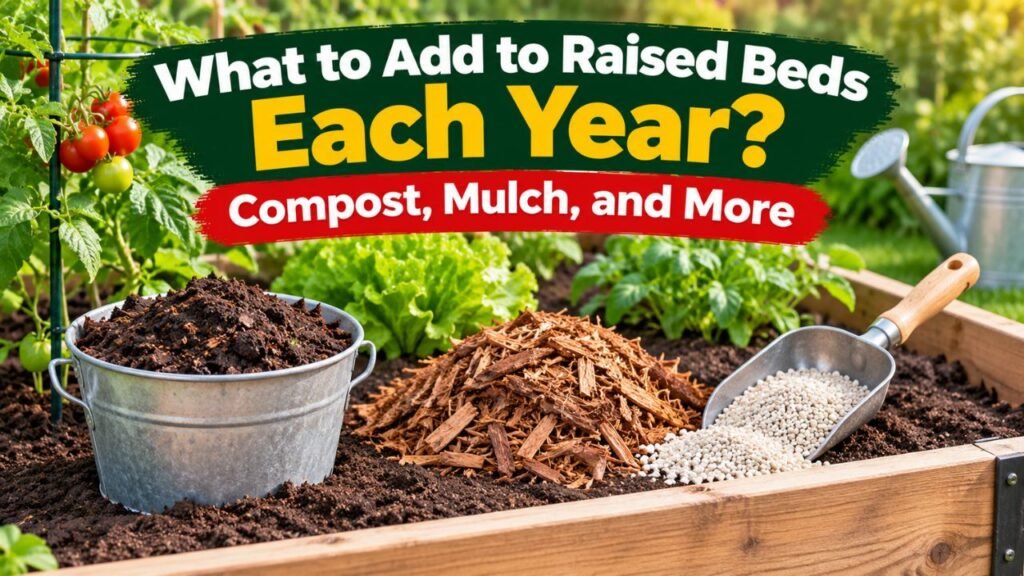
What to Add to Raised Beds Each Year: Compost, Mulch, and More
The most useful things to add to raised garden beds each year are finished compost and organic mulch, with fertilizer or replacement soil added only when needed. For an established vegetable bed, a layer of approximately ¼–1 inch of mature compost is a practical annual starting point, while 2–3 inches of suitable organic mulch can help retain moisture and protect the soil.
Raised garden beds gradually change as plants absorb nutrients, organic matter decomposes, and the soil mixture settles. Without proper maintenance, the growing medium may lose some of its structure, become compacted, or develop nutrient imbalances.
However, adding more fertilizer, manure, or compost every year isn’t automatically beneficial. Too much of certain amendments can increase soluble salts or create excessive phosphorus levels. A balanced maintenance routine should account for soil condition, crop requirements, and previous amendments.
The good news is that most established raised beds don’t need to be emptied or completely refilled each season.
In this article, I explain what to add to raised beds each year, including compost, mulch, topsoil, organic matter, and fertilizer. You’ll learn how much to use, when to apply each material, how to refresh soil in spring and fall, and which common amendments should be avoided unless a soil test shows they’re necessary.
What to Add to Raised Beds Each Year: Quick Reference
The following table summarizes common raised-bed soil additions and their purposes.
| Material | Typical annual use | Main benefit |
| Finished compost | About ¼–1 inch if needed | Replenishes organic matter and contributes nutrients |
| Organic mulch | Replenish to about 2–3 inches | Retains moisture and suppresses weeds |
| Raised-bed soil mix | Add only when the growing medium has settled significantly | Restores rooting volume |
| Balanced fertilizer | Only as needed for crops and soil fertility | Supplies plant nutrients |
| Nitrogen fertilizer | Based on crop demand and soil conditions | Supports leafy growth |
| Shredded leaves | Optional seasonal mulch | Protects soil and gradually adds organic matter |
| Leaf mold | Optional | Improves moisture retention and structure |
| Worm castings | Optional, in modest amounts | Adds organic matter and some nutrients |
| Cover crops | Optional between growing seasons | Protects soil and supports biological activity |
| Lime or sulfur | Only when a soil test indicates a need | Adjusts soil pH |
You don’t need to add every material listed.
For many established vegetable beds, compost, mulch, and occasional targeted fertilizer are enough.
Key Takeaway: The goal of annual raised-bed maintenance is to replace what the soil actually needs, not to add as many amendments as possible.
1. Add Finished Compost to Raised Beds Each Year
Finished compost is one of the most useful additions for maintaining raised-bed soil.
It contains decomposed organic materials that help support soil structure, moisture retention, and microbial activity.
Compost also supplies nutrients, although the amounts vary depending on its ingredients and maturity.
How Much Compost Should You Add Each Year?
For an established vegetable garden, ¼–1 inch of finished compost annually is a useful guideline.
The Oregon State University Extension guide to using compost recommends applying approximately ¼–1 inch of compost per year to existing vegetable beds.
A full inch isn’t automatically necessary for every bed.
Use smaller quantities when the soil already contains abundant organic matter or has high nutrient levels.
If a soil test identifies excessive phosphorus, additional compost may need to be limited, especially manure-based compost.
What Type of Compost Is Best?
Suitable options include:
- Finished homemade compost.
- Well-decomposed plant-based compost.
- Compost made from shredded leaves.
- Quality commercial compost intended for vegetable gardens.
Choose compost that is mature and stable.
Finished compost generally has a crumbly texture and an earthy smell.
It shouldn’t contain large amounts of recognizable fresh food waste.
Avoid using compost that is still heating actively or smells strongly of ammonia.
How to Add Compost to an Existing Raised Bed
Follow these steps:
- Remove weeds and unwanted plant debris.
- Move existing mulch aside.
- Spread the desired amount of finished compost over the soil.
- Distribute it evenly with a rake.
- Leave it on the surface for a no-dig approach, or gently incorporate it into the upper soil when appropriate.
- Replace the mulch after planting or soil preparation.
- Water as needed.
You generally don’t need to turn over the entire bed.
Keeping soil disturbance limited can help preserve existing structure and minimize the exposure of buried weed seeds.
Can You Add Too Much Compost?
Yes.
Compost is beneficial, but excessive applications can cause problems.
Depending on the compost source, these may include:
- Excess phosphorus.
- Elevated soluble salts.
- Nutrient imbalances.
- Excessively high organic matter.
- Changes in moisture behavior.
The University of Minnesota Extension cautions that repeated applications of manure-based compost can contribute excessive phosphorus.
Compost should be treated as a soil amendment and nutrient source, not an unlimited filler.
2. Replenish Organic Mulch Every Year
Mulch protects the soil surface from direct sunlight, heavy rain, and excessive evaporation.
It is especially useful in raised beds because their exposed sides can contribute to moisture loss.
Organic mulch gradually decomposes, so it often needs to be replenished.
Best Mulch Materials for Raised Beds
Common choices include:
- Clean, seed-free straw.
- Shredded dry leaves.
- Leaf mold.
- Partially decomposed plant-based mulch.
- Fine wood chips around suitable established plants.
- Untreated grass clippings applied in thin layers.
The best option depends on the crop, climate, and available materials.
For vegetable beds, clean straw and shredded leaves are often convenient.
How Much Mulch Should You Add?
A layer approximately 2–3 inches deep is a practical starting point for many vegetable beds.
However, the appropriate depth depends on the material.
Fine grass clippings should be applied in much thinner layers so they don’t form a dense, wet mat.
The Oregon State University Extension raised-bed gardening guide recommends protecting beds with approximately 2 inches of leaves or other organic material over winter.
When Should You Replace Mulch?
Replenish mulch when the existing layer has decomposed, washed away, or become too thin.
Common times include:
- After spring planting.
- During hot summer weather.
- After heavy rainfall.
- Following fall cleanup.
- Before winter in colder regions.
You don’t necessarily need to remove clean, partially decomposed organic mulch.
It can remain in place if it isn’t creating problems.
Keep Mulch Away From Plant Stems
Avoid piling thick mulch directly against plant stems or crowns.
Excess moisture around the base of plants can contribute to decay.
For small seedlings, leave enough open soil for light and emergence.
Key Takeaway: Organic mulch is one of the easiest yearly additions because it protects the soil while gradually contributing organic matter.
3. Add Raised-Bed Soil Mix if the Soil Level Has Dropped
Raised-bed soil often settles after installation.
Organic components gradually decompose, watering removes air pockets, and the growing medium becomes more compact.
Some settling is normal.
However, a substantial decrease in soil level may reduce the available rooting depth.
Should You Add More Soil Every Year?
Not necessarily.
Add soil when the bed has lost enough depth to affect plant growth or when the soil level is noticeably lower than intended.
A bed that has settled slightly may only need compost and mulch.
A bed that has lost several inches of growing medium may benefit from additional soil mix.
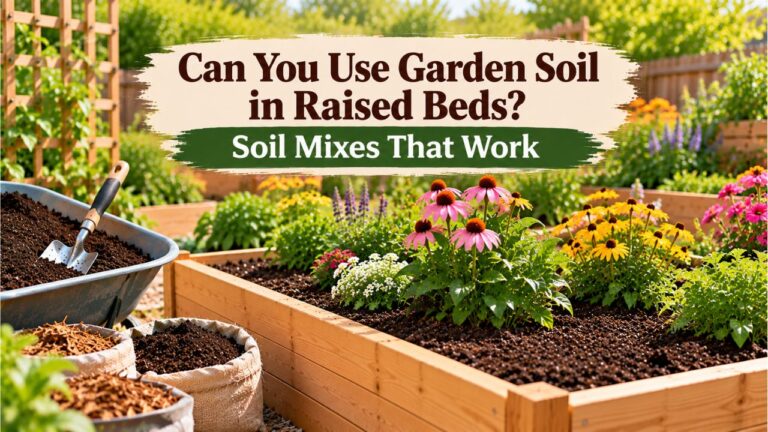
What Soil Should You Add?
Use a suitable raised-bed soil mixture that complements the existing growing medium.
For a traditional raised bed in contact with the ground, this may include quality screened topsoil and finished compost.
For a shallow elevated planter with a solid bottom, use a growing medium appropriate for container-style conditions.
Avoid filling a raised bed entirely with compost.
A balanced soil mixture generally provides more reliable structural support and moisture management than compost alone.
How to Top Off a Raised Bed
- Measure the depth of the missing growing medium.
- Remove weeds and large debris.
- Loosen a compacted surface gently if needed.
- Add the appropriate soil mixture.
- Blend only the immediate interface if necessary.
- Level the surface.
- Add compost or mulch as needed.
If plants are already growing, avoid burying their crowns or stems unless the crop tolerates additional soil around the stem.
Does Adding More Soil Replace Fertilizer?
No.
Additional soil restores growing volume, but it may not provide all the nutrients required for crops.
Fertility depends on the new soil’s composition and the existing nutrient levels.
Use soil-test recommendations to decide whether additional fertilizer is appropriate.
4. Add Fertilizer Only When Your Raised Beds Need Nutrients
Vegetables remove nutrients from the soil as they grow.
Some of those nutrients leave the garden when you harvest the crop.
Fertilizer can help replace nutrients when compost and the existing soil don’t provide enough.
However, applying fertilizer every year without assessing fertility can create imbalances.
What Fertilizer Should You Use?
The main fertilizer nutrients are:
- Nitrogen (N): Supports leafy growth and chlorophyll production.
- Phosphorus (P): Supports energy transfer, root development, and other plant processes.
- Potassium (K): Supports water regulation and various plant functions.
The appropriate fertilizer depends on the crop and soil condition.
A balanced fertilizer may be suitable when several nutrients are needed.
A nitrogen-focused fertilizer may be better when phosphorus and potassium are already sufficient.
Should You Add 10-10-10 Fertilizer Every Year?
Not automatically.
A 10-10-10 fertilizer contains equal percentages of nitrogen, phosphorus, and potassium by weight.
It can be useful under certain conditions.
However, repeatedly applying all three nutrients may be unnecessary when the soil already contains adequate phosphorus or potassium.
The University of Minnesota Extension’s soil testing guidance explains that excess phosphorus can accumulate in garden soils and recommends using test results to avoid unnecessary applications.
Which Vegetables May Need More Fertilizer?
Nutrient demand varies among crops.
| Vegetable category | Examples | General nutrient considerations |
| Leafy vegetables | Lettuce, kale, spinach | Nitrogen supports leafy growth |
| Fruiting vegetables | Tomatoes, peppers | Need balanced nutrition throughout growth |
| Heavy-feeding crops | Corn, cabbage, squash | May need additional nutrients during the season |
| Root crops | Carrots, beets, radishes | Excess nitrogen may favor leaves over roots |
| Legumes | Beans, peas | Often need less added nitrogen when effectively nodulated |
These are general tendencies.
Weather, plant development, soil fertility, and crop variety also affect nutrient needs.
When Should You Apply Fertilizer?
Many vegetable fertilizers are applied before planting or during active growth.
Some crops benefit from additional fertilizer later in the season.
Follow the soil-test recommendations and fertilizer label.
Avoid applying excessive fertilizer to dry soil or placing concentrated fertilizer directly against sensitive roots.
Key Takeaway: Compost helps maintain soil organic matter, but targeted fertilizer may still be necessary for demanding crops. Base fertilizer decisions on nutrient needs rather than a fixed annual routine.
5. Add Shredded Leaves or Leaf Mold for Organic Matter
Leaves can be a useful, inexpensive addition to raised garden beds.
As they decompose, they contribute organic matter and help protect the soil surface.
However, fresh leaves and finished leaf mold should be treated differently.
Shredded Leaves as Mulch
Dry leaves can be shredded and spread over the soil.
Shredding helps reduce matting and allows water to reach the growing medium.
A layer of shredded leaves can protect the soil during fall and winter.
Avoid thick mats of whole leaves that remain wet and block water or air movement near small plants.
Leaf Mold as a Soil Amendment
Leaf mold is decomposed leaf material.
It is generally valued for its ability to improve soil structure and moisture management.
You can spread a modest layer of finished leaf mold over the soil or use it as part of an organic mulch system.
Leaf mold isn’t a complete fertilizer.
It contributes organic matter but shouldn’t be relied upon to supply all the nitrogen and other nutrients required by vegetables.
Can You Mix Fresh Leaves Into Raised-Bed Soil?
Fresh leaves can decompose slowly.
Large quantities mixed into the root zone may temporarily affect nitrogen availability as microorganisms break them down.
For established raised beds, using shredded leaves as surface mulch is often more straightforward.
They can decompose gradually without extensive soil disturbance.
6. Use Worm Castings as an Optional Soil Supplement
Worm castings are material produced by earthworms as they process organic matter.
They can contribute organic matter and small amounts of plant nutrients.
However, they aren’t essential for maintaining a productive raised bed.
Are Worm Castings Better Than Compost?
Not necessarily.
Worm castings and finished compost can both contribute to soil health.
Their nutrient composition depends on the original materials and processing conditions.
Worm castings are often more expensive than ordinary compost.
For a large raised bed, quality finished compost is usually the more economical amendment.
How Much Worm Casting Should You Add?
Use a modest amount according to the product’s instructions.
You might apply a thin topdressing around plants or incorporate a small quantity into the upper growing medium.
Avoid assuming that a large amount will automatically improve growth.
If the bed already has adequate organic matter and nutrients, additional castings may provide limited benefit.
7. Grow Cover Crops Between Planting Seasons
Cover crops are living plants grown primarily to protect and improve the soil rather than to produce a harvest.
They can be useful in raised beds that remain empty for several months.
What Do Cover Crops Add to Soil?
Depending on the species, cover crops may:
- Protect soil from erosion.
- Reduce bare soil exposure.
- Contribute organic residues.
- Support soil biological activity.
- Capture nutrients that might otherwise be lost.
- Improve soil structure through root growth.
Legume cover crops may also contribute nitrogen through biological nitrogen fixation when effective root nodules form.
Best Cover Crops for Raised Beds
Possible options include:
- Oats.
- Winter rye.
- Field peas.
- Crimson clover.
- Hairy vetch.
- Buckwheat during appropriate warm-season periods.
The best species depends on climate, planting date, and how the bed will be used next.
For example, oats may winterkill in colder regions, while winter rye often survives and requires deliberate termination before spring planting.
Do You Need Cover Crops Every Year?
No.
Cover crops are optional.
They can be useful when you have an empty bed and enough time to grow and manage them.
However, they require planning.
A cover crop that continues growing into the next planting season can interfere with vegetable planting.
If you don’t want to manage cover crops, organic mulch is a practical alternative for protecting bare soil.
How Much Compost Should You Add to a Raised Bed Each Year?
Calculating compost volume helps prevent buying too much or applying an unnecessarily thick layer.
For a rectangular raised bed, use the following formula:
Compost needed (cubic feet) = Length (ft) × Width (ft) × Compost depth (in) ÷ 12
This converts the compost depth from inches to feet.
Annual Compost Quantity Chart
| Raised bed size | ½-inch layer | 1-inch layer |
| 3 × 6 feet | 0.75 cu. ft. | 1.50 cu. ft. |
| 3 × 8 feet | 1.00 cu. ft. | 2.00 cu. ft. |
| 4 × 4 feet | 0.67 cu. ft. | 1.33 cu. ft. |
| 4 × 8 feet | 1.33 cu. ft. | 2.67 cu. ft. |
| 4 × 12 feet | 2.00 cu. ft. | 4.00 cu. ft. |
These quantities describe the loose compost volume needed for the specified surface layer.
They don’t account for settling or spreading losses.
Example: How Much Compost for a 4 × 8 Raised Bed?
Suppose you have a raised bed measuring 4 feet wide and 8 feet long.
You want to apply 1 inch of compost.
First, calculate the bed area:
4 × 8 = 32 square feet
Then calculate the compost volume:
32 × 1 ÷ 12 = 2.67 cubic feet
You would need approximately 2.7 cubic feet of compost.
If the compost is sold in 1-cubic-foot bags, three bags would provide enough material.
For a ½-inch layer, you would need approximately 1.33 cubic feet.
Do You Need a Full Inch Every Year?
No.
The appropriate amount depends on soil condition and previous applications.
Some beds may benefit from a full inch.
Others may need only a light topdressing or no compost in a particular year if nutrient levels are already excessive.
A soil test helps guide the decision.
When Is the Best Time to Add Compost to Raised Beds?
Compost can be added at several times of year.
Spring and fall are particularly convenient because they often coincide with planting preparation or garden cleanup.
Adding Compost in Spring
Spring is a good time to prepare raised beds for vegetables.
A simple routine includes:
- Remove winter debris and weeds.
- Check soil moisture and condition.
- Spread finished compost as needed.
- Apply any recommended fertilizer.
- Prepare the planting surface.
- Plant seeds or transplants.
- Mulch at an appropriate time.
Avoid working soil when it is saturated.
Wet soil can become compacted or form hard clods when disturbed.
Adding Compost in Fall
Fall is another suitable time to refresh raised beds.
After harvesting:
- Remove diseased plants and weeds.
- Leave healthy roots in place where appropriate.
- Add finished compost if needed.
- Protect the surface with mulch or a cover crop.
- Leave the bed ready for the next growing season.
Fall compost additions can gradually integrate into the soil through weathering and biological activity.
However, avoid unnecessary nutrient applications where leaching or runoff is a concern.
Can You Add Compost While Vegetables Are Growing?
Yes.
Finished compost can be applied as a topdressing around established vegetables.
Keep it away from plant stems and crowns.
Spread a modest amount over exposed soil and water as appropriate.
Avoid disturbing established roots unnecessarily.
Spring vs. Fall Raised-Bed Soil Maintenance
Different seasons call for different types of care.
| Task | Spring | Summer | Fall |
| Inspect soil level | Yes | As needed | Yes |
| Add finished compost | Often appropriate | Light topdressing if needed | Often appropriate |
| Test soil | Before amendments when scheduled | Usually unnecessary | Good time for planning |
| Add fertilizer | Based on crop needs | Side-dress when appropriate | Only when specifically needed |
| Replenish mulch | After planting | As mulch decomposes | Protect exposed soil |
| Plant cover crops | Sometimes | Between crops | Often appropriate |
| Remove weeds | Yes | Regularly | Yes |
| Check drainage | Yes | After heavy rain | Before winter |
This schedule is flexible.
In warm regions, raised beds may support multiple planting seasons throughout the year.
In colder regions, spring and fall may be the main times for soil maintenance.
Do Raised Beds Need New Soil Every Year?
No. Most established raised garden beds don’t need their soil completely replaced each year.
Soil is a long-term growing medium.
It can remain productive for many years when its structure, organic matter, drainage, and nutrient levels are maintained.
Why Does Raised-Bed Soil Shrink?
The soil level may decrease because:
- Organic matter decomposes.
- Loose material settles.
- Fine particles move downward.
- Soil is removed during harvesting.
- Watering reduces large air pockets.
These processes are normal to some degree.
They don’t automatically mean the soil is exhausted.
When Should You Top Off the Soil?
Consider adding more growing medium when the bed has lost significant depth or no longer provides enough rooting space.
Use a suitable soil blend rather than adding multiple inches of compost alone.
If the bed drains poorly or develops persistent compaction, investigate the underlying cause before adding more material.
When Should You Replace the Soil Completely?
Complete replacement is generally unnecessary.
It may be appropriate when the soil is contaminated, contains a severe persistent problem that cannot reasonably be managed, or was filled with an unsuitable material.
For ordinary nutrient depletion, adding suitable amendments and adjusting crop management is usually sufficient.
Should You Test Raised-Bed Soil Every Year?
Not every established bed requires annual laboratory testing.
However, regular soil testing helps prevent unnecessary fertilizer use and nutrient accumulation.
The University of Minnesota Extension raised-bed guidance recommends collecting a soil test every 2–3 years for established raised beds.
More frequent testing may be appropriate when a significant problem is suspected.
What Does a Soil Test Measure?
A routine garden soil test may report:
- Soil pH.
- Phosphorus.
- Potassium.
- Organic matter.
- Selected secondary or micronutrients.
- Other measurements depending on the laboratory.
Not every soil test directly measures plant-available nitrogen reliably.
Nitrogen recommendations may depend on the crop and regional extension guidance.
When Should You Test Sooner?
Consider testing sooner if:
- Plants consistently perform poorly.
- Leaves show unexplained nutrient-deficiency symptoms.
- You have repeatedly applied manure or compost.
- Soil pH is suspected to be unsuitable.
- Fertilizers have been used excessively.
- You are unsure what materials were previously added.
A soil test provides more useful information than guessing which amendment to apply.
Should You Add Lime Every Year?
No.
Lime raises soil pH and should be applied only when needed.
If the soil is already neutral or alkaline, additional lime can make certain nutrients less available.
Likewise, sulfur is sometimes used to lower pH, but it shouldn’t be applied routinely without knowing the current pH and target range.
For many vegetables, mildly acidic to near-neutral soil is suitable.
The appropriate pH depends on the crop and growing medium.
What Not to Add to Raised Beds Every Year
Some materials are useful only under particular conditions.
Others can cause problems if applied repeatedly or without preparation.
Fresh Animal Manure
Avoid using fresh manure as a routine amendment in raised beds growing edible crops.
It may contain human pathogens, weed seeds, and excessive soluble salts.
Finished, properly processed compost is generally a more manageable choice.
Manure-based compost should still be used carefully because it can contribute substantial phosphorus.
Too Much Compost
Compost is beneficial, but thick annual applications can gradually increase certain nutrient concentrations.
If you already have rich soil, don’t assume that adding several inches every spring will improve growth.
Use modest amounts and monitor fertility.
Coffee Grounds in Large Quantities
Used coffee grounds can contribute organic matter, particularly when composted.
However, they are not a balanced fertilizer.
Large quantities applied directly can form a dense surface layer or create undesirable growing conditions.
Composting grounds with other materials is generally more practical than using them as the main annual amendment.
Wood Ash Without Testing
Wood ash can raise soil pH and contribute potassium.
However, it should not be added automatically.
If your soil already has adequate potassium or high pH, wood ash may create problems.
Avoid using ash from treated, painted, or contaminated wood.
Sand as a Universal Drainage Fix
Adding a small amount of sand to heavy soil doesn’t automatically improve drainage.
Depending on soil texture and proportions, it may provide little benefit or produce an undesirable mixture.
Address compaction, drainage outlets, and soil structure rather than assuming sand is always the solution.
Thick Layers of Undecomposed Wood Chips Mixed Into Soil
Wood chips can be useful as surface mulch.
However, mixing large amounts of fresh wood chips into the root zone may temporarily reduce available nitrogen during decomposition.
For established vegetable beds, keep coarse wood-chip mulch primarily on the surface.
Random Fertilizer Blends
Avoid adding bone meal, blood meal, lime, sulfur, and balanced fertilizer together without knowing what the soil needs.
Different amendments supply different nutrients or change soil chemistry.
Unnecessary applications waste money and may create nutrient imbalances.
Key Takeaway: More amendments don’t automatically create better soil. Use finished compost and mulch thoughtfully, and reserve concentrated fertilizers or pH adjustments for demonstrated needs.
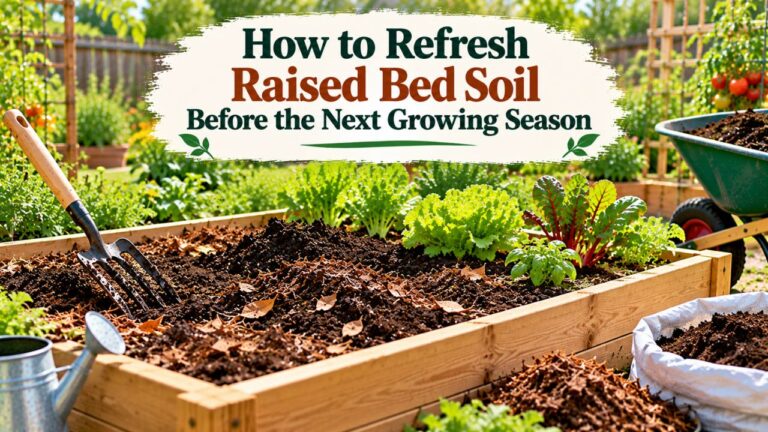
How to Refresh Raised-Bed Soil Without Digging It Up
A no-dig or low-dig approach can maintain soil structure while reducing unnecessary disturbance.
It is particularly convenient for raised beds that have been cultivated for several seasons.
Step 1: Remove Weeds and Unwanted Debris
Pull weeds before they set seed.
Remove diseased crop material when necessary.
Healthy roots can often be left to decompose in place after harvesting.
Step 2: Inspect the Soil
Check whether the soil is:
- Crumbly or compacted.
- Moist or excessively dry.
- Draining properly.
- Noticeably lower than before.
- Covered by sufficient organic material.
If the soil is compacted, gentle loosening with a garden fork may be appropriate.
Avoid unnecessary deep turning.
Step 3: Add Finished Compost
Spread approximately ¼–1 inch if the bed would benefit from an organic matter addition.
Use a thinner layer if the soil already has high nutrient levels.
Level the compost without deeply disturbing the bed.
Step 4: Add Fertilizer if Needed
Follow the soil-test recommendations and crop requirements.
Don’t apply fertilizer automatically just because it’s the beginning of a new season.
Step 5: Plant and Mulch
Plant the desired vegetables.
Once seedlings are established and the soil has warmed appropriately, apply suitable organic mulch.
Keep mulch away from tender stems and crowns.
Step 6: Monitor the Bed During the Season
Watch plant growth and soil moisture.
If crops show unusual symptoms, investigate watering, temperature, pests, diseases, and nutrition rather than assuming fertilizer is the only solution.
Best Annual Soil Additions for Different Raised-Bed Crops
The best amendments depend partly on what you’re growing.
Vegetables, flowers, herbs, and perennial crops don’t all have the same nutrient requirements.
Raised Vegetable Beds
Vegetable beds often benefit from modest annual compost additions.
High-demand crops may need additional fertilizer.
Use mulch to retain moisture and suppress weeds.
Consider cover crops when beds are empty between planting seasons.
Raised Flower Beds
Flower beds may need compost and mulch to maintain soil quality.
However, perennial flowers often require less aggressive soil disturbance.
Avoid burying established plant crowns under thick compost or mulch.
Fertilize according to species and soil conditions.
Raised Herb Beds
Herbs vary widely in nutrient and moisture requirements.
Some Mediterranean herbs prefer relatively lean, well-drained soil.
Excessive compost or nitrogen fertilizer may encourage soft growth and reduce the desirable characteristics of certain herbs.
Don’t treat all herb beds like heavy-feeding vegetable beds.
Raised Beds for Tomatoes and Peppers
Tomatoes and peppers benefit from suitable soil fertility and consistent moisture.
Compost can improve soil structure.
However, too much nitrogen may encourage excessive leafy growth at the expense of fruit production.
Use soil-test results and appropriate crop-specific fertilizer recommendations.
Raised Beds for Leafy Greens
Leafy greens often require a dependable nitrogen supply for vigorous growth.
Compost contributes nutrients, but nitrogen availability can be variable.
Additional nitrogen fertilizer may be appropriate when indicated by soil fertility and crop condition.
Simple Annual Raised-Bed Maintenance Checklist
Use this checklist at the beginning or end of each growing season.
- Remove weeds and unwanted plant debris.
- Inspect the soil level and drainage.
- Check whether the growing medium is compacted.
- Add a modest layer of finished compost if needed.
- Replenish organic mulch.
- Replace lost soil volume with suitable raised-bed mix when necessary.
- Apply fertilizer according to soil and crop needs.
- Test the soil if due or if problems are suspected.
- Check for excessive nutrient buildup from repeated amendments.
- Consider a cover crop for beds that will remain empty.
- Keep permanent walkways separate to avoid soil compaction.
- Monitor plant growth, soil moisture, and drainage during the season.
Most gardeners won’t need to perform every task each year.
The goal is to maintain a healthy soil environment with as little unnecessary intervention as possible.
Conclusion
Knowing what to add to raised beds each year makes it easier to maintain fertile, productive soil without completely replacing the growing medium.
For established vegetable beds, finished compost is usually the most useful annual addition. A modest layer of approximately ¼–1 inch can help replenish organic matter, while organic mulch protects the soil and reduces moisture loss.
Additional raised-bed mix may be needed if the soil level has dropped significantly. Fertilizer should be applied according to crop requirements and soil fertility rather than automatically added every spring.
Shredded leaves, leaf mold, worm castings, and cover crops are useful options, but they aren’t all necessary.
I recommend checking soil condition first, applying compost only in an appropriate amount, and replenishing mulch as needed. A laboratory soil test every few years can help identify nutrient or pH problems before additional amendments are purchased.
The best yearly raised-bed maintenance routine is simple: protect the soil, replenish organic matter thoughtfully, and add nutrients only when plants and soil conditions require them.
FAQs About What to Add to Raised Beds Each Year
Do You Need to Add Compost to Raised Beds Every Year?
Many vegetable beds benefit from regular compost additions because organic matter gradually decomposes.
For established beds, approximately ¼–1 inch per year is a useful general guideline.
However, beds with high nutrient levels or excessive organic matter may need less or none in a given year.
Use soil tests and bed conditions to guide the amount.
How Much Compost Should I Add to a 4 × 8 Raised Bed?
A 4 × 8-foot raised bed has an area of 32 square feet.
For a 1-inch compost layer, you’ll need approximately 2.67 cubic feet of compost.
For a ½-inch layer, you’ll need approximately 1.33 cubic feet.
These figures describe compost volume, not a requirement to apply that amount every year.
Should I Add New Soil to My Raised Garden Bed Every Spring?
Not necessarily.
Add new soil when the growing medium has settled significantly or the bed needs additional rooting depth.
If the soil level is adequate, a modest compost topdressing and mulch may be sufficient.
Use suitable raised-bed soil mix rather than filling the bed with compost alone.
What Is the Best Fertilizer to Add to Raised Beds Each Year?
There is no single fertilizer that is best for every raised bed.
The appropriate product depends on soil-test results and crop nutrient requirements.
For example, a bed with adequate phosphorus but low nitrogen may benefit from nitrogen-focused fertilization rather than a complete fertilizer containing additional phosphorus.
Should I Add Manure to Raised Beds Every Year?
No.
Manure isn’t a required annual amendment.
Fresh manure can introduce food-safety concerns, while repeated manure-based compost applications can contribute excessive phosphorus or salts.
Use finished, appropriately processed compost and follow soil-test guidance.
Is It Better to Add Compost in Spring or Fall?
Both spring and fall can be suitable.
Spring applications help prepare soil before planting.
Fall applications can replenish organic matter and protect the soil during the off-season when paired with mulch.
Choose the timing that fits your gardening schedule and local climate.
Can I Put Leaves in My Raised Garden Bed Every Year?
Yes.
Shredded leaves can be used as organic mulch.
They help cover the soil and gradually decompose.
Avoid thick mats of whole leaves that prevent water movement or interfere with seedlings.
Finished leaf mold can also be used as a soil amendment.
Do Raised Beds Lose Nutrients Every Year?
Plants remove nutrients as they grow, and harvested crops carry some nutrients away.
Other changes can occur through leaching, decomposition, and biological activity.
However, the rate of nutrient loss varies.
Not every bed needs the same fertilizer addition each year, which is why periodic soil testing is useful.

I’m Maya L. Greenwood, a lifelong plant lover who believes anyone can grow something beautiful with the right guidance. After years of testing soil mixes, pruning methods, irrigation tricks, and pest-safe solutions, I started EasyGardenTips.com to turn hard-won lessons into step-by-step advice. From seed starting and container gardens to composting and seasonal checklists, my goal is to make gardening simple, sustainable, and fun.