How to Rotate Crops in Raised Beds: 4-Year Plan for Beginners
To rotate crops in raised beds, divide your vegetables into plant families and move each family to a different bed every growing season. For example, if you grow tomatoes in one bed this year, plant a different family, such as beans, carrots, or cabbage, in that bed next year. Ideally, allow three or more growing seasons before returning tomatoes or related crops to the same soil.
Crop rotation helps reduce the buildup of certain soilborne diseases and pests. It also encourages a more diverse planting system and can help balance nutrient use between crops with different growing requirements.
According to the University of Minnesota Extension, gardeners should generally avoid planting vegetables from the same family in a raised bed for three to four years. That means tomatoes, peppers, potatoes, and eggplants should be treated as one rotation group rather than four unrelated vegetables.
However, rotating crops can be challenging when you have only one or two raised beds.
In this article, I explain how to rotate crops in raised beds step by step, identify the major vegetable families, and provide practical three- and four-year rotation charts. You’ll also learn how to manage crop rotation in small gardens, combine rotation with succession planting, maintain soil fertility, and avoid mistakes that can reduce its effectiveness.
What Is Crop Rotation in Raised Beds?
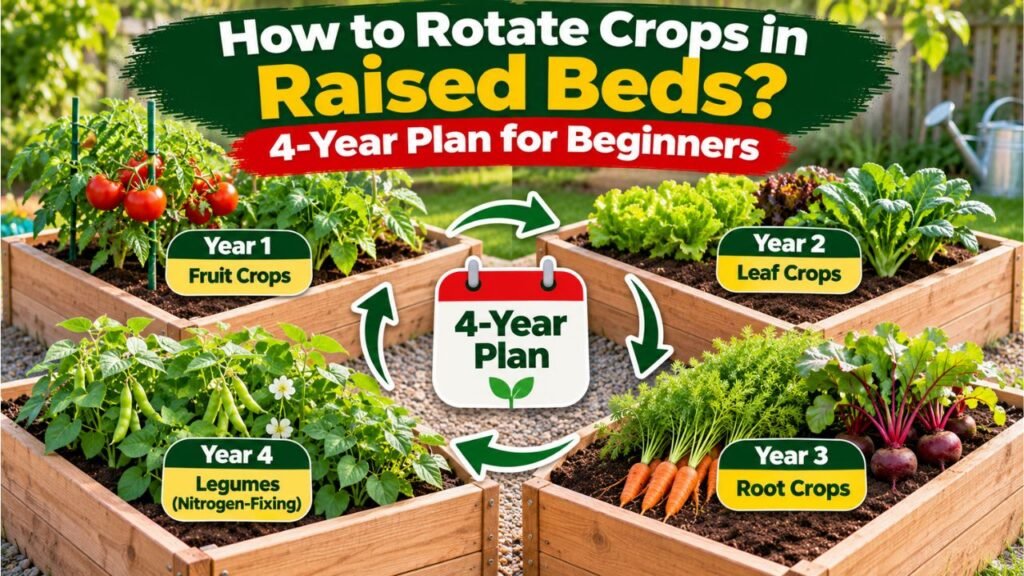
Crop rotation is the practice of growing different plant families in the same garden space over successive growing seasons instead of planting the same family repeatedly in one location.
In a raised-bed garden, this usually means moving vegetables between beds each year.
For example, suppose you have three raised beds.
During the first year:
- Bed 1 grows tomatoes.
- Bed 2 grows cabbage.
- Bed 3 grows green beans.
The following year, each crop moves to a different bed.
This changes the plants growing in each soil area.
Over time, rotation can help interrupt certain pest and disease cycles associated with repeatedly growing related vegetables in the same location.
Why Crop Rotation Matters
Vegetables belonging to the same botanical family often share susceptibility to particular diseases and pests.
For example, tomatoes and peppers belong to the nightshade family.
If you grow tomatoes in a raised bed one year and peppers in the same bed the next, you’ve changed the vegetable, but you haven’t changed its plant family.
Some soilborne disease organisms that affect tomatoes may also affect peppers.
The same relationship applies to other vegetable groups.
According to the University of Minnesota Extension’s raised-bed gardening guidance, creating several separate raised beds makes it easier to rotate crop families and manage some soilborne disease problems.
What Crop Rotation Can and Cannot Do
Crop rotation may help:
- Reduce pressure from certain soilborne pathogens.
- Interrupt the life cycles of some pests.
- Introduce different root systems into the soil.
- Diversify nutrient uptake.
- Improve long-term garden planning.
However, rotation does not guarantee that diseases will disappear.
Some pathogens survive in soil for many years, while others spread through wind, water, tools, or infected transplants.
Because raised beds are often located close together, rotation may also provide less disease protection than moving crops between widely separated fields.
Key Takeaway: Crop rotation is a preventive gardening practice, not a cure for every soil or plant disease.
How to Rotate Crops in Raised Beds Step by Step
A successful rotation plan begins with identifying what you grow and understanding which vegetables are related.
Follow these steps to organize your raised beds.
Step 1: List the Vegetables You Want to Grow
Start by writing down your preferred crops.
For example:
- Tomatoes
- Bell peppers
- Cucumbers
- Zucchini
- Green beans
- Peas
- Broccoli
- Kale
- Carrots
- Lettuce
- Onions
- Spinach
Include vegetables you grow during spring, summer, and fall.
This is important because raised beds may contain several crops within a single year.
A spring crop still counts toward the bed’s planting history even if it is removed before summer.
Step 2: Group Vegetables by Plant Family
This is the most important step.
Crop rotation should primarily follow botanical families, not whether the vegetable is a root, leaf, or fruit crop.
For example, tomatoes and potatoes belong to the same family, despite producing different edible parts.
Likewise, broccoli, kale, cabbage, and radishes belong to the cabbage family.
Use the plant-family chart below to organize your vegetables.
Step 3: Number Your Raised Beds
Assign each bed a permanent number.
For example:
- Raised Bed 1
- Raised Bed 2
- Raised Bed 3
- Raised Bed 4
Record each bed’s dimensions and location.
If all the beds receive similar sunlight, rotating crops between them is usually simpler.
If one bed receives less sunlight or has a different soil depth, account for those differences when selecting crops.
Step 4: Record This Year’s Plantings
Create a simple garden map showing what grew in each location.
Record the family rather than only the individual vegetable.
For example:
| Raised bed | Current crop | Plant family |
| Bed 1 | Tomatoes | Nightshade |
| Bed 2 | Broccoli | Brassica |
| Bed 3 | Green beans | Legume |
| Bed 4 | Cucumbers | Cucurbit |
If several crops share one bed, record each crop and the specific section it occupied.
This information becomes the starting point for next year’s plan.
Step 5: Move Each Family to a Different Bed
During the next planting season, move each group into a bed where that family hasn’t grown recently.
For example:
- Tomatoes move out of Bed 1.
- Broccoli moves out of Bed 2.
- Beans move out of Bed 3.
- Cucumbers move out of Bed 4.
Replace them with vegetables from unrelated families.
The goal is to avoid repeatedly exposing the same soil to crops susceptible to similar problems.
Step 6: Maintain a Three- to Four-Year Rotation
Try to keep each family out of the same bed for approximately three or four growing seasons before returning it.
The appropriate interval depends on the crop and disease risks.
For example, if tomatoes grew in Bed 1 during Year 1, a four-year schedule could use different families in Years 2, 3, and 4 before tomatoes return in Year 5.
This provides three complete intervening seasons without nightshades.
Step 7: Update the Plan Every Season
At the end of each growing season, record:
- Vegetables grown
- Plant families
- Planting and harvest dates
- Disease symptoms
- Pest problems
- Fertilizer and compost applications
- Soil test results
Keep these records in a notebook or simple garden spreadsheet.
They will make next year’s planting decisions much easier.
Vegetable Family Chart for Raised-Bed Crop Rotation
Botanical families are the foundation of a reliable rotation system.
The following table identifies common raised-bed vegetables and their related crops.
| Plant family | Common vegetables | Important rotation relationship |
| Nightshade (Solanaceae) | Tomatoes, potatoes, peppers, eggplants, tomatillos | Treat all as one group |
| Brassica (Brassicaceae) | Broccoli, cabbage, cauliflower, kale, radishes, turnips, Brussels sprouts | Avoid following one with another repeatedly |
| Legume (Fabaceae) | Green beans, peas, lima beans, cowpeas | Rotate beans and peas together |
| Cucurbit (Cucurbitaceae) | Cucumbers, zucchini, squash, pumpkins, melons | Treat all vine crops as one family |
| Carrot (Apiaceae) | Carrots, celery, parsnips, parsley, cilantro, dill | Related crops share a family |
| Onion (Amaryllidaceae) | Onions, garlic, leeks, shallots, chives | Keep in the same rotation group |
| Amaranth (Amaranthaceae) | Spinach, beets, Swiss chard | Rotate together |
| Daisy (Asteraceae) | Lettuce, endive, escarole | Can be used in a separate rotation group |
| Mint (Lamiaceae) | Basil, thyme, oregano, sage, mint | Useful herb family to recognize |
| Grass (Poaceae) | Sweet corn, oats, wheat | Separate from most common garden vegetables |
Some older gardening references use different family names, such as Chenopodiaceae for spinach and beets or Liliaceae for onions.
Modern botanical classification places these crops in the families shown above.
Why You Shouldn’t Plant Tomatoes After Peppers
Tomatoes and peppers belong to Solanaceae.
They may share certain soilborne pathogens.
Replacing tomatoes with peppers does not provide a true family rotation.
The same applies to potatoes and eggplants.
Instead, follow tomatoes with a vegetable from another family, provided it doesn’t share a diagnosed disease problem.
Why Broccoli Shouldn’t Follow Cabbage
Broccoli and cabbage belong to Brassicaceae.
So do kale, cauliflower, radishes, and turnips.
Growing one immediately after another may maintain suitable hosts for certain family-associated pests or pathogens.
Choose a vegetable from an unrelated family when possible.
Can You Plant Cucumbers After Zucchini?
Both belong to Cucurbitaceae.
They share some pests and diseases.
For a disease-focused rotation, avoid planting cucumbers immediately after zucchini in the same bed.
Instead, choose a different plant family.
Key Takeaway: Remembering the plant families is more useful than memorizing a rigid sequence of individual vegetables.
Four-Year Crop Rotation Plan for Four Raised Beds
A four-bed rotation is one of the easiest systems for beginners to organize.
With four distinct crop groups, each family can move through all four beds before returning to its original location.
For this example, use:
- Group A: Nightshades — tomatoes and peppers
- Group B: Brassicas — broccoli and kale
- Group C: Legumes — peas and beans
- Group D: Cucurbits — cucumbers and squash
Four-Year Raised-Bed Rotation Chart
| Year | Raised Bed 1 | Raised Bed 2 | Raised Bed 3 | Raised Bed 4 |
| Year 1 | Nightshades | Brassicas | Legumes | Cucurbits |
| Year 2 | Cucurbits | Nightshades | Brassicas | Legumes |
| Year 3 | Legumes | Cucurbits | Nightshades | Brassicas |
| Year 4 | Brassicas | Legumes | Cucurbits | Nightshades |
| Year 5 | Return to Year 1 | Return to Year 1 | Return to Year 1 | Return to Year 1 |
This arrangement gives every crop family three intervening years away from each particular bed.
For example, tomatoes grow in Bed 1 during Year 1.
They move to Bed 2 in Year 2, Bed 3 in Year 3, and Bed 4 in Year 4.
They return to Bed 1 in Year 5.
How to Use This Chart
First, match your preferred vegetables to the four families.
Then move each group one bed forward every year, following the chart.
For example, replace the word Nightshades with tomatoes and peppers if those are the crops you want.
Replace Brassicas with broccoli and kale.
The family rotation remains the same.
What About Carrots, Lettuce, and Onions?
The four-family table is a simplified example, not a complete list of vegetables.
Carrots, lettuce, onions, and spinach belong to additional families.
They can be incorporated into the plan according to the previous crops in each bed.
For example, you could use lettuce or carrots in a bed scheduled for a different family, provided the chosen crops have not recently grown there and the planting conditions are suitable.
If you grow many different families, a more detailed schedule may work better than four broad groups.
Does Every Bed Need the Same Size?
Not necessarily.
However, bed dimensions affect which crops fit.
Tomatoes and cucumbers may need support or trellising, while large pumpkins can spread well beyond a small bed.
Plan for mature plant size and root space.
A rotation system is useful only when the selected crops can grow successfully in their assigned locations.
Three-Year Crop Rotation Plan for Three Raised Beds
A three-bed garden can also support an organized crop rotation.
However, using only three beds for three recurring families provides a shorter break than a four-bed rotation.
Three-Bed Rotation Example
| Year | Raised Bed 1 | Raised Bed 2 | Raised Bed 3 |
| Year 1 | Tomatoes | Cabbage | Beans |
| Year 2 | Beans | Tomatoes | Cabbage |
| Year 3 | Cabbage | Beans | Tomatoes |
| Year 4 | Return to Year 1 | Return to Year 1 | Return to Year 1 |
This keeps each family moving and avoids consecutive-year planting in the same bed.
However, each family returns to its original bed after only two intervening growing seasons.
That is shorter than the three- to four-year break commonly recommended for disease management.
How to Improve a Three-Bed Rotation
If you want a longer break, add a fourth growing area.
Possible options include:
- A large fabric grow bag
- A container suitable for tomatoes or peppers
- Another small raised bed
- An in-ground growing area with appropriate soil
You can also rotate additional unrelated families into the three beds and avoid growing every crop family every year.
For example, use carrots or lettuce during a season when you would otherwise repeat tomatoes.
The best solution depends on available space and which vegetables you want to harvest annually.
How to Rotate Crops With Only Two Raised Beds
Two raised beds are common in small backyards.
Although a traditional four-bed schedule isn’t possible without additional planting areas, you can still use the principles of crop rotation.
Example Two-Bed Planting Plan
| Year | Raised Bed 1 | Raised Bed 2 |
| Year 1 | Tomatoes | Broccoli |
| Year 2 | Green beans | Cucumbers |
| Year 3 | Broccoli | Tomatoes |
| Year 4 | Cucumbers | Green beans |
| Year 5 | Tomatoes | Broccoli |
In this example, tomatoes return to Bed 1 in Year 5 after three intervening years.
The other families also avoid returning to the same bed during the four-year cycle.
However, tomatoes are not grown in the raised beds every year.
That is an important limitation when working with a small number of beds.
What if You Want Tomatoes Every Year?
If you rotate tomatoes between only two beds annually, each bed gets just one year without nightshades before tomatoes return.
That may be a reasonable practical compromise for some healthy gardens, but it does not provide the recommended three-year break.
A better option is to grow tomatoes in a large container with fresh, suitable growing media during years when both raised beds need a break from nightshades.
You can also prioritize other disease-management practices.
Use Different Plant Families
Avoid growing tomatoes in one bed and replacing them with peppers in the next season.
Both belong to the same family.
Use genuinely different families, such as beans, cabbage, or carrots.
Keep Detailed Records
With two beds, even small changes can make rotation confusing.
Record each crop and planting season.
This helps you avoid accidentally returning the same family too soon.
How to Rotate Crops in a Single Raised Bed
A single raised bed presents the greatest challenge.
However, there are still practical ways to vary your planting.
Option 1: Rotate Families Over Several Years
If the bed is used primarily for one crop group each year, try a four-year sequence.
For example:
| Year | Main crop family | Example vegetables |
| Year 1 | Nightshades | Tomatoes |
| Year 2 | Legumes | Green beans |
| Year 3 | Carrot family | Carrots |
| Year 4 | Brassicas | Kale |
| Year 5 | Nightshades | Tomatoes return |
This creates a longer break between plantings of the same family.
However, it may not suit gardeners who want tomatoes every year.
Option 2: Divide the Bed Into Sections
A 4 × 8-foot raised bed can be divided into four sections measuring approximately 4 × 2 feet each.
Assign a different plant family to each section.
Move the families between sections the following year.
This can improve planting diversity and reduce repeated cropping in the exact same spot.
However, dividing one bed does not create completely isolated soil areas.
Roots, water, insects, and pathogens may move between neighboring sections.
For disease prevention, small sections within one bed generally provide less separation than independent raised beds.
Option 3: Use Containers for Certain Crops
Large containers can provide separate growing areas for tomatoes, peppers, and other vegetables.
This allows the main raised bed to grow unrelated crops for a season.
Choose containers with adequate drainage and sufficient rooting volume.
Use suitable growing media rather than transferring potentially contaminated soil from a diseased bed.
Option 4: Prioritize Diversity and Soil Care
When strict crop rotation isn’t practical, focus on:
- Growing different plant families.
- Choosing disease-resistant varieties.
- Removing infected plant debris.
- Maintaining appropriate soil moisture.
- Improving airflow.
- Using healthy transplants.
- Avoiding excessive fertilization.
- Keeping records of recurring problems.
The University of Minnesota Extension’s soil health guidance specifically recommends planting a diversity of crop families when garden space is too limited for a full rotation.
Key Takeaway: One raised bed can still benefit from crop diversity, but a true multi-year disease rotation becomes easier when you have additional separate growing areas.
What Vegetables Should Follow Each Other in Raised Beds?
The most important consideration is choosing an unrelated family rather than following a universally fixed vegetable sequence.
The following examples can help with planning.
| Previous crop | Possible following crop | Why it can work |
| Tomatoes | Green beans | Different plant family |
| Peppers | Carrots | Different family and growing habit |
| Broccoli | Cucumbers | Different family |
| Cabbage | Peas | Different family |
| Cucumbers | Lettuce | Different family |
| Zucchini | Onions | Different family |
| Green beans | Broccoli | Different family |
| Peas | Carrots | Different family |
| Carrots | Spinach | Different family |
| Onions | Lettuce | Different family |
| Spinach | Tomatoes | Different family |
| Lettuce | Green beans | Different family |
These examples are general rotation possibilities.
They do not guarantee that the next crop will grow well in every season or climate.
Consider temperature, sunlight, crop maturity, and soil conditions.
Also remember that unrelated vegetables can sometimes share diseases.
For example, Verticillium wilt can affect plants from multiple families, so a diagnosed disease problem may require a more specific crop selection.
Should You Rotate Heavy Feeders and Light Feeders?
Nutrient demand can be considered when planning a rotation.
However, it should be secondary to plant family and disease history when disease prevention is the main goal.
Heavy-Feeding Vegetables
Vegetables commonly requiring substantial nutrients include:
- Tomatoes
- Peppers
- Broccoli
- Cabbage
- Sweet corn
- Some squash crops
Their actual fertilizer needs depend on soil fertility, variety, growing conditions, and expected yield.
Moderate- or Lower-Demand Crops
Some lettuce, carrot, onion, and other crops may require less total fertilizer than large, heavy-producing vegetables.
However, no vegetable grows without nutrients.
Even crops described as light feeders can perform poorly in deficient soil.
Where Do Beans and Peas Fit?
Beans and peas belong to the legume family.
Under suitable conditions, they form associations with nitrogen-fixing bacteria.
These bacteria allow legumes to obtain some nitrogen from the atmosphere.
However, growing beans does not automatically leave enough extra nitrogen to fertilize the next crop.
The amount of nitrogen remaining depends on factors such as:
- Soil conditions
- Root nodulation
- Existing soil nitrogen
- Crop biomass
- Harvest removal
- Whether plant residues remain
A harvested bean crop may leave less nitrogen than a legume cover crop grown mainly to produce biomass.
Use soil testing to decide whether the following vegetable needs fertilizer.
How to Combine Crop Rotation With Succession Planting
Raised beds are often used for several crops during the same year.
For example, a gardener may grow spring peas, summer cucumbers, and fall spinach in one bed.
This is called succession planting.
It differs from crop rotation, although the two practices can work together.
Crop Rotation vs. Succession Planting
Crop rotation: Changes the crop family grown in a location across growing seasons or years.
Succession planting: Uses the same growing space for additional crops as earlier crops are harvested.
Succession planting increases productivity by reducing the amount of time a bed remains empty.
Crop rotation focuses more specifically on changing plant families over time.
Example Spring-to-Fall Planting Sequence
| Season | Vegetable | Plant family |
| Spring | Peas | Legume |
| Summer | Cucumbers | Cucurbit |
| Fall | Spinach | Amaranth |
This provides three different crop families during one growing year.
However, all three must be recorded in the bed’s planting history.
If you want a strict three-year break for each family, avoid growing those families in the same bed during the following years.
Avoid Repeating Related Crops Within One Year
For example, growing spring broccoli followed by fall kale does not provide a family rotation.
Both crops are brassicas.
Similarly, spring potatoes followed by fall tomatoes repeat the nightshade family.
If a soilborne disease associated with a particular family is present, this repetition may maintain the problem.
Consider the Growing Season
Succession planting must also match local weather.
Cool-season vegetables may grow well in spring and fall but struggle during hot summer weather.
Warm-season vegetables such as tomatoes, peppers, and cucumbers need suitable temperatures.
The University of Maryland Extension’s succession planting guide provides examples of combining crops across different parts of the growing season.
How to Prepare Raised-Bed Soil Between Crop Rotations
Changing vegetables does not eliminate the need for soil maintenance.
Healthy soil remains essential for productive raised beds.
Remove Finished Plants
After harvest, remove dead or diseased plant material.
For healthy crops, some residue may be suitable for composting.
However, visibly infected material should be handled according to guidance for the particular disease.
Do not assume that an ordinary home compost pile reaches temperatures sufficient to kill all plant pathogens.
Check Soil Condition
Look for:
- Compaction
- Poor drainage
- Excessive dryness
- Low soil level
- Crusting
- Weed growth
- Signs of nutrient deficiency
Raised beds often develop settling over time as organic matter decomposes.
Some topping up may be necessary.
Test the Soil
A soil test can identify pH and nutrient levels.
This is more reliable than applying fertilizer based only on which crop grew previously.
A garden may already have adequate phosphorus or potassium but still need nitrogen during the growing season.
Excess fertilization can create nutrient imbalances.
Add Compost When Needed
Finished compost can improve soil structure and replenish organic matter.
The University of Maryland Extension notes that approximately 1 inch of compost per year can help maintain productivity in many vegetable gardens.
However, compost requirements depend on the current soil condition and nutrient levels.
Do not automatically add large amounts of compost every season.
Overapplication can lead to excessive nutrient accumulation, particularly phosphorus.
Avoid Unnecessary Deep Digging
Most established raised beds do not need to be completely dug out between crops.
A low-disturbance approach can help preserve soil structure.
Remove weeds, loosen only where necessary, and prepare the planting area according to the next crop’s requirements.
Add Mulch
Mulch helps reduce moisture loss and soil splash.
Organic mulches may also contribute organic matter as they decompose.
Keep mulch away from plant crowns when necessary to reduce moisture-related problems.
Can Cover Crops Help With Raised-Bed Rotation?
Yes. Cover crops can help maintain soil cover, provide living roots, and contribute organic matter.
They can also add another plant family to the overall rotation.
However, cover crops must be chosen carefully.
Oats
Oats belong to the grass family.
They can be a useful cover crop for gardeners who mainly grow nightshades, brassicas, and legumes.
In colder climates, fall-planted oats may winterkill.
In milder climates, they may continue growing and require termination before spring planting.
Clover
Clover belongs to the legume family.
It can contribute nitrogen through biological nitrogen fixation under suitable conditions.
However, planting clover counts as growing a legume.
If you’re trying to keep legumes out of a bed for disease-management reasons, clover may not fit that rotation.
Winter Rye
Winter rye is a grass-family cover crop.
It can protect soil during colder months.
However, it may survive winter and grow vigorously in spring.
This makes termination timing important, particularly in small raised beds.
How to Use a Cover Crop
- Choose a species suitable for your climate and planting season.
- Confirm that it fits your planned crop-family rotation.
- Sow it after the main vegetable harvest.
- Allow it to establish.
- Terminate it before the next crop according to recommended timing.
- Manage residue so it does not interfere with planting.
Avoid allowing an unwanted cover crop to set seed.
The Penn State Extension guide to raised-bed soil health recommends maintaining living roots and plant diversity as part of improving soil health.
Does Crop Rotation Prevent Diseases in Raised Beds?
Crop rotation can reduce certain disease risks, but its effectiveness varies.
Some soilborne pathogens depend heavily on particular plant hosts.
Growing unrelated crops may reduce the opportunity for those pathogens to reproduce.
However, several limitations matter.
Diseases That May Benefit From Rotation
Rotation can be part of managing certain problems associated with:
- Soilborne fungal pathogens
- Some bacterial diseases
- Certain soil-dwelling pests
- Family-specific disease organisms
The benefit depends on the specific organism, its survival period, and whether the replacement crop is also susceptible.
Diseases That Rotation May Not Control Well
Some diseases spread through wind, infected seeds, transplants, splashing water, or contaminated tools.
Others remain in soil for long periods without a susceptible crop.
For example, clubroot affecting brassicas can persist for many years.
A standard three-year rotation may be insufficient in heavily infested soil.
Similarly, some diseases affect multiple unrelated plant families.
Why Small Raised Beds Have Limitations
In a compact garden, adjacent raised beds may be only a few feet apart.
Insects can move easily between them.
Water, soil, and tools may also move pathogens.
The University of Maryland Extension notes that crop rotation may offer more limited pest and disease benefits in home gardens than in farms where fields are widely separated.
This does not make rotation useless.
It means you should combine it with additional practices.
Other Important Disease-Prevention Practices
Use:
- Disease-resistant varieties where available
- Healthy transplants
- Clean gardening tools
- Appropriate plant spacing
- Drip irrigation or careful watering
- Mulch to reduce soil splash
- Good drainage
- Removal of diseased plant debris
- Accurate diagnosis of recurring problems
If a disease repeatedly affects the same crop, contact a local Cooperative Extension office or plant diagnostic laboratory.
Key Takeaway: Rotation works best as one part of an integrated disease-management plan, not as a standalone guarantee.
Common Crop Rotation Mistakes in Raised Beds
Several mistakes can make a rotation plan less useful.
| Mistake | Why it matters | Better approach |
| Tomatoes followed by peppers | Same nightshade family | Choose an unrelated family |
| Broccoli followed by kale | Both are brassicas | Rotate to another family |
| Cucumbers followed by squash | Both are cucurbits | Choose another family |
| Rotating only by root, leaf, or fruit type | Does not reliably separate disease hosts | Use botanical families |
| Forgetting spring crops | Creates an incomplete history | Record every crop in every season |
| Assuming beans replace fertilizer | Nitrogen contribution varies | Use soil tests |
| Overusing compost | Can cause nutrient accumulation | Apply according to soil needs |
| Rotating crops but not managing diseased debris | Pathogens may remain | Follow proper sanitation |
| Assuming a single bed is four independent beds | Soil and pathogens may move between sections | Use separate beds or containers |
| Ignoring sunlight and space needs | Crops may grow poorly | Match the crop to the bed |
Mistake 1: Rotating Vegetables Instead of Families
This is the most common planning error.
Tomatoes followed by eggplants may look like a rotation, but both belong to the same family.
Check botanical relationships before selecting the next crop.
Mistake 2: Following a Rigid Nutrient Sequence
Some gardening charts prescribe a sequence such as heavy feeders, legumes, root crops, and leafy greens.
This can be a useful planning aid, but it should not replace family-based rotation when disease management is the goal.
A soil test is also more reliable than assuming a specific crop has depleted or restored a particular nutrient.
Mistake 3: Forgetting Succession Crops
If you plant spring peas and summer cucumbers in the same bed, both families belong in your records.
Do not record only the final crop of the season.
Mistake 4: Expecting Rotation to Eliminate Existing Disease
Some pathogens remain viable for years and may infect multiple families.
Correct identification matters.
If plants repeatedly develop similar symptoms, investigate the cause rather than relying solely on a rotation chart.
Mistake 5: Changing the Plan Without Keeping Records
It’s easy to forget where vegetables grew two or three years ago.
A simple diagram with bed numbers and annual plantings is usually enough.
Update it as each crop is planted and removed.
How to Make a Simple Raised-Bed Crop Rotation Planner
You don’t need specialized software.
A notebook, printed chart, or spreadsheet can work.
Information to Record
Create columns for:
- Bed number
- Year
- Season
- Vegetable
- Plant family
- Planting date
- Harvest date
- Disease observations
- Soil amendments
For example:
| Year | Bed | Season | Crop | Family | Notes |
| 2026 | 1 | Summer | Tomato | Nightshade | Healthy crop |
| 2026 | 2 | Spring | Broccoli | Brassica | Minor insect damage |
| 2026 | 3 | Summer | Green beans | Legume | Good harvest |
| 2026 | 4 | Summer | Cucumber | Cucurbit | Trellised |
| 2027 | 1 | Summer | Cucumber | Cucurbit | Planned |
| 2027 | 2 | Summer | Tomato | Nightshade | Planned |
| 2027 | 3 | Spring | Broccoli | Brassica | Planned |
| 2027 | 4 | Summer | Green beans | Legume | Planned |
This illustrates how to move crop families while preserving a planting history.
Review the Plan Every Winter
Before ordering seeds, check which families occupied each bed.
Identify crops that should be kept out of particular locations.
Then assign your desired vegetables to suitable beds.
If the rotation conflicts with sunlight, space, or planting dates, adjust the plan rather than forcing an unsuitable crop into a bed.
The goal is to create a practical, sustainable planting schedule.
Conclusion
Learning how to rotate crops in raised beds begins with understanding plant families and tracking where each family grows.
Instead of planting the same vegetables in one bed every year, move related crops through different growing areas.
A four-bed rotation is a convenient system because it allows each family to remain out of a particular bed for three intervening seasons before returning in Year 5.
For smaller gardens, two- or three-bed rotations can still improve planting diversity, although they may require compromises. Containers and additional growing areas can help when a longer rotation interval is needed.
I recommend starting with a simple planting chart that groups tomatoes and peppers together, broccoli and cabbage together, beans and peas together, and cucumbers and squash together.
Record every planting, including spring and fall succession crops, and update the chart annually.
Combine rotation with healthy soil practices, appropriate compost use, disease-resistant varieties, and good sanitation.
A well-planned rotation won’t prevent every gardening problem, but it can help you maintain more diverse and productive raised beds over time.
FAQs About How to Rotate Crops in Raised Beds
How Often Should You Rotate Crops in Raised Beds?
Move crop families to different growing areas each year when practical.
For disease management, a common recommendation is to allow three or more growing seasons before returning the same family to the same bed.
The exact interval depends on the crop and disease history.
Can You Rotate Crops in Just One Raised Bed?
Yes, but the options are limited.
You can grow different plant families in successive years or divide a large bed into sections.
However, sections within one raised bed are not completely isolated.
Additional containers or separate beds provide more flexibility.
What Should You Plant After Tomatoes in a Raised Bed?
Beans, carrots, lettuce, and brassicas are examples of vegetables from families unrelated to tomatoes.
Avoid immediately following tomatoes with peppers, potatoes, or eggplants because they share the nightshade family.
Choose the next crop according to the season, soil conditions, and disease history.
Do You Need Four Raised Beds for Crop Rotation?
No. You can rotate crops with two or three beds.
However, four separate growing areas make it easier to maintain a four-year rotation while growing the same four crop families annually.
With fewer beds, you may need to rotate additional crops, skip certain vegetables for a season, or use containers.
Should You Add Compost Every Time You Rotate Crops?
Not necessarily.
Finished compost can help replenish organic matter, but excessive applications may cause nutrient accumulation.
Consider the existing soil condition and soil test recommendations before adding more.
Changing crop families does not automatically mean the soil needs a large compost application.
Can You Grow Beans After Tomatoes?
Yes. Beans belong to the legume family, while tomatoes are nightshades.
They are commonly suitable for rotation.
However, beans do not automatically provide enough extra nitrogen for the next crop, and planting decisions should account for the soil’s condition and any diagnosed diseases.
What Is the Best Four-Year Raised-Bed Crop Rotation?
A practical example uses nightshades, brassicas, legumes, and cucurbits, with each family moving to a different bed every year.
After four years, each family has occupied all four beds.
In Year 5, the rotation repeats.
Other vegetable families can be incorporated according to the crops you grow.
Does Crop Rotation Stop Tomato Blight?
Not all tomato blights respond to rotation in the same way.
Some diseases involve soilborne inoculum, while others spread through wind, water, infected plants, or other sources.
Rotation can be part of prevention, but it does not guarantee protection.
Correctly identify the disease and follow appropriate management guidance.
Can You Plant Different Vegetables in the Same Raised Bed Every Season?
Yes. Succession planting allows multiple vegetables to grow in one bed throughout the year.
For rotation planning, record every crop family used.
Avoid repeatedly growing the same family if the goal is to reduce family-associated disease pressure.

I’m Maya L. Greenwood, a lifelong plant lover who believes anyone can grow something beautiful with the right guidance. After years of testing soil mixes, pruning methods, irrigation tricks, and pest-safe solutions, I started EasyGardenTips.com to turn hard-won lessons into step-by-step advice. From seed starting and container gardens to composting and seasonal checklists, my goal is to make gardening simple, sustainable, and fun.