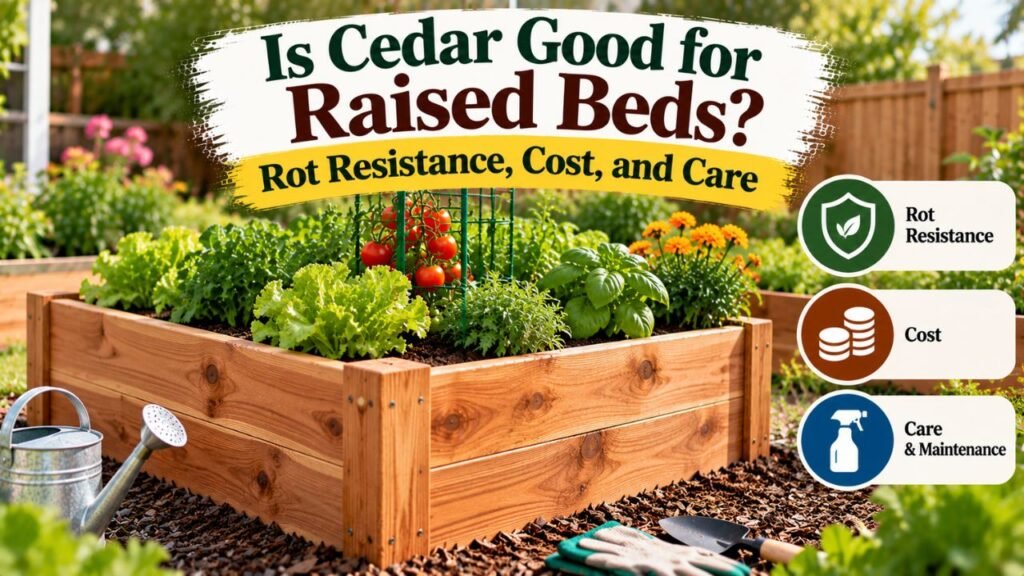
Is Cedar Good for Raised Beds? Rot Resistance, Cost, and Care
Yes, cedar is a good material for raised garden beds because untreated cedar naturally resists decay, can be used around edible plants, and is easy to cut and assemble. It usually costs more than basic pine, but its longer service life often makes it worth considering for permanent garden frames.
Cedar is not rot-proof. Boards that stay wet, touch damp soil, or contain a lot of less-durable sapwood can deteriorate. The type and quality of cedar you purchase matter, as do board thickness, corner supports, and how you manage water around the frame.
If you’re building beds for vegetables, you may also wonder whether cedar needs a plastic liner or protective coating, how long it will last, and whether pine or metal would be a better buy. Choosing based on the wood’s properties rather than a general lifespan claim helps avoid paying extra for poor-quality lumber.
In this article, I explain why cedar works well for raised beds, the differences between common cedar boards, and the tradeoffs in cost and durability. You’ll also learn how to build a longer-lasting frame, prevent rot, and decide when another material makes more sense.
Is Cedar Good for Raised Beds? Main Benefits and Drawbacks
Cedar is one of the more practical untreated wood choices for permanent raised beds. Its natural decay resistance, manageable weight, and appearance make it suitable for vegetable gardens and backyard landscaping.
However, its benefits depend on the quality of the lumber and the conditions in which it is used.
Cedar Naturally Resists Rot and Decay
Cedar contains naturally occurring compounds in its heartwood that help resist decay-causing fungi.
These compounds make certain cedar species more durable outdoors than many commonly available untreated softwoods.
In a raised garden bed, this resistance is particularly useful because the inside surfaces remain in contact with moist soil throughout the growing season.
Untreated pine and fir generally deteriorate more quickly under similar wet conditions.
However, cedar’s resistance is not permanent protection against rot. Prolonged moisture exposure can eventually damage even high-quality boards.
Untreated Cedar Is Suitable for Vegetable Gardens
One of cedar’s main advantages is that it does not need chemical pressure treatment to provide a useful level of decay resistance.
This makes untreated cedar attractive for gardeners who prefer to avoid added wood preservatives around edible crops.
You can use suitable untreated cedar boards to build raised beds for:
- Tomatoes and peppers.
- Lettuce and leafy greens.
- Carrots and radishes.
- Cucumbers and beans.
- Herbs and flowers.
The growing medium still needs adequate nutrients, moisture, and drainage.
Cedar does not automatically improve soil fertility or make vegetables grow faster. Its primary function is to provide a durable frame that keeps the growing medium contained.
Cedar Is Lightweight and Easy to Work With
Many cedar lumber products are relatively lightweight and easy to cut, drill, and fasten.
This makes cedar convenient for DIY raised-bed construction.
A basic rectangular frame can be assembled using cedar boards, appropriately sized corner supports, and exterior-compatible fasteners.
Cedar is also suitable for custom shapes and dimensions when the design includes adequate reinforcement.
However, cedar is generally softer than many structural hardwoods. Its resistance to decay should not be confused with high structural strength.
Long boards can bow under soil pressure if they are too thin or inadequately supported.
Cedar Has a Natural Garden Appearance
Cedar typically has warm reddish, pinkish, or brown tones, depending on the species and lumber grade.
Its visible grain works well in vegetable gardens, flower beds, and natural-looking landscapes.
When left unfinished outdoors, cedar gradually develops a gray weathered appearance.
This color change is normal and does not automatically indicate rot.
You can leave the wood unfinished or use a suitable exterior finish if preserving its original appearance is important.
Main Disadvantages of Cedar Raised Beds
Despite its benefits, cedar has several limitations:
- Higher initial cost: Cedar often costs more than untreated pine or fir.
- Not completely rot-proof: Constant moisture eventually affects the wood.
- Variable lumber quality: Boards with substantial sapwood may be less durable.
- Potential warping and splitting: Poorly dried or unsupported boards may deform.
- Maintenance requirements: The frame still needs occasional inspection and repair.
- Regional availability: Cedar prices and species vary considerably across the United States.
Key Takeaway: Cedar is an excellent untreated wood option for raised beds when durability and material simplicity matter more than the lowest purchase price.
Is Cedar Safe for Raised Garden Beds With Vegetables?
Yes, untreated cedar lumber from a known, uncontaminated source is generally considered safe for growing vegetables. It is widely recommended for edible garden beds because of its natural resistance to decay.
The University of Maryland Extension’s raised-bed vegetable gardening guidance identifies cedar among the naturally decay-resistant woods suitable for constructing raised beds.
Unlike wood treated with chemical preservatives, untreated cedar relies on its natural properties to resist deterioration.
Does Cedar Leach Harmful Chemicals Into Garden Soil?
Ordinary untreated cedar does not contain added pressure-treatment chemicals.
The wood naturally contains organic compounds responsible for its smell and some of its decay resistance.
These naturally occurring substances should not be confused with industrial wood preservatives.
There is no established reason to avoid suitable untreated cedar boards simply because vegetables will grow beside them.
However, a board sold as cedar is not necessarily untreated.
Some cedar products may have been stained, painted, or treated after manufacturing.
Check the product description before purchasing lumber for an edible garden.
Is Cedar Better Than Pressure-Treated Wood for Vegetable Beds?
Cedar provides a way to build a decay-resistant wooden raised bed without purchasing chemically pressure-treated lumber.
Modern residential pressure-treated wood commonly uses copper-based preservatives, such as micronized copper azole.
These treatments differ from older chromated copper arsenate (CCA) preservatives, which contained arsenic.
Current pressure-treated lumber can be a reasonable option when appropriately rated and used according to manufacturer guidance.
However, some gardeners prefer untreated cedar because it avoids the additional questions associated with preservative-treated wood.
For a straightforward untreated vegetable-garden frame, cedar is a practical choice.
Can You Use Reclaimed Cedar for Raised Beds?
Yes, if its history and condition are known.
Reclaimed cedar may be suitable when it has not been exposed to harmful chemicals or inappropriate treatments.
Avoid lumber with:
- Unknown industrial use.
- Old peeling paint of uncertain composition.
- Chemical spills or unusual stains.
- Suspected preservative contamination.
- Significant structural decay.
Do not assume that reclaimed cedar is safe simply because the original wood species is naturally decay-resistant.
How Long Does Cedar Last in Raised Beds?
Cedar raised beds can remain functional for many years, and a well-built frame made with suitable cedar heartwood may last a decade or longer under favorable conditions.
However, there is no guaranteed lifespan for every cedar raised bed.
The actual service life depends on the wood species, heartwood content, board thickness, climate, soil moisture, and construction quality.
The University of Minnesota Extension’s raised-bed gardening guide explains that cedar generally outlasts less decay-resistant woods such as pine and fir and recommends practical construction methods to reduce warping and frame damage.
Factors That Affect Cedar Raised Bed Lifespan
| Factor | Effect on cedar durability |
| Heartwood content | Greater natural decay resistance |
| High sapwood content | Usually less resistance to decay |
| Board thickness | Thicker boards provide more material before structural failure |
| Constantly wet soil | Encourages fungal decay |
| Warm, humid climate | Can accelerate deterioration |
| Poorly supported long boards | Increases risk of bowing |
| Proper drainage | Reduces prolonged saturation |
| Construction quality | Helps prevent joint and frame failure |
These factors explain why two raised beds made from cedar can have noticeably different lifespans.
A thick, well-supported cedar frame in a relatively dry climate may remain serviceable much longer than thin boards exposed to constantly wet soil.
Does Cedar Heartwood Last Longer Than Sapwood?
Yes. Cedar heartwood generally provides substantially better natural decay resistance than cedar sapwood.
Heartwood is the older inner wood of the tree. In many cedar species, it contains natural compounds that help resist fungal decay.
Sapwood is the younger outer wood that originally transported water through the tree.
Cedar sapwood is generally less decay-resistant than the heartwood.
When buying cedar lumber, examine the boards rather than assuming every board offers identical durability.
Color can provide a clue, but species and manufacturing differences make it an imperfect way to judge heartwood content.
Ask the supplier about the species, grade, and suitability for outdoor soil-contact applications.
Does Cedar Rot When Buried in Soil?
Yes, cedar can eventually rot when buried or kept in contact with continuously moist soil.
Its natural decay resistance slows deterioration; it does not eliminate it.
The parts most likely to experience moisture-related problems include:
- Lower inside edges.
- End grain near the ground.
- Corners that stay wet.
- Areas where debris traps moisture.
- Boards in constant contact with saturated soil.
If the surrounding site remains waterlogged, improving drainage may be more useful than adding another protective coating.
Which Type of Cedar Is Best for Raised Garden Beds?
The word cedar is used for several different wood species. Their durability, appearance, strength, and availability are not identical.
For raised garden beds, Western red cedar is a widely used choice.
However, other cedar species can also be suitable.
Western Red Cedar
Western red cedar is commonly used for outdoor projects because of its natural decay resistance and dimensional stability.
It is often available as boards suitable for garden beds, fencing, and exterior construction.
Advantages include:
- Durable heartwood.
- Relatively low weight.
- Good workability.
- Attractive grain.
- Natural resistance to moisture-related decay.
Western red cedar is a strong choice when suitable boards are available at a reasonable price.
However, not every Western red cedar board contains the same amount of durable heartwood.
Lower-grade or sapwood-heavy lumber may perform differently.
Eastern Red Cedar
Eastern red cedar is another naturally durable wood, although it belongs to a different botanical group from Western red cedar.
Its heartwood is known for resistance to decay.
However, lumber availability and dimensions can be less convenient for some raised-bed projects.
Eastern red cedar may be more readily available as posts or smaller boards than as wide dimensional lumber, depending on the region.
If suitable boards are available locally, it can be an option.
Northern White Cedar
Northern white cedar is lightweight and has naturally decay-resistant heartwood.
It is commonly used for certain outdoor applications.
Its availability varies across the United States, and the grades offered by local lumber suppliers may differ.
Choose boards suitable for the proposed frame and ensure adequate support for long spans.
Which Cedar Lumber Grade Should You Buy?
Choose lumber based on structural condition and durability rather than appearance alone.
Look for:
- Straight boards without excessive twisting.
- Limited severe knots near fastener locations.
- No visible decay.
- Minimal splitting through critical sections.
- Suitable thickness for the frame height.
- A reasonable amount of durable heartwood.
- Lumber appropriate for outdoor use.
A decorative clear grade may not be necessary for a functional vegetable bed.
However, extremely knotty or badly warped boards can create installation problems and reduce structural reliability.
Cedar vs. Pine, Pressure-Treated Wood, and Metal Raised Beds
Cedar isn’t the only practical raised-bed material.
Pine, pressure-treated lumber, and galvanized steel may offer better value depending on your budget and intended garden lifespan.
Raised Bed Material Comparison
| Material | Durability | Cost tendency | Main consideration |
| Untreated cedar | Good natural decay resistance | Higher | Suitable untreated wood for long-term beds |
| Untreated pine | Lower natural decay resistance | Lower | Economical but usually needs earlier replacement |
| Pressure-treated pine | Good resistance when properly specified | Often moderate | Contains approved wood preservatives |
| Redwood | Naturally decay-resistant | Often higher | Price and availability vary |
| Galvanized steel | Does not suffer wood rot | Varies | Requires suitable metal construction and drainage |
These are general comparisons, not fixed rankings for every product.
The actual price and lifespan depend on material quality, local availability, climate, and installation.
Cedar vs. Pine for Raised Beds
Cedar generally lasts longer than untreated pine when both materials are exposed to garden soil and outdoor moisture.
Pine is often cheaper and widely available.
For a temporary garden or a project with a limited budget, untreated pine may be sufficient.
However, replacing deteriorated pine boards can increase the long-term expense.
Choose cedar if you’re planning a more permanent wooden garden frame and the additional cost is acceptable.
Cedar vs. Pressure-Treated Pine
Pressure-treated pine is designed to resist decay and insect damage through added preservatives.
It may provide a long service life, sometimes matching or exceeding untreated cedar depending on the products and conditions.
Cedar offers natural decay resistance without added pressure-treatment chemicals.
The better choice depends on cost, durability expectations, the specific preservative system, and personal preference.
For gardeners prioritizing untreated materials, cedar has the advantage.
Cedar vs. Galvanized Metal Raised Beds
Galvanized steel does not rot like wood and may offer a longer structural service life when the metal and its protective coating are suitable for the environment.
Metal beds can also be convenient because many are sold as prefabricated kits.
Cedar is easier to cut and customize using common woodworking tools.
It also has a natural appearance that some gardeners prefer.
Metal may be more suitable when minimizing future wood replacement is the priority.
Cedar remains a strong option when traditional appearance and flexible DIY construction matter more.
How Much Does a Cedar Raised Garden Bed Cost?
Cedar usually costs more upfront than basic untreated softwood.
However, the total cost depends on the bed’s size, board thickness, lumber grade, and local supplier.
For a fair comparison, calculate the complete frame cost rather than comparing a single board.
Materials That Affect Cedar Raised Bed Cost
A typical cedar raised bed may require:
- Cedar side and end boards.
- Corner supports.
- Exterior-compatible screws.
- Intermediate braces for longer spans.
- Optional protective finish.
- Optional sidewall liner.
- Growing soil.
The soil may represent a significant share of the total project cost, particularly for deep beds.
A taller bed requires more framing material and more soil unless the design uses a suitable alternative filling arrangement.
Is Cedar Worth the Extra Money?
Cedar is often worth considering when the bed will remain in the same location for many growing seasons.
Its natural resistance to decay can reduce how often the frame needs replacement.
However, spending more does not always guarantee a longer-lasting bed.
Thin cedar boards with poor support may fail structurally before thick, well-supported boards made from another suitable material.
Compare the installed cost, expected maintenance, and quality of the actual materials.
Practical Recommendation: For a permanent home vegetable garden, prioritize sound cedar boards of adequate thickness over expensive decorative grades that provide little additional structural benefit.
What Size Cedar Boards Should You Use for Raised Beds?
The best board size depends on the bed’s length, height, and the amount of soil pressure it must withstand.
For many simple ground-level raised beds, nominal 2-inch-thick lumber provides a practical starting point.
Common choices include:
- 2×6 cedar boards: Approximately 1.5 inches thick and 5.5 inches wide.
- 2×8 cedar boards: Approximately 1.5 inches thick and 7.25 inches wide.
- 2×10 cedar boards: Approximately 1.5 inches thick and 9.25 inches wide.
- 2×12 cedar boards: Approximately 1.5 inches thick and 11.25 inches wide.
These are typical finished dimensions for standard dimensional lumber. Rough-sawn products and specialty boards may differ.
Are 1-Inch Cedar Boards Thick Enough?
Nominal 1-inch cedar boards can be used in some smaller or adequately reinforced raised beds.
However, they are more likely to bow under soil pressure than thicker boards spanning the same distance.
Long walls may need additional supports.
For a permanent raised bed, nominal 2-inch lumber often provides a more robust frame.
What Height Should a Cedar Raised Bed Be?
A cedar raised bed approximately 8–12 inches tall is practical for many vegetable gardens placed directly on suitable soil.
Because the bottom remains open, roots can continue growing into the underlying ground.
Taller beds can make gardening more accessible and provide additional growing depth.
However, taller walls require stronger construction.
A 24-inch-high bed holding wet soil creates substantially more lateral pressure than a shallow frame.
Do not simply stack additional boards without considering the fasteners, posts, and required reinforcement.
How Wide and Long Should the Bed Be?
For a raised bed accessible from both sides, a width of approximately 3–4 feet works well for many gardeners.
The length can be adjusted to fit the available space.
Common dimensions include:
- 3×6 feet.
- 4×4 feet.
- 4×6 feet.
- 4×8 feet.
Long cedar boards may bow if unsupported.
For beds around 6–8 feet long, appropriate intermediate bracing can help maintain the intended shape.
How to Build a Cedar Raised Garden Bed That Lasts
A simple cedar raised bed can be built using basic woodworking tools.
The most important construction details are adequate board thickness, strong connections, and proper site preparation.
Step 1: Choose a Suitable Garden Location
Select reasonably level ground with enough sunlight for the crops you intend to grow.
Most fruiting vegetables need substantial direct sunlight.
Avoid placing the frame where water regularly collects.
A persistently wet site can shorten the wood’s service life and create problems for plant roots.
Clear large debris and assess the underlying soil before installation.
Step 2: Cut the Cedar Boards to Size
Measure the planned bed carefully.
For a rectangular frame, cut the side and end boards according to the intended outside or inside dimensions.
Keep track of whether the ends will fit between the long sides or overlap them.
Those assembly choices affect the finished dimensions.
Use suitable cutting equipment and support the boards securely.
Wear eye protection and follow the tool manufacturer’s safety instructions.
Step 3: Assemble the Frame With Appropriate Fasteners
Position the boards on a stable surface.
Connect the corners using suitable exterior-rated screws and supports.
Stainless steel fasteners are a good option for cedar because they resist corrosion and are less likely to create staining around the connections.
Hot-dip galvanized fasteners may also be suitable when their coating and compatibility are appropriate.
Avoid ordinary indoor screws.
For longer sides, install additional bracing to resist outward movement from wet soil.
Step 4: Position the Frame and Check Drainage
Place the finished frame in its intended location.
Make sure it sits securely without excessive rocking.
For a conventional ground-level raised bed, leave the bottom open.
This allows excess water to move into the soil underneath and gives roots access to additional growing space.
Remove significant compaction beneath the frame when necessary.
If burrowing pests are a concern, suitable galvanized hardware cloth can be installed under the bed without sealing the bottom.
Step 5: Fill the Bed With Suitable Growing Soil
Use a growing mixture appropriate for an open-bottom raised bed.
A practical starting point is approximately two parts quality topsoil and one part finished compost.
Adjust the materials according to existing soil texture and fertility.
Spread the mixture evenly without stepping inside the bed or compressing it heavily.
Leave approximately 1–2 inches below the rim for watering and mulch.
Water the bed and check for settling before planting.
Does a Cedar Raised Bed Need a Plastic Liner?
No, an untreated cedar raised bed does not normally require a plastic liner.
Cedar already provides natural resistance to decay, and a typical open-bottom bed can function properly without lining.
However, some gardeners choose to line the inside walls to reduce direct contact between damp soil and the wood.
When a Sidewall Liner May Help
A suitable sidewall liner may be worth considering when:
- The bed will remain permanently in one location.
- The inside boards experience frequent moisture exposure.
- You want to reduce direct soil contact with the frame.
- The liner can be installed without trapping water against the wood.
Use a material suitable for the intended application.
Attach it to the inner walls without creating a sealed basin.
A liner may help reduce direct moisture contact, but it is not a guaranteed way to prevent wood decay.
Should You Line the Bottom of a Cedar Raised Bed?
For a cedar bed resting directly on suitable garden ground, generally leave the bottom open.
Covering the entire bottom with impermeable plastic can prevent natural drainage and restrict root growth.
If the bed sits on concrete or has an enclosed bottom, it needs a drainage arrangement designed for that situation.
Important: Do not confuse sidewall protection with drainage. A waterproof liner that traps water can cause more problems than it solves.
Should You Seal or Treat Cedar Raised Beds?
Untreated cedar can be used without staining, painting, or sealing.
Its natural decay resistance is one of the reasons gardeners choose it.
However, a suitable exterior finish may help preserve its appearance and limit moisture absorption at exposed surfaces.
Can You Leave Cedar Raised Beds Unfinished?
Yes. Cedar can be left unfinished outdoors.
Over time, sunlight and weather will change its color.
A gray surface does not automatically mean the wood has become structurally unsound.
Inspect the boards for actual decay rather than using color alone to judge their condition.
What Should You Use to Seal Cedar?
If you want to apply a protective product, select one intended for exterior wood and verify that its use is appropriate around edible gardens.
Check the manufacturer’s instructions for:
- Intended application.
- Wood compatibility.
- Soil-contact restrictions.
- Drying and curing requirements.
- Maintenance intervals.
A product described as natural or plant-based is not automatically approved for every food-growing application.
Avoid applying unknown preservatives to surfaces that will contact vegetable-growing soil.
Should You Seal Both Sides of the Boards?
The appropriate treatment depends on the product and construction design.
For a conventional bed, protecting exterior surfaces and exposed end grain can be useful.
However, coating or sealing wood should not create locations where water becomes trapped.
Allow boards to dry appropriately before assembly and follow the finish manufacturer’s application instructions.
A protective coating does not eliminate the need for drainage and structural maintenance.
How to Keep Cedar Raised Beds From Rotting
Even naturally durable cedar benefits from practical maintenance.
The goal is to reduce prolonged moisture exposure and identify small problems before they weaken the frame.
Keep Water From Collecting Around the Base
Position the raised bed on reasonably well-drained ground.
Avoid locations where roof runoff or surface water continually flows against the wooden walls.
Keep surrounding soil and mulch from building up excessively against the outside boards.
Persistent wet conditions encourage fungal decay.
Prevent Soil Pressure From Bowing the Boards
Inspect long walls periodically.
If boards begin bowing outward, check the corner connections and intermediate supports.
Do not wait until the frame separates at the joints.
Install reinforcement appropriate for the structure rather than relying on a few additional screws to correct a seriously distorted frame.
Avoid Spraying the Wood Unnecessarily
Use watering methods that deliver moisture to the growing medium rather than constantly soaking the wooden walls.
Drip irrigation or a carefully positioned soaker hose may help.
However, proper watering should prioritize plant needs.
Do not allow plants to become excessively dry simply to keep the wood from getting wet.
Check for Early Signs of Wood Rot
Inspect the frame before each growing season.
Signs that cedar may be deteriorating include:
- Soft or spongy wood.
- Crumbling material near corners.
- Deep decay around fasteners.
- Sections that break apart under light pressure.
- Loose boards caused by weakened connections.
- Significant deterioration along the bottom edges.
Superficial weathering and small surface cracks are not necessarily signs of serious structural damage.
Replace boards that have lost substantial strength.
If the frame is holding a large volume of soil, support the structure before removing damaged components.
Maintain the Raised Bed Without Burying the Frame
As you add soil or mulch over time, keep the exterior perimeter reasonably clear.
Avoid creating conditions where water becomes trapped against the lower boards.
Check that the raised bed remains level and structurally stable.
A well-maintained cedar frame can continue performing its function for many growing seasons without extensive treatment.
When Is Cedar Not the Best Material for Raised Beds?
Cedar is a strong all-around choice, but another material may be more practical under certain conditions.
When Your Budget Is Very Limited
Untreated pine can provide an inexpensive starting frame for a small garden.
It may require earlier replacement, but the lower initial expense can be appealing for a temporary project.
If you’re testing a garden layout before building permanent beds, inexpensive lumber may make more sense.
When You Want Minimal Wood Maintenance
Galvanized steel, suitable stone, or masonry can eliminate wood rot as a maintenance issue.
These materials have their own installation and durability considerations, but they do not decay like untreated lumber.
For a permanent installation where wood replacement is undesirable, they may be worth comparing.
When Cedar Is Unusually Expensive Locally
Cedar pricing varies by region and lumber type.
If only premium decorative cedar is available, another suitable decay-resistant material may provide better value.
Compare the total installed cost rather than paying a premium simply for the cedar name.
When Building a Very Tall Raised Bed
Tall beds carry substantial soil loads.
Cedar can be used, but the design may require heavy posts, reinforced connections, and additional structural support.
For a large elevated planter or tall retaining-style garden bed, the frame must be designed for the intended weight and loading conditions.
A simple shallow-bed construction method should not be extended to a much taller structure without evaluating its strength.
Conclusion
So, is cedar good for raised beds? Yes. Cedar is one of the better untreated wood choices for raised vegetable gardens because it naturally resists decay, is easy to work with, and doesn’t require chemical pressure treatment.
Its main disadvantage is cost. Cedar usually costs more than untreated pine, but its greater durability can make the investment worthwhile for a long-term garden.
Choose sound lumber with good heartwood content, use adequate board thickness, reinforce longer walls, and avoid locations where water continually collects around the frame.
A plastic liner or protective finish is optional for most ordinary cedar raised beds. Good drainage and sound construction are more important than adding unnecessary layers or coatings.
For a permanent DIY vegetable bed, I recommend suitable untreated cedar boards with strong corner connections and an open bottom. This provides a straightforward balance of durability, food-growing suitability, and maintenance.
FAQs About Is Cedar Good for Raised Beds
Is Cedar Better Than Pine for Raised Garden Beds?
Cedar is generally better than untreated pine when long-term decay resistance is the main priority.
Pine usually costs less initially, but it may deteriorate sooner when exposed to moist soil.
For a permanent vegetable garden, cedar often provides better long-term value if the initial price is affordable.
How Many Years Will a Cedar Raised Bed Last?
A well-built cedar raised bed can remain usable for many years, potentially a decade or longer under favorable conditions.
However, the lifespan depends on cedar species, heartwood content, board thickness, climate, drainage, and construction.
No fixed replacement interval applies to every cedar bed.
Is Western Red Cedar Good for Raised Beds?
Yes. Western red cedar is a good choice because its heartwood has natural decay resistance and the lumber is relatively easy to cut and assemble.
Choose boards with appropriate thickness and limited defects.
Avoid assuming every board has the same durability simply because it is labeled Western red cedar.
Does Cedar Wood Need to Be Sealed for Raised Beds?
No. Untreated cedar does not need sealing to function as a raised-bed frame.
A suitable exterior finish may help preserve its appearance and reduce moisture absorption, but it cannot make the wood permanently rot-proof.
Always confirm that a chosen finish is appropriate for the intended gardening application.
Will Cedar Raised Beds Attract Termites?
Cedar heartwood has some natural resistance to insect attack, but it is not termite-proof.
Termites and other wood-damaging organisms may still affect cedar under favorable conditions, especially when the wood contains less-resistant sapwood or has begun deteriorating.
Maintain the frame and inspect it for insect damage rather than relying entirely on the wood species.
Does Cedar Make Raised-Bed Soil Too Acidic?
Cedar boards are not normally expected to make a properly prepared raised bed excessively acidic simply through contact with the soil.
Soil pH depends mainly on the growing medium, amendments, irrigation water, and existing chemical conditions.
If soil acidity is a concern, use a laboratory soil test instead of assuming the cedar frame is responsible.
Can You Use Cedar Fence Boards for Raised Beds?
Yes, suitable untreated cedar fence boards can be used, but they are often thinner than standard structural lumber.
Thin boards may bow or split when holding a large volume of wet soil.
Use adequate supports, check the board dimensions, and avoid damaged or heavily weathered material.
For a deeper permanent bed, thicker cedar lumber is generally the more robust choice.

I’m Maya L. Greenwood, a lifelong plant lover who believes anyone can grow something beautiful with the right guidance. After years of testing soil mixes, pruning methods, irrigation tricks, and pest-safe solutions, I started EasyGardenTips.com to turn hard-won lessons into step-by-step advice. From seed starting and container gardens to composting and seasonal checklists, my goal is to make gardening simple, sustainable, and fun.