What to Do With Raised Beds in the Fall: Winter Prep Checklist
In the fall, clean up finished vegetable crops, remove diseased plants and weeds, replenish the soil with finished compost when needed, and cover exposed soil with mulch or a suitable cover crop. These steps help protect raised garden beds from erosion, reduce overwintering pest and disease problems, and prepare the soil for next spring.
However, you do not need to remove every plant or completely empty your raised beds. Healthy roots can often remain in the soil, while cold-hardy vegetables, garlic, and perennial crops may continue growing through fall or winter.
Raised beds require some seasonal attention because their exposed sides can make soil temperatures fluctuate more than in-ground gardens. Without protection, winter rain, wind, and repeated freezing and thawing may affect the upper soil surface.
The right fall preparation also depends on your climate. Gardeners in cold northern regions may focus on winter protection, while those in warmer areas can continue growing vegetables.
In this article, I explain what to remove, what to leave, how to improve and cover raised-bed soil, and which crops can grow during colder months. I also cover cover crops, winter watering, bed maintenance, and common fall gardening mistakes.
What to Do With Raised Beds in the Fall: Step-by-Step Checklist
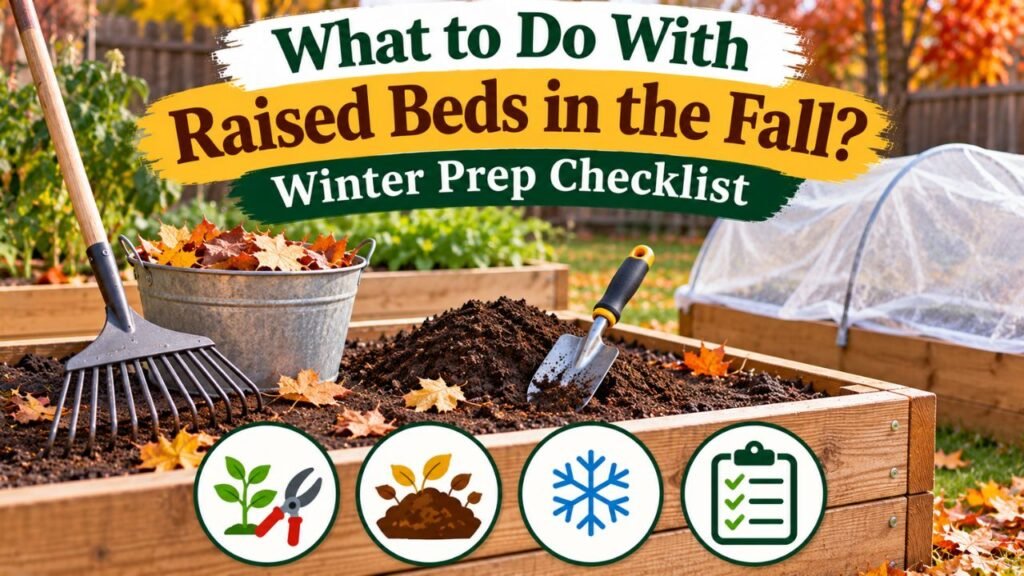
The most important fall tasks are cleaning up unhealthy plant material, protecting the soil, and deciding whether the bed will remain planted through winter.
Not every raised bed needs the same treatment.
A bed growing winter spinach needs different preparation from an empty bed that will remain unused until spring.
Fall Raised-Bed Checklist
| Fall Task | What to Do | Why It Matters |
| Harvest remaining vegetables | Collect mature crops before damaging freezes | Prevents crop loss |
| Remove diseased plants | Take out infected plant material | Reduces sources of future disease |
| Manage healthy plants | Compost healthy debris or leave suitable roots | Returns organic matter to the soil |
| Pull weeds | Remove weeds before they produce seeds | Reduces future competition |
| Check the soil | Test pH and nutrients when appropriate | Guides soil amendments |
| Add finished compost | Apply a modest layer if needed | Replenishes organic matter |
| Plant a cover crop | Sow early enough for establishment | Protects and improves soil |
| Mulch empty beds | Cover exposed soil with leaves, straw, or other mulch | Reduces erosion and temperature fluctuations |
| Protect winter crops | Use suitable row covers or cold frames | Extends the growing season |
| Inspect bed structures | Check boards, screws, drainage, and irrigation | Prevents avoidable damage |
| Plan spring planting | Record crops and soil problems | Makes next season easier |
According to the University of Minnesota Extension’s fall garden guidance, raised beds benefit from compost or other organic amendments when needed and approximately 2–4 inches of mulch to protect exposed soil.
However, the best mulch depth and preparation method should be adjusted for existing crops and local weather conditions.
Key Takeaway: Fall raised-bed preparation does not mean clearing everything and leaving bare soil. Preserve healthy soil conditions while removing material that could create problems next season.
1. Harvest Remaining Vegetables Before the First Hard Freeze
Start by checking the raised bed for vegetables that are still ready to harvest.
Cooler weather affects crops differently.
Some vegetables are damaged by even a relatively light frost, while others tolerate cold conditions and may remain productive.
Harvest Warm-Season Vegetables First
Warm-season vegetables generally have limited frost tolerance.
These include:
- Tomatoes
- Peppers
- Eggplants
- Cucumbers
- Summer squash
- Zucchini
- Many bean varieties
Harvest mature produce before a damaging freeze.
Green tomatoes that have reached an appropriate stage of development may continue ripening indoors under suitable conditions.
Do not leave frost-damaged vegetables in the bed indefinitely, as decaying fruit can encourage pests and unwanted volunteer seedlings.
Leave Cold-Hardy Vegetables When Appropriate
Some vegetables tolerate light frost or colder conditions.
Examples include:
- Kale
- Carrots
- Parsnips
- Spinach
- Collard greens
- Brussels sprouts
- Certain cabbage varieties
- Some lettuce varieties
Their cold tolerance depends on the cultivar, plant maturity, temperature, and available protection.
In colder areas, mulch or row covers may extend the harvest.
In warmer regions, some of these crops can remain productive throughout winter.
What About Root Vegetables?
Carrots, parsnips, and some other root crops can sometimes be left in the soil during cold weather.
Insulating mulch may help prevent the ground from freezing deeply.
However, extremely cold conditions, waterlogged soil, rodents, or repeated freezing and thawing can damage stored roots.
If winter conditions are unsuitable, harvest and store the vegetables properly.
Should You Harvest Everything in One Day?
Not necessarily.
Harvest crops according to their frost tolerance and condition.
For example, tomatoes may need immediate attention before a freeze, while kale can remain in a protected bed longer.
Key Takeaway: Harvest frost-sensitive crops first, but keep healthy cold-hardy vegetables growing when your climate and garden setup allow it.
2. Remove Dead, Diseased, and Spent Vegetable Plants
Fall cleanup helps reduce the amount of problematic plant material remaining in the vegetable garden.
However, it is important to distinguish healthy plant residue from material affected by disease.
Remove Diseased Plants From the Bed
Inspect plants for signs of significant disease.
Possible symptoms include:
- Unusual leaf spotting
- Severe blight
- Rotting stems
- Wilt associated with infection
- Disease-related discoloration
- Abnormal growth
- Extensive fungal infection
Remove plants with confirmed or strongly suspected disease problems.
Some pathogens survive winter on infected plant debris and can cause problems the following season.
For example, South Dakota State University Extension’s fall garden cleanup guidance recommends removing diseased plants and managing potentially infected residue carefully to reduce future disease pressure.
Can You Compost Diseased Plants?
For a typical home compost pile, it is usually safer to keep potentially infected plant material out.
Many home piles do not maintain uniformly high temperatures long enough to destroy all plant pathogens.
A properly managed high-temperature composting process may handle some diseases, but the result depends on the pathogen and composting conditions.
If you are unsure, follow local extension advice and use an appropriate disposal method.
Do not burn garden debris unless local regulations explicitly permit it and conditions are safe.
What Should You Do With Healthy Plant Material?
Healthy vegetable debris can often be composted.
Examples include:
- Healthy bean vines
- Undamaged leaves
- Spent lettuce plants
- Healthy cucumber vines
- Small nonwoody stems
Chopping larger healthy material into smaller pieces may speed decomposition.
You can add this material to a properly managed compost system or use suitable residue in a no-dig gardening approach.
Should You Pull Out All the Roots?
Not always.
In a no-dig raised bed, healthy roots can often remain underground.
A simple approach is to cut the plant at soil level and leave suitable roots to decompose naturally.
As the roots break down, they contribute organic matter and help support soil structure.
However, remove roots when they are diseased, infected with certain pests, or interfering with necessary bed repairs.
What About Tomato and Pepper Stems?
Remove dead aboveground growth when the season ends.
Healthy roots can sometimes remain in the soil in a no-dig system.
If the plant had a disease that can persist in roots or plant residue, remove the affected material according to the relevant disease guidance.
Key Takeaway: Remove diseased crops and problematic debris. Compost healthy material, and consider leaving healthy roots in place when practicing no-dig gardening.
3. Remove Weeds Before They Set More Seeds
Fall weed removal is one of the easiest ways to reduce work in spring.
Weeds can continue growing after warm-season vegetables stop producing.
Some species also survive winter and begin growing again when temperatures rise.
Which Weeds Should You Remove?
Focus on:
- Weeds with mature seed heads
- Perennial weeds
- Aggressive grasses
- Weeds growing along bed edges
- Weeds around irrigation lines
- Weeds growing between raised beds
Remove perennial weeds with as much of the root system as practical.
Examples include bindweed and other persistent plants that regenerate from underground structures.
Why Remove Weeds in Fall?
Leaving weeds can create several problems.
They may:
- Produce seeds
- Compete with winter vegetables
- Host certain pests
- Interfere with spring planting
- Spread into nearby beds
Fall cleanup is particularly useful for preventing weeds from reproducing before winter.
Can You Leave Weeds as Mulch?
Small, healthy weeds without mature seeds may be suitable for composting or controlled decomposition.
However, avoid using weeds with viable seeds or persistent roots as surface mulch.
Some can continue growing or spread.
Should You Weed the Paths Too?
Yes.
Keep the walkways around raised beds manageable.
Weeds growing beside the bed may spread into the planting area.
A layer of suitable wood chips or another walkway mulch can help reduce future weed growth.
Key Takeaway: Remove weeds before winter, particularly seed-producing and perennial species. This reduces competition and makes spring preparation easier.
4. Add Compost to Raised Beds in the Fall
Fall is a useful time to add finished compost, especially when raised-bed soil has settled or lost organic matter during the growing season.
However, compost should be applied according to the bed’s condition rather than automatically adding a large amount every year.
Why Add Compost in Fall?
Finished compost can contribute:
- Organic matter
- Improved soil structure
- Better moisture retention
- Nutrient cycling
- A more favorable environment for soil organisms
It may also help replenish material lost through gradual decomposition and soil settling.
How Much Compost Should You Add?
For an established raised bed in reasonably good condition, approximately ½–1 inch of finished compost is a practical starting range when a top-dressing is needed.
This is not a universal annual requirement.
Some beds may need less, particularly if previous compost applications have already produced high nutrient levels.
Others may require additional soil mix to restore planting depth.
Compost Amount for a 4 × 8-Foot Raised Bed
A 4 × 8-foot bed has a surface area of 32 square feet.
| Compost Depth | Approximate Volume |
| ½ inch | 1.33 cubic feet |
| 1 inch | 2.67 cubic feet |
| 2 inches | 5.33 cubic feet |
If the bed needs only a light top-dressing, approximately 2.7 cubic feet covers the full surface at a 1-inch depth.
Avoid interpreting soil settlement as proof that the bed needs pure compost.
If a large amount of soil has disappeared, it may be more appropriate to replenish the bed with a balanced raised-bed soil mixture.
Should You Mix Compost Into the Soil?
Not necessarily.
A no-dig approach allows you to spread finished compost over the existing soil surface.
Earthworms and other soil organisms can help integrate organic matter gradually.
If the soil has specific structural problems, gentle loosening or limited incorporation may be appropriate.
Avoid unnecessary deep tilling.
Can You Use Manure Instead?
Well-composted manure may be suitable when the composting process and source are reliable.
However, manure can contribute substantial nutrients and salts.
Avoid applying raw or incompletely composted manure directly around vegetables intended for harvest soon afterward.
Raw manure can contain pathogens that create food-safety risks.
Fall application alone does not guarantee safe handling or pathogen elimination.
Use properly finished compost and follow applicable food-safety guidance.
Should You Fertilize in Fall?
Do not apply fertilizer automatically.
The correct amount depends on:
- Existing nutrient levels
- Soil test results
- Whether crops are still growing
- The type of fertilizer
- Local climate
- Risk of nutrient loss
Excess fertilizer may be wasted or contribute to nutrient runoff.
For empty beds, there is often no reason to apply large amounts of readily soluble nitrogen before winter.
Key Takeaway: A modest layer of finished compost can help replenish raised-bed soil, but avoid overapplication and unnecessary fertilization.
5. Test Raised-Bed Soil Before Adding Lime or Fertilizer
Fall is a useful time to evaluate soil conditions.
Testing can identify problems before spring planting begins.
What Does a Soil Test Measure?
A standard laboratory test may report:
- Soil pH
- Phosphorus
- Potassium
- Organic matter
- Selected nutrient levels
- Recommended amendments
Available measurements differ by laboratory.
Why Test Soil in Fall?
Some soil amendments take time to react.
Fall testing allows you to plan changes before spring.
For example, lime or sulfur may be recommended when soil pH is outside the suitable range for planned crops.
However, you should not add these amendments without a clear need.
How Often Should You Test Raised-Bed Soil?
Testing every few years may be adequate for stable beds.
More frequent testing can be useful when:
- Starting a new raised bed
- Experiencing repeated crop problems
- Using large amounts of compost
- Correcting nutrient imbalances
- Managing unusual pH conditions
Follow your local soil laboratory’s recommendations.
Should You Test Every Bed Separately?
If beds contain different soil mixtures or receive different amendments, separate testing may be useful.
Avoid combining samples from beds with significantly different growing histories.
What About Store-Bought Soil Test Kits?
Home test kits may provide a rough indication of certain conditions.
However, a laboratory soil test usually provides more useful information for making fertilizer and pH decisions.
Key Takeaway: Test soil when necessary before applying lime, sulfur, or major fertilizer additions. Fall offers time to plan corrections before the next growing season.
6. Cover Empty Raised Beds With Mulch
One of the most important fall gardening steps is keeping exposed soil covered during winter.
Bare soil is more vulnerable to erosion, surface crusting, temperature fluctuations, and the loss of organic material.
A protective mulch layer helps reduce these problems.
Best Mulches for Raised Beds in Fall
Several organic materials can work.
| Mulch Material | Main Benefit | Important Consideration |
| Shredded leaves | Adds organic matter and protects soil | Whole leaves may form mats |
| Weed-free straw | Insulates soil and is easy to move | May need replenishment |
| Finished compost | Protects and improves the upper soil layer | Excessive amounts may add unwanted nutrients |
| Dried untreated grass clippings | Breaks down relatively quickly | Apply thinly to prevent matting |
| Pine needles | Provides a loose protective layer | Slow decomposition |
| Clean wood chips | Long-lasting surface protection | Less convenient for direct-seeded vegetables |
| Winter-killed cover crop residue | Protects soil naturally | Requires timely fall establishment |
For most empty vegetable beds, shredded leaves or clean straw are practical choices.
How Thick Should Fall Mulch Be?
The University of Minnesota Extension recommends approximately 2–4 inches of mulch for protecting raised beds.
This is a useful general range for empty beds.
However, adjust the depth according to the material and whether living crops remain.
A thick layer that works over an empty bed may be unsuitable directly against small lettuce plants.
Why Shred Leaves Before Applying Them?
Whole leaves sometimes form dense, wet layers.
Shredding them helps:
- Reduce matting
- Improve water movement
- Limit wind displacement
- Encourage decomposition
You can shred dry leaves with appropriate lawn equipment or another suitable method.
Avoid adding diseased plant debris from vegetable crops to the mulch.
Can You Use Cedar Mulch?
Yes, clean untreated cedar chips can protect soil.
However, cedar breaks down slowly.
This can make it inconvenient when preparing the bed for direct seeding in early spring.
For frequently replanted vegetable beds, straw or shredded leaves are often easier to manage.
Cedar and other coarse wood chips are especially useful for permanent garden pathways.
What if the Bed Already Has Mulch?
Check its condition and depth.
Do not automatically add another thick layer.
If the existing mulch is clean, functional, and sufficiently deep, it may already provide adequate protection.
Key Takeaway: Cover empty raised beds with approximately 2–4 inches of suitable mulch, adjusting for existing plants and the material used. Shredded leaves and straw are often practical choices.
7. Plant Fall Cover Crops in Raised Beds
Cover crops are plants grown primarily to protect and improve soil rather than for harvest.
They can help reduce erosion, capture nutrients, suppress weeds, and contribute organic matter.
Best Cover Crops for Raised Beds
| Cover Crop | Main Benefit | Winter Behavior |
| Oats | Quick growth and soil protection | Usually winter-killed in cold climates |
| Winter rye | Strong soil coverage and nutrient capture | Often survives winter and regrows |
| Winter wheat | Protects soil through winter | Usually overwinters |
| Crimson clover | Can contribute nitrogen through biological fixation | Winter survival varies |
| Hairy vetch | Nitrogen-fixing legume | Often survives winter |
| Forage radish | Develops substantial roots | Often winter-killed in cold climates |
| Field peas | Can contribute nitrogen | Commonly winter-killed in colder areas |
The best crop depends on your climate, planting date, and spring schedule.
When Should You Plant Cover Crops?
In many temperate U.S. regions, late summer through early fall is the main planting period.
The University of Maryland Extension’s guide to garden cover crops describes a typical planting window from mid-August through mid-October, depending on the crop and growing conditions.
However, the correct timing varies across the United States.
In northern climates, oats may need to be planted earlier.
Winter rye can often be planted later than oats because it tolerates cold conditions and can resume growth in spring.
Are Oats Good for Raised Beds?
Oats are often a beginner-friendly cover crop in cold-winter areas.
They grow relatively quickly when planted early enough.
After repeated hard freezes, oats commonly die and leave plant residue on the soil.
This residue can protect the bed until spring.
However, winterkill is not guaranteed in warm climates.
Is Winter Rye Better?
Winter rye provides strong soil protection.
It can continue growing during cooler weather and often survives winter.
However, it requires a spring termination plan.
If allowed to grow too long, rye may become difficult to manage in a small raised bed.
Its residue can also temporarily affect nitrogen availability as it decomposes.
How Do You Plant a Cover Crop?
A simple process involves:
- Remove spent vegetable plants and weeds.
- Prepare the soil surface lightly.
- Select a cover crop suitable for your climate.
- Sow seeds at the recommended rate.
- Rake or press the seeds into the soil as directed.
- Water gently.
- Keep the seedbed adequately moist during establishment.
- Allow the plants to grow before winter conditions arrive.
Use the seed supplier’s or extension service’s seeding rate for the selected species.
What if It Is Too Late to Plant Cover Crops?
If temperatures are too low for successful germination and growth, use mulch instead.
Shredded leaves or straw can still protect the soil.
You do not need to force a cover crop planting simply because it is fall.
What Happens to Cover Crops in Spring?
Winter-killed crops may leave residue that can remain as surface mulch or be managed during planting.
Overwintering crops such as rye often begin growing again when temperatures rise.
Terminate them before they compete with spring vegetables.
The appropriate timing depends on the cover crop, its growth stage, and the following vegetable.
Key Takeaway: Cover crops can protect and improve raised-bed soil. Oats are convenient where winterkill is reliable, while winter rye requires a spring management plan.
8. Plant Fall and Winter Vegetables in Raised Beds
Not every raised bed needs to become empty in fall.
In many parts of the United States, raised beds can support cool-season vegetables and overwintering crops.
The main factors are local temperatures, day length, crop variety, and protection.
Vegetables Suitable for Fall Growing
Common options include:
- Spinach
- Kale
- Lettuce
- Arugula
- Radishes
- Carrots
- Turnips
- Collard greens
- Mustard greens
- Beets
- Certain cabbage varieties
Some crops are better suited to an early fall harvest.
Others can remain in the garden through winter under appropriate conditions.
Can You Grow Spinach in Winter?
In suitable climates, spinach can survive cold weather.
In colder areas, row covers or low tunnels may improve survival.
However, growth often slows dramatically during short winter days.
A plant surviving winter does not necessarily mean it will produce new leaves quickly.
What About Kale?
Kale is relatively cold-tolerant.
Certain varieties can withstand light frosts and continue producing during cooler weather.
However, severe freezes may damage foliage or plants.
Cold tolerance depends on the variety and growing conditions.
Should You Plant Garlic in Fall?
In much of the United States, garlic is planted in fall for harvest the following year.
For many cold-climate gardens, planting occurs around the first killing frost or shortly afterward.
Use locally recommended planting dates.
Garlic needs time to establish roots before winter.
Plant cloves with the pointed ends facing upward at the depth and spacing recommended for your climate and variety.
Apply appropriate mulch in colder regions to moderate temperature fluctuations.
What About Strawberries and Perennial Herbs?
Perennial crops may also remain in raised beds through winter.
Examples include:
- Established strawberries
- Chives
- Thyme
- Oregano
- Sage
- Other locally hardy perennial herbs
Cold tolerance varies by species and cultivar.
Raised beds may expose roots to greater temperature fluctuations than in-ground soil.
Some perennial plants benefit from winter mulch or other protection.
Key Takeaway: Raised beds can remain productive in fall. Choose cold-tolerant crops and match planting dates and protection methods to your local climate.
9. Protect Fall Vegetables With Row Covers or Cold Frames
If you plan to keep vegetables growing, you may need additional cold protection.
Row covers, low tunnels, and cold frames can extend the growing season.
However, they provide different amounts of protection.
Floating Row Covers
Floating row covers are lightweight garden fabrics placed over crops.
Depending on the material, they can:
- Reduce frost exposure
- Provide modest insulation
- Protect against certain insects
- Reduce wind stress
Support the fabric with hoops when necessary to prevent damage to plants.
Anchor the edges securely.
Low Tunnels
A low tunnel uses hoops positioned over the raised bed.
The covering may be frost fabric or appropriately managed greenhouse film.
Low tunnels can help protect vegetables from cold conditions.
However, clear plastic can trap heat rapidly during sunny weather.
Ventilate when necessary.
Cold Frames
A cold frame is a low, enclosed structure with a transparent top.
It can provide additional protection for cool-season vegetables and seedlings.
However, temperatures inside a cold frame may rise quickly on sunny days.
Regular ventilation is important.
Should You Keep the Cover Closed All Winter?
Not automatically.
Living plants need suitable temperatures, airflow, and moisture.
Check the cover regularly.
Ventilation requirements depend on the weather and the type of structure.
Can a Row Cover Prevent Every Freeze?
No.
A row cover provides limited protection.
Its effectiveness depends on fabric weight, temperature, wind, duration of cold exposure, and installation.
Severe freezing conditions may damage plants even when covered.
Key Takeaway: Row covers, low tunnels, and cold frames can extend the fall harvest, but they require monitoring and cannot guarantee protection against extreme cold.
10. Prepare Raised Beds for Freezing Weather and Winter Moisture
Raised beds can experience more rapid temperature changes because their sides are exposed.
This is particularly important for shallow beds and beds placed on concrete or other hard surfaces.
Do You Need to Water Raised Beds Before Winter?
It depends on the soil moisture and whether living plants remain.
If the bed contains winter crops or perennials, avoid allowing the root zone to become excessively dry.
However, do not saturate soil that already has adequate moisture.
In wet climates, additional irrigation may be unnecessary.
Should Empty Beds Be Watered?
An empty, mulched bed generally does not require routine irrigation simply because it is winter.
Natural rainfall or snow may provide moisture.
In unusually dry regions, moisture management depends on the soil, climate, and any living plants.
Check Drainage Before Heavy Rain
Raised beds must allow excess water to drain.
Inspect for:
- Blocked drainage openings
- Water pooling
- Compacted growing media
- Settled soil obstructing outlets
- Problems where the bed meets a patio or concrete surface
A raised bed with a closed bottom must have an appropriate drainage system.
Do not allow water to accumulate in a way that damages plant roots or bed materials.
Should You Drain Drip Irrigation Lines?
In freezing climates, protect irrigation equipment according to the manufacturer’s instructions.
Possible tasks include:
- Disconnecting hose timers
- Removing batteries when recommended
- Draining exposed irrigation lines
- Disconnecting hoses
- Storing vulnerable components indoors
- Protecting exterior faucets
Do not assume drip lines, timers, and connectors are all freeze-resistant.
Does Winter Mulch Prevent Soil From Freezing?
No.
Mulch primarily moderates temperature changes and reduces exposure.
It may help delay freezing or reduce repeated freeze-thaw fluctuations.
However, soil can still freeze beneath mulch during sufficiently cold conditions.
Key Takeaway: Check drainage, manage moisture according to living crops, and winterize irrigation equipment where freezing conditions occur.
11. Inspect and Repair Raised-Bed Frames in Fall
Fall is a convenient time to check the physical condition of raised garden beds.
Once annual crops are removed, the frame may be easier to inspect.
Wooden Raised Beds
Inspect wooden frames for:
- Rotting boards
- Loose screws
- Splitting
- Bowed sidewalls
- Weak corner connections
- Soil leaking through gaps
Replace damaged components before the following growing season.
Do not assume every discolored board is structurally unsound.
However, soft wood, severe splitting, or visible movement may indicate a problem.
Metal Raised Beds
Check for:
- Loose bolts
- Bent panels
- Sharp edges
- Damaged protective coatings
- Corrosion
- Soil pressure causing distortion
Use compatible replacement hardware.
Avoid leaving sharp edges exposed where people will work in the garden.
Plastic and Composite Raised Beds
Inspect joints and connectors.
Check for cracking, deformation, or loosened sections.
Some materials become more brittle after prolonged outdoor exposure.
Should You Empty the Bed to Repair It?
Usually not.
Minor repairs can often be completed without removing the soil.
If the frame is severely damaged and needs replacement, temporary soil removal may be necessary.
Plan the repair carefully to avoid damaging nearby plant roots and irrigation lines.
Check Garden Pathways
Inspect paths for erosion and drainage problems.
Add suitable mulch or repair surfaces where needed.
Keep walkways safe and accessible.
Key Takeaway: Inspect raised-bed frames after the main harvest. Address loose connections, damaged boards, corrosion, and drainage problems before winter makes repairs more difficult.
12. Should You Cover Raised Beds With Plastic in the Fall?
You do not normally need to cover empty raised beds with plastic for the entire winter.
A layer of organic mulch or a suitable cover crop is often sufficient for protecting soil.
Plastic covers serve different purposes depending on their design.
Organic Mulch vs. Plastic Cover
| Covering | Main Purpose | Best Use |
| Shredded leaves | Soil protection and organic matter | Empty vegetable beds |
| Straw | Insulation and weed suppression | Empty beds and overwintering crops |
| Cover crop | Living soil protection | Beds planted early enough |
| Opaque tarp | Temporary weed suppression | Specific weed-control projects |
| Clear plastic over hoops | Heat retention | Managed low tunnels |
| Floating row cover | Modest frost protection | Growing fall vegetables |
Why Is Organic Mulch Often Better?
Organic mulch allows water to reach the soil while protecting the surface.
It also gradually decomposes.
A tightly installed plastic sheet over soil can change water movement and create undesirable moisture conditions if used incorrectly.
When Is a Tarp Useful?
An opaque tarp may be useful for suppressing persistent weeds in an otherwise unused bed.
However, it must be secured against wind.
Its use should be temporary and planned.
A tarp is not automatically necessary for routine winter soil care.
Is Clear Plastic Good for Winter Vegetables?
Clear greenhouse film over properly supported hoops can provide additional warmth.
However, it may cause overheating on sunny days.
Ventilation is essential.
Do not assume clear plastic laid directly on plants provides the same protection as a properly managed tunnel.
Key Takeaway: Use mulch or cover crops for ordinary winter soil protection. Reserve plastic tarps and greenhouse film for specific purposes with appropriate installation and monitoring.
What to Do With Raised Beds in the Fall in Different U.S. Climates
Fall gardening practices vary considerably across the United States.
The first frost date, winter temperature, rainfall, and growing season length all affect raised-bed preparation.
Cold Northern Regions
In regions with long, freezing winters, focus on:
- Harvesting tender crops before hard freezes
- Removing diseased vegetable debris
- Mulching empty soil
- Protecting hardy perennials
- Planting garlic at the appropriate time
- Winterizing irrigation
- Managing cover crops before freezing weather
In these regions, oats may winterkill while winter rye often survives.
Temperate Regions With Moderate Winters
In areas with relatively mild fall weather but occasional winter freezes:
- Continue suitable cool-season crops
- Use row covers when needed
- Plant fall cover crops early enough
- Mulch unused beds
- Monitor winter moisture and drainage
- Prepare for occasional hard freezes
Southern and Mild-Winter Regions
In many southern areas, fall can be an important growing season.
Raised beds may support:
- Lettuce
- Kale
- Spinach
- Carrots
- Radishes
- Collards
- Other cool-season vegetables
The main challenges may include variable temperatures, heavy rain, and occasional freezes rather than prolonged snow cover.
Coastal or Rainy Winter Climates
In areas with substantial winter rainfall, pay particular attention to:
- Drainage
- Soil erosion
- Slug activity
- Mulch thickness
- Overwatering
- Waterlogged soil
Avoid unnecessary irrigation when the soil is already wet.
Regional Comparison
| Climate | Main Fall Priority |
| Cold northern winter | Protect empty soil and overwintering crops |
| Moderate winter | Combine cleanup with cool-season planting |
| Mild southern winter | Continue vegetable production |
| Wet coastal winter | Manage drainage and soil protection |
| Dry winter region | Monitor moisture around living plants |
| Windy or exposed location | Secure mulch, covers, and trellises |
Key Takeaway: Fall preparation should follow local frost dates and weather conditions. Raised beds in Minnesota and Florida do not need identical winter routines.
Fall Raised-Bed Preparation Schedule
A simple timeline can help you organize the work.
However, use your local frost dates rather than relying on the calendar alone.
Early Fall
When summer crops begin slowing down:
- Harvest remaining produce.
- Remove weeds.
- Identify crops that are finished.
- Check for disease.
- Plant suitable fall vegetables.
- Sow cover crops where time allows.
- Arrange soil testing if necessary.
Mid-Fall
As temperatures fall:
- Remove spent warm-season crops.
- Compost healthy residue.
- Dispose of problematic diseased material.
- Add finished compost where needed.
- Prepare beds for garlic planting.
- Install frost protection for suitable crops.
- Apply mulch to empty areas.
Late Fall
Before prolonged freezing weather:
- Check mulch depth.
- Secure row covers and tunnels.
- Inspect raised-bed frames.
- Remove or secure unsupported trellises.
- Winterize irrigation equipment.
- Check drainage.
- Record plans for the following season.
Quick 30-Minute Cleanup for a Small Bed
If you have limited time, prioritize:
- First 10 minutes: Harvest remaining produce and remove obvious diseased plants.
- Next 10 minutes: Pull weeds and remove unwanted debris.
- Final 10 minutes: Spread available clean mulch over exposed soil.
This short routine is not a replacement for every maintenance task.
However, it addresses several important issues before winter.
Key Takeaway: Work gradually through fall rather than waiting for the first hard freeze. The most time-sensitive tasks are harvesting tender crops and establishing cover crops before the growing window closes.
What Should You Leave in Raised Beds Over Winter?
Not everything needs to be removed.
Leaving selected materials can benefit the soil and garden ecosystem.
Healthy Plant Roots
In no-dig systems, healthy roots can remain underground.
They gradually decompose and contribute organic matter.
Remove roots when disease or pest concerns make removal appropriate.
Finished Compost
A suitable compost top-dressing can remain on the bed through winter.
It does not need to be removed before spring planting.
Organic Mulch
Straw, shredded leaves, and other appropriate mulch materials can remain in place.
Move mulch aside in spring when necessary to allow the soil to warm or to prepare seed rows.
Cover Crop Residue
Winter-killed cover crops can remain as protective surface material.
Overwintering cover crops require appropriate termination before spring planting.
Cold-Hardy Vegetables
Suitable kale, spinach, garlic, and other cold-tolerant crops may remain growing.
Their survival depends on climate and protection.
Healthy Perennial Stems and Habitat
In perennial flower beds, some healthy stems and seed heads can remain standing.
They may provide food or shelter for wildlife.
However, this approach differs from leaving infected vegetable crop residue in a bed where disease could recur.
Key Takeaway: Healthy roots, mulch, cover crop residue, and appropriately hardy plants can remain in raised beds. Remove material that is diseased or likely to create problems.
Common Mistakes When Preparing Raised Beds for Fall
Avoiding a few common errors can protect soil health and reduce spring work.
1. Leaving Soil Completely Bare
Uncovered soil is more vulnerable to erosion and surface damage.
Apply suitable mulch or establish a cover crop.
2. Composting Diseased Plants Without Proper Management
Home compost piles may not reliably eliminate plant pathogens.
Keep potentially infected material out unless the composting method is appropriate.
3. Adding Too Much Compost
Excessive compost can cause nutrient accumulation or other soil imbalances.
Use soil testing and the bed’s condition to guide application.
4. Applying Fertilizer Without Testing
Fall is not automatically the right time for large nutrient applications.
Avoid wasting fertilizer or increasing runoff risk.
5. Mixing Fresh Wood Chips Into the Soil
Fresh woody materials can temporarily immobilize nitrogen during decomposition.
Use wood chips primarily as surface mulch or walkway material rather than mixing them into the vegetable root zone.
6. Planting Cover Crops Too Late
Seeds need suitable temperatures and time to establish.
If planting conditions are no longer favorable, mulch the bed instead.
7. Forgetting Spring Cover Crop Management
Winter rye and other overwintering cover crops can resume growing in spring.
Plan how and when you will terminate them.
8. Using Excessively Thick Mulch Around Living Plants
Mulch can protect soil but may cause problems when piled against crowns or stems.
Keep the immediate plant bases clear.
9. Ignoring Drainage
Wet soil can remain waterlogged beneath mulch or covers.
Check that the bed drains correctly.
10. Removing Every Healthy Root
Healthy roots can contribute organic matter as they decompose.
Complete removal is not always necessary in a no-dig gardening system.
11. Forgetting Irrigation Equipment
Freezing weather can damage exposed hoses, timers, and connectors.
Follow the manufacturer’s winterization instructions.
12. Assuming Every Bed Needs Plastic
Routine empty-bed protection usually does not require a sealed plastic cover.
Organic mulch or a cover crop is often more appropriate.
Key Takeaway: The biggest fall mistakes are leaving bare soil, failing to remove diseased material, overapplying amendments, and ignoring winter moisture or cover crop management.
How to Prepare Fall Raised Beds for Easy Spring Planting
Fall preparation should make the next growing season easier.
A well-managed bed often needs less disruptive work in spring.
Record What Grew in Each Bed
Write down the crops grown during the season.
Include any recurring disease or pest problems.
This helps with crop rotation and future planning.
Plan Crop Rotation
Avoid growing the same crop family in the same location repeatedly when practical.
For example, tomatoes, peppers, and eggplants belong to the nightshade family.
Rotating crop families can help reduce some disease and pest problems.
However, rotation is not equally effective against every pathogen, and small gardens have limited space.
Note Soil Problems
Record issues such as:
- Poor drainage
- Excessive drying
- Compaction
- Low soil levels
- Nutrient deficiencies
- Persistent weeds
- Soilborne disease concerns
These notes help determine what needs attention before the next planting.
Plan Spring Mulch Removal
In spring, you may need to pull back some mulch so the soil can warm and seeds can germinate.
Do not assume that all winter mulch needs to be removed permanently.
It can often be returned around established plants.
Prepare to Terminate Cover Crops
If you planted winter rye or another overwintering crop, plan its removal or termination before spring vegetables are planted.
Allow appropriate time for decomposition.
Avoid letting the cover crop become an unwanted competitor.
Check Soil Moisture Before Working
Do not cultivate or heavily disturb soil when it is saturated.
Working excessively wet soil can damage its structure.
Wait until the soil is workable.
Make a Spring Planting Plan
Decide:
- Which vegetables to grow
- Which bed each crop will use
- Whether trellises are needed
- When to start seeds
- Whether additional compost is necessary
- Which irrigation repairs need completion
Key Takeaway: Use fall to document problems and prepare for spring. Good records, protected soil, and planned cover crop management make the next season easier.
Conclusion
Knowing what to do with raised beds in the fall helps protect your garden soil, reduce future pest and disease problems, and prepare for a more productive spring.
Start by harvesting remaining vegetables and removing diseased plants. Pull weeds before they produce more seeds, then evaluate the condition of the soil.
If the bed needs additional organic matter, apply an appropriate amount of finished compost. Avoid excessive fertilizer or manure applications without considering soil test results and food safety.
Next, protect exposed soil with shredded leaves, straw, or another suitable mulch. A fall cover crop is another option when enough growing time remains before winter.
You do not need to remove every healthy root or leave every bed empty. Cold-hardy vegetables, garlic, and perennial plants can remain in raised beds when properly managed for the local climate.
Also inspect the bed frame, check drainage, and winterize irrigation equipment where freezing temperatures occur.
For most empty raised beds, I recommend a simple approach: remove problematic debris, add compost only as needed, and keep the soil covered until spring.
These steps help maintain soil conditions while reducing unnecessary gardening work.
FAQs About What to Do With Raised Beds in the Fall
Should I empty my raised garden beds in the fall?
No. Raised beds generally do not need to be emptied each fall. Remove spent or diseased plants, manage healthy roots as appropriate, and protect the existing soil with mulch or a cover crop. Replace soil only when there is a specific structural or soil-quality reason.
Should I put compost in raised beds in the fall?
Yes, if the soil needs additional organic matter. A modest layer of finished compost can help maintain soil structure and replenish material lost through decomposition. However, avoid adding large amounts automatically, especially when the bed already has high nutrient levels.
What is the best thing to cover raised beds with in winter?
Shredded leaves and weed-free straw are practical choices for many empty vegetable beds. A suitable cover crop is another option when planted early enough. Approximately 2–4 inches of mulch is a useful general range for protecting empty soil, depending on the material and conditions.
Should I pull out dead vegetable plants before winter?
Remove diseased and problematic plant material. Healthy aboveground residue can often be composted, while healthy roots may remain underground in a no-dig bed. Remove roots when disease, pests, or necessary bed repairs make it appropriate.
Can I leave my raised beds uncovered all winter?
You can, but it is generally better to protect exposed soil. Bare soil is more vulnerable to erosion, temperature fluctuations, and surface damage. Organic mulch or cover crops provide useful protection without requiring a permanent plastic covering.
What vegetables can I grow in raised beds during fall and winter?
Depending on the climate, suitable crops include spinach, kale, lettuce, carrots, radishes, collard greens, and other cool-season vegetables. Garlic is commonly planted in fall for harvest the following year. Cold frames and row covers can provide additional protection in some regions.
Do I need to water raised beds in winter?
It depends on the weather and whether living plants remain. Empty beds usually do not need routine winter irrigation when natural precipitation supplies adequate moisture. Overwintering vegetables and perennials may need occasional watering during prolonged dry periods, provided the soil is not frozen or waterlogged.

I’m Maya L. Greenwood, a lifelong plant lover who believes anyone can grow something beautiful with the right guidance. After years of testing soil mixes, pruning methods, irrigation tricks, and pest-safe solutions, I started EasyGardenTips.com to turn hard-won lessons into step-by-step advice. From seed starting and container gardens to composting and seasonal checklists, my goal is to make gardening simple, sustainable, and fun.