Should I Cover My Raised Beds With Plastic in Winter? What Works
Usually, no—you do not need to cover an empty raised garden bed with plastic for the entire winter. A layer of shredded leaves, clean straw, or another organic mulch generally protects bare soil while allowing rainfall and air exchange. Plastic becomes more useful when stretched over hoops to shelter winter vegetables or temporarily used as a managed tarp for weeds or very wet conditions.
The key distinction is whether plastic lies directly on the soil or forms a tunnel above growing plants. A sealed sheet may keep out beneficial precipitation and does little to improve soil. A supported clear cover can shield cold-hardy crops from wind and rain, but it must be secured and ventilated to prevent overheating. Plastic touching leaves during freezing weather may also damage them.
Raised beds can freeze and thaw more quickly than surrounding soil, especially when their sides are exposed. That makes seasonal protection worthwhile, but the right material depends on climate, crops, and drainage.
In this article, I explain when winter plastic is helpful or harmful, how to protect empty beds and living crops, and which covers work best. You’ll also learn how to build a low tunnel, manage wet weather, and prepare the soil for spring.
Should I Cover My Raised Beds With Plastic in Winter or Leave Them Uncovered?
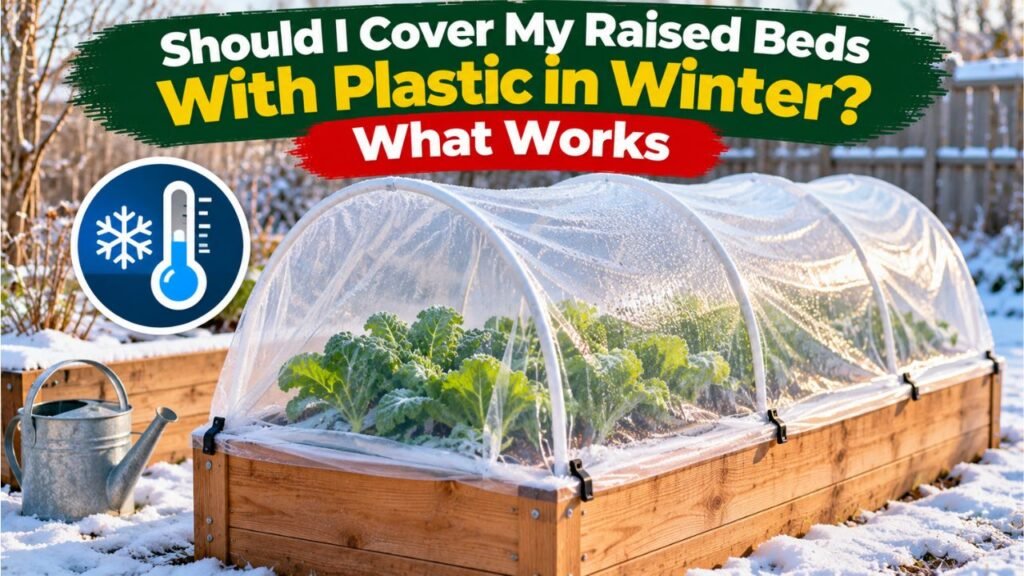
For an empty raised bed, organic mulch or a winter cover crop is generally a better choice than a tightly sealed plastic sheet. However, plastic can be useful for protecting actively growing winter vegetables when supported above the plants.
The decision depends on what you want to protect.
A raised bed containing bare soil has different needs from one growing kale, spinach, or other cold-tolerant vegetables.
Winter Raised Bed Covering: Quick Comparison
| Raised Bed Condition | Recommended Protection | Is Plastic Necessary? |
| Empty bed after summer harvest | Shredded leaves, straw, or cover crops | Usually no |
| Bed with winter vegetables | Frost cloth or a supported low tunnel | Sometimes |
| Bed exposed to heavy winter rain | Mulch, drainage management, or a ventilated rain shelter | Occasionally |
| Bed with significant weed problems | Mulch or temporary managed tarping | Sometimes |
| Bed in a snowy climate | Organic mulch and suitable plant protection | Usually not for bare soil |
| Bed prepared for early spring planting | Temporary black or clear plastic soil-warming methods | Optional |
| Bed with established perennial plants | Suitable mulch around plants | Usually no |
A plastic sheet should not automatically be used just because winter is approaching.
For many raised beds, protecting the soil with organic material is simpler and more beneficial.
Why Empty Raised Beds Usually Don’t Need Plastic
Bare soil benefits from protection against erosion, heavy rainfall, and temperature changes.
However, impermeable plastic blocks precipitation from reaching the surface.
It also doesn’t contribute organic matter as it breaks down.
In a direct response to a gardener asking whether to cover raised beds with plastic during winter, University of Maryland Extension recommended shredded leaves instead.
The extension specialist explained that plastic prevents precipitation from entering the covered soil and suggested winter cover crops as another beneficial option.
When Plastic Becomes Useful
Plastic may be appropriate when you want to:
- Protect winter vegetables from cold wind and heavy rain.
- Create a small greenhouse-like tunnel.
- Temporarily suppress weeds using an opaque tarp.
- Keep a planting area drier before early spring preparation.
- Warm soil before planting certain warm-season crops.
The type of plastic and installation method matter.
A clear plastic tunnel and a black tarp lying directly on the soil do not perform the same function.
Key Takeaway: Leave empty beds protected with mulch or cover crops. Reserve plastic for specific purposes such as season extension, managed weed suppression, or temporary soil preparation.
What Happens if You Cover Raised Bed Soil With Plastic All Winter?
A plastic sheet placed directly over the soil changes how moisture, sunlight, and air reach the bed.
That can be beneficial under carefully managed conditions, but it may also create problems.
Plastic Prevents Rain and Snow From Reaching the Soil
Most ordinary polyethylene sheeting is waterproof.
If the edges are secured, rainfall and melting snow cannot easily enter the covered soil from above.
This can be helpful when you are deliberately trying to keep an excessively wet bed drier.
However, an empty garden bed doesn’t normally need to be isolated from winter precipitation.
Soil moisture supports biological activity, and rain helps replenish water supplies for spring.
The actual result depends on how wet the soil was before covering, drainage, and whether water enters from the sides.
A Tight Cover Changes Soil Surface Conditions
An impermeable plastic sheet limits direct air and water exchange at the covered soil surface.
This is different from organic mulch, which allows rainwater to move through the material.
Temporary plastic coverings can be useful in agricultural production, but leaving a tightly sealed sheet in place without a specific purpose provides fewer soil-building benefits than organic mulch or cover crops.
Plastic Doesn’t Improve Soil Fertility
Plastic does not decompose into useful organic matter.
By contrast, materials such as shredded leaves and straw gradually break down.
Organic mulch can help protect the soil surface and contribute organic material over time.
That doesn’t mean a plastic-covered bed automatically becomes infertile.
It means the plastic itself does not provide the soil-improvement benefits associated with decomposing plant material.
Plastic May Trap Moisture Beneath the Cover
A tightly covered bed may experience condensation or localized moisture accumulation.
If the soil was already saturated, covering it does not solve poor drainage.
Water entering from surrounding ground or through the bed’s sides can also remain a problem.
Plastic should not be considered a substitute for proper drainage.
Plastic Can Create Waste and Cleanup Problems
Lightweight sheeting can tear under wind, sunlight, snow, and repeated handling.
Fragments may become mixed with the garden soil.
For a reusable covering system, select durable, appropriately rated material and inspect it regularly.
Remove damaged plastic before pieces become scattered through the garden.
Key Takeaway: Keeping plastic directly over bare soil all winter is generally unnecessary unless you’re deliberately managing weeds, rain exposure, or spring planting conditions.
What Is the Best Way to Protect Empty Raised Garden Beds in Winter?
The simplest approach is to protect exposed soil with organic mulch or a suitable cover crop.
These methods reduce erosion and help maintain soil condition between growing seasons.
Option 1: Cover the Soil With Shredded Leaves
Shredded leaves are an excellent winter covering for many raised beds.
They are inexpensive, easy to obtain in fall, and gradually decompose.
Use leaves that are free of significant contamination and inappropriate pesticide residues.
Spread approximately 2 inches over the soil surface as a practical starting point.
According to Oregon State University Extension’s raised-bed gardening guide, covering raised beds with 2 inches of leaves or other organic material each winter can help protect and improve the beds.
Shredding leaves reduces matting and makes them less likely to blow away.
Avoid burying small living plants beneath dense layers.
Option 2: Apply Clean Straw Mulch
Straw can also provide a protective winter layer.
A loose covering of approximately 2–3 inches is a useful starting point.
Choose clean straw with minimal seeds.
Verify that it is suitable for vegetable gardening and has not been exposed to herbicides that could harm future crops.
Straw helps moderate temperature changes and reduce the impact of rain on exposed soil.
However, thick damp layers can shelter slugs or rodents.
Check the bed occasionally.
Option 3: Plant a Winter Cover Crop
Cover crops protect soil using living roots and aboveground growth.
They can help:
- Reduce erosion
- Suppress weeds
- Retain nutrients
- Support soil organisms
- Add organic matter
- Improve soil structure
Examples include winter rye, oats, crimson clover, and suitable mixtures.
Not every crop survives winter in every climate.
Winter rye is relatively cold-hardy, while oats may winterkill in colder regions.
Crimson clover performance also depends on the local climate and planting date.
Choose a cover crop suitable for your USDA region and the time available before freezing weather.
Remember that living cover crops need to be terminated or managed before spring vegetable planting.
Option 4: Use Finished Compost as a Topdressing
Finished compost can be applied to a raised bed after the growing season.
A modest layer can add organic matter and improve the surface condition.
However, compost is not always as effective as coarse mulch for suppressing weeds or cushioning heavy rain.
For an empty bed, combining an appropriate compost topdressing with shredded leaves can be practical.
Avoid adding excessive compost or fertilizer without considering soil test results.
Organic Winter Covering Comparison
| Material | Soil Protection | Weed Suppression | Adds Organic Matter |
| Shredded leaves | Good | Moderate to good | Yes |
| Clean straw | Good | Good at suitable depth | Yes |
| Finished compost | Moderate | Limited to moderate | Yes |
| Winter cover crops | Good | Depends on establishment | Yes |
| Black plastic tarp | Can shield soil temporarily | Good when managed correctly | No |
| Clear plastic sheet | Depends on use | Not reliable for suppressing weeds | No |
Key Takeaway: For most empty raised beds, shredded leaves, straw, or an appropriate cover crop provide more useful long-term soil protection than an impermeable plastic sheet.
Should You Cover Raised Beds With Plastic When Growing Vegetables in Winter?
Yes, a clear plastic low tunnel can be useful for protecting cold-tolerant vegetables during winter.
However, the plastic should be supported above the crops rather than resting directly on their leaves.
This creates a sheltered growing area that can reduce exposure to wind, rain, and some cold conditions.
What Is a Plastic Low Tunnel?
A low tunnel is a short protective structure built over a garden bed.
It usually consists of:
- Flexible hoops
- Clear greenhouse-rated plastic
- Stakes or other suitable supports
- Clips or fasteners
- Anchors for the edges
The hoops hold the plastic above the plants.
Sunlight passes through the clear cover, helping warm the enclosed space during the day.
The covering also reduces direct wind exposure.
Which Vegetables Can Benefit?
Cold-tolerant crops are the best candidates.
Examples include:
- Spinach
- Kale
- Arugula
- Mâche
- Certain lettuce varieties
- Swiss chard
- Carrots
- Beets
- Parsley
The ability of these crops to survive winter varies with variety, plant maturity, local temperatures, and the amount of protection provided.
A simple plastic tunnel will not reliably keep warm-season vegetables such as tomatoes and peppers alive through severe winter freezes.
How Much Cold Protection Does Plastic Provide?
A low tunnel can moderate the environment around plants.
However, it is not equivalent to a heated greenhouse.
The benefit depends on sunlight, soil heat, wind, cover design, and nighttime temperatures.
During a prolonged severe freeze, temperatures inside an unheated tunnel may still fall below the survival limits of the crops.
Additional insulating row cover beneath the plastic may help, but it cannot guarantee survival in extreme conditions.
Why Ventilation Matters
Sunlight can quickly raise the temperature inside a clear plastic tunnel.
Even during cold weather, an enclosed tunnel may overheat on a sunny day.
The University of Minnesota Extension’s season-extension guidance recommends opening the ends of supported covers for ventilation when conditions become warm.
Plastic also restricts airflow more than breathable row-cover fabric.
Excess humidity and condensation can develop if the tunnel remains tightly closed.
Key Takeaway: A supported clear plastic tunnel can extend the harvest of cold-hardy vegetables, but it needs ventilation, monitoring, and additional protection during severe freezes.
How to Cover a Raised Garden Bed With Plastic for Winter
If you plan to keep vegetables growing through winter, building a low tunnel is usually more effective than laying plastic directly over them.
The following method works for many standard rectangular raised beds.
Materials You’ll Need
- Clear greenhouse-rated polyethylene film
- Flexible PVC, fiberglass, or metal hoops suitable for garden use
- Appropriate hoop anchors or stakes
- Clips or fasteners designed for the covering
- Soil staples, sandbags, or other suitable edge weights
- A thermometer for monitoring conditions
- Optional frost cloth for extra insulation
Some gardeners use approximately 6-mil greenhouse film, but the appropriate material depends on the structure, climate, and product specifications.
Choose UV-resistant plastic intended for repeated outdoor exposure if you plan to reuse it.
Step 1: Prepare the Raised Bed
Remove weeds and unhealthy plant debris.
Inspect the soil and drainage.
Check that the winter vegetables are established and suitable for the expected temperatures.
Water if needed before covering.
Avoid starting with saturated soil.
Step 2: Install the Hoops
Position hoops across the width of the raised bed.
For a typical 4×8-foot bed, several hoops spaced approximately 2–3 feet apart can provide a useful starting arrangement.
The exact number depends on hoop strength, tunnel height, wind exposure, and expected snow loads.
Anchor them securely.
The tunnel should provide enough room for plants to grow without touching the plastic.
Step 3: Drape Clear Plastic Over the Hoops
Place the plastic over the structure.
Allow enough material to reach the sides and ends.
Keep the film reasonably taut so it doesn’t sag onto the plants.
Avoid sharp frame edges that could tear the material.
Step 4: Secure the Cover
Fasten the plastic using appropriate clips or other manufacturer-approved methods.
Anchor the sides to prevent wind from lifting the cover.
Use suitable weights or buried edges according to the tunnel design.
Do not place unstable bricks or heavy objects where they could fall onto someone or damage the bed.
Step 5: Create Accessible Ventilation
Design the tunnel so the ends or sides can be opened.
This allows you to:
- Release excess daytime heat
- Reduce condensation
- Check soil moisture
- Inspect plants
- Harvest vegetables
A completely sealed tunnel is more difficult to manage.
Step 6: Monitor Temperature and Moisture
Place a suitable thermometer inside the tunnel.
Inspect the conditions during sunny periods and freezing nights.
Ventilate when the interior becomes too warm.
Check whether the soil needs water because rainfall may not reach it through the cover.
Avoid watering so heavily that the bed remains saturated.
Step 7: Inspect After Wind or Snow
Snow and strong wind can damage a lightweight low tunnel.
Inspect the hoops, anchors, and plastic after storms.
Remove excessive snow from the structure when it is safe to do so.
A simple garden tunnel is not necessarily designed to support heavy snow loads.
If substantial snow or ice accumulation is expected, use a structure rated for those conditions or another appropriate protection method.
Key Takeaway: A winter plastic tunnel needs strong supports, secure edges, adequate plant clearance, and adjustable ventilation.
Clear Plastic vs. Black Plastic for Raised Beds in Winter
Clear and black plastic serve different gardening purposes.
Choosing the wrong type can make a winter covering ineffective.
Clear Plastic vs. Black Plastic Comparison
| Feature | Clear Plastic | Black Plastic |
| Transmits light | Yes | No |
| Suitable above growing crops | Yes, when supported and managed | No, if it blocks needed light |
| Helps create a greenhouse effect | Yes | Not in the same way |
| Used for weed suppression | Sometimes for solarization in warm seasons | Yes, through light exclusion |
| Used to warm soil | Yes | Yes |
| Allows rain through | No, unless designed with openings | No, unless designed with openings |
| Best winter use | Supported low tunnels | Temporary managed tarping |
| Requires removal or management | Yes | Yes |
When Clear Plastic Is Better
Use clear plastic when growing vegetables beneath a low tunnel.
It allows sunlight to reach the plants while providing protection from direct wind and rain.
However, clear plastic can also cause excessive heating.
Ventilation remains essential.
When Black Plastic Is Better
Black plastic blocks sunlight and can suppress plant growth underneath.
This makes it potentially useful for temporary weed management or preparing a bed for spring planting.
However, it is generally unsuitable for covering growing winter vegetables because they need light.
Black plastic should not be treated as an all-purpose winter soil improvement method.
Does Black Plastic Keep Raised Beds Warm?
Black plastic can absorb sunlight and help warm soil under suitable conditions.
It is often used to prepare soil for planting in early spring.
However, winter sunlight, snow cover, and weather conditions strongly influence its effectiveness.
It does not provide the same protection as an insulating blanket or a properly designed low tunnel.
Does Clear Plastic Kill Weeds in Winter?
Not reliably.
Clear plastic is used for soil solarization, a technique that relies on strong solar heating to suppress certain weeds and soilborne pests.
It is generally most effective during warm, sunny periods rather than in the middle of winter.
Black tarping works differently by excluding light.
Neither technique should be assumed to eliminate every weed seed or persistent perennial weed.
Can You Use a Tarp to Cover an Empty Raised Bed in Winter?
A tarp can be useful for a specific short-term purpose.
For example, gardeners sometimes cover beds temporarily to suppress weeds or prevent excessive rainfall immediately before planting.
However, leaving an impermeable tarp in place for the entire winter is usually unnecessary when organic mulch or cover crops would meet the goal.
When Tarping May Help
Temporary tarping can be useful when:
- You need to suppress existing weeds.
- You want to reduce new weed emergence before planting.
- You are preparing a bed during a particularly wet period.
- You need to keep a small area drier for upcoming soil work.
How to Use a Tarp Correctly
- Remove large weeds and unsuitable debris.
- Prepare the soil according to your weed-management goal.
- Check the existing soil moisture.
- Lay an opaque, reusable tarp over the bed.
- Secure the edges against wind.
- Avoid allowing large amounts of water to pool on the surface.
- Inspect the covering periodically.
- Remove it when its intended purpose has been achieved.
- Check soil moisture and condition before planting.
Tarping is a managed garden practice rather than a permanent soil covering.
Will a Tarp Stop Weeds From Growing?
An opaque tarp can suppress many weeds by blocking sunlight.
However, effectiveness depends on duration, temperature, weed species, and the condition of the soil.
Certain perennial weeds can survive or regrow after tarping.
Cover crops and organic mulch may provide better long-term benefits when weed suppression is not the only goal.
Can Plastic Prevent Winter Nutrient Loss?
Excluding rainfall can reduce certain water-related processes, but it isn’t a complete nutrient-management strategy.
Winter cover crops can absorb and retain nutrients that might otherwise move out of the soil.
For ordinary raised-bed gardening, maintaining soil cover with living plants or organic mulch is often a more practical approach.
Key Takeaway: Use a tarp when you have a defined weed-control or soil-preparation goal. Don’t assume every raised bed needs to remain sealed under plastic all winter.
Plastic vs. Frost Cloth vs. Mulch: Which Is Best for Winter Protection?
Plastic isn’t the only option for protecting raised beds.
Frost cloth, organic mulch, and cover crops serve different purposes.
Winter Protection Materials Compared
| Material | Main Purpose | Best Use |
| Clear greenhouse plastic | Creates a sheltered growing space | Winter low tunnels |
| Frost cloth | Provides limited cold protection | Living plants |
| Shredded leaves | Protects and improves soil | Empty beds |
| Clean straw | Insulates the soil surface | Bare soil and certain crops |
| Winter cover crops | Protects soil with living roots | Empty beds before winter |
| Black tarp | Excludes light | Temporary weed suppression |
| Cold frame | Shelters crops in a rigid enclosure | Winter greens and seedlings |
Frost Cloth for Winter Vegetables
Frost cloth is usually made from a lightweight synthetic fabric.
Unlike ordinary plastic film, many horticultural row covers allow air and water to pass through.
That can reduce the need for ventilation and watering compared with an impermeable cover.
However, heavy row covers can still trap heat on sunny days.
Choose a fabric with a suitable weight and temperature-protection rating.
Do not assume every frost cloth offers the same level of protection.
Can You Put Frost Cloth Directly Over Plants?
Many floating row-cover fabrics are specifically designed to rest over suitable crops with enough slack for growth.
However, some tender plants or windy conditions benefit from hoop support.
Follow the product instructions.
Heavy fabric can damage delicate plants if it becomes wet, frozen, or weighed down by snow.
Can You Put Plastic Directly on Plants?
Avoid placing ordinary plastic directly against leaves during freezing conditions.
Where plastic touches foliage, cold injury may occur.
For overhead plastic protection, use hoops or another suitable frame.
This separates the plants from the plastic surface and provides a more controlled growing space.
Is Mulch Better Than Plastic for Empty Beds?
Usually, yes.
Organic mulch protects the soil surface while allowing water to penetrate.
It also gradually contributes organic matter.
Plastic may be useful for specialized tasks, but it doesn’t provide the same decomposition benefits.
Key Takeaway: Use organic mulch for empty beds, frost cloth for straightforward crop protection, and supported clear plastic when you need a more enclosed winter-growing structure.
Should You Cover Raised Beds With Plastic in Snowy or Rainy Climates?
Winter conditions vary widely across the United States.
A raised bed in Minnesota has different needs from one in coastal Oregon or the Southeast.
Raised Beds in Cold, Snowy Climates
In regions with long freezing periods, organic mulch can help moderate soil temperature changes.
Snow itself may provide insulation when it forms a consistent covering.
However, exposed raised-bed sides can lose heat more quickly than in-ground soil.
For empty beds, mulch is usually sufficient.
For living crops, choose plants hardy enough for the local winter and consider row covers or appropriate cold frames.
Do not assume a thin plastic tunnel will protect vegetables during every severe freeze.
Raised Beds in Wet Winter Climates
In climates with heavy winter rainfall, water management may be a major concern.
Raised beds can improve drainage, but excess rainfall and poorly draining soil may still create problems.
A ventilated rain shelter can help protect certain winter vegetables.
However, a waterproof sheet laid directly on the soil doesn’t fix underlying drainage issues.
Inspect the growing medium and provide suitable outlets for excess water.
Raised Beds in Mild Winter Climates
In warmer regions, gardeners may grow vegetables throughout much of winter.
A lightweight row cover may be enough for occasional frosts.
During mild weather, a clear plastic tunnel may become excessively warm.
Use ventilation and monitor conditions carefully.
Raised Beds in Dry Winter Climates
In dry climates, preventing unnecessary soil moisture loss may be more important than excluding rain.
Organic mulch can help reduce evaporation.
If you use a waterproof tarp, check that the bed doesn’t become excessively dry.
Watering requirements depend on soil moisture, active plant growth, and weather conditions.
Key Takeaway: Choose winter protection according to local rainfall, snowfall, freezing temperatures, and whether the bed contains living crops.
How to Prepare Raised Garden Beds for Winter Without Plastic
You can winterize most empty raised beds using a few simple steps.
The goal is to protect the soil and make spring planting easier.
Step 1: Remove Unhealthy Plant Debris
After the growing season, remove spent vegetable plants as appropriate.
Pay particular attention to plants affected by serious disease or pest problems.
Healthy plant material may be suitable for composting.
However, diseased material may require different disposal depending on the disease and composting method.
Avoid removing every piece of harmless organic material simply for a bare appearance; some plant residues support beneficial garden organisms.
Step 2: Remove Established Weeds
Pull weeds before they produce more seeds.
Remove persistent roots and rhizomes where practical.
Weed control is usually easier before the soil freezes.
Step 3: Check the Soil Level
Raised-bed soil gradually settles as organic materials decompose.
Add suitable growing medium or finished compost when needed.
Avoid filling the bed so high that mulch or soil washes over its edges.
Step 4: Consider a Soil Test
If crops performed poorly during the growing season, a soil test can help identify nutrient or pH problems.
A soil test is more reliable than adding large amounts of fertilizer without knowing what the soil needs.
Follow regional extension recommendations for interpreting results.
Step 5: Apply Organic Mulch
Cover exposed soil with approximately 2 inches of shredded leaves or another appropriate organic material.
For straw, about 2–3 inches is a useful starting point.
Spread the material loosely.
Keep sensitive crowns and stems clear if perennial plants remain in the bed.
Step 6: Inspect the Raised Bed Structure
Check wooden boards for decay or loose fasteners.
Inspect metal beds for damage and stability.
Look for areas where soil is leaking through joints.
Repair structural problems before winter weather makes access difficult.
Step 7: Protect Irrigation Equipment
Drain and disconnect irrigation components as required for your climate.
Some hoses, fittings, valves, and timers can be damaged by freezing water.
Follow the equipment manufacturer’s winterization instructions.
Step 8: Inspect Periodically During Winter
Check the mulch after strong winds or storms.
Replace material that has blown away.
Look for drainage problems, signs of pests, or damaged bed walls.
In most cases, an empty mulched raised bed requires relatively little winter maintenance.
Key Takeaway: Cleaning up serious disease problems, managing weeds, protecting soil, and maintaining the bed structure are more useful winter tasks than automatically covering the entire bed with plastic.
When Should You Remove Winter Covers From Raised Beds?
The removal time depends on the cover type and the next planting schedule.
Removing Organic Mulch
Organic mulch can remain on the bed through winter.
In early spring, you may pull back some of the mulch to allow the soil to warm and dry before direct seeding.
After seedlings emerge or transplants become established, return mulch around the plants where appropriate.
Avoid working the soil while it is saturated.
Removing Plastic Low Tunnels
Plastic low tunnels need regular monitoring rather than a single universal removal date.
Open or remove the covering when daytime temperatures become too warm.
As the season progresses, the structure may no longer be necessary.
However, consider late spring frost risk before removing protection permanently.
Removing Winter Tarps
Remove an opaque tarp before preparing the bed for planting.
Check for weeds, soil moisture, and surface condition.
If the soil is excessively wet, allow it to dry sufficiently before working it.
If it is too dry, water appropriately before planting.
What About Early Spring Soil Warming?
Black or clear plastic may be used temporarily to warm soil before planting.
Clear plastic allows solar radiation to reach the soil, while black plastic absorbs sunlight and can suppress weeds.
The effectiveness depends on weather and how the material is installed.
Remove or manage the plastic according to your planting method.
Do not confuse temporary spring soil warming with winter frost protection.
Common Mistakes When Covering Raised Beds in Winter
Avoiding a few mistakes can protect both the soil and the plants.
Covering Bare Soil With Plastic Without a Specific Reason
An empty bed generally doesn’t need an impermeable cover all winter.
Organic mulch or a cover crop is often more beneficial.
Letting Plastic Touch Living Plants During Freezing Weather
Ordinary plastic can contribute to leaf damage where it contacts foliage in cold conditions.
Use hoops to keep the plastic above the plants.
Forgetting to Ventilate a Low Tunnel
Even in winter, sunlight can cause heat buildup.
Open the tunnel when necessary and monitor its internal temperature.
Assuming a Low Tunnel Prevents All Frost Damage
An unheated tunnel provides limited protection.
Plants can still be injured during severe freezes.
Choose appropriately hardy crops and provide additional protection when necessary.
Using Black Plastic Over Growing Winter Vegetables
Opaque plastic blocks light.
It isn’t suitable as an overhead growing cover for plants that need sunlight.
Ignoring Watering Under Waterproof Covers
Rain may not reach the soil beneath a plastic tunnel or tightly secured tarp.
Check soil moisture and water when appropriate.
Failing to Secure Plastic Against Wind
Loose plastic can tear, flap against plants, or blow away.
Use suitable anchoring systems.
Inspect covers after storms.
Allowing Heavy Snow to Collapse the Tunnel
Lightweight hoops may not support significant snow or ice.
Use a structure designed for expected conditions and inspect it safely.
Leaving Damaged Plastic in the Soil
Torn fragments are difficult to remove once mixed into garden soil.
Repair or replace damaged covering material promptly.
Key Takeaway: Plastic works best when it is chosen for a clear purpose, installed correctly, and monitored throughout the winter.
Conclusion
So, should I cover my raised beds with plastic in winter? Usually not if the beds are empty. A covering of shredded leaves, clean straw, or a suitable winter cover crop is generally the more practical choice for protecting bare soil.
Organic mulch helps reduce erosion, moderate temperature changes, and support long-term soil improvement without preventing rainfall from entering the bed.
Plastic becomes more useful when you are growing winter vegetables or managing a specific soil-preparation problem.
For winter crops, clear plastic supported on hoops can provide protection from wind and rain while creating a warmer daytime environment. However, proper ventilation, secure anchoring, and plant clearance are essential.
Black plastic or reusable tarps can help with temporary weed suppression or spring preparation, but they should not be treated as universal winter soil covers.
The best approach depends on your climate, drainage, and whether plants are actively growing.
For most home gardeners, protecting empty raised beds with organic material and using plastic only when it serves a specific purpose is the simplest winter strategy.
FAQs About Should I Cover My Raised Beds With Plastic in Winter
Should I Cover Empty Raised Garden Beds With Plastic in Winter?
Usually not. Empty raised beds generally benefit more from shredded leaves, straw, or cover crops. These protect the soil surface without blocking precipitation. Plastic may be useful temporarily for a specific weed-control or soil-preparation purpose.
Will Plastic Keep Raised Bed Soil From Freezing?
Plastic may influence soil temperature, but a thin sheet is not reliable insulation against severe freezing. Organic mulch can moderate temperature fluctuations. A supported plastic tunnel can provide some protection for growing crops, although an unheated structure cannot guarantee frost survival.
Is Black or Clear Plastic Better for Winter Raised Beds?
Clear plastic is generally better for a supported tunnel because it lets sunlight reach growing plants. Black plastic is used for weed suppression and soil warming, but it blocks light and is unsuitable as an overhead growing cover. Neither is usually necessary for protecting empty soil.
Can I Put Plastic Directly Over My Raised Bed Plants?
Avoid allowing ordinary plastic to touch plant foliage during freezing weather. Use hoops or another suitable frame to hold it above the plants. Horticultural frost cloth may be a better choice for direct covering when its instructions permit that use.
What Is the Best Material to Cover Raised Beds in Winter?
For empty beds, shredded leaves, clean straw, or a suitable winter cover crop are excellent options. For living winter vegetables, breathable frost cloth or a supported clear plastic tunnel may be appropriate, depending on the crop and climate.
How Thick Should Winter Mulch Be on Raised Beds?
Approximately 2 inches of shredded leaves is a practical starting point. Straw is often applied around 2–3 inches deep. Adjust the amount based on the material, weather, and whether plants remain in the bed. Avoid burying crowns or tender seedlings.
When Should I Remove Plastic From Raised Beds in Spring?
Remove temporary tarps before preparing the soil for planting. For plastic tunnels, open or remove the covering when temperatures become too warm, while considering remaining frost risk. If the plastic was used to warm soil before planting, manage or remove it according to the chosen planting method.

I’m Maya L. Greenwood, a lifelong plant lover who believes anyone can grow something beautiful with the right guidance. After years of testing soil mixes, pruning methods, irrigation tricks, and pest-safe solutions, I started EasyGardenTips.com to turn hard-won lessons into step-by-step advice. From seed starting and container gardens to composting and seasonal checklists, my goal is to make gardening simple, sustainable, and fun.