What Not to Fill a Raised Garden Bed With: 10 Mistakes to Avoid
You should not fill a raised garden bed with contaminated soil, fresh manure, construction debris, thick gravel layers, or large amounts of uncomposted organic materials. These materials can create food safety concerns, interfere with drainage, restrict root growth, or cause problems as the growing medium breaks down.
A raised bed needs more than enough material to reach the top of its frame. The growing medium must support healthy roots, retain useful moisture, provide nutrients, and allow excess water to escape.
Some inexpensive fillers seem attractive, especially when building a tall raised bed. However, using too many logs, branches, wood chips, or leaves can reduce usable soil depth and cause uneven settling. Other materials, such as pure compost or dense clay, may create problems with moisture and nutrient management.
Not every alternative filling material is harmful. Some can be useful when placed correctly and used in appropriate amounts.
In this article, I cover which materials to avoid, why certain fillers cause problems, and when logs, cardboard, or leaves may be acceptable. You’ll also learn what to use instead, how to fill different raised bed types, and how to correct common filling mistakes.
What Not to Fill a Raised Garden Bed With: 10 Materials to Avoid
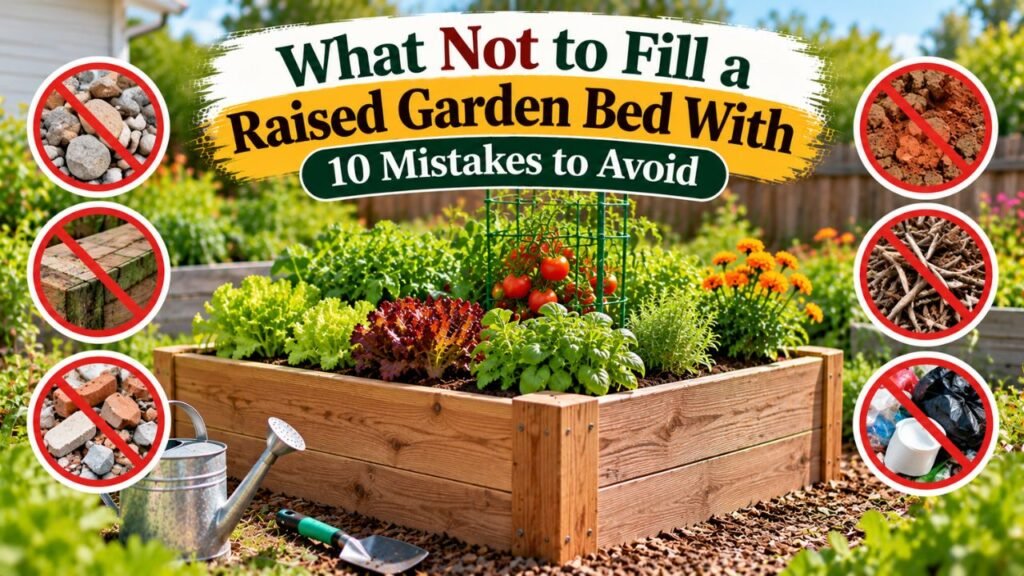
The following materials are unsuitable as the main growing medium or require special precautions before being added to a raised garden bed.
Some should be avoided entirely, while others are useful only in limited amounts or specific situations.
| Material | Main Problem | Better Alternative |
| Contaminated soil | Possible harmful substances | Verified clean topsoil |
| Fresh animal manure | Food safety and plant damage risks | Properly processed compost |
| Pure compost | Excess nutrients and settling | Balanced soil-compost mixture |
| Dense clay or poor subsoil | Compaction and slow drainage | Well-structured topsoil |
| Fresh sawdust or wood chips | Temporary nitrogen tie-up | Finished compost |
| Large logs in shallow beds | Reduced root space and settling | Suitable growing soil |
| Thick gravel or rock layers | Restricted rooting volume and drainage problems | Consistent growing medium |
| Pure peat or coconut coir | Poor nutrient supply and moisture management | Balanced raised bed mix |
| Construction waste or plastic trash | Contamination and physical obstruction | Clean soil and appropriate amendments |
| Herbicide-contaminated organic material | Potential plant injury | Verified clean compost and mulch |
1. Contaminated Soil or Unknown Construction Fill
Contaminated soil is one of the most important materials to avoid when preparing a raised bed for vegetables.
Soil may contain unwanted substances from previous land use, industrial activities, old building materials, or chemical spills.
Potential contaminants include:
- Lead from deteriorating lead-based paint
- Certain pesticide residues
- Petroleum products
- Industrial chemicals
- Excessive concentrations of heavy metals
- Unknown residues from construction or demolition work
Adding compost does not automatically eliminate chemical contamination.
Likewise, placing contaminated soil at the bottom of a raised bed does not guarantee that plant roots or water will remain isolated from it.
The University of Maryland Extension’s guidance on soil for raised beds recommends testing existing soil before establishing vegetable beds and specifically checking for lead when growing food.
For soil with a total lead concentration above 400 parts per million, the guidance advises against planting vegetables directly in that soil.
If contamination is suspected, arrange appropriate testing and use verified clean growing medium.
A raised bed installed over contaminated ground may also require a properly designed separation barrier and additional site-specific precautions.
Important: Never assume that inexpensive excavation soil, construction fill, or soil from an unknown dumping location is safe for growing food.
2. Fresh Manure and Pet Waste
Fresh animal manure should not be used as the primary filling material for a raised vegetable bed.
Although manure can contain useful nutrients, raw manure may introduce harmful microorganisms and excessive concentrations of certain nutrients.
Fresh manure can also contain high levels of ammonia or soluble salts that damage sensitive roots.
For vegetable gardens, the main concerns include:
- Potential foodborne pathogens
- Excessive nutrient concentrations
- Damage to young seedlings
- Unpleasant odors
- Weed seeds
- Possible herbicide residues originating from animal feed
Properly composted manure is generally more suitable, but it should still be used in appropriate amounts.
Dog and cat feces should not be added to vegetable raised beds. They may contain parasites or pathogens that present food safety concerns.
If raw livestock manure is used as a soil amendment, recognized food safety precautions include substantial intervals between incorporation and harvest. For most home gardeners, purchasing properly processed compost is the simpler approach.
3. Pure Compost Without a Balanced Growing Medium
Compost is useful for improving garden soil, but filling an entire raised bed with compost alone is usually unnecessary and can create problems.
Compost primarily consists of decomposed organic materials.
It does not necessarily provide the same long-term physical stability as a suitable mineral-soil mixture.
Potential problems include:
- Significant settling as organic materials continue decomposing
- Excessive nutrient concentrations
- Salt accumulation from certain compost products
- Rapid drying under some conditions
- Changes in moisture retention
- Inconsistent structure between compost products
A compost-only mixture may also contain more nutrients than the intended crops need.
This is particularly relevant when using manure-based compost repeatedly.
The University of Minnesota Extension’s raised bed gardening guidance recommends a mixture containing approximately one-half to two-thirds topsoil and one-third to one-half plant-based compost for raised beds. It also warns that excessive compost and repeated manure applications can create moisture-management and nutrient problems.
For a conventional open-bottom raised bed, a balanced mixture of suitable topsoil and finished compost is usually a better starting point than compost alone.
4. Dense Clay, Compacted Subsoil, or Poor-Quality Fill Dirt
Not all soil taken from the ground is suitable for filling a raised garden bed.
Healthy garden soil can be reused, but dense clay or compacted subsoil may perform poorly without preparation.
Heavy clay can become difficult to work when wet and may drain slowly when compacted.
Poor-quality fill dirt may contain excessive stones, construction debris, or infertile subsoil.
Possible problems include:
- Slow water movement
- Restricted root growth
- Hard clumps
- Poor aeration
- Limited organic matter
- Difficult planting and harvesting
However, clay itself is not harmful.
Clay particles help soil retain water and nutrients. The problem is often excessive compaction or an unsuitable balance of soil components.
If your available soil is heavy clay, improve its structure where practical or blend it with suitable, well-structured topsoil and mature compost.
Avoid assuming that a small amount of ordinary sand will correct clay drainage problems. The result depends on the soil texture, sand characteristics, and proportions used.
5. Large Amounts of Fresh Wood Chips or Sawdust
Fresh wood chips and sawdust are not good substitutes for the main rooting medium.
They contain substantial amounts of carbon relative to available nitrogen.
When fresh woody material is mixed into the growing soil, microorganisms breaking it down may temporarily use nitrogen that plants would otherwise access.
This process is called nitrogen immobilization.
Fresh wood chips also decompose over time, changing the volume and structure of the material.
Potential problems include:
- Temporary nitrogen shortages near decomposing wood
- Uneven settling
- Limited nutrient supply
- Large air spaces between coarse pieces
- Reduced usable soil volume
This doesn’t mean wood chips are always bad for gardening.
They are often useful as a surface mulch or in pathways.
The important distinction is between placing wood chips on the soil surface and using large amounts of fresh wood as the growing medium.
Better choice: Use mature compost within the soil mixture and reserve suitable wood chips for surface mulching.
6. Large Logs and Branches in Shallow Raised Beds
Logs, branches, and other woody materials are sometimes used to reduce the amount of purchased soil needed for tall raised beds.
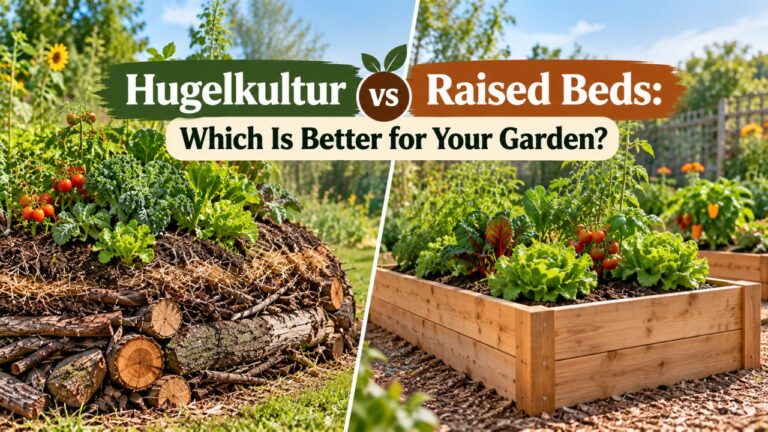
This approach is related to Hugelkultur, a gardening method that incorporates woody material into a growing mound or deep bed.
However, large pieces of wood are not ideal fillers for every raised bed.
In shallow beds, logs can occupy much of the available rooting space.
As wood decomposes, the material above it can settle unevenly.
Large gaps between branches may also create inconsistent moisture conditions.
For example, a raised bed that is only 10 inches deep provides limited growing space. Filling its lower half with thick branches leaves considerably less room for suitable soil.
That can be particularly problematic for vegetables grown in beds with solid bottoms.
When Are Logs Acceptable in Raised Beds?
Logs may be used in certain deep, open-bottom raised beds when the design intentionally incorporates woody materials.
This approach requires understanding that:
- The wood will decompose gradually.
- Soil levels may fall over time.
- Additional growing medium may be required.
- The upper root zone must contain sufficient suitable soil.
- The method is not appropriate for every crop or bed design.
Avoid treated, painted, contaminated, or unknown reclaimed wood.
For ordinary shallow vegetable beds, using appropriate soil throughout the available depth is generally more predictable.
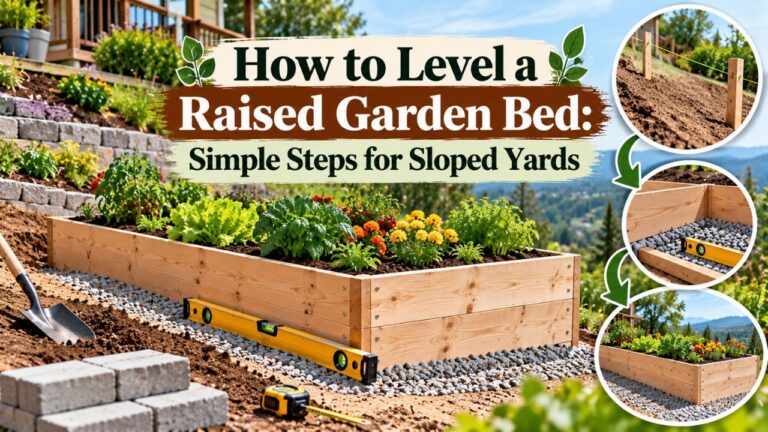
7. Thick Gravel, Rocks, or Broken Concrete as a Drainage Layer
A common gardening misconception is that placing gravel at the bottom of a raised bed automatically improves drainage.
In many situations, it does not.
When a layer of fine growing medium sits above coarse gravel, water may remain in the finer layer until enough moisture accumulates to enter the coarse material.
This can contribute to a perched water table, particularly in contained planters.
A thick gravel layer also occupies valuable rooting space.
For conventional open-bottom raised beds, water should generally move through the growing medium into suitably prepared native soil.
For elevated planters, drainage should be provided by suitable openings and a growing medium designed for contained planting.
Avoid using thick layers of:
- Gravel
- River rocks
- Crushed stone
- Broken bricks
- Concrete rubble
- Large decorative stones
These materials are not suitable substitutes for growing soil.
Small amounts of stone naturally present in mineral soil are a different matter.
Gravel can also be useful beneath structural footings or around garden paths, but that does not mean it belongs beneath the root zone as a drainage layer.
8. Pure Peat Moss, Coconut Coir, or Lightweight Potting Ingredients
Peat moss and coconut coir are common ingredients in potting mixes.
They can help retain moisture and contribute to the physical structure of a growing medium.
However, using either material alone to fill a permanent raised bed is usually a poor choice.
These materials do not provide a complete nutrient supply for vegetables.
They also behave differently from mineral soil.
For example, some peat-rich mixtures can become difficult to rewet after severe drying.
Pure coir may require additional nutrient management because its nutrient content and chemical properties vary by product.
Commercial potting mixes can also settle or dry quickly in large open-bottom beds, depending on their composition.
These materials are not inherently unsafe.
They are simply better treated as components of a properly designed growing mixture rather than automatic substitutes for all the soil in a permanent garden bed.
For elevated planters or beds on concrete, a lightweight container-style mix may be appropriate because the drainage and root-space conditions are different.
9. Construction Debris, Plastic Waste, and Unknown Treated Wood
A raised garden bed should never become a disposal location for household or construction waste.
Avoid burying materials such as:
- Plastic bottles and bags
- Painted wood scraps
- Unknown pressure-treated wood offcuts
- Drywall pieces
- Asphalt fragments
- Metal scraps
- Fiberglass insulation
- Broken glass
- Chemical containers
- Unidentified demolition materials
These materials may introduce contaminants, create physical obstacles, or make future soil maintenance difficult.
Even materials that appear inert can occupy valuable space needed by plant roots.
Plastic waste can also fragment over time.
Using ordinary household trash to reduce the cost of filling a tall bed is not a good gardening practice.
If you need to reduce the amount of soil purchased, consider adjusting the bed’s height or using a suitable deep-bed filling strategy rather than burying waste.
10. Herbicide-Contaminated Hay, Grass Clippings, or Weed-Infested Material
Organic materials are not automatically safe simply because they come from plants.
Certain herbicides can persist in hay, grass clippings, manure, or compost made from treated vegetation.
Residues from persistent broadleaf herbicides may damage sensitive vegetables even when the original material has begun decomposing.
Tomatoes, beans, peas, and other broadleaf crops can be particularly susceptible to certain herbicide residues.
If purchasing hay, straw, manure, or compost from an unfamiliar supplier, ask about its source and possible herbicide exposure.
Also avoid filling the bed with weeds carrying mature seeds or persistent underground roots.
A large quantity of fresh grass clippings packed into one layer may mat together and decompose unevenly.
Better choice: Use clean, mature compost and mulch from a trustworthy source. Compost only plant materials known to be suitable for that purpose.
What Materials Can Go in the Bottom of a Raised Garden Bed?
Not every material placed beneath a raised bed is harmful.
The correct choice depends on whether the bed is shallow or deep, open-bottomed or contained, and what plants will grow in it.
Can You Put Cardboard at the Bottom?
Yes, plain cardboard can be used temporarily to suppress existing grass or weeds beneath a new raised bed.
However, cardboard is not necessary for every bed.
In an open-bottom bed built over healthy soil, removing persistent weeds and loosening the ground may be sufficient.
If using cardboard:
- Remove plastic tape and staples.
- Avoid glossy or heavily coated material.
- Use it for temporary weed suppression.
- Recognize that it can initially slow water movement.
- Avoid creating an unnecessarily thick barrier.
Cardboard eventually decomposes, so it is not a permanent root or weed barrier.
Can You Put Leaves at the Bottom?
Clean fallen leaves can contribute organic matter, but they shouldn’t replace most of the growing medium.
Large amounts of loosely packed leaves shrink substantially as they decompose.
Wet, compacted leaf layers may also interfere with even moisture movement.
Leaves are often more useful when shredded and incorporated into a composting process or applied as surface mulch.
In deep beds designed for decomposing organic layers, leaves can form part of the lower fill.
However, allow for settling and maintain enough suitable growing medium above them.
Can You Use Small Branches and Untreated Wood?
Small untreated branches can be used in certain deep raised beds as part of a deliberate organic filling system.
They should not occupy most of the root zone in a shallow bed.
Avoid wood containing paint, chemical preservatives, unknown coatings, or other contamination.
Remember that buried woody material decomposes gradually and changes the bed’s volume.
For a conventional bed less than about 2 feet high, filling primarily with suitable soil is often the simpler approach.
Can You Use Native Garden Soil?
Yes. Clean, fertile, well-drained native garden soil is often an excellent material for permanent open-bottom raised beds.
It may only need compost or another amendment according to its condition.
Native soil is not automatically inferior to commercially packaged raised bed soil.
However, avoid collecting soil from locations with unknown contamination, severe compaction, or persistent soilborne disease problems.
What Should You Fill a Raised Garden Bed With Instead?
A suitable raised bed growing medium should provide enough structure to support roots, retain useful moisture, and drain excess water.
For conventional open-bottom raised beds, a mixture of good-quality mineral topsoil and mature plant-based compost is a practical starting point.
The ideal proportions depend on the original soil, intended crops, and bed construction.
A Practical Soil Mix for Open-Bottom Raised Beds
One starting mixture is:
- Two parts clean, well-structured topsoil
- One part finished plant-based compost
Measure the materials by volume.
For example, six cubic feet of topsoil combined with three cubic feet of compost produces approximately nine cubic feet of loose mixture before significant settling or compaction.
This is not a mandatory recipe for every bed.
If your existing soil already contains substantial organic matter, adding less compost may be appropriate.
A laboratory soil test can help identify pH and nutrient requirements.
How to Choose Quality Topsoil
Look for topsoil that is:
- Clean and free from concerning contamination
- Relatively loose and crumbly
- Reasonably well-drained
- Not excessively sandy or clay-heavy
- Free from large amounts of debris
- Obtained from a reliable supplier
If purchasing bulk topsoil, ask about its origin and whether the seller has test results.
Avoid judging quality by dark color alone.
A very dark material may contain substantial organic waste without enough mineral soil.
How to Choose Finished Compost
Good compost should be sufficiently mature for garden use.
Look for material with a reasonably uniform texture and an earthy smell.
Avoid compost that contains substantial undecomposed waste, strong ammonia odors, or questionable feedstock.
Plant-based compost is often a practical choice when improving soil organic matter.
Manure-based compost can also be useful, but repeated heavy applications may cause excessive nutrient accumulation.
How to Fill Different Raised Bed Types Correctly
The correct growing medium depends partly on whether roots and water can move into the ground beneath the bed.
Open-Bottom Raised Beds on Natural Ground
These beds can use suitable native soil as part of their growing environment.
A practical process is:
- Select a reasonably level, well-drained location.
- Remove persistent weeds and unwanted debris.
- Check whether the underlying soil is compacted.
- Loosen compacted areas when the soil is workable.
- Add suitable topsoil and mature compost where necessary.
- Blend the transition between native soil and added soil when appropriate.
- Water gently and allow normal settling.
Avoid unnecessary waterproof bottom liners.
Roots can extend into the ground beneath an open-bottom bed when the soil is suitable.
Raised Beds on Concrete or Pavement
Raised beds on hard surfaces need a reliable drainage route.
Unlike open-bottom beds on natural ground, roots cannot grow into the soil below.
These beds often perform better with a lighter growing medium designed for contained planting.
Select a suitable mixture and provide enough depth for the crops.
Also consider the weight of the filled bed and where drainage water will escape.
Avoid dense clay-only fill or gravel layers intended to compensate for inadequate drainage.
Elevated Raised Garden Beds With Solid Bottoms
An elevated planter on legs functions more like a large container.
It needs:
- A structurally supported bottom
- Appropriate drainage holes or slots
- A growing medium with adequate air space
- Sufficient soil depth for the plants
- A frame rated for the weight of wet growing medium
Dense native topsoil may be unnecessarily heavy and could drain poorly in some contained designs.
A suitable commercial planter mix is generally more convenient.
Avoid filling the bottom with rocks simply to reduce the amount of potting mix.
How Much Good Soil Should Be Above Any Bottom Filler?
The available rooting depth is especially important in tall raised beds that contain organic materials in their lower sections.
A shallow bed should normally devote most or all of its volume to suitable growing soil.
A very tall bed may allow room for a separate lower filling system, provided the upper growing zone remains deep enough.
Rooting Depth and Raised Bed Height
| Raised Bed Situation | Practical Approach |
| 6–8 inches deep over healthy soil | Use suitable growing medium; roots may extend into the ground |
| 10–12 inches deep over healthy soil | Fill primarily with appropriate soil |
| 12 inches deep with a solid bottom | Preserve the available root space |
| 18–24 inches deep with a solid bottom | Provide adequate growing depth for selected crops |
| More than 24 inches deep and open-bottomed | Lower organic layers may be considered, with settling expected |
These are general design considerations, not minimum depth requirements for every vegetable.
For example, short-rooted crops can grow in less soil depth than large tomatoes or certain root vegetables.
In an open-bottom bed, healthy native soil beneath the frame can contribute additional rooting space.
In a solid-bottom bed, all usable root volume must be provided within the structure.
Practical Tip: If you’re building a tall raised bed mainly to reduce bending, consider whether an elevated planter with an appropriately engineered bottom would better meet your needs. Filling a very tall structure entirely with soil can be expensive and heavy.
How to Fix a Raised Garden Bed Filled With the Wrong Materials
Discovering unsuitable material in an existing raised bed doesn’t always mean you need to empty everything.
The appropriate correction depends on the material and whether it creates a safety or growing problem.
If You Used Too Much Compost
Avoid adding more compost or manure automatically.
A soil test can help determine whether nutrient levels are excessive.
If the bed is otherwise healthy, adjusting future fertilizer and compost applications may be enough.
For severely imbalanced mixtures, blending in appropriate mineral topsoil or replacing part of the medium may be necessary.
If You Buried Too Many Logs or Branches
Check whether the bed provides enough usable soil above the woody layer.
If the root zone is too shallow, remove some material or increase the growing depth where structurally feasible.
Expect settling as the wood decomposes.
Top up the bed with suitable soil when needed rather than automatically adding more coarse organic fillers.
If You Added a Thick Gravel Layer
If the bed is empty or newly constructed, removing an unnecessary gravel layer is often the simplest solution.
For established plants, investigate whether drainage or root restriction is actually occurring before disturbing the entire bed.
If drainage is poor, correct the outlet or underlying soil conditions instead of adding more rocks.
If You Used Dense Clay Soil
Wait until the soil is moist but workable.
Gently loosen compacted areas and evaluate drainage.
Appropriate organic matter and better-quality mineral soil may improve the mixture.
For severe problems, partial replacement may be necessary.
Avoid working saturated clay or trying to correct it by adding arbitrary amounts of sand.
If You Suspect Chemical Contamination
Stop using the questionable material for edible crops until it has been properly evaluated.
Identify the source and arrange appropriate soil testing.
Do not attempt to solve suspected contamination simply by covering it with more compost.
If the soil is confirmed unsuitable, follow appropriate remediation or disposal guidance.
Common Raised Bed Filling Mistakes That Waste Money
Some filling choices aren’t necessarily unsafe, but they can increase costs or make long-term maintenance difficult.
Buying More Soil Than the Bed Requires
Calculate soil volume using the actual inside measurements.
For a rectangular bed:
Soil Volume = Length × Width × Fill Depth
Use feet for all dimensions to calculate cubic feet.
For example, a 4 × 8-foot bed filled to a depth of 12 inches requires:
4 × 8 × 1 = 32 cubic feet
Divide by 27 to convert cubic feet into cubic yards.
32 ÷ 27 = approximately 1.19 cubic yards.
Account for existing soil and the space you plan to leave below the rim.
Purchasing Unverified Cheap Fill
Inexpensive bulk soil may seem like a bargain.
However, poor-quality material can require additional amendments or removal.
Ask about the soil’s source and inspect its texture before purchasing.
For vegetable beds, prioritize clean, suitable growing soil over the lowest possible price.
Using Too Many Different Layers
Some gardeners create separate layers of gravel, branches, leaves, compost, topsoil, and potting mix.
A complicated layered arrangement is not automatically better than a consistent growing medium.
Sharp differences between soil layers can affect water movement and root development.
For most ordinary raised beds, a suitable mixed growing medium is simpler to manage.
Adding Fertilizer Without a Soil Test
Fertilizer is not a substitute for good soil structure.
Applying excessive amounts can contribute to salt accumulation and nutrient imbalances.
Use soil testing and crop requirements to guide amendments rather than guessing.
Conclusion
Knowing what not to fill a raised garden bed with helps prevent drainage problems, poor plant growth, unnecessary settling, and potential food safety risks.
Avoid contaminated soil, raw manure used without proper precautions, construction debris, and materials with unknown chemical exposure.
Also avoid relying on pure compost, fresh wood chips, dense clay, or thick gravel layers as substitutes for a balanced growing medium.
Materials such as logs, branches, leaves, and cardboard can have specific gardening uses, but they should not automatically replace the root-growing soil in an ordinary raised bed.
For most permanent open-bottom vegetable beds, suitable mineral topsoil combined with mature compost is a dependable starting choice.
The best approach is to provide enough clean, well-structured growing medium for your plants and use alternative fillers only when they serve a clear purpose.
FAQs About What Not to Fill a Raised Garden Bed With
Can I Fill a Raised Garden Bed With Only Compost?
You can grow some plants in compost-rich media, but filling a permanent raised bed entirely with compost is generally not ideal. Compost continues decomposing and may create excessive nutrient levels or inconsistent moisture conditions. A suitable topsoil-and-compost mixture is usually more stable.
Is It Bad to Put Rocks at the Bottom of a Raised Bed?
A thick rock or gravel layer is usually unnecessary and does not automatically improve drainage. It can reduce rooting space and interfere with water movement, particularly in contained planters. Use proper drainage openings and a suitable growing medium instead.
Can I Put Old Logs at the Bottom of a Raised Garden Bed?
Yes, untreated, uncontaminated logs can be used in certain deep, open-bottom raised beds designed around decomposing woody material. However, they occupy growing space and cause settling as they break down. Avoid using large logs as filler in shallow beds.
Can I Fill a Raised Bed With Regular Dirt From My Yard?
Yes, provided the soil is clean, fertile, and reasonably well-drained. Healthy native garden soil can be an effective raised bed growing medium. Dense clay, compacted subsoil, or material from potentially contaminated locations may need improvement or replacement.
Can I Put Grass Clippings at the Bottom of a Raised Bed?
Small amounts of clean grass clippings can be composted or used as appropriate surface mulch. However, thick layers of fresh clippings can mat together and decompose unevenly. Avoid clippings from lawns treated with persistent herbicides or other products incompatible with vegetable gardening.
Should I Put Cardboard Under My Raised Garden Bed?
Cardboard can temporarily suppress grass and weeds beneath a new open-bottom bed. Use plain cardboard without plastic tape or coatings. It is not necessary in every location and can temporarily slow water infiltration before decomposing.
Can I Use Potting Soil to Fill a Raised Garden Bed?
Yes, certain potting mixes can work in raised beds, particularly elevated or contained planters. However, lightweight mixes may dry out quickly or become expensive when used to fill large permanent beds. For open-bottom beds on natural ground, suitable mineral topsoil and mature compost are often more practical.
What Is the Cheapest Safe Way to Fill a Raised Garden Bed?
Using clean, suitable native garden soil is often the least expensive approach. You can improve it with mature compost when necessary. For larger beds, purchasing a verified bulk topsoil-and-compost mix may cost less than buying many individual bags.
Should I Fill a Tall Raised Bed With Leaves and Sticks?
Leaves and sticks may form part of a deep organic filling system, but they should not replace the upper growing zone needed by plant roots. These materials shrink as they decompose, so the soil level may drop. For shallow beds, filling primarily with suitable soil is more predictable.

I’m Maya L. Greenwood, a lifelong plant lover who believes anyone can grow something beautiful with the right guidance. After years of testing soil mixes, pruning methods, irrigation tricks, and pest-safe solutions, I started EasyGardenTips.com to turn hard-won lessons into step-by-step advice. From seed starting and container gardens to composting and seasonal checklists, my goal is to make gardening simple, sustainable, and fun.