Cinder Block vs Wood Raised Bed: Cost, Safety, and Durability
Wood is generally the better choice for an affordable, customizable raised garden bed, while cinder blocks are ideal for a durable, permanent structure. Both materials can support healthy vegetables, herbs, and flowers, but they differ in installation, maintenance, temperature behavior, and usable planting space.
Wooden raised beds are relatively lightweight, easy to assemble, and available in several lumber types. However, wood eventually deteriorates when exposed to moisture and soil. Cinder blocks resist decay and can remain functional for decades, although their weight and installation requirements make them less convenient to relocate.
Material safety is another important consideration, especially for vegetable gardening. Modern pressure-treated lumber differs from older arsenic-treated products, while some concrete masonry blocks contain fly ash or other ingredients that raise questions about soil contact.
The best choice depends on your budget, garden location, climate, and how long you expect the structure to remain in place.
This comparison examines construction costs, expected lifespan, food-growing safety, soil temperature, drainage, planting capacity, and maintenance to help you choose the most practical raised-bed material.
Cinder Block vs Wood Raised Bed: Main Differences
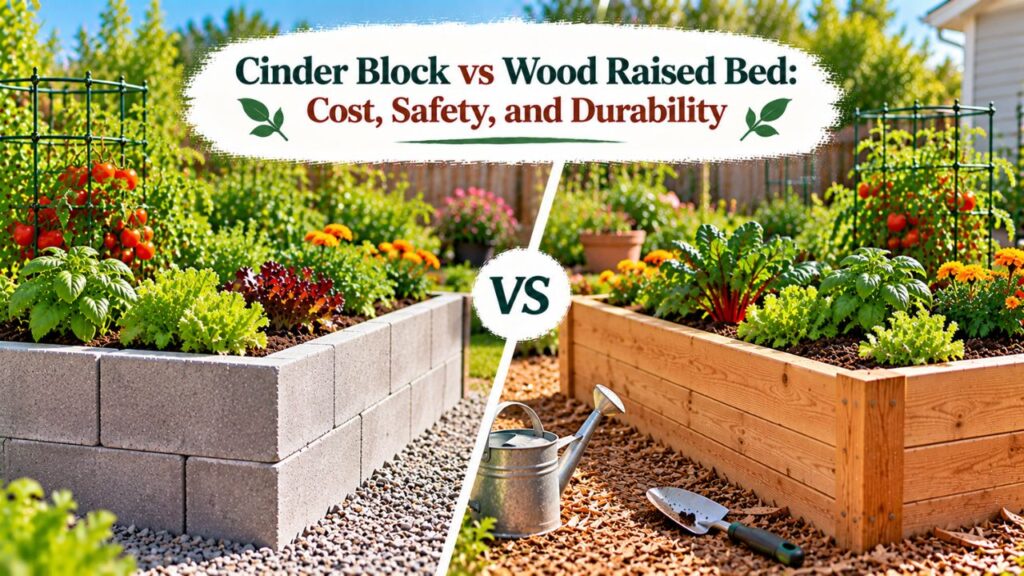
Cinder block and wood raised beds perform the same basic function: they hold growing soil above the surrounding ground. Their differences come from the physical properties of the framing materials.
Cinder blocks are masonry units made primarily from cement and aggregates, while wooden beds use lumber connected with screws, brackets, or other fasteners.
The term cinder block is commonly used for hollow concrete masonry units, although the ingredients can differ between products.
Cinder Block vs Wood Raised Bed Comparison Chart
| Feature | Cinder Block Raised Bed | Wood Raised Bed |
| Initial cost | Varies with block prices and installation | Often affordable with basic lumber |
| Lifespan | Often decades with proper installation | Depends on lumber, climate, and treatment |
| Installation | Heavy lifting and careful leveling | Cutting, measuring, and fastening |
| Durability | Does not rot or attract wood-decay fungi | Susceptible to moisture-related decay |
| Maintenance | Inspect shifting, joints, and foundation | Inspect rot, fasteners, and bowed boards |
| Soil temperature | Stores and releases heat | Generally less thermal mass |
| Planting space | Thick walls reduce interior space | Thinner walls preserve more space |
| Portability | Difficult to move after construction | Easier to dismantle or relocate |
| Appearance | Masonry or industrial appearance | Natural, traditional garden appearance |
| Vegetable safety | Depends partly on block composition | Depends on lumber and preservatives |
Neither material automatically produces healthier plants. Soil quality, drainage, sunlight, and watering have a greater direct influence on plant growth.
For most small backyard gardens, wood offers easier construction and future modifications. Cinder blocks are attractive when longevity and resistance to decay are the main priorities.
How Durable Are Cinder Block Raised Beds Compared With Wood?
Durability is one of the largest differences between the two materials.
Cinder blocks resist biological decay, while wood gradually breaks down as moisture and microorganisms affect its structure.
How Long Do Cinder Block Raised Beds Last?
A properly installed concrete masonry raised bed can remain usable for decades.
Concrete blocks do not rot, and their structural strength is not dependent on organic fibers that gradually decompose.
However, durability depends on more than the blocks themselves.
A masonry bed can develop problems if:
- The soil underneath settles unevenly.
- Freeze-thaw cycles damage saturated blocks.
- Poor drainage weakens the supporting ground.
- Unsecured blocks shift outward under soil pressure.
- Mortar joints crack or deteriorate.
A stable, level foundation helps prevent these problems.
For taller structures, the blocks may need reinforcement, bonding, or a properly designed wall system.
Important: Dry-stacked blocks are not automatically stable at every height. A tall raised bed should be designed to withstand lateral pressure from wet soil.
How Long Do Wood Raised Beds Last?
Wooden raised-bed longevity depends on the lumber species, moisture exposure, soil contact, and whether preservatives are used.
Different materials have different resistance to decay.
Untreated pine: Usually one of the more economical lumber options, but it can deteriorate relatively quickly in constantly moist conditions.
Cedar: Contains natural compounds that help resist decay. Heartwood generally offers better durability than sapwood.
Redwood: Naturally decay-resistant heartwood can provide a long service life, although availability and price vary by region.
Modern pressure-treated lumber: Designed to resist fungal decay and insects, often lasting longer than comparable untreated softwood.
No wood species is completely immune to deterioration.
Warm, humid climates and constant contact with wet soil can accelerate decay. Good construction and appropriate material selection can extend the useful life of a wooden bed.
Which Material Wins for Longevity?
Cinder blocks generally last longer than ordinary untreated wooden boards.
However, a poorly installed block bed can shift or crack, while a well-built cedar or appropriately treated wooden bed may remain functional for many years.
If you want a garden frame that may never need routine board replacement, masonry has an advantage.
If replacing an individual damaged component is acceptable, wood remains a practical long-term choice.
Cinder Block vs Wood Raised Bed Cost Comparison
The cheaper option depends on the type of lumber, block price, raised-bed dimensions, and installation method.
A basic wooden bed made with inexpensive lumber can cost less than a comparable masonry structure. However, inexpensive concrete blocks, especially reclaimed ones, may also provide good value.
Initial Material and Construction Costs
A wooden raised bed typically requires:
- Lumber for the sides.
- Exterior-rated screws or compatible fasteners.
- Corner brackets or supports when necessary.
- Cutting and measuring tools.
- Suitable growing soil.
A cinder block raised bed typically requires:
- Concrete masonry blocks.
- A level supporting surface.
- Foundation preparation where necessary.
- Masonry adhesive or mortar if the design requires bonding.
- Suitable growing soil.
Wood often requires fewer heavy materials and less site preparation.
Cinder blocks may not need cutting or drilling, but carrying and leveling multiple blocks adds labor.
A detailed Virginia Cooperative Extension comparison of raised-bed materials and costs found that cost comparisons depend partly on the amount of usable growing space and soil required by each construction method.
Its historical cost examples are useful for understanding these differences, but they should not be treated as current retail prices.
Why the Same Outside Dimensions Can Cost Different Amounts
Consider two raised beds measuring 4 feet by 8 feet from their outside edges.
Wooden boards are relatively thin, so most of the footprint remains available for planting.
Concrete masonry blocks are commonly several inches thick, reducing the interior growing area.
In Virginia Cooperative Extension’s example, the wooden frame provided approximately 30 square feet of interior planting space, compared with 18 square feet for its block design.
The block bed therefore needed less filling soil but also provided substantially less growing space.
This creates an important distinction:
A cheaper completed bed is not necessarily cheaper per square foot of usable planting area.
When comparing prices, use interior dimensions rather than exterior measurements alone.
Long-Term Replacement and Maintenance Costs
Wooden beds may require occasional board replacement, particularly when built with untreated softwood.
A cinder block bed generally avoids this type of recurring material expense.
However, masonry repairs can involve correcting a shifting foundation, replacing damaged blocks, or repairing mortar joints.
For a temporary garden, low-cost lumber may be the more economical choice.
For a permanent installation intended to remain in the same location for many years, cinder blocks may provide better long-term value if the initial installation is sound.
Are Cinder Blocks or Wood Safer for Vegetable Raised Beds?
Both materials are used for edible gardens, but safety depends on their composition and previous use.
It is important to distinguish documented risks from concerns where research remains limited.
Are Cinder Blocks Safe for Growing Vegetables?
Concrete masonry blocks are widely used in raised-bed gardening, but not every block contains identical ingredients.
Some incorporate fly ash, which is a byproduct of coal combustion and can contain potentially harmful metals.
The amount and movement of these substances depend on the material’s composition and environmental conditions.
The University of Maryland Extension’s guidance on raised-bed material safety explains that block labels often provide limited information about aggregate ingredients and that research on possible contamination remains limited.
This does not establish that every concrete block is dangerous for vegetable gardening. It also does not justify assuming that every unknown or reclaimed block is harmless.
For vegetable beds:
- Prefer new blocks from a reputable supplier when their composition can be confirmed.
- Avoid blocks from unknown industrial or demolition sites.
- Do not use masonry with suspected chemical contamination.
- Consider separating the soil from the block walls if material contact is a concern.
- Use another material if the block composition cannot be verified to your satisfaction.
Any liner should be suitable for the intended use and must not prevent necessary drainage.
Safety Note: A block marketed for construction is not automatically certified for direct contact with food-growing soil. Ask the manufacturer for material information when this is a deciding factor.
Is Untreated Wood Safe for Raised Beds?
Untreated lumber from a known, uncontaminated source is a straightforward option for edible gardens.
Cedar and redwood are popular because their heartwood naturally resists decay.
Untreated pine can also be used, although it generally needs replacement sooner.
Avoid using reclaimed lumber that may have been coated with lead-containing paint, industrial preservatives, or unknown chemicals.
Painted or chemically treated demolition wood should not be assumed suitable for growing vegetables.
Is Pressure-Treated Wood Safe for Vegetables?
Modern residential pressure-treated wood differs from older lumber treated with chromated copper arsenate (CCA).
CCA-treated wood contained arsenic, and its use for most residential applications ended in the United States after 2003.
Modern products commonly use copper-based preservatives, such as micronized copper azole.
Research summarized by the University of Maryland Extension indicates that copper can move into a small amount of soil next to treated lumber, but the cited research did not find increased copper concentrations in the plants grown in those beds.
If you prefer to reduce direct soil contact, you can install a suitable barrier against the inside walls while keeping the bed’s drainage functional.
Avoid old CCA-treated wood, railroad ties treated with creosote, and lumber containing unknown preservatives.
For gardeners following certified organic production rules, additional restrictions may apply to treated lumber.
Which Material Is the Safer Choice?
For someone who wants a simple material decision with minimal uncertainty about preservatives or masonry ingredients, new untreated cedar or another known, suitable untreated lumber is a reasonable preference.
Modern concrete blocks and appropriately selected treated lumber can also be considered, but their composition and intended use deserve attention.
The safest practical choice is a known material with a clean history, not simply the one labeled wood or concrete.
Do Cinder Blocks or Wood Affect Raised-Bed Soil Temperature?
The framing material can influence temperatures near the edges of a raised bed, especially in sunny locations.
However, its actual effect depends on climate, wall thickness, color, sun exposure, soil moisture, and bed design.
How Cinder Blocks Store and Release Heat
Concrete has substantial thermal mass, meaning it can absorb and store heat.
During sunny weather, exposed blocks warm up. As surrounding temperatures decrease, they gradually release some of that stored heat.
This behavior may help moderate temperatures near the walls in certain cool-weather conditions.
However, dark or heavily sun-exposed blocks can also become hot during summer.
Plants growing near the edges may experience warmer soil conditions than plants in the center of the bed.
In hot climates, monitor moisture near masonry walls because plants in these areas may experience additional heat stress.
How Wooden Raised Beds Handle Heat
Wood generally transfers heat less readily than concrete masonry.
A wooden frame therefore has less of the heat-storage effect associated with thick concrete blocks.
This can be useful in gardens exposed to intense summer sunlight.
However, a wooden bed can still become hot or dry when exposed to strong sun, especially when the growing medium is shallow.
Wood does not eliminate the need for regular watering and mulching.
Which Raised Bed Is Better for Hot or Cold Weather?
In cooler conditions, masonry’s heat-storage properties may offer a small localized advantage.
In consistently hot, sunny climates, wood may be preferable when minimizing heat buildup near the bed walls is a priority.
Neither material guarantees a warmer or cooler root zone throughout the entire bed.
Soil depth, irrigation, mulch, and exposure often influence growing conditions more than the frame material alone.
Cinder Block vs Wood Raised Bed Drainage and Soil Moisture
Neither cinder blocks nor wood automatically provides superior drainage.
Water movement depends mainly on the soil mixture, bed depth, underlying ground, and whether the structure has an open or enclosed bottom.
Drainage in Cinder Block Raised Beds
Most simple block raised beds have open bottoms, allowing excess water to enter the ground beneath them.
The block walls may have small gaps between joints, but these should not be relied upon as the main drainage system.
If the ground is heavily compacted or the bed sits on concrete, water management requires additional planning.
Moisture can also collect in hollow blocks, especially when their openings are filled with soil.
Drainage in Wooden Raised Beds
Wooden raised beds are commonly constructed with open bottoms as well.
Water can move into the underlying soil when drainage conditions are suitable.
The boards themselves do not need gaps or drilled holes when the entire bottom is open.
For an enclosed wooden planter, drainage outlets are necessary.
Regardless of material, avoid placing an impermeable plastic sheet over the entire bottom of a ground-level raised bed unless a specific design requires separation and includes appropriate drainage.
Key Takeaway: Choose a suitable growing mixture and prepare the site correctly. Changing from wood to cinder blocks will not fix poor soil drainage by itself.
Which Raised Bed Provides More Growing Space?
Wood usually provides more usable planting area for a given outside footprint because wooden boards are thinner than masonry blocks.
This difference becomes especially noticeable in narrow beds.
Cinder Block Wall Thickness and Planting Area
A typical hollow concrete masonry block is approximately 8 inches wide, although actual dimensions vary by product.
If a raised bed measures 4 feet across its outside edges and uses 8-inch-wide block walls on both sides, the interior width is reduced substantially.
The thick walls occupy space that could otherwise support vegetables.
This is particularly important when gardening in small yards or arranging several beds close together.
Hollow blocks can sometimes be filled with soil and used for small plants, but those openings are not equivalent to a continuous deep root zone.
Wood Raised Bed Wall Thickness
Wooden beds commonly use nominal 2-inch-thick boards, which are typically about 1.5 inches thick.
This leaves more interior growing area within the same outside dimensions.
Wood is especially useful for narrow beds where preserving several inches of width makes a practical difference.
It is also easier to create custom lengths and widths using lumber.
For small-space vegetable gardening, wood generally has the advantage in usable planting area.
Which Raised Bed Is Easier to Build?
Wood is usually easier to customize, while cinder blocks can be assembled without cutting lumber when the layout fits standard block dimensions.
The difficulty of each project depends on available tools and physical ability.
Building a Wood Raised Bed
A basic rectangular wooden bed can be assembled using boards, corner supports, and appropriate fasteners.
The general construction process is:
- Measure the desired length, width, and height.
- Select suitable lumber and compatible fasteners.
- Cut the boards to size.
- Assemble the frame on a level surface.
- Install corner supports and any necessary bracing.
- Position the frame and fill it with prepared growing soil.
Long boards may require additional reinforcement to prevent outward bowing under wet soil pressure.
Use corrosion-resistant fasteners appropriate for the lumber treatment and outdoor exposure.
Wood is particularly convenient when building beds with unusual dimensions or installing several matching garden frames.
Building a Cinder Block Raised Bed
A low block bed can often be assembled without cutting materials.
However, leveling is important because uneven support can cause blocks to shift or settle.
A practical installation process includes:
- Mark the bed’s outline.
- Remove vegetation and unstable surface material.
- Prepare a level, stable perimeter foundation.
- Position the first course of blocks carefully.
- Check alignment and level.
- Add additional courses only if the design supports their height and soil load.
- Secure the blocks where needed and install suitable caps if desired.
- Fill the interior with prepared growing medium.
Wear gloves and appropriate footwear when handling masonry.
Concrete blocks are heavy, and repeated lifting can cause strain or injury. Use appropriate handling equipment or assistance for larger projects.
A taller masonry bed may require a reinforced foundation and professional design. Local construction requirements may also apply to substantial retaining structures.
Which Material Is Easier to Repair?
Wood usually allows simpler component replacement.
A damaged board can often be removed without dismantling the entire frame, provided the remaining structure is sound.
Cinder blocks are durable, but foundation movement may require lifting and resetting several blocks.
For gardeners who frequently redesign their planting layout, wood is the more flexible choice.
Cinder Block vs Wood Raised Bed Maintenance
Both materials require occasional attention, although the maintenance tasks differ.
Maintaining Cinder Block Beds
Inspect masonry beds for:
- Uneven settlement.
- Loose or displaced blocks.
- Cracked mortar or damaged caps.
- Weed growth around the base.
- Soil escaping through open joints.
Clean debris from block openings and keep the surrounding ground reasonably level.
For dry-stacked beds, periodically confirm that the walls remain stable.
Masonry does not need protection against wood rot, but it still needs a sound supporting base.
Maintaining Wooden Beds
Wooden raised beds benefit from inspections for:
- Soft or decaying boards.
- Loose fasteners.
- Outward bowing.
- Damaged corner connections.
- Soil accumulating against vulnerable exterior joints.
Replace damaged components before the frame loses structural support.
Avoid leaving sprinklers spraying directly against wooden boards unnecessarily.
If using a protective finish, choose a product suitable for the bed material and intended gardening application.
Routine inspection is usually more effective than waiting until the frame begins to collapse.
Which Material Is Better for Different Garden Locations?
The most suitable raised-bed frame depends partly on where it will be installed.
Small Backyard Vegetable Gardens
Wood is usually the better option.
It preserves more planting space, adapts to different layouts, and is easier to modify.
A wooden frame can also be removed or relocated when redesigning the garden.
Permanent Garden Installations
Cinder blocks are worth considering.
A properly constructed masonry bed provides long-term resistance to decay and may suit a permanent landscape design.
However, the supporting ground must be capable of carrying the load.
Hot and Sunny Gardens
Wood may offer an advantage where direct sun exposure causes masonry surfaces to become excessively hot.
If using cinder blocks, pay particular attention to moisture near the edges.
The best choice still depends on the local climate and garden exposure.
Raised Beds on Patios or Concrete
Either material can work if the supporting surface and drainage system are suitable.
However, concrete blocks add substantial weight before any soil or water is included.
Do not assume that a deck, balcony, rooftop, or elevated patio can safely support a masonry raised bed.
The combined weight of the blocks, saturated growing medium, water, and plants must be considered. Obtain a qualified structural assessment when the supporting capacity is uncertain.
Temporary Gardens and Rental Properties
Wood is generally more convenient because it can be dismantled or moved with less effort.
For a temporary growing space, purchasing heavy blocks and preparing a permanent foundation may not be worthwhile.
Accessible Raised Beds
Either material can be used to create a taller gardening structure.
A masonry bed with properly secured caps may provide a durable edge, while wood can be built to customized heights.
For beds designed for sitting, leaning, or wheelchair access, make sure the structure is stable and the dimensions accommodate the intended user.
Do not treat an ordinary dry-stacked masonry wall as seating without confirming that it is constructed to support that load.
Should You Choose Cinder Blocks or Wood for Your Raised Bed?
The decision becomes easier when you identify the most important requirement.
Choose a wood raised bed if:
- You want easier construction.
- You have limited gardening space.
- You prefer a traditional wooden appearance.
- You may move or redesign the beds later.
- You want flexible sizes and shapes.
- You are comfortable maintaining or replacing boards over time.
Choose a cinder block raised bed if:
- You want a long-lasting masonry structure.
- The bed will remain in one location.
- You can provide a stable foundation.
- You have enough room for thicker walls.
- You want to avoid wood deterioration.
- You can confirm the block materials are appropriate for your intended use.
A simple untreated cedar bed is an appealing choice for gardeners prioritizing known material composition, appearance, and straightforward installation.
A concrete block bed is more attractive when permanent construction and resistance to decay outweigh the additional weight and installation effort.
Neither choice should be made on durability alone. Consider soil capacity, installation conditions, material sourcing, and long-term maintenance together.
Conclusion
In a cinder block vs wood raised bed comparison, neither material is universally better. The right choice depends on the garden’s location, available space, budget, and intended lifespan.
Wood is generally the more practical option for small and medium backyard vegetable beds. It is easy to customize, preserves growing space, and offers several lumber choices, including naturally decay-resistant cedar.
Cinder blocks provide excellent resistance to rot and can support a long-lasting garden structure. However, they are heavy, require careful installation, and occupy more space around the planting area.
For most home gardeners building their first raised bed, a well-constructed wooden frame is the more convenient starting choice. For a permanent installation with suitable ground support and verified materials, concrete masonry is a durable alternative.
Whichever material you choose, use quality growing soil, provide proper drainage, and maintain a stable structure. These factors will have a greater influence on the garden’s long-term success than the frame material alone.
FAQs About Cinder Block vs Wood Raised Bed
Can You Grow Vegetables in the Holes of Cinder Blocks?
Yes, some small plants and herbs can grow in the hollow openings of concrete blocks when the spaces contain suitable growing medium.
However, the openings provide limited rooting space and may dry quickly during hot weather.
Choose plants appropriate for small containers and monitor soil moisture regularly. Avoid assuming that block openings provide enough space for larger vegetables.
Do Cinder Blocks Make Raised-Bed Soil More Alkaline?
Concrete masonry can potentially raise soil pH near the block surfaces because of its alkaline cement-based components.
The actual effect depends on the block composition, soil chemistry, moisture, and exposure time.
If you suspect a pH problem, use a soil test before adding amendments. Do not automatically apply sulfur or other acidifying materials.
Can You Stack Cinder Blocks Without Mortar for a Raised Bed?
Low raised beds are sometimes constructed with dry-stacked blocks, but stability depends on wall height, block design, soil pressure, and foundation conditions.
Dry-stacked blocks are generally less secure than properly bonded or reinforced construction.
For taller beds, additional structural measures may be necessary. Follow the block manufacturer’s guidance and applicable local requirements.
Can You Combine Wood and Cinder Blocks in One Raised Bed?
Yes, wood and concrete blocks can be combined in a raised-bed design.
For example, masonry may form part of a supporting structure while wood provides other sections of the frame.
The materials should be connected or supported in a way that accounts for movement, moisture exposure, and the pressure of the soil.
Avoid relying on loose blocks to support tall, heavily loaded wooden walls.
Is Cedar Better Than Cinder Blocks for Vegetable Gardens?
Cedar is often preferable when easy construction, natural appearance, and known untreated material composition are priorities.
Cinder blocks usually offer greater resistance to biological decay but require more effort to move and install.
Both can support successful vegetable gardening when the materials are suitable and the structure provides adequate soil depth and drainage.
Do Wood and Cinder Block Raised Beds Need a Bottom?
No. Most raised beds installed directly on suitable garden ground can have open bottoms.
This allows water to move into the underlying soil and gives roots access to additional growing space.
Beds placed on concrete or other hard surfaces need enough growing depth and suitable drainage. The frame material alone does not determine whether a bottom is necessary.
Are Reclaimed Cinder Blocks Better Than Reclaimed Wood?
Neither reclaimed material is automatically safer or more suitable.
Reclaimed blocks may have unknown aggregate ingredients or a history of chemical exposure. Reclaimed lumber may contain older preservatives, paint, or other treatments.
For edible gardening, use reclaimed materials only when their source and condition are sufficiently known. New, traceable materials may be preferable when contamination cannot be ruled out.

I’m Maya L. Greenwood, a lifelong plant lover who believes anyone can grow something beautiful with the right guidance. After years of testing soil mixes, pruning methods, irrigation tricks, and pest-safe solutions, I started EasyGardenTips.com to turn hard-won lessons into step-by-step advice. From seed starting and container gardens to composting and seasonal checklists, my goal is to make gardening simple, sustainable, and fun.