What Vegetables Grow Best in Raised Beds? 15 Productive Crops
The vegetables that grow best in raised beds include lettuce, spinach, radishes, carrots, beets, kale, Swiss chard, bush beans, peas, tomatoes, peppers, cucumbers, green onions, garlic, and zucchini. These crops benefit from loose soil, good drainage, controlled spacing, and easier access for planting and harvesting.
Raised beds are particularly useful for leafy greens and root vegetables because their soil is less likely to become compacted by foot traffic. Crops such as tomatoes, peppers, and cucumbers also perform well when the bed provides sufficient rooting space, sunlight, and support.
However, not every vegetable is equally suited to a small raised garden. Large pumpkins, sprawling melons, and sweet corn often require more space than a typical 4-by-8-foot bed can comfortably provide.
The best choices also depend on your growing season, local climate, and bed depth.
In this article, I cover 15 productive vegetables for raised beds, including their growing seasons, sunlight needs, and planting requirements. I also explain which crops work best for beginners, small beds, shallow soil, and partial shade, along with practical advice on spacing, watering, succession planting, and arranging vegetables for a longer harvest.
What Vegetables Grow Best in Raised Beds? 15 Top Choices
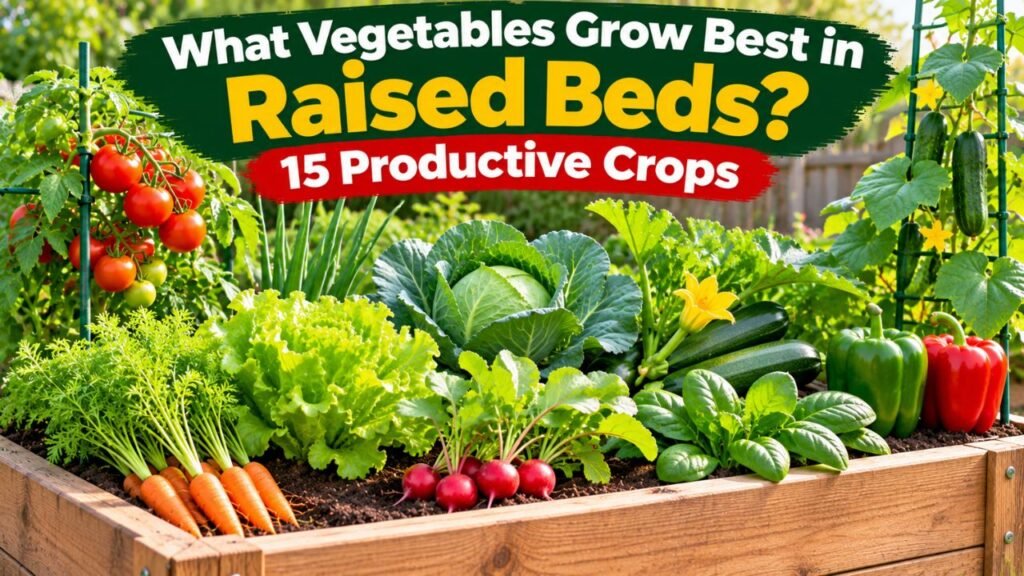
Most vegetables can grow in raised beds when their basic requirements are met. However, certain crops make particularly efficient use of the available growing space.
Leafy greens grow relatively quickly, root vegetables appreciate loose soil, and climbing vegetables can be trained vertically.
The following vegetables are useful starting points for home gardeners.
| Vegetable | Best growing season | Sunlight | Why it works well |
| Lettuce | Spring and fall | 4–6+ hours | Compact and quick to harvest |
| Spinach | Spring and fall | 4–6+ hours | Suitable for cool-season planting |
| Radishes | Spring and fall | 4–6+ hours | Fast-growing root vegetable |
| Carrots | Spring and fall | 6+ hours; some shade tolerated | Benefit from loose soil |
| Beets | Spring and fall | 4–6+ hours | Edible roots and greens |
| Kale | Spring and fall | 4–6+ hours | Repeated leaf harvesting |
| Swiss chard | Spring through fall | 4–6+ hours | Long harvesting season |
| Bush beans | Late spring and summer | 6–8 hours | Compact, productive plants |
| Peas | Cool spring or fall | 6+ hours | Can grow vertically |
| Tomatoes | Warm season | 6–8+ hours | Productive with proper support |
| Peppers | Warm season | 6–8+ hours | Suitable for compact beds |
| Cucumbers | Warm season | 6–8+ hours | Can climb a trellis |
| Green onions | Spring and fall; climate-dependent | 4–6+ hours | Require relatively little space |
| Garlic | Fall planting in many regions | 6+ hours | Uses bed space through winter |
| Zucchini | Warm season | 6–8+ hours | Productive but needs room |
Sunlight requirements are approximate. Varieties, temperatures, and local growing conditions can change their performance.
According to the University of Maryland Extension’s vegetable gardening guide, bush beans, tomatoes, cucumbers, peppers, lettuce, summer squash, and leafy greens are among the easiest vegetables for home gardeners.
1. Lettuce
Best for: Beginners, small raised beds, and repeated harvests
Lettuce is one of the easiest vegetables to grow in a raised garden bed.
It has a relatively compact root system and doesn’t require the same growing space as large fruiting vegetables.
Leaf lettuce is particularly useful because you can harvest individual outer leaves while allowing the plant to continue growing.
Popular choices include:
- Loose-leaf lettuce.
- Butterhead lettuce.
- Romaine lettuce.
- Oakleaf lettuce.
- Mixed salad greens.
Lettuce performs best in cool weather.
Excessive heat can cause bolting, when the plant begins flowering and its leaves may develop a bitter flavor.
Plant lettuce in early spring or again in late summer for a fall harvest, depending on your climate.
For full-sized leaf lettuce, approximately 6–10 inches between plants is a reasonable starting point, depending on the variety.
Baby lettuce can be grown at closer spacing.
Growing tip: Sow small batches every one or two weeks during favorable weather instead of planting the entire bed at once.
This helps extend the harvest.
2. Spinach
Best for: Cool-season gardens and compact planting areas
Spinach is another excellent raised bed vegetable.
It grows quickly in cool conditions and can provide nutritious leaves for salads, soups, and cooked dishes.
The loose soil in a raised bed makes planting and harvesting easier.
Spinach can be grown from seeds sown directly into the soil.
Thin plants according to the seed packet, commonly leaving approximately 3–6 inches for mature plants.
Spinach doesn’t perform as well during hot weather.
High temperatures and long days can encourage bolting.
For that reason, spring and fall are usually the preferred growing seasons in many U.S. regions.
Growing tip: Keep the soil evenly moist during germination and early growth. Spinach seeds may germinate poorly when the soil becomes excessively hot.
3. Radishes
Best for: Fast harvests and beginning gardeners
Radishes are among the quickest vegetables to grow in raised beds.
Some common spring radish varieties can be harvested approximately 25–35 days after sowing, depending on conditions.
Their short growing season makes them useful for filling temporary gaps between slower-growing vegetables.
Radishes prefer:
- Loose soil.
- Cool temperatures.
- Consistent moisture.
- Adequate spacing.
- Direct sunlight or light partial shade.
Sow seeds directly in the raised bed.
Thin seedlings to approximately 2 inches apart for many small round varieties, adjusting for the mature root size.
If plants are crowded, their roots may remain small or develop poorly.
Growing tip: Plant a short row of radishes every one or two weeks during cool weather for a more continuous harvest.
Radishes are particularly useful before planting warm-season vegetables in late spring.
4. Carrots
Best for: Raised beds with loose, deep soil
Carrots are particularly well suited to raised beds because they grow best in soil that allows their roots to develop without major obstructions.
Compacted soil, rocks, and hard clumps can cause irregular or forked roots.
Raised beds often provide a more favorable growing environment.
The University of Maryland Extension’s raised bed guidance specifically identifies carrots as a crop that benefits from deeper, looser soil.
Choose a carrot variety according to the available growing depth.
Short varieties are useful for shallower beds.
Longer varieties require more unobstructed soil.
For a bed with a solid bottom or installed over pavement, approximately 12 inches of growing depth is a useful starting point for many carrot varieties, though the required depth depends on the mature root length.
Sow carrots directly rather than transplanting them.
Thin seedlings to approximately 2–3 inches apart for many standard varieties.
Growing tip: Keep the seedbed consistently moist during germination. Carrot seeds can take longer to emerge than many other vegetable seeds.
5. Beets
Best for: Gardeners who want edible roots and greens
Beets are useful in raised beds because both their roots and leaves are edible.
They grow well in loose soil and relatively cool weather.
Beets can be planted in spring and again for fall harvesting.
Sow the seeds directly into the bed.
For full-sized roots, thin seedlings to approximately 3–4 inches apart.
Beet seeds sold for planting are often seed clusters, so more than one seedling may emerge from a single planting point.
Thinning helps prevent overcrowding.
Young beet greens can be harvested carefully, but removing too many leaves may reduce root development.
Growing tip: Keep the soil evenly moist while the roots enlarge. Inconsistent watering and excessive crowding can affect root quality.
6. Kale
Best for: Repeated leaf harvesting and cool-season production
Kale is a productive leafy vegetable for raised beds.
Unlike vegetables harvested once, kale can continue producing leaves over an extended period.
You can harvest mature outer leaves while allowing the center of the plant to grow.
Popular types include curly kale, lacinato kale, and red Russian kale.
Kale generally performs well in cooler weather.
Established plants of many varieties tolerate light frost, and some survive colder conditions.
However, cold tolerance depends on the variety and growing environment.
For full-sized plants, allow approximately 12–18 inches or more between plants, depending on the cultivar.
Baby kale can be planted more densely.
Growing tip: Harvest older outer leaves first and avoid damaging the central growing point.
This supports continued leaf production.
7. Swiss Chard
Best for: Long-season leaf production
Swiss chard is a versatile raised bed vegetable.
Its leaves and tender stalks can be used in many cooked dishes.
Some varieties have colorful stems, adding visual interest to the garden.
Swiss chard can tolerate warmer conditions than spinach, making it useful when spring spinach begins declining.
However, it still needs consistent moisture and suitable temperatures for healthy growth.
For mature plants, approximately 8–12 inches between plants is a practical starting point, depending on the desired size.
Baby-leaf chard can be planted closer.
Growing tip: Remove mature outer leaves regularly while leaving the younger center leaves to develop.
A few healthy plants can provide harvests over a long growing period.
8. Bush Beans
Best for: Productive summer gardens with limited space
Bush beans are among the easiest warm-season vegetables for raised beds.
They grow in relatively compact plants and usually don’t require a tall trellis.
This makes them more space-efficient than many sprawling vegetables.
Bush beans prefer warm soil and full sun.
Plant them after the danger of frost has passed and the soil has warmed sufficiently.
Direct sowing is usually preferable.
For many bush bean varieties, approximately 4–6 inches between plants provides a useful starting point.
Always check the specific seed packet.
Bush beans often produce a concentrated harvest over several weeks.
Growing tip: Plant another small batch every two or three weeks during favorable summer weather to extend production.
Avoid sowing into cold, excessively wet soil.
9. Peas
Best for: Early-season raised beds and vertical gardening
Garden peas are excellent cool-season vegetables.
They can be grown in spring and sometimes again in fall, depending on climate.
Popular choices include:
- Sugar snap peas.
- Snow peas.
- Shelling peas.
Many varieties climb and benefit from a trellis.
This helps use vertical space instead of allowing the plants to spread across the bed.
Peas are usually direct-seeded.
They prefer cooler weather and may struggle as summer temperatures increase.
For trellised types, follow the variety’s recommended seed spacing, commonly a few inches apart along the support.
Growing tip: Place the trellis along the north side of a bed where practical to reduce shading of shorter crops.
Once peas finish producing, their space can be used for a warm-season vegetable.
10. Tomatoes
Best for: Sunny raised beds with adequate soil depth
Tomatoes can grow very successfully in raised beds.
However, they need more space, water, nutrients, and support than most leafy vegetables.
For smaller beds, choose suitable compact varieties.
Useful types include:
- Determinate tomatoes.
- Patio tomatoes.
- Compact cherry tomatoes.
- Bush-type tomatoes.
Not every cherry tomato is compact. Some indeterminate cherry varieties become very large.
Read the mature size listed on the plant label.
Tomatoes generally need at least 6–8 hours of direct sunlight each day, and more can be beneficial.
They also need well-developed root systems.
For raised beds installed over an impermeable surface, the University of Maryland Extension recommends approximately 12–24 inches of growing depth for tomatoes, peppers, and squash.
Open-bottom beds over suitable native soil may allow roots to grow deeper than the bed frame.
Growing tip: Install stakes, cages, or trellises when planting. Adding supports later can damage established roots.
11. Peppers
Best for: Compact warm-season planting
Peppers are productive raised bed vegetables when they receive sufficient warmth and sunlight.
Both sweet and hot peppers can grow successfully.
Examples include:
- Bell peppers.
- Jalapeños.
- Banana peppers.
- Serrano peppers.
- Other compact pepper varieties.
Peppers generally prefer full sun and warm growing conditions.
They may grow slowly in cold soil.
In many temperate U.S. regions, gardeners start peppers indoors or purchase transplants.
Set them outside after frost danger has passed and conditions are warm enough.
For many varieties, approximately 18–24 inches between plants is appropriate, although mature sizes vary.
Growing tip: Avoid excessive nitrogen fertilization, which can encourage leafy growth without necessarily improving fruit production.
Use soil test results and crop-specific recommendations to guide fertilization.
12. Cucumbers
Best for: Raised beds with a sturdy trellis
Cucumbers are excellent raised bed crops when they are trained vertically.
Without support, vining varieties can spread across a large area.
A trellis helps keep plants more organized and can improve access to harvesting.
Choose from:
- Slicing cucumbers.
- Pickling cucumbers.
- Compact bush cucumbers.
- Trellis-friendly vining varieties.
Cucumbers prefer warm weather and full sun.
They are sensitive to frost.
For trellised plants, spacing around 12–18 inches may work for some varieties, depending on their growth habit and recommended management.
The University of Maryland Extension’s close-spacing guidance describes trellised cucumbers grown approximately 18 inches apart as an intensive planting option.
However, crowding can reduce airflow and increase disease pressure.
Growing tip: Install a sturdy trellis before the vines begin climbing. Keep the soil consistently moist, particularly during flowering and fruit development.
13. Green Onions
Best for: Narrow spaces and bed edges
Green onions, also called scallions, are useful for filling smaller planting areas.
They have a relatively upright growth habit and don’t occupy as much room as many fruiting vegetables.
They can be grown from seed or suitable young plants.
Green onions are commonly grown in cool or mild weather, although planting seasons vary with climate and variety.
They can tolerate some partial shade, but growth may be slower with less sunlight.
For individual scallions, approximately 2–3 inches between plants is a reasonable starting point.
Smaller harvest sizes may allow closer planting.
Growing tip: Use green onions along accessible bed edges where they won’t be shaded by larger vegetables.
Harvest when the stalks reach a useful size for cooking.
14. Garlic
Best for: Fall planting and long-term bed planning
Garlic can grow well in raised beds because it benefits from good drainage and relatively loose soil.
In many U.S. regions, garlic is planted in fall and harvested the following summer.
However, timing varies in warmer climates.
Choose garlic types suited to local growing conditions.
Hardneck and softneck garlic have different climatic preferences.
Separate a garlic bulb into individual cloves shortly before planting.
Plant each clove with the pointed end facing upward.
A typical spacing is approximately 4–6 inches between cloves, depending on the variety and intended bulb size.
Garlic occupies bed space for several months.
Growing tip: Plan its location before planting. Fall-planted garlic may remain in the bed until early or midsummer, limiting what can be grown in that space during spring.
15. Zucchini
Best for: Productive raised beds with extra room
Zucchini is a warm-season vegetable that can produce substantial harvests from a relatively small number of plants.
However, it is not as space-efficient as lettuce, radishes, or green onions.
Even bush zucchini varieties develop large leaves.
For a typical home raised bed, one healthy zucchini plant may occupy a substantial portion of the growing area.
Choose compact bush varieties when space is limited.
Depending on the cultivar, plants may need approximately 2–4 feet of space.
Check the specific seed packet for mature spread.
Zucchini generally needs full sun, consistent moisture, and adequate pollination.
Growing tip: Avoid planting several zucchini plants in a small bed without checking their mature dimensions.
One well-maintained plant may be more productive than multiple overcrowded plants.
Key Takeaway: Leaf lettuce, radishes, bush beans, carrots, and Swiss chard are especially practical for small raised beds. Tomatoes, cucumbers, and zucchini can also be productive, but they require more careful space planning.
Which Vegetables Are Best for Beginners in Raised Beds?
If you’re starting your first raised bed vegetable garden, choose crops that are relatively easy to establish and maintain.
A useful beginner selection includes:
- Leaf lettuce.
- Radishes.
- Bush beans.
- Swiss chard.
- Green onions.
- Kale.
- Compact cherry tomatoes.
These vegetables provide different harvesting experiences without requiring a large garden.
Best Fast-Growing Vegetable for Beginners
Radishes are a strong choice for quick results.
Many spring varieties mature in approximately 25–35 days.
Leaf lettuce is another practical option because it can be harvested young.
Growing quick crops helps you learn soil moisture management and planting depth before committing to a full-season vegetable.
Best Vegetable for Repeated Harvests
Swiss chard and leaf lettuce can provide repeated harvests when managed properly.
Kale also produces harvestable leaves over time.
These vegetables are useful when you want fresh produce regularly rather than a single large harvest.
Best Beginner Summer Vegetable
Bush beans are a good choice.
They are relatively compact and usually require less structural support than climbing beans or indeterminate tomatoes.
Plant them in warm soil, provide sufficient sunlight, and maintain consistent moisture.
Best Vegetables for Small Raised Garden Beds
Small beds benefit from vegetables that grow upright, mature quickly, or can be harvested repeatedly.
For a compact 2-by-4-foot or 4-by-4-foot bed, consider:
- Leaf lettuce.
- Radishes.
- Spinach.
- Green onions.
- Baby carrots.
- Beets.
- Swiss chard.
- Compact kale.
These vegetables generally occupy less space than sprawling squash or pumpkin vines.
Best Vegetables for a 2-by-4-Foot Raised Bed
A 2-by-4-foot bed provides 8 square feet of growing area.
This is enough for a small salad garden.
For example, you could allocate portions of the bed to:
- Leaf lettuce.
- Radishes.
- Green onions.
Allow the spacing recommended for each crop.
Avoid filling every inch with seeds.
Overcrowding can reduce airflow, root development, and water availability.
Best Vegetables for a 4-by-4-Foot Raised Bed
A 4-by-4-foot bed provides 16 square feet.
It can accommodate several groups of compact vegetables.
One simple cool-season arrangement is:
- One section of leaf lettuce.
- One section of spinach.
- One section of carrots.
- One section of radishes.
Once spring crops finish, you can replace them with suitable warm-season plants.
A small bed should not be expected to hold several full-sized tomatoes, zucchini plants, and cucumbers together.
Best Vegetables for a 4-by-8-Foot Raised Bed
A 4-by-8-foot bed provides 32 square feet.
This allows more flexibility.
You could use the bed for several groups of leafy greens and root vegetables or dedicate it to a few larger warm-season crops.
For example, a spring garden might contain lettuce, radishes, peas, and spinach.
After harvesting the cool-season plants, selected areas can be replanted with bush beans or peppers.
A trellis along one edge may also support cucumbers.
Keep the mature plant sizes in mind rather than planting according to seedling size.
Best Vegetables for Shallow Raised Beds
Raised bed depth affects which vegetables can develop healthy roots.
However, the depth of the frame isn’t always the same as the available rooting depth.
An open-bottom raised bed installed over healthy native soil allows roots to continue growing into the ground.
A raised bed installed over concrete, pavement, or another impermeable surface has a more restricted rooting volume.
Vegetables for 6–8-Inch Raised Beds
Shallow raised beds can work for certain crops when they are open-bottomed or otherwise provide adequate rooting conditions.
Good candidates include:
- Leaf lettuce.
- Baby spinach.
- Radishes.
- Green onions.
- Baby kale.
- Microgreens.
However, an enclosed bed over pavement generally benefits from at least 8 inches of suitable growing media for leafy greens and selected compact vegetables.
Vegetables for 8–12-Inch Raised Beds
A deeper bed gives gardeners more crop options.
Depending on the underlying soil and variety, suitable choices may include:
- Lettuce.
- Spinach.
- Radishes.
- Short carrots.
- Beets.
- Bush beans.
- Peas.
- Swiss chard.
- Kale.
- Trellised cucumbers.
Carrot varieties should be selected according to their mature root length.
Avoid assuming all long-rooted vegetables will perform equally well in 8 inches of soil.
Vegetables for 12–24-Inch Raised Beds
Deeper beds are especially useful when gardening over hard surfaces.
They provide more root space for:
- Tomatoes.
- Peppers.
- Eggplants.
- Summer squash.
- Larger root crops.
- Other vegetables with substantial root systems.
The University of Maryland Extension’s updated raised bed recommendations specify at least 8 inches of growing depth for leafy greens, beans, and cucumbers on impermeable surfaces, and approximately 12–24 inches for tomatoes, peppers, and squash.
Raised Bed Depth Comparison
| Available growing depth | Crops to consider |
| 6–8 inches | Baby greens and selected shallow crops where rooting conditions permit |
| 8–12 inches | Leafy greens, radishes, beans, short carrots, and selected cucumbers |
| 12–18 inches | Broader range of greens, root crops, peppers, and compact fruiting vegetables |
| 18–24 inches | Greater rooting volume for tomatoes, squash, peppers, and larger crops |
These are practical selection guidelines, not guarantees for every crop.
The underlying surface, soil composition, drainage, and root characteristics also matter.
Key Takeaway: For shallow beds, begin with greens and compact vegetables. Deeper beds provide more flexibility, especially when roots cannot access native soil underneath.
Best Vegetables for Raised Beds With Partial Shade
Not every raised garden receives full sunlight.
Some areas are shaded by fences, trees, buildings, or nearby structures.
Vegetables grown for leaves generally tolerate limited sunlight better than crops grown primarily for fruit.
Vegetables That Can Tolerate Some Shade
Consider:
- Leaf lettuce.
- Spinach.
- Kale.
- Swiss chard.
- Radishes.
- Beet greens.
- Green onions.
These crops may grow with approximately 4–6 hours of direct sunlight, depending on the season and conditions.
However, yields may be lower than in a well-lit location.
Vegetables That Need More Sun
Tomatoes, peppers, cucumbers, and zucchini generally perform best with at least 6–8 hours of direct sunlight daily.
Inadequate light may reduce flowering, fruit set, and overall production.
The University of Minnesota Extension’s raised bed guidance identifies tomatoes, peppers, and eggplants as full-sun crops, while suggesting leafy vegetables and some root greens for partly shaded sites.
Can Vegetables Grow in Full Shade?
Most vegetables don’t grow productively in deep, continuous shade.
Even shade-tolerant greens need sufficient light to support photosynthesis and healthy growth.
If a raised bed receives very little usable light, moving the bed or choosing a different growing location may be more effective than trying increasingly shade-tolerant vegetables.
Best Raised Bed Vegetables by Growing Season
One of the advantages of raised bed gardening is the ability to grow different crops during the same year.
However, planting times vary considerably across the United States.
Use local frost dates and soil temperatures rather than relying on one national calendar.
Spring Vegetables
Cool-season crops are useful during spring.
Good choices include:
- Lettuce.
- Spinach.
- Radishes.
- Peas.
- Carrots.
- Beets.
- Kale.
- Green onions.
These crops generally tolerate cooler growing conditions than tomatoes or peppers.
Raised bed soil often warms earlier in spring than surrounding ground-level soil.
However, this doesn’t make frost-sensitive vegetables safe to plant before freezing conditions have passed.
Summer Vegetables
Warm-season crops include:
- Tomatoes.
- Peppers.
- Bush beans.
- Cucumbers.
- Zucchini.
These crops generally need warm soil and sufficient direct sunlight.
Plant frost-sensitive vegetables according to local recommendations.
Mulching and appropriate irrigation may be particularly important during hot weather.
Fall Vegetables
Fall is a useful season for growing another crop of cool-season vegetables.
Good choices include:
- Lettuce.
- Spinach.
- Radishes.
- Kale.
- Beets.
- Carrots.
- Turnips.
- Mustard greens.
Some vegetables grow well as temperatures become cooler.
However, planting early enough is important because day length decreases during fall.
Winter Vegetables
Winter growing opportunities depend strongly on climate.
In mild-winter regions, some leafy greens, garlic, and other cool-season crops may grow outdoors.
In colder regions, cold frames or low tunnels may help protect certain vegetables.
However, winter protection doesn’t guarantee active growth when temperatures and daylight are too low.
Choose varieties and protection methods suitable for your USDA region and local winter conditions.
Seasonal Planting Chart
| Season | Recommended crops |
| Early spring | Peas, spinach, radishes, lettuce |
| Mid to late spring | Carrots, beets, kale, green onions |
| Late spring after frost | Bush beans, tomatoes, peppers, cucumbers, zucchini |
| Summer | Tomatoes, peppers, beans, cucumbers, squash |
| Late summer for fall harvest | Kale, beets, carrots, radishes, spinach |
| Fall | Lettuce, spinach, kale, garlic in suitable climates |
| Winter in mild climates | Selected greens and overwintering vegetables |
Use local cooperative extension planting calendars to determine actual sowing and transplant dates.
Vegetables That Are Less Practical for Small Raised Beds
Some vegetables can grow in raised beds but aren’t the best use of limited space.
The problem is usually their mature size, growth habit, or production requirements.
Sweet Corn
Sweet corn generally performs best when planted in blocks rather than a single short row.
This arrangement supports wind pollination.
A small 4-by-8-foot bed may not provide an efficient planting area for producing well-filled ears.
Corn also grows tall and can shade nearby vegetables.
Large Pumpkins
Pumpkin vines can spread across a large area.
They may extend several feet beyond the raised bed.
Although vines can sometimes trail outside the frame, the plant still needs suitable soil volume, moisture, and space.
Compact or small-fruited varieties are more manageable.
Watermelons
Watermelon vines can become extensive.
They also require warm conditions and adequate growing space.
Small-fruited varieties may be suitable with careful planning.
However, ordinary large watermelon plants aren’t usually the most efficient choice for a small raised bed.
Large Winter Squash
Many winter squash varieties produce long vines.
They can occupy considerable garden space.
Bush or semi-bush varieties may be more manageable.
Check the mature spread before planting.
Potatoes
Potatoes can grow well in raised beds.
However, they can occupy a substantial area for much of the season.
They may be less space-efficient than leafy vegetables or root crops when the bed is very small.
For gardeners who particularly want homegrown potatoes, a dedicated raised bed or suitable container can still be worthwhile.
Key Takeaway: Avoid choosing crops solely because they can grow in raised beds. Consider mature plant size and the amount of harvest you’re likely to obtain from the available space.
How to Arrange Vegetables in a Raised Bed Garden
Good raised bed planning involves more than deciding which vegetables to plant.
Spacing, sunlight, rooting requirements, and the mature size of each crop all influence the layout.
Place Taller Vegetables Where They Won’t Block Sunlight
Tall crops can shade smaller vegetables.
When practical, position trellises and tall crops along the north side of a bed in the Northern Hemisphere.
This can help reduce shade over lower-growing vegetables.
However, surrounding buildings and trees may change the best arrangement.
Observe sunlight patterns before installing permanent supports.
Use Trellises for Climbing Vegetables
Vertical supports are particularly useful for:
- Peas.
- Pole beans.
- Vining cucumbers.
- Indeterminate tomatoes.
A trellis can reduce the amount of ground space occupied by sprawling stems.
However, support structures must be strong enough for mature plants and exposed wind conditions.
Install them securely before the plants become large.
Group Vegetables With Similar Seasonal Needs
Cool-season greens are easier to manage when they occupy the same general section.
Warm-season crops can be planted after those greens finish.
This simplifies seasonal changes and helps avoid removing productive plants prematurely.
Don’t Plant Vegetables Too Closely
Crowding can lead to:
- Reduced airflow.
- More competition for sunlight.
- Higher water demand.
- Increased disease pressure.
- Smaller roots or fruits.
- Difficult harvesting.
The University of Maryland Extension’s guidance on intensive vegetable spacing notes that closer spacing can increase production per area in some situations but can also reduce yield per plant and increase pest or disease problems.
Use seed packet spacing as a starting point.
Adjust only when you understand the crop’s mature growth habit.
Raised Bed Vegetable Spacing Chart
The following distances are general starting ranges for home gardening.
Spacing depends on the cultivar, harvest size, pruning, and growing conditions.
| Vegetable | Approximate spacing between plants |
| Leaf lettuce | 6–10 inches |
| Spinach | 3–6 inches |
| Radishes | 2–3 inches |
| Carrots | 2–3 inches |
| Beets | 3–4 inches |
| Kale | 12–18 inches for mature plants |
| Swiss chard | 8–12 inches |
| Bush beans | 4–6 inches |
| Trellised peas | A few inches, based on variety |
| Determinate tomatoes | 18–30 inches, variety-dependent |
| Peppers | 18–24 inches |
| Trellised cucumbers | 12–18 inches for suitable varieties |
| Green onions | 2–3 inches |
| Garlic | 4–6 inches |
| Bush zucchini | Approximately 24–48 inches, depending on variety |
These ranges shouldn’t replace the seed packet or transplant label.
For example, an indeterminate tomato can require substantially more room than a compact determinate variety.
Similarly, zucchini varieties differ in mature spread.
How to Prepare a Raised Bed for Growing Vegetables
Good soil preparation is important regardless of which vegetables you choose.
Raised beds work best when the growing medium supports drainage, moisture retention, root growth, and nutrient availability.
Step 1: Choose a Sunny Location
For most fruiting vegetables, select a location receiving at least 6–8 hours of direct sun daily.
Leafy greens can tolerate somewhat less sunlight.
Position the bed where watering and harvesting are convenient.
Step 2: Make the Bed Easy to Reach
A raised bed approximately 3–4 feet wide is practical when accessible from both sides.
This allows gardeners to reach the center without walking on the soil.
Avoid making the bed so wide that routine maintenance requires stepping inside.
Foot traffic can cause compaction.
Step 3: Use a Suitable Soil Mix
Good raised bed soil should retain some moisture while allowing excess water to drain.
It should also provide enough pore space for root growth.
Possible ingredients include:
- Suitable mineral topsoil.
- Finished compost.
- Appropriate growing media.
- Other amendments based on soil conditions.
Avoid filling the entire bed with unfinished organic debris or fresh manure.
A growing medium containing excessive compost can also develop nutrient imbalances.
Step 4: Check Soil pH and Nutrients
Most vegetables grow well in slightly acidic to near-neutral soil.
The University of Maryland Extension identifies approximately pH 6.2–6.8 as a useful range for many garden vegetables.
However, individual crops differ.
A laboratory soil test helps determine nutrient availability and whether pH adjustment is necessary.
Avoid adding lime, sulfur, or fertilizer without understanding the soil’s needs.
Step 5: Confirm Adequate Drainage
Raised beds generally drain well, but the actual drainage depends on the soil mix and underlying surface.
An open-bottom bed over permeable ground may drain differently from a containerized bed over concrete.
Ensure that excess water has somewhere to go.
Avoid creating a sealed, waterlogged container.
Step 6: Plant According to the Crop
Some vegetables grow best when seeds are planted directly into the bed.
Examples include carrots, radishes, beans, and peas.
Others are commonly transplanted.
Examples include tomatoes and peppers.
Follow the seed packet for planting depth and spacing.
Don’t bury seeds deeper than recommended.
How to Water Vegetables in Raised Beds
Raised beds often dry faster than ground-level garden soil.
This is particularly noticeable during hot, windy weather.
The frequency of watering depends on soil composition, plant size, temperature, rainfall, and bed depth.
Check Moisture Below the Surface
Don’t judge soil moisture only by appearance.
The top layer can look dry while the root zone remains moist.
Check several inches below the surface using your finger, a small trowel, or an appropriate moisture-monitoring method.
Water according to the crop’s needs.
Use Drip Irrigation or Soaker Hoses
Drip irrigation can deliver water near plant roots.
It can also reduce unnecessary wetting of foliage compared with overhead irrigation.
A properly designed drip system is especially useful when growing several vegetables in one raised bed.
However, adjust irrigation duration according to soil moisture rather than relying on a fixed schedule.
Apply Mulch
Suitable organic mulch can reduce evaporation and protect the soil surface.
Options include clean straw and shredded leaves.
Apply mulch after seedlings are established, when appropriate.
Keep it away from plant stems to avoid trapping excessive moisture.
Avoid Overwatering
Good drainage doesn’t mean overwatering is harmless.
Saturated soil can restrict oxygen availability around roots.
Maintain a moist but appropriately aerated root zone.
Different crops and growth stages may require different watering schedules.
How to Grow More Vegetables in One Raised Bed
A raised bed can produce several crops in one growing season when planting is planned carefully.
One of the most useful methods is succession planting.
What Is Succession Planting?
Succession planting means planting another crop after an earlier crop finishes, or sowing small batches at intervals for repeated harvests.
For example:
- Grow radishes in early spring.
- Harvest them before warm weather.
- Plant bush beans in the cleared space.
- Harvest beans during summer.
- Plant spinach for fall.
The exact sequence depends on local frost dates and the growing season.
Sample Spring-to-Fall Raised Bed Schedule
| Growing period | Example crop |
| Early spring | Radishes and spinach |
| Late spring | Leaf lettuce or peas |
| Summer | Bush beans or cucumbers |
| Late summer | Kale or beets |
| Fall | Spinach or radishes |
This is an example sequence, not a universal calendar.
The available growing season may support fewer or more crop changes.
The University of Maryland Extension’s succession planting guide recommends planning different crops across spring, summer, and fall.
It also describes sowing small groups of certain crops approximately every two weeks to extend harvesting.
Harvest Leafy Vegetables Repeatedly
Some vegetables can be harvested without removing the entire plant.
Examples include:
- Leaf lettuce.
- Kale.
- Swiss chard.
Harvesting mature outer leaves may allow continued production.
However, avoid removing so many leaves that the plant cannot maintain healthy growth.
Choose Compact Varieties
Variety selection is especially important in small raised beds.
Look for terms such as:
- Bush.
- Patio.
- Compact.
- Dwarf.
- Determinate.
- Short-rooted.
These terms can indicate a smaller growth habit, but always check the actual mature dimensions.
Some plants labeled compact still require substantial space.
Grow Vertically
Trellised vegetables can make better use of limited ground area.
Peas, climbing beans, and suitable cucumber varieties are useful candidates.
Install sturdy supports and maintain sufficient root space and airflow.
Vertical gardening reduces the ground area occupied by vines, but it doesn’t eliminate the plant’s water and nutrient requirements.
Common Mistakes When Growing Vegetables in Raised Beds
Planting Too Many Large Vegetables
Small seedlings can make a bed appear empty.
However, a tomato or zucchini plant may become several feet wide.
Plan according to mature plant size.
Using a Bed That Is Too Shallow
Some vegetables need deeper rooting space than others.
Choose crops according to the available soil depth and whether roots can enter the underlying ground.
Choosing Crops Without Considering Sunlight
Tomatoes and peppers generally require more direct sun than leafy greens.
Match crops to the actual light conditions.
Overfilling the Bed With Compost
Too much compost can raise certain nutrient levels excessively.
Use an appropriate soil mix and apply amendments based on soil needs.
Ignoring Soil Moisture
Raised beds may dry quickly, especially when installed over hard surfaces.
Check the soil regularly rather than watering on a rigid schedule.
Forgetting to Thin Seedlings
Carrots, radishes, and beets need appropriate spacing.
Crowded seedlings may produce poorly developed roots.
Thin them according to the variety and intended harvest size.
Planting Warm-Season Crops Too Early
Raised bed soil may warm earlier in spring, but late frost can still damage tender vegetables.
Wait for suitable planting conditions.
Not Planning for Harvest Timing
Some crops mature quickly, while others occupy the bed for several months.
Plan planting sequences so finished crops can be replaced without disturbing productive plants.
How to Choose the Best Raised Bed Vegetables for Your Garden
The best selection depends on four practical factors: space, sunlight, season, and what you actually want to eat.
For the Easiest Start
Choose lettuce, radishes, bush beans, and Swiss chard.
They are useful for developing basic planting, watering, and harvesting skills.
For Maximum Variety in a Small Bed
Choose a mixture of leafy greens and compact roots.
For example, lettuce, spinach, green onions, and radishes use space more efficiently than several sprawling squash plants.
For Summer Harvests
Choose bush beans, peppers, compact tomatoes, and trellised cucumbers.
Provide sufficient sunlight, root space, and support.
For Fall and Cool Weather
Choose spinach, kale, radishes, carrots, beets, and suitable lettuce varieties.
Check local frost dates to make sure crops have enough time to mature.
For a Bed With Limited Sunlight
Start with leafy greens and selected root vegetables.
Expect slower growth or smaller harvests in lower light.
For a Deeper Raised Bed
Tomatoes, peppers, carrots, cucumbers, and squash become more practical when adequate rooting volume is available.
Always account for the mature size of the plant above ground.
Conclusion
Choosing what vegetables grow best in raised beds depends on the amount of sunlight, available soil depth, growing season, and space between plants.
Lettuce, spinach, radishes, carrots, beets, kale, and Swiss chard are especially suitable because they benefit from loose soil and can be grown in relatively compact areas.
Bush beans and peas are also useful choices, while tomatoes, peppers, cucumbers, and zucchini can produce excellent harvests when given sufficient room and support.
For beginners, I recommend starting with leaf lettuce, radishes, bush beans, and Swiss chard. These crops provide a good combination of manageable care requirements and useful harvests.
For a larger raised bed, add compact tomatoes, peppers, or trellised cucumbers.
Remember that raised beds can dry out faster than surrounding soil. Consistent watering, appropriate spacing, suitable soil amendments, and careful seasonal planning are essential.
A productive raised bed isn’t necessarily the one with the most plants. It is the one where each vegetable has enough space, light, water, and nutrients to grow well.
FAQs About What Vegetables Grow Best in Raised Beds
What Are the Easiest Vegetables to Grow in a Raised Bed?
Leaf lettuce, radishes, bush beans, Swiss chard, and kale are among the easiest choices.
They have relatively manageable growing requirements and can perform well in appropriately prepared raised beds.
What Vegetables Grow Best in a 4-by-8-Foot Raised Bed?
A 4-by-8-foot bed can grow lettuce, carrots, radishes, beets, bush beans, peppers, and trellised cucumbers.
However, the number of plants depends on their mature sizes. Avoid overcrowding the bed with several large tomatoes or squash plants.
What Vegetables Grow Best in Shallow Raised Beds?
Leaf lettuce, baby spinach, radishes, green onions, and baby kale are useful candidates.
For beds over pavement, at least 8 inches of suitable growing medium is a practical starting point for many leafy vegetables. Root vegetables may require more depth depending on the variety.
Can You Grow Tomatoes and Cucumbers Together in a Raised Bed?
Yes, when the bed provides enough room, root space, sunlight, and support.
Both are warm-season crops. However, large tomato plants and spreading cucumber vines can compete for resources.
Use appropriate spacing and train suitable cucumber varieties vertically.
Can You Grow Vegetables Year-Round in Raised Beds?
In some climates, yes.
Mild-winter regions may support cool-season vegetables during winter. Colder areas may require cold frames, low tunnels, or other season-extension methods.
The actual growing period depends on temperatures, daylight, and crop selection.
What Vegetables Should You Avoid in Small Raised Beds?
Sweet corn, large pumpkins, watermelons, and sprawling winter squash are generally less practical in small beds.
They require substantial space or have other growing requirements that make compact planting difficult.
Smaller varieties may still be possible with careful planning.
How Many Vegetables Can You Plant in a 4-by-4-Foot Raised Bed?
A 4-by-4-foot bed provides 16 square feet, but the number of plants depends on the crop.
It can support many small lettuce or radish plants, fewer peppers, or perhaps one large squash plant with suitable growing space.
Follow the mature spacing requirements for each variety rather than using one fixed plant count.

I’m Maya L. Greenwood, a lifelong plant lover who believes anyone can grow something beautiful with the right guidance. After years of testing soil mixes, pruning methods, irrigation tricks, and pest-safe solutions, I started EasyGardenTips.com to turn hard-won lessons into step-by-step advice. From seed starting and container gardens to composting and seasonal checklists, my goal is to make gardening simple, sustainable, and fun.