How Many Pots Fit in a Grow Tent? Capacity by Pot Size
Choosing the right grow tent is only half the equation. You also need to know how many pots can actually fit inside it without overcrowding your plants or restricting airflow.
Many beginners make the mistake of calculating capacity based only on the tent’s dimensions. For example, a 4×4 grow tent may seem large enough to hold eight or more 5-gallon pots. However, once you account for plant canopies, grow lights, fans, and the space needed to access your plants, the practical number is often much lower.
The size of your pots has a direct impact on your entire indoor gardening setup. Larger containers support bigger root systems and healthier plant growth, but they also reduce the number of plants you can fit inside the tent. Smaller pots save space, yet they may require more frequent watering and can limit root development for larger plants.
Research from the University of Florida’s Institute of Food and Agricultural Sciences (UF/IFAS) shows that proper plant spacing improves light distribution, air circulation, and overall plant health. Those same principles are especially important in grow tents, where every square foot of space matters.
In this guide, I’ll show you how many pots fit in each grow tent size using common container sizes ranging from 1-gallon to 15-gallon pots. You’ll also learn what affects pot capacity, how different pot sizes change your grow tent layout, and how to maximize your growing space without overcrowding your plants.
Learn More: how many plants fit in a grow tent
How Many Pots Fit in a Grow Tent?
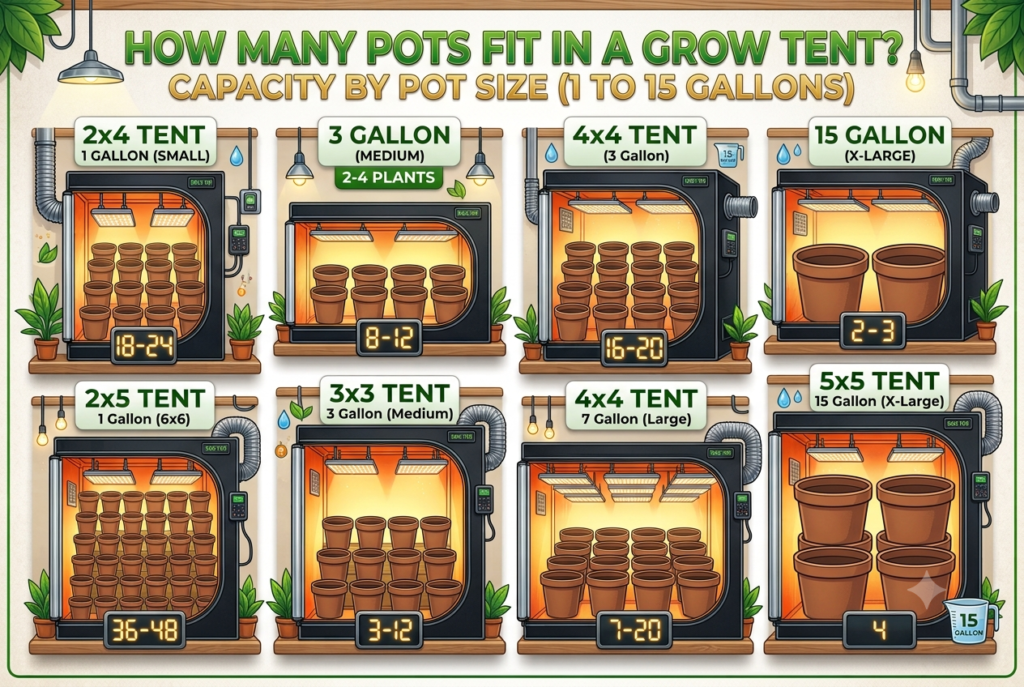
The number of pots that fit inside a grow tent depends on two things: the size of the tent and the size of the pots.
As pot size increases, each container occupies more floor space. Larger pots also require additional spacing between plants to maintain good airflow and allow room for healthy canopy development.
The table below provides a practical starting point for planning your grow tent layout.
| Grow Tent Size | 1-Gallon | 3-Gallon | 5-Gallon | 7-Gallon | 10-Gallon | 15-Gallon |
| 2×2 ft | 4 | 2 | 1 | 1 | 1 | 1 |
| 2×4 ft | 8 | 4 | 2 | 2 | 1 to 2 | 1 |
| 3×3 ft | 9 | 6 | 4 | 3 | 2 | 1 to 2 |
| 4×4 ft | 16 | 9 | 4 to 6 | 4 | 4 | 2 to 4 |
| 5×5 ft | 25 | 12 | 6 to 9 | 6 | 4 to 6 | 4 |
| 4×8 ft | 32 | 18 | 8 to 12 | 8 | 8 | 4 to 6 |
Note: These are recommended capacities for most home growers. The actual number depends on the mature size of your plants, the shape of your containers, your training method, and the amount of space needed for lighting, airflow, and maintenance.
If your goal is maximum yield from a few large plants, larger pots are usually the better choice. If you’re growing herbs, leafy greens, seedlings, or other compact plants, smaller pots can make much better use of the available space.
Rather than treating these numbers as strict limits, use them as planning guidelines. Giving your plants a little extra room often results in better airflow, healthier growth, and an easier-to-manage grow tent.
What Affects How Many Pots Fit in a Grow Tent?
The size of your grow tent is only one part of the equation. Two gardeners with the same 4×4 grow tent may fit a different number of pots because their plants, equipment, and growing methods are different.
Before deciding how many pots to use, consider the following factors.
Pot Diameter
Not all 5-gallon or 10-gallon pots have the same dimensions. Some are wider, while others are taller and narrower.
Always check the actual diameter of the pot instead of relying only on its gallon rating. A few extra inches can significantly affect how many containers fit inside your grow tent.
Plant Canopy Size
The pot only occupies part of the available space. As plants mature, their branches and leaves spread far beyond the edges of the container.
Even if additional pots physically fit inside the tent, the plants themselves may become overcrowded.
Equipment Inside the Tent
Your grow tent isn’t empty except for pots.
You’ll also need space for:
- Grow lights
- Inline fan
- Carbon filter
- Oscillating fans
- Humidifier or dehumidifier
- Ducting
These items reduce the usable growing area and should be considered when planning your layout.
Airflow and Plant Spacing
Healthy plants need space between them for proper air circulation.
Placing pots too close together can trap heat and humidity, increasing the risk of mold, mildew, and pest problems. Leaving a small gap between containers often leads to healthier plants.
Growing Method
Your growing style also affects pot capacity.
For example, growers using SCROG typically use fewer, larger pots because each plant is trained to fill more of the canopy. In contrast, Sea of Green (SOG) setups often use many smaller pots placed closer together.
Access for Maintenance
Don’t forget to leave room for yourself.
You’ll need to water plants, inspect leaves, prune branches, and harvest without constantly moving pots around. A layout that’s easy to access is usually much more enjoyable to maintain.
Keeping these factors in mind will help you choose a pot layout that supports healthy growth rather than simply fitting the maximum number of containers into your grow tent.
Next, I’ll break down each grow tent size and show you how many 1-gallon, 3-gallon, 5-gallon, 7-gallon, 10-gallon, and 15-gallon pots fit comfortably in each one.
Pot Capacity by Grow Tent Size
The recommendations below are based on practical layouts that leave enough room for healthy plant growth, airflow, and routine maintenance. While you may be able to squeeze in a few extra pots, doing so often makes your grow tent harder to manage.
How Many 1-Gallon Pots Fit in a Grow Tent?
One-gallon pots are compact and work well for seedlings, herbs, leafy greens, and other small plants.
Because these containers are small, they allow you to maximize the available floor space. However, they also dry out faster and are generally best suited for smaller plants or shorter growing cycles.
How Many 3-Gallon Pots Fit in a Grow Tent?
Three-gallon pots are a popular choice for many indoor gardens because they provide a good balance between root space and plant capacity.
| Grow Tent Size | Recommended 3-Gallon Pots |
| 2×2 ft | 2 |
| 2×4 ft | 4 |
| 3×3 ft | 6 |
| 4×4 ft | 9 |
| 5×5 ft | 12 |
| 4×8 ft | 18 |
These containers are suitable for a wide variety of plants and fit comfortably in most grow tents without sacrificing too much growing space.
How Many 5-Gallon Pots Fit in a Grow Tent?
Five-gallon pots are one of the most common choices for home gardeners. They provide plenty of room for healthy root development while still allowing a reasonable number of plants in most grow tents.
| Grow Tent Size | Recommended 5-Gallon Pots |
| 2×2 ft | 1 |
| 2×4 ft | 2 |
| 3×3 ft | 4 |
| 4×4 ft | 4 to 6 |
| 5×5 ft | 6 to 9 |
| 4×8 ft | 8 to 12 |
For many indoor growing setups, 5-gallon pots offer one of the best combinations of plant size, maintenance, and overall productivity.
Next, I’ll cover 7-gallon, 10-gallon, and 15-gallon pots, including when they’re worth using and how many fit in each grow tent size.
How Many 7-Gallon Pots Fit in a Grow Tent?
Seven-gallon pots are ideal for larger plants that need additional root space. Because they’re wider than 5-gallon containers, they reduce the number of pots that can comfortably fit inside a grow tent.
| Grow Tent Size | Recommended 7-Gallon Pots |
| 2×2 ft | 1 |
| 2×4 ft | 2 |
| 3×3 ft | 3 |
| 4×4 ft | 4 |
| 5×5 ft | 6 |
| 4×8 ft | 8 |
These pots are a good choice if your goal is to grow fewer, larger plants rather than maximizing plant count.
How Many 10-Gallon Pots Fit in a Grow Tent?
Ten-gallon pots provide a substantial amount of root space and are commonly used for large, long-term plants.
| Grow Tent Size | Recommended 10-Gallon Pots |
| 2×2 ft | 1 |
| 2×4 ft | 1 to 2 |
| 3×3 ft | 2 |
| 4×4 ft | 4 |
| 5×5 ft | 4 to 6 |
| 4×8 ft | 8 |
Because these containers take up more floor space, make sure there’s still enough room for airflow and maintenance.
How Many 15-Gallon Pots Fit in a Grow Tent?
Fifteen-gallon pots are designed for very large plants with extensive root systems. They’re best suited for spacious grow tents where each plant has plenty of room to spread.
| Grow Tent Size | Recommended 15-Gallon Pots |
| 2×2 ft | 1 |
| 2×4 ft | 1 |
| 3×3 ft | 1 to 2 |
| 4×4 ft | 2 to 4 |
| 5×5 ft | 4 |
| 4×8 ft | 4 to 6 |
Before using containers this large, make sure your grow tent has enough vertical clearance, lighting, and ventilation to support the larger plants they’ll produce.
While bigger pots can encourage stronger root development, they also require more growing medium, more water, and more floor space.
Can You Fit More Pots Than Recommended?
Technically, yes.
In many cases, you can physically place more pots inside a grow tent than the recommended numbers shown in this guide. However, just because the pots fit doesn’t mean your plants will have enough room to thrive.
As plants mature, their leaves and branches extend well beyond the edges of the containers. A layout that looks spacious on day one can become overcrowded just a few weeks later.
Packing too many pots into a grow tent can lead to several problems, including:
- Poor airflow between plants
- Uneven light distribution
- Higher humidity levels
- Increased risk of mold and pests
- Difficult watering and maintenance
- Reduced overall plant health
For example, you might be able to squeeze eight 5-gallon pots into a 4×4 grow tent, but doing so leaves very little space between plants. As the canopy fills in, airflow decreases and it becomes much harder to access the plants in the back of the tent.
Instead of aiming for the maximum number of pots, consider leaving a little extra space around each plant. Better light penetration and improved air circulation often result in healthier growth and better overall performance.
A good rule of thumb is to start with the recommended capacity and only increase it if you’re confident your lighting, ventilation, and growing method can support a denser layout.
Round vs. Square Pots: Which Fits More?
The shape of your pots can affect how efficiently you use the available space inside a grow tent.
Round pots are the most common option for home gardeners. They’re widely available, provide good drainage, and work well for most growing setups. However, because they’re circular, they leave small gaps between containers when placed side by side.
Square pots make better use of the tent’s floor space. Their straight sides allow them to sit closely together, reducing wasted space and often allowing you to fit one or two additional pots in larger grow tents.
Here’s a quick comparison:
| Feature | Round Pots | Square Pots |
| Space efficiency | Good | Excellent |
| Air gaps between pots | More | Less |
| Best for maximizing plant count | No | Yes |
| Most commonly available | Yes | Less common |
| Suitable for most growers | Yes | Yes |
While square pots are more space-efficient, that doesn’t always mean they’re the better choice. Plants still need adequate airflow and enough room for their canopy to develop.
If your priority is maximizing the number of pots in a grow tent, square containers can be a smart option. If you value flexibility and easy availability, round pots remain an excellent choice.
In most home gardens, the difference between round and square pots is relatively small compared to other factors such as plant size, training method, and ventilation.
Tips for Maximizing Grow Tent Space
You don’t have to overcrowd your grow tent to make the most of it. A few smart planning decisions can help you use the available space more efficiently.
Here are some practical tips:
- Choose pot sizes that match your plants rather than using the largest containers possible.
- Arrange pots evenly to improve light coverage and airflow.
- Leave enough space to reach every plant for watering and maintenance.
- Match your grow light’s coverage area to your grow tent size.
- Use plant training techniques if you want to make better use of the canopy.
- Keep fans and other equipment positioned so they don’t block valuable growing space.
A well-organized grow tent is easier to maintain and usually produces healthier plants than one that’s filled to its maximum capacity.
Frequently Asked Questions
Can I Fit More Pots Than the Recommended Number?
Yes, but it’s usually not recommended. While extra pots may physically fit inside the tent, overcrowding can reduce airflow, block light, and make watering and maintenance much more difficult.
Are Fabric Pots Larger Than Plastic Pots?
Not necessarily, but fabric pots often expand slightly when filled with growing medium. Their exact dimensions vary by manufacturer, so it’s always a good idea to check the pot’s diameter before planning your layout.
Is It Better to Use Fewer Large Pots or More Small Pots?
It depends on your growing goals.
If you want to grow larger plants with more root space, fewer large pots are usually the better option. If you’re growing compact plants or seedlings, smaller pots allow you to fit more plants in the same grow tent.
Does Pot Shape Affect Capacity?
Yes. Square pots generally make more efficient use of floor space because they fit closely together with fewer gaps. Round pots leave small spaces between containers, although the difference is usually minor in most home grow tents.
Should Every Pot Touch the Next One?
No. Leaving a small gap between pots improves airflow, makes plant maintenance easier, and helps reduce humidity around the canopy.
Conclusion
Choosing the right pot size is just as important as choosing the right grow tent. While it may be tempting to fit as many pots as possible into your available space, a well-planned layout almost always produces healthier plants and a more manageable indoor garden.
As a general rule, use smaller pots for compact plants and short growing cycles, and larger pots when your plants need additional root space. Always leave enough room for lighting, airflow, and routine maintenance instead of filling every inch of your grow tent.
Use the recommendations in this guide as a starting point, then adjust your layout based on your plant size, growing method, and equipment. With the right balance of pot size and spacing, you’ll create a grow tent that’s both productive and easy to maintain.

I’m Maya L. Greenwood, a lifelong plant lover who believes anyone can grow something beautiful with the right guidance. After years of testing soil mixes, pruning methods, irrigation tricks, and pest-safe solutions, I started EasyGardenTips.com to turn hard-won lessons into step-by-step advice. From seed starting and container gardens to composting and seasonal checklists, my goal is to make gardening simple, sustainable, and fun.