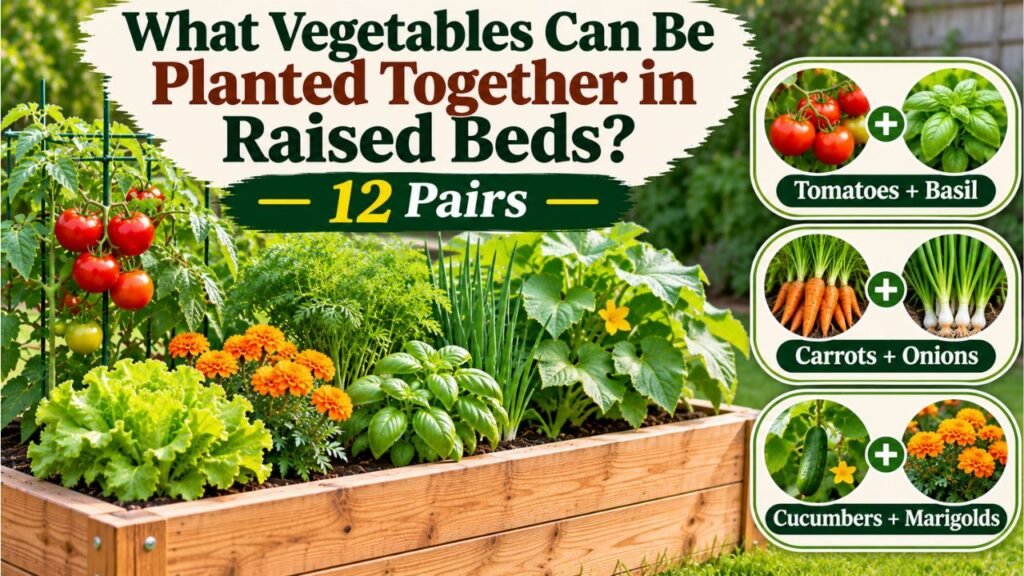
What Vegetables Can Be Planted Together in Raised Beds? 12 Pairs
Tomatoes can grow with basil and early lettuce, carrots pair well with quick-growing radishes, and peppers can share a raised bed with scallions or leafy greens. Other practical combinations include cabbage with lettuce, peas with spinach, and trellised cucumbers with short-season salad crops. The best pairings make efficient use of sunlight, space, and growing time rather than relying on claims that one vegetable magically protects another.
Raised beds make mixed planting convenient because the soil is accessible and crops can be grouped closely. However, planting too densely can create competition for water, nutrients, and light. A sprawling squash vine can overwhelm nearby seedlings, while mature tomato foliage may shade sun-loving neighbors.
Good companion planting also depends on your climate and season. Cool-weather peas and spinach usually fit together in spring, while peppers and basil prefer warmer soil. Early crops can often be harvested before larger summer plants reach full size.
In this article, I explain reliable vegetable combinations, which pairings need extra space, and how to arrange crops in 4×4 and 4×8 raised beds. You’ll also learn practical spacing, seasonal planting sequences, and how to avoid common companion-planting mistakes.
What Vegetables Can Be Planted Together in Raised Beds?
Many vegetables can grow successfully together when they have compatible sunlight, moisture, temperature, and space requirements.
This gardening method is commonly called companion planting or interplanting.
It involves growing two or more crops close to one another to make better use of garden space or achieve another practical benefit.
Not every traditional companion-planting claim is supported by scientific research.
For example, some online charts suggest that particular vegetables always repel pests or dramatically improve neighboring plants’ flavor.
In reality, the results depend on the crop, pest species, garden conditions, and specific planting arrangement.
For most raised beds, the strongest reasons to combine crops are efficient spacing, different growth habits, and complementary harvest schedules.
Best Vegetable Combinations for Raised Beds
| Vegetable combination | Why they work together | Important consideration |
| Carrots + radishes | Radishes mature before carrots need full space | Thin seedlings properly |
| Cabbage + leaf lettuce | Lettuce uses space around larger cabbage plants | Leave room for mature cabbage heads |
| Broccoli + radishes | Radishes provide an early harvest | Harvest before broccoli spreads |
| Peas + spinach | Both prefer cool growing conditions | Trellis climbing peas |
| Peas + radishes | Short-season crops fit together in spring | Prevent pea vines from covering radishes |
| Tomatoes + leaf lettuce | Lettuce can be harvested before tomatoes mature | Avoid excessive summer shade |
| Peppers + scallions | Upright peppers and narrow scallions use space differently | Maintain pepper spacing |
| Peppers + basil | Similar warm-season conditions | Avoid crowding pepper stems |
| Cucumbers + lettuce | Trellised cucumbers leave room for early greens | Remove lettuce as vines spread |
| Pole beans + lettuce | Vertical beans and low greens use different growing areas | Manage shade and watering |
| Beets + onions | Both can be arranged in compact rows | Allow adequate root and bulb development |
| Kale + carrots | Upright foliage and root crops can share a bed | Prevent mature kale from shading carrots |
These are practical combinations, not guarantees that the plants will increase each other’s yields.
The University of Minnesota Extension’s companion planting guidance highlights arrangements such as carrots with radishes and early lettuce or spinach with later-maturing tomatoes and peppers.
The main advantage is that gardeners can harvest smaller, faster-growing vegetables before the larger crops require more room.
Key Takeaway: Choose vegetable companions based on space, growing season, plant height, and harvest timing. Avoid planting combinations solely because an online chart describes them as beneficial.
12 Best Vegetable Combinations for Raised Garden Beds
The following combinations are suitable starting points for mixed vegetable planting.
Each works best when the crops have enough room to reach their intended harvest size.
1. Carrots and Radishes
Carrots and radishes are one of the most practical raised-bed combinations.
Radishes usually grow faster than carrots.
Many small spring radish varieties are ready in approximately 25–35 days under favorable conditions, while carrots often take substantially longer.
This allows you to grow both crops in the same area.
How to plant them:
- Prepare loose, stone-free soil.
- Sow carrots at their recommended depth.
- Sow radishes in a neighboring or lightly interspersed row.
- Keep the seedbed consistently moist during germination.
- Harvest radishes promptly.
- Thin carrots to their recommended final spacing.
The radishes should be removed before they begin competing with developing carrot roots.
Avoid scattering seeds so densely that thinning becomes difficult.
Best season: Spring and fall in many U.S. regions.
2. Cabbage and Leaf Lettuce
Cabbage and lettuce can grow together during cool weather.
Cabbage develops large leaves and a substantial head.
Leaf lettuce can occupy some of the open ground while the cabbage plants are relatively small.
As cabbage grows, nearby lettuce can be harvested.
How to arrange them:
- Position cabbage plants according to their mature spacing.
- Grow leaf lettuce in the open areas between them.
- Harvest lettuce leaves regularly.
- Remove lettuce plants that become crowded.
For full-size cabbage, allow the mature leaf spread specified for the variety.
Some varieties need approximately 18–24 inches of growing space.
Smaller cabbage varieties may require less.
Best season: Spring or fall.
3. Broccoli and Radishes
Broccoli is another cool-season vegetable that can share space with radishes.
Young broccoli plants initially leave some exposed soil between them.
Radishes can grow in these areas before broccoli reaches its mature size.
How to plant them:
Sow radishes between young broccoli transplants while maintaining the required broccoli spacing.
Harvest the radishes before broccoli leaves cover the area.
This combination works best when the radishes are already developing as the broccoli becomes established.
Because both vegetables belong to the brassica family, they may share some insect pests.
Companion planting does not remove the need for insect monitoring.
Best season: Cool spring or fall weather.
4. Peas and Spinach
Peas and spinach prefer relatively cool growing conditions.
They are useful companions for an early-season raised bed.
Peas grow upward when supported, while spinach stays relatively low.
How to arrange them:
- Install a trellis along the back or north side of the bed.
- Sow climbing peas near the support.
- Plant spinach in the open area in front.
- Leave sufficient space for harvesting.
- Remove spinach when it bolts or when pea growth becomes too dense.
In much of the United States, spring peas decline as summer heat develops.
Spinach can also bolt during warm weather.
Best season: Early spring or fall, depending on regional temperatures.
5. Peas and Radishes
Peas and radishes can share a cool-season planting area.
The radishes are usually harvested before pea plants become large.
This pairing is useful when you want several early vegetables from one small bed.
How to plant them:
Grow peas along a trellis or another suitable support.
Sow radishes along the front edge or in short rows between the developing pea plants.
Keep the radishes outside the densest part of the pea root and vine area.
Harvest radishes promptly to prevent overcrowding.
Best season: Spring and suitable fall conditions.
6. Tomatoes and Leaf Lettuce
Tomatoes and lettuce can share a raised bed when their growth stages are managed carefully.
This is primarily a seasonal space-saving combination.
Lettuce prefers cooler weather, while tomatoes perform best when conditions become warm.
Start lettuce early, then transplant tomatoes when the weather is appropriate.
By the time the tomatoes grow large, the spring lettuce can be harvested.
How to arrange them:
- Grow lettuce during cool spring weather.
- Leave a suitable position for the future tomato plant.
- Install tomato support before the plant becomes large.
- Transplant the tomato after frost danger has passed and conditions are suitable.
- Harvest the lettuce as the tomato canopy develops.
A little afternoon shade may help some lettuce during mild warming conditions.
However, deep shade and excessive heat can still reduce lettuce quality.
Best season: Spring transitioning into summer.
7. Peppers and Scallions
Peppers and scallions can share space because they have different growth habits.
Pepper plants develop branching foliage above the soil.
Scallions remain relatively narrow and upright.
This makes them easier to fit near the edges of a pepper planting area than large, sprawling vegetables.
How to arrange them:
- Space peppers according to the mature variety.
- Plant scallions in small groups along the accessible bed edges.
- Keep scallions away from pepper stems.
- Harvest scallions as needed.
- Avoid damaging pepper roots during harvesting.
This pairing is mainly useful for efficient space management.
There is no need to assume that scallions will eliminate pepper pests.
Best season: Spring through summer where temperature conditions overlap.
8. Peppers and Basil
Basil is an herb rather than a vegetable, but it is a useful edible companion for peppers.
Both prefer warm temperatures and generally grow well in sunny conditions.
Basil can occupy some of the space near pepper plants when adequately spaced.
How to plant them:
Place pepper plants at the correct distance for their mature size.
Plant basil nearby without crowding the pepper stems.
Trim basil regularly to encourage manageable growth.
Do not let basil create a dense mass that restricts airflow around peppers.
This pairing also makes harvesting convenient for cooking.
Best season: Warm spring and summer weather.
9. Cucumbers and Lettuce
Cucumbers can be grown vertically to make more room for smaller crops.
This is especially useful in a narrow raised bed.
A trellis keeps cucumber vines from spreading across the entire soil surface.
Lettuce can grow in the available space during the early part of cucumber development.
How to arrange them:
- Install a sturdy cucumber trellis.
- Plant a suitable climbing cucumber variety near the support.
- Grow lettuce in the open area.
- Harvest lettuce as cucumber vines expand.
- Keep the trellis from shading the entire bed.
Some bush cucumber varieties may be less suitable for this arrangement because they have different growth habits.
Best season: Late spring transitioning into summer.
10. Pole Beans and Lettuce
Pole beans climb vertically and can make efficient use of garden space.
Leaf lettuce can occupy lower areas early in the growing season.
However, mature bean vines can create substantial shade.
How to plant them:
Install a strong trellis.
Sow pole beans according to the seed packet.
Grow lettuce in an accessible section that receives enough light.
Harvest the lettuce before the bean canopy becomes excessively dense.
In hot climates, carefully positioned partial shade may help certain leafy greens.
However, lettuce still needs adequate light and suitable temperatures.
Best season: Late spring and early summer, with timing adjusted to local conditions.
11. Beets and Onions
Beets and onions can be planted in neighboring rows.
Both are suitable for compact garden arrangements when given enough room.
Beets produce edible roots and leaves.
Onions develop bulbs or green tops, depending on the variety and harvest stage.
How to arrange them:
Plant beets and onions in separate short rows or alternating sections.
Follow the recommended spacing for each crop.
For full-size beet roots, spacing of approximately 3–4 inches is a common starting point.
Bulb onions often need more room than scallions.
Both crops should have enough sunlight to develop properly.
Best season: Spring and fall where suitable.
12. Kale and Carrots
Kale and carrots can grow in the same bed when their mature sizes are considered.
Kale develops upright stems and broad leaves.
Carrots occupy more of their growing space below the soil surface.
However, kale can shade nearby carrots if planted too densely.
How to arrange them:
- Place kale along the back or northern section of the bed.
- Sow carrots in the sunnier open areas.
- Thin carrot seedlings properly.
- Remove lower kale leaves during harvesting when appropriate.
- Maintain enough space for airflow.
This pairing works best with moderate kale plant density.
Large mature kale plants should not be allowed to cover the entire carrot planting area.
Best season: Spring and fall.
How to Choose Vegetables That Grow Well Together
Companion planting becomes more reliable when you compare actual growing requirements.
Two crops may look attractive together but still compete heavily for resources.
Match Sunlight Requirements
Most fruiting vegetables require abundant sunlight.
Examples include:
- Tomatoes.
- Peppers.
- Eggplants.
- Cucumbers.
- Beans.
- Squash.
Many perform best with at least 6–8 hours of direct sunlight.
Leafy vegetables may tolerate somewhat less sunlight, especially during warm weather.
However, tolerance for partial shade does not mean they grow well in complete shade.
Place tall plants where they will not block sunlight from neighboring crops.
Match Seasonal Temperature Needs
Vegetables can be grouped by their preferred growing conditions.
Cool-season crops:
- Lettuce.
- Spinach.
- Peas.
- Radishes.
- Carrots.
- Kale.
- Broccoli.
- Cabbage.
Warm-season crops:
- Tomatoes.
- Peppers.
- Cucumbers.
- Beans.
- Eggplants.
- Squash.
These are general categories.
Some cool-season crops survive light frosts, while others may be damaged by freezing temperatures.
Warm-season crops generally require sufficiently warm soil and protection from frost.
Do not force vegetables with very different temperature requirements into the same planting schedule.
Compare Water Requirements
Plants growing close together share the same soil moisture.
Companion crops should have reasonably compatible watering needs.
For example, two actively growing vegetables that prefer consistent moisture are generally easier to manage together than one requiring frequent irrigation and another that prefers drier soil.
Raised beds can lose moisture relatively quickly.
Monitor the root zone, especially during hot weather.
Consider Mature Plant Size
Seedlings are small, but mature vegetables may spread several feet.
A tomato transplant and a cucumber seedling may fit comfortably into a small space in spring.
By midsummer, their foliage can overlap heavily.
Always plan using mature plant dimensions rather than seedling size.
Combine Different Growth Habits
A useful approach is mixing:
- Tall plants with low-growing crops.
- Trellised plants with compact vegetables.
- Fast-growing vegetables with slow-growing ones.
- Root crops with suitable leafy crops.
However, different root systems do not eliminate competition.
All plants still need adequate water, nutrients, and growing space.
Consider Harvest Timing
This is one of the most useful companion-planting principles.
A radish may be ready in a few weeks.
A tomato can occupy its space for several months.
When the shorter-season crop is removed early, the longer-season crop has more room to grow.
This allows the bed to produce multiple harvests without remaining permanently overcrowded.
Raised Bed Vegetable Companion Planting Chart
The following chart provides a practical overview of vegetable combinations.
These suggestions focus on compatible growing habits and manageable spacing.
| Main vegetable | Practical companions | Main reason |
| Tomatoes | Early lettuce, basil, scallions | Seasonal space use and compact companions |
| Peppers | Basil, scallions, early lettuce | Compatible arrangement when spaced properly |
| Carrots | Radishes, onions, leaf lettuce | Different growth and harvest patterns |
| Cucumbers | Early lettuce, radishes | Trellising and staggered harvest |
| Broccoli | Radishes, leaf lettuce | Early crops occupy temporary open space |
| Cabbage | Leaf lettuce, radishes | Shorter crops around developing heads |
| Kale | Carrots, scallions, early lettuce | Different plant forms |
| Spinach | Peas, radishes, leaf lettuce | Similar cool-season conditions |
| Peas | Spinach, radishes, early lettuce | Spring planting and vertical support |
| Bush beans | Early radishes or lettuce | Short-season use before bean canopy develops |
| Pole beans | Early lettuce, radishes | Vertical growing and early harvest |
| Beets | Onions, lettuce, radishes | Compact planting with proper spacing |
| Onions | Beets, carrots, lettuce | Narrow growth habit |
| Eggplants | Basil, early leafy greens | Warm-season planting with short companions |
These combinations are starting points.
They are not evidence that each crop chemically protects or fertilizes its neighbor.
The growing environment matters more than simply choosing names from a companion planting chart.
How Far Apart Should Companion Vegetables Be in Raised Beds?
Spacing is one of the most important parts of mixed raised-bed planting.
A common mistake is placing crops too close together because raised beds support intensive gardening.
Intensive planting still requires enough space for mature leaves, roots, and air circulation.
General Vegetable Spacing Guide
| Vegetable | Approximate final spacing |
| Radishes | 2–3 inches |
| Carrots | 2–3 inches |
| Scallions | 2–4 inches |
| Beets | 3–4 inches |
| Leaf lettuce | 6–10 inches, depending on harvest size |
| Spinach | 4–6 inches for larger leaves |
| Bush beans | 4–6 inches |
| Basil | 12–18 inches |
| Kale | 12–18 inches |
| Peppers | 18–24 inches |
| Broccoli | 18–24 inches |
| Cabbage | 18–24 inches |
| Trellised cucumbers | 12–18 inches, depending on variety |
| Tomatoes | 24–36 inches or as specified for the variety |
These are general home-garden planning ranges.
Compact varieties may allow closer planting.
Large or vigorous varieties may require more space.
Always give priority to the seed packet or transplant label.
Can You Plant Vegetables Closer in Raised Beds?
Sometimes.
Raised beds can support efficient planting because the soil is accessible and not repeatedly compacted by foot traffic.
However, close spacing has limits.
Overcrowded crops may experience:
- Reduced airflow.
- Smaller harvests.
- Stronger competition for sunlight.
- Increased moisture stress.
- Greater difficulty inspecting for pests.
- More challenging harvesting.
In particular, avoid planting large vegetables at the same spacing used for small leafy greens.
Use Square-Foot Spacing Carefully
Square-foot gardening divides the growing area into sections, often 12 × 12 inches.
This can simplify planning for compact vegetables.
However, not every crop fits into a single square foot.
Large tomatoes, squash, cabbage, and other vigorous plants may need several square feet of growing space.
The planting density should match the mature variety.
Best Vegetable Combinations for a 4×4 Raised Garden Bed
A 4×4 raised bed provides 16 square feet of growing area.
Because space is limited, compact vegetables are usually easier to manage.
A large indeterminate tomato or vigorous squash can occupy much of the bed.
Option 1: Cool-Season Salad Garden
A 4×4 bed can contain:
- Leaf lettuce.
- Spinach.
- Radishes.
- Scallions.
This combination is suitable for spring or fall.
Divide the bed into sections rather than planting every crop randomly.
For example:
| Bed section | Vegetable |
| Back-left | Spinach |
| Back-right | Leaf lettuce |
| Front-left | Radishes |
| Front-right | Scallions |
Within each section, follow the appropriate crop spacing.
Harvest radishes early and replant if the season remains suitable.
This is one of the simpler arrangements for beginners.
Option 2: Pepper and Greens Garden
A warm-season arrangement might contain:
- Two compact pepper plants.
- A small number of basil plants.
- Early lettuce or scallions near the edges.
Position the peppers where they receive adequate sunlight.
Avoid filling the entire bed with basil or lettuce before accounting for mature pepper spread.
Early lettuce can be harvested as the peppers grow.
Option 3: Tomato With Early Crops
For a small bed, consider:
- One supported tomato plant.
- Early spring lettuce.
- Radishes.
- A small basil planting.
A vigorous indeterminate tomato may eventually occupy most of the available space.
Harvest the early vegetables before it becomes large.
Use appropriate supports and keep the foliage managed.
Do not attempt to fit several full-size indeterminate tomatoes into the same small bed without enough room.
Key Takeaway: In a 4×4 bed, a group of compact vegetables is easier to manage than several large fruiting crops. Use early harvests to free space for summer growth.
Best Vegetable Combinations for a 4×8 Raised Garden Bed
A 4×8 raised bed provides 32 square feet of growing space.
This offers more flexibility for combining vegetables.
You can arrange crops by height, planting season, and harvest schedule.
Option 1: Tomato, Basil, and Lettuce Bed
This arrangement is useful for spring transitioning into summer.
A possible plan is:
- Two supported tomato plants along the north side.
- Basil plants in suitable open areas.
- Early lettuce toward the south side.
The exact number of tomatoes depends on their mature size.
Plant the tomatoes at appropriate spacing.
Harvest the lettuce as the tomatoes develop.
Leave enough room for airflow and access.
Option 2: Peas, Spinach, and Radish Bed
For spring planting:
- Install a pea trellis along the north side.
- Grow spinach in the central area.
- Plant radishes along accessible front edges.
The vegetables have compatible cool-season growing conditions.
Harvest radishes first.
Then continue harvesting spinach and peas until the weather becomes too warm for the crops.
After the spring harvest, the bed can be prepared for summer vegetables.
Option 3: Trellised Cucumbers and Early Greens
A summer-oriented arrangement may include:
- Trellised cucumbers along the north side.
- Early lettuce or radishes in front.
- Additional compact crops where adequate space remains.
The early vegetables should be harvested before cucumber vines create dense shade.
Cucumber plants need proper support and adequate root space.
Avoid overcrowding them with additional large crops.
Option 4: Cabbage and Lettuce Bed
This arrangement is useful during cool weather.
Plant cabbage transplants at their mature spacing.
Fill suitable gaps with leaf lettuce.
As the cabbage leaves spread, harvest the lettuce.
The bed gradually becomes dominated by the cabbage plants without wasting as much space early in the season.
How to Arrange Vegetables in a Raised Bed
The physical layout matters as much as crop selection.
A good arrangement provides sunlight, access, airflow, and enough growing space.
Put Tall Vegetables on the North Side
In the Northern Hemisphere, placing taller crops toward the north side of a bed often reduces their shading of shorter plants.
For example:
- North: Trellised peas or tomatoes.
- Middle: Medium-height vegetables.
- South: Lettuce, radishes, or scallions.
However, nearby trees, buildings, and fences can change actual sun exposure.
Observe the garden throughout the day before deciding where to place tall plants.
Use Vertical Supports
Trellises can make mixed planting easier.
They are useful for:
- Pole beans.
- Peas.
- Suitable climbing cucumbers.
- Indeterminate tomatoes.
Install supports before plants become difficult to manage.
Secure them appropriately for wind and mature plant weight.
Keep climbing crops trained so their vines do not spread across neighboring vegetables.
Leave Space for Harvesting
Raised beds are generally easier to manage when gardeners can reach the center without stepping on the soil.
A width of approximately 3–4 feet is practical for many home gardens with access from both sides.
Make sure you can harvest vegetables without damaging neighboring plants.
Avoid placing thorny, sprawling, or heavily supported crops where they block access to the rest of the bed.
Keep Similar Watering Needs Together
A mixed bed often shares one irrigation system.
Choose crops with reasonably compatible moisture needs.
For example, lettuce and young radishes usually benefit from consistent moisture.
Mature tomatoes also need regular watering, but their root systems and growth patterns differ.
Use soil moisture checks to determine irrigation needs rather than assuming every plant requires the same daily amount.
Allow Air Circulation
Avoid tightly packing foliage together.
Proper spacing helps leaves dry after rainfall and makes it easier to inspect plants.
This is particularly important for crops susceptible to fungal diseases.
Remove unnecessary plant debris and follow crop-specific pruning recommendations.
Can You Plant Tomatoes, Peppers, and Cucumbers Together?
Yes. Tomatoes, peppers, and cucumbers can grow in the same raised bed when there is enough space.
They generally prefer warm growing conditions and abundant sunlight.
However, they are relatively large plants.
Tomatoes and Peppers
Tomatoes and peppers can share a bed, but both require adequate root space and access to sunlight.
They also belong to the nightshade family.
That means they can share certain pests and diseases.
Planting them together is not automatically harmful, but grouping many related crops can complicate disease management.
Tomatoes and Cucumbers
Tomatoes and cucumbers can also grow near one another.
The main concern is controlling their mature size.
Both may produce vigorous foliage.
Use suitable supports and keep the vines from becoming tangled.
Avoid placing a cucumber trellis where it completely shades the tomato plants.
Peppers and Cucumbers
Peppers and cucumbers can grow together when their watering, sunlight, and spacing requirements are met.
A trellised cucumber planting may leave space for peppers nearby.
However, vigorous cucumber vines can quickly overwhelm small pepper plants if not trained.
Should You Plant All Three in One Small Bed?
For a 4×4 bed, this combination may be unnecessarily crowded.
A larger bed or separate planting areas would usually provide more flexibility.
If you have only one small bed, choose fewer large plants and add compact companions instead.
What Vegetables Should Not Be Planted Together in Raised Beds?
There are fewer universally incompatible vegetable pairs than many companion-planting charts suggest.
Most problems involve excessive competition, unsuitable growing seasons, or shared pest and disease risks.
Large Squash Plants With Small Leafy Vegetables
Summer squash and winter squash can spread widely.
Their foliage may cover nearby lettuce, radishes, or other small plants.
This is mainly a space problem.
If growing squash in a raised bed, choose compact varieties or provide enough room for vines to extend outside the bed where appropriate.
Tall Corn With Sun-Loving Short Crops
Corn grows tall and can shade nearby vegetables.
It also requires sufficient plants grouped together for reliable wind pollination.
A small raised bed containing only a few corn plants may produce poorly pollinated ears.
Corn is generally more suitable for a larger planting area than a tightly packed mixed bed.
Tomatoes and Potatoes in a Crowded Bed
Tomatoes and potatoes belong to the same family.
They can share certain diseases, including late blight.
Growing them close together does not automatically cause disease, but it can increase management challenges if a disease develops.
For small beds, separating them may simplify crop care.
Too Many Brassicas in One Bed
Broccoli, cabbage, kale, cauliflower, and radishes all belong to the brassica family.
They can grow together successfully when seasonal conditions and spacing are appropriate.
However, they may attract some of the same insect pests.
A mixed brassica bed should be monitored for cabbageworms, flea beetles, and other common pests.
Plants With Conflicting Seasonal Needs
Peas and peppers illustrate a common timing issue.
Peas favor cool conditions.
Peppers prefer warm weather.
Growing them in the same bed is often more practical as a sequence rather than as two fully mature crops at the same time.
Are Beans and Onions Bad Companions?
Many traditional companion-planting charts advise keeping beans away from onions and garlic.
However, broad claims that these plants consistently inhibit one another in home gardens are not strongly established.
Do not automatically treat them as incompatible.
Instead, consider their watering needs, plant size, spacing, and your ability to manage them.
Key Takeaway: The biggest risks are overcrowding, shading, incompatible growing conditions, and shared pest problems—not universal rules that two vegetables must never grow next to each other.
How to Combine Vegetables by Growing Season
One of the most effective ways to maximize raised-bed production is succession planting.
This means replacing harvested crops with new vegetables as the season progresses.
Sometimes the crops overlap briefly.
At other times, the next crop is planted after the first has been removed.
Spring Planting Combinations
Useful spring crops include:
- Peas.
- Spinach.
- Radishes.
- Lettuce.
- Carrots.
- Beets.
- Broccoli.
- Cabbage.
For example, a bed can begin with peas, spinach, and radishes.
The radishes are harvested first.
Spinach can be removed when it bolts.
Peas are harvested until warm weather reduces production.
Summer Planting Combinations
Useful summer crops include:
- Tomatoes.
- Peppers.
- Beans.
- Cucumbers.
- Eggplants.
- Basil.
For example, a spring lettuce bed can be replanted with bush beans once the soil has warmed.
A pea trellis can be reused for another compatible climbing crop after the pea harvest.
Fall Planting Combinations
Depending on your climate and the remaining growing season, fall crops may include:
- Spinach.
- Lettuce.
- Radishes.
- Kale.
- Turnips.
- Carrots.
- Broccoli.
Plan backward from the expected first fall frost.
Check each crop’s days to maturity and cold tolerance.
Some cool-season crops can continue growing after light frost, while others need additional protection.
Sample Three-Season Raised Bed Plan
| Season | Main crops | Harvest strategy |
| Spring | Lettuce + radishes | Harvest before summer heat |
| Summer | Bush beans | Use the cleared spring space |
| Fall | Spinach or broccoli | Plant according to remaining growing time |
The University of Maryland Extension’s guide to vegetable succession and companion planting provides examples of lettuce followed by green beans and broccoli, as well as peas followed by summer squash and kale.
These schedules demonstrate how one bed can produce several crops during a growing season.
The exact planting dates vary considerably by location.
Does Companion Planting Help Control Garden Pests?
Sometimes, but results depend on the plants and pests involved.
A companion planting should not be expected to eliminate pest problems automatically.
How Plant Diversity Can Help
A bed containing several plant species may provide a more varied habitat than a single-crop planting.
Some flowering plants attract beneficial insects.
Others can influence how pests locate their host plants.
However, the effect is specific to particular species and growing conditions.
Tomatoes and Basil
Basil is often recommended as a tomato companion.
Some research suggests that basil can influence certain tomato pests.
However, planting a few basil plants does not guarantee pest-free tomatoes.
Good tomato care still requires monitoring and appropriate disease management.
Brassicas and Flowering Plants
Some companion plants have shown benefits against specific brassica pests in research.
However, the results are not universal.
If caterpillars or flea beetles are a serious problem, properly installed insect netting may provide more dependable physical protection.
Flowers Near Vegetable Beds
Flowers can attract pollinators and beneficial insects.
Suitable flowering plants may include:
- Alyssum.
- Calendula.
- Certain marigolds.
- Dill allowed to flower.
- Cilantro allowed to flower.
Choose species appropriate for your climate.
Plant flowers where they will not overcrowd vegetables or interfere with harvesting.
Why Companion Planting Is Not a Complete Pest Solution
Garden pests are influenced by:
- Weather.
- Local pest populations.
- Host plant availability.
- Crop health.
- Garden management.
- Natural predators.
- Planting time.
Use companion planting as one part of an integrated pest management approach.
Inspect plants regularly and respond to problems based on the pest involved.
Do Beans and Peas Give Nitrogen to Nearby Vegetables?
Beans and peas are legumes.
When they form an effective relationship with suitable soil bacteria, they can convert atmospheric nitrogen into forms used by the plant.
This is called biological nitrogen fixation.
However, it is misleading to assume that planting beans beside tomatoes will immediately provide the tomatoes with substantial fertilizer.
How Nitrogen Fixation Works
Legume roots can develop nodules containing nitrogen-fixing bacteria.
The bacteria convert atmospheric nitrogen into compounds the legume can use.
This may reduce the legume’s dependence on nitrogen from the soil.
Does the Nitrogen Immediately Feed Neighboring Plants?
Usually not in substantial amounts.
Much of the fixed nitrogen remains in the growing legume’s tissues.
More nitrogen may become available to other plants after roots and residues decompose.
The amount depends on the species, soil conditions, bacterial activity, and whether the harvested plants are removed.
Should You Plant Beans Beside Heavy Feeders?
You can grow beans near other vegetables when spacing and seasonal requirements are suitable.
However, don’t rely on them to replace fertilizer for tomatoes, peppers, or other crops.
Use soil testing and appropriate amendments to meet each crop’s nutrient needs.
How to Plan a Mixed Raised Bed Before Planting
Planning the bed before sowing helps prevent common spacing mistakes.
A simple drawing is often enough.
Step 1: Measure the Growing Area
Record the bed’s length, width, and soil depth.
For example:
4 feet × 8 feet = 32 square feet.
Note whether the bed has an open bottom or sits on an impermeable surface.
This affects available rooting depth.
Step 2: Identify the Sunniest Side
Observe where sunlight falls during the day.
Plan to place larger plants where they will not shade shorter sun-loving vegetables unnecessarily.
Step 3: Choose One or Two Main Crops
Select the vegetables that matter most to your harvest.
For example:
- Tomatoes.
- Peppers.
- Cucumbers.
- Broccoli.
Give these crops enough room first.
Then choose smaller companions to use the remaining space.
Step 4: Add Fast-Growing Vegetables
Consider:
- Radishes.
- Leaf lettuce.
- Spinach.
- Scallions.
These can often be harvested before the larger plants become crowded.
Step 5: Draw Mature Plant Sizes
Do not draw every seedling as a tiny dot.
Estimate the mature canopy and spacing based on variety information.
This makes overcrowding easier to identify.
Step 6: Plan Supports and Irrigation
Install trellises before climbing crops become established.
Decide how the bed will be watered.
Drip irrigation may be convenient when growing crops of different sizes.
Step 7: Create a Harvest Schedule
Record:
- Planting dates.
- Expected harvest periods.
- When short-season crops should be removed.
- When replacement crops can be planted.
- Estimated first and last frost dates.
A simple schedule can make mixed planting considerably more productive.
Common Mistakes When Planting Vegetables Together
Even suitable vegetable combinations can fail when garden management is poor.
Planting Too Many Vegetables in One Bed
More plants do not automatically produce more food.
Crowding can reduce plant growth and make harvesting difficult.
Start with a manageable number of crops.
Ignoring Mature Plant Size
A small squash seedling can become a large plant.
Likewise, a tomato transplant may grow several feet tall and wide.
Plan for full growth.
Forgetting About Sunlight
Tall crops can shade nearby vegetables.
Use appropriate placement and supports.
Mixing Crops With Different Seasonal Requirements
Spring spinach and midsummer peppers need different growing conditions.
Use succession planting when their preferred seasons do not overlap well.
Believing Every Companion Planting Claim
Some traditional pairings have limited scientific support.
Prioritize practical benefits such as spacing, harvest timing, and airflow.
Assuming Beans Fertilize Everything Nearby
Nitrogen fixation does not automatically provide immediate fertilizer to neighboring plants.
Maintain soil fertility based on actual crop needs.
Failing to Thin Seedlings
Closely sown carrots, radishes, and beets may need thinning.
Failure to thin can produce undersized roots.
Planting Related Crops Repeatedly in One Bed
Repeatedly growing the same crop family can increase certain pest and disease risks.
Rotate crop families when practical.
In small gardens, rotation alone may not provide enough separation to prevent disease, so sanitation and resistant varieties also matter.
Ignoring Soil Moisture
Raised beds can dry relatively quickly.
Mixed plantings may require regular moisture checks.
Not Replacing Harvested Crops
Leaving empty spaces unused can reduce total seasonal production.
When conditions permit, sow a new suitable vegetable after harvesting an earlier crop.
Conclusion
So, what vegetables can be planted together in raised beds? Carrots and radishes, cabbage and lettuce, peas and spinach, peppers and scallions, and trellised cucumbers with early leafy greens are all practical combinations.
Tomatoes can also share space with basil or early lettuce when the plants are spaced correctly.
The most reliable approach is to combine vegetables with compatible growing conditions and different growth or harvest patterns.
Fast-growing crops can be harvested before larger vegetables need more space, while trellising can free soil area for shorter plants.
Avoid overcrowding, excessive shading, and combinations with conflicting seasonal needs.
My recommendation is to choose one or two main vegetables for each raised bed, then add compact, quick-growing crops that can be harvested before the main plants mature.
This approach is easier to manage and more dependable than following rigid companion-planting charts.
FAQs About What Vegetables Can Be Planted Together in Raised Beds
What Are the Best Vegetables to Plant Together in a Raised Bed?
Carrots and radishes, peas and spinach, cabbage and lettuce, and peppers with scallions are practical combinations. They work because of compatible growing conditions, different growth habits, or staggered harvest times. Always maintain suitable spacing.
Can Tomatoes and Cucumbers Grow Together in a Raised Bed?
Yes. Tomatoes and cucumbers can share a raised bed when they have enough space, sunlight, and appropriate support. Both can become large, so use trellises where suitable and prevent their foliage from crowding each other.
Can You Plant Tomatoes and Peppers Together?
Yes. Tomatoes and peppers have broadly similar warm-season growing requirements. However, both belong to the nightshade family and can share certain pests and diseases. Maintain proper spacing and inspect the plants regularly.
What Vegetables Grow Well Together in a 4×4 Raised Bed?
Leaf lettuce, spinach, radishes, scallions, and other compact crops work well in a 4×4 raised bed. You can also grow one supported tomato with early lettuce or a small number of pepper plants with suitable companions. Avoid overcrowding with several large vegetables.
Can You Plant Carrots and Radishes Together?
Yes. This is a useful combination because radishes often mature much sooner than carrots. Harvest the radishes before the carrots need additional growing space, and thin both crops according to their recommended spacing.
What Vegetables Should Not Be Planted Together?
Most vegetables are not universally incompatible. Problems usually involve overcrowding, excessive shade, incompatible seasonal requirements, or shared diseases. For example, large squash plants can overwhelm small leafy crops, while tomatoes and potatoes share certain disease risks.
Is Companion Planting Better Than Growing One Vegetable Per Bed?
It can improve space efficiency and provide multiple harvests, especially when fast-growing vegetables are combined with slower crops. However, growing one crop per bed may simplify watering, fertilizing, and pest management. Choose the arrangement that best fits your garden size and maintenance routine.

I’m Maya L. Greenwood, a lifelong plant lover who believes anyone can grow something beautiful with the right guidance. After years of testing soil mixes, pruning methods, irrigation tricks, and pest-safe solutions, I started EasyGardenTips.com to turn hard-won lessons into step-by-step advice. From seed starting and container gardens to composting and seasonal checklists, my goal is to make gardening simple, sustainable, and fun.