How Many Corn Plants in a 4×8 Raised Bed? Spacing and Layout
A 4×8 raised garden bed can accommodate approximately 16–32 sweet corn plants, depending on spacing and variety. For a practical starting layout, I recommend 24 plants arranged in four short rows of six, provided the bed has fertile soil, consistent irrigation, and enough sunlight. Planting 32 corn stalks in a 12-inch grid is possible, but this intensive spacing increases competition for water, nutrients, and light.
Corn grows differently from most raised-bed vegetables. It is wind-pollinated, meaning pollen from the tassels must reach the silks on developing ears. A single long row may produce poorly filled ears, while a compact block of several rows improves the chances of successful pollination.
A 4×8 bed provides 32 square feet of growing area, but its limited width creates a challenge: balancing adequate plant spacing with enough neighboring stalks for pollination.
In this article, I explain how many corn plants fit in a 4×8 raised bed using different spacing arrangements, with layouts for 16, 18, 24, and 32 plants. I also cover planting depth, soil preparation, wind pollination, hand-pollination, watering, fertilizer, harvest expectations, and how to avoid overcrowding.
How Many Corn Plants in a 4×8 Raised Bed by Spacing?
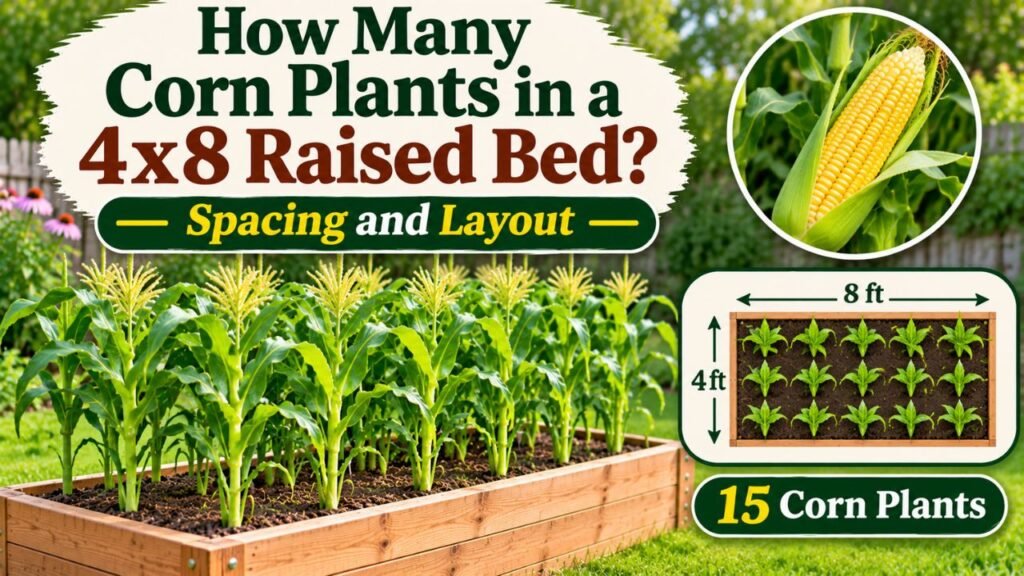
The number of corn plants depends on the distance between individual stalks and the arrangement of rows.
A 4×8-foot bed measures:
- Width: 4 feet or 48 inches
- Length: 8 feet or 96 inches
- Growing area: 32 square feet
You can calculate the number of planting positions by dividing the available area into a planting grid.
However, the mathematical maximum is not necessarily the best number for healthy growth.
Corn Planting Density Comparison
| Planting Layout | Final Plant Count | Approximate Spacing | Main Consideration |
| 4 rows × 4 plants | 16 | 12 inches between rows, 24 inches along rows | More lengthwise space |
| 3 rows × 6 plants | 18 | 16-inch grid | More balanced individual spacing |
| 4 rows × 5 plants | 20 | 12 inches between rows, about 18–20 inches along rows | Moderate density |
| 4 rows × 6 plants | 24 | 12 inches between rows, 16 inches along rows | Practical intensive starting layout |
| 4 rows × 8 plants | 32 | 12-inch grid | High density; greater competition |
All these layouts are more compact than conventional field-style sweet corn spacing.
University extension recommendations commonly specify approximately 9–12 inches between plants and 24–36 inches between rows.
A 4-foot-wide raised bed cannot accommodate four rows at conventional row spacing.
Therefore, intensive block planting is a compromise between plant population and pollination.
Is 24 Corn Plants a Good Number?
Twenty-four plants can be a reasonable starting point when growing a relatively compact sweet corn variety in fertile, well-managed raised-bed soil.
The arrangement provides:
- Four rows for pollen distribution
- Six corn stalks in each row
- Approximately 16 inches between plants along each row
- A compact block rather than a narrow line
However, the 12-inch distance between rows is tighter than conventional recommendations.
You will need to pay particular attention to watering, fertility, and plant growth.
If the corn becomes severely crowded, a lower population may produce better-developed ears.
Can You Grow 32 Corn Plants?
Yes, you can physically fit 32 corn plants into a 4×8 bed using a 12-inch square grid.
This arrangement contains:
4 rows × 8 plants = 32 corn plants
Each plant occupies approximately 1 square foot.
However, this is a high-density planting rather than a universally recommended spacing.
The plants may compete heavily for light, water, and nitrogen.
A closely packed bed may also produce smaller ears or fewer fully developed ears per stalk.
For beginners, I recommend starting with fewer than 32 plants unless you have experience managing intensive corn plantings.
Is 16 Corn Plants Enough?
Sixteen corn plants can grow in a 4×8 raised bed.
However, the arrangement matters.
Four short rows of four plants create a more favorable pollination pattern than one long row of 16 plants.
The limitation is the small number of pollen-producing stalks.
Because corn depends on wind to move pollen, a small planting may produce incomplete kernel development.
Hand-pollination can help compensate for this limitation.
Key Takeaway: A 4×8 raised bed can fit up to 32 corn plants using an intensive 12-inch grid, but 18–24 plants provide more individual growing space. A four-row block is generally preferable to one or two long rows.
Best 4×8 Raised Bed Corn Layout: 24 Plants
For a gardener who wants to try growing sweet corn in a single 4×8 bed, a four-row arrangement is a practical starting point.
The following example uses 24 plants.
Recommended Four-Row Layout
| Row | Planting Positions | Total |
| Row 1 | Corn × 6 | 6 |
| Row 2 | Corn × 6 | 6 |
| Row 3 | Corn × 6 | 6 |
| Row 4 | Corn × 6 | 6 |
| Total | 24 plants |
Arrange the four rows along the 8-foot length of the bed.
Space the row centers approximately 12 inches apart across the width.
Within each row, place the corn approximately 16 inches apart.
With this layout, the first and last planting positions can sit around 8 inches from the ends, while the outer rows are approximately 6 inches from the sides.
This creates a compact planting block.
Why Four Rows Matter
Corn has separate male and female flowers on the same plant.
The tassel at the top produces pollen.
The silks extending from the developing ears receive that pollen.
Because wind carries the pollen, several short rows give it more opportunities to reach neighboring plants.
According to the University of Maryland Extension’s 2026 sweet corn guide, gardeners should plant at least three short rows, preferably four, to improve pollination.
However, four closely spaced rows do not eliminate the risks of overcrowding.
The plant population still needs to suit the variety and growing conditions.
Should You Stagger the Corn Plants?
Staggering can help distribute plants across the bed rather than lining every stalk up directly.
However, keep the planting positions reasonably uniform.
Do not create clusters with several stalks growing only a few inches apart.
Uniform spacing helps distribute light, moisture, and nutrients more evenly.
For your first corn planting, a simple rectangular grid is easier to measure, thin, and maintain.
How to Grow 32 Corn Plants in a 4×8 Raised Bed
A 32-plant layout uses a 12-inch grid.
This is the maximum count among the suggested arrangements, but it is also the most crowded.
Four Rows of Eight Plants
| Row | Plants | Distance Along Row |
| Row 1 | 8 | 12 inches |
| Row 2 | 8 | 12 inches |
| Row 3 | 8 | 12 inches |
| Row 4 | 8 | 12 inches |
| Total | 32 |
The planting rows are approximately 12 inches apart.
This results in one plant per square foot.
Advantages of a 32-Plant Layout
Potential advantages include:
- More stalks within the same area
- A compact four-row pollination block
- Efficient use of planting positions
- The possibility of a larger total harvest if growth conditions support the population
However, these advantages are conditional.
A larger number of stalks does not automatically mean more usable ears.
Disadvantages of Growing 32 Corn Plants
Potential problems include:
- Increased competition for nitrogen
- Faster depletion of soil moisture
- Smaller individual plants
- Reduced ear development
- Poorer access for inspection
- Greater shading within the canopy
- Higher risk of stalk lodging when growth is weak or root support is inadequate
The Colorado State University Extension’s raised-bed planting guidance emphasizes adequate spacing, soil fertility, and watering for intensive vegetable planting.
Its corn guidance uses wider row spacing than a 12-inch square grid and recommends multiple rows to promote pollination.
Therefore, treat 32 plants as an intensive experiment rather than a guaranteed high-yield layout.
Should Beginners Plant 32 Corn Stalks?
I generally recommend a less crowded arrangement for beginners.
Twenty or 24 plants may be easier to manage, particularly if the soil mixture is new or the irrigation system is not yet established.
For large, vigorous sweet corn varieties, 16–18 plants or a larger growing area may be more appropriate.
How Far Apart Should Corn Plants Be in a Raised Bed?
Sweet corn spacing recommendations vary depending on the growing system.
In conventional vegetable gardens, corn is commonly spaced approximately:
- 8–12 inches between plants within rows
- 24–36 inches between rows
This provides more room than many intensive raised-bed layouts.
However, smaller block-style plantings sometimes use closer row spacing.
Is 12-Inch Spacing Enough for Corn?
Twelve-inch spacing between individual stalks can work in some intensive arrangements.
However, spacing every plant 12 inches apart in both directions creates a much higher overall density than conventional row planting.
This may reduce ear size or quality.
The best result depends on:
- Corn variety
- Available soil volume
- Soil fertility
- Water supply
- Sunlight
- Plant health
- Local growing conditions
If your main priority is producing well-developed ears rather than maximizing stalk count, use a more generous layout.
Is 16-Inch Spacing Better?
Sixteen-inch spacing provides more growing area per plant.
For example, a 3×6 layout with approximately 16-inch spacing accommodates 18 plants.
This may reduce competition compared with a 32-plant grid.
However, the arrangement provides only three rows rather than four.
Pollination may therefore require greater attention.
What About 18-Inch Spacing?
Spacing corn approximately 18 inches apart gives individual plants additional room.
However, fewer stalks fit inside a 4×8 bed.
The smaller pollen-producing population may make pollination less reliable.
If using wider spacing, consider placing another corn bed nearby or assisting pollination by hand.
Why Corn Should Be Planted in Blocks Instead of Long Rows
Pollination is one of the biggest challenges when growing sweet corn in a small raised bed.
Unlike tomatoes, peppers, or beans, corn does not rely primarily on insects for pollination.
It depends on wind moving pollen from the tassels onto the silks.
How Corn Pollination Works
Each corn stalk develops male flowers at the top, called tassels.
Lower on the plant, developing ears produce silks.
Each silk is connected to a potential kernel.
For a kernel to develop, compatible pollen must reach its silk.
When many silks receive enough pollen, the ear fills with kernels.
When pollination is incomplete, gaps may appear.
Why One Long Row Is Less Effective
Suppose you plant 16 corn stalks in one long row.
Wind can carry much of the pollen away from the row rather than across neighboring ears.
The plants may not receive enough pollen during the critical flowering period.
This can produce ears with missing kernels.
Why a Square or Rectangular Block Helps
Several short rows create a larger pollen-receiving area.
As the wind changes direction, pollen can move between neighboring plants.
A four-row block is generally more dependable than one or two isolated rows.
However, a 4×8 bed is still relatively small for sweet corn.
Good pollination is possible, but it is not guaranteed.
Can You Grow Corn in Just One Raised Bed?
Yes.
One 4×8 bed can produce sweet corn.
However, a larger planting generally provides more flexibility in spacing and pollination.
If the single bed is isolated from other corn, consider hand-pollinating during tasseling and silking.
How to Hand-Pollinate Corn in a 4×8 Raised Bed
Hand-pollination can help improve kernel formation when only a small number of corn plants are growing.
It is particularly useful when the bed is isolated or the wind does not distribute pollen effectively.
Step 1: Wait for Tassels to Release Pollen
Watch the tops of the corn stalks.
The tassels develop first and begin releasing pollen around the time that ear silks emerge.
Pollen may appear as a fine dust when the tassels are gently disturbed.
Do not remove healthy tassels prematurely.
Step 2: Locate the Ear Silks
Look for silks extending from developing ears lower on the stalk.
Fresh silks are the receptive parts of the female flowers.
The goal is to deposit viable pollen onto these silks.
Step 3: Transfer Pollen
On a dry morning when pollen is shedding, gently shake a tassel so pollen falls toward the silks.
You can also carefully collect pollen from a shedding tassel and transfer it onto fresh silks.
Avoid excessive force that damages the stalks.
The University of Florida IFAS Extension’s corn-growing guide describes hand-pollination methods for small gardens.
Step 4: Repeat During the Pollination Period
Corn does not necessarily release all its pollen on one day.
Different silks may also become receptive at slightly different times.
Repeat the process on several mornings while pollen is being shed and fresh silks are present.
This can improve the chances of complete kernel development.
Step 5: Avoid Drought Stress
Even careful hand-pollination may not compensate for severe water stress.
Dry conditions can interfere with tasseling, silking, and kernel development.
Maintain consistent soil moisture during this period.
Key Takeaway: Hand-pollination is worthwhile when growing a small block of corn, particularly if the bed contains fewer than 24 plants or stands apart from other corn.
How Deep Should a 4×8 Raised Bed Be for Corn?
Corn develops an extensive root system and grows much taller than many common raised-bed vegetables.
The available soil depth affects root development, nutrient access, moisture retention, and wind stability.
Can Corn Grow in a 6-Inch Raised Bed?
Yes, under certain conditions.
If the raised bed has an open bottom and sits directly on suitable, loosened garden soil, corn roots may extend into the ground beneath it.
In that situation, the total available rooting depth is greater than the height of the bed walls.
However, a 6-inch-deep raised planter with a solid bottom offers very limited root space.
It is not a good choice for standard full-size sweet corn.
Is a 12-Inch-Deep Raised Bed Enough?
A 12-inch-deep bed can support corn when drainage, soil fertility, and rooting conditions are suitable.
It is particularly useful when the bed is open to the ground beneath.
However, deeper rooting space is beneficial.
If the bed sits on an impermeable surface, more soil volume is desirable.
Is an 18- or 24-Inch-Deep Bed Better?
A deeper bed provides greater soil volume.
It can help support moisture retention and root development.
However, greater depth does not eliminate the need for adequate spacing or pollination.
A 24-inch-deep bed still cannot guarantee that 32 densely planted corn stalks will produce large ears.
Best Raised Bed Depth for Corn
| Raised Bed Depth | Practical Assessment |
| 6 inches | Most suitable when roots can extend into healthy soil below |
| 8–12 inches | Can work with suitable underlying soil |
| 12–18 inches | Useful for deeper contained growing space |
| 18–24 inches | Provides more root-zone volume |
| Over 24 inches | Can work, but requires substantial soil and structural support |
For a closed-bottom planter on concrete, a deeper bed with dependable drainage is preferable.
Avoid using a shallow, poorly drained container for full-size sweet corn.
What Soil Is Best for Corn in a Raised Bed?
Sweet corn grows best in fertile, well-drained soil with sufficient organic matter.
It uses substantial nutrients during rapid stalk growth and ear development.
Use a Balanced Raised-Bed Soil Mix
A suitable mixture should:
- Drain excess water
- Retain adequate moisture
- Support root development
- Contain mature organic matter
- Provide access to essential nutrients
A loam-based raised-bed soil is often a good choice.
Avoid filling the bed entirely with uncomposted organic material or pure sand.
What Soil pH Does Corn Prefer?
Sweet corn generally performs well in slightly acidic to near-neutral soil.
A practical target is approximately pH 6.0–7.0.
However, the ideal range and amendment requirements depend on soil conditions.
A soil test can identify whether pH adjustment is necessary.
Should You Add Compost?
Mature compost can improve soil structure and contribute organic matter.
Incorporate a suitable amount before planting.
However, compost alone may not supply all the nutrients needed by a densely planted corn bed.
A soil test is particularly helpful when growing 24 or more plants in 32 square feet.
Do You Need More Fertilizer for Dense Corn Plantings?
Densely planted corn can create greater nutrient competition.
Corn is a relatively heavy feeder, especially for nitrogen.
Use fertilizer based on soil test results, crop needs, and product instructions.
Avoid assuming that applying excessive fertilizer will compensate for severely crowded plants.
How to Plant Corn Seeds in a 4×8 Raised Bed
Once the layout is decided, direct seeding is usually straightforward.
Corn is commonly planted directly into warm garden soil.
Step 1: Choose the Right Variety
Select a sweet corn variety suited to your local growing season.
For a small raised bed, consider an early-maturing or relatively compact cultivar.
Examples to investigate include:
- Early Sunglow
- Golden Bantam
- Other early sweet corn cultivars appropriate to your region
However, early maturity does not automatically mean a variety can tolerate very close spacing.
Check its mature height and recommended spacing.
Step 2: Wait Until the Soil Is Warm
Corn is sensitive to cold soil and frost.
Plant after the danger of frost has passed.
Many standard sweet corn varieties can germinate when soil temperatures are around 55–60°F, although warmer soil generally supports faster emergence.
Some supersweet varieties require approximately 65°F or warmer soil for dependable germination.
Follow the seed packet’s specific temperature guidance.
Step 3: Mark the Planting Grid
For a 24-plant arrangement:
- Divide the 4-foot width into four planting rows.
- Position the rows approximately 12 inches apart.
- Mark six planting positions along each 8-foot row.
- Keep approximately 16 inches between plants along each row.
- Confirm there are 24 planting positions.
Measure before sowing.
Avoid planting uneven clusters with several seeds very close together.
Step 4: Plant the Seeds
For many sweet corn varieties, a planting depth of approximately 1 inch is suitable.
Some seed packets recommend different depths depending on soil temperature and moisture.
Follow the variety-specific instructions.
You may sow an extra seed at each planting station to account for possible germination failures.
However, the final goal is one healthy plant per marked position.
Step 5: Water Gently
After planting, water the bed to moisten the seed zone.
Avoid using a high-pressure stream that displaces seeds.
Maintain consistent moisture during germination.
Do not keep the soil saturated.
Step 6: Thin the Seedlings
When seedlings are established, remove extras so only one plant remains at each final position.
Use scissors to cut weaker seedlings at the soil surface when pulling them could disturb nearby roots.
Do not leave two or three plants growing from one planting hole.
Crowding increases competition and may reduce ear development.
How Much Water Does Corn Need in a 4×8 Raised Bed?
Sweet corn requires consistent moisture, especially during tasseling, silking, and ear filling.
A practical starting target is at least about 1 inch of water per week, with higher requirements possible during hot, dry conditions.
Watering Amounts for a 4×8 Bed
One inch of water over 1 square foot equals approximately 0.623 U.S. gallons.
A 4×8 bed contains 32 square feet.
Therefore:
32 × 0.623 = approximately 20 gallons
| Weekly Water Depth | Equivalent Water Volume |
| 1 inch | 20 gallons |
| 1.5 inches | 30 gallons |
| 2 inches | 40 gallons |
These are water-depth equivalents, not fixed irrigation requirements.
Rainfall contributes to the total.
Actual demand depends on plant size, temperature, humidity, wind, soil, and drainage.
Water More Carefully During Pollination
The most important moisture-sensitive stages include:
- Rapid stalk growth
- Tassel formation
- Silk emergence
- Pollination
- Ear filling
Severe water stress during tasseling and silking can interfere with kernel development.
Check the soil frequently during these stages.
Water deeply enough to moisten the active root zone.
Should You Water Corn Every Day?
Not necessarily.
Established corn may not need daily watering during mild weather.
However, a densely planted raised bed can dry quickly during summer heat.
Check soil moisture several inches below the surface.
If the root zone is becoming dry, water thoroughly.
Avoid both severe drying and prolonged saturation.
Is Drip Irrigation Good for Corn?
Yes.
Drip irrigation can deliver water near the root zone without unnecessarily wetting the foliage.
For a 4-foot-wide bed, multiple drip lines may be appropriate.
Position them so water reaches the entire corn planting rather than only one edge.
Test soil moisture after irrigation to ensure adequate coverage.
How to Fertilize Corn in a Small Raised Bed
Corn requires adequate nitrogen to support vigorous leaf and stalk growth.
However, fertilizer needs should be based on soil conditions rather than plant count alone.
Fertilize Before Planting
Prepare the soil with suitable compost and fertilizer if a soil test indicates a need.
Mix amendments into the active rooting area according to the product instructions.
Avoid placing concentrated fertilizer directly against germinating seeds.
Feed During Active Growth
Corn may benefit from additional nitrogen during rapid growth.
The University of Maryland Extension recommends side-dressing sweet corn when plants are approximately 12–18 inches tall and again when tassels appear.
However, the actual fertilizer amount depends on soil fertility and product analysis.
Watch for Nutrient Deficiency
Possible signs of nutrient problems include:
- Pale green or yellow leaves
- Slow growth
- Weak stalk development
- Poor ear formation
However, these symptoms are not unique to nutrient deficiency.
Root damage, overwatering, drought, poor drainage, and other stresses can create similar appearances.
Inspect the growing conditions before adding more fertilizer.
Avoid Excessive Fertilizer
Applying too much fertilizer can create nutrient imbalances or damage roots.
It may also contribute to unnecessary nutrient runoff.
Follow soil test recommendations and the fertilizer label.
For a small raised bed, measure fertilizer carefully rather than estimating by eye.
How Many Ears of Corn Can You Harvest From a 4×8 Raised Bed?
The number of ears is not always equal to the number of planted stalks.
Many sweet corn varieties produce one well-developed primary ear per healthy stalk.
Some varieties can develop a second ear under favorable conditions.
However, the second ear may be smaller.
Example Harvest Expectations
| Final Plant Count | Simple Planning Reference |
| 16 plants | Around 16 primary-ear opportunities |
| 18 plants | Around 18 primary-ear opportunities |
| 20 plants | Around 20 primary-ear opportunities |
| 24 plants | Around 24 primary-ear opportunities |
| 32 plants | Around 32 primary-ear opportunities |
This table does not guarantee the number of harvestable ears.
Actual production may be lower because of:
- Poor pollination
- Insect damage
- Water stress
- Nutrient deficiency
- Overcrowding
- Disease
- Wind damage
- Unsuitable growing conditions
Some healthy plants may produce an additional usable ear.
However, it is better to plan around one main ear per stalk rather than assuming two full-sized ears from every plant.
Does Planting More Corn Always Increase Yield?
No.
Growing 32 stalks instead of 24 increases plant density by one-third.
However, this does not guarantee one-third more harvestable corn.
If additional crowding reduces ear size or causes poor development, total usable yield may not improve.
For a small bed, 24 healthy stalks with well-filled ears may be more valuable than 32 crowded stalks with smaller or incomplete ears.
How to Support Tall Corn in a Raised Bed
Corn stalks can grow several feet tall and may be exposed to strong winds.
Raised beds can also expose the root zone differently from in-ground planting.
Choose a Sheltered Location
Select a sunny position that is not excessively exposed to damaging winds.
However, avoid placing corn in deep shade.
Corn needs substantial sunlight for healthy growth.
Provide Adequate Root Space
Healthy roots help stabilize the stalks.
A shallow closed-bottom bed may restrict root development.
For tall corn, provide appropriate soil depth and drainage.
Use Perimeter Support if Necessary
A supportive string arrangement around the outside of the corn block may reduce stalk movement during storms.
Use sturdy stakes placed outside the main root zone.
Avoid tying individual stalks too tightly.
Do not use thin wire that may cut into stems.
Protect the Raised Bed Structure
Tall metal or wooden raised beds should be stable before planting.
Do not attach heavy support structures to thin panels unless the bed is designed to support the load.
For windy sites, use independent stakes or suitable anchors.
Can You Grow Other Vegetables With Corn in a 4×8 Raised Bed?
Yes, but a corn-filled 4×8 raised bed has limited remaining space.
Corn is a heavy feeder and forms a substantial canopy.
Additional vegetables may compete for light, water, and nutrients.
Can You Grow Beans With Corn?
Corn and beans are commonly associated with the traditional Three Sisters planting method.
However, a small raised bed already containing 24–32 corn plants may not have enough room for vigorous climbing beans.
Beans can also add weight to corn stalks.
For a compact garden, bush beans in a separate bed may be easier to manage.
Can You Grow Squash With Corn?
Squash leaves can cover the soil and reduce weed growth.
However, standard squash varieties can spread extensively.
A 4×8 bed densely planted with corn may not have enough space.
If trying a Three Sisters arrangement, a larger growing area is generally preferable.
What About Radishes or Lettuce?
Fast-growing vegetables can sometimes be grown before corn becomes tall.
For example, radishes may be harvested early in the season.
However, avoid disturbing corn roots during harvesting.
Once the corn canopy becomes dense, small crops may receive insufficient light.
For beginners, dedicating the 4×8 bed primarily to corn is the simplest approach.
Common Mistakes When Growing Corn in a 4×8 Raised Bed
Small corn plantings require careful planning because there is little room to correct major spacing problems after the stalks become tall.
Planting Corn in One Long Row
A single row may receive inadequate wind pollination.
Use three or four short rows in a block whenever possible.
Planting 128 Corn Stalks With Square-Foot Spacing
Some intensive gardening charts suggest planting four corn plants per square foot.
In a 4×8 bed, that would produce:
32 square feet × 4 plants = 128 plants
This means approximately 6 inches between stalks in both directions.
For ordinary full-size sweet corn, that is excessively dense and should not be treated as a dependable planting recommendation.
The plants would face severe competition for resources.
Ignoring the Corn Variety
Sweet corn varieties differ in mature height, vigor, and spacing requirements.
Do not assume every cultivar can tolerate a 12-inch grid.
Check the seed packet.
Planting Too Early
Cold soil can cause poor germination and seed rot.
Wait until the soil reaches a suitable temperature.
Supersweet varieties often need warmer conditions than standard sweet corn.
Forgetting About Pollination
A bed may contain healthy green stalks but still produce incomplete ears.
Watch for tassels and silks.
Consider hand-pollination in small, isolated plantings.
Underwatering During Silking
Water stress during pollination can reduce kernel formation.
Maintain consistent moisture during flowering and ear development.
Applying Too Much Nitrogen
More fertilizer does not always produce a better harvest.
Excess fertilizer can create problems.
Use soil test results and appropriate application rates.
Ignoring Sunlight
Corn generally needs at least 6 hours of direct sun and performs better with approximately 8–10 hours.
A shaded raised bed may produce weak stalks and poor ears.
Also remember that tall corn can shade nearby garden crops.
Is a 4×8 Raised Bed Big Enough for Sweet Corn?
Yes, a 4×8 raised bed is large enough to attempt a small sweet corn crop.
However, it is not an ideal substitute for a larger corn plot.
Advantages of Growing Corn in One Raised Bed
A single bed offers:
- Easier soil preparation
- Better control over drainage
- Convenient irrigation
- Reduced soil compaction
- Easy weeding around the plants
- A manageable trial growing area
It can be particularly useful for gardeners who want to experiment with growing a small amount of fresh corn.
Limitations of a 4×8 Bed
The main limitations are:
- Restricted total growing area
- More difficult spacing decisions
- Limited pollen-producing population
- Potentially higher competition for water and nutrients
- Tall stalks shading nearby vegetables
- A relatively small harvest
These limitations do not make corn impossible to grow.
They simply mean that expectations should remain realistic.
Would Two 4×8 Raised Beds Be Better?
Yes, two adjacent 4×8 beds can provide significantly more growing area and a larger corn population.
They also allow more conventional spacing and a broader pollination block.
Colorado State University Extension illustrates using two neighboring 4-foot-wide raised beds to create a suitable corn block.
If your goal is a reliable household sweet corn harvest, two beds or a larger plot may be a better long-term arrangement.
My Recommended 4×8 Corn Planting Plan
For a first attempt at growing sweet corn in one 4×8 raised bed, I recommend the following approach.
| Planning Factor | Recommendation |
| Bed size | 4 × 8 feet |
| Total area | 32 square feet |
| Starting plant count | 24 corn plants |
| Arrangement | 4 rows × 6 plants |
| Row spacing | Approximately 12 inches |
| Plant spacing along rows | Approximately 16 inches |
| Corn type | Early or relatively compact sweet corn |
| Sunlight | Preferably 8–10 hours |
| Soil | Fertile, well-drained, moisture-retentive |
| Irrigation | Keep root zone consistently moist |
| Pollination | Wind pollination, with hand assistance if needed |
| Fertilizer | Based on soil testing and crop needs |
| Harvest expectation | Variable; often one primary ear per productive stalk |
This is an intensive raised-bed layout, not a replacement for standard field-spacing guidance.
If your soil is poor, water supply is limited, or corn variety is particularly large, reduce the population toward 16–18 plants.
If you are experienced with intensive growing and want to experiment, a 32-plant grid is physically possible, but it carries greater crowding risk.
For the most dependable crop, consider growing a larger block of corn across adjacent beds.
Conclusion
Determining how many corn plants in a 4×8 raised bed depends on the corn variety, spacing, soil quality, and your willingness to manage an intensive planting.
A 4×8 raised bed provides 32 square feet of growing space. It can physically accommodate 32 corn plants at 12-inch spacing, but this is a crowded arrangement.
For many small-garden experiments, 18–24 plants offer a more manageable starting population. A layout of 24 plants in four rows of six is worth considering when the soil is fertile, irrigation is reliable, and you are prepared to monitor overcrowding.
However, traditional corn-growing recommendations provide more space between rows, and a single 4×8 bed cannot easily satisfy those dimensions while maintaining four rows for pollination.
Corn also requires full sun, sufficient nitrogen, consistent moisture, and adequate pollen transfer.
I recommend starting with 24 plants if you want to experiment with intensive raised-bed corn production, while recognizing that fewer plants or a larger bed may produce better-developed ears.
For the best chance of full, healthy ears, prioritize adequate growing space and successful pollination rather than simply fitting the maximum number of corn stalks into the bed.
FAQs About How Many Corn Plants in a 4×8 Raised Bed
Can You Grow 32 Corn Plants in a 4×8 Raised Bed?
Yes, 32 corn plants fit mathematically in a 4×8 raised bed at 12-inch grid spacing. However, this is a high-density arrangement. Crowding can increase competition for water, nutrients, and sunlight, potentially reducing ear quality. A less crowded planting may be more dependable.
Is 16 Corn Plants Enough for Pollination?
Sixteen plants can produce corn, especially when arranged in a compact four-row block rather than one long row. However, such a small planting may not receive consistent wind pollination. Hand-pollination can help improve kernel development.
What Is the Best Spacing for Corn in a 4×8 Raised Bed?
For an intensive trial, a four-row layout with approximately 12 inches between rows and 16 inches between plants accommodates 24 stalks. However, conventional extension recommendations generally use 24–36 inches between rows. The smaller bed requires a compromise, so choose a suitable variety and monitor crowding.
How Many Ears of Corn Will 24 Plants Produce?
Many sweet corn varieties produce one primary ear per healthy stalk, with some varieties capable of a second ear under favorable conditions. Therefore, 24 plants provide approximately 24 primary-ear opportunities, but actual harvestable yield may be lower because of pollination problems, weather, pests, or crowding.
Can You Plant Corn 6 Inches Apart in a Raised Bed?
Six-inch spacing is generally too close for ordinary full-size sweet corn when used in both directions. It creates heavy competition and may reduce ear development. For a reliable harvest, use more generous spacing appropriate to the variety and growing system.
How Deep Should a 4×8 Raised Bed Be for Corn?
Corn can grow in a relatively shallow open-bottom raised bed if its roots can extend into suitable soil below. For contained beds on hard surfaces, approximately 12–18 inches or more of usable, well-drained soil is preferable. Adequate rooting space is especially important for tall plants exposed to wind.
Do You Need to Hand-Pollinate Corn in a 4×8 Raised Bed?
Not always, but hand-pollination can improve results when a small corn block is isolated or wind pollination is inconsistent. When tassels release pollen and fresh silks appear, gently transfer pollen onto the silks during the pollination period. Repeat as needed over several days.

I’m Maya L. Greenwood, a lifelong plant lover who believes anyone can grow something beautiful with the right guidance. After years of testing soil mixes, pruning methods, irrigation tricks, and pest-safe solutions, I started EasyGardenTips.com to turn hard-won lessons into step-by-step advice. From seed starting and container gardens to composting and seasonal checklists, my goal is to make gardening simple, sustainable, and fun.