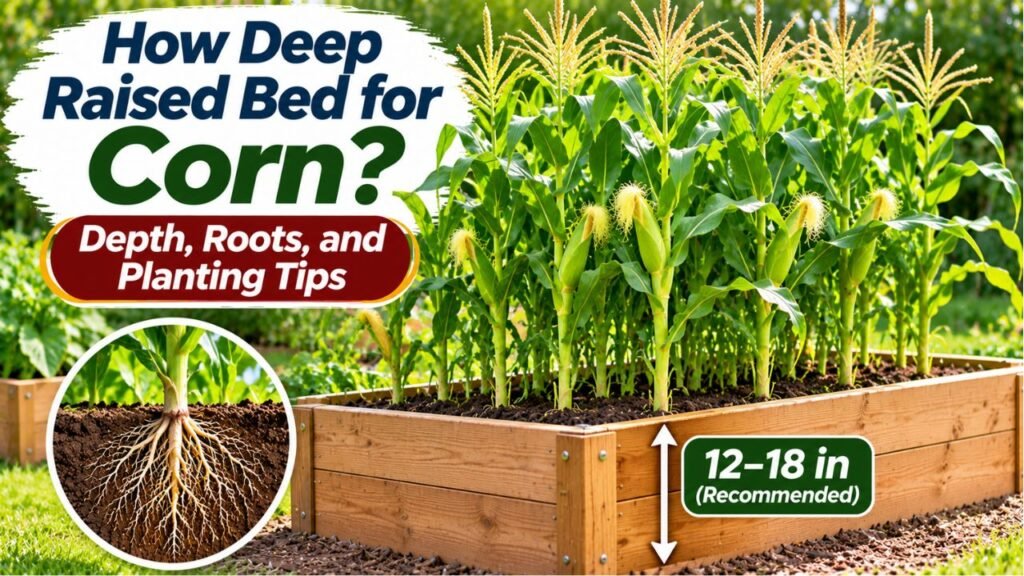
How Deep Raised Bed for Corn? Depth, Roots, and Planting Tips
A raised garden bed should ideally have 12–18 inches of good-quality soil for growing sweet corn, especially when the bed is open to the ground beneath it. If the bed has a solid bottom or sits over concrete, providing approximately 18–24 inches of usable soil is a more practical choice because the roots cannot extend into the ground below.
Corn can grow in shallower raised beds when the underlying soil is loose, fertile, and well-drained. However, a shallow, enclosed planter restricts the space available for roots to absorb water and nutrients and support tall stalks.
Choosing the right depth is important because corn grows quickly, develops substantial foliage, and needs consistent moisture during tasseling, silking, and ear development. A deeper growing area provides more space for roots and can reduce how quickly the soil dries out.
In this article, I explain how deep a raised bed for corn should be under different growing conditions, including open-bottom beds, raised planters, and beds built over concrete. I also cover corn root depth, planting depth, soil preparation, bed dimensions, watering, drainage, and spacing requirements for healthy growth and reliable pollination.
How Deep Raised Bed for Corn: Recommended Soil Depths
The ideal depth depends on whether corn roots can grow into the natural soil beneath the raised bed.
A raised bed built directly over healthy garden soil has a different rooting environment from a container with an enclosed bottom.
Recommended Raised Bed Depth by Setup
| Raised Bed Setup | Suggested Soil Depth | Suitability for Corn |
| Open-bottom bed over healthy soil | 6–8 inches above ground can work | Roots must be able to grow into soil below |
| Open-bottom bed for general gardening | 12 inches | Good practical starting depth |
| Open-bottom bed with extra soil volume | 12–18 inches | Recommended for easier moisture management |
| Bed over compacted or poor soil | 18–24 inches, or improve the underlying soil | Provides more usable rooting space |
| Bed over concrete | 18–24 inches | Better option when roots cannot enter the ground |
| Bottomed raised planter | 18–24 inches or more | Provides additional root volume and water storage |
| Shallow enclosed planter | 6–8 inches | Not recommended for typical mature sweet corn |
These are practical gardening recommendations, not universal minimum requirements for every corn variety.
The University of Maryland Extension explains that roots in open-bottom raised beds can extend into the underlying soil. For beds on impermeable surfaces, it recommends greater soil depth for larger vegetable crops because plants are restricted to the soil contained within the bed.
Why 12–18 Inches Is a Good Starting Point
A raised bed with 12–18 inches of suitable soil offers several benefits:
- More space for root development.
- Greater soil volume for storing moisture.
- More flexibility for managing soil fertility.
- Better conditions for supporting tall corn plants.
- Less dependence on frequent irrigation than very shallow enclosed beds.
However, deeper walls alone don’t guarantee healthier corn.
Soil quality, drainage, sunlight, planting density, and pollination remain important.
Key Takeaway: For an open-bottom raised bed over healthy soil, 12–18 inches is a practical choice. For a bottomed bed or one over concrete, aim for approximately 18–24 inches of usable soil.
How Deep Do Corn Roots Grow?
Corn develops a fibrous root system that spreads both downward and outward.
The actual rooting depth varies with the corn variety, soil structure, moisture, temperature, and the presence of compacted layers.
Some roots can extend several feet into favorable soil, although the depth at which most water and nutrients are absorbed may be much shallower.
Corn Roots Are Not Limited to 12 Inches
Corn roots don’t automatically stop growing at a depth of 12 inches.
In an open-bottom raised bed, they can extend beyond the raised soil and into the ground beneath it.
That means the height of the bed frame doesn’t represent the plant’s total potential rooting depth.
For example, corn planted in a 12-inch-deep open-bottom bed may develop roots extending into another foot or more of suitable natural soil.
The actual depth depends on conditions.
Why Corn Root Depth Varies
According to a Michigan State University Ask Extension response, corn rooting depth can vary considerably with soil conditions.
While exceptionally deep roots are possible, compacted layers and other restrictions can greatly limit root penetration.
This explains why a deep raised bed is helpful but cannot compensate for every underlying soil problem.
What Are Corn Brace Roots?
Corn produces visible roots near the lower portion of its stalk.
These are often called brace roots or prop roots.
They develop from nodes above the soil surface and help support the plant.
According to University of Minnesota Extension, these visible roots primarily help stabilize the corn stalk rather than providing substantial water and nutrient uptake.
Don’t remove them unnecessarily.
Why Root Space Matters
Corn needs an effective root system to:
- Absorb water.
- Take up nutrients.
- Support vigorous stalk and leaf growth.
- Maintain moisture during ear development.
- Help anchor the plant against wind.
A severely restricted root system can make corn more vulnerable to drought stress and poor growth.
However, adding soil depth won’t fully solve problems caused by overcrowding or inadequate sunlight.
Is a 6-Inch Raised Bed Deep Enough for Corn?
A 6-inch raised bed can support corn if it has an open bottom and suitable soil underneath.
However, 6 inches of soil in a bottomed planter is generally too shallow for growing typical mature sweet corn successfully.
When 6 Inches Can Work
Consider a raised bed built directly over existing garden soil.
If the underlying ground is:
- Well-drained.
- Not severely compacted.
- Free of major rooting barriers.
- Suitable for vegetable growing.
Then corn roots can extend below the raised frame.
In this situation, the raised portion acts as an improved planting layer rather than the entire root zone.
Colorado State University Extension explains that the height of a raised-bed frame is less important when crop roots can grow freely into suitable soil beneath it.
See its raised-bed construction guidance.
When 6 Inches Is Not Enough
A 6-inch-deep enclosed planter provides limited soil volume.
The roots cannot extend downward beyond the container.
This can lead to:
- Rapid moisture loss.
- Greater fertilizer management challenges.
- Restricted root development.
- Increased vulnerability to heat.
- Poor support for tall stalks.
For ordinary sweet corn, choose a deeper planter.
Should You Upgrade an Existing 6-Inch Bed?
Not necessarily.
If your 6-inch bed is open to healthy garden soil, you may be able to grow corn without rebuilding it.
Check the underlying soil first.
If it is extremely compacted, poorly drained, or obstructed, improving the rooting conditions or increasing the soil depth would be more useful.
Is a 12-Inch Raised Bed Deep Enough for Sweet Corn?
Yes. A 12-inch-deep raised bed is generally suitable for growing sweet corn when the bottom is open to healthy soil.
This depth provides a useful growing layer while allowing roots to extend farther down.
Advantages of a 12-Inch Raised Bed
A 12-inch bed can:
- Hold a substantial amount of garden soil.
- Improve drainage compared with some poorly structured ground-level soil.
- Reduce the need for bending.
- Provide room for compost and other suitable amendments.
- Support strong corn growth when other conditions are favorable.
It also costs less to fill than an 18- or 24-inch bed of the same length and width.
What if the 12-Inch Bed Has a Solid Bottom?
A 12-inch-deep bottomed planter may support some corn growth, but it offers limited rooting space for large sweet corn plants.
The soil can dry quickly, particularly during warm weather.
Plant size and ear production may be restricted.
If you’re building a new self-contained planter specifically for corn, a deeper design is generally preferable.
Can You Grow Dwarf Corn in a 12-Inch Bed?
Some compact corn varieties may be more manageable in limited growing spaces.
However, dwarf foliage doesn’t always mean the variety requires only a shallow root zone.
Check the cultivar’s height, spacing, and growing requirements.
A shorter corn plant may still need substantial moisture and nutrients.
Is an 18-Inch Raised Bed Better for Corn?
An 18-inch raised bed is an excellent practical choice when you want more growing-medium volume.
It offers additional space for roots and greater flexibility for managing soil moisture.
Benefits of 18 Inches of Soil
Compared with a 12-inch enclosed bed, an 18-inch bed provides 50% more soil volume when the length and width are unchanged.
This additional volume can:
- Store more plant-available water.
- Provide additional rooting space.
- Reduce rapid drying under some conditions.
- Accommodate a larger volume of fertile growing medium.
However, the benefit depends on the soil mix and drainage.
An 18-inch bed filled with compacted or waterlogged material may perform worse than a shallower bed with healthy, well-aerated soil.
Is 18 Inches Necessary?
No.
Many gardeners can grow corn successfully in shallower open-bottom raised beds.
The extra depth is more valuable when the underlying soil is poor or the bed is partially enclosed.
Is 18 Inches Enough for a Bottomed Planter?
It is a reasonable starting point for a larger container-style planting.
However, corn grown in enclosed planters still needs adequate horizontal growing space, irrigation, nutrients, and drainage.
An 18-inch-deep planter that is only 12 inches wide isn’t necessarily suitable for a mature corn planting.
Do You Need a 24-Inch-Deep Raised Bed for Corn?
A 24-inch raised bed isn’t necessary for most open-bottom gardens.
However, it can be a useful option when the soil beneath the bed is unavailable to roots.
When 24 Inches Makes Sense
Consider 24 inches when:
- The raised bed sits over concrete.
- The bed has a permanent solid bottom.
- The native soil is unsuitable for root growth.
- You want a taller bed for easier access.
- You need additional soil volume for moisture management.
A 24-inch bed can provide a larger growing reservoir than a shallow planter.
However, it is more expensive to fill and may require structural reinforcement.
Is Deeper Always Better?
Not necessarily.
Corn doesn’t automatically produce a better harvest simply because the bed is 24 inches tall.
If it receives too little sunlight or grows in a small, poorly pollinated planting, extra depth won’t solve those problems.
A 12-inch open-bottom bed with healthy soil underneath may provide more accessible rooting space than a 24-inch enclosed bed.
What About Beds Deeper Than 24 Inches?
Taller raised beds can be useful for accessibility.
However, make sure the walls are strong enough to hold the weight of the soil, especially after watering.
Large beds can contain substantial weight.
Follow the bed manufacturer’s structural recommendations.
How Deep Should a Raised Bed Be for Corn on Concrete?
For sweet corn grown above concrete or another impermeable surface, 18–24 inches of usable growing medium is a practical target.
This is a conservative design recommendation rather than a corn-specific minimum established by comparative field trials.
The purpose is to provide more space for roots and water storage because plants cannot extend into natural soil below.
Why Concrete Changes the Depth Requirement
Concrete creates a physical barrier beneath the growing medium.
Corn roots cannot pass through it.
Consequently, the plants depend entirely on the soil contained within the bed.
The raised bed also may experience additional heat from surrounding paved surfaces.
University of Maryland Extension explains that vegetable beds on hard surfaces require adequate growing-medium depth and careful watering because the plants lack access to underlying soil moisture.
Drainage Is Essential
A bed over concrete must have a way for excess water to escape.
If water collects inside the bottom of the planter, roots can remain saturated.
This may reduce oxygen availability and contribute to root diseases.
Use a raised-bed or planter design with a suitable drainage path.
Don’t create a sealed container without drainage.
Should You Add Gravel at the Bottom?
Adding gravel to the bottom of a planter doesn’t automatically improve drainage.
In many container systems, a gravel layer reduces the amount of usable growing medium and can contribute to unfavorable water distribution.
The University of Maryland Extension guide to container gardening specifically advises that adding gravel or rocks doesn’t improve container drainage.
Instead, use an appropriate soil mix and ensure the planter has functioning drainage.
What About Heat?
Concrete can absorb and reflect heat.
This may increase moisture loss from the bed during summer.
Monitor soil moisture closely and consider organic mulch.
Avoid placing dark, uninsulated planters in locations where excessive heat will create severe root-zone stress.
Should a Corn Raised Bed Have an Open Bottom?
For most backyard gardens, an open-bottom raised bed is preferable when the underlying soil is suitable for growing vegetables.
It allows corn roots to explore the soil beneath the raised frame.
Benefits of an Open Bottom
An open-bottom design offers:
- Greater potential rooting depth.
- Access to moisture beneath the raised bed.
- Natural contact with soil organisms.
- Less dependence on the soil volume inside the frame.
- More flexibility when using shallow bed walls.
When a Bottom Barrier May Be Necessary
If burrowing rodents are a problem, you may need a protective mesh barrier.
For example, hardware cloth can help keep certain rodents from entering the bed.
Use a mesh appropriate for the pest and install it securely.
Unlike a solid plastic bottom, hardware cloth allows water movement and some interaction with the underlying soil.
However, mesh can also affect the path of larger roots depending on its opening size and installation.
When Not to Use an Open Bottom
An open-bottom bed isn’t appropriate when the site contains contaminated soil that plants should not contact.
If you’re gardening on a property with suspected soil contamination, obtain appropriate testing and remediation guidance.
A raised bed intended to isolate crops from contaminated ground needs a properly designed barrier and sufficient clean growing medium.
How to Prepare Soil for Corn in a Raised Bed
Choosing the right soil is as important as choosing the bed depth.
Corn performs well in fertile, well-drained soil with enough moisture-holding capacity to support rapid growth.
Step 1: Check the Existing Ground
If the raised bed will sit on native soil, evaluate the ground before installation.
Look for:
- Severe compaction.
- Standing water after rainfall.
- Construction debris.
- Large rocks.
- Poor drainage.
- Suspected contamination.
If the soil is compacted, loosen it where appropriate before adding the raised-bed soil.
Avoid working saturated soil because that can damage its structure.
Step 2: Choose an Appropriate Growing Mix
For an open-bottom bed, a suitable combination of good-quality topsoil and finished compost can provide a productive growing medium.
Avoid filling the entire bed with pure compost.
Corn needs both adequate nutrients and a physically stable, well-drained rooting environment.
For an enclosed planter, use a growing medium appropriate for large container-grown vegetables.
It should retain moisture while allowing excess water to drain.
Step 3: Check Soil pH
Sweet corn grows best in slightly acidic to neutral soil.
University of Minnesota Extension identifies approximately pH 5.8–7.0 as a suitable range.
Use a soil test to determine whether amendments are necessary.
Don’t add lime or sulfur without considering the test results.
Step 4: Plan for Fertilizer
Corn has a relatively high nutrient requirement, particularly for nitrogen.
A soil test can help determine whether fertilizer is needed.
University of Maryland Extension recommends fertilizing sweet corn appropriately during active growth, including side-dressing at specific development stages when needed.
Avoid assuming that compost alone will always supply sufficient nutrients.
Step 5: Fill to the Intended Depth
Add enough growing medium to provide the planned usable soil depth.
Leave a small amount of space below the rim for watering and mulch, typically around 1 inch, depending on your bed design.
Don’t compact the soil heavily while filling it.
Water gently to settle the mix and top up if necessary.
Step 6: Prepare the Planting Surface
Rake the topsoil until it is reasonably level.
Remove large debris.
Moisten the soil before sowing if it is dry.
The seedbed should be moist but not waterlogged.
Key Takeaway: Healthy, well-drained soil and sufficient root access matter more than simply building taller raised-bed walls.
How Deep Should You Plant Corn Seeds in a Raised Bed?
Corn seed planting depth is different from raised-bed soil depth.
For many home-garden sweet corn varieties, sowing seeds approximately 1 inch deep is appropriate.
The exact depth depends on the corn type, soil conditions, and seed packet instructions.
Recommended Sweet Corn Seed Depth
University of Minnesota Extension recommends planting sweet corn seed approximately 1 inch deep.
For certain supersweet varieties, it advises keeping the depth around ¾–1 inch because these seeds can be more sensitive to unfavorable germination conditions.
Follow the seed packet when the variety has specific requirements.
Why Seed Depth Matters
Seeds planted too shallowly may dry out before germination.
Seeds planted too deeply may struggle to emerge, particularly in cool or compacted soil.
Consistent planting depth helps encourage more uniform germination.
How to Plant the Seeds
- Prepare a level, moist seedbed.
- Make planting holes or furrows at the recommended depth.
- Place the corn seeds according to the spacing plan.
- Cover with loose soil.
- Water gently.
- Maintain consistent moisture until germination.
Don’t press the soil into a hard crust.
What Soil Temperature Does Corn Need?
Corn is a warm-season crop.
University of Minnesota Extension notes that many sweet corn varieties germinate best when soil temperatures are near 60°F.
Some supersweet varieties require warmer soil, around 65°F or higher.
Plant after the danger of frost has passed and conditions are appropriate for the variety.
How Wide and Long Should a Raised Bed Be for Corn?
Depth alone doesn’t determine whether a corn planting will succeed.
Corn also needs adequate horizontal space for roots, leaves, and wind pollination.
Recommended Bed Width
Many raised garden beds are 3–4 feet wide so gardeners can reach the center without stepping on the soil.
This is convenient for general vegetable gardening.
However, corn requires enough plants arranged in multiple short rows to improve pollination.
A single narrow raised bed may not provide sufficient width for a conventional corn block.
Recommended Corn Spacing
The University of Maryland Extension sweet corn guide recommends:
- 9–12 inches between plants within rows.
- 24–36 inches between rows.
- At least three short rows side by side, preferably four.
Spacing varies with the variety and its mature size.
For compact early-maturing varieties, somewhat closer spacing may be appropriate.
Why Corn Should Grow in Blocks
Corn is wind-pollinated.
Pollen falls from tassels onto the silks of developing ears.
Growing corn in several short, adjacent rows increases the likelihood that enough pollen reaches the silks.
A single long row or a few isolated plants may produce ears with missing kernels.
Is a 4×4 Raised Bed Big Enough?
A 4×4-foot bed provides limited space for a conventional sweet corn planting.
Even if the soil is 24 inches deep, it may not hold enough properly spaced plants for reliable pollination.
A 4×4 bed can be used for an experimental planting, but productivity may be disappointing.
Is a 4×8 Raised Bed Big Enough?
A 4×8 bed offers more planting space.
However, it remains narrow for four conventionally spaced corn rows.
If you want to grow corn in raised beds, consider using adjacent beds as a connected block or a larger growing area.
Colorado State University Extension suggests a block layout that uses multiple rows across neighboring 4-foot-wide beds.
Important: Increasing bed depth doesn’t compensate for inadequate pollination. A larger planting area can be more valuable than an unnecessarily deep container.
How Much Soil Do You Need for a Corn Raised Bed?
The soil volume depends on the bed’s length, width, and usable depth.
Calculate it using:
Soil volume (cubic feet) = Length (ft) × Width (ft) × Depth (ft)
To convert cubic feet to cubic yards:
Cubic yards = Cubic feet ÷ 27
Soil Volume for a 4×8 Raised Bed
| Usable Soil Depth | Cubic Feet | Cubic Yards |
| 6 inches | 16 | 0.59 |
| 8 inches | 21.3 | 0.79 |
| 12 inches | 32 | 1.19 |
| 18 inches | 48 | 1.78 |
| 24 inches | 64 | 2.37 |
These are geometric estimates for a rectangular interior measuring exactly 4×8 feet.
Actual soil requirements can differ because of wall thickness, settling, and any unfilled space beneath the rim.
Example: An 18-Inch-Deep Bed
For a 4×8 bed:
4 × 8 × 1.5 = 48 cubic feet
48 ÷ 27 = 1.78 cubic yards
Therefore, filling the bed with 18 inches of soil requires approximately 1.78 cubic yards before accounting for settling and other adjustments.
Does More Soil Mean Better Corn?
Not automatically.
More soil can provide additional rooting space and water storage.
However, a healthy 12-inch bed connected to good natural soil may support better corn growth than an isolated 24-inch planter with poor drainage.
Choose the soil depth based on the complete growing conditions.
How to Water Corn in a Raised Garden Bed
Raised beds often dry faster than conventional in-ground gardens.
Corn is particularly sensitive to moisture stress during establishment, tasseling, silking, and ear development.
How Much Water Does Corn Need?
University of Minnesota Extension identifies approximately 1 inch of water per week as a useful general starting point for sweet corn.
This includes rainfall and irrigation.
Additional moisture may be necessary during hot, dry weather.
Check the Root Zone
Insert a trowel or soil probe into the bed to check moisture below the surface.
If only the top inch is wet while deeper soil remains dry, watering may not have penetrated far enough.
Avoid allowing the root zone to dry severely between waterings.
Water Slowly
Drip irrigation or soaker hoses can distribute moisture near the roots.
Apply water slowly enough for the growing medium to absorb it.
Avoid excessive surface runoff.
Use Mulch
A suitable layer of organic mulch can reduce evaporation and help moderate soil temperature.
Keep mulch from piling directly against corn stalks.
Watch Shallow and Bottomed Beds Closely
Corn grown in a self-contained planter depends entirely on the moisture held within that planter.
During hot summer weather, these beds may require more frequent irrigation than open-bottom beds connected to natural soil.
However, don’t water automatically when the soil is already saturated.
How to Keep Tall Corn Stable in Raised Beds
Corn stalks can become tall and top-heavy.
Their stability depends on root anchorage, plant health, wind exposure, and growing conditions.
Allow Adequate Root Development
Avoid severely restricting the rooting area.
Well-structured soil encourages roots to develop and spread.
A deep, narrow planter may still provide limited lateral space.
Protect Brace Roots
Don’t remove visible brace roots around the base of the stalks.
These roots help stabilize the plant.
Avoid disturbing them during cultivation.
Avoid Excessive Crowding
Crowded corn plants may compete for sunlight, water, and nutrients.
Follow appropriate spacing recommendations.
Consider Wind Protection
Strong storms may bend or topple corn.
University of Maryland Extension notes that a strand or two of heavy string positioned around the perimeter of a corn block can help reduce lodging during thunderstorms.
Use appropriately supported perimeter restraints rather than tying each stalk tightly.
Keep the Bed Structure Strong
If the bed is tall and filled with wet soil, its walls experience substantial pressure.
Choose construction materials and reinforcement suitable for the bed’s size.
Don’t rely on loose decorative panels to support a heavily loaded planter.
Common Mistakes When Choosing Raised Bed Depth for Corn
Assuming Every Corn Bed Must Be 24 Inches Deep
Open-bottom beds over suitable soil don’t necessarily need tall walls.
Roots can extend into the ground beneath them.
Using a Shallow Planter With a Solid Bottom
A 6-inch enclosed planter offers very little soil volume for mature corn.
Choose a deeper design or an open-bottom bed where appropriate.
Ignoring the Underlying Soil
A 12-inch raised bed placed over severely compacted soil may have less usable root space than expected.
Evaluate and improve the ground conditions before planting.
Filling the Bottom With Gravel
Gravel doesn’t automatically improve container drainage.
It also reduces the amount of growing medium available to roots.
Provide proper drainage outlets instead.
Using Only Compost
Pure compost isn’t a suitable universal substitute for a balanced growing medium.
Use an appropriate soil or container mix.
Overcrowding Corn in a Small Bed
Corn needs sufficient space and effective wind pollination.
Too few plants or excessively tight spacing can reduce the harvest.
Ignoring Watering Needs
Raised beds may dry quickly.
This is particularly important in deep but isolated planters that can’t access moisture below.
Planting Seeds Too Deep
Corn seed planting depth is not the same as bed depth.
For many sweet corn varieties, approximately 1 inch is appropriate.
Expecting a Deeper Bed to Solve Poor Sunlight
Corn requires full sun.
A deeper planter won’t compensate for inadequate light.
Forgetting About Soil Settling
New raised-bed soil may settle after watering.
Check the finished depth and top up the growing medium as necessary.
Best Raised Bed Setup for Growing Sweet Corn
For a typical backyard garden, I recommend an open-bottom raised bed built on healthy, well-drained soil.
A depth of approximately 12–18 inches provides a practical growing layer without requiring the expense of a very tall bed.
Recommended Open-Bottom Setup
- Soil depth above ground: 12–18 inches.
- Bottom: Open to suitable native soil.
- Soil: Fertile, well-drained growing medium.
- Sunlight: At least 6 hours of direct sun, preferably 8–10.
- Plant spacing: Follow the sweet corn variety; commonly 9–12 inches in rows.
- Row arrangement: Multiple short rows forming a sufficiently large block.
- Watering: Consistent moisture, especially during silking and ear growth.
- Drainage: Free-draining soil without persistent saturation.
Recommended Hard-Surface Setup
If you must grow corn over concrete or in a self-contained raised planter:
- Aim for approximately 18–24 inches of usable soil.
- Use a large planter with sufficient horizontal space.
- Ensure adequate drainage.
- Choose a suitable growing medium.
- Monitor moisture frequently.
- Consider compact corn varieties where appropriate.
- Plan for effective pollination.
Neither setup guarantees a successful harvest.
However, these choices help address the major constraints associated with growing corn in raised beds.
Conclusion
So, how deep raised bed for corn? For most backyard gardens, 12–18 inches of soil is a practical recommendation when the bed is open to healthy soil beneath it.
If you already have a 6–8-inch raised bed, you may still be able to grow corn successfully as long as roots can extend into suitable natural soil. A 12-inch open-bottom bed is generally sufficient for many home-garden situations.
For raised beds over concrete or planters with a solid bottom, I recommend approximately 18–24 inches of usable growing medium. These designs restrict the rooting area, so extra depth can improve moisture storage and provide more growing space.
However, soil depth is only part of successful sweet corn production. Corn also needs full sunlight, adequate nutrients, regular watering, and proper block planting for wind pollination.
If you’re building a new raised bed, I recommend prioritizing good soil, an open bottom where possible, and enough planting area for several rows of corn rather than making the bed unnecessarily tall.
FAQs About How Deep Raised Bed for Corn
What Is the Minimum Raised Bed Depth for Corn?
An open-bottom raised bed can be as shallow as approximately 6–8 inches above ground when the underlying soil is suitable for root growth.
However, 12–18 inches is a more practical depth for general raised-bed gardening.
For bottomed planters, deeper soil is recommended.
Is 12 Inches Deep Enough for Corn?
Yes. A 12-inch-deep raised bed can support sweet corn when it has an open bottom and suitable soil underneath.
If the bed has a solid bottom, additional depth can provide more room for roots and moisture storage.
Is an 18-Inch Raised Bed Deep Enough for Sweet Corn?
Yes. An 18-inch raised bed provides substantial growing-medium volume and is a practical choice for sweet corn.
It is particularly useful when the underlying soil is poor or when the bed is partly enclosed.
However, corn still needs adequate spacing and pollination.
Can You Grow Corn in a 6-Inch Raised Bed?
Yes, if the raised bed has an open bottom and the roots can grow into healthy soil beneath it.
A 6-inch-deep planter with a solid bottom is generally too shallow for typical mature sweet corn.
How Deep Do Sweet Corn Roots Grow?
Sweet corn roots can extend below the upper soil, but actual rooting depth varies widely with soil conditions, moisture, and compaction.
The active root system isn’t limited to the height of a raised-bed frame when the bottom is open.
Can You Grow Corn in a Raised Bed on Concrete?
Yes, but provide sufficient growing-medium depth and functioning drainage.
Approximately 18–24 inches of usable soil is a practical target for a large planter over concrete.
The bed also needs adequate horizontal space and careful moisture management.
How Deep Should Corn Seeds Be Planted in a Raised Bed?
Many sweet corn varieties should be planted approximately 1 inch deep.
Some supersweet varieties are best planted around ¾–1 inch deep.
Follow the seed packet and plant when the soil is warm enough for the variety.
Does Corn Need a Deep or Wide Raised Bed?
Both usable rooting depth and growing area matter.
However, sufficient horizontal space is particularly important because corn needs to be planted in a block for effective wind pollination.
A deep but very narrow planter may not produce well-filled ears.
Can You Grow Corn in a 4×8 Raised Bed?
Yes, but a single 4×8 bed may be too narrow for the number of conventionally spaced rows needed for reliable pollination.
Consider neighboring raised beds or a larger growing area to create a more effective corn block.
Should Corn Raised Beds Have a Bottom?
An open bottom is preferable when the underlying soil is healthy and suitable for gardening.
It allows roots to extend into natural soil.
A bottomed planter can work but needs enough soil volume, appropriate drainage, and careful watering.

I’m Maya L. Greenwood, a lifelong plant lover who believes anyone can grow something beautiful with the right guidance. After years of testing soil mixes, pruning methods, irrigation tricks, and pest-safe solutions, I started EasyGardenTips.com to turn hard-won lessons into step-by-step advice. From seed starting and container gardens to composting and seasonal checklists, my goal is to make gardening simple, sustainable, and fun.