Are Plastic Raised Garden Beds Safe? Materials, Risks, and Tips
Yes, plastic raised garden beds are generally safe for growing vegetables, herbs, and flowers when they’re made from suitable, durable materials such as high-density polyethylene (HDPE) or polypropylene (PP). However, not all plastics are equally appropriate for growing food. The type of plastic, its additives, previous use, and resistance to sunlight and weathering all affect its suitability.
Plastic raised beds have become a popular alternative to wooden and metal garden beds because they’re lightweight, resistant to rot, and relatively easy to assemble. Some products are manufactured specifically for vegetable gardening, while others are made from recycled plastic or composite boards.
The main concerns involve possible chemical migration, microplastic shedding, excessive heat, and deterioration after prolonged outdoor exposure. These risks shouldn’t be ignored, but they also don’t mean every plastic garden bed is unsafe.
In this article, I cover which plastics are most suitable for edible gardens, how to identify questionable materials, and what current gardening guidance says about chemical and microplastic concerns. You’ll also learn how plastic compares with wood and metal, how to install a plastic raised bed properly, and when an aging bed should be replaced.
Are Plastic Raised Garden Beds Safe for Growing Vegetables?
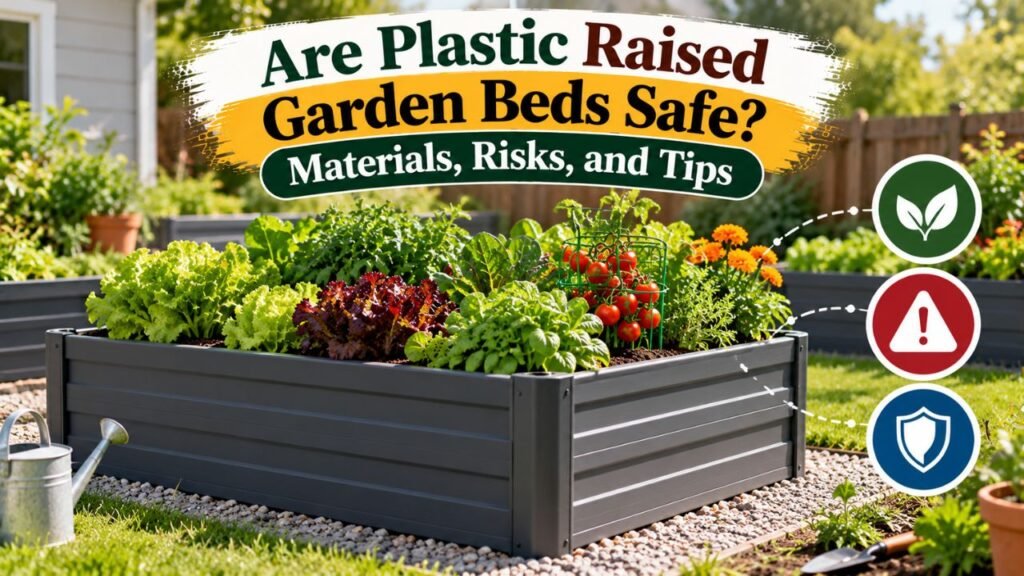
Plastic raised beds can be suitable for growing edible plants when their materials are appropriate for prolonged outdoor use and contact with garden soil.
The biggest consideration isn’t whether the bed contains plastic. It’s what type of plastic it contains and whether the finished product is designed for gardening.
Some plastics have a long history of use in food-related applications. Others contain additives or have manufacturing histories that make them less desirable for edible gardens.
For example, high-density polyethylene is commonly used in food containers, outdoor products, and certain raised garden bed systems.
Polypropylene is another material frequently used in food-related products and gardening containers.
According to the University of Maryland Extension’s guidance on growing vegetables in containers, plastics identified by recycling codes #2 (HDPE), #4 (LDPE), and #5 (PP) are suitable choices for food-growing containers. The guidance also recommends avoiding certain other plastics when repurposing containers for edible plants.
These recommendations provide a useful starting point, although recycling codes alone don’t establish the safety of every finished product.
Can Plastic Chemicals Leach Into Raised Bed Soil?
Some chemicals associated with plastic materials can migrate into surrounding environments under certain conditions.
However, the likelihood and extent depend on several factors:
- The plastic resin.
- Additives used during manufacturing.
- Temperature and sunlight exposure.
- Age and physical condition.
- Duration of soil contact.
- Soil chemistry and moisture.
- Previous exposure to chemicals.
A plastic product manufactured specifically for edible gardening may have a different risk profile from an unknown industrial container.
It’s also important to distinguish between a substance entering soil and reaching edible plant tissues at a concentration that creates a health concern.
Those are different questions, and the outcome varies with the chemical and growing conditions.
There is no sound basis for claiming that every plastic raised bed releases dangerous chemicals into vegetables. Equally, a product shouldn’t be declared completely free of chemical migration simply because it is labeled plastic or recycled.
Choosing a suitable, well-documented material reduces avoidable uncertainty.
Are Recycled Plastic Raised Beds Safe for Food Gardens?
Recycled plastic raised beds can be appropriate for vegetables, but their suitability depends on the source material and manufacturing process.
Products made from known-source recycled HDPE may offer a practical alternative to wood.
However, recycled plastic can contain different resins, pigments, stabilizers, or other additives.
The word recycled doesn’t automatically mean food-safe or unsafe.
Before purchasing, check whether the manufacturer identifies the plastic composition and explicitly recommends the finished product for edible gardening.
Avoid products with unidentified materials or unclear previous uses.
Which Types of Plastic Are Best for Raised Garden Beds?
Different plastics have different properties.
Some are rigid enough to form structural garden walls, while others are better suited to liners or lightweight containers.
| Plastic Type | Recycling Code | Suitability for Edible Gardening |
| High-density polyethylene (HDPE) | #2 | Preferred option when appropriately formulated |
| Low-density polyethylene (LDPE) | #4 | Suitable for certain liners and flexible containers |
| Polypropylene (PP) | #5 | Suitable when designed for gardening and outdoor use |
| Polyvinyl chloride (PVC) | #3 | Generally avoid for repurposed edible-growing containers |
| Polystyrene (PS) | #6 | Not a preferred choice for repurposed vegetable containers |
| Other or mixed plastics | #7 | Requires identification of the actual material |
The recycling code describes the resin category, not every additive or the complete safety of a finished product.
For an edible garden, confirm the product’s intended application rather than relying on the number alone.
HDPE Plastic Raised Garden Beds
High-density polyethylene (HDPE) is one of the most practical plastics to consider for raised garden beds.
It is used in many durable consumer and industrial products and is available in rigid boards and molded garden components.
Suitable HDPE garden products offer several advantages:
- Resistance to moisture-related rot.
- No need for conventional wood preservatives.
- Relatively low maintenance.
- Availability in recycled formulations.
- Compatibility with modular bed designs.
- Durability when appropriately stabilized for outdoor use.
However, HDPE can expand and contract with temperature changes.
Long panels may also bend under soil pressure without adequate support.
Look for products with proper connectors, reinforcing components, and manufacturer-specified height limits.
Best choice: Outdoor-rated HDPE boards or raised bed kits explicitly intended for growing edible plants.
Polypropylene Raised Garden Beds
Polypropylene, commonly identified by recycling code #5, is another plastic used in food-related containers and garden products.
It can be manufactured into rigid or flexible components.
Polypropylene may be suitable for raised bed panels, planters, and modular gardening systems when the finished product is engineered for outdoor use.
However, not every polypropylene product contains the same additives or UV protection.
Ordinary indoor storage containers may deteriorate more quickly in direct sunlight than products designed for outdoor gardening.
For permanent raised beds, choose a gardening-specific product with documented weather resistance.
LDPE Plastic Raised Beds and Liners
Low-density polyethylene is typically more flexible than HDPE.
It is commonly used in films, bags, and liners.
LDPE can be suitable for certain garden liners and flexible containers when the product is appropriate for edible growing applications.
However, thin LDPE sheeting isn’t a structural substitute for rigid raised bed walls.
It needs separate support.
If used as a liner, make sure it doesn’t block the bed’s necessary drainage.
PVC Plastic Raised Beds
Polyvinyl chloride is identified by recycling code #3.
PVC products can contain different additives depending on their intended uses.
For repurposed vegetable-growing containers, University of Maryland Extension advises avoiding PVC.
This is a sensible precaution when the finished material wasn’t manufactured for growing food.
However, PVC pipe used as an irrigation or structural component is a different application from using an unknown PVC container as the entire growing bed.
Don’t assume all PVC products are identical.
If you’re considering a PVC-based raised bed system, obtain material and food-growing suitability information directly from the manufacturer.
Composite Plastic Raised Garden Beds
Composite raised beds may combine plastic with wood fibers, fillers, pigments, or other ingredients.
Some are manufactured using recycled plastic.
Their safety and durability depend on the exact formulation.
A composite product shouldn’t automatically be treated as equivalent to solid HDPE or polypropylene.
Ask whether the manufacturer provides information about:
- Plastic resin composition.
- Recycled material sources.
- Soil-contact suitability.
- Outdoor weather resistance.
- Additives or surface coatings.
- Intended use in edible gardens.
If the manufacturer cannot identify the materials or confirm their intended use, a better-documented product is preferable.
Can Plastic Raised Beds Release Microplastics Into Soil?
Plastic can gradually break into smaller particles through environmental weathering, mechanical damage, and physical deterioration.
These particles may include microplastics.
However, the amount released from a particular raised garden bed and the implications for edible crops are not fully established.
According to the University of Minnesota Extension’s raised bed gardening guidance, research remains limited regarding potential microplastic release into soil from synthetic fabric growing bags.
The same broader concern applies when considering long-term weathering of plastic gardening products, although different materials may behave differently.
How Plastic Breakdown Happens
Several environmental conditions can contribute to plastic deterioration.
These include:
- Ultraviolet radiation from sunlight.
- Repeated temperature changes.
- Mechanical abrasion.
- Physical impacts.
- Weather exposure.
- Aging of the material.
As plastic becomes brittle, cracks or fragments may develop.
Materials that contain suitable UV stabilizers and are intended for outdoor exposure may resist deterioration better than ordinary indoor plastics.
However, no plastic product should be assumed to remain unchanged indefinitely.
Do Microplastics Enter Vegetables?
Research has examined how small plastic particles interact with soil, roots, and plants.
However, the behavior depends on particle size, composition, plant species, and experimental conditions.
Results from controlled studies shouldn’t automatically be treated as proof that vegetables grown in ordinary plastic raised beds contain dangerous concentrations of microplastics.
There isn’t enough information to establish a universal exposure level or health risk for every plastic raised bed product.
The practical response is to reduce unnecessary plastic deterioration.
Choose durable materials, inspect them regularly, and replace components that are cracking or shedding fragments.
Are Plastic Raised Beds Still Worth Using?
Yes, suitable plastic raised beds remain a reasonable gardening option despite these uncertainties.
The available evidence doesn’t justify treating every intact, outdoor-rated plastic garden bed as unsafe.
However, gardeners who prefer to minimize plastic contact with growing soil can choose alternatives such as suitable natural stone, brick, or metal.
Material selection should reflect both known properties and unresolved concerns.
Do Plastic Raised Garden Beds Get Too Hot?
Plastic raised beds can become warm in direct sunlight, particularly when they have dark-colored walls.
The effect depends on the color, thickness, bed dimensions, surrounding air temperature, and soil moisture.
Dark surfaces generally absorb more solar radiation than light-colored ones.
This may increase the temperature of the material and nearby growing soil.
Black Plastic vs. Light-Colored Plastic
Black and dark gray plastic raised beds may become hotter in strong sunlight.
Light-colored materials tend to reflect more sunlight.
However, wall color is only one factor affecting root-zone temperature.
A large raised bed containing substantial moist soil may respond differently from a small plastic planter with limited soil volume.
The surrounding ground, plant canopy, and irrigation also influence temperature.
Can Hot Plastic Walls Damage Plant Roots?
Excessive root-zone temperatures can interfere with normal plant development.
The risk may be greater in small containers, shallow beds, and locations exposed to intense afternoon sun.
Watch for conditions such as:
- Soil drying unusually quickly.
- Plants wilting despite appropriate watering.
- Excessive heating near exposed walls.
- Poor root growth in very shallow containers.
These symptoms can have several causes, so don’t assume the plastic material is always responsible.
How to Reduce Heat Around Plastic Raised Beds
In hot climates, consider the following:
- Choose a light-colored bed when practical.
- Use enough growing soil for the intended crops.
- Maintain appropriate soil moisture.
- Apply organic mulch to protect the soil surface.
- Avoid placing shallow plastic planters against excessively hot walls.
- Use appropriate shade for crops that need protection from intense heat.
Avoid covering the entire bed with an impermeable sheet that prevents proper drainage or airflow.
Are Plastic Raised Beds Durable Enough for Outdoor Use?
Plastic raised beds can last for multiple growing seasons, but their lifespan depends on the product.
There isn’t one reliable number of years that applies to all plastic materials.
UV Resistance and Outdoor Weathering
Ultraviolet exposure is an important consideration.
Some plastics are manufactured with additives designed to slow sunlight-related degradation.
Other products may become brittle or discolored after outdoor exposure.
A container made for indoor storage shouldn’t automatically be used as a permanent raised garden bed.
Look for an outdoor-rated product with information about UV resistance.
Plastic Warping and Bowing
Plastic panels may bend outward under the weight of wet soil.
This is especially relevant for taller raised beds with long, unsupported walls.
Proper structural design can include:
- Reinforced corner connections.
- Cross braces.
- Stronger side panels.
- Support stakes.
- Manufacturer-approved reinforcement.
Avoid assembling a tall bed from thin plastic sheets unless the complete structure is designed to retain the soil.
Plastic Raised Beds in Cold Weather
Cold weather can affect plastic flexibility and impact resistance.
Some materials become more brittle at low temperatures.
Repeated temperature changes can also affect connections and joints.
Outdoor-rated products are generally preferable in climates with freezing winters.
Follow the manufacturer’s storage and winter-use recommendations.
How to Choose a Safe Plastic Raised Garden Bed
A suitable plastic raised bed should be safe for the intended crops, structurally stable, and durable under the expected outdoor conditions.
Use the following checks before buying.
1. Identify the Plastic Material
Look for clearly stated materials such as HDPE or polypropylene.
Avoid relying on vague descriptions such as premium plastic or eco-friendly resin.
These terms don’t identify the polymer or establish food-growing suitability.
2. Check Its Intended Use
Choose a product specifically intended for raised gardening, preferably one that identifies edible crops as an appropriate use.
A food-contact declaration may provide useful information, but food-contact suitability under specified conditions is not the same as a guarantee about decades of outdoor soil exposure.
Manufacturer documentation is more informative than unsupported marketing claims.
3. Check the Recycled Material Source
Recycled plastic can be suitable, but ask whether the manufacturer controls and identifies its input materials.
Be cautious with products made from unspecified mixed industrial waste.
Avoid repurposed plastic that previously contained chemicals, solvents, pesticides, or other hazardous materials.
4. Confirm UV and Weather Resistance
Check whether the product is designed for prolonged outdoor exposure.
Look for manufacturer guidance about weathering, temperature, and expected service conditions.
A warranty can be useful when comparing products, but it doesn’t establish material safety by itself.
5. Check Structural Support
A tall bed filled with moist soil can place significant pressure on its sidewalls.
Choose a product designed for the intended bed height.
Inspect the connectors, braces, and panel thickness.
Don’t assume a material is structurally suitable just because it doesn’t rot.
6. Inspect Drainage Design
Determine whether the bed has an open bottom or a solid base.
Open-bottom beds placed over suitable garden ground generally allow water and roots to move into the soil underneath.
Bottomed plastic planters need suitable drainage outlets or a properly designed water reservoir with overflow management.
7. Consider Replacement and Maintenance
Choose a product that can be inspected and maintained easily.
Replaceable panels and connectors may extend the bed’s useful life.
Avoid designs that make it difficult to detect cracks, trapped water, or loose connections.
How to Install Plastic Raised Garden Beds Safely
Proper installation helps prevent structural problems, poor drainage, and unnecessary stress on the growing medium.
Step 1: Select a Suitable Location
Choose a reasonably level area with appropriate sunlight.
Most fruiting vegetables, including tomatoes and peppers, need substantial direct sunlight during the growing season.
Avoid locations where water repeatedly collects.
If the ground has known contamination, the bed may need an appropriate separation system and clean growing soil.
Step 2: Prepare the Ground
Remove grass, persistent weeds, and loose debris.
For an open-bottom bed on healthy natural ground, loosen compacted soil where necessary.
Avoid unnecessary plastic sheeting beneath the bed.
A waterproof barrier can interfere with drainage and root growth.
Step 3: Assemble the Plastic Frame
Follow the manufacturer’s instructions.
Connect panels and corners securely.
Install any required braces before filling the bed.
Check that sharp or damaged edges aren’t exposed.
Don’t drill extra structural holes or modify supports unless the manufacturer permits it.
Step 4: Check the Frame’s Stability
Position the assembled bed on a stable surface.
Make sure the walls are supported evenly.
A twisted frame may place unnecessary strain on plastic connections.
Correct uneven ground before filling the bed with soil.
Step 5: Add Suitable Growing Soil
For an open-bottom raised bed on healthy ground, a mixture of quality topsoil and mature compost is often appropriate.
A practical starting blend is approximately two parts mineral topsoil to one part finished compost.
However, the exact mixture should reflect the soil’s existing quality.
For a bottomed plastic planter, a suitable container growing medium may be preferable.
Step 6: Water and Inspect the Bed
Moisten the soil gently.
Check whether the frame remains stable as the soil settles.
Look for leaking soil, bowing panels, or loose connections.
If the bed has a solid bottom, confirm that excess water drains correctly.
Step 7: Protect the Soil Surface
After planting, apply an appropriate organic mulch.
Mulch helps moderate soil moisture and temperature.
Keep irrigation consistent without leaving the growing medium saturated.
Inspect the plastic walls occasionally for cracks or visible deterioration.
Plastic vs. Wood vs. Metal Raised Garden Beds
Plastic isn’t the only alternative for gardeners who want a durable raised bed.
Wood and metal have different advantages and limitations.
| Feature | Plastic | Wood | Metal |
| Rot resistance | Generally high | Depends on wood and moisture | Doesn’t rot biologically |
| Structural rigidity | Product-dependent | Good with suitable framing | Good with suitable panels |
| Chemical considerations | Resins, additives, recycled content | Wood treatments and coatings | Metals and protective coatings |
| UV exposure | Can cause deterioration | Can weather and discolor | Depends on coating |
| Maintenance | Usually low | Varies with species and condition | Depends on corrosion protection |
| Appearance | Various colors and finishes | Natural, traditional | Modern or industrial |
| Repairability | Depends on modular design | Boards often replaceable | Depends on construction |
| Vegetable suitability | Good with suitable materials | Good with suitable wood | Good with suitable metal products |
Plastic vs. Wooden Raised Beds
Plastic doesn’t absorb moisture and decay like natural wood.
This can reduce maintenance associated with rot and insect damage.
However, suitable wood may be easier to cut, repair, and modify.
Wood also offers a natural appearance that many gardeners prefer.
Plastic is often more convenient for gardeners who want a prefabricated, low-maintenance system.
Plastic vs. Galvanized Metal Raised Beds
Both materials can resist biological decay.
Galvanized steel is generally more rigid than thin plastic panels, although actual structural capacity depends on the design.
Metal can develop corrosion problems when its protective coating is damaged or environmental conditions are unfavorable.
Plastic doesn’t rust, but some products can become brittle, warp, or crack.
Neither material is universally safer for growing vegetables.
Material composition and product quality matter more than broad categories.
Plastic vs. Stone Raised Beds
Natural stone is another option for gardeners who prefer to avoid plastic.
Stone doesn’t undergo plastic-related UV degradation or shed polymer fragments.
However, stone beds can be heavy, expensive, and difficult to modify.
They may also require stable foundations and proper wall construction.
For a permanent garden, stone can be attractive. For a lightweight modular design, suitable plastic may be more practical.
Can You Use Plastic Raised Beds on Concrete or Patios?
Yes. Plastic raised beds can be used on patios, concrete, or other hard surfaces when their construction provides adequate soil depth and drainage.
However, open-bottom frames and bottomed planters behave differently.
Open-Bottom Plastic Frames
An open-bottom plastic frame placed on concrete doesn’t automatically retain all its soil or provide drainage.
If the growing medium sits directly on an impermeable surface, water needs a suitable escape route.
Fine soil may also wash out from beneath the frame.
Use a system designed for that installation rather than assuming any open-bottom raised bed kit will work on pavement.
Bottomed Plastic Raised Planters
A raised planter with a solid base must have drainage openings or a properly designed self-watering reservoir and overflow system.
Without an escape route, excess water can remain trapped around the roots.
Use a growing medium appropriate for container cultivation.
Avoid filling a shallow, bottomed planter with dense topsoil that may become poorly aerated.
Check the Filled Weight
Plastic frames may be lightweight when empty, but soil and water add substantial weight.
A large raised bed filled with moist soil can become extremely heavy.
For patios on natural ground, this may be straightforward to manage.
For balconies, rooftops, or elevated decks, obtain confirmation that the structure can safely support the completed bed before installation.
Can You Use Recycled Plastic Containers as Raised Garden Beds?
Some recycled or repurposed plastic containers can be suitable for edible gardening.
However, reusing an arbitrary plastic container isn’t equivalent to purchasing a purpose-built raised bed.
Food-Grade Plastic Containers
Food-grade HDPE or polypropylene containers may be practical choices when their previous contents are known and the containers remain in good condition.
For example, a clean food-grade container that previously held edible ingredients is generally a better candidate than an unidentified industrial bucket.
Make sure the material is appropriate for outdoor exposure.
Also provide sufficient drainage and growing depth.
Plastic Storage Bins
Ordinary storage bins aren’t necessarily designed for permanent outdoor gardening.
Some may crack, warp, or become brittle in direct sunlight.
A recycling code alone doesn’t verify the complete product’s suitability.
If the manufacturer doesn’t identify the intended soil-contact or outdoor use, choose a purpose-built planter instead.
Plastic Barrels and Large Containers
Certain food-grade plastic barrels can be repurposed into planters when their material and previous contents are documented.
However, barrels previously used for industrial chemicals, fuel, pesticides, or unknown substances shouldn’t be reused for food-growing applications.
Washing doesn’t necessarily remove contaminants that have penetrated or been absorbed into a plastic material.
Cut barrels also need safe edges, structural stability, and appropriate drainage.
When Should You Replace a Plastic Raised Garden Bed?
Plastic raised beds don’t have one fixed replacement schedule.
Their useful life depends on the resin, manufacturing quality, sunlight exposure, structural loading, and maintenance.
Inspect the bed regularly, especially before each growing season.
Signs That a Plastic Bed Needs Replacement
Watch for:
- Cracks extending through panels.
- Brittle or crumbling plastic.
- Visible plastic fragments breaking away.
- Walls bowing excessively under soil pressure.
- Failed or loose structural connectors.
- Severe warping.
- Damaged supports that cannot be repaired properly.
Discoloration alone doesn’t always mean the material is unsafe or structurally damaged.
However, discoloration accompanied by cracking or surface breakdown deserves attention.
Can You Repair a Cracked Plastic Raised Bed?
Minor cosmetic damage may not require replacement.
However, cracks in load-bearing panels or connection points can reduce stability.
Don’t assume that tape, glue, or an improvised patch restores the original structural capacity.
Use manufacturer-approved replacement components when available.
For severe damage, replacing the affected panel or the entire frame is safer than continuing to use an unstable bed.
Should You Replace the Soil When Replacing the Plastic Frame?
Not necessarily.
If the growing soil is healthy and free from known contamination, it may be reusable.
However, if an old plastic structure has visibly degraded and shed substantial fragments into the soil, inspect the growing medium before reusing it for edible crops.
There is no universal visual test that proves soil is free from microscopic plastic particles.
Where contamination is a serious concern, seek appropriate testing or local extension guidance rather than assuming the soil is safe based solely on appearance.
How to Keep Plastic Raised Garden Beds Safe Over Time
Proper care can help maintain structural stability and reduce unnecessary deterioration.
Avoid Harsh Cleaning Chemicals
Clean the exterior using mild soap and water when needed.
Avoid strong solvents or abrasive cleaning methods that may damage the plastic.
Follow the manufacturer’s care instructions.
Don’t Burn or Heat Plastic Panels
Avoid burning plastic garden materials.
Also, don’t use open flames or improvised heating methods to reshape damaged panels.
Heating can damage the material and release unwanted fumes.
Avoid Unnecessary Surface Damage
Keep sharp tools away from plastic walls.
Repeated impacts from shovels, trimmers, or other garden equipment can scratch or crack the material.
Repair or replace damaged components promptly.
Check the Bed After Extreme Weather
Inspect the structure after severe heat, freezing conditions, or storms.
Look for weakened connectors, warped panels, and changes in the bed’s shape.
Check that the soil hasn’t washed out around the base.
Follow the Manufacturer’s Load Limits
Don’t add extra height or soil beyond the product’s intended design.
A taller plastic bed places more pressure on the lower panels and joints.
If additional growing depth is required, choose a structure designed to support it.
Conclusion
So, are plastic raised garden beds safe? Yes, suitable plastic raised beds are generally a reasonable choice for growing vegetables, herbs, and flowers.
Outdoor-rated HDPE and appropriately manufactured polypropylene are among the more practical materials to consider. However, product formulation, recycled content, additives, and long-term weather resistance still matter.
Avoid repurposing unidentified chemical containers or using deteriorating plastics that are cracking and shedding fragments. Although concerns about microplastics deserve attention, the available research doesn’t establish that every intact plastic raised bed creates an unsafe food-growing environment.
For an edible garden, I recommend choosing a purpose-built, outdoor-rated raised bed with clearly identified materials and manufacturer guidance confirming its suitability for growing food.
A well-made plastic bed with proper drainage, structural support, and routine inspection can provide a convenient alternative to wood or metal.
FAQs About Are Plastic Raised Garden Beds Safe
Are HDPE Raised Garden Beds Safe for Vegetables?
Yes. HDPE is generally considered a suitable material for vegetable-growing containers when the finished product is appropriately manufactured.
Choose outdoor-rated HDPE raised beds intended for edible gardening.
Avoid using damaged or contaminated plastic products.
Are Recycled Plastic Raised Beds Toxic?
Not necessarily. Recycled plastic doesn’t automatically mean a product is toxic.
However, the safety of recycled plastic depends on its composition, additives, manufacturing process, and material source.
Choose products with clearly identified materials and documented gardening suitability.
Do Plastic Raised Beds Leach BPA Into Soil?
Not every plastic contains BPA.
HDPE and polypropylene are different materials from polycarbonate, a plastic historically associated with BPA use.
However, finished-product safety also depends on additives and manufacturing conditions. A BPA-free label alone doesn’t establish that every other possible chemical concern has been evaluated.
Can Plastic Raised Beds Cause Microplastics in Vegetables?
Weathered plastic can shed particles, but the amount of microplastic transferred from a particular raised bed into edible plant tissues is not well established.
The risks depend on the materials and conditions involved.
Choosing durable, outdoor-rated products and replacing deteriorating components are sensible precautions.
Are Black Plastic Raised Beds Safe in Hot Weather?
Black plastic raised beds can be used in hot weather, but their surfaces may absorb substantial sunlight and become warm.
This can affect nearby soil temperatures, particularly in shallow beds.
Adequate growing depth, appropriate watering, and mulch help manage heat stress.
Is PVC Safe for Raised Vegetable Beds?
PVC isn’t a preferred choice for repurposed food-growing containers because its additives and formulations vary.
Some PVC products may be used as structural or irrigation components, but that is different from using unknown PVC material to contain vegetable-growing soil.
For direct soil contact, HDPE or suitable polypropylene products are generally more straightforward choices.
How Long Do Plastic Raised Garden Beds Last?
There is no universal lifespan for plastic raised beds.
Durability depends on resin type, UV protection, panel thickness, structural support, climate, and product quality.
Inspect the bed regularly and replace panels that become brittle, severely cracked, or structurally unstable.

I’m Maya L. Greenwood, a lifelong plant lover who believes anyone can grow something beautiful with the right guidance. After years of testing soil mixes, pruning methods, irrigation tricks, and pest-safe solutions, I started EasyGardenTips.com to turn hard-won lessons into step-by-step advice. From seed starting and container gardens to composting and seasonal checklists, my goal is to make gardening simple, sustainable, and fun.