What to Plant With Pumpkins in Raised Bed: Easy Planting Guide
In a raised bed, good pumpkin companions include early radishes, leaf lettuce, spinach, scallions, and carefully spaced bush beans. Basil and flowering plants such as nasturtiums, calendula, and sweet alyssum can also grow near pumpkins, provided the vines have room to spread. The best combination depends on the pumpkin variety, your planting season, and whether the neighboring crop will be harvested before the pumpkin canopy fills the space.
Pumpkins are not small raised-bed vegetables. Even a compact bush type can occupy several square feet, while traditional vining varieties may spread far beyond a 4×8-foot bed. Companion planting works best when you plan for the mature vines rather than the size of new seedlings.
Pollination matters, too. Pumpkin plants produce separate male and female flowers, and bees transfer pollen between them. Nearby flowers can offer resources for pollinators, but no companion plant guarantees more pumpkins or freedom from pests.
In this article, I explain the most practical pumpkin companions, plants that compete for space, and realistic layouts for 4×4 and 4×8 beds. You’ll also learn how to manage vines, timing, watering, and pollinator access.
What to Plant With Pumpkins in Raised Bed: Best Companions
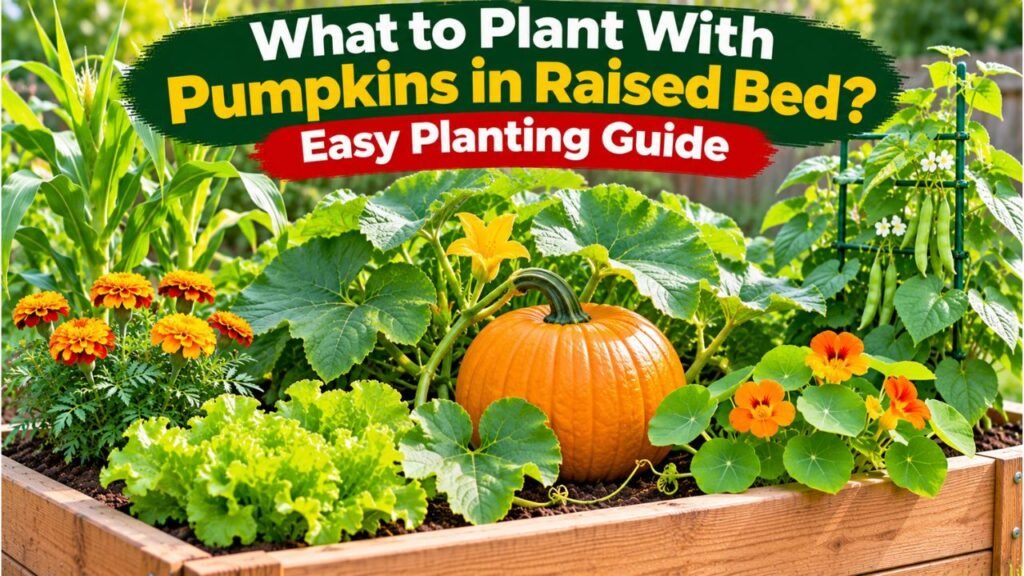
Pumpkins can share growing space with several vegetables, herbs, and flowers, but their large leaves and spreading vines make spacing especially important.
For most small raised beds, the best companions are plants that either mature before pumpkin vines spread or grow along the edges without competing heavily.
Pumpkin Companion Planting Chart
| Companion plant | Main advantage | Best location |
| Radishes | Quick harvest before vines spread | Early open spaces |
| Leaf lettuce | Uses space during early growth | Bed edges or temporary gaps |
| Spinach | Cool-season crop harvested early | Spring planting area |
| Scallions | Narrow, upright growth | Accessible edges |
| Bush beans | Compact warm-season crop | Separate sunny section |
| Beets | Root crop for early harvesting | Outer rows |
| Carrots | Different growth habit | Separate rows with loose soil |
| Basil | Warm-season culinary herb | Sunny edge or nearby container |
| Nasturtiums | Flowers useful to some pollinators | Outside edge or neighboring planter |
| Calendula | Provides flowers and garden diversity | Border or separate container |
These combinations do not guarantee pest control or improved pumpkin yields.
The practical benefits come from using the available space efficiently, providing flowering resources, and avoiding excessive competition.
For a small raised bed, select only one or two companion plants from this chart.
10 Best Companion Plants for Pumpkins in Raised Beds
The following plants can work alongside pumpkins when their spacing, sunlight, and harvest requirements are managed correctly.
1. Radishes
Radishes are one of the most useful vegetables to plant near young pumpkins.
Their biggest advantage is fast growth.
Many small radish varieties reach harvest size in approximately 25–35 days under suitable conditions.
Pumpkins usually require much longer to develop mature fruits.
This creates an opportunity to grow radishes before the pumpkin canopy occupies the surrounding soil.
How to plant radishes with pumpkins:
- Reserve enough room for the mature pumpkin plant.
- Sow radishes in short rows along the open edges.
- Follow the seed packet for sowing depth.
- Thin the seedlings to their recommended spacing.
- Harvest the radishes before pumpkin leaves cover the area.
Radishes perform best during cooler weather.
In areas where summer temperatures rise quickly, they may be more practical as a crop grown before pumpkins are planted.
Best for: Early-season space-saving and succession planting.
2. Leaf Lettuce
Leaf lettuce is another useful short-season companion.
It can occupy open soil while pumpkins are still small.
However, pumpkins and lettuce have different preferred temperatures.
Lettuce generally grows better during cool weather.
Pumpkins require warm conditions and are damaged by frost.
This makes early harvesting important.
How to plant lettuce near pumpkins:
- Grow lettuce during early spring.
- Reserve a planting position for the pumpkin.
- Plant the pumpkin once frost danger has passed and the soil has warmed.
- Harvest remaining lettuce before pumpkin vines create heavy shade.
In some climates, the two crops can overlap briefly.
In hotter regions, lettuce may be harvested before pumpkin planting begins.
Leaf lettuce is generally more convenient than large head lettuce because individual leaves can be harvested early.
Best for: Spring-to-summer succession planting.
3. Spinach
Spinach grows well during cool conditions and can provide an early harvest before pumpkins become large.
Its relatively compact habit makes it useful in raised beds.
However, spinach often bolts when temperatures become high.
For this reason, it should not be treated as a dependable midsummer pumpkin companion.
How to plant spinach:
Sow spinach during cool weather in the area where pumpkins will eventually grow.
Harvest the leaves as they develop.
When the weather becomes suitable for pumpkins, clear enough space for the pumpkin plant and its expanding root system.
If both crops are present briefly, avoid covering spinach with pumpkin leaves.
This is primarily a succession-planting arrangement rather than a permanent combination.
Best for: Early spring harvesting before pumpkin vines expand.
4. Scallions
Scallions, also called green onions, have narrow upright leaves.
They can be easier to fit along raised-bed edges than larger vegetables.
Unlike sprawling squash or large leafy greens, scallions generally require relatively little aboveground space.
How to plant scallions:
Place them along an accessible edge of the raised bed.
Follow the variety’s recommended spacing, commonly around 2–4 inches for bunching onions.
Keep them away from the pumpkin’s main stem.
Harvest carefully to avoid disturbing pumpkin roots.
Scallions can be particularly useful if you already grow them for regular kitchen use.
However, do not assume that their smell automatically repels squash bugs or cucumber beetles.
Evidence for broad companion-planting pest-repellent claims is limited.
Best for: Narrow borders and convenient harvesting.
5. Bush Beans
Bush beans can grow near pumpkins when there is sufficient space.
Both prefer warm growing conditions.
Bush beans also remain shorter than pole beans and do not require tall trellises.
However, they still need sunlight and adequate root space.
How to plant bush beans:
- Reserve a separate section along the sunny edge of a larger raised bed.
- Plant bush beans according to their seed packet.
- Keep them out of the pumpkin’s main growing area.
- Direct pumpkin vines away from the bean plants.
- Harvest beans before the vines become excessively crowded.
Bush beans are often ready for their first harvest approximately 50–60 days after sowing, depending on the variety.
Pumpkin foliage can expand significantly during that period.
If you have a small bed, bush beans may be more successful in a separate planting area.
Do Beans Fertilize Pumpkins?
Beans are legumes.
They can form relationships with nitrogen-fixing bacteria in their roots.
However, this does not mean they immediately supply large amounts of usable nitrogen to nearby pumpkins.
Much of the fixed nitrogen remains within the bean plant during growth.
Additional nitrogen may become available as plant residues decompose.
Do not use beans as a substitute for proper pumpkin fertilization.
Best for: Larger raised beds with enough room for both crops.
6. Beets
Beets are another possible companion because they grow differently from pumpkins.
Their edible roots develop underground.
However, beet leaves still require sunlight, and the roots need sufficient space to develop.
How to grow beets near pumpkins:
Plant beets along an open edge or in a separate section.
Thin seedlings according to the desired root size, commonly around 3–4 inches for medium-size beets.
Harvest them before pumpkin vines create dense shade.
Avoid digging close to the pumpkin’s main stem.
Beets are usually more practical during cooler parts of the growing season.
In hot regions, they may be better grown before pumpkins.
Best for: Early-season root-crop harvesting.
7. Carrots
Carrots can grow near pumpkins when they have suitable soil and sufficient sunlight.
Their main edible portion develops below the surface.
However, carrot seedlings are relatively slow to establish and may struggle if pumpkin vines quickly shade them.
How to plant carrots:
- Prepare a loose, stone-free planting area.
- Sow carrots in a separate row.
- Keep the seedbed consistently moist during germination.
- Thin seedlings to the recommended spacing.
- Harvest before pumpkin growth makes the area difficult to access.
Avoid planting carrots immediately beside the pumpkin stem.
Harvesting mature carrots can disturb nearby roots.
For a small raised bed, carrots grown before pumpkin planting may be easier to manage.
Best for: Spring succession planting or separate edge rows.
8. Basil
Basil is an herb rather than a vegetable, but it can be a useful companion for pumpkins.
Both prefer warm temperatures and substantial sunlight.
Basil can also provide an additional edible harvest.
However, basil can become quite large when left untrimmed.
How to plant basil:
Place basil in a sunny area along the raised-bed edge.
Alternatively, grow it in a container immediately beside the bed.
Keep it away from pumpkin stems.
Harvest leaves regularly to maintain manageable growth.
Basil flowers may attract visiting insects, but they do not guarantee improved pumpkin pollination.
Likewise, basil should not be relied upon to prevent pumpkin pests.
Best for: Warm-season planting in a sunny edge or container.
9. Nasturtiums
Nasturtiums are flowering plants commonly grown near vegetable gardens.
They produce attractive flowers, and some varieties have edible leaves and flowers.
They can provide resources for visiting insects, including some pollinators.
However, nasturtiums are not necessarily small plants.
Some varieties spread widely.
How to plant nasturtiums near pumpkins:
Choose a compact variety if space is limited.
Grow it at the outside edge of the bed or in a separate container.
Prevent it from climbing over pumpkin plants or covering developing fruits.
Maintain adequate access to the pumpkin flowers.
Nasturtiums may attract aphids and other insects.
That can sometimes be useful in specific trap-cropping systems, but it can also create additional pest-management work.
Best for: Nearby flowering borders or containers.
10. Calendula
Calendula is another flowering option for a pumpkin garden.
Its flowers may provide nectar and pollen for visiting insects.
It can also add color to the growing area.
However, it is not a guaranteed pumpkin-pollination booster.
How to grow calendula:
Plant it in an accessible sunny border or container.
Allow enough room for its mature size.
Remove spent flowers if you want to encourage continued flowering.
Keep the plant from shading young pumpkin seedlings.
Calendula often performs best in relatively mild conditions.
In very hot climates, flowering may decline during peak summer heat.
Choose planting times appropriate for your region.
Best for: Garden borders and pollinator-friendly planting areas.
Key Takeaway: Radishes, lettuce, and spinach are useful early companions. Scallions, bush beans, and basil may work during pumpkin growth when space permits. Flowering plants are generally easiest to manage along the bed perimeter.
What Flowers Should You Plant Near Pumpkins for Pollination?
Pumpkins depend heavily on insect pollination.
This makes the surrounding garden environment important.
Flowering plants can provide food resources for pollinators, especially when they bloom before or after pumpkin flowers.
However, nearby flowers do not automatically increase pumpkin yield.
Why Pumpkins Need Pollinators
Pumpkin plants produce separate male and female flowers.
Male flowers produce pollen.
Female flowers have a small immature fruit beneath the blossom.
For a pumpkin to develop normally, pollen must reach the female flower.
According to the University of Maryland Extension’s pumpkin-growing guide, bees carry pollen from male to female pumpkin flowers, and poor pollination can occur when rainy weather limits bee activity.
A single healthy pumpkin plant can produce both types of flowers.
You generally do not need separate male and female pumpkin plants.
Good Flowering Plants to Consider
Several flowering plants may be useful near a pumpkin garden:
| Flower | Potential benefit | Placement |
| Sweet alyssum | Provides small flowers visited by some beneficial insects | Nearby border |
| Calendula | Offers additional flowers | Sunny edge or container |
| Nasturtiums | Attracts various flower-visiting insects | Separate planter or outer edge |
| Borage | Produces bee-visited flowers | Larger nearby planting area |
| Zinnias | Provides flowers during warm weather | Separate sunny flower bed |
| Marigolds | Adds floral diversity | Border or nearby container |
Choose plants adapted to your climate.
Prefer a mixture that flowers during different parts of the growing season.
Can You Grow Marigolds With Pumpkins?
Yes.
Marigolds can grow near pumpkins when they receive adequate light and space.
However, claims that marigolds automatically repel squash bugs, cucumber beetles, or other pumpkin pests are not consistently supported.
Their primary value is as ornamental flowers and part of a more diverse garden.
Do not crowd marigolds directly into the pumpkin’s main root area.
Should Flowers Be Inside the Raised Bed?
Not necessarily.
In a small pumpkin bed, nearby containers or a separate flower strip may be better.
This gives pumpkin vines more room to grow.
Pollinators can visit flowers surrounding the bed without those flowers sharing the exact same soil space.
Key Takeaway: Flowering companions are useful for supporting garden biodiversity, but providing suitable bee habitat and keeping pumpkin flowers accessible are more important than relying on any single flower species.
What Should You Not Plant Next to Pumpkins?
Most vegetables are not inherently incompatible with pumpkins.
The main concerns are overcrowding, shading, root competition, and shared pest problems.
A plant can be a reasonable neighbor in a large garden but a poor choice for a small raised bed.
Zucchini and Other Squash
Zucchini, summer squash, and winter squash can grow near pumpkins.
However, they belong to the same plant family.
They may share common pests and diseases, including:
- Squash bugs.
- Squash vine borers.
- Cucumber beetles.
- Powdery mildew.
- Certain plant viruses.
They also compete for space.
For a small raised bed, growing several squash-family crops together is usually impractical.
Cucumbers
Cucumbers are another member of the cucurbit family.
They can grow near pumpkins in a sufficiently large garden.
However, both crops may produce vigorous vines and share some pests and diseases.
A cucumber trellis can reduce ground-level spread, but the roots still need adequate space.
If you have only one small raised bed, consider growing cucumbers separately.
Potatoes
Potatoes require space for root and tuber development.
Harvesting potatoes involves digging, which may disturb nearby pumpkin roots.
Potatoes and pumpkins also have different growth and management requirements.
They are generally easier to grow in separate sections.
Tall Corn
Corn is sometimes grown with pumpkins as part of a traditional Three Sisters planting system.
However, corn can shade pumpkins when the arrangement is poorly designed.
Corn also needs adequate plant numbers and positioning for wind pollination.
A few corn stalks in a narrow raised bed may not provide reliable ear production.
Sunflowers
Sunflowers can attract visiting insects, but large varieties may create substantial shade.
They also use water, nutrients, and root space.
Grow tall sunflowers in a separate area where they won’t block pumpkin sunlight.
Mint
Mint spreads aggressively under favorable conditions.
It can become difficult to control in a raised bed.
Grow mint in a separate container rather than directly among pumpkin roots.
Plants to Use Cautiously
| Plant | Main concern |
| Zucchini | Shared pests and heavy foliage |
| Winter squash | Similar sprawling growth |
| Cucumbers | Competition and shared pest concerns |
| Potatoes | Digging may disturb pumpkin roots |
| Corn | Height, shade, and pollination requirements |
| Large sunflowers | Shade and root competition |
| Mint | Aggressive spreading |
| Large tomatoes | Competition for sunlight, water, and space |
Key Takeaway: Avoid combining pumpkins with multiple large, vigorous crops in a small bed. The problem is generally competition and maintenance difficulty, not a universal chemical incompatibility.
How Much Space Do Pumpkins Need in a Raised Garden Bed?
Pumpkin spacing depends heavily on the variety.
This is one of the most important factors in deciding what to plant nearby.
There are three broad pumpkin growth habits:
- Bush.
- Semi-bush or short vine.
- Full vine.
The names describe plant growth rather than just fruit size.
A pumpkin producing small fruit can still have long vines.
Pumpkin Spacing by Growth Type
| Pumpkin growth type | General space needs | Raised-bed suitability |
| Compact bush | Several square feet or more | Best choice for smaller beds |
| Semi-bush | Moderate to substantial spread | Suitable with enough room |
| Short-vining miniature | Varies by cultivar | Possible with support or external growing space |
| Full-vining | Often spreads many feet | Needs substantial space outside a small bed |
| Giant pumpkin | Very large growing area | Usually unsuitable for small raised beds |
The University of New Hampshire Extension’s pumpkin-growing guidance recommends bush varieties for smaller spaces and raised beds.
It also notes that pumpkin spacing varies with growth habit and fruit size.
For example, between-row requirements for bush varieties may be around 4–5 feet, while long-vining types can require approximately 10–12 feet.
Exact spacing should come from the selected seed variety.
Can a Pumpkin Grow in a 4×4 Raised Bed?
Yes, a suitable compact pumpkin variety may grow in a 4×4 raised bed.
However, a single plant may occupy most of the available growing space.
The bed provides 16 square feet of soil surface.
That is not enough to contain the entire vine spread of many standard pumpkin varieties.
If growing a vining type, plan where the vines will extend beyond the bed.
Do not expect a large pumpkin plant and several full-size vegetables to remain comfortably inside a 4×4 bed.
Can You Grow Pumpkins in a 4×8 Raised Bed?
Yes.
A 4×8 bed provides 32 square feet of growing area.
This offers more flexibility for a compact bush or short-vining variety.
However, many full-vining pumpkins require substantially more space than 32 square feet.
Choose the cultivar before planning companion plants.
Can You Train Pumpkin Vines Outside a Raised Bed?
Yes.
Some gardeners plant pumpkins near one edge and direct the vines into an adjacent open growing area.
This can preserve some soil space inside the bed.
However, the surrounding area must be suitable for vine growth and fruit development.
Avoid directing vines across frequently used paths.
Pumpkin vines can develop additional roots at certain stem nodes when they contact suitable moist soil.
Take care not to damage those stems while managing the vines.
What to Plant With Pumpkins in a 4×4 Raised Bed
A 4×4 bed is best suited to a compact pumpkin variety with minimal competition.
The simplest approach is to give the pumpkin priority.
Layout 1: One Compact Pumpkin With Early Radishes
Plant one appropriate compact pumpkin in the planned main growing position.
Use temporary open space near the accessible edges for radishes.
Harvest the radishes before the pumpkin becomes large.
Do not continue sowing radishes once the vines occupy most of the bed.
Layout 2: Pumpkin With Early Lettuce
Grow leaf lettuce during cool spring weather.
Reserve the planned pumpkin location.
Once the soil is warm enough, plant the pumpkin and harvest the remaining lettuce as needed.
In some climates, this will be a sequence rather than simultaneous planting.
Layout 3: Pumpkin With Flowers Outside the Bed
Use the raised bed primarily for the pumpkin.
Place flowering plants in nearby containers.
Suitable options include:
- Calendula.
- Nasturtiums.
- Sweet alyssum.
This provides additional flowering resources without crowding pumpkin roots.
Best 4×4 Arrangement
| Area | Planting choice |
| Main growing space | One suitable compact pumpkin |
| Temporary open edge | Early radishes or lettuce |
| Nearby containers | Pollinator-friendly flowers |
| Outside growing area | Additional vine space if the cultivar requires it |
My recommendation for a 4×4 bed is one compact pumpkin with early crops that will be harvested before its foliage spreads.
Avoid trying to grow several large vegetables in the same bed.
What to Plant With Pumpkins in a 4×8 Raised Bed
A 4×8 bed gives you more options, but the pumpkin variety still determines how much room remains.
Layout 1: Compact Pumpkin and Bush Beans
For a suitable compact pumpkin variety, you may reserve one section for the pumpkin and another for bush beans.
Position the beans where they will receive enough sunlight.
Direct the pumpkin’s growth away from them.
This works only when the mature pumpkin size leaves adequate room for the beans.
If the vines begin covering the beans, the arrangement is too crowded.
Layout 2: Pumpkin With Scallions and Basil
Another warm-season arrangement uses:
- One compact pumpkin.
- A small scallion row near an accessible edge.
- Basil along a sunny perimeter or in a nearby container.
Allow the pumpkin adequate space.
Do not fill the entire bed with companion plants.
Layout 3: Full-Vining Pumpkin With External Vine Space
If you want to grow a traditional vining pumpkin, position the plant near one end of the bed.
Direct the vines into a suitable adjacent garden area.
Use the open raised-bed space for early crops such as radishes or lettuce.
Harvest those crops before the pumpkin canopy expands.
This arrangement requires substantial additional space outside the bed.
It is not suitable where vines would obstruct paths or be repeatedly damaged.
Example 4×8 Planting Plan
| Bed section | Plant |
| Main planting area | One pumpkin suited to the available space |
| Accessible outer edge | Scallions or early radishes |
| Temporary spring section | Leaf lettuce |
| Nearby container | Basil or calendula |
| External area, if needed | Space for vining pumpkin growth |
The precise layout depends on the pumpkin cultivar.
A large standard pumpkin may need the entire bed and much of the surrounding area.
Can You Plant Corn, Beans, and Pumpkins Together?
Yes, this is the basis of the traditional Three Sisters growing system associated with Indigenous agricultural practices in North America.
The arrangement involves:
- Corn.
- Climbing beans.
- Squash or pumpkins.
Each crop has a different growth habit.
How the Three Sisters System Works
Corn grows upright and can provide support for climbing beans.
Beans grow vertically.
Pumpkin or squash vines spread over the soil surface.
The broad squash leaves can help cover exposed soil and reduce some weed growth.
The crops are traditionally arranged together in a planned planting system.
Do Beans Feed Corn and Pumpkins?
Legumes can fix atmospheric nitrogen through relationships with suitable bacteria.
However, most of that nitrogen is not immediately transferred to nearby plants during active growth.
The fertility benefits depend on soil conditions, root activity, and decomposition of plant residues.
Do not assume beans eliminate the need for proper soil fertility management.
Can You Grow Three Sisters in a 4×8 Bed?
A conventional 4×8 raised bed is usually too small for a full Three Sisters planting involving vigorous corn, beans, and pumpkins.
Corn requires sufficient plants for reliable pollination.
Climbing beans need support.
Pumpkins need extensive growing room.
Combining all three in one small bed can lead to excessive crowding.
A larger garden area or substantial raised growing space is more appropriate.
For a small raised bed, use the principle of combining different growth habits without trying to reproduce a full Three Sisters arrangement.
When Should You Plant Pumpkin Companions?
Pumpkins are warm-season crops.
They should generally be planted after the danger of frost has passed and the soil has warmed.
Companion vegetables have different planting schedules.
Early Spring
Suitable crops include:
- Radishes.
- Lettuce.
- Spinach.
- Peas.
- Carrots.
- Beets.
Many of these vegetables grow best in cooler conditions.
They may be harvested before pumpkin planting begins.
Late Spring
Once frost danger has passed and the soil is sufficiently warm, plant pumpkins according to their variety requirements.
Warm-season companions may include:
- Bush beans.
- Basil.
- Certain flowering plants.
However, keep enough space for the pumpkin’s mature spread.
Summer
During summer, focus on maintaining the pumpkin rather than continually adding new crops nearby.
Pumpkin vines may cover most of the available soil.
Companion planting becomes more difficult as the canopy expands.
Continue harvesting accessible herbs or other plants without disturbing pumpkin roots.
Fall
In regions where pumpkins mature before cold weather, remove the vines after harvest.
The bed can then be prepared for suitable fall crops if enough growing time remains.
Possible crops include:
- Spinach.
- Radishes.
- Lettuce.
- Kale.
The exact schedule depends on your location and expected frost dates.
Seasonal Companion Planting Chart
| Season | Suitable crops | Relationship to pumpkins |
| Early spring | Radishes, lettuce, spinach, peas | Often grown before pumpkins |
| Late spring | Bush beans, basil, scallions | May overlap with young pumpkins |
| Summer | Basil and suitable flowers | Grow at edges or nearby |
| Fall | Lettuce, radishes, spinach | Often planted after pumpkin harvest |
Key Takeaway: Succession planting is often more practical than growing many vegetables beside pumpkins at the same time. Use cool-season crops before pumpkins and compact warm-season companions only when space allows.
How to Prepare Raised Bed Soil for Pumpkins and Companion Plants
Pumpkins grow best in fertile, well-drained soil with enough moisture to support vigorous growth.
Their nutrient and water needs must be considered before adding companions.
Choose a Suitable Soil Mix
A raised bed should contain a stable growing medium with adequate drainage and organic matter.
A suitable mix may include:
- Quality mineral soil or raised-bed soil.
- Mature compost.
- Appropriate amendments based on soil conditions.
Avoid filling the bed mostly with fresh grass clippings, uncomposted manure, or other rapidly decomposing material.
Pumpkins need a dependable root zone.
Check Soil Depth
Pumpkin roots need sufficient soil volume.
A bed with approximately 12–18 inches of suitable soil may support a compact pumpkin, depending on its design and underlying ground.
An open-bottom bed allows roots to explore suitable soil below.
A closed-bottom bed restricts rooting depth.
Larger pumpkin varieties may require considerably more root volume and surrounding space.
Test the Soil
A soil test can help determine:
- Soil pH.
- Nutrient availability.
- Fertilizer requirements.
- Appropriate amendments.
Pumpkins are relatively demanding crops.
However, too much nitrogen may encourage excessive vine growth at the expense of balanced fruit development.
Follow soil-test recommendations rather than applying fertilizer without measuring the need.
Water Consistently
Pumpkins need regular moisture, especially during flowering and fruit development.
Water deeply enough to reach the root zone.
Avoid allowing the soil to alternate repeatedly between severe dryness and waterlogging.
Raised beds may dry faster than nearby ground soil.
Check moisture beneath the surface instead of judging only by appearance.
Use Mulch Carefully
A suitable mulch can reduce evaporation and suppress weeds.
Options include:
- Clean straw.
- Shredded leaves.
- Suitable untreated grass clippings.
- Other appropriate organic mulches.
Keep mulch away from the pumpkin’s main stem.
Avoid thick, wet clumps that restrict airflow or create persistent moisture around the crown.
How to Manage Pumpkin Vines Without Crowding Companion Plants
Pumpkin vines can spread rapidly once warm weather encourages growth.
Early management makes it easier to protect smaller companions.
Direct Vines Into Open Space
Guide vines toward an area where they can spread without covering other vegetables.
Do this while the vines are young and flexible.
Mature pumpkin stems can become brittle.
Avoid twisting or bending them sharply.
Can You Grow Pumpkins on a Trellis?
Some small-fruited pumpkin varieties can be trained vertically.
However, the trellis must be strong enough for the mature plant and fruit.
Small pumpkins may also need slings for additional support.
Large carving pumpkins and giant varieties are generally impractical for ordinary raised-bed trellises.
Choose the growing method based on fruit weight and cultivar growth habit.
Should You Prune Pumpkin Vines?
Pruning may be useful in certain situations, but aggressive pruning can reduce healthy leaf area.
Leaves are essential for photosynthesis and fruit development.
Remove damaged or diseased foliage when appropriate.
If you need to control vine growth, follow guidance suitable for the specific variety.
Avoid cutting major vines simply to make room for companions without considering the effect on the pumpkin crop.
Protect Developing Fruits
Keep developing pumpkins from resting in persistently wet conditions.
Depending on the garden, a clean board, suitable support, or dry mulch beneath the fruit may help reduce direct contact with damp soil.
Do not repeatedly move large developing fruits because doing so can damage their stems or vines.
How to Protect Pumpkins and Their Companions From Pests
Pumpkins are susceptible to several common insect pests and diseases.
Companion planting does not replace regular inspection.
Watch for Squash Bugs
Squash bugs may feed on leaves and stems.
Inspect the undersides of pumpkin leaves for eggs and young insects.
Early detection can make management easier.
Remove pests manually when practical.
Use appropriate controls only when needed.
Monitor Cucumber Beetles
Cucumber beetles can damage cucurbit foliage.
They may also spread certain plant diseases.
Check young plants frequently.
Protecting seedlings may reduce early damage.
Watch for Squash Vine Borers
Squash vine borers can injure stems of susceptible squash and pumpkin varieties.
The risk differs among cucurbit species and cultivars.
Inspect the stems and look for symptoms such as sudden wilting or frass near feeding sites.
Consult local extension guidance for management suited to your region.
Manage Powdery Mildew
Powdery mildew commonly affects pumpkin leaves.
Symptoms include white, powdery growth on leaf surfaces.
To reduce favorable conditions:
- Maintain appropriate plant spacing.
- Avoid unnecessary overcrowding.
- Use resistant varieties when available.
- Remove severely affected plant debris.
- Monitor the crop regularly.
Some pumpkin leaves naturally have pale or silvery markings, so confirm the diagnosis before treating.
Keep Pumpkin Flowers Accessible
Pumpkins need pollination to produce fruit.
Insect netting can protect young plants from pests, but it also excludes bees.
Remove or open insect-proof covers when pumpkin flowers require pollination.
Hand pollination may be possible when natural pollinator access is limited.
Avoid pesticide applications when bees are actively visiting flowers.
Key Takeaway: A healthy pumpkin garden depends on adequate spacing, regular inspection, suitable watering, and pollinator access. Companion plants can complement these practices but cannot replace them.
Common Mistakes When Companion Planting With Pumpkins
Several avoidable mistakes can reduce the success of both pumpkins and neighboring crops.
Planting Too Many Vegetables in One Bed
Pumpkins need substantial growing space.
Adding numerous companion vegetables can increase competition for sunlight, moisture, and nutrients.
Choose only a few suitable companions.
Selecting a Large Pumpkin Variety for a Small Bed
A full-vining pumpkin may spread far beyond a standard raised bed.
Check the seed packet for growth habit and spacing requirements.
Choose compact varieties when space is limited.
Planting Companions Too Close to the Pumpkin Stem
Pumpkin roots can spread through a large area.
Avoid repeatedly disturbing the soil directly around the main plant.
Growing Cool-Season Crops Too Late
Radishes, lettuce, and spinach often struggle during hot weather.
Plant them early enough to harvest before summer temperatures become unsuitable.
Believing Marigolds or Herbs Prevent All Pests
No single companion plant guarantees insect protection.
Use regular inspections and proven pest-management methods.
Planting Several Large Cucurbits Together
Pumpkins, zucchini, cucumbers, and other squash-family crops may share pests and diseases.
They also require substantial growing space.
Avoid crowding them in a small bed.
Forgetting About Pollination
Healthy vines may produce few pumpkins if female flowers do not receive adequate pollen.
Make sure pollinators can reach the flowers.
Allowing Vines to Cover Every Companion
Once pumpkin foliage forms a dense canopy, smaller crops may receive too little light.
Harvest early companions or redirect vines before overcrowding becomes severe.
Ignoring Water Needs
Pumpkins and their companions share soil moisture.
Overcrowded plantings may increase total water demand.
Check the soil regularly.
Trying to Grow Three Sisters in Too Little Space
Corn, pole beans, and pumpkins can work together in a suitably designed planting area.
However, a small raised bed rarely provides enough room for a full traditional arrangement.
Conclusion
If you’re wondering what to plant with pumpkins in raised bed, start with radishes, leaf lettuce, spinach, or scallions.
These crops can make use of temporary open space while pumpkin plants are still developing.
Bush beans and basil may also work when the bed is large enough.
Flowering plants such as nasturtiums, calendula, and sweet alyssum can be grown near pumpkins to add garden diversity and provide resources for visiting pollinators.
However, the pumpkin variety should determine the planting plan.
Compact bush types are generally easier to manage in raised beds, while traditional vining pumpkins often need substantial additional space.
My recommendation is to give pumpkins priority, harvest short-season vegetables before the vines spread, and grow most flowering companions around the bed rather than directly in it.
This approach provides a more manageable garden while preserving the sunlight, root space, and pollinator access pumpkins need for healthy fruit development.
FAQs About What to Plant With Pumpkins in Raised Bed
What Vegetables Grow Best Next to Pumpkins?
Radishes, early lettuce, spinach, scallions, and carefully spaced bush beans are practical choices. Short-season crops are particularly useful because they can be harvested before pumpkin vines spread. Choose companions according to local growing conditions.
Can You Plant Pumpkins and Tomatoes Together?
Yes, but both can become large plants that compete for sunlight, nutrients, and root space. In a small raised bed, growing them separately is usually easier. If you have a larger planting area, provide adequate spacing and keep pumpkin vines from covering tomato plants.
Can You Grow Pumpkins and Beans Together?
Yes. Bush beans may share a larger growing area with pumpkins if both receive adequate sunlight and space. Pole beans can also be part of a traditional Three Sisters planting system, but the arrangement needs considerably more room than a typical small raised bed.
Can You Plant Marigolds With Pumpkins?
Yes. Marigolds can grow near pumpkins and provide flowers visited by some insects. However, they do not reliably eliminate squash bugs or cucumber beetles. Plant them near the bed perimeter or in containers to avoid crowding pumpkin roots.
How Many Pumpkin Plants Can Grow in a 4×4 Raised Bed?
One suitable compact pumpkin plant is a reasonable starting choice for a 4×4 raised bed. Even then, the plant may occupy most of the available space. Standard full-vining pumpkins generally need substantial room outside the bed.
Can You Plant Cucumbers Next to Pumpkins?
Yes, but both belong to the cucurbit family and may share pests and diseases. Their vines can also compete heavily for space. In a small raised bed, separating the crops is usually more manageable.
Do Pumpkins Need Other Plants for Pollination?
No. Most pumpkin varieties produce both male and female flowers on the same plant. However, pollen must move from male to female flowers, usually with help from bees. Nearby flowering plants can support pollinator activity, but they are not required for a pumpkin plant to produce both flower types.

I’m Maya L. Greenwood, a lifelong plant lover who believes anyone can grow something beautiful with the right guidance. After years of testing soil mixes, pruning methods, irrigation tricks, and pest-safe solutions, I started EasyGardenTips.com to turn hard-won lessons into step-by-step advice. From seed starting and container gardens to composting and seasonal checklists, my goal is to make gardening simple, sustainable, and fun.