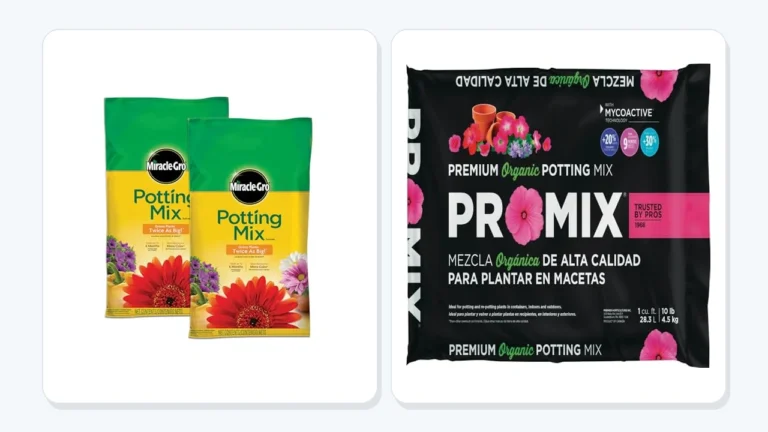
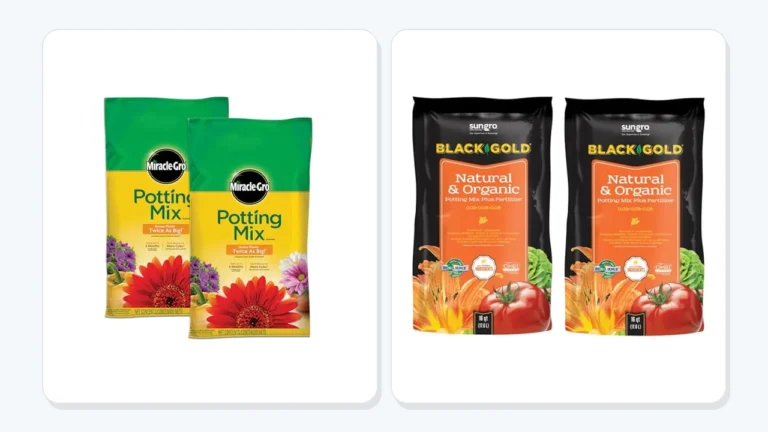
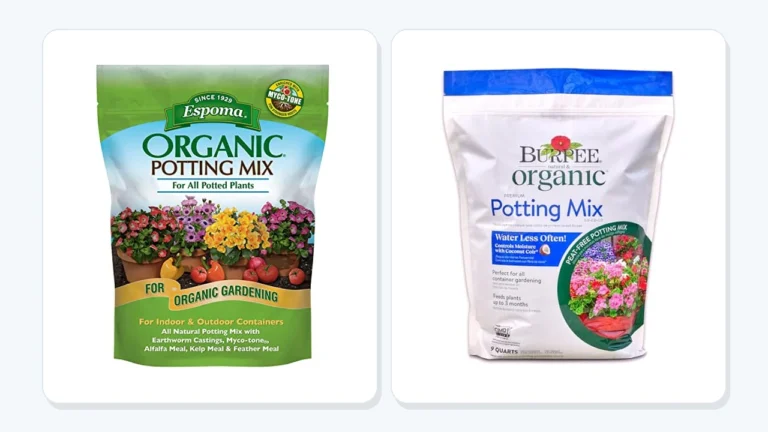
Miracle Gro Vs Burpee Potting Mix: Detailed Comparison and Verdict
If you’re weighing Miracle-Gro vs Burpee potting mix, the practical choice is mostly about where you’ll use it, how much you need, and how long you want the mix to feed plants. Miracle-Gro is the better fit for a larger batch of outdoor containers; Burpee’s OMRI Listed Ideal mix offers indoor and outdoor use, coco coir, and a shorter stated feeding period.
The package sizes make a real difference: Miracle-Gro comes as two 16-quart bags, while Burpee comes in a 9-quart bag. Miracle-Gro says it feeds plants for up to six months; Burpee says it feeds immediately and provides slow-release nutrition for up to three months.
That doesn’t make one mix the automatic winner. If you’re filling several patio pots, Miracle-Gro gives you more mix and a longer feeding window. If you want an OMRI Listed mix for indoor or outdoor containers and value coco coir’s moisture balance, Burpee may suit your routine better.
Below, I’ll compare their intended uses, quantities, feeding claims, and day-to-day implications. I’ll also point out where the available details don’t support a direct comparison, so you can choose without guessing about ingredients or performance.
| Miracle-Gro Potting Mix 16 Qt. 2-Pack | OMRI Listed Ideal |
 |
 |
Miracle Gro Vs Burpee Potting Mix Detailed Comparison
These are both potting mixes for container growing, but they’re packaged and positioned for different jobs. Miracle-Gro Potting Mix 16 Qt. 2-Pack is an outdoor-focused option sold as two 16-quart bags. OMRI Listed Ideal is Burpee’s 9-quart potting mix, described for indoor and outdoor containers as well as raised beds.
For a bigger outdoor planting session, Miracle-Gro has the quantity advantage. Its 32 quarts total are twice the volume of Burpee’s 9-quart bag by more than a simple one-bag comparison might suggest: the bundle contains about three and a half times as much mix. Each Miracle-Gro bag is said to fill one 12-inch container, though the amount needed can vary with the root ball.
Burpee’s smaller bag can be handy if you’re refreshing one or two modest pots, or don’t want a large amount left over. But there’s no stated container-coverage estimate for it, so don’t assume that a 9-quart bag fills a particular pot size. Pot shape, depth, and the plant’s root ball all affect how much mix you’ll use.
The feeding windows also differ. Miracle-Gro says its mix feeds potted plants for up to six months, while Burpee describes immediate feeding followed by slow-release nutrition for up to three months. Those are stated maximum periods, not a guarantee that every plant will need no additional care for that long.
That distinction matters if you’re planning a long season in a container. Miracle-Gro’s longer stated window may mean fewer routine feeding decisions at the start, while Burpee’s shorter window gives you a reason to check your plant’s needs sooner. Either way, plant type, watering, and growing conditions affect what care is appropriate.
Burpee has a specific material feature that isn’t stated for Miracle-Gro: coco coir. Burpee describes it as helping with aeration and moisture retention, and says it can help reduce watering frequency while maintaining drainage. That may appeal if you’re trying to manage moisture in a container, but it doesn’t mean you can stop checking the soil.
One other difference is the organic-gardening signal. Burpee’s mix is OMRI Listed, a designation that may matter to gardeners looking for products suitable for organic production practices. Miracle-Gro’s provided product details don’t identify an equivalent designation, so there’s no basis here to treat the two as matching on that point.
For example, picture two situations: you’re filling several outdoor flower pots before summer, or you’re potting a single indoor herb container and prefer a mix with an organic-gardening designation. The larger, longer-feeding Miracle-Gro bundle lines up more naturally with the first job; Burpee’s indoor/outdoor positioning, smaller bag, and coco coir may make more sense for the second.
Key Differences That Matter
1. Intended growing spaces
Miracle-Gro is described for outdoor container plants, including flowers, vegetables, herbs, shrubs, annuals, and perennials. That’s a broad range of outdoor planting, but the stated use is specifically outside containers.
Burpee is described for indoor and outdoor plants in pots, along with raised beds. If you’re choosing one mix for an indoor planter and an outdoor container, that stated versatility is useful. It doesn’t mean every plant or setup has identical needs; it just gives Burpee the clearer fit across those locations.
Choose by where the plant will live. For a patio or porch container, either product is positioned for outdoor use. For indoor growing or a raised bed, Burpee has the more explicit stated fit.
2. Total amount and container planning
Miracle-Gro’s two 16-quart bags provide 32 quarts in total. The stated estimate is one 12-inch container per bag, with the reminder that root-ball size can change the amount required. That gives you a useful planning point for a group of outdoor pots.
Burpee’s 9-quart bag is a much smaller quantity. The benefit is less mix to manage if your project is limited; the drawback is that you may need more than one bag for a larger planting day. Since no coverage estimate is given, measure your pots and allow for the root ball rather than treating the bag size as a guaranteed pot count.
This is also a storage question. If you have multiple containers ready, extra volume can save you from running short mid-project. If you’re potting only one small planter, a larger bundle may leave you with more mix to store than you want.
3. Feeding timeline
Miracle-Gro states a feeding period of up to six months for potted plants. Burpee says it feeds immediately, with slow-release nutrition lasting up to three months. On the stated timelines, Miracle-Gro offers the longer feeding window.
That’s a meaningful difference, but it shouldn’t be read as a universal fertilizer schedule. “Up to” sets a limit rather than a promise for every plant and growing environment. Keep an eye on plant growth and follow suitable care guidance for the specific crop or flower you’re growing.
If you prefer to make fewer feeding decisions during the first part of the season, Miracle-Gro’s stated duration may be appealing. If you’re comfortable checking plant needs and revisiting feeding sooner, Burpee’s shorter stated period may fit your routine.
4. Moisture feature and organic-gardening designation
Burpee specifically includes coco coir, which it describes as supporting aeration and moisture retention while helping with drainage. This is the most specific material-based feature in the comparison. It gives a buyer a reason to consider Burpee when moisture balance is a priority.
Burpee is also OMRI Listed. That can help gardeners who are looking for a mix with that designation for organic gardening. The product details provided for Miracle-Gro don’t state a comparable designation or identify coco coir, so those points should be treated as Burpee-specific stated features—not proof that Miracle-Gro lacks any particular ingredient or property.
Neither feature removes the need to check a pot. A container can dry or stay wet depending on its size, location, plant, and weather. Coco coir may support moisture balance, but it isn’t a substitute for adjusting watering to what the plant and pot actually need.
Performance, Features, and Everyday Use
Before you open either bag, consider the scale of the job. With Miracle-Gro, the two-bag bundle is aimed at outdoor container planting and supplies 32 quarts total. Its stated coverage—one 12-inch container per bag—offers a rough starting point, but a large root ball can reduce how much mix goes into a pot.
Burpee’s 9-quart bag is easier to match to a smaller project, though the quantity alone doesn’t tell you exactly how many pots it will fill. If you’re buying for a particular planter, check its dimensions and think about how much of the space the plant’s root ball will occupy. That’s more reliable than guessing from the bag size.
For Miracle-Gro, the basic potting sequence is straightforward: fill the container about one-third full, set the plant in place, add mix around it, and press lightly. The instruction gives you a starting method without requiring you to pack the mix down hard. Leave room to position the plant properly as you fill.
Burpee’s description focuses on its coco coir and moisture balance. For a gardener who sometimes struggles to keep container soil from drying too quickly, that feature may be worth considering. Still, “less frequent watering” is not a set schedule: feel or check the soil and respond to the plant’s conditions rather than assuming the mix will stay moist for a fixed number of days.
Indoor use is a notable point for Burpee. A pot inside a home may have a different watering rhythm from an outdoor container exposed to sun and weather. Burpee is specifically presented for indoor as well as outdoor plants, while Miracle-Gro’s stated directions emphasize outdoor containers. If indoor use is your main need, that distinction makes Burpee the clearer match based on the stated use.
For a raised bed, Burpee is also explicitly described as suitable. Miracle-Gro’s details here focus on outdoor containers, so they don’t establish the same raised-bed use. If your project is a raised bed, Burpee has the more direct fit; don’t infer that the two products have identical intended applications.
Feeding can shape the amount of follow-up you do. Miracle-Gro’s up-to-six-month claim may suit a gardener who wants a longer initial feeding window for seasonal containers. Burpee’s up-to-three-month slow-release period is shorter, so it makes sense to plan to reassess plant needs sooner rather than assume the initial feeding lasts through a long growing season.
Miracle-Gro also makes a growth comparison against unfed plants, saying plants can grow twice as big. Treat that as a claim tied to the comparison with unfed plants—not a guaranteed result for every pot or a promise that it will outperform Burpee. Plant variety, light, water, and care all matter, and there is no direct head-to-head growth result established here.
Burpee’s OMRI Listed status may matter more to some gardeners than a longer feeding interval. If that designation is part of how you choose inputs for your garden, it’s a clear point in Burpee’s favor. If your priority is simply filling several outdoor pots with a mix that has a longer stated feeding period, Miracle-Gro may be more practical.
Neither choice should be treated as a complete substitute for paying attention to the plant. Check moisture, watch how the plant responds, and avoid assuming a feeding claim means you’ll never need to adjust care. The best fit depends on your growing space, how much mix the project needs, and how hands-on you want to be.
Pros and Cons
Miracle-Gro Potting Mix 16 Qt. 2-Pack
Pros
- ✓32 quarts total: Useful for several outdoor containers in one planting session.
- ✓Longer stated feeding window: Up to six months may mean fewer early feeding decisions.
- ✓Coverage estimate: Each bag is intended to fill one 12-inch container, subject to root-ball size.
Cons
- –Outdoor-container focus: Less directly suited to buyers seeking a stated indoor or raised-bed use.
- –More mix to store: The 32-quart bundle may be excessive for one small pot.
- –No stated OMRI designation: A drawback for shoppers who specifically want that designation.
OMRI Listed Ideal
Pros
- ✓Indoor and outdoor use: Fits buyers potting plants in different locations.
- ✓Coco coir included: Supports the stated focus on moisture balance and aeration.
- ✓OMRI Listed: Relevant for gardeners seeking that organic-gardening designation.
- ✓Raised-bed use: Offers a stated application beyond pots alone.
Cons
- –Smaller 9-quart bag: May not stretch far across a group of larger containers.
- –Shorter stated feeding period: Up to three months means checking plant needs sooner.
- –No stated coverage estimate: Buyers must plan quantities around their own pots.
Which One Should You Buy?
Pick Miracle-Gro Potting Mix 16 Qt. 2-Pack if you’re setting up several outdoor containers and want a larger amount in one purchase. Its 32 quarts total and stated estimate of one 12-inch container per bag make project planning easier than with a bag that has no coverage estimate.
It’s also the stronger fit if a longer initial feeding window matters to you. The up-to-six-month claim is longer than Burpee’s up-to-three-month period, though it shouldn’t be treated as a promise that every plant will need no additional feeding for that entire time.
Who Should Skip This: Skip the Miracle-Gro bundle if you only need a small amount, want a product specifically described for indoor use or raised beds, or are shopping for an OMRI Listed mix. Its larger quantity and outdoor-container focus may not match those priorities.
Choose Burpee’s OMRI Listed Ideal if you want a potting mix described for indoor and outdoor plants, containers, and raised beds. Coco coir is a specific plus if moisture balance is on your mind, and the OMRI Listed designation can be a deciding point for gardeners who look for it.
Burpee may also be the more comfortable quantity for a small project. A 9-quart bag is less mix to deal with than a 32-quart bundle, but there’s no stated pot-coverage figure. If you’re filling several large containers, make sure you have enough rather than assuming one bag will cover them.
Who Should Skip This: Skip Burpee if your priority is a large volume for multiple outdoor pots or the longer stated feeding period. Its smaller bag and up-to-three-month feeding window may call for more planning during a larger or longer-season project.
Think about the consequence of choosing the wrong size before you buy. Too little mix can interrupt a planting session, while too much can leave you with storage you didn’t need. Match the bag quantity to the number and dimensions of your containers, then weigh feeding duration and intended location.
FAQS About Miracle Gro Vs Burpee Potting Mix
Which potting mix feeds plants longer, Miracle-Gro or Burpee?
Miracle-Gro states up to six months of feeding. Burpee states immediate feeding and slow-release nutrition for up to three months. Both periods are stated maximums, not guarantees for every plant.
Is Miracle-Gro or Burpee better for indoor plants?
Burpee is explicitly described for indoor and outdoor use. Miracle-Gro’s stated use focuses on outdoor container plants, so Burpee is the clearer fit if indoor use is your main need.
Which mix gives you more potting soil?
Miracle-Gro provides two 16-quart bags, or 32 quarts total. Burpee comes in a 9-quart bag, making the Miracle-Gro bundle substantially larger.
Does Burpee potting mix contain coco coir?
Yes. Coco coir is a stated component of Burpee’s mix and is described as helping with aeration and moisture balance.
Final Verdict: Which One Wins?
Miracle-Gro wins for a larger outdoor-container project where you want more mix and a longer stated feeding window. The two 16-quart bags offer 32 quarts total, and the up-to-six-month feeding period is the longer of the two products’ stated timelines.
Burpee wins for indoor/outdoor flexibility, raised-bed use, coco coir, and an OMRI Listed designation. Its 9-quart bag is better suited to a smaller job if the quantity works for your pots, while its up-to-three-month feeding period calls for an earlier check-in. Choose based on the space you’re planting, how much mix you’ll use, and which features matter most—not on a universal claim that one potting mix is best for every garden.

I’m Maya L. Greenwood, a lifelong plant lover who believes anyone can grow something beautiful with the right guidance. After years of testing soil mixes, pruning methods, irrigation tricks, and pest-safe solutions, I started EasyGardenTips.com to turn hard-won lessons into step-by-step advice. From seed starting and container gardens to composting and seasonal checklists, my goal is to make gardening simple, sustainable, and fun.