Miracle Gro Potting Mix Vs Moisture Control Potting Mix: Detailed
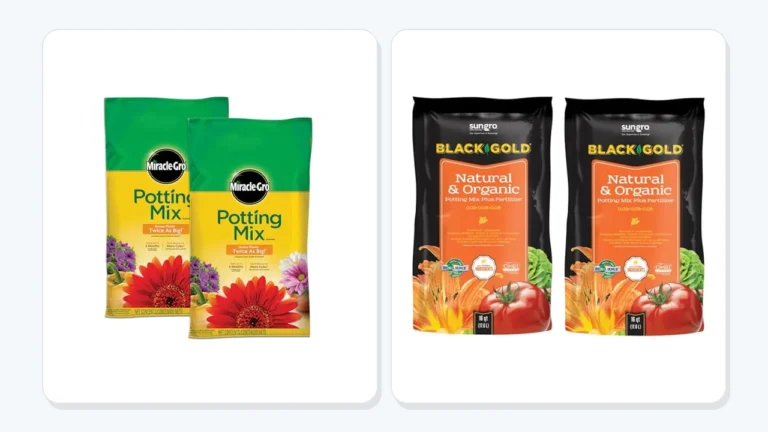
If you’re choosing between Miracle-Gro Potting Mix and Moisture Control Potting Mix, the practical difference is water management: the standard mix gives you more potting mix per two-bag pack, while Moisture Control is designed to help guard against both overwatering and underwatering. Both are intended for outdoor container plants and feed for up to six months.
For a larger repotting job or several substantial containers, the 16-quart bags are the more useful starting point. If your watering schedule is uneven or containers tend to dry between checks, the moisture-control formula may be a better fit.
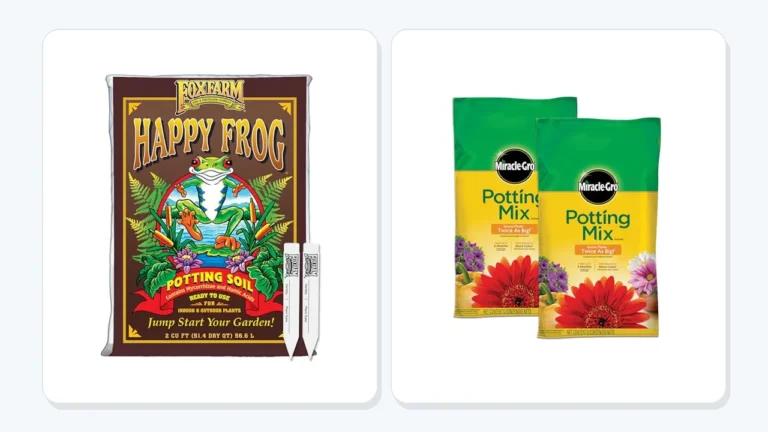
The pack sizes aren’t equivalent: Miracle-Gro Potting Mix comes as two 16-quart bags, and Moisture Control comes as two 8-quart bags. The standard mix’s stated coverage is one 12-inch container per bag; each Moisture Control bag is sized to fill two 8-inch containers, though root-ball size changes how much mix you need.
Below, I’ll compare their water-related claims, feeding, coverage, and everyday use. The short version: choose based on how you water and how much mix your pots actually need—not just the shared brand name.
| Miracle-Gro Potting Mix 16 Qt. 2-Pack | Miracle-Gro Moisture Control Potting Mix 8 Qt. 2-Pack Plant Soil |
 |
 |
Miracle Gro Potting Mix Vs Moisture Control Potting Mix Detailed Comparison
These are both outdoor potting mixes for container plants, and both are described as feeding plants for up to six months. The core choice is whether you’d rather have twice the total mix in the pack or a formula specifically designed to manage moisture.
Miracle-Gro Potting Mix 16 Qt. 2-Pack contains two 16-quart bags, or 32 quarts total. Each bag is intended to fill one 12-inch container. That gives you a straightforward way to estimate a project: two bags are sized for two containers of that stated size, with the actual amount affected by the root ball.
Miracle-Gro Moisture Control Potting Mix 8 Qt. 2-Pack Plant Soil contains two 8-quart bags, or 16 quarts total. Each bag is sized to fill two 8-inch containers. That smaller bag size can be handy when you’re working with several modest pots, but it gives you less total mix for a bigger container project.
Don’t read the moisture claim as proof that one product holds 33% more water than the other. Moisture Control is described as absorbing up to 33% more water than basic potting soil without sphagnum peat moss, coir, and a wetting agent. That comparison is against a stated basic-soil reference, not specifically against the standard Miracle-Gro mix in this comparison.
In practical terms, the moisture-control feature is meant to help protect against both overwatering and underwatering. It doesn’t mean you can ignore a pot’s drainage or water on a fixed schedule regardless of conditions. Pot size, plant needs, weather, and where a container sits all affect how often it needs water.
Both products are intended for outdoor containers with plants such as flowers, vegetables, annuals, perennials, and shrubs. The standard mix’s stated uses also include herbs. Both share the same broad feeding period and growth claim, so those details don’t settle the choice on their own.
Picture two different jobs. If you’re refreshing a couple of larger outdoor pots, the 16-quart pack gives you more mix to work with. If you’re filling several smaller containers and sometimes miss a watering, Moisture Control offers the more relevant feature—provided you still use pots with drainage and check the soil as needed.
Key Differences That Matter
1. Moisture management
The clearest formula distinction is Moisture Control’s stated ability to help guard against over- and underwatering. It contains sphagnum peat moss, coir, and a wetting agent, and its water-absorption claim is measured against basic potting soil that lacks those ingredients.
That feature may suit someone whose containers dry out between waterings or whose routine isn’t perfectly consistent. It isn’t a substitute for checking the mix or adjusting to hot, dry weather. And because the 33% comparison is not specifically with the standard product here, it shouldn’t be treated as a direct performance score between these two mixes.
The standard Potting Mix does not have a moisture-control claim in the verified product details. That doesn’t establish that it cannot retain moisture; it simply means the special over- and underwatering protection is the distinguishing claim attached to the other product.
2. Total volume and stated coverage
The standard pack provides 32 quarts total, compared with 16 quarts in the Moisture Control pack. That’s a useful difference if you’re filling larger containers or several pots and want to reduce the chance of running short mid-project.
The stated coverage uses different container sizes: one 16-quart bag fills one 12-inch container, while one 8-quart bag fills two 8-inch containers. Those figures aren’t a direct, like-for-like comparison of identical pots. Root balls take up space, and actual fill needs vary, so measure the project by your containers rather than assuming the stated counts will fit every planting.
For a few small containers, two 8-quart bags may be easier to portion across the job. For a mix of larger pots, the standard pack’s greater total volume is the more relevant advantage. Neither pack is automatically the better value because no price comparison is established here.
3. Feeding period and plant uses
Both mixes feed plants for up to six months. Both are intended for a range of outdoor container plants, including flowers, vegetables, annuals, perennials, and shrubs. The standard mix also specifically names herbs among its suggested uses.
Both products carry a growth claim comparing plants with unfed plants. That does not mean either one is proven to outperform the other: the comparison is against unfed plants, not between these two mixes. If you’re choosing solely by feeding duration or the shared growth claim, those details don’t give one a clear edge.
Plant type still matters to your routine. A vegetable pot on a sunny patio may need different watering attention from a shaded container, even when both use a mix with a six-month feeding period. Choose the moisture feature for the watering challenge, not because it changes the stated feeding window.
4. Setup and drainage
For the standard mix, the stated potting method is to fill the container about one-third full, place the plant, then add mix around it and press lightly. Moisture Control’s directions also begin with filling a pot about one-third full and setting the plant in place, then covering it with mix; they specify watering thoroughly and letting the pot drain.
The Moisture Control directions explicitly call for a pot with a drainage hole. In practice, drainage deserves attention with either potting mix: extra water needs somewhere to go, and moisture management does not mean a container should stay waterlogged. Check that the pot and saucer arrangement allow excess water to drain rather than collect around the roots.
Performance, Features, and Everyday Use
Start with the pot, not the bag. Check its size, the space the root ball will occupy, and how many containers you plan to fill. The pack coverage is a helpful estimate, but it can’t account for every plant and pot combination.
If your job involves large containers, the standard mix’s 16-quart bags offer more volume per bag and twice as much total mix per pack. That can make planning simpler when you’re filling several substantial pots. It doesn’t guarantee that the pack will cover a particular project; the amount needed depends on your containers and root balls.
For a group of smaller pots, Moisture Control’s coverage estimate may be easier to apply: one 8-quart bag is sized for two 8-inch containers. You can open one bag for part of the job and keep the second for the remaining pots, though how much is left will depend on the plants and fill level.
The day-to-day distinction appears after planting. Moisture Control is designed to absorb more water than the stated basic-soil comparison and to help protect against watering too much or too little. If you often return to dry containers after a busy day, that feature may offer useful leeway. It still won’t tell you when the plant needs water, and it shouldn’t replace checking conditions.
For either product, avoid treating “up to six months” as a watering instruction or a guarantee that every plant needs no other care during that period. The claim describes the feeding window. Watering needs continue to depend on the plant, container, and outdoor conditions.
Both products are intended for a broad selection of outdoor container plants, including flowers, vegetables, and shrubs. That makes either a reasonable candidate for a mixed patio planting if the pot size and watering approach fit. The standard mix’s listed use includes herbs as well; the verified details for Moisture Control don’t specifically name herbs, so check the package guidance if herbs are central to your plan.
Keep the growth claim in perspective. Both products describe larger growth compared with unfed plants, but that isn’t a head-to-head result. A suitable container, appropriate watering, and matching the product to your project are more useful decision points than assuming one will produce a bigger plant than the other.
One common buying mistake is choosing Moisture Control because “more water” sounds safer for every plant. Its claim is about water absorption and protection from over- and underwatering, not permission to skip drainage. Another is buying the smaller pack for a large container job without checking the volume first; if you run short, you may need more mix to finish the planting.
Before opening the bags, group the pots you plan to fill and estimate the volume. If you’re repotting a single plant, set the root ball beside the container to judge how much space remains. That simple check can matter more than the product name when deciding whether 16 or 32 quarts is enough.
Pros and Cons
Miracle-Gro Potting Mix 16 Qt. 2-Pack
Pros
- ✓More total mix: The two bags provide 32 quarts for larger jobs.
- ✓Broad outdoor use: Suitable for flowers, vegetables, herbs, and shrubs in containers.
- ✓Six-month feeding: Matches the feeding period of Moisture Control.
Cons
- –No stated moisture-control feature: Less targeted for buyers seeking help with uneven watering.
- –Larger pack: May be more mix than a small-pot project needs.
Miracle-Gro Moisture Control Potting Mix 8 Qt. 2-Pack Plant Soil
Pros
- ✓Water-management focus: Designed to help protect against over- and underwatering.
- ✓Smaller bags: Practical for portioning across smaller containers.
- ✓Six-month feeding: Offers the same stated feeding period as the standard mix.
Cons
- –Half the total volume: The pack has 16 quarts, which may limit larger projects.
- –Not a watering replacement: Buyers still need to check moisture and provide drainage.
Which One Should You Buy?
Choose Miracle-Gro Potting Mix 16 Qt. 2-Pack if you’re filling larger outdoor containers, refreshing several pots, or want more mix on hand. Its 32-quart total is the clearest advantage, and its stated uses include herbs as well as flowers, vegetables, and shrubs. You still need to estimate the amount against your pot sizes and root balls.
Who Should Skip This: Skip the standard mix if your main reason for buying is a formula specifically designed to help manage over- and underwatering. The verified product details don’t give it that feature claim; the Moisture Control mix is the more direct match for that concern.
Choose Miracle-Gro Moisture Control Potting Mix 8 Qt. 2-Pack Plant Soil if water management is the deciding factor and your project suits the smaller pack. It may fit a busy routine or containers that tend to dry between checks, while its stated coverage is geared toward 8-inch pots. Keep watering based on the plants and conditions, and use a pot with drainage.
Who Should Skip This: Skip Moisture Control if you need a larger supply for a substantial repotting job and don’t have a particular need for its moisture-focused feature. The pack contains half the total mix of the standard option, so you may need additional bags for a bigger project.
If you’re stuck between them, ask one question: is the bigger frustration running short of mix, or keeping container moisture on track? The first points toward the standard 16-quart pack; the second points toward Moisture Control. If neither is a concern, both share the same stated feeding period, so let container size and total volume guide the decision.
There’s no universal winner here. Buying the smaller pack for a large job can mean stopping before the pots are filled, while choosing a moisture-focused mix won’t remove the need to monitor watering. Match the pack to the work you have planned and the routine you can realistically maintain.
FAQS About Miracle Gro Potting Mix Vs Moisture Control Potting Mix
What is the main difference between Miracle-Gro Potting Mix and Moisture Control?
Moisture Control is designed to help protect against over- and underwatering and has a water-absorption claim against basic potting soil. The standard pack provides more total mix: 32 quarts versus 16 quarts.
Does Moisture Control absorb 33% more water than the standard Miracle-Gro Potting Mix?
That comparison is not established. The stated figure is against basic potting soil without sphagnum peat moss, coir, and a wetting agent—not specifically against the standard mix here.
Do both Miracle-Gro potting mixes feed plants for six months?
Both are described as feeding plants for up to six months. That shared claim does not establish that one feeds better or lasts longer than the other.
Which pack covers more containers?
The standard pack contains more total mix: two 16-quart bags, each sized for one 12-inch container. Each Moisture Control 8-quart bag is sized for two 8-inch containers. Root-ball size affects actual coverage.
Can Moisture Control replace checking and watering container plants?
No. It is designed to help manage moisture, but you still need to monitor plants and use a pot with drainage. Watering needs vary with the plant and outdoor conditions.
Final Verdict: Which One Wins?
Miracle-Gro Potting Mix 16 Qt. 2-Pack wins for volume and larger container projects. Its 32-quart total gives you twice as much mix as the Moisture Control pack, with stated coverage suited to 12-inch containers.
Miracle-Gro Moisture Control Potting Mix 8 Qt. 2-Pack Plant Soil wins when moisture management is the priority. Its formula is designed to help protect against over- and underwatering, and its smaller bags suit projects built around 8-inch pots.
Both share a feeding period of up to six months and broad outdoor container use. Choose by the job in front of you: more mix for larger pots, or the moisture-focused option for a watering routine that needs a little more flexibility.

I’m Maya L. Greenwood, a lifelong plant lover who believes anyone can grow something beautiful with the right guidance. After years of testing soil mixes, pruning methods, irrigation tricks, and pest-safe solutions, I started EasyGardenTips.com to turn hard-won lessons into step-by-step advice. From seed starting and container gardens to composting and seasonal checklists, my goal is to make gardening simple, sustainable, and fun.