How Far Apart to Plant Squash in a Raised Bed: Spacing Guide
Plant bush-type squash approximately 24–36 inches apart in a raised bed, while most traditional vining winter squash varieties need around 36–48 inches between plants and substantial room for their vines to spread. Compact varieties may tolerate closer spacing if the seed packet recommends it. For a 4×4-foot raised bed, one standard bush squash plant is often the easiest choice, while a 4×8-foot bed can generally accommodate two or three appropriately spaced bush plants.
Squash grows quickly and produces surprisingly large leaves. Planting too closely can create competition for sunlight, water, and nutrients. Dense foliage also makes harvesting difficult and can complicate pest and disease management.
The most important distinction is between bush and vining varieties. Zucchini and many yellow summer squashes form large bushes, while traditional butternut and other winter squashes may spread several feet beyond the bed. Trellising can reduce their ground footprint, but it doesn’t eliminate their root-space requirements.
In this guide, I explain the correct spacing for different squash types, how many plants fit in common raised-bed sizes, and how to arrange bush or climbing varieties. You’ll also learn planting depth, trellis requirements, soil preparation, watering, and ways to avoid overcrowding.
How Far Apart to Plant Squash in a Raised Bed? Quick Spacing Chart
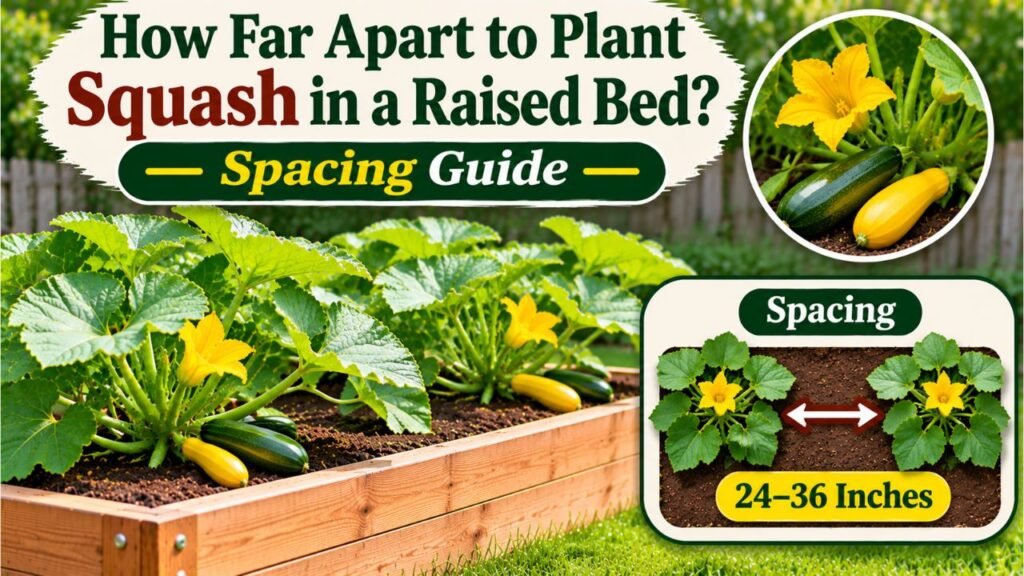
The ideal spacing depends primarily on the plant’s mature growth habit.
Most summer squash varieties are bush-type plants, although some produce longer vines. Winter squash varieties may be compact, semi-bush, or long-vining.
Squash Plant Spacing by Type
| Squash Type | Recommended Plant Spacing | Growth Habit |
| Zucchini, standard bush varieties | 24–36 inches | Large bush |
| Yellow straightneck squash | 24–36 inches | Bush |
| Yellow crookneck squash | 24–36 inches | Usually bush |
| Pattypan squash | 24–36 inches | Usually bush |
| Compact bush zucchini | Follow cultivar label; often around 18–24 inches | Compact bush |
| Bush acorn squash | Approximately 24–36 inches, depending on variety | Bush or semi-bush |
| Bush butternut squash | Approximately 24–36 inches, depending on variety | Bush or semi-bush |
| Traditional vining butternut | Approximately 36–48 inches between plants | Long vine |
| Vining acorn squash | Approximately 36–48 inches | Vine |
| Spaghetti squash, vining types | Approximately 36–48 inches or as labeled | Vine |
| Hubbard squash | Approximately 36–60 inches or more | Vigorous vine |
| Large winter squash varieties | Follow cultivar-specific spacing | Often large vine |
These distances are starting points, not universal requirements.
The mature size printed on the seed packet takes priority over a general spacing chart.
According to the University of Maryland Extension’s summer squash growing guide, single summer squash plants are commonly spaced 2–3 feet apart, with wider distances between conventional rows.
For traditional winter squash, University of Maryland Extension recommends approximately 3–4 feet between planting positions and 6–8 feet between rows, depending on the variety.
Raised beds do not automatically allow vigorous plants to grow at much closer distances. Their foliage and roots still need adequate space.
Why Bush and Vining Squash Need Different Spacing
Bush squash grows from relatively compact central stems.
However, even bush varieties can develop a large canopy.
Vining squash sends out long stems that travel across the ground or can be trained onto suitable supports.
A vining squash plant may have its roots inside the raised bed while most of its leaves and fruit develop outside it.
That means both planting distance and available surrounding space matter.
Key Takeaway: Use 24–36 inches for most bush summer squash and around 36–48 inches or more for traditional vining winter squash, depending on the cultivar.
How Far Apart to Plant Zucchini in a Raised Bed?
Standard bush zucchini plants generally need approximately 2–3 feet between plant centers.
This provides room for their broad leaves, thick stems, and developing fruit.
Although a zucchini seedling looks small, the mature plant can occupy much of a compact raised bed.
Recommended Zucchini Spacing
For standard bush zucchini:
- Allow approximately 24–36 inches between plants.
- Use wider spacing for vigorous varieties.
- Allow leaves to extend beyond the bed only where they won’t block access.
- Keep enough room to inspect and harvest fruit.
- Avoid planting additional large vegetables directly between mature zucchini plants.
A compact zucchini cultivar may require less room, but only when its growth habit supports closer spacing.
Can Zucchini Be Planted 12 Inches Apart?
Twelve inches is usually too close for standard bush zucchini.
At that distance, mature plants can overlap heavily.
They may compete for water and nutrients, and dense growth can make it difficult to inspect leaves or harvest developing squash.
Even if the plants survive, productivity may suffer.
Choose a cultivar specifically bred for compact growing if you need closer spacing.
Can You Plant Two Zucchini Plants Together?
Yes, provided each plant receives enough room.
For example, two zucchini plants in a 4×8-foot bed can be positioned along its length with about 3 feet between their centers.
The remaining space helps accommodate the leaves.
Two full-sized plants in a 4×4-foot bed are possible only with careful variety selection and substantial allowance for foliage extending beyond the bed.
For beginners, a single vigorous zucchini plant is usually more manageable in that smaller space.
Does Zucchini Need More Than One Plant for Pollination?
No.
Most zucchini plants produce separate male and female flowers on the same plant.
Pollen must move from male flowers to female flowers for normal fruit development.
Bees commonly perform this task.
You don’t necessarily need two zucchini plants to obtain fruit, provided compatible flowers are available and pollination occurs.
Planting multiple squash plants may increase the availability of flowers, but it is not a universal requirement.
Key Takeaway: Give standard zucchini 24–36 inches and don’t assume two plants are necessary for pollination.
How Far Apart to Plant Yellow Squash in a Raised Bed?
Yellow summer squash includes straightneck and crookneck types.
Most common varieties have a bush growth habit.
Their spacing requirements are therefore similar to zucchini.
Yellow Straightneck Squash Spacing
Plant standard yellow straightneck squash approximately 24–36 inches apart.
Choose the wider end when the variety produces a broad canopy.
Leave enough space for harvesting because yellow squash grows quickly and fruits can become oversized if overlooked.
Yellow Crookneck Squash Spacing
Most yellow crookneck varieties also benefit from approximately 24–36 inches between plants.
Some varieties are more compact.
Check the seed packet’s mature plant width and growth habit.
Can You Plant Yellow Squash and Zucchini Together?
Yes.
Yellow squash and zucchini often have similar requirements for:
- Full sun
- Warm growing conditions
- Well-drained soil
- Consistent moisture
- Adequate nutrients
However, don’t treat them as small companion plants.
A standard yellow squash and a standard zucchini may each need a 2–3-foot planting footprint.
A 4×8-foot bed can often accommodate one of each when properly arranged.
Do Yellow Squash Plants Need Extra Room for Airflow?
A reasonably open planting arrangement makes it easier to inspect foliage, locate pests, and remove fruit.
Crowding can create a dense canopy where plant problems are harder to detect.
However, spacing alone doesn’t prevent every disease.
Proper watering, healthy plants, and suitable varieties remain important.
Key Takeaway: Treat most yellow straightneck and crookneck squash like zucchini when planning plant spacing.
How Far Apart to Plant Winter Squash in a Raised Bed?
Winter squash generally needs more room than standard bush summer squash when it produces long vines.
Common winter squash types include butternut, acorn, spaghetti, buttercup, and Hubbard squash.
However, many winter squash types are available in compact cultivars.
Standard Vining Winter Squash Spacing
For traditional vining varieties, a useful starting point is approximately:
- 36–48 inches between individual plants
- Several feet of surrounding room for vine growth
- Additional spacing for especially vigorous varieties
Conventional garden row spacing is often substantially wider because the vines need space to spread.
For example, University of Maryland Extension recommends winter squash planting positions approximately 3–4 feet apart, with rows 6–8 feet apart.
In a raised bed, you can direct vines over the edge or onto suitable supports, but the mature plant still needs room.
How Far Apart to Plant Butternut Squash?
Traditional vining butternut squash varieties generally need around 3–4 feet between plants.
They may send vines several feet beyond the original planting location.
In a small raised bed, plant near an edge and guide the vine into a suitable surrounding area.
Compact bush butternut varieties may fit closer together when their cultivar instructions allow it.
How Far Apart to Plant Acorn Squash?
Acorn squash can have bush, semi-bush, or vining growth habits.
Spacing therefore depends on the variety.
A compact bush acorn squash may fit at approximately 2–3-foot spacing.
A long-vining cultivar may require 3–4 feet or more between plants, plus room for vines.
How Far Apart to Plant Spaghetti Squash?
Traditional spaghetti squash plants often produce vigorous vines.
Allow approximately 3–4 feet between plants as a starting point and provide substantial vine space.
Some compact spaghetti squash cultivars are better suited to smaller gardens.
Check the growth habit before planting.
How Far Apart to Plant Hubbard Squash?
Hubbard squash can become particularly vigorous.
Some cultivars produce vines many feet long.
The University of New Hampshire Extension lists approximately 3–5 feet between plants for its Baby Blue Hubbard growing guide.
Larger, more vigorous Hubbard varieties may require additional room.
A small raised bed can support the roots of a Hubbard squash plant, but its foliage may occupy a much larger surrounding area.
Key Takeaway: Choose compact winter squash varieties when space is limited. Traditional vining varieties need both generous planting distance and space beyond the raised-bed edges.
How Many Squash Plants Can You Grow in a 4×4 Raised Bed?
A 4×4-foot raised bed contains 16 square feet of growing surface.
This is enough for a small squash planting, but the number of plants depends on their mature size.
Recommended Plant Counts for a 4×4 Bed
| Squash Type | Practical Starting Count | Notes |
| Standard bush zucchini | 1 plant | Most manageable arrangement |
| Yellow bush squash | 1 plant | Leaves may reach the edges |
| Pattypan squash | 1 plant | Depends on cultivar size |
| Compact bush zucchini | 1–2 plants | Two only if mature spacing permits |
| Compact bush winter squash | Usually 1 plant | Verify the variety’s mature width |
| Traditional vining butternut | 1 plant | Train vine beyond the bed |
| Vining spaghetti squash | 1 plant | Needs room outside the bed |
| Large Hubbard squash | Usually not ideal as a contained crop | Requires substantial vine area |
These are practical layouts rather than strict maximum plant capacities.
Best 4×4 Layout for Bush Squash
For standard zucchini or yellow squash, plant one seedling near the center.
<text>Conceptual layout:</text>
4 feet
┌─────────────────┐
│ │
│ │
│ S │
│ │
│ │
└─────────────────┘
4 feet
S = One bush squash plant
This provides room for the plant’s leaves to spread toward each edge.
The leaves may eventually overhang the bed, depending on the variety.
Keep nearby paths accessible.
Can You Fit Two Squash Plants in a 4×4 Bed?
Two compact bush plants may fit if their seed-packet spacing permits it.
However, two full-sized zucchini plants will likely crowd much of the bed.
Even when placed diagonally, their foliage may overlap and extend well beyond the edges.
If you want two different summer squash varieties, a 4×8 bed usually provides a more convenient arrangement.
Best 4×4 Layout for Vining Squash
For a traditional vining winter squash, position one plant near a suitable edge.
Guide the developing vine toward an open area outside the bed or an appropriately sized trellis.
Do not allow the vines to block walkways or interfere with other vegetables.
The roots remain in the raised bed while the foliage occupies additional space.
Key Takeaway: One standard bush squash plant is a practical starting choice for a 4×4 raised bed. A vining plant can also be grown there if its vines have room outside the bed.
How Many Squash Plants Can You Grow in a 4×8 Raised Bed?
A 4×8-foot raised bed contains 32 square feet.
This provides more flexibility for growing zucchini, yellow squash, or compact winter squash.
Recommended Plant Counts for a 4×8 Bed
| Squash Type | Practical Starting Count |
| Standard bush zucchini | 2 plants |
| Yellow bush squash | 2–3 plants |
| Mixed zucchini and yellow squash | 2 plants total |
| Compact bush summer squash | 2–3 plants, sometimes more if the cultivar permits |
| Compact bush winter squash | 2 plants, depending on mature size |
| Traditional vining winter squash | 1–2 plants with external vine space |
| Large vigorous winter squash | Usually 1 plant with ample surrounding room |
For standard bush squash, two plants are often the easiest starting arrangement.
Three may work with suitable varieties and thoughtful placement.
Simple 4×8 Layout for Two Squash Plants
Place the two plants along the centerline of the bed, approximately 3–4 feet apart.
8 feet
┌─────────────────────────────┐
│ │
│ S S │
│ │
└─────────────────────────────┘
4 feet
S = Bush squash plant
This arrangement allows the foliage to spread toward the sides.
It also makes it easier to access the plants from both long edges.
Can You Plant Three Squash Plants in a 4×8 Bed?
Yes, with suitable bush varieties.
If placing three plants along the 8-foot length, spacing near 3 feet between centers can be possible.
However, the outer plants must have enough room to spread beyond their planting positions.
Leaves may extend over the bed edges.
Choose compact or moderate-sized varieties and keep the surrounding paths clear.
For vigorous zucchini, two plants may be more productive and manageable than three crowded plants.
Can You Grow Zucchini and Butternut Squash Together?
Yes, but the arrangement requires planning.
A bush zucchini plant may occupy one portion of the raised bed.
A vining butternut squash can be planted near the opposite end and trained away from the zucchini.
However, the butternut vine must have enough room outside the bed.
Do not allow it to bury the zucchini plant beneath dense foliage.
Key Takeaway: A 4×8 bed is usually well suited to two standard bush squash plants, with additional flexibility for compact varieties or externally trained vines.
How Far Apart to Plant Squash in a 2×4 or 2×8 Raised Bed?
Narrow raised beds can grow squash, but plant choice matters.
Squash in a 2×4 Raised Bed
A 2×4 bed provides 8 square feet of growing surface.
One compact bush squash may work if its leaves can extend beyond the bed.
A standard zucchini plant may become too large for the available space.
Choose a compact cultivar whenever possible.
A vining plant can also be rooted near an edge and trained into an open area, but the narrow bed must still provide a healthy root zone.
Squash in a 2×8 Raised Bed
A 2×8 bed provides 16 square feet.
The long, narrow shape can accommodate two compact squash plants if they are spaced appropriately and their foliage can spread outside the bed.
Two standard bush zucchini plants may overhang the sides substantially.
For vining winter squash, consider planting along one edge and directing the vines away from the bed.
Is a Narrow Raised Bed Better for Trellised Squash?
It can be.
A narrow bed is convenient when you have a sturdy trellis positioned along its long edge.
However, trellising primarily saves horizontal vine space.
It doesn’t eliminate the need for adequate plant spacing, root volume, or irrigation.
Can You Plant Squash Closer Together in Raised Beds?
Raised beds sometimes allow efficient use of growing space.
However, efficiency doesn’t mean every vegetable should be planted at half its usual spacing.
Squash has a large mature canopy and substantial water requirements.
What Happens When Squash Plants Are Too Close?
Excessively close spacing can cause:
- Competition for sunlight
- Increased demand on the shared root zone
- Reduced access to nutrients and water
- Dense foliage
- Difficult harvesting
- Reduced ability to inspect pests
- Greater difficulty removing diseased leaves
- Less convenient airflow
Squash plants may survive close spacing, but that does not mean they will grow optimally.
Does Square-Foot Gardening Change Squash Spacing?
Square-foot gardening can help organize a raised bed into planting sections.
However, a standard squash plant typically occupies several square feet of canopy space.
It should not be treated like a small lettuce or radish plant.
One standard zucchini may occupy a substantial portion of a 4×4 bed.
Compact varieties are better suited to intensive planting.
Can You Plant Squash 18 Inches Apart?
Some compact cultivars may permit approximately 18-inch spacing.
However, this is not a good general recommendation for standard bush zucchini or vigorous winter squash.
Check the seed packet’s mature width.
If the variety normally requires 24–36 inches, use that guidance rather than planting closer simply because the bed is raised.
Key Takeaway: Raised beds can improve garden organization and soil conditions, but squash still needs spacing appropriate to its mature growth habit.
How Far Apart to Plant Trellised Squash in a Raised Bed?
Trellising can make some vining squash varieties more practical for small gardens.
It allows the vines to grow vertically rather than spreading across the ground.
However, vertical growing does not automatically justify dramatically reducing the distance between plants.
Recommended Trellised Squash Spacing
For many traditional vining winter squash varieties, approximately 3–4 feet between plants remains a practical starting point.
Use closer spacing only when the cultivar and growing system support it.
According to the University of Minnesota Extension’s guide to trellises and cages, vining vegetables should generally be planted at their normal spacing even when grown on a trellis.
The trellis saves space by redirecting the vines, not by reducing the root system’s requirements.
Which Squash Varieties Are Best for Trellising?
Good candidates include varieties that produce relatively small fruits.
Examples may include:
- Small-fruited butternut varieties
- Compact vining acorn squash
- Delicata squash
- Certain small spaghetti squash cultivars
- Other small winter squash varieties with manageable vines
The best choice depends on fruit weight, vine vigor, and trellis strength.
University of Minnesota Extension notes that vining crops producing fruit up to approximately 3 pounds are particularly well suited to trellising.
Large, heavy squash and pumpkins are generally better grown on the ground.
How to Trellis Squash in a Raised Bed
- Choose a suitable vining squash variety.
- Install a sturdy trellis before the plant becomes large.
- Position it so the crop receives adequate sunlight.
- Plant at the recommended spacing near the trellis base.
- Water the transplant or seedling thoroughly.
- Guide developing vines onto the support.
- Use soft plant ties when necessary.
- Inspect the vines and fruits regularly.
- Add fruit support if required by the variety and trellis design.
Squash vines may need occasional guidance to stay on the structure.
Avoid sharply bending or breaking young stems.
Do Squash Fruits Need Slings?
Small squash fruits may not need additional support when grown on a strong, suitable trellis.
However, larger fruits can place considerable weight on the vine and support structure.
Some gardeners use soft fabric slings to support moderately sized fruits.
Do not rely on a lightweight trellis to support heavy winter squash.
Choose a system appropriate for the expected fruit weight.
Can Bush Zucchini Be Trellised?
Some gardeners support bush zucchini vertically using sturdy stakes or specialized support systems.
However, standard bush zucchini does not climb like a long-vining squash.
The plant must be guided and supported rather than expected to attach itself to a trellis.
Staking can improve access and reduce its ground footprint in some situations, but adequate plant spacing remains important.
Key Takeaway: Trellising works best for suitable small-fruited vining squash. Keep normal root spacing unless the specific cultivar’s instructions support a closer arrangement.
How Deep Should a Raised Bed Be for Squash?
Spacing is important, but the depth and quality of the growing medium also influence squash growth.
Squash develops an extensive root system and benefits from fertile, well-drained soil.
Raised Beds Built Over Garden Soil
If the raised bed sits directly over healthy, uncompacted soil, roots may grow into the ground beneath it.
In this situation, the depth of the raised bed’s wooden or metal walls is not the only available root-zone depth.
A relatively shallow raised structure may work well if the underlying soil is suitable.
Raised Beds on Concrete or Other Hard Surfaces
If the bed is placed on a hard surface, roots cannot access soil beneath it.
The contained growing medium must provide sufficient depth.
According to University of Maryland Extension’s raised-bed gardening guidance, beds on hard surfaces should generally provide approximately 12–24 inches of growing-medium depth for squash, tomatoes, and peppers.
Beds on hard surfaces also require effective drainage.
Is a 6-Inch Raised Bed Deep Enough?
A 6-inch raised bed may work when it is open to suitable native soil below.
However, a closed-bottom bed with only 6 inches of growing medium is generally too shallow for vigorous squash growth.
Is a 12-Inch Raised Bed Good for Squash?
A 12-inch raised bed can work well, particularly when roots can grow into the underlying soil.
For a contained bed on a hard surface, 12 inches is closer to the minimum practical depth.
More depth can provide additional root volume and moisture capacity.
Is an 18-Inch Raised Bed Better?
An 18-inch bed provides more root-zone space and can be useful for squash grown on hard surfaces.
However, a deeper bed doesn’t compensate for overcrowding or poor drainage.
The soil mixture and irrigation still matter.
Key Takeaway: A 12–24-inch contained growing depth is a useful target when squash cannot root into native soil beneath the bed.
How to Plant Squash Seeds at the Correct Spacing
Direct sowing is a common way to establish squash in a raised bed.
Squash generally germinates and grows well when the soil is warm.
Step 1: Wait Until After Frost
Squash is a frost-sensitive warm-season vegetable.
Plant after the danger of frost has passed and the soil has warmed sufficiently.
A soil temperature around 70°F is a useful target for dependable germination.
Cool, wet soil can delay germination and increase the risk of seed problems.
Local planting dates vary by region.
Step 2: Prepare the Growing Medium
Use fertile, well-draining raised-bed soil.
Mix in finished compost where appropriate.
Avoid creating a waterlogged growing environment.
If possible, use a soil test to guide fertilizer decisions.
Step 3: Mark the Planting Positions
Measure the final plant spacing before sowing.
For example:
- Bush zucchini: 24–36 inches
- Yellow bush squash: 24–36 inches
- Traditional vining winter squash: commonly 36–48 inches
- Compact varieties: follow the seed packet
Mark the positions with small stakes or labels.
This helps prevent overcrowding while the plants are still small.
Step 4: Sow the Seeds
Plant squash seeds approximately ½–1 inch deep, depending on the cultivar and seed-packet instructions.
Some extension guides recommend 1 inch for common summer squash.
Others recommend approximately ½ inch.
Soil texture and moisture conditions can influence the preferred depth.
You can sow two seeds at a planting position as insurance against poor germination.
Step 5: Thin the Seedlings
After the seedlings become established, keep the strongest plant at each intended planting position for a single-plant layout.
Cut unwanted seedlings at soil level using clean scissors.
This avoids unnecessarily disturbing the roots of the plant you want to keep.
Traditional hill planting may use more than one plant per mound, but it requires the wider hill spacing recommended for that system.
Step 6: Water Gently
Keep the soil evenly moist during germination.
Use a gentle spray or watering method that doesn’t uncover seeds.
Avoid saturating the soil.
Step 7: Monitor Growth and Adjust
As the plants grow, check whether the leaves are beginning to overlap excessively.
Guide vining squash away from neighboring plants.
Remove weeds while they are small.
Keep the growing area accessible for future harvesting.
Key Takeaway: Mark mature plant spacing before sowing, plant in warm soil, and thin seedlings to the intended number of plants.
Is Planting Squash in Hills Different From Planting in Raised Beds?
Yes.
In traditional squash gardening, a hill usually means a slightly raised mound or planting station.
It doesn’t necessarily mean a large mound of soil.
A raised bed is an entire elevated growing area.
Traditional Squash Hill Planting
In a conventional garden, several seeds may be sown together in one hill.
After germination, the seedlings are thinned according to the recommended hill planting system.
Some extension recommendations allow two or three plants per hill.
However, the hills are spaced much farther apart than individual plants.
Single-Plant Raised-Bed Spacing
For a compact raised bed, planting one squash plant per marked position is often easier.
It makes spacing and harvesting more predictable.
For example, two zucchini plants spaced 3 feet apart in a 4×8 bed are not the same as two traditional hills containing multiple plants.
Why the Distinction Matters
Planting two or three squash plants close together without providing the wider spacing used for traditional hills can create severe crowding.
Do not interpret a recommendation for multiple plants per hill as permission to place several vigorous squash plants into one square foot.
Key Takeaway: Raised-bed planting is usually easiest when each squash plant receives its own properly spaced growing position.
How Much Sunlight and Water Do Squash Plants Need?
Even correctly spaced squash may perform poorly without sufficient sunlight and moisture.
Sunlight Requirements
Squash grows best in full sun.
Aim for at least six hours of direct sunlight per day.
Eight or more hours is often beneficial when available.
Avoid positioning tall trellises where they cast unnecessary shade over the main squash bed.
Watering Requirements
Squash needs consistent soil moisture, especially during flowering and fruit development.
A general starting point is approximately 1–1½ inches of water per week from rainfall and irrigation combined.
Hot temperatures, wind, and fast-draining soil may increase the need for irrigation.
Instead of relying entirely on a fixed schedule, check moisture below the soil surface.
Why Raised Beds Can Dry Out Quickly
Raised beds often have good drainage and exposed sides.
These features can increase drying during hot weather.
A large squash plant also uses substantial amounts of water through its foliage.
Consistent irrigation helps prevent repeated moisture stress.
Best Watering Method
Drip irrigation or a soaker hose can provide water near the root zone.
This limits unnecessary wetting of leaves.
Avoid allowing the bed to remain saturated.
Water deeply when needed, then monitor soil moisture.
Should You Mulch Around Squash?
Yes.
Suitable organic mulch can help reduce evaporation and suppress weeds.
Options include:
- Clean straw
- Shredded leaves
- Untreated dried grass clippings
- Other appropriate organic mulches
Keep mulch slightly away from the main stem.
Avoid covering newly planted seeds with a thick layer before germination.
Key Takeaway: Give squash full sun and steady moisture. Proper spacing works best when the plants also receive consistent care.
How Does Squash Spacing Affect Pollination?
Squash plants generally produce separate male and female flowers.
For ordinary squash varieties, pollen must be transferred from a male flower to a female flower.
Bees and other pollinators commonly perform this task.
Does Planting Squash Closer Improve Pollination?
Not necessarily.
Squash plants placed too closely may compete for light and nutrients.
That can interfere with healthy growth.
Pollination depends more directly on flower availability and pollinator activity.
Planting several appropriately spaced plants may increase the number of flowers, but crowding them isn’t necessary.
Can One Squash Plant Produce Fruit?
Yes.
A single typical squash plant can produce both male and female flowers.
If compatible flowers open and pollen transfer occurs, fruit can develop.
Some parthenocarpic squash cultivars can develop fruit without pollination.
Why Are Squash Fruits Small or Misshapen?
Poor pollination can cause small or misshapen fruits.
Other possible factors include:
- Water stress
- Excessive heat
- Plant disease
- Nutrient problems
- Immature fruit development
The University of Maryland Extension’s summer squash guide explains that male flowers commonly appear before female flowers and that poor pollination can affect fruit development.
Should You Remove Row Covers When Squash Flowers?
For ordinary varieties that require insect pollination, yes.
Remove or open insect-exclusion covers when flowering begins so pollinators can reach the flowers.
Some parthenocarpic varieties are an exception because they can set fruit without pollination.
Follow the specific cultivar’s instructions.
Key Takeaway: Proper plant spacing supports healthy growth, but close planting doesn’t guarantee better pollination.
What Happens if Squash Plants Are Overcrowded?
Overcrowding is one of the most common raised-bed squash problems.
It often begins because the seedlings look small and the bed appears empty after planting.
Reduced Light
Large leaves may overlap and shade nearby plants.
When plants receive insufficient sunlight, photosynthesis can be reduced.
This may affect growth and fruit production.
Greater Water Competition
Squash has substantial water needs.
Several large plants sharing a small soil volume may deplete moisture quickly.
Raised beds can intensify this problem during hot weather.
Nutrient Competition
Squash requires adequate nutrients for foliage and fruit development.
Crowded plants compete for the same available resources.
Fertilizer alone cannot fully compensate for inadequate growing space.
Difficult Pest Inspection
Dense foliage makes it harder to inspect stems and leaf undersides.
Common squash pests include squash bugs, cucumber beetles, and squash vine borers.
Early detection is easier when plants are accessible.
Difficult Harvesting
Squash fruit can develop beneath large leaves.
When plants overlap heavily, it becomes difficult to locate ripe fruit.
Summer squash should be harvested regularly while the skin and flesh remain tender.
More Difficult Disease Management
Powdery mildew and other foliage problems can affect squash.
Spacing helps make leaf inspection and garden maintenance easier.
However, some squash diseases can develop even in well-spaced plants.
Choose suitable resistant varieties when available and follow appropriate disease-management practices.
Key Takeaway: Overcrowding creates competition and makes maintenance difficult. Planting fewer vigorous squash plants is often more practical than maximizing the number of seedlings.
Best Squash Varieties for Small Raised Beds
Selecting the right growth habit can be more effective than trying to force large plants into a small space.
Look for descriptions such as:
- Bush
- Compact
- Patio
- Short-vine
- Semi-bush
- Container-friendly
These terms indicate growth habits, but their exact meanings vary by breeder.
Check the cultivar’s recommended spacing and mature dimensions.
Compact Zucchini
Compact bush zucchini cultivars are useful for smaller raised beds.
They often have shorter stems and a more concentrated growth habit than vigorous standard varieties.
However, some still grow several feet wide.
Don’t assume every compact zucchini fits into one square foot.
Compact Yellow Squash
Certain yellow straightneck and crookneck varieties have relatively compact plants.
These can work well in a 4×4 or 4×8 bed.
Follow the cultivar label rather than applying a universal compact spacing.
Bush Acorn Squash
Bush acorn squash varieties can provide winter squash without extensive long vines.
They still require adequate room for foliage.
A 4×4 bed may be suitable for one plant, depending on its mature size.
Bush Butternut Squash
Some butternut cultivars have shorter vines or a semi-bush habit.
These are often easier to manage than traditional vigorous butternut plants.
However, the terms bush and semi-bush don’t always mean the plant remains small.
Check the expected spread and fruit size.
Small-Fruited Vining Squash
Some compact-fruited winter squash varieties are well suited to trellising.
These can be useful when your raised bed has a sturdy vertical support nearby.
Choose fruit size and vine vigor that match the support structure.
Key Takeaway: In a small raised bed, selecting a compact cultivar is usually more effective than planting a full-sized variety too closely.
Common Mistakes When Spacing Squash in Raised Beds
Avoid these mistakes when planning your squash planting.
Planting Every Squash Type at the Same Distance
Bush zucchini and traditional vining winter squash have different growth habits.
Use spacing appropriate to the variety.
Planting Too Many Seeds and Not Thinning
Several seedlings may emerge from one planting position.
Thin them before severe crowding develops.
Assuming Vines Stay Inside the Bed
Long-vining squash can extend far beyond the original root zone.
Plan where the vines will grow before planting.
Counting Only the Bed’s Square Footage
A 4×4 bed may support the roots of a vining squash plant, but the foliage may need many additional square feet.
Account for both root space and aboveground spread.
Using a Weak Trellis
Small-fruited squash can be trellised successfully with proper support.
Large, heavy squash may overload lightweight structures.
Choose a suitable crop and support system.
Planting Standard Zucchini 12 Inches Apart
This is generally too close.
Most standard bush zucchini requires approximately 24–36 inches.
Growing Too Close to Walkways
Squash leaves can extend beyond the bed.
Leave enough room to access nearby paths and plants.
Ignoring Soil Depth
A raised bed on concrete requires enough contained growing medium for the roots.
A shallow bed over healthy ground soil may work differently because roots can grow below the bed.
Overwatering or Underwatering
Crowded beds are difficult to manage, but correctly spaced plants still need appropriate irrigation.
Monitor the root zone rather than watering by appearance alone.
Forgetting Pollinators
Most conventional squash varieties need pollinator access during flowering.
Remove exclusion covers when appropriate.
Ignoring Pest and Disease History
Squash, cucumbers, melons, and pumpkins share some pests and diseases.
Rotate crop families where practical and avoid repeatedly planting susceptible crops in the same soil.
Key Takeaway: Plan for mature plant size, not seedling size, and choose squash varieties that fit both the raised bed and the surrounding garden.
How to Plan Your Squash Raised Bed for the Best Harvest
A simple planting plan can prevent spacing problems later in the season.
Step 1: Identify the Growth Habit
Read the seed packet or plant label.
Determine whether the squash is bush, compact bush, semi-bush, or vining.
This is the most important decision.
Step 2: Measure Your Raised Bed
Record its length, width, and depth.
Check whether it sits over native soil or a hard surface.
Also measure the surrounding area available for foliage and vines.
Step 3: Mark Plant Centers
Use a measuring tape to mark the intended plant positions.
For standard bush summer squash, use approximately 24–36 inches between centers.
For vining winter squash, use the appropriate wider cultivar spacing.
Step 4: Check Sunlight
Choose a location with at least six hours of direct sunlight.
Avoid placing tall support structures where they shade nearby crops unnecessarily.
Step 5: Prepare the Soil
Use a fertile, well-draining growing medium.
Incorporate appropriate organic matter and fertilizer according to soil needs.
Avoid heavy compaction.
Step 6: Install Trellises Before Planting
If growing squash vertically, install the support before the root system becomes established.
This reduces the risk of damaging roots later.
Step 7: Plant After the Soil Warms
Squash is frost-sensitive.
Wait until conditions are suitable for warm-season planting.
Follow the recommended seed depth.
Step 8: Thin Seedlings
Remove extra seedlings so each planting position contains the intended number of plants.
For single-plant layouts, leave one healthy plant.
Step 9: Water and Mulch
Maintain consistent moisture.
Apply suitable mulch after seedlings establish, keeping the material away from sensitive stems.
Step 10: Monitor Growing Space
As squash plants mature, guide vines and inspect the canopy.
Harvest summer squash frequently.
Keep walkways accessible and avoid allowing vigorous growth to overwhelm neighboring crops.
Key Takeaway: A successful raised-bed squash planting begins with variety selection, mature spacing, and a realistic plan for where the foliage will grow.
Conclusion
Understanding how far apart to plant squash in a raised bed starts with identifying whether you’re growing bush summer squash or vining winter squash.
Most standard zucchini, yellow straightneck, crookneck, and pattypan squash plants need approximately 24–36 inches between plants.
Traditional vining winter squash commonly needs around 36–48 inches or more, along with substantial room for vines.
For a 4×4-foot raised bed, one standard bush squash plant is often the easiest arrangement. A 4×8-foot bed can generally accommodate two properly spaced standard bush plants, with additional flexibility for compact varieties.
If you want to grow winter squash in a small bed, choose a compact cultivar or train a suitable small-fruited vining variety onto a sturdy trellis.
Avoid assuming that raised-bed gardening eliminates normal squash spacing requirements.
Healthy plants still need adequate sunlight, root volume, nutrients, water, and access for harvesting.
By choosing the right variety and planning for its mature size, you can grow productive squash plants without overcrowding your raised garden bed.
FAQs About How Far Apart to Plant Squash in a Raised Bed
How Far Apart Should Zucchini Be Planted in a Raised Bed?
Standard bush zucchini should generally be planted 24–36 inches apart. Compact cultivars may allow closer spacing when specified on the seed packet. Avoid planting ordinary zucchini only 12 inches apart because mature plants need substantial room for leaves and roots.
Can You Plant Two Squash Plants in a 4×4 Raised Bed?
You may be able to grow two compact bush squash plants if their mature spacing permits it and their foliage can extend beyond the bed. For standard zucchini or yellow squash, one plant is usually more manageable in a 4×4 raised bed.
How Many Squash Plants Can You Grow in a 4×8 Raised Bed?
Two standard bush squash plants are a practical starting point. Some compact or moderate-sized cultivars may allow three appropriately spaced plants. For vigorous winter squash, one or two plants may be suitable when their vines can spread outside the bed or grow on an appropriate trellis.
Can Squash Be Planted 12 Inches Apart?
Twelve-inch spacing is generally too close for standard bush zucchini and traditional vining squash. Certain specially bred compact varieties may permit relatively close spacing, but follow the cultivar’s actual recommendations rather than assuming all squash can grow intensively.
How Far Apart Should Trellised Squash Be Planted?
For many vining winter squash varieties, approximately 3–4 feet between plants remains a useful starting distance. Trellising saves horizontal vine space but doesn’t eliminate the need for adequate root spacing. Choose smaller-fruited varieties that match the trellis’s strength.
How Deep Should a Raised Bed Be for Squash?
A raised bed over healthy native soil can be relatively shallow because roots may grow into the ground beneath it. For beds placed on hard surfaces where roots cannot extend below the bed, approximately 12–24 inches of suitable growing medium is recommended.
Do You Need Two Squash Plants to Get Fruit?
No. Most conventional squash plants produce both male and female flowers on the same plant. A single plant can produce fruit when pollen is transferred successfully. Bees commonly provide pollination, and some specially bred parthenocarpic varieties can develop fruit without pollination.

I’m Maya L. Greenwood, a lifelong plant lover who believes anyone can grow something beautiful with the right guidance. After years of testing soil mixes, pruning methods, irrigation tricks, and pest-safe solutions, I started EasyGardenTips.com to turn hard-won lessons into step-by-step advice. From seed starting and container gardens to composting and seasonal checklists, my goal is to make gardening simple, sustainable, and fun.