5 Best Self-Propelled Mulching Gas Lawn Mower Practical Guide
The best self-propelled mulching gas lawn mower should do more than move under its own power. It should maintain a steady pace, cut cleanly, offer a useful mulching system, and handle the shape and conditions of your yard without making routine mowing feel unnecessarily difficult.
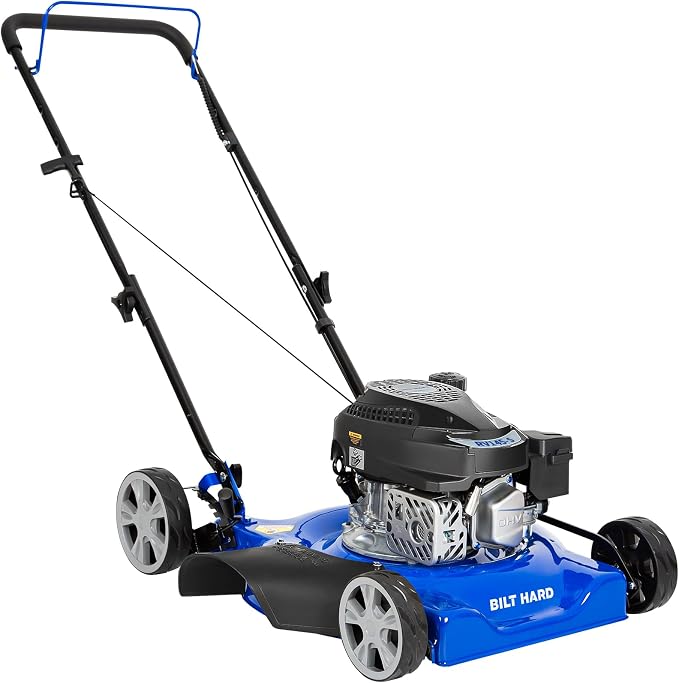
For most homeowners, the BILT HARD 21″ Self Propelled Gas Lawn is the strongest overall recommendation in this group. Its 201cc engine, steel 3-in-1 deck, rear-wheel drive, eight cutting-height positions, and no-choke, no-primer starting design give it a particularly well-rounded specification. The Powersmart 21″ Self-Propelled Gas Lawn Mower is the clear alternative, especially for shoppers who want large rear wheels, rear-wheel drive, and a 1.4-bushel bag on a mower intended for medium to large yards.
This guide compares the five mowers by looking at mulching and discharge flexibility, engine and drive configuration, cutting-width efficiency, height adjustment, handling, storage, cleanup, and the practical compromises behind each ranking. The goal is not simply to list specifications, but to explain which type of lawn and owner each mower suits best.
Best Self-Propelled Mulching Gas Lawn Mower: Quick Comparison
| Product | Name | Price |
|---|---|---|
 |
BILT HARD 21″ Self Propelled Gas Lawn | Check Price |
 |
Powersmart 21″ Self-Propelled Gas Lawn Mower | Check Price |
 |
SENIX 22” Self Propelled Gas Lawn Mower | Check Price |
 |
YARDMAX 22 In. 201cc Select PACE 6 | Check Price |
 |
Self Propelled Gas Lawn Mower | Check Price |
1. BILT HARD 21″ Self Propelled Gas Lawn
The BILT HARD takes the top position because it combines the features most people want from a self-propelled gas mower without leaning too heavily toward one specialized use. Its 21-inch steel deck supports all three common mowing modes: mulching, side discharge, and rear bagging. That flexibility matters because lawn conditions change. Mulching is convenient during regular maintenance, while bagging or side discharge can be more practical when the grass is especially long or damp.
Power comes from a 201cc four-cycle OHV engine rated at 9.0 ft·lb of torque. The supplied information does not establish a specific runtime or cutting capacity, but the engine configuration gives this model a substantial power-oriented profile for a walk-behind mower. Its rear-wheel-drive, single-speed propulsion should also be useful when mowing larger areas or navigating a yard with modest slopes. A foam-wrapped, angled handle is intended to reduce hand fatigue, although the fixed single-speed drive offers less pace control than a variable-speed system.
One of its most useful conveniences is the no-choke, no-primer starting design. There are fewer manual starting steps to remember, which can make seasonal use less frustrating. The single lever adjusts all four wheels together across eight positions, from 1.2 to 3.75 inches. That range accommodates a close appearance as well as a taller cut when lawn conditions call for it.
This is a strong match for homeowners who want one mower for routine mulching, occasional bagging, and general-purpose yard maintenance. Buyers should still confirm the deck’s clearance and storage space before ordering, and should follow the engine’s fuel, oil, and blade-care instructions. The single-speed drive is the main limitation for people who prefer to vary walking pace frequently.
2. Powersmart 21″ Self-Propelled Gas Lawn Mower
The Powersmart earns second place as a practical alternative to the BILT HARD, particularly for owners who value traction and straightforward operation on medium or larger lawns. It uses a 170cc OHV engine and rear-wheel drive, with 10-inch rear wheels designed to improve movement over slopes and uneven terrain. Rear-wheel drive generally places the powered wheels where they can provide useful assistance while climbing or crossing less-than-perfect ground, though actual results will depend on the yard surface and conditions.
Its steel deck cuts a 21-inch path, a familiar width that balances coverage with reasonable maneuverability around landscaping and tighter areas. The 3-in-1 arrangement includes mulching, rear discharge, and bagging. The included 1.4-bushel bag gives owners a way to collect clippings when they do not want them left on the lawn. For ordinary mowing, mulching can return finely cut clippings to the turf; when growth is heavy, switching modes can prevent the deck from becoming overloaded.
A single lever sets one of six cutting heights between 1.5 and 3.9 inches. That range includes a relatively tall setting for seasonal or heat-sensitive mowing, while the lower settings support a shorter finished appearance. Six positions are fewer than the BILT HARD’s eight, but the upper limit is slightly higher.
This mower is a good choice for someone who wants a familiar 21-inch steel-deck layout, large rear wheels, and a rear-wheel-drive system without moving to a more complex transmission. Its 3.5 rating from 1,876 reviews provides much more buyer feedback than several alternatives here, though ratings alone do not determine how it will perform in a particular yard. The single-speed drive remains a constraint for users who need very fine pace adjustment, and buyers should inspect the bagging and discharge components during assembly to ensure each mode is installed correctly.
3. SENIX 22” Self Propelled Gas Lawn Mower
The SENIX stands out with the widest cutting deck in this group at 22 inches, making it appealing to owners who want to cover more lawn in each pass. Its 170cc four-cycle OHV engine powers a rear-wheel-drive, single-speed system. The combination is aimed at consistent, uncomplicated mowing rather than adjustable travel speed or transmission-focused control. It is positioned for small to medium-sized yards, where the added deck width can reduce the number of passes without becoming as cumbersome as a much larger machine.
Like the leading models, this mower offers a steel-deck 3-in-1 cutting system. Owners can mulch, use the side-discharge chute, or collect clippings in the included 19-gallon bagger. That choice is helpful when grass length varies across the property. A washout port is integrated into the design, making it easier to rinse grass residue from beneath the deck after the engine and mower have been handled safely. The supplied package also includes engine oil and a mulch plug, which can simplify initial setup, though the owner still needs to read the assembly and maintenance directions before starting.
Height adjustment uses one lever and six positions, spanning 1.25 to 4 inches. The high end is useful when a taller cut is preferred, while the 1.25-inch minimum gives more flexibility for owners seeking a shorter finish. Eight-inch front wheels and 11-inch rear wheels are intended to help the mower travel over uneven terrain.
Storage is one of the SENIX’s most appealing practical details. Its handle folds, and the mower is designed for vertical storage, a benefit in a crowded garage or shed. The trade-offs are the single-speed drive and the product’s medium-yard positioning. A 22-inch deck may be efficient in open areas but less convenient around narrow beds and obstacles. The included two-year limited warranty adds ownership context, but buyers should still verify the current warranty process and maintain the blade, underside, oil, and air-intake areas according to the manual.
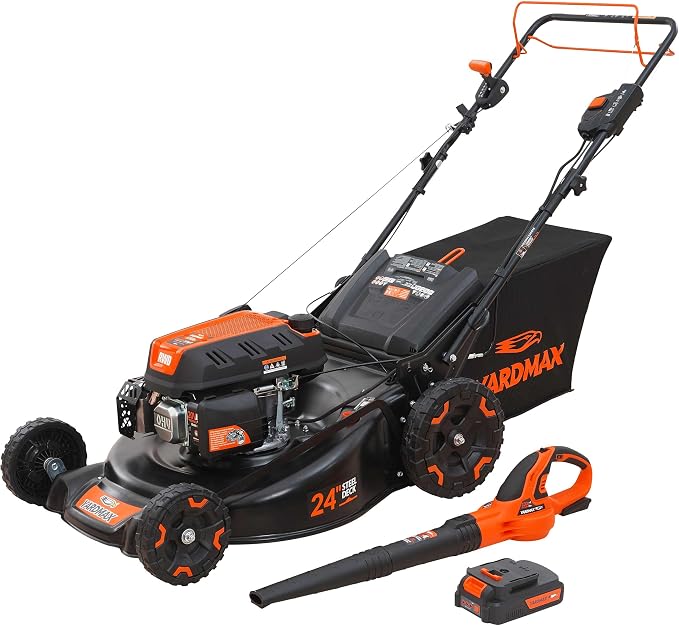
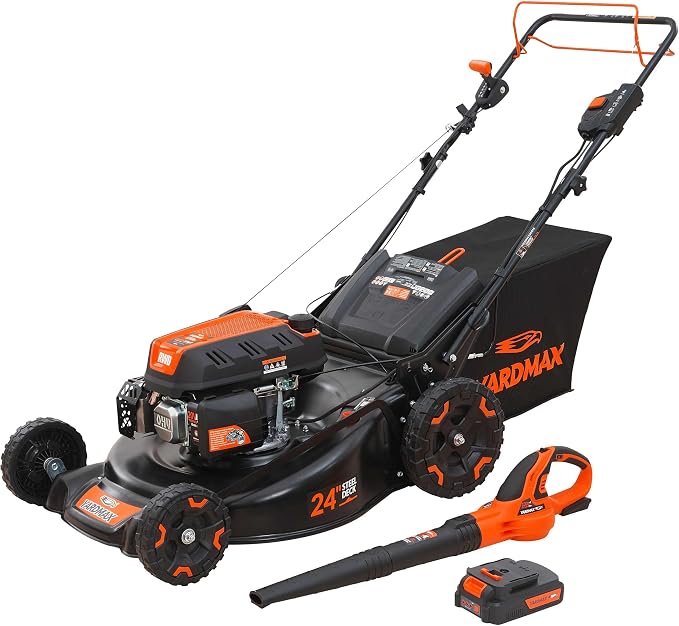
4. YARDMAX 22 In. 201cc Select PACE 6
The YARDMAX is ranked fourth not because it lacks capability, but because its strengths are more specialized and its front-wheel-drive layout may not suit every lawn. It uses a 22-inch deck and a 201cc engine, giving it a substantial mowing profile for homeowners who want broad coverage. Its defining feature is the six-speed CVT system. Rather than operating at only one preset pace, the mower lets the user select among six speeds so the machine can better match walking speed and terrain.
That adjustable pace can be valuable when moving between open lawn, narrow passages, and areas where a slower speed is more comfortable. It also gives this mower a different feel from the single-speed BILT HARD, Powersmart, and SENIX models. However, the supplied product title identifies this version as front-wheel drive. Front-wheel drive can be convenient for turning because lifting or redirecting the front end may make maneuvering easier, but it is important to consider whether that arrangement matches a yard with significant slopes or frequent traction demands.
Traction is supported by rubber tires with an aggressive spiked tread pattern. A deck cleanout port simplifies removal of accumulated grass from beneath the cutting deck, and a single-lever adjustment makes height changes quick. The automatic choke system is another starting convenience because it eliminates the need to manually prime or choke the engine during normal starting.
This is the most compelling option here for a homeowner who prioritizes speed control over the simplest possible drivetrain. It may also suit yards where mowing pace changes often. The key ownership consideration is that the six-speed CVT introduces more controls and mechanical complexity than a single-speed system, so the owner should become familiar with the shift lever before tackling slopes or tight areas. Confirming that the front-wheel-drive behavior feels appropriate for the property is especially important.
5. Self Propelled Gas Lawn Mower
This unnamed model offers a compact 20-inch steel deck, an 8-level cutting-height adjustment, and a 3-in-1 system that supports mulching, side discharge, and rear bagging. It is the smallest-deck option in the ranking, which can be an advantage for owners who need to maneuver around trees, garden borders, or narrow lawn sections. Its 141cc air-cooled OHV engine is listed at 9.0 ft·lb of torque, while the self-propelled design uses a no-choke, no-primer starting approach.
The height lever adjusts all four wheels together from 1 to 3 inches. That gives more incremental settings than several of the other mowers, but the maximum height is lower. Owners who prefer a taller cut may therefore find the BILT HARD, Powersmart, or SENIX more adaptable. The 50-liter grass catcher has a widened opening intended to make collection and emptying easier, and a side-discharge rail can be attached without tools or hardware according to the supplied information.
This mower is also marketed with a foldable design and large wheels for transport and storage. Those details may appeal to someone with limited garage space or a smaller property. The product information makes a much broader claim about mowing more than two acres on a single tank and mentions a 19-gallon capacity, but those details conflict with the listed 50-liter catcher and should be treated cautiously rather than used as a guaranteed operating expectation. The available review count is also only 11, so there is less buyer history to evaluate than with the other ranked models.
It is best considered when a narrower deck, many height settings, and a large catcher matter more than a high level of established product feedback. Before purchase, confirm the fuel-tank, bagger, replacement-blade, and warranty details with the seller. Routine oil checks, blade sharpening, underside cleaning, and safe fuel storage will be particularly important because the specification set is less thoroughly documented.
How to Choose the Best Self-Propelled Mulching Gas Lawn Mower
Choosing a mower for mulching requires a slightly different approach than choosing one only for bagging or simple side discharge. A good mulcher must cut grass into small pieces and spread those pieces across the lawn rather than leaving visible clumps. Self-propulsion then adds another layer: the drive system must make the mower easier to move without making turning, speed control, or maintenance unnecessarily complicated.
Start with the shape and condition of the lawn
Deck width is one of the first specifications to consider. A 22-inch deck, such as the one on the SENIX or YARDMAX, covers a little more ground per pass than a 21-inch deck. That can save time in broad, open sections. The difference is less important in a small yard divided by trees, beds, fences, and walkways, where a narrower mower may turn and position more easily. The 20-inch model in this group can be more convenient where maneuverability matters.
Also consider whether the yard is flat, sloped, uneven, or frequently wet. Rear-wheel-drive models in this roundup include the BILT HARD, Powersmart, and SENIX. The Powersmart specifically pairs rear-wheel drive with large rear wheels for slopes and uneven terrain. The YARDMAX uses front-wheel drive, which may feel agile during turns but should be assessed carefully if the mower must maintain traction while climbing. A self-propelled system does not remove the need for safe footing or careful mowing on slopes.
For a lawn with many obstacles, a wider deck and large turning arc can become inconvenient. For a broad property, a small deck can increase mowing time. Measure gates, storage doors, and the narrowest path before choosing based only on cutting width.
Understand the value of 3-in-1 mowing
A 3-in-1 mower can mulch, discharge clippings, or collect them in a bag. That flexibility is useful because the correct mode depends on the grass and weather. Mulching works best when the mower is not being forced through excessive growth. Cutting only a modest amount from the grass at a time helps reduce the chance of large clumps. If the grass is tall, wet, or unusually dense, side discharge may move material away from the deck more efficiently, while bagging produces a cleaner-looking result.
The mulch plug and discharge components need to fit securely. Before switching modes, shut the mower off completely, wait for moving parts to stop, and follow the manufacturer’s instructions. Never reach under the deck to clear an obstruction while the engine is running. The SENIX includes a mulch plug, and its included bagger gives it a relatively complete starting package. The BILT HARD, Powersmart, and the fifth-ranked mower also provide the key mode choices listed in their product information.
Bag size is relevant, but a larger catcher does not automatically mean fewer interruptions. How quickly the bag fills depends on grass height, moisture, cutting width, and the selected cutting height. The Powersmart’s 1.4-bushel bag and the SENIX’s 19-gallon bagger are stated in different units, so they should not be compared as though the numbers are directly interchangeable without conversion. The fifth mower lists a 50-liter catcher. In each case, check how the bag attaches and whether replacement bags are available.
Choose the engine and drive system with realistic expectations
Engine displacement gives useful context but should not be treated as a complete performance guarantee. The BILT HARD and YARDMAX list 201cc engines, while the Powersmart and SENIX use 170cc engines. The fifth mower lists 141cc. Other factors include blade condition, deck design, mowing speed, grass height, terrain, and maintenance. A larger engine may be appealing for demanding conditions, but it can also be more than necessary for a small, regularly maintained lawn.
Most of the ranked choices use a single-speed self-propelled system. Single-speed operation is simple: engage the drive and walk at the mower’s set pace. It can be a good fit for owners who value fewer controls. The limitation is that the mower may feel too quick for tight spaces or too slow for a long, open stretch. The YARDMAX’s six-speed CVT directly addresses that issue by allowing the operator to select a more suitable pace.
Variable speed is not automatically better for every owner. It adds a control that must be learned and adjusted. If multiple people use the mower, a simple single-speed setup may be easier to share. If one person has a shorter or slower natural walking pace, or if the property includes varied terrain, the YARDMAX’s six settings may justify the extra complexity.
Compare cutting-height range, not just the number of positions
Cutting height affects lawn appearance, stress, and how much material the deck must process. The BILT HARD adjusts from 1.2 to 3.75 inches across eight positions. The Powersmart ranges from 1.5 to 3.9 inches with six positions. The SENIX offers 1.25 to 4 inches with six positions, giving it the highest listed maximum. The YARDMAX’s supplied information confirms a single-lever adjustment but does not provide the numerical range. The fifth mower uses eight positions from 1 to 3 inches.
More positions can make it easier to fine-tune the cut, but range matters more than the raw count. A homeowner who wants a tall setting should pay attention to the upper limit. Someone who wants a very short finish should inspect the minimum. Adjusting all wheels with one lever is generally more convenient than changing each wheel separately, particularly when switching between seasonal settings.
Do not lower the mower dramatically in one pass through tall grass. A high first cut followed by a later adjustment can reduce the load on the engine and improve the quality of the finished mulch. The exact appropriate height depends on the grass type and local growing conditions, neither of which is specified for these products.
Give starting and setup features proper weight
Gas mowers require more preparation than battery models, but a convenient starting system can reduce routine friction. The BILT HARD and fifth-ranked mower are described as using no-choke, no-primer starting. The YARDMAX has an automatic choke system. These features are designed to reduce manual adjustments, but they do not eliminate the need for correct fuel, oil, storage, and seasonal maintenance.
Read the assembly instructions before adding fuel or attempting to start the engine. Check whether engine oil is included. The SENIX specifically includes engine oil, a mulch plug, a discharge chute, and a 19-gallon bagger. Other products may require separate preparation or may have different package contents depending on the seller and model variant.
Inspect the handle, drive cable, bagger, mulch plug, and discharge chute during setup. A component that is not seated correctly can create poor collection, unexpected discharge, or an unsafe operating condition. Keep hands and feet away from the blade area, and remove the spark-plug connection only as directed when performing certain maintenance tasks.
Plan for cleaning and blade maintenance
Mulching produces fine clippings that can collect beneath the deck, especially when mowing damp grass. A dirty deck can restrict discharge and reduce the consistency of the mulch. The SENIX and YARDMAX specifically include washout or deck-cleanout features, which can make routine cleanup easier. Even with those features, the owner should follow the manufacturer’s safety procedure and never clean around a running blade.
Inspect the blade periodically for dullness or damage. A dull blade may tear grass rather than cut it cleanly and can make the mower work harder. Keep the underside free from packed material, but do not assume a washout port replaces manual inspection. The deck, discharge openings, bagger, and mulch plug all need to remain clear.
Engine maintenance should include checking oil, keeping the air-intake area reasonably clean, and using the fuel specified by the manual. Store fuel safely and avoid leaving the machine in conditions that invite moisture or corrosion. At the end of the season, follow the manufacturer’s storage directions rather than guessing about fuel treatment or draining procedures.
Think about storage before buying
Self-propelled gas mowers are substantial pieces of equipment, and the deck width is not the only storage consideration. Handle folding can make a major difference. The SENIX specifically supports folding and vertical storage, while the fifth product is described as having a foldable design. Owners should still confirm how much floor or wall clearance is required and whether the mower can be stored vertically according to the manual.
Measure the mower’s path through the garage, shed, gate, and any storage doorway. A 22-inch deck may fit easily through one opening and not another once the wheels and handle are taken into account. Store the mower in a stable position away from children, ignition sources, and areas where fuel vapors could accumulate. Never trade safe, stable storage for a compact position that the manufacturer does not approve.
Use customer feedback as context, not as the only deciding factor
The products have different amounts of available review history. The Powersmart listing has 1,876 reviews and a 3.5 rating, the SENIX has 1,299 reviews and a 3.9 rating, the BILT HARD has 117 reviews and a 4.2 rating, and the YARDMAX has 426 reviews and a 4.0 rating. The fifth product has 11 reviews and a 4.2 rating. A larger review sample can reveal recurring ownership patterns more clearly, while a small sample can make a rating less stable.
Look beyond the headline number when researching the current listing. Pay attention to comments about starting, self-propel engagement, bag attachment, assembly, deck clogging, wheel adjustment, and customer service. Verify that the reviews apply to the exact model and not a similar variation. Product listings can change, and the supplied data does not establish long-term durability for any mower.
Match the mower to the type of owner you are
A homeowner who wants the broadest balance of power, adjustment, and mowing modes may prefer the BILT HARD. Someone emphasizing large rear wheels and a conventional 21-inch layout may lean toward the Powersmart. The SENIX is attractive when a 22-inch deck, tall height setting, included accessories, and vertical storage matter together. The YARDMAX makes the most sense for someone who will actually use six speed settings. The fifth model is more appropriate when a 20-inch deck, eight height positions, and a large listed catcher are priorities, provided the buyer is comfortable with the smaller review history and less consistent specification details.
In every case, select the mower based on the property first and the feature list second. A mower that fits through the gate, turns around the landscaping, reaches a comfortable cutting height, and can be stored safely will usually be more satisfying than one with a larger engine that does not suit the yard.
FAQ
Is a self-propelled gas mower good for mulching?
Yes. Self-propulsion and mulching address different needs. The drive system helps move the mower, while the deck, blade, and mulch plug determine how clippings are processed. Each mower in this ranking is listed with a mulching function as part of a 3-in-1 system. For the best result, mow regularly, avoid removing too much grass at once, and use side discharge or bagging when the lawn is excessively tall or wet.
Which drive type is better for a self-propelled mulching mower?
Rear-wheel drive can be useful on slopes and uneven ground because the powered wheels are at the rear. The BILT HARD, Powersmart, and SENIX use rear-wheel drive. Front-wheel drive can feel convenient for turning, and the YARDMAX combines it with a six-speed CVT, but buyers should consider whether it provides the traction behavior they want on their property. There is no single drive type that is best for every lawn.
Does a wider deck make a mower better at mulching?
Not necessarily. A wider deck can cover more ground per pass, but mulching quality also depends on mowing height, grass volume, blade condition, and whether the deck becomes clogged. A 22-inch mower can be efficient on open lawn, while a 20- or 21-inch model may be easier to maneuver around obstacles. Choose width according to the property rather than assuming the largest deck is automatically superior.
How high should a self-propelled gas mower be set when mulching?
The correct height depends on the lawn and grass type, so there is no universal setting among these products. Use the mower’s adjustment range and avoid cutting an excessive amount in one pass. The SENIX reaches 4 inches, the Powersmart reaches 3.9 inches, and the BILT HARD reaches 3.75 inches. The fifth model tops out at 3 inches. A taller setting can be useful when the lawn is stressed or growth is heavy.
Do these mowers require a mulch plug?
A mulch plug is commonly used to close the discharge opening when operating in mulching mode, but the exact installation depends on the mower. The SENIX listing specifically includes a mulch plug. Always install the correct component securely and follow the product manual. Turn off the engine and wait for the blade to stop before changing from mulching to bagging or discharge.
What maintenance does a gas mulching mower need?
Routine ownership includes checking engine oil, maintaining the blade, clearing grass from the deck, keeping the bagger and discharge openings clean, and following the fuel and storage instructions. A dull or damaged blade can reduce cutting quality and affect mulching. Deck-cleanout features on the SENIX and YARDMAX can simplify cleanup, but they do not replace safe inspections and regular maintenance.
Conclusion
The BILT HARD 21″ Self Propelled Gas Lawn is the strongest overall choice because it combines a 201cc engine, rear-wheel drive, eight height settings, a steel 3-in-1 deck, and convenient starting. The Powersmart is the clearest alternative for owners who value large rear wheels and a familiar 21-inch layout. The SENIX, YARDMAX, and fifth-ranked mower each have more specialized advantages, so the best final choice depends on deck width, terrain, speed control, storage, and the cutting-height range your lawn actually needs.

I’m Maya L. Greenwood, a lifelong plant lover who believes anyone can grow something beautiful with the right guidance. After years of testing soil mixes, pruning methods, irrigation tricks, and pest-safe solutions, I started EasyGardenTips.com to turn hard-won lessons into step-by-step advice. From seed starting and container gardens to composting and seasonal checklists, my goal is to make gardening simple, sustainable, and fun.