3 Best Cordless Mower for Medium Lawn: Reliable Battery Picks
Are you looking for the best cordless mower for medium lawn maintenance but are unsure whether one battery can actually finish the yard? A mower with too little runtime, a narrow cutting deck, or weak performance in thick grass can turn a simple weekly mow into multiple charging sessions.
For a typical medium-size lawn, I want roughly a 21-inch cutting width, enough battery capacity for about 1/3 to 1/2 acre under normal conditions, a brushless motor, useful cutting-height adjustment, and preferably self-propelled drive. I researched the current options and selected three cordless mowers that approach that job differently.
My primary recommendation is the EGO POWER+ LM2156SP 21-Inch Select Cut XP Self-Propelled Mower. I prefer it for most medium lawns because its 56V 10.0Ah battery, up-to-75-minute runtime, strong cutting torque, multi-blade system, and responsive self-propel drive create an unusually complete balance.
The Greenworks 80V 21-Inch Self-Propelled Cordless Lawn Mower with 8.0Ah Battery is the alternative I would consider when extended runtime and larger-lawn capacity are priorities. Its high-capacity battery system, steel deck, variable-speed drive, and 4-in-1 mowing system make it particularly suitable for a medium lawn that approaches the larger end of the category.
For buyers who already use Makita cordless tools or prioritize a commercial-grade steel deck, I would consider the Makita XML08PT1 36V LXT 21-Inch Self-Propelled Lawn Mower Kit. Its four-battery configuration and heavy-duty construction are excellent for demanding lawns, although it is noticeably heavier than the EGO.
Best Cordless Mowers for Medium Lawns

1. EGO POWER+ LM2156SP 21-Inch Select Cut XP Self-Propelled Mower
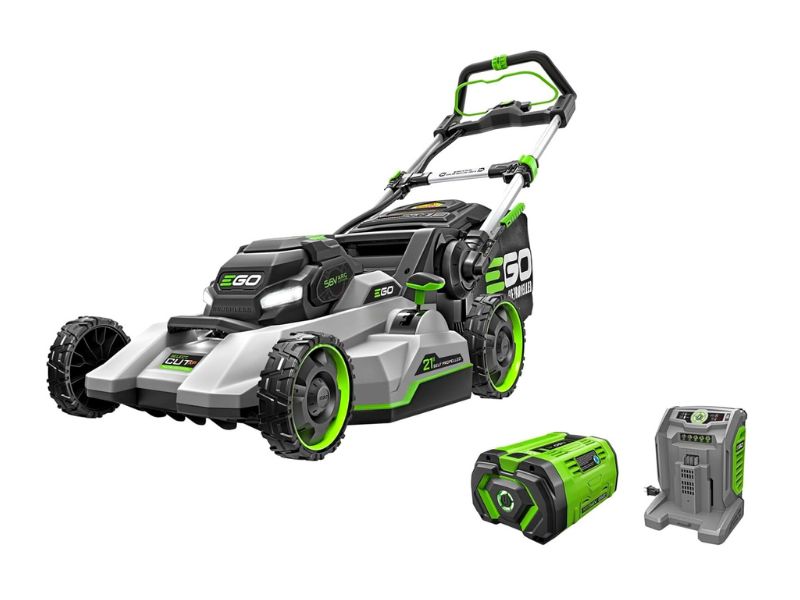
Key Features
- 56V ARC Lithium battery platform
- Included 10.0Ah battery
- Up to approximately 75 minutes runtime
- 21-inch cutting deck
- Up to 8.3 ft-lbs cutting torque
- Select Cut multi-blade system
- Variable-speed Touch Drive self-propel
- Self-propel range of approximately 0.9–3.1 MPH
- Eight cutting-height positions from approximately 1–4 inches
- Mulching, bagging, and side-discharge capability
- Foldable vertical-storage design
- IPX4 weather-resistant construction
The EGO LM2156SP is the mower I would choose first for a typical medium lawn because it combines the three things that matter most in this category: runtime, cutting performance, and manageable size.
A medium residential lawn does not usually require the enormous battery capacity of a riding mower, but it demands more endurance than the compact cordless mowers designed around tiny urban yards.
The included 56V 10.0Ah ARC Lithium battery is therefore an important part of the package.
EGO specifies up to approximately 75 minutes of mowing runtime under suitable conditions. Actual runtime will vary with grass height, moisture, mowing speed, self-propel use, blade selection, terrain, and how aggressively the motor has to work.
That qualification matters.
A homeowner mowing dry grass every week may get much closer to the maximum than someone cutting damp, overgrown turf after missing two mowing cycles.
Even so, the 10.0Ah battery provides considerably more useful energy capacity than many entry-level cordless mower kits.
For lawns around 1/4 to roughly 1/2 acre, depending on conditions, that gives you a realistic chance of completing the job without interrupting the mowing session to recharge.
21-Inch Deck Is Well Suited to Medium Yards
The 21-inch cutting width is another major advantage.
Small 16- or 17-inch cordless mowers are highly maneuverable, but a medium lawn requires many additional passes when the cutting width is narrow.
A 21-inch deck is close to the familiar size used by traditional residential gas mowers.
That makes it broad enough to cover open lawn efficiently while remaining manageable around trees, landscaping, fences, garden beds, and other obstacles.
Going much larger can reduce the number of passes, but the mower becomes harder to maneuver and store.
For most suburban medium lawns, 21 inches is the practical sweet spot.
Select Cut Multi-Blade System
One of the defining features of the LM2156SP is EGO’s Select Cut multi-blade system.
Instead of relying on one fixed blade configuration for every mowing situation, the mower uses an upper blade together with interchangeable lower blades.
The available blade choices are intended to emphasize different priorities, including mulching, bagging, and extended runtime.
This flexibility matters because mowing performance is not a single metric.
A blade that maximizes airflow into the collection bag may consume more battery energy than a configuration optimized for runtime.
Likewise, a dedicated mulching setup can produce smaller clippings when you prefer to return nutrients to the lawn.
For a medium yard where one mower may need to handle spring growth, summer maintenance, and fall cleanup, that adaptability is genuinely useful.
Strong Cutting Torque
EGO rates this mower at up to 8.3 ft-lbs of cutting torque.
Torque becomes particularly important when the blade meets thicker or taller grass.
A weak cordless mower may reduce blade speed dramatically in dense areas, resulting in missed blades, clumps, or the need for a second pass.
The LM2156SP is designed to provide enough power to function much more like a full-size gas replacement than a lightweight electric mower.
That does not mean you should expect ideal results while rushing through soaking wet, severely overgrown grass.
Any walk-behind mower performs better when grass is reasonably dry and you avoid removing excessive height in one pass.
But the EGO gives you useful power reserve for common medium-lawn conditions.
Touch Drive Self-Propelled System
Self-propel becomes increasingly valuable as lawn size grows.
Pushing a lightweight mower across 2,000 square feet is easy for many people. Pushing a fully equipped mower across 10,000 to 20,000 square feet—especially on slopes—can become tiring.
EGO’s Touch Drive system allows the mower to propel itself while you mainly steer.
The variable-speed range of approximately 0.9 to 3.1 MPH lets you match the mower to your natural walking pace.
Slower speeds are useful in dense grass because the blades have more time to process each section.
Faster speeds work well when conditions are easy and you are covering long open passes.
The ability to vary self-propel speed is more useful than a simple one-speed drive because lawns rarely have identical conditions from one end to the other.
Eight Cutting Heights
The mower provides eight cutting-height positions covering approximately 1 to 4 inches.
That wide range makes it compatible with many common residential turf types.
Cutting height should be selected according to your grass species and seasonal conditions rather than simply choosing the shortest possible setting.
For example, many cool-season grasses benefit from being maintained relatively tall, especially during summer heat.
Removing too much leaf tissue at once stresses the lawn and can increase vulnerability to weeds, drought, and heat.
A useful general guideline is the one-third rule: avoid removing much more than one-third of the grass blade in a single mowing whenever practical.
Mulching, Bagging, and Side Discharge
The LM2156SP supports three common clipping-management methods:
Mulching recuts clippings into small pieces and returns them to the lawn.
Bagging collects clippings when you want a cleaner surface, are mowing excessive growth, or need to remove leaves and debris.
Side discharge moves clippings away from the mower and can be helpful when grass is too long for efficient mulching.
For routine medium-lawn mowing, I generally prefer mulching when grass is dry and the mower is cutting only a moderate amount.
It saves the time required to empty a bag and returns organic material to the lawn.
Storage Is Better Than It Looks
Cordless mowers eliminate gasoline and oil, which opens up more storage options.
The EGO’s folding design allows it to occupy much less garage space than a traditional mower with a permanently extended handle.
This is particularly useful for suburban homeowners sharing a garage with vehicles, bikes, garden equipment, storage bins, and other tools.
The deck itself is still full-size, but vertical storage significantly reduces its footprint.
Battery Ecosystem
Another consideration is the EGO 56V battery platform.
The mower battery can be used with compatible EGO outdoor equipment such as blowers, string trimmers, hedge trimmers, chainsaws, and other lawn tools.
Battery-platform compatibility becomes increasingly important as you add cordless equipment.
Owning five different yard-tool brands can mean five different batteries and chargers occupying garage space.
If you intend to transition several outdoor tools away from gas, choosing the mower can effectively mean choosing the battery ecosystem.
What I Like
- Excellent balance for medium lawns
- Long runtime from the included 10.0Ah battery
- Strong 8.3 ft-lbs cutting torque
- 21-inch deck covers ground efficiently
- Select Cut multi-blade versatility
- Smooth variable-speed self-propel
- Wide 1- to 4-inch cutting-height range
- Folding design simplifies storage
- Large outdoor-tool battery ecosystem
What I Do Not Like
- Large 10.0Ah battery adds weight
- Multi-blade configuration is more complex than a basic single-blade mower
- High-lift or demanding mowing conditions can reduce runtime
- More mower than a very small urban lawn actually needs
For a medium lawn where I want to replace a conventional gas mower without sacrificing cutting width or usable runtime, the EGO LM2156SP is the most balanced option here. It has enough endurance for substantial suburban yards but remains easier to handle and store than heavier commercial-style cordless mowers.
2. Greenworks 80V 21-Inch Self-Propelled Cordless Lawn Mower with 8.0Ah Battery
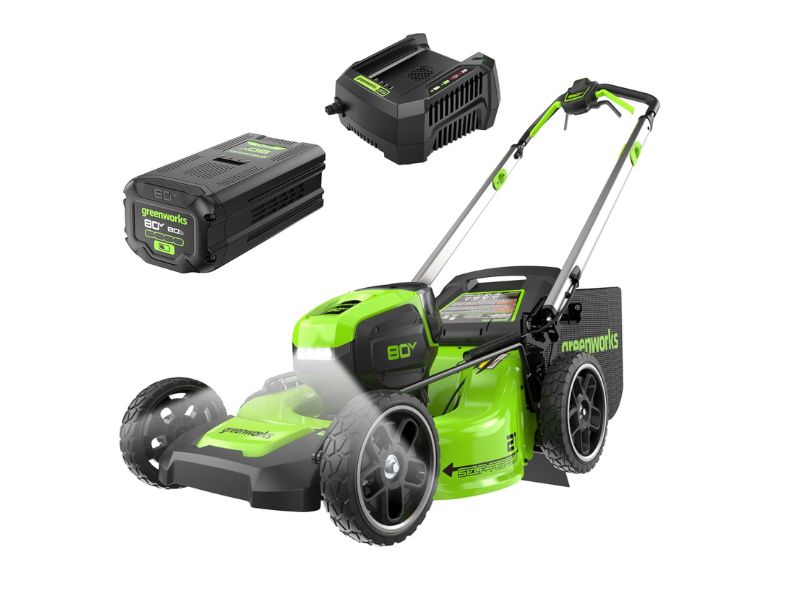
Key Features
- 80V lithium-ion platform
- 8.0Ah battery
- Up to approximately 80 minutes runtime
- Designed for mowing areas up to around 3/4 acre under suitable conditions
- 21-inch cutting deck
- Brushless motor
- Variable-speed self-propelled drive
- Seven cutting-height positions
- Approximately 1.38- to 4-inch cutting range
- 4-in-1 mowing capability
- 60L grass bag
- LED headlights
- Folding storage design
Greenworks takes second place because this configuration puts a strong emphasis on endurance.
With its high-capacity 80V 8.0Ah battery, it is especially attractive if your definition of a medium lawn is closer to 1/2 acre than 1/4 acre.
Greenworks rates the mower for up to approximately 80 minutes of runtime in appropriate conditions, with mowing capability extending toward roughly 3/4 acre.
As always, acreage ratings should be treated as guidance rather than guarantees.
Grass density, lawn moisture, terrain, cutting height, self-propel usage, mowing pattern, and battery condition all affect how much ground can actually be covered.
But the large battery provides useful capacity for homeowners who worry about stopping before the final section of the yard is finished.
80V Brushless Power System
The mower uses a brushless motor.
Brushless motors eliminate the carbon brushes used in traditional brushed motors and electronically control the motor instead.
For lawn equipment, the practical benefits can include high efficiency, good torque response, reduced maintenance, and long operating life.
The higher 80V system should not automatically be interpreted as being “better” than every 40V or 56V mower.
Voltage is only one part of the power system.
Battery capacity, motor design, controller electronics, blade geometry, and overall efficiency are equally important.
What the Greenworks 80V platform does provide is a high-voltage outdoor-tool system capable of supporting demanding equipment.
21-Inch Deck
Like the EGO, this mower uses a 21-inch deck.
For a medium lawn, that width is far more practical than a compact mower if efficiency matters.
Suppose two mowers are otherwise comparable and one cuts a 16-inch path while the other cuts approximately 21 inches.
Across a large rectangular lawn, the narrower mower needs significantly more passes.
Every additional pass adds walking distance, turning, battery consumption, and mowing time.
This is why I strongly prefer a mower around 20 or 21 inches once the yard moves beyond small-lawn territory.
Variable-Speed Self-Propelled Drive
The Greenworks includes variable-speed self-propelled rear-wheel drive.
Rear-wheel drive is especially useful when the mower needs traction while climbing gentle slopes or pushing through heavier turf.
The mower supplies the forward force, allowing you to concentrate on guiding it.
Self-propel is not mandatory for a flat medium lawn, but it becomes increasingly valuable when:
- The yard contains slopes.
- The grass is thick.
- The mower is relatively heavy.
- You bag clippings.
- Mowing takes 40 minutes or longer.
- Physical fatigue is a concern.
The additional energy used by the drive system can reduce maximum battery runtime compared with manually pushing the mower, but for many users the reduction in effort is worth the trade.
Steel Deck Construction
The Greenworks uses a steel cutting deck, which gives it a traditional, durable feel.
Steel handles impacts and routine residential use well, although it adds weight compared with many composite mower decks.
Deck material is not solely a durability issue.
Weight influences maneuverability, especially when pulling the mower backward, turning around landscaping, moving it between front and back yards, or loading it for transport.
The Greenworks is therefore more substantial to handle than some lighter composite-deck cordless mowers.
The self-propel system compensates while mowing forward, but mower weight is still noticeable when the drive is disengaged.
4-in-1 Mowing System
This model offers a versatile 4-in-1 mowing system.
Depending on configuration, you can manage clippings through mulching, bagging, side discharge, and a turbo-style leaf-pickup function.
The leaf-pickup capability is particularly interesting for homeowners with deciduous trees.
A mower that can help process or collect dry fallen leaves reduces the need to use a rake or dedicated yard vacuum for every cleanup.
For routine summer mowing, mulching and bagging remain the most important functions.
Cutting Height
The seven-position height-adjustment system provides a range of approximately 1.38 to 4 inches.
That should accommodate the mowing heights used by most common residential grasses.
Single-lever adjustment is important because changing four independent wheels can become annoying when lawn conditions change throughout the year.
During periods of rapid spring growth, you may need a different setting from the one used during hot, dry summer conditions.
A convenient height system makes those changes easier.
Runtime and Medium-Lawn Suitability
The main reason I would choose the Greenworks over the EGO is if I were particularly concerned about battery reserve.
An advertised maximum of around 80 minutes gives this configuration substantial theoretical endurance.
A medium lawn with numerous trees, landscaping beds, and irregular boundaries takes longer to mow than an open rectangular yard of the same square footage.
Likewise, self-propelled mowing on slopes uses more energy.
Starting with a high-capacity battery reduces the chance that an unexpectedly demanding mowing session leaves the last portion unfinished.
Battery Platform
The 80V battery works within the compatible Greenworks 80V outdoor-tool ecosystem.
This can be a major reason to select the mower if you already own an 80V blower, trimmer, chainsaw, snow tool, or other compatible equipment.
Conversely, if you already have several high-capacity batteries from another ecosystem, switching platforms can increase cost and charger clutter.
This is why I recommend checking your existing cordless tools before choosing any battery mower.
What I Like
- Excellent runtime potential
- Strong fit for larger medium lawns
- 21-inch cutting width
- Brushless motor
- Variable-speed rear-wheel self-propel
- Durable steel deck
- Wide cutting-height range
- 4-in-1 clipping management
- Large 80V outdoor-tool ecosystem
What I Do Not Like
- Heavier than lighter composite-deck alternatives
- Large battery and steel construction reduce portability
- High capacity may be unnecessary for a modest 1/4-acre lawn
- Maneuvering manually in tight spaces takes more effort
The Greenworks 80V mower is the option I would choose when the lawn sits toward the larger end of “medium” and finishing on one battery is particularly important. Its extra weight is the main tradeoff, but self-propelled drive and strong runtime make it a capable option for larger suburban properties.
3. Makita XML08PT1 36V LXT 21-Inch Self-Propelled Lawn Mower Kit
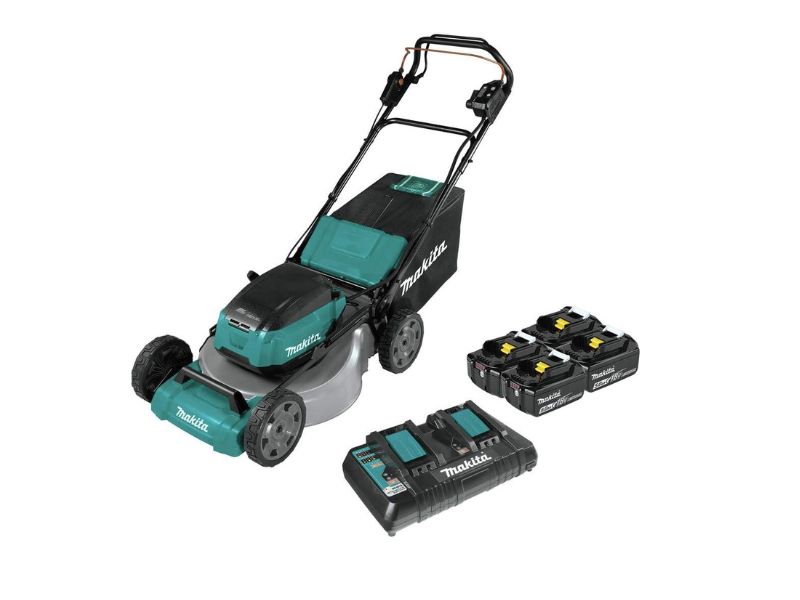
Key Features
- 36V system powered by two 18V LXT batteries
- Four 18V 5.0Ah batteries included
- Four-bay battery compartment
- Up to approximately 2/3 acre in 60 minutes or less under suitable conditions
- 21-inch cutting width
- Commercial-grade steel deck
- Brushless motor
- Up to approximately 2,800 RPM
- Quiet Mode around 2,300 RPM
- Variable self-propel from approximately 1.5–3 MPH
- Cutting-height range of approximately 1.25–4 inches
- 3-in-1 mulching, bagging, and side discharge
- Approximately 2-bushel bag
- Heavy-duty construction
Makita’s XML08PT1 is the most heavy-duty mower of these three.
It uses a 36V configuration created by running two 18V LXT batteries together, while the mower’s four-bay battery compartment allows two additional batteries to remain installed for extended mowing.
This design will immediately make sense to anyone who already owns Makita 18V LXT power tools.
Instead of creating a completely separate high-voltage battery platform exclusively for outdoor equipment, Makita leverages its established 18V system.
That can provide outstanding battery compatibility for someone whose workshop already contains Makita drills, saws, impact drivers, grinders, or other cordless equipment.
Four Included 5.0Ah Batteries
The kit includes four 18V 5.0Ah batteries.
Two batteries power the mower at a time.
The four-bay configuration provides additional onboard capacity so that the mower can continue operating after the first battery pair is depleted by switching to the second pair.
Makita rates the configuration for mowing up to approximately 2/3 acre in 60 minutes or less, depending on conditions.
That places it comfortably within the requirements of most medium lawns.
Battery runtime is still highly conditional.
Dense grass requires more motor power. Self-propel consumes energy. Aggressive cutting heights increase blade load. Wet clippings add resistance.
But four batteries give the mower substantial energy reserves.
Commercial-Grade Steel Deck
The Makita’s commercial-grade steel deck is one of the strongest reasons to buy it.
This mower feels more like professional outdoor equipment than a lightweight residential cordless machine.
Steel is durable and provides a rigid mowing platform.
The tradeoff is weight.
The mower weighs substantially more than many cordless alternatives, especially after batteries are installed.
That weight can make manual handling difficult.
If you need to repeatedly lift the mower into a truck bed, carry it down stairs, or maneuver it without the drive system, the difference matters.
For normal mowing, however, the variable self-propel system does most of the forward work.
Self-Propelled Speed
The variable self-propel system operates from approximately 1.5 to 3 MPH.
A lower walking speed is useful when cutting dense turf or working around landscaping.
Higher speeds help cover open lawn efficiently when grass conditions are easy.
The self-propel system is particularly valuable on this mower because of its heavier steel construction.
Without powered drive, pushing a mower of this weight around a large lawn would be much more demanding.
Brushless Motor and Blade Speed
The Makita-built brushless motor reaches approximately 2,800 RPM under normal maximum operation.
RPM alone does not tell the entire story about mowing performance.
Blade design, motor torque, deck airflow, grass conditions, and mowing speed all influence cut quality.
However, the system is clearly designed around sustained heavy-duty lawn work rather than minimal lightweight mowing.
Quiet Mode
One unusual feature is Quiet Mode, which maintains a lower blade speed of around 2,300 RPM.
Reducing blade speed can reduce noise when full cutting power is unnecessary.
That can be valuable in suburban environments where homes are close together.
For example, if you are mowing relatively short, dry grass during a routine maintenance cut, maximum motor speed may not always be required.
When grass becomes heavy, the standard operating mode is more appropriate.
21-Inch Cutting Width
Again, Makita uses the highly practical 21-inch cutting width.
This reinforces why these three mowers suit medium yards.
The deck is large enough to make efficient progress without becoming so wide that residential maneuverability suffers.
The XML08PT1 is especially at home on relatively open medium lawns where its commercial build and long runtime can be used effectively.
In a highly landscaped property with numerous narrow passages and small turning areas, its weight becomes more noticeable.
3-in-1 Clipping Management
The Makita provides:
- Mulching
- Rear bagging
- Side discharge
This gives the homeowner flexibility throughout the growing season.
Mulching is ideal for frequent maintenance when grass is dry and not excessively long.
Bagging works well when the lawn is overgrown or when you want to collect leaves and debris.
Side discharge can be useful when conditions are too heavy for effective mulching.
Cutting-Height Adjustment
The mower covers approximately 1.25 to 4 inches of cutting height.
That range makes it suitable for a variety of turf species and seasonal mowing strategies.
Do not automatically mow at the shortest setting just because the mower allows it.
Cut height should reflect grass type, temperature, moisture conditions, and lawn health.
Scalping a lawn exposes soil to more sunlight, reduces photosynthetic leaf area, and can encourage stress.
LXT Battery Compatibility
For an existing Makita owner, this is where the XML08PT1 becomes particularly compelling.
The 18V LXT batteries used by the mower belong to a large cordless tool ecosystem.
A homeowner who already uses Makita batteries can potentially share packs across workshop and lawn equipment.
The mower itself needs two batteries simultaneously for operation, so battery quantity still matters.
But platform consolidation can be far more convenient than maintaining unrelated systems.
What I Like
- Commercial-grade steel construction
- Four 5.0Ah batteries included
- Excellent runtime potential
- 21-inch cutting width
- Variable-speed self-propel
- Quiet Mode
- Wide 1.25- to 4-inch height range
- Excellent fit for existing Makita LXT owners
- 3-in-1 clipping management
What I Do Not Like
- Significantly heavier than many residential cordless mowers
- Four-battery system is more complex
- More difficult to transport or manually maneuver
- Heavy-duty construction may be unnecessary for a simple flat lawn
The Makita XML08PT1 is the mower I would choose when build quality and battery-platform compatibility matter more than minimizing weight. For an existing Makita LXT owner with a medium lawn, it can be particularly attractive because the battery system extends far beyond lawn equipment.
Cordless Mower Comparison
| Product | Battery System | Cutting Width | Maximum Rated Runtime | Self-Propelled | Cutting Height | Deck | Mowing Functions | Main Strength | Main Limitation |
| EGO POWER+ LM2156SP | 56V, 10.0Ah | 21 in. | Up to 75 min | Variable 0.9–3.1 MPH | 1–4 in., 8 positions | Composite | Mulch, bag, side discharge | Best overall balance | Large battery adds weight |
| Greenworks 80V Self-Propelled | 80V, 8.0Ah | 21 in. | Up to 80 min | Variable speed | 1.38–4 in., 7 positions | Steel | 4-in-1 system | Long runtime | Heavier construction |
| Makita XML08PT1 | 36V using 2×18V; four 5.0Ah packs | 21 in. | Up to about 60 min | Variable 1.5–3 MPH | 1.25–4 in. | Steel | Mulch, bag, side discharge | Heavy-duty build | High mower weight |
All three provide the 21-inch deck and self-propelled drive I prefer for a medium lawn.
The EGO is the most balanced choice because its runtime, power, blade flexibility, and lower bare mower weight suit a broad range of homeowners.
Greenworks provides greater emphasis on battery reserve and is particularly attractive when your property is approaching the larger end of medium-lawn territory.
Makita emphasizes construction and battery-platform flexibility, making it especially logical for homeowners already invested in the LXT system.
What Size Lawn Is Considered a Medium Lawn?
There is no official universal definition, but for cordless mower selection I generally treat approximately 1/4 to 1/2 acre of mowable grass as medium-sized residential territory.
One acre contains 43,560 square feet.
Therefore:
1/4 acre = 10,890 square feet
1/3 acre = about 14,520 square feet
1/2 acre = 21,780 square feet
Your property size and actual mowing area are not necessarily the same.
A half-acre property containing a large home, driveway, patio, pool, garden beds, and trees might have only 10,000 square feet of actual turf.
That distinction can dramatically change the mower you need.
Measure the mowable area rather than relying solely on the lot size shown in property records.
How to Choose a Cordless Mower for a Medium Lawn
Battery Capacity and Runtime
Runtime is the first specification most buyers examine, and for good reason.
A mower that stops at 80% completion creates an annoying routine:
Mow most of the yard.
Recharge.
Return later.
Finish the final section.
For medium lawns, I prefer a mower with enough rated capacity that typical mowing uses less than the theoretical maximum battery runtime.
That reserve accounts for difficult conditions.
Battery runtime can drop when:
- Grass is tall.
- Grass is wet.
- The blade is dull.
- You mulch heavy growth.
- Self-propel runs continuously.
- The lawn has slopes.
- The cutting height is very low.
- Temperatures are unfavorable.
- The battery has aged.
Do not size a mower so closely that completing the yard requires ideal conditions every time.
Cutting Width
For most medium lawns, 20 to 22 inches is the practical range.
A 21-inch mower gives you good productivity without becoming difficult to navigate around residential obstacles.
Smaller decks have advantages in confined spaces but require more passes.
If your lawn consists primarily of open rectangular turf, deck width becomes even more valuable.
Self-Propelled vs. Push
I strongly prefer self-propelled drive once lawn size becomes substantial.
Push mowers can be lighter and consume slightly less battery power, but the physical effort increases over long sessions.
Self-propel is especially worthwhile when:
- The lawn slopes.
- The mower has a steel deck.
- You regularly bag clippings.
- You have thick turf.
- The property requires long mowing sessions.
Variable-speed drive is preferable because it can match your walking speed.
Brushless Motor
A brushless motor uses electronic commutation rather than replaceable carbon brushes.
For a mower, brushless technology can support efficient power delivery, strong torque, and reduced motor maintenance.
All three mowers reviewed here use brushless designs.
For a medium lawn where the mower may run for 40 minutes or longer per session, efficiency becomes particularly valuable.
Deck Material
The two common choices are steel and composite.
Steel decks offer traditional durability and rigidity but add weight and can eventually corrode if neglected.
Composite decks reduce weight and do not rust in the same way, although some buyers prefer the substantial feel of metal.
Neither material is automatically superior.
For easy maneuvering, I appreciate a quality composite deck.
For rugged use, steel has obvious appeal.
Cutting Height
Look for a mower with a sufficiently wide cutting-height range.
The exact height you need depends on turf species.
Many popular lawn grasses should not be cut extremely short.
Keeping grass at an appropriate height helps develop deeper roots, shades soil, and can improve resilience during hot weather.
A range extending to approximately 4 inches is valuable for homeowners growing taller cool-season grasses.
Mulching Performance
Mulching is convenient because you do not have to stop and empty a bag.
Properly chopped clippings decompose and return nutrients to the soil.
Good mulching requires:
- Sharp blades
- Reasonably dry grass
- Moderate mowing height reduction
- Adequate blade speed
- Effective deck airflow
If grass has become excessively long, bagging or side discharge may work better than forcing the mower to mulch a heavy volume.
Bagging
Bagging is useful when:
- Grass has grown too long.
- The lawn contains substantial leaves.
- Disease concerns make clipping removal desirable.
- You want a particularly clean appearance.
Remember that a full bag adds weight.
This makes self-propelled drive particularly useful on a medium lawn.
Battery Ecosystem
Battery compatibility should influence your decision more than many buying guides acknowledge.
The battery is one of the most important and valuable components in a cordless mower.
EGO uses its 56V platform.
Greenworks uses its 80V platform.
Makita uses its established 18V LXT packs in pairs.
If you already own compatible outdoor equipment, staying within the same ecosystem can simplify charging and spare-battery management.
How Much Runtime Do You Need for a Medium Lawn?
For most medium lawns, I would target at least 45–60 minutes of realistic mowing capability, with more reserve being preferable.
Do not assume your mowing time based only on property area.
A flat open lawn can be cut efficiently with long straight passes.
The same square footage filled with:
- Trees
- Flower beds
- Play equipment
- Fences
- Narrow passages
- Slopes
can require considerably more time.
If your current gas mower takes 50 minutes to finish the yard, I would avoid choosing a cordless mower whose maximum advertised runtime is only 50 minutes.
Build in a margin.
One Large Battery or Multiple Smaller Batteries?
Both approaches work.
A single large battery minimizes battery changes and keeps operation simple.
Multiple smaller batteries provide flexibility and may be easier to use across smaller cordless tools.
The EGO uses a large 10.0Ah pack.
Makita uses multiple smaller 18V packs.
Neither architecture is inherently better.
The right choice depends on the tool ecosystem you prefer.
Large mower batteries can feel bulky in handheld tools, while smaller batteries may require more battery management.
How Long Do Cordless Mower Batteries Last?
A quality lithium-ion lawn mower battery can provide many years of useful service, but lifespan depends heavily on use and storage.
Lithium-ion batteries gradually lose capacity with age and charge cycles.
Avoid routinely storing batteries:
- Completely discharged
- In extreme heat
- In freezing conditions for extended periods when manufacturer guidance says otherwise
- In direct sunlight
- Where terminals can short against metal objects
Follow the battery manufacturer’s storage instructions.
Battery replacement cost should also be considered when comparing long-term ownership.
Should You Mow Wet Grass With a Cordless Mower?
Avoid mowing wet grass whenever practical.
Wet grass clumps more easily, sticks to the deck, requires more cutting power, reduces bagging efficiency, and can shorten battery runtime.
Wet lawns are also slippery.
Electrical equipment should always be operated according to the manufacturer’s weather and safety instructions.
A weather-resistance rating does not mean a battery mower should be deliberately operated in heavy rain.
How to Get More Runtime From a Cordless Mower
Start with a fully charged battery.
Keep the mower blade sharp.
Avoid cutting excessive grass height in one pass.
Mow when turf is dry.
Use an efficient walking pace.
Reduce unnecessary self-propel use on easy flat sections if runtime becomes critical.
Keep the underside of the deck reasonably clear.
For heavy overgrowth, raise the deck and make a higher first pass rather than forcing the motor through an extreme cut.
These habits reduce motor load and can increase usable battery runtime.
Cordless Mower Maintenance
Battery mowers require less routine maintenance than gasoline engines, but they are not maintenance-free.
Keep the Blade Sharp
A dull blade tears grass instead of cutting it cleanly.
It also increases the motor’s workload.
Inspect the blade periodically and sharpen or replace it when necessary.
Always remove the battery and follow the manufacturer’s safety procedure before accessing the mower blade.
Clean the Deck
Grass buildup underneath the deck can disrupt airflow.
This affects mulching, bagging, and discharge.
Allow the mower to stop completely and remove the battery before cleaning.
Avoid directing water into electrical components unless specifically permitted by the manufacturer.
Check the Wheels
Remove wrapped grass, string, and debris from wheel areas.
A wheel that does not rotate freely adds resistance and makes maneuvering more difficult.
Inspect the Bag
Keep the collection bag reasonably clean.
A bag whose ventilation openings are heavily blocked may reduce airflow and collection performance.
Store the Battery Properly
The mower can tolerate garage storage better than the battery in many climates.
Extreme garage temperatures can shorten lithium-ion battery life.
Follow the manufacturer’s battery storage recommendations.
Common Mistakes When Buying a Cordless Mower for a Medium Lawn
Buying Based on Voltage Alone
An 80V mower is not automatically superior to a 56V mower.
Battery capacity, motor design, controller efficiency, blade system, and deck geometry matter.
Compare the complete system.
Choosing Too Little Runtime
If your lawn normally takes an hour, do not choose a mower whose best-case runtime is approximately an hour with no reserve.
Grass conditions will eventually be more difficult than ideal.
Ignoring Self-Propelled Drive
A mower may feel easy to push for five minutes in a store.
That does not mean you will enjoy pushing it for an hour across a sloped lawn with a full collection bag.
Choosing Too Narrow a Deck
A 16-inch mower can technically mow a medium lawn.
It simply requires far more walking.
A 21-inch deck is usually a much better match.
Ignoring Existing Batteries
Buying into another cordless platform can mean purchasing more chargers and expensive battery packs.
Check what you already own.
Cutting Too Much Grass at Once
Even a powerful cordless mower can struggle when asked to remove half the grass height in one pass.
Mow more frequently or raise the deck for the first pass.
Assuming Advertised Runtime Is Guaranteed
Runtime specifications are normally obtained under defined conditions.
Your real lawn may be thicker, wetter, hillier, or more irregular.
Treat rated runtime as a comparison tool rather than an absolute promise.
Frequently Asked Questions
What is the best cordless mower for medium lawn use?
The EGO LM2156SP is my preferred overall choice for most medium residential lawns.
Its 21-inch cutting deck, 10.0Ah battery, up-to-75-minute runtime, 8.3 ft-lbs of cutting torque, variable-speed self-propel system, and multi-blade design provide an excellent balance. Greenworks is especially attractive for buyers prioritizing maximum runtime, while Makita suits buyers who prefer commercial-grade construction or already own LXT batteries.
Is a cordless mower good for a medium-sized lawn?
Yes, modern high-capacity cordless mowers can comfortably maintain many 1/4- to 1/2-acre lawns.
Choose a full-size deck and sufficient battery capacity rather than a compact mower designed for tiny yards. Runtime should include enough reserve for thick grass, slopes, self-propel use, and battery aging. A 20- or 21-inch self-propelled mower is particularly practical.
What size cordless mower is best for a medium lawn?
A cutting width of approximately 20 to 22 inches is ideal for most medium lawns.
This width covers substantially more ground than small 14- to 17-inch mowers without becoming difficult to maneuver around normal residential landscaping. The 21-inch decks used by EGO, Greenworks, and Makita are particularly well suited to suburban properties.
How much battery runtime do I need?
Aim for at least 45–60 minutes of realistic runtime, preferably with additional reserve.
If your lawn currently takes 45 minutes to mow, selecting a mower rated for only 45 minutes leaves little margin for tall grass or slopes. High-capacity configurations rated for around 60–80 minutes provide more flexibility for medium lawns.
Can a battery mower cut half an acre?
Yes, many current full-size cordless mowers can handle roughly half an acre under suitable conditions.
Actual coverage depends on turf density, moisture, terrain, cutting height, walking speed, and self-propel use. High-capacity models such as the three reviewed here are much better suited to half-acre mowing than entry-level compact battery mowers.
Is self-propel worth it on a medium lawn?
Yes, self-propel is particularly useful when mowing larger, sloped, or uneven residential lawns.
The drive motor reduces the physical effort required to move the mower. This is especially valuable with heavier steel-deck machines or when the grass bag becomes full. Variable-speed self-propel is preferable because you can adapt the pace to conditions.
Is 40V enough for a medium lawn?
Yes, voltage alone does not determine whether a cordless mower can handle a medium lawn.
A well-engineered 40V system with sufficient battery capacity can outperform a poorly optimized higher-voltage mower. Consider runtime, cutting width, motor design, battery watt-hours, blade system, and grass conditions together rather than comparing only voltage numbers.
Is 56V better than 80V for a lawn mower?
Neither voltage is automatically better; the overall mower design matters more than the voltage label.
The EGO 56V system provides excellent power and runtime, while Greenworks uses an 80V platform effectively. Battery capacity, motor electronics, blade efficiency, and mowing conditions ultimately determine practical performance.
How many batteries do I need for a medium lawn?
One high-capacity battery may be enough, although a spare provides useful insurance.
The EGO’s 10.0Ah pack is designed around long single-battery runtime. Makita takes another approach by using multiple 18V batteries. If your lawn pushes a mower close to its maximum rated range, having additional charged battery capacity prevents interruptions.
Are cordless lawn mowers good on hills?
Self-propelled cordless mowers can work very well on moderate slopes when used within manufacturer limits.
Rear-wheel or responsive self-propel systems reduce the effort required to climb. However, steep slopes create rollover and footing hazards. Always follow the mower’s slope guidance and operating instructions rather than assuming powered drive makes every incline safe.
Do cordless mowers cut thick grass?
Yes, powerful brushless cordless mowers can handle thick grass, but mowing technique still matters.
Dense or overgrown turf increases motor load and reduces runtime. Slow the mowing pace, raise the deck when necessary, avoid wet grass, and make a second pass rather than forcing the mower through extreme growth in one cut.
Is a steel mower deck better than composite?
Steel offers rugged durability, while composite decks reduce weight and resist corrosion.
Greenworks and Makita use steel decks in the models reviewed here, while EGO’s lighter deck helps reduce overall mower weight. The better choice depends on whether you prioritize heavy-duty construction or easier handling.
How often should I sharpen a cordless mower blade?
Sharpen the blade whenever cutting quality declines rather than relying only on a fixed schedule.
A dull blade leaves ragged grass tips, increases mower load, and can reduce runtime. Inspect the blade periodically for dents, chips, or dull edges. Always remove the battery and follow the manufacturer-recommended procedure before working near the blade.
Can I store a cordless mower vertically?
Many modern cordless mowers support compact or vertical storage, but follow the specific model instructions.
Without gasoline and engine oil, battery mowers are easier to store in folded positions than conventional gas mowers. Remove the battery if recommended, keep the storage area dry, and protect the mower from extreme environmental conditions.
How long does a cordless mower last?
A quality cordless mower can provide many years of residential service with proper maintenance.
The battery is usually the component most affected by age. Lithium-ion capacity gradually declines over time, while the brushless motor and deck can remain serviceable much longer. Blade care, dry storage, proper battery handling, and routine cleaning all support longer life.
Conclusion
Choosing the best cordless mower for medium lawn maintenance comes down to balancing runtime, deck width, cutting power, self-propel performance, and battery-platform compatibility.
My primary recommendation is the EGO POWER+ LM2156SP 21-Inch Select Cut XP Self-Propelled Mower. Its 21-inch deck, 10.0Ah battery, strong cutting torque, multi-blade system, variable-speed drive, and approximately 75-minute maximum runtime make it the most balanced option for a typical 1/4- to 1/2-acre residential lawn.
The Greenworks 80V 21-Inch Self-Propelled Cordless Lawn Mower is the alternative I would choose when maximum battery reserve is more important. Its 8.0Ah battery configuration and long rated runtime make it especially useful for lawns approaching the larger end of medium-size territory.
The Makita XML08PT1 36V LXT Self-Propelled Lawn Mower is better suited to buyers who want commercial-grade steel construction or already own Makita 18V LXT equipment. Its four-battery setup offers strong endurance, but the heavy steel design makes it less maneuverable when the drive system is not engaged.
For most homeowners starting from scratch, I would choose the EGO LM2156SP. It provides the combination of mowing capacity, runtime, handling, and cutting flexibility that best matches a medium residential lawn.

I’m Maya L. Greenwood, a lifelong plant lover who believes anyone can grow something beautiful with the right guidance. After years of testing soil mixes, pruning methods, irrigation tricks, and pest-safe solutions, I started EasyGardenTips.com to turn hard-won lessons into step-by-step advice. From seed starting and container gardens to composting and seasonal checklists, my goal is to make gardening simple, sustainable, and fun.