3 Best Cordless Mower for Uneven Lawns: Top Picks for Rough Yards
Are you looking for the best cordless mower for uneven lawns because your current mower bounces, scalps high spots, loses traction, or becomes exhausting to push across dips and slopes? Uneven ground demands more than battery power—a good mower needs self-propulsion, traction, stable wheels, flexible cutting-height adjustment, and enough torque to maintain blade speed when the deck moves through thick or irregular grass.
After researching cordless mowers that can handle rough residential yards, I selected three models that stand out for rear-wheel-drive performance, wheel design, deck stability, runtime, cutting-height range, and maneuverability.
My top recommendation is the Greenworks 80V 21-Inch Brushless Self-Propelled Lawn Mower. Its variable-speed rear-wheel drive, 10-inch rear wheels, 21-inch cutting deck, and high cutting-height capability make it particularly useful for bumpy, rolling, and moderately sloped lawns.
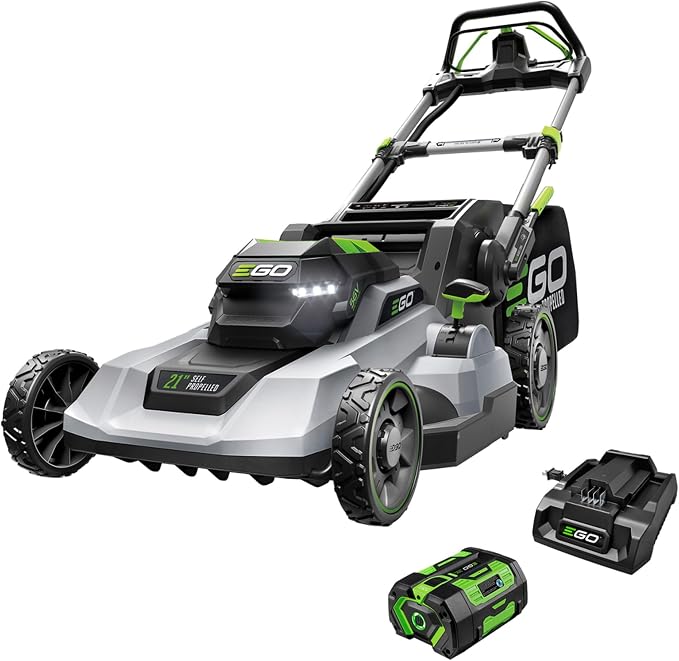
For homeowners who want more premium cutting performance, the EGO POWER+ LM2156SP 21-Inch Select Cut XP Self-Propelled Mower is my second choice. Its Touch Drive propulsion, strong cutting torque, Select Cut multi-blade system, and large 10Ah battery make it especially capable when uneven terrain is combined with dense or fast-growing grass.
The Toro 60V MAX 22-Inch Recycler with Personal Pace is an excellent option for homeowners who prefer a mower that responds naturally to their walking speed. Its rear-wheel-drive system, 22-inch steel deck, Personal Pace technology, and roughly 1-to-4-inch cutting-height range suit larger rolling lawns particularly well.
3 Best Cordless Mower for Uneven Lawns
| Image | Product Name | Check Price |
|---|---|---|
Best Choice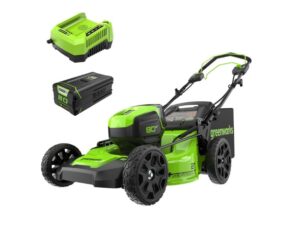 | Greenworks 80V 21-Inch Brushless Self-Propelled Lawn Mower | Check Price |
Second Best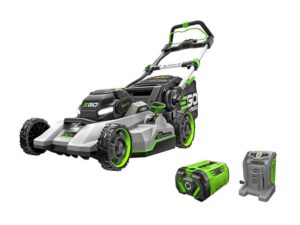 | EGO POWER+ LM2156SP 21-Inch Select Cut XP Self-Propelled Mower | Check Price |
Third Choice | Toro 60V MAX 22-Inch Recycler with Personal Pace | Check Price |
Why Uneven Lawns Need a Different Cordless Mower
A perfectly level lawn is relatively easy for almost any decent mower.
The deck remains at a fairly consistent angle, the wheels roll smoothly across the turf, and the operator does not have to constantly compensate for changes in elevation.
An uneven lawn is different.
Small depressions can cause one wheel to suddenly drop. Raised areas can bring the blade closer to the turf than intended. Tree roots, drainage channels, worn pathways, mole activity, settling soil, and naturally rolling terrain can all change how the mower sits relative to the grass.
This creates several problems.
One of the most common is lawn scalping.
When one or more wheels drop into a depression while the blade passes over a high point, the cutting deck may suddenly sit much closer to the ground. The result can be patches where the grass is cut dramatically shorter than the surrounding lawn.
Traction is another issue.
A lightweight push mower that feels effortless on flat ground can become tiring if you repeatedly have to push it up shallow hills, through thick low areas, and over small bumps.
Then there is cut consistency.
If a mower bounces or tilts excessively, one section of the lawn may end up noticeably shorter than another.
For these reasons, the features I prioritize for uneven lawns are different from those I would prioritize for a perfectly flat suburban yard.
I look for:
Self-propelled drive
Rear-wheel traction
Larger wheels
A cutting-height range reaching approximately 4 inches
Variable or responsive drive speed
A stable 20- to 22-inch deck
Strong brushless-motor performance
Enough battery capacity to power both the blade and propulsion system
Those characteristics make mowing rough ground easier, safer, and more consistent.
1. Greenworks 80V 21-Inch Brushless Self-Propelled Lawn Mower – Best Overall
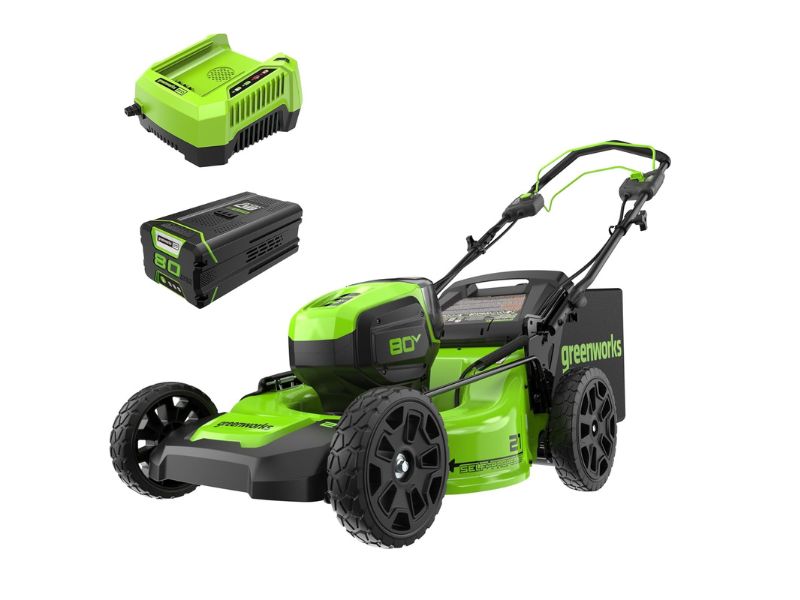
The Greenworks 80V 21-inch self-propelled mower is my first choice for uneven lawns because several of its most important design features directly address the problems that rough residential terrain creates.
It combines a brushless motor, variable-speed rear-wheel drive, 8-inch front wheels, 10-inch rear wheels, a 21-inch cutting deck, and multiple cutting-height positions.
For a lawn containing moderate slopes, shallow depressions, exposed roots, rough patches, and sections of inconsistent grass density, that is an excellent combination.
Rear-Wheel Drive Is a Major Advantage
A rear-wheel-drive mower is particularly useful when the lawn is not flat.
As you move uphill, more effective weight transfers toward the back of the mower.
That can increase traction at the rear wheels.
Because the Greenworks mower drives the rear wheels rather than relying entirely on your pushing force, it can continue pulling itself forward as the terrain rises.
This becomes even more useful when the grass bag begins filling.
A bag full of clippings adds additional weight toward the rear of the mower. On a rear-wheel-drive design, this weight can help keep the driven tires planted against the turf.
The result is generally a more confident feel on rolling residential terrain than you get from a basic push mower.
This does not mean any walk-behind mower should be used on dangerously steep slopes.
Operator safety and the mower manufacturer’s slope guidance always come first.
But for ordinary lawn undulations and moderate grades, rear-wheel-drive self-propulsion is one of the features I value most.
10-Inch Rear Wheels Handle Bumps Better
Another major reason I rank the Greenworks first is its 10-inch rear wheels.
Larger wheels generally roll over shallow ruts, bumps, and changes in soil level more smoothly than very small wheels.
Think about rolling a tiny caster wheel and a larger wheel over the same edge.
The small wheel drops farther relative to its diameter and tends to stop more abruptly.
The larger wheel transitions over the irregularity more gradually.
The same basic principle helps on lawns.
Larger rear wheels can make the mower feel less nervous as it crosses:
Exposed roots, shallow depressions, minor ruts, uneven soil, worn pathways, and transitions between different lawn sections.
The mower will still react to significant terrain changes.
No walk-behind mower can completely ignore a severely uneven yard.
But larger wheels make mild-to-moderate irregularities easier to negotiate.
Variable-Speed Self-Propulsion Adds Control
Different sections of an uneven lawn should not necessarily be mowed at the same speed.
On smooth open turf, you may want to move fairly quickly.
When approaching a root, depression, raised patch, landscaping border, or slope transition, slowing down gives the deck more time to follow the terrain.
It also gives you more time to steer.
The Greenworks variable-speed drive allows you to reduce forward speed rather than being forced to follow one aggressive preset pace.
This is important because an overly fast self-propelled mower can sometimes be harder to control on rough ground than a manual push mower.
A controllable drive system gives you the benefit of powered propulsion without making the mower feel as though it is pulling you through difficult sections.
High Cutting Settings Help Reduce Scalping
Uneven lawns usually benefit from being mowed slightly higher.
Trying to maintain very short turf on a bumpy lawn greatly increases the chance of scalping.
A high spot only needs to rise slightly before the blade reaches much closer to the grass crown than intended.
The Greenworks mower provides several height positions, with configurations in this family reaching approximately 4 inches at the upper end.
That additional clearance is useful.
On a rough lawn, I would generally begin at a relatively high setting.
Mow one section.
Then inspect the lawn for any areas where the mower has removed too much grass.
If there is no scalping, you can consider reducing the height slightly during future cuts.
This is much safer than starting too low.
Brushless Motor Helps With Uneven Grass Density
Uneven lawns are often uneven in more ways than one.
Low areas may retain more moisture and grow thicker.
Higher spots may dry out more quickly.
Shade from trees may make one area lush while another section remains relatively thin.
A mower may therefore move from light cutting into heavy grass within a few feet.
A brushless motor is useful because these motors are generally efficient, durable, and capable of responding well to changing load.
Greenworks also uses adaptive motor control in various 80V mower configurations so additional power can be delivered when heavier grass increases blade resistance.
That is valuable on a lawn where grass conditions change constantly.
Instead of operating at maximum demand all the time, the mower can use power more intelligently.
21-Inch Deck Is a Good Size for Rough Residential Yards
Deck size involves a tradeoff.
A very narrow mower can follow ground contours well but requires many more passes.
A very wide mower is productive on open turf but may bridge depressions and high points more noticeably.
A 21-inch deck sits in a useful middle ground.
It is wide enough to cut a medium residential lawn efficiently but still compact enough to maneuver around trees, landscaping, raised areas, and narrow passages.
For uneven suburban lawns, I generally prefer this size over either extreme.
A More Substantial Mower Can Feel Stable
Extremely lightweight mowers are easy to carry and pivot.
However, they can also feel more reactive when one wheel hits an irregularity.
A somewhat more substantial mower may feel planted as it rolls across bumpy ground.
The Greenworks 80V platform carries the weight of its battery, drive system, deck, and motor.
Normally that could make pushing harder.
But because the mower is self-propelled, the motor takes over much of that workload.
This is one of the reasons a sturdy self-propelled mower can be an excellent match for rough terrain.
You get better stability without having to manually push the mower’s full weight through the entire yard.
Battery Runtime
Runtime depends heavily on the battery included with the specific package.
Greenworks offers 80V mower configurations with different battery capacities.
Terrain is particularly important when estimating runtime.
A mower working on a smooth flat lawn requires less propulsion energy.
On an uneven lawn, the drive motor may be working more often.
Climbing grades consumes additional power.
Thick grass requires additional blade torque.
Repeated acceleration and speed changes can also affect battery usage.
Therefore, I would never choose a battery mower assuming that its maximum advertised runtime will always be achieved in a rough yard.
If your normal mowing session approaches the limit of one battery, having a second compatible battery is extremely convenient.
Mulching, Bagging, and Discharge Options
Uneven lawns often develop inconsistent grass growth.
That may influence how you want to manage clippings.
When the grass is dry and you mow frequently, mulching can work very well.
Fine clippings fall back into the turf and decompose.
If the low areas have grown much taller than the high sections, bagging may produce a cleaner finish.
Having multiple clipping-management options gives you more flexibility as lawn conditions change during the season.
Where the Greenworks Is Less Ideal
There are two main compromises.
First, this is not an ultralight mower.
If your yard contains many tiny spaces where you constantly need to pull the mower backward, lift the front end, and manually reposition it, a lighter machine may feel more agile.
Second, an 80V battery platform represents a larger initial investment than a basic low-voltage push mower.
However, the Greenworks system becomes much more economical if you already own or plan to buy other compatible 80V outdoor tools.
For homeowners with a genuinely uneven lawn, I think paying extra for rear-wheel self-propulsion, larger wheels, and stronger battery capability is justified.
Who Should Buy It?
The Greenworks 80V is my first choice if your lawn contains:
Moderate slopes, shallow ruts, dips, tree roots, rolling terrain, rough patches, thicker low areas, or a mixture of several of those conditions.
It strikes an excellent balance between terrain capability, battery power, deck size, wheel design, and value.
For the broadest range of uneven residential lawns, it is the mower I would choose first.
2. EGO POWER+ LM2156SP 21-Inch Select Cut XP Self-Propelled Mower – Best Premium Choice
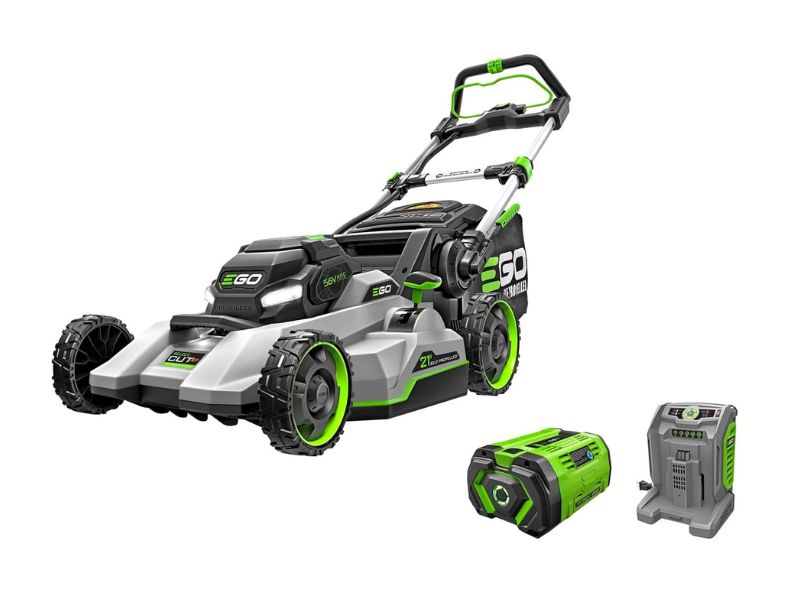
The EGO POWER+ LM2156SP is my premium choice and arguably the most capable mower in this comparison when cutting performance is considered separately from price.
It combines up to 8.3 ft-lb of cutting torque, EGO’s Select Cut multi-blade system, Touch Drive self-propel technology, variable propulsion speed, a 21-inch deck, and cutting-height positions ranging from approximately 1 to 4 inches.
The common kit includes a large 56V 10Ah ARC Lithium battery, giving the mower substantial energy capacity for demanding residential use.
Strong Cutting Torque Matters on Rough Lawns
The terrain itself is only part of the problem with an uneven yard.
Low sections frequently retain more moisture.
That can make grass thicker and heavier.
Shaded areas may also grow differently from dry raised areas.
A mower can therefore be moving through ordinary turf and suddenly encounter dense growth.
When blade torque is insufficient, blade speed can drop.
That may leave behind uncut blades or thick clumps of grass.
The LM2156SP’s strong torque gives it an advantage in these conditions.
EGO markets this model with up to 8.3 ft-lb of cutting torque, putting it among the stronger cordless walk-behind mowers in its class.
For a homeowner whose lawn is both uneven and thick, this matters.
Touch Drive Provides Precise Propulsion Control
EGO’s Touch Drive self-propel system is integrated into the handle.
You control propulsion while keeping your hands in a natural mowing position.
A separate dial allows speed adjustment.
This works well on changing terrain.
You can move quickly across open smooth turf, then reduce speed before reaching:
A depression, root, slope, tight turn, landscaping edge, or rough patch.
That control lets you guide the mower rather than simply following whatever speed the drive mechanism dictates.
On uneven ground, slowing down often improves cut consistency.
The deck has more time to transition across changing contours, and you have more time to correct direction before a wheel drops into a depression.
Select Cut Multi-Blade System
One of the major features separating the EGO from simpler battery mowers is its Select Cut system.
The mower works with different lower-blade options along with an upper blade.
Depending on the configuration, you can prioritize:
Mulching, bagging performance, or extended runtime.
This is useful on uneven lawns because grass conditions are rarely identical across the entire yard.
If your lower areas are dense and you are collecting clippings, you may prefer a stronger bagging configuration.
If the grass is relatively short and dry, a blade optimized for runtime may make more sense.
Wide Cutting-Height Range
The LM2156SP provides a cutting-height range of roughly 1 to 4 inches.
For uneven lawns, I care much more about the upper end of that range than the lower end.
A mower capable of cutting at one inch may sound impressive, but very low mowing is usually a poor match for bumpy ground.
Using a 3- to 4-inch setting gives the deck significantly more clearance.
That reduces the chance that a high spot will suddenly enter the blade path.
Easy Height Adjustment
The EGO’s centralized height adjustment is another useful feature.
On older mower designs, you may have to change each wheel separately.
That is annoying enough that homeowners often leave the mower at one setting all season.
A simpler adjustment mechanism makes it realistic to change deck height between different lawn sections.
You might mow a relatively level front yard slightly lower, then raise the deck before tackling a rough backyard.
That kind of flexibility is valuable.
Excellent Battery Capacity
The common LM2156SP kit uses a 56V 10Ah battery.
EGO advertises up to approximately 75 minutes of runtime under suitable conditions.
Actual mowing time will vary.
On uneven turf, self-propel use is often higher.
Thick patches increase cutting load.
Inclines require more drive energy.
Wet or overgrown grass can reduce runtime significantly.
Still, a 10Ah battery gives the mower a substantial energy reserve.
For a medium residential lawn, that is reassuring.
Fast Charging Is Useful for Larger Yards
Battery capacity is only one part of cordless mower convenience.
Charge time matters too.
With the appropriate EGO rapid charger, the large battery can be recharged relatively quickly compared with many older cordless systems.
That becomes especially important if you own a larger lawn.
If one battery cannot finish the entire yard, rotating two EGO batteries can make cordless mowing much more practical.
The same 56V battery platform works with many other EGO outdoor tools, which is another reason the mower makes sense for homeowners already invested in the ecosystem.
Strong Performance in Thick Grass
If your uneven lawn also tends to become overgrown between mowing sessions, the EGO is the mower I would lean toward.
Strong blade torque and the multi-blade system help when grass becomes dense.
This is particularly useful during spring growth when a lawn may become significantly taller between cuts.
A less powerful mower may require you to slow down dramatically or make multiple passes.
The EGO has more reserve performance.
Weather-Resistant Design
The LM2156SP has an IPX4 weather-resistant construction.
That does not mean you should mow in heavy rain or leave the mower exposed outdoors.
Wet grass can reduce traction and cutting quality regardless of the mower.
However, outdoor tools inevitably encounter damp conditions, morning dew, and occasional moisture.
Weather resistance is therefore a useful durability feature.
Why It Is Number Two
The EGO is arguably the most premium mower of the three.
So why is it not first?
The primary reason is value.
The Greenworks gives uneven-lawn buyers an especially attractive combination of 10-inch rear wheels, rear-wheel drive, cutting-height flexibility, and a substantial buyer history.
The EGO costs more and may be more mower than some homeowners need.
If your lawn is moderately uneven but the grass itself is not particularly difficult to cut, the Greenworks may offer the better value.
If your yard combines uneven terrain with thick, demanding turf, the EGO’s higher-end cutting system may justify its premium.
Who Should Buy It?
Choose the EGO LM2156SP if you want:
Strong cutting torque, premium self-propel control, a large battery, multiple blade options, easy height adjustment, and enough cutting capability for thick grass.
It is the strongest choice here for homeowners who care as much about cutting performance as terrain handling.
3. Toro 60V MAX 22-Inch Recycler with Personal Pace – Best Personal-Pace Option
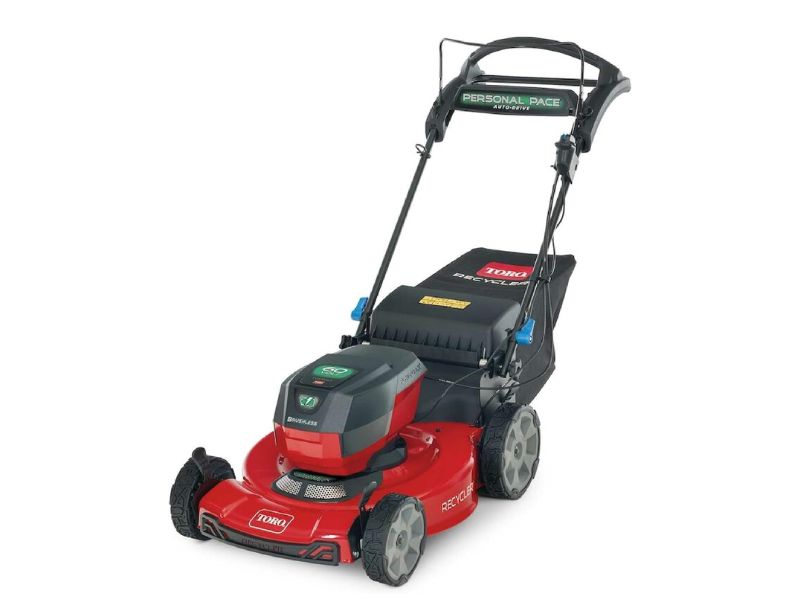
The Toro 60V MAX 22-inch Recycler with Personal Pace takes a different approach to self-propulsion.
Greenworks uses variable-speed rear-wheel drive.
EGO uses Touch Drive with adjustable speed.
Toro’s Personal Pace system is designed to respond more naturally to how quickly you push against the handle and walk behind the mower.
For rolling lawns where your pace constantly changes with the terrain, this can feel very intuitive.
The mower also combines rear-wheel drive, a 22-inch steel cutting deck, approximately 1-to-4-inch height adjustment, and Toro’s 60V Flex-Force battery platform.
Personal Pace Works Naturally on Rolling Terrain
One of the annoying things about some self-propelled mowers is that you always feel like you are adjusting to the mower.
The mower wants to travel at one speed.
You want to travel at another.
This can become more noticeable on uneven ground because your walking speed changes frequently.
You naturally slow down when climbing, approaching a rough depression, or turning.
Then you speed up once you reach open flat ground.
Toro’s Personal Pace design is intended to make the mower respond to those changes more naturally.
Instead of constantly reaching for a speed control, your movement helps determine propulsion.
For many users, this creates a very comfortable mowing experience.
Rear-Wheel Drive Helps on Hills and Dips
The Toro also uses rear-wheel drive.
That is one of the main reasons it made this list.
On a rolling lawn, rear-wheel traction can make climbing small grades easier.
This becomes particularly noticeable when the grass bag fills and adds weight toward the rear.
A mower with powered rear wheels is generally easier to control across changing elevations than a basic push mower.
22-Inch Deck Increases Productivity
Toro uses a 22-inch cutting deck, giving it a slightly wider path than the Greenworks and EGO models.
One extra inch may not sound significant.
But over a medium or larger lawn, every additional bit of cutting width reduces overlap and the number of total passes required.
The Toro therefore makes particular sense for relatively open lawns.
There is a tradeoff.
As decks become wider, they can potentially bridge uneven sections more than narrower decks.
However, a 22-inch deck is still within the normal residential walk-behind range.
It is not so large that it becomes difficult to control on ordinary rolling ground.
Steel Deck Feels Durable
The Toro Recycler uses a steel deck.
I like this for a mower expected to spend years traveling over bumpy turf.
Repeated vibration places stress on the mower structure.
A sturdy deck adds durability and helps the machine feel planted.
The downside is weight.
A steel mower can feel heavier than a lightweight polymer-deck machine when pulling it backward.
Fortunately, the self-propel system handles much of the forward workload.
Cutting Height Reaches About 4 Inches
Like the other two mowers, the Toro gives you enough height range to mow rough turf conservatively.
Its roughly 1-to-4-inch adjustment range allows you to raise the deck significantly when the ground is irregular.
For many uneven lawns, I would begin around 3 inches or higher.
Then inspect the cut.
If the mower clears every high spot without scalping, you can decide whether lowering the deck is appropriate for your grass type.
Recycler System Helps With Mulching
Toro’s Recycler design is built around processing clippings into smaller pieces so they can be returned to the lawn.
When grass is dry and you mow regularly, mulching can be very convenient.
You do not have to stop and empty a bag repeatedly.
Uneven lawns, however, can develop tall areas faster than others.
If the low sections have become particularly long, bagging may create a cleaner finish.
Having multiple clipping-management options makes the mower more versatile.
60V Flex-Force Battery Ecosystem
The mower is part of Toro’s 60V Flex-Force platform.
That means the battery can be shared with other compatible Toro equipment.
Cordless lawn tools become significantly more economical once several products use the same battery family.
If you already own a Toro 60V blower, trimmer, or other equipment, staying within the platform makes sense.
Likewise, if you buy the mower first, future Toro bare tools may cost less because you already own the battery and charger.
Storage Is Another Advantage
Toro’s SmartStow-style design on relevant Recycler models allows more compact upright storage.
This is not a terrain-performance feature.
But it matters if your garage or shed has limited room.
A 22-inch steel-deck mower occupies a considerable amount of floor space.
Being able to fold the handle and store the mower efficiently is useful.
Where the Toro Falls Behind
The Toro earns third place primarily because the particular battery model has a smaller current Amazon review base than the Greenworks and EGO listings.
That does not mean Toro’s Recycler platform is new.
Toro has a long history of producing walk-behind mowers.
However, for this specific cordless configuration, the buyer feedback pool is smaller.
I also think the Greenworks wheel setup and the EGO’s raw cutting performance provide clearer advantages for particularly rough conditions.
The Toro’s strongest selling point is Personal Pace.
If that responsive self-propel feel matters to you, it may be the best of the three despite ranking third overall.
Who Should Buy It?
Choose the Toro if you have a relatively open, rolling lawn and want:
A responsive self-propel system, rear-wheel drive, a durable 22-inch steel deck, high cutting settings, and a mower that naturally adapts to changes in walking speed.
Best Cordless Mower for Uneven Lawns Comparison
| Product | Deck Size | Drive System | Wheel / Terrain Advantage | Cutting Height | Battery | Best For |
| Greenworks 80V Self-Propelled | 21 in. | Variable-speed rear-wheel drive | 10-in. rear wheels | Up to about 4 in. | 80V | Best overall |
| EGO LM2156SP | 21 in. | Touch Drive variable self-propel | Strong control and torque | About 1–4 in. | 56V 10Ah | Premium cutting performance |
| Toro 60V Recycler | 22 in. | Personal Pace rear-wheel drive | Responsive walking-speed control | About 1–4 in. | 60V | Open rolling lawns |
What Makes a Cordless Lawn Mower Good for Uneven Ground?
Battery voltage gets a lot of attention, but it is not the first specification I would look at for rough terrain.
Mechanical design matters just as much.
Self-Propulsion
A self-propelled mower dramatically reduces the physical work required to move through an uneven lawn.
Every small rise becomes another place where a push mower requires additional effort.
With self-propulsion, the drive system carries much of the load.
You can concentrate on steering, deck position, and avoiding obstacles.
For a tiny uneven yard, a lightweight push mower can still work.
For medium and larger lawns, self-propulsion is worth paying for.
Rear-Wheel Drive
Rear-wheel drive is particularly useful on changing terrain.
As the mower moves uphill, rear-wheel traction often becomes more valuable.
A filled grass bag also adds weight above or near the rear axle.
That can help keep the drive wheels planted.
For these reasons, rear-wheel-drive models such as the Greenworks and Toro are especially appealing for rough lawns.
Wheel Size
Large rear wheels can roll across minor irregularities more smoothly.
They will not eliminate the effect of deep holes or exposed roots.
But they can make shallow bumps and depressions less disruptive.
The Greenworks mower’s 10-inch rear wheels are one of the strongest terrain-specific features among these three products.
Cutting-Height Range
A higher maximum cutting setting gives you more protection against scalping.
On a very smooth lawn, mowing low may be relatively straightforward.
On irregular turf, the same setting can cause the deck to strike every high spot.
A mower capable of reaching around 4 inches gives you more room to experiment.
Motor Power
Rough lawns frequently have thick grass in low areas.
A strong brushless motor helps maintain blade speed when conditions suddenly become heavier.
This is where the EGO LM2156SP particularly stands out.
Its strong cutting torque makes it a good match for difficult turf as well as difficult terrain.
Are Larger Wheels Better for Uneven Lawns?
Generally, yes.
A larger wheel does not fall as sharply into small surface irregularities.
That can make transitions smoother.
Large wheels are particularly useful when dealing with:
Minor ruts, tree-root areas, worn patches, slightly raised soil, and naturally rolling turf.
However, wheel diameter is only one part of mower stability.
You also need to consider:
Wheelbase, mower weight, deck width, traction pattern, self-propel design, and operating speed.
A mower with large rear wheels and powered rear-wheel traction gives you more terrain capability than large wheels alone.
Rear-Wheel Drive vs. Front-Wheel Drive for Uneven Lawns
For uneven terrain, I generally prefer rear-wheel drive.
Front-wheel drive works very well on flat lawns where frequent turns are required.
You can often lift the front wheels slightly to pivot.
However, traction can decrease if the front becomes light while climbing.
Rear-wheel drive is usually better suited to slopes and rolling terrain because the rear wheels remain loaded as the mower climbs.
That is why both the Greenworks and Toro designs are attractive here.
What Cutting Height Should You Use on a Bumpy Lawn?
There is no universal setting for every grass species.
But when dealing specifically with uneven ground, starting high is sensible.
For many lawns, approximately 3 to 4 inches is a useful starting range.
The higher deck gives you additional clearance over raised soil.
After mowing, inspect high areas carefully.
If you see patches that have suddenly turned pale or brown because too much leaf material was removed, you are likely scalping the lawn.
Raise the deck before the next cut.
The best cutting height also depends on the turf species, climate, season, and lawn health.
Why Does My Mower Scalp High Spots?
Scalping happens when the cutting blade gets too close to the soil or grass crown.
On uneven terrain, common causes include:
A wheel dropping into a low area.
The deck crossing a high point.
Cutting height set too low.
Sharp turns on uneven ground.
Severe lawn humps.
A wide mower bridging depressions.
A better mower can reduce scalping, but it cannot completely compensate for severe ground problems.
If the same spot gets scalped every time regardless of mower settings, leveling the ground may be the real solution.
Is a Lightweight Cordless Mower Better for Uneven Ground?
Not necessarily.
Lightweight mowers have advantages.
They are easier to turn, lift, reverse, and maneuver around landscaping.
But very lightweight machines may also bounce more noticeably across irregular turf.
Heavier mowers can feel more planted.
The ideal compromise is often a reasonably substantial mower with self-propulsion.
That gives you deck stability without forcing you to manually push the entire mower weight.
All three products in this guide use self-propel systems for exactly that reason.
Is an 80V Mower Better Than a 56V or 60V Mower?
Not automatically.
Battery voltage alone does not determine mower quality.
A higher voltage allows manufacturers to design power systems in different ways, but overall performance depends on many variables:
Motor design, battery capacity, controller efficiency, blade geometry, deck airflow, drive system, and software.
The 56V EGO can deliver extremely strong cutting performance despite having a lower nominal voltage than the Greenworks 80V.
Similarly, Toro’s 60V system provides enough power for a full-size self-propelled Recycler mower.
Do not choose solely from the voltage printed on the battery.
How Much Battery Runtime Do You Need?
Estimate how long your actual lawn takes to mow.
Do not rely only on acreage.
A flat open quarter-acre lawn may be very quick to cut.
Another yard of the same size may contain:
Trees, garden beds, slopes, narrow pathways, rough sections, and landscaping obstacles.
That second lawn will require far more time.
Uneven terrain can also reduce battery life because self-propulsion works harder.
If your normal mowing time is 45 minutes, I would prefer a battery system with more than exactly 45 minutes of ideal claimed runtime.
Extra capacity provides a margin for:
Tall grass, slopes, aging batteries, hot weather, heavy mulching, and wet conditions.
How to Mow an Uneven Lawn Without Scalping It
The mower is only part of the solution.
Technique matters.
Use a relatively high cutting setting.
Slow down before major dips or bumps.
Avoid aggressively forcing the mower over high spots.
Allow the wheels to follow the surface.
Change your mowing direction periodically.
If you always mow the exact same route, wheel tracks and uneven wear can become more obvious.
Be careful around exposed tree roots.
Never intentionally run the mower deck directly over large roots.
A blade strike can damage both the mower and the tree.
Should You Mow Across or Up and Down Slopes?
Always prioritize the mower manufacturer’s safety instructions.
For walk-behind mowers, common safety guidance often involves mowing across the face of slopes rather than directly up and down, but exact recommendations and maximum safe slope limits vary.
Avoid mowing slopes where you cannot maintain secure footing.
Cordless self-propulsion makes hills easier, but it does not make unsafe terrain safe.
Wet grass can also reduce traction dramatically.
If a slope feels unsafe while dry, do not attempt it simply because the mower has rear-wheel drive.
When Should You Level the Lawn Instead?
A better mower can handle moderate unevenness.
It cannot repair the yard.
If the lawn has:
Very deep depressions, severe humps, large exposed roots, drainage channels, major soil settlement, or repeated scalping at every practical cutting height,
then grading or leveling may produce a greater improvement than buying another mower.
Minor low areas may sometimes be corrected gradually with appropriate topdressing.
Major grading problems may require professional assistance.
The goal should be to make the terrain reasonably mowable instead of expecting a walk-behind mower to absorb severe impacts indefinitely.
Frequently Asked Questions
What is the best cordless mower for uneven lawns?
The Greenworks 80V 21-inch self-propelled mower is my best overall choice.
Its combination of variable-speed rear-wheel drive, 10-inch rear wheels, a 21-inch deck, brushless power, and high cutting settings makes it particularly well suited to moderately bumpy and rolling residential lawns.
What type of mower is best for uneven ground?
A rear-wheel-drive self-propelled mower with larger wheels and high cutting settings is usually best.
Self-propulsion reduces fatigue, rear-wheel traction helps on slopes, and larger wheels cross small irregularities more smoothly.
Are cordless mowers good for uneven lawns?
Yes, modern cordless self-propelled mowers can handle uneven residential lawns very well.
Choose a model with enough battery capacity, strong drive performance, good wheel traction, and a cutting-height range appropriate for rough turf.
Is a self-propelled mower worth it for a bumpy lawn?
Yes, especially for medium or large uneven yards.
The drive system handles much of the forward effort, allowing you to concentrate on steering and controlling the mower over dips and rises.
Is rear-wheel drive better for uneven lawns?
Rear-wheel drive is one of the best choices for rolling or moderately sloped terrain.
The rear wheels can maintain useful traction while climbing and may gain additional grip as weight shifts toward the back of the mower.
Are big rear wheels better on rough lawns?
Yes, larger rear wheels generally negotiate small bumps and depressions more smoothly.
The Greenworks’ 10-inch rear wheels are one of the main reasons it earns the top position in this comparison.
Is the EGO LM2156SP good for uneven lawns?
Yes, especially if the lawn also has thick or difficult grass.
Its strong cutting torque, Touch Drive self-propulsion, Select Cut blade system, and wide cutting-height range give it excellent control and cutting performance.
Is Greenworks 80V better than EGO 56V?
Greenworks has the terrain-handling advantage here, while EGO offers more premium cutting performance.
The Greenworks provides large rear wheels and rear-wheel drive. The EGO counters with very strong torque, sophisticated propulsion controls, and a multi-blade cutting system.
Is Toro Personal Pace good for uneven terrain?
Yes, Personal Pace is particularly useful when your walking speed constantly changes with the terrain.
The Toro also combines that system with rear-wheel drive and a durable 22-inch steel cutting deck.
What mower height is best for an uneven lawn?
Starting around 3 to 4 inches is sensible for many bumpy lawns.
The exact height depends on grass species and conditions, but higher settings provide more blade clearance and reduce scalping.
Can cordless lawn mowers handle hills?
Yes, powerful self-propelled cordless mowers can handle moderate residential hills.
However, battery propulsion does not override manufacturer slope limits or basic safety precautions. Avoid steep, slippery, or unstable slopes.
Do battery mowers use more power on uneven ground?
Yes, uneven terrain can reduce runtime.
Self-propulsion, climbing, thick grass, and frequent changes in speed all require additional energy compared with mowing smooth flat turf.
Should I mow a bumpy lawn slowly?
Yes, slowing down over rough areas generally improves control and cut consistency.
It gives the wheels more time to follow the terrain and reduces the chance of the deck suddenly dropping into a depression.
Final Verdict
For most homeowners searching for the best cordless mower for uneven lawns, the Greenworks 80V 21-inch self-propelled mower is my first recommendation.
Its variable-speed rear-wheel drive, 10-inch rear wheels, brushless motor, 21-inch deck, and high cutting settings directly address many of the problems that make rough turf difficult to mow.
The EGO POWER+ LM2156SP is the better premium choice when uneven ground is combined with dense or demanding grass. Its strong cutting torque, Touch Drive propulsion, Select Cut blade system, large 10Ah battery, and broad height adjustment give it impressive cutting capability.
The Toro 60V MAX Recycler with Personal Pace is the best fit for homeowners who want the mower to respond naturally to changes in walking speed. Its rear-wheel drive, Personal Pace operation, 22-inch steel deck, and high cutting range make it particularly comfortable on open rolling lawns.
The key is not simply buying the mower with the highest battery voltage. For rough terrain, traction, wheel size, self-propel control, deck stability, cutting height, and mowing technique matter just as much as motor power.
Raise the deck when necessary, slow down over severe irregularities, and correct major ground problems instead of expecting the mower to absorb them forever. With the right combination of mower design and technique, an uneven lawn can be cut much more consistently without the fatigue and scalping that come from using the wrong machine.

I’m Maya L. Greenwood, a lifelong plant lover who believes anyone can grow something beautiful with the right guidance. After years of testing soil mixes, pruning methods, irrigation tricks, and pest-safe solutions, I started EasyGardenTips.com to turn hard-won lessons into step-by-step advice. From seed starting and container gardens to composting and seasonal checklists, my goal is to make gardening simple, sustainable, and fun.