5 Best Self Propelled Electric Lawn Mower for Hills: Explained
Finding the best self propelled electric lawn mower for hills means looking beyond battery power and deck size. Sloped lawns demand dependable traction, manageable speed, enough runtime to finish the job, and controls that do not make the mower harder to handle.
My primary recommendation is the EGO POWER+ 21″ Cordless Electric Lawn Mower. It combines a strong 56V battery, up to 6.0 ft-lbs of cutting torque, a 21-inch deck, and a self-propel system that can be engaged with either hand. The Electric Lawn Mower ranked second is the clearest alternative for shoppers who value one-touch electric height adjustment and adjustable self-propelled speed.
The five models below were compared by examining their drive systems, traction-related features, motor output, battery capacity, claimed coverage, cutting adjustments, deck design, mowing modes, and ownership details. Because slopes vary greatly, the rankings also account for practical limitations such as runtime, available user feedback, and whether the design appears better suited to small or larger properties.
Best Self Propelled Electric Lawn Mower for Hills Picks at a Glance
| Product | Name | Price |
|---|---|---|
 |
EGO POWER+ 21″ Cordless Electric Lawn Mower | Check Price |
 |
Electric Lawn Mower | Check Price |
 |
20.5″ 40V Brushless Cordless Electric Self Propelled | Check Price |
 |
Greenworks 80V 21in Self-Propelled Lawn Mower | Check Price |
 |
Litheli 18″ Self-Propelled Lawn Mower | Check Price |
1. EGO POWER+ 21″ Cordless Electric Lawn Mower
The EGO POWER+ LM2114SP takes the top position because it offers the most balanced combination of cutting strength, runtime, deck coverage, and control for sloped residential lawns. Its 56V 6.0Ah ARC Lithium battery provides up to 50 minutes of runtime on a charge, although actual results will vary with grass density, terrain, and how much self-propelled drive is used. That is a useful reserve for homeowners who do not want to stop halfway through a mowing session.
Cutting performance is another reason it ranks first. The mower is rated for up to 6.0 ft-lbs of cutting torque, and its brushless motor is designed for long runtimes, low vibration, and durability. The 21-inch deck can cover a practical amount of lawn per pass without becoming unusually large or cumbersome. Seven cutting-height positions from 1.25 to 4 inches also give the operator flexibility when mowing through different grass conditions.
On hills, the dual-toggle handleset is particularly useful. It lets the operator engage self-propelled operation with either hand, which can make hand placement more natural while steering around a slope or changing direction. A push-button start keeps operation simple, and the mower supports mulching, bagging, and side discharge.
The main trade-off is that the stated 50-minute figure is a maximum claim rather than a guarantee for hilly, thick, or wet grass. Self-propelled use can also consume battery energy faster than simply pushing. Before buying, confirm that the included 56V battery and charger fit your storage and charging routine; this is a complete kit, not merely a bare tool. Keep the blade and underside clear of packed clippings, and use the highest suitable cutting setting when grass is tall to reduce the chance of bogging down.
2. Electric Lawn Mower
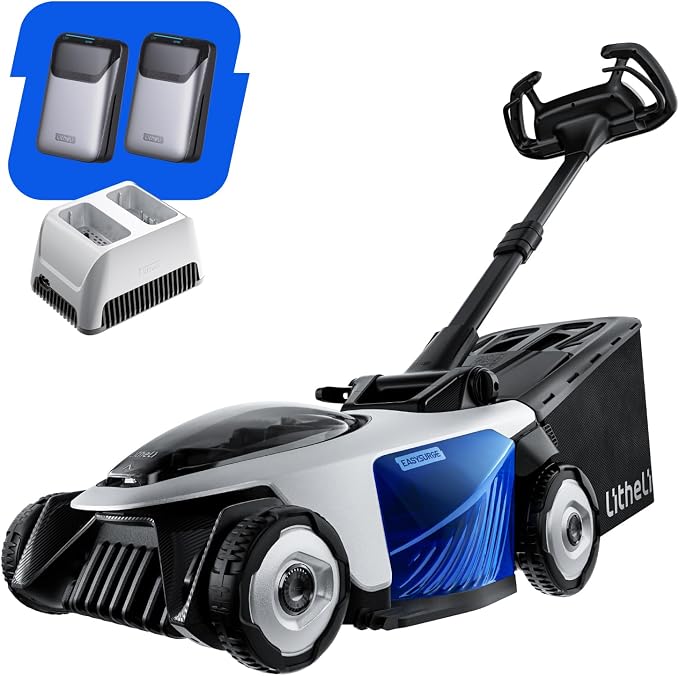
This 40V self-propelled mower is a strong second choice because it adds an unusual convenience feature: six-position electric cutting-height adjustment. Instead of bending down to move a manual lever, the operator can change height with one touch. That can be helpful when a sloped yard has sections requiring different treatment, or when starting high and gradually lowering the cut to reduce the chance of stalling.
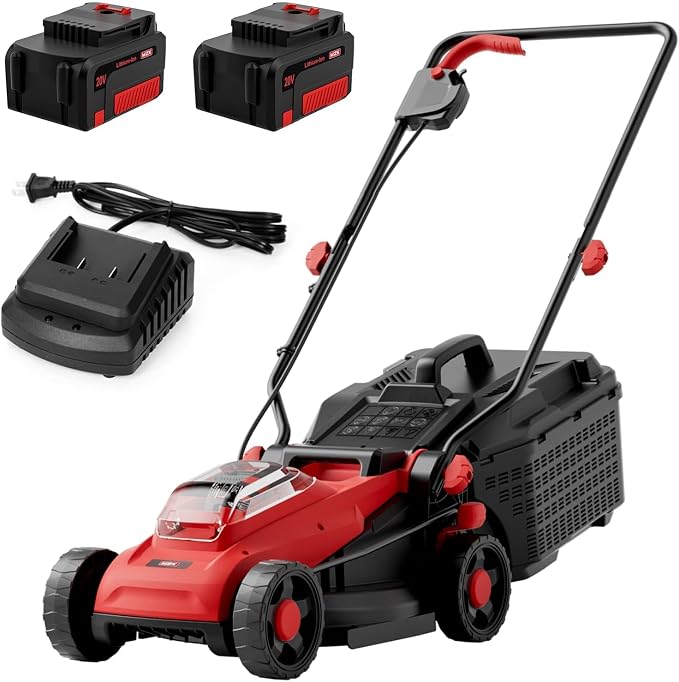
The mower uses two 20V batteries together and includes two 4.0Ah batteries with a rapid charger. Its claimed runtime is up to 30 minutes, covering as much as 1/6 acre under stated conditions. That is considerably less reserve than the top-ranked EGO, so this model makes more sense for a smaller property or a homeowner who is comfortable charging between sessions. Terrain, grass type, and operating conditions can reduce the actual mowing area.
Its self-propelled speed varies from 1.3 to 2.9 mph. Variable speed matters on hills because a slower pace can provide more deliberate control, while a higher setting can make open areas less tedious. The Easysurge system is rated for up to 4,100 RPM, and the brushless motor is intended to handle different grass types efficiently. The 18.5-inch deck is narrower than the EGO’s, which may help maneuverability in tighter areas but requires more passes across a large lawn.
The folding T-shaped handle is designed for easier storage, bag placement, and removal. That is a useful ownership detail for garages with limited room. Its main limitation is the shorter runtime and smaller deck. Buyers should keep both batteries charged and follow the suggested practice of beginning with a higher cutting setting before moving lower. If your property approaches the claimed 1/6-acre coverage regularly, the larger-battery EGO or Greenworks model may provide a more comfortable margin.
3. 20.5″ 40V Brushless Cordless Electric Self Propelled
This mower earns third place by offering a substantial dual-battery energy reserve, a relatively wide deck, and a broad range of cutting adjustments. Its 40V system combines two 20V Max 8.0Ah batteries, producing a stated 296Wh of rated energy. The manufacturer says that reserve supports lawns up to 1/4 acre per charge and represents 48% more battery energy than a 200Wh setup. That makes it an interesting option for homeowners who need more coverage than a compact cordless mower can provide.
The self-propelled drive is intended to reduce pushing effort on larger lawns, slopes, and uneven areas. Its 20.5-inch deck sits between the 18.5-inch model ranked second and the 21-inch models above it, offering a reasonable compromise between coverage and maneuverability. The brushless motor can reach up to 4,100 RPM and is designed to maintain cutting performance as conditions change.
Practical flexibility is a strength. The mower has a 3-in-1 system for mulching, bagging, and rear discharge, an 8-level height adjustment from 1.2 to 3.9 inches, and a 16-gallon grass bag. The bag’s capacity may reduce emptying interruptions when collecting clippings over a larger area.
It ranks below the first two options mainly because the supplied customer feedback is much thinner and less favorable: the listed rating is 2.9 from only 10 reviews. That does not establish that every unit will perform poorly, but it does make long-term ownership confidence harder to judge. Buyers should verify that both 20V batteries and the charging equipment are included as expected and keep the paired batteries maintained together. Its claimed quarter-acre coverage is useful guidance, not a promise for steep slopes, tall grass, or frequent self-propelled operation.
4. Greenworks 80V 21in Self-Propelled Lawn Mower
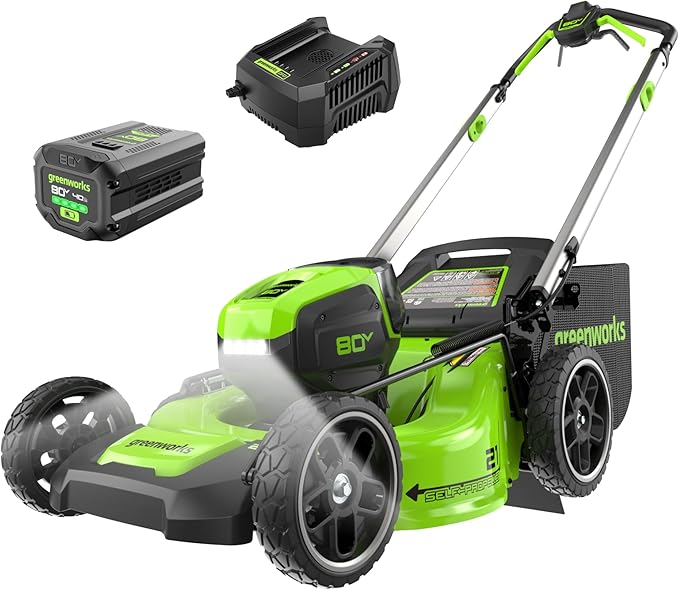
The Greenworks 80V model is a compelling choice for larger lawns and for shoppers already invested in the Greenworks 80V tool system. It includes a 4.0Ah battery and charger, and the manufacturer claims coverage of up to 1/2 acre on a full charge. Actual coverage depends on grass condition and operator technique, but the stated capacity gives this mower one of the strongest large-yard positions in the group.
A brushless motor and durable 21-inch steel deck give it a substantial design for routine residential mowing. The rear-wheel-drive self-propelled system is especially relevant to hills because it is built around traction, maneuverability, and control. Variable speed allows the operator to choose a more comfortable pace rather than being forced to move at one fixed rate. The mower also operates more quietly than gas equipment according to the supplied product information, and LED headlights support early-morning or late-evening mowing.
Another significant ownership advantage is platform compatibility. The included battery works with more than 75 Greenworks 80V tools, including trimmers, blowers, and chainsaws. Someone building a larger cordless yard-care collection may be able to share batteries across equipment, although the mower itself comes with the listed 4.0Ah battery and charger. Greenworks also backs the tool and battery with a four-year limited warranty.
The reason it does not rank higher is not a lack of capability. Rather, the EGO offers a stronger stated torque figure and longer listed runtime, while the second-ranked mower adds more specialized height-adjustment convenience. The Greenworks remains a particularly sensible purchase when half-acre coverage, rear-wheel drive, and ecosystem compatibility matter most. On a steep property, maintain a controlled walking pace, avoid mowing when the surface is slippery, and remember that a larger battery claim will still vary with slope, grass height, and driving frequency.
5. Litheli 18″ Self-Propelled Lawn Mower
The Litheli 18-inch mower is designed around easier handling on smaller lawns, uneven ground, and modest slopes. Its self-propelled drive has stepless speed adjustment from 1.4 to 2.9 mph, allowing the operator to select a pace that feels controlled rather than relying on a limited number of settings. The product information specifically describes resistance to rollback and wheel slip, along with the ability to move through thick or tall growth without stalling or clogging.
Power comes from two 5.0Ah batteries in a 40V system. The upgraded battery capacity is described as 25% greater than a 4.0Ah battery, with coverage suitable for areas up to 1/8 acre. That makes the mower better aligned with small yards than large properties. The 18-inch cutting width should be easier to guide around obstacles and narrow sections, but it will require more passes than a 21-inch deck on an expansive lawn.
The brushless motor is intended to deliver steady power with low noise and minimal vibration. Six cutting heights range from 0.98 to 2.98 inches, and the three-position handle accommodates users from 5.3 to 6.7 feet tall. It uses a 2-in-1 mulching and bagging system rather than offering side or rear discharge as an additional option. Two spare blades are included, which is a useful maintenance provision if the original blade becomes damaged or dull.
The trade-off is the listed 3.0 rating from 99 reviews, which provides less reassurance than the higher-rated EGO and Greenworks models. Its 1/8-acre coverage also limits its appeal for larger yards or long, steep mowing sessions. Buyers should confirm how the two batteries are charged and stored, inspect the blades after encountering branches or stones, and use the adjustable speed deliberately on slopes. For a compact lawn where maneuverability and spare blades matter, it remains a practical lower-ranked option.
How to Choose the Best Self-Propelled Electric Mower for Hills
A mower that works well on a flat suburban lot may feel completely different on a slope. The drive system has to move the machine uphill without making steering unpredictable, while the operator must remain able to slow down, turn, and stop safely. Battery capacity also becomes more important because self-propelled operation uses energy in addition to the energy required to spin the blade.
Start with the shape and size of the property
Coverage claims provide a useful starting point, but they should not be treated as guarantees. The listed models range from the Litheli’s claimed 1/8 acre to the Greenworks model’s claimed 1/2 acre. The second-ranked mower is listed for up to 1/6 acre, while the dual-20V model is described for lawns up to 1/4 acre. EGO lists up to 50 minutes of runtime rather than an acre figure.
Hills, tall grass, damp conditions, frequent turns, and constant self-propelled use can all reduce real-world coverage. If your lawn is close to a mower’s stated limit, choose the model with more battery reserve or plan a charging break. A mower that finishes comfortably is generally more useful than one that appears adequate only under ideal conditions.
Understand why battery energy matters on slopes
Battery labels can be confusing because voltage and amp-hour capacity describe different parts of the system. Voltage indicates the electrical platform, while amp-hours describe capacity within that platform. Watt-hours, when supplied, offer a more direct way to compare total rated energy. The third-ranked mower, for example, lists a 296Wh dual-battery system, while the other products emphasize their voltage and amp-hour configurations differently.
Do not compare a 40V mower and an 80V mower by voltage alone. Runtime depends on the battery’s total energy, blade load, speed, grass conditions, and how often the drive system is engaged. A high-capacity battery can provide more operating margin, but steep terrain and heavy growth may still shorten a session.
Give traction and drive layout priority
For hills, self-propelled operation is not simply about eliminating effort. It should help the mower maintain a predictable pace while the operator guides it. The Greenworks model specifically uses rear-wheel drive with variable speed control. The Litheli emphasizes resistance to rollback and wheel slip. The EGO uses a dual-toggle handleset so self-propelled operation can be engaged with either hand.
These features address different parts of the problem. Rear-wheel drive can be meaningful when traction at the rear wheels is important, while variable speed helps the operator match the mower to the slope. A control that can be operated comfortably with either hand may help when repositioning grip. Look for the combination that best matches your yard rather than treating any single feature as a guarantee of safe performance.
Choose a speed range you can control
Higher speed is not always better on a slope. A faster setting can reduce mowing time on level ground, but a slower setting may be more manageable near landscaping, uneven sections, or turns. The second-ranked mower offers a range from 1.3 to 2.9 mph, and the Litheli offers a stepless 1.4-to-2.9-mph range.
A wide range gives the operator more opportunity to find a comfortable pace. If a product has variable-speed control, use the lower end when learning the mower and when approaching transitions in the terrain. Avoid allowing the machine to become difficult to steer simply because a higher setting is available.
Consider deck width and maneuverability
A wider deck reduces the number of passes needed, which can be valuable on a larger property. The EGO and Greenworks models use 21-inch decks, while the third-ranked mower uses a 20.5-inch deck. The second-ranked mower has an 18.5-inch deck, and the Litheli uses an 18-inch deck.
Width is only one part of usability. A narrower mower may be easier to guide around trees, garden borders, gates, and tight side yards. A larger deck may cover open ground faster but can feel less convenient in confined spaces. On a hilly property with many obstacles, maneuverability may be worth more than saving a few passes.
Match the height adjustment to your mowing habits
Height adjustment becomes especially useful when grass is long or when different parts of the property grow at different rates. The EGO provides seven positions from 1.25 to 4 inches. The third-ranked mower has eight positions from 1.2 to 3.9 inches. The second-ranked model offers six positions and uses an electric adjustment system that can be changed with one touch.
The electric adjustment is convenient, but it should not be the only deciding factor. A broad height range and easy-to-understand controls are more important if you regularly vary the cutting height. Starting high and lowering gradually can help reduce the risk of stalling in tall grass, a practice specifically recommended for the second-ranked mower.
Decide how you want to handle clippings
Mulching returns finely cut clippings to the lawn, while bagging collects them for removal. Discharge options can be useful when grass is especially heavy or when collecting every clipping is not practical. The EGO supports mulching, bagging, and side discharge. The second-ranked mower supports its stated mowing functions but the supplied details do not specify a three-way discharge arrangement. The third-ranked model offers mulching, bagging, and rear discharge, while Litheli is specified as a 2-in-1 mulching and bagging mower.
The Greenworks feature data supplied here does not specify its clipping modes, so verify the exact configuration before purchase if that detail affects your decision. Also consider bag capacity. The third-ranked mower lists a 16-gallon grass bag, which may mean fewer emptying stops during a long session.
Think about battery compatibility before buying
Battery compatibility can change the value of a cordless mower over time. Greenworks clearly states that its 80V battery platform works with more than 75 tools, including trimmers, blowers, and chainsaws. That is a meaningful advantage for an owner already using Greenworks 80V equipment or planning to build that collection.
The other products are presented with their own included battery arrangements. The EGO includes a 56V 6.0Ah ARC Lithium battery, the second mower includes two 4.0Ah batteries and a rapid charger, the third uses two 20V Max 8.0Ah batteries, and the Litheli includes two 5.0Ah batteries. Confirm charger inclusion, battery quantity, and platform requirements on the specific listing before ordering. Do not assume batteries from a different voltage system will interchange.
Account for storage and charging
Electric mowers avoid fuel storage and engine maintenance, but they still need a dry, convenient place for the mower, batteries, and charger. The second-ranked model has a folding T-shaped handle intended to simplify storage and bag removal. Other folding or storage details were not supplied for the remaining models, so check the product instructions and dimensions if garage space is limited.
Charge batteries according to the manufacturer’s instructions and avoid leaving the mower where moisture can collect around electrical components. Keeping the charger accessible makes it more likely that the mower will be ready when the grass needs attention. If your yard requires multiple sessions, plan the charging schedule before beginning rather than waiting until the battery is nearly empty.
Use safe mowing habits on slopes
Even a self-propelled mower requires active control. Walk at a deliberate pace, keep both hands positioned securely on the handle, and avoid sudden changes in direction. Do not mow when the grass is slippery if doing so makes traction uncertain. Remove branches, stones, and other objects before mowing because they can damage blades or become projectiles.
On a slope, use the direction and technique recommended in the mower’s manual. Keep the mower under control during turns and at the top or bottom of a grade. If the mower begins to slide, bog down, or move faster than you can safely manage, stop and reassess rather than forcing it through the area. A self-propelled feature reduces pushing effort; it does not remove the need for safe operating judgment.
Plan simple maintenance
Battery mowers need less routine mechanical maintenance than gas mowers, but the cutting system still requires attention. After allowing the mower to stop completely, inspect the underside for packed grass and check the blade for damage or dullness. The Litheli includes two spare blades, which may be useful over the life of the mower. For every model, use only the replacement parts and procedures specified by the manufacturer.
Keep ventilation areas clear, inspect the handle and drive controls, and make sure the grass bag or discharge components are properly attached before mowing. A clean deck can help prevent buildup that interferes with clipping flow. Do not wash electrical components casually; follow the owner’s instructions for cleaning and storage.
Use ratings as context, not the entire decision
The supplied ratings range from 2.9 for the third-ranked mower to 4.4 for both the EGO and Greenworks models. Review count also varies considerably, from only 10 reviews for the third-ranked model to 709 for Greenworks. A larger review history can provide more ownership context, but it does not guarantee that a particular mower will suit every lawn.
Pay attention to the pattern of features that match your yard. A shopper with a large slope may prioritize battery reserve and rear-wheel drive. Someone with a small, uneven lawn may prefer a narrower deck and a wide speed range. Another homeowner may place greater value on the EGO’s cutting torque, the second mower’s one-touch height adjustment, or Greenworks platform compatibility.
FAQ About Self-Propelled Electric Mowers for Hills
What is the best self-propelled electric mower for hills in this roundup?
The EGO POWER+ 21-inch model is the leading choice because it combines a 56V 6.0Ah battery, up to 50 minutes of listed runtime, up to 6.0 ft-lbs of cutting torque, a 21-inch deck, and a dual-toggle self-propel control. The Greenworks 80V model is a strong alternative for larger yards and buyers who value rear-wheel drive and compatibility with more than 75 Greenworks 80V tools.
Is rear-wheel drive important for mowing hills?
Rear-wheel drive can be useful because it is designed to provide traction and control, and the Greenworks model specifically lists rear-wheel drive with variable speed. However, drive layout alone does not make a mower suitable for every slope. Battery reserve, speed control, surface conditions, operator technique, and the specific slope all matter.
How much battery runtime do I need for a sloped lawn?
Choose based on total mowing time rather than acreage alone. Hills and tall grass can consume more energy, especially when self-propelled drive is used continuously. The EGO lists up to 50 minutes, the second-ranked mower lists up to 30 minutes and up to 1/6-acre coverage, and other models provide different acreage estimates. Leave a practical margin instead of planning to finish with only a few minutes of charge remaining.
Can an electric mower handle tall grass on a hill?
Several products are described as handling thick or tall growth, but results depend on grass condition and mowing height. Begin with a higher cutting setting, then lower it if needed. Move at a controlled speed, avoid wet or slippery conditions, and never force the mower if the blade begins to bog down.
Is a narrower mower better for a small hilly yard?
It can be. An 18- or 18.5-inch deck may be easier to maneuver around obstacles and narrow areas, while a 21-inch deck can reduce passes across open ground. The best choice depends on whether your priority is tight-space control or faster coverage.
Do self-propelled electric mowers eliminate pushing on slopes?
No. They reduce the effort required to move the mower, but the operator still has to steer, control speed, manage turns, and respond to changing traction. Treat self-propulsion as assistance rather than a substitute for safe handling.
Final Verdict
The EGO POWER+ 21-inch mower is the strongest all-around pick for hilly residential lawns, while the second-ranked Electric Lawn Mower is the best alternative for shoppers who want one-touch height adjustment and adjustable drive speed. Choose Greenworks for larger coverage and 80V tool compatibility, and consider the narrower Litheli or dual-battery 40V model when their specific size or capacity better matches your property.

I’m Maya L. Greenwood, a lifelong plant lover who believes anyone can grow something beautiful with the right guidance. After years of testing soil mixes, pruning methods, irrigation tricks, and pest-safe solutions, I started EasyGardenTips.com to turn hard-won lessons into step-by-step advice. From seed starting and container gardens to composting and seasonal checklists, my goal is to make gardening simple, sustainable, and fun.