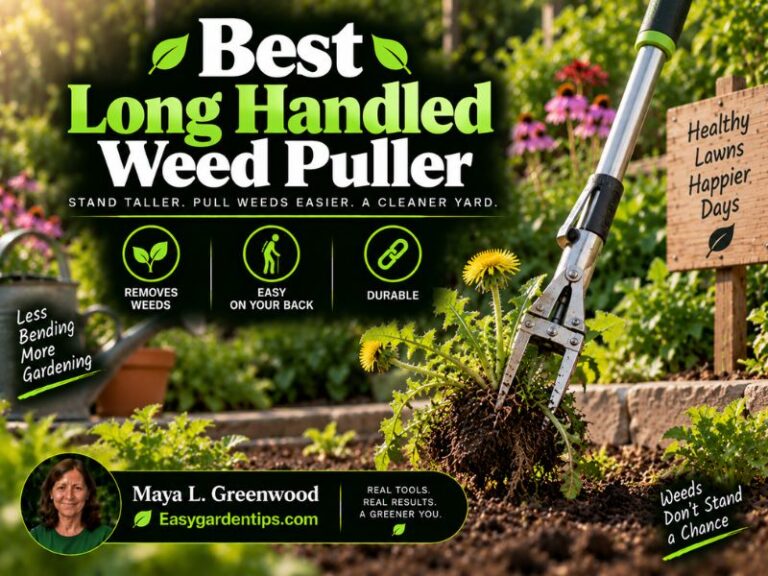
3 Best Dandelion Weeder Tools for Fast, Complete Root Removal
The best dandelion weeder for most homeowners is Grampa’s Weeder Original Stand Up Weed Puller. It has an exceptionally large Amazon buyer history, a simple four-claw steel head, and a long bamboo handle that lets you pull dandelions without kneeling or bending.
For a more modern stand-up design, the Fiskars 4-Claw Stand-Up Weed Puller is my second choice. Its stainless-steel claws, reinforced foot platform, ergonomic handle, and weed-eject mechanism make repetitive lawn weeding fast and comfortable.
If stubborn taproots are your main problem, the Radius Garden 205 PRO Stainless Steel Weeder offers more digging leverage than a claw-style puller. University of California IPM testing gave it top marks for removing mature dandelions together with their taproots.
Dandelions, or Taraxacum officinale, are perennial broadleaf weeds with deep taproots. Removing only the leaves is rarely enough because plants can regrow from remaining root tissue, making a proper taproot-removal tool much more useful than simply cutting the top growth.
Best Dandelion Weeder Tools for Fast, Complete Root Removal

Grampa’s Weeder Original Stand Up Weed Puller – Best Overall
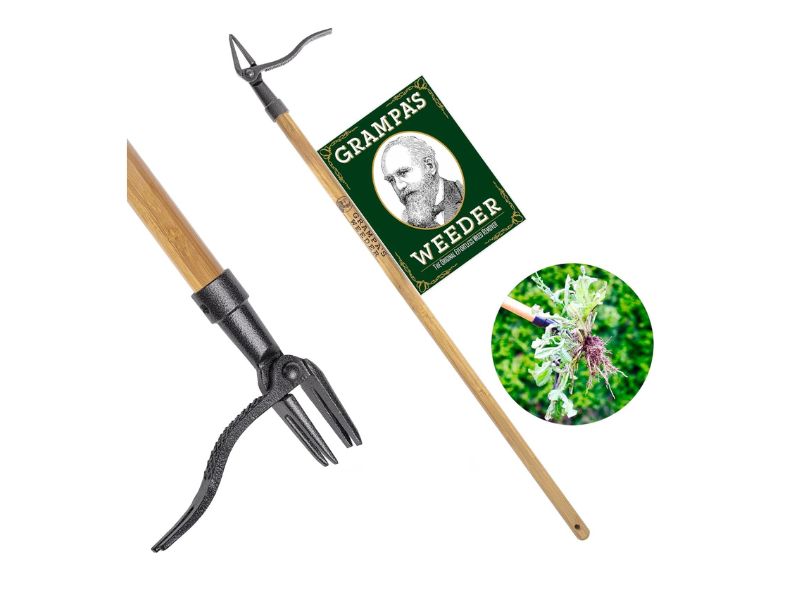
Grampa’s Weeder earns my top position because it combines proven dandelion-removal performance with one of the strongest buyer histories in the category.
Current Amazon market data shows the B001D1FFZA listing with tens of thousands of reviews and strong ongoing sales, considerably more feedback than most competing manual weed pullers.
The design is surprisingly simple.
You position the four-claw steel head over the center of the dandelion, push the tool into the soil with your foot, tilt the handle, and use leverage to pull the weed upward.
The approximately 45-inch bamboo handle allows the entire process to be completed while standing. Grampa’s states that the tool weighs around 3 pounds and uses a real bamboo handle with a heavy-duty steel head.
That standing design is particularly useful when a lawn contains dozens of dandelions. Repeatedly kneeling with a hand fork becomes tiring quickly, while the long handle reduces bending and knee strain.
More importantly, this is not just a comfortable tool.
UC IPM included Grampa’s Weeder in its testing of dandelion-removal tools and found it to be one of the long-handled options that consistently removed dandelions together with their taproots. It scored especially well for ease of use, though researchers noted that it was less effective on very small dandelion plants.
That distinction matters.
The claws need enough of a root crown to grip. For tiny seedlings, a narrow hand weeder may provide better precision.
For established lawn dandelions, however, the leverage system works extremely well.
I also like that there is very little mechanism to break. There are no plastic eject buttons, springs, cables, or complicated moving assemblies. The basic steel-and-bamboo construction is one reason this design has remained popular for so long.
The main limitation is soil condition.
Like most stand-up weed pullers, it performs best when the ground is slightly moist rather than extremely dry and compacted. Moist soil allows the root to release more easily instead of snapping several inches underground. Oregon State University and Cornell both recommend pulling taproot weeds when the soil is moist to increase the chances of removing more of the root intact.
It can also leave a small hole where a mature dandelion was extracted. That is normal when removing a thick taproot.
For homeowners who want a chemical-free lawn weeding tool that can handle repeated dandelion removal without constant bending, Grampa’s Weeder is the most balanced choice here.
Fiskars 4-Claw Stand-Up Weed Puller – Best for Easy Weed Removal
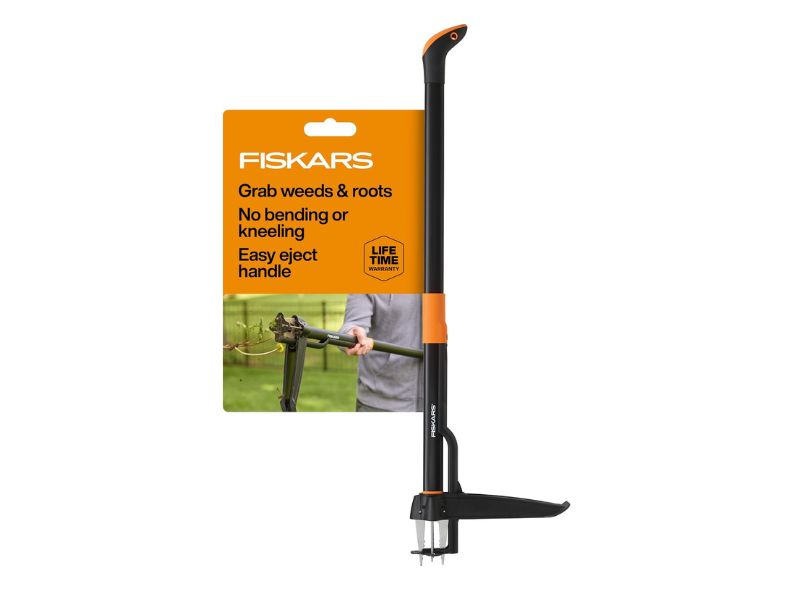
The Fiskars 4-Claw Stand-Up Weed Puller is a better choice if you want a more refined mechanism with easy weed ejection after every pull.
Fiskars uses four serrated stainless-steel claws that surround the root crown. You step on the reinforced foot platform to push those claws into the ground, pull back on the handle, and use the built-in eject mechanism to release the weed without touching it.
The tool measures roughly 39 inches long, so most users can work from a standing position.
Fiskars also uses an offset ergonomic handle intended to reduce wrist strain, along with a viewing opening near the pedal that helps position the claws around the center of the weed.
That makes it particularly good for lawns with many scattered dandelions.
You can develop a simple rhythm:
position, step, pull, eject, move to the next weed.
Independent testing supports its usefulness. Bob Vila found the Fiskars stand-up puller particularly effective on small-to-medium weeds, including dandelions, while noting that large weeds and hard clay soil can be more challenging.
Its Amazon history is also substantial. Recent product data shows around 30,000 customer ratings for ASIN B0030MIHAU, making it one of the most widely purchased manual weeders in this category.
The tool is particularly useful for people who do not want to handle the soil-covered weed after extraction. The eject feature pushes the root and soil clump away from the claws, so you can drop weeds directly into a bucket.
Fiskars also gives the tool a lifetime warranty, which is reassuring because claw-style pullers place significant leverage on the working head and foot platform.
There is one trade-off with this style.
Multi-claw pullers sometimes remove a larger plug of turf and soil than a narrow dandelion fork. UC IPM testing of similar tine-style tools noted that some stand-up designs can leave visible divots in lawns and may occasionally break the taproot instead of extracting all of it.
Technique matters.
Center the tool carefully over the crown and use it when the soil has some moisture. If you insert the claws several inches away from the plant, you are more likely to miss the main root.
Compared with Grampa’s simpler steel mechanism, Fiskars offers more ergonomics and convenience features.
For someone who wants to walk through a lawn and remove dozens of weeds quickly with minimal bending or contact with dirt, it is an excellent choice.
Radius Garden 205 PRO Stainless Steel Weeder – Best for Deep Taproots
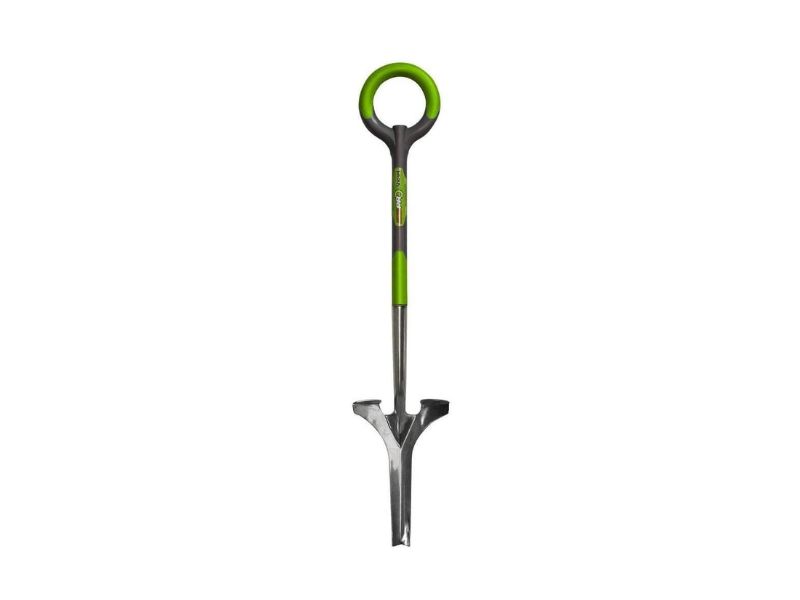
The Radius Garden 205 PRO takes a different approach.
Instead of using several claws to grab the weed, it behaves more like a narrow professional digging tool. The stainless-steel blade penetrates beside the dandelion so you can loosen and lift the taproot using leverage.
That makes it particularly useful for large, established dandelions where removing as much root as possible matters more than speed.
UC IPM gave the Radius 205 PRO a top score of 5 out of 5 for dandelion removal in its testing. Researchers specifically noted that it was easy to get the entire taproot and praised its sturdy, ergonomic construction.
The Radius uses a strong stainless-steel blade attached to a carbon-steel shaft. Its distinctive Natural Radius O-handle provides several grip positions and additional leverage when pushing the blade into compacted soil.
That design is especially helpful in harder ground.
A claw puller works best when its tines can penetrate easily and close around the root. In firm soil, the Radius lets you deliberately work the blade alongside the taproot and loosen the surrounding soil before lifting.
The downside is speed.
This is not a point-step-eject tool like the Fiskars.
You may have to work the blade into the soil, lever the plant upward, and then remove the weed manually. UC IPM also noted that the Radius can disturb more lawn soil and that you may still need to bend down to collect the extracted dandelion.
At approximately 42.5 inches long and around 3.2 pounds, it is still primarily a standing tool, and its elevated forward step gives you a solid platform for driving the blade downward.
The product also carries a lifetime guarantee for continental U.S. customers according to Radius Garden.
I would choose the Radius when I care most about root extraction accuracy, especially for mature weeds that have already developed substantial taproots.
It is less convenient for removing 100 tiny weeds quickly, but better suited to methodically removing stubborn established dandelions with less risk of simply snapping them off at the surface.
Dandelion Weeder Comparison Table
| Product | Tool Style | Handle | Best Feature | Best For |
| Grampa’s Weeder | 4-claw stand-up puller | Bamboo | Simple leverage design | Best overall |
| Fiskars 4-Claw Weeder | 4-claw stand-up puller | Aluminum/ergonomic grip | Easy-eject mechanism | Fast repetitive lawn weeding |
| Radius Garden 205 PRO | Long-handle digging weeder | O-handle | Deep root leverage | Large stubborn taproots |
Why Dandelions Are Difficult to Pull
The main problem is the taproot.
Unlike shallow annual weeds that can often be pulled easily after rain, mature dandelions develop a thick central root that extends deep into the soil.
Penn State Extension identifies dandelion as a perennial lawn weed with a deep taproot, while UC IPM notes that established plants can regenerate when portions of the root remain underground.
That is why pulling only the yellow flower, stem, or leaf rosette accomplishes very little.
Effective mechanical control needs to remove or severely disrupt the underground structure.
Stand-Up Dandelion Puller vs Hand Weeder
A stand-up dandelion puller is better when you have many weeds scattered across a lawn.
You can work faster without repeatedly kneeling.
Grampa’s Weeder and Fiskars are ideal examples.
A narrow digging or hand weeder gives you more precision.
It is useful around:
garden plants, flower beds, landscape borders, vegetable rows, and tight spaces where disturbing surrounding roots or turf would be undesirable.
For lawns, I usually prefer a long-handled tool.
For densely planted beds, a hand tool or narrow digging weeder often makes more sense.
Four-Claw vs Forked Dandelion Weeder
Four-claw tools surround the root crown and use leverage to lift the plant.
They are fast and easy to use.
A traditional forked dandelion weeder is narrower and is inserted alongside the taproot.
The fork can work well when soil is loose, but UC IPM testing found that basic fork-style weeders did not consistently remove complete dandelion taproots and often required more effort.
This is one reason I prefer more substantial designs for established lawn weeds.
Use a Dandelion Weeder When the Soil Is Moist
Timing can dramatically improve results.
The ideal time to pull dandelions is often after rainfall or watering, when the soil is moist but not muddy.
Oregon State University recommends pulling dandelions when the soil is slightly moist because the root is more likely to come out intact. Cornell similarly notes that strong taproot weeds are easiest to pull in moist soil.
In dry compacted soil, the upper portion may snap while several inches remain underground.
If the ground is extremely hard, water the area and wait for moisture to penetrate before trying again.
How to Remove a Dandelion With a Stand-Up Weeder
Center the claws directly over the crown where all the leaves meet.
Push the tool vertically into the soil instead of inserting it at a steep angle.
Drive the claws deep enough to grip below the crown.
Then use the handle as leverage and pull slowly rather than jerking aggressively.
A slow pull gives the soil time to release the root.
If the taproot breaks, monitor the same area. New growth may indicate enough root remained to regenerate.
Should You Fill the Hole After Removing a Dandelion?
Large dandelions can leave visible holes.
For small openings, surrounding turf usually closes over naturally.
A larger hole can be filled with a little topsoil or lawn soil, gently compacted, and overseeded if necessary.
This is particularly useful with claw-style weed pullers because they may remove a small plug of surrounding soil along with the taproot.
Chemical-Free Dandelion Control
Manual weeding is particularly attractive when only scattered dandelions are present.
It allows individual plants to be removed without applying broadleaf herbicide across the entire yard.
Iowa State Extension recommends hand-pulling or digging in garden beds and emphasizes removing the entire taproot whenever possible.
Manual removal is also useful around vegetable gardens and ornamental beds where herbicide contact could damage desirable plants.
How to Reduce Future Dandelions
Removing existing weeds is only half of the job.
A dense lawn gives new dandelion seedlings less open soil and sunlight in which to establish.
UC IPM recommends maintaining vigorous turf and removing isolated plants before they produce seed.
Also avoid scalping the lawn.
Thin turf and bare patches provide opportunities for windblown dandelion seeds to establish.
Maintaining an appropriate mowing height, filling bare spots, and correcting irrigation or fertility problems can reduce future weed pressure.
Frequently Asked Questions
What is the best dandelion weeder?
Grampa’s Weeder is my best overall choice for most lawns.
Its long handle minimizes bending, the steel claw system removes established weeds by leverage, and UC IPM testing found it effective at removing dandelions together with their taproots. It also has one of the largest Amazon buyer histories in the category.
Which tool removes the entire dandelion root?
A deep-root weeder such as the Radius Garden 205 PRO offers excellent taproot control.
UC IPM gave the Radius model a 5/5 dandelion-removal score and specifically noted its ability to remove the entire taproot. Grampa’s Weeder also performed strongly among long-handled tools.
Is Fiskars good for removing dandelions?
Yes, the Fiskars 4-Claw Stand-Up Weeder is very effective for typical lawn dandelions.
Its serrated stainless-steel claws surround the root, while the foot platform provides penetration and leverage. It works best when the soil is not extremely dry or hard.
Should I pull dandelions before or after rain?
Pull them after rain or watering when the soil is slightly moist.
Moist soil releases taproots more easily, increasing your chances of removing the root intact instead of snapping it underground.
Will dandelions grow back if the root breaks?
Yes, dandelions can regrow from remaining taproot tissue.
UC IPM reports that established dandelions can regenerate when even a relatively small section of root remains in the soil. That is why complete root removal is the goal.
Do stand-up weeders damage the lawn?
They can leave small holes, particularly when removing large mature weeds.
Claw-style tools sometimes remove surrounding soil with the taproot. Carefully centering the tool over the weed helps minimize turf disturbance.
Is a four-claw or three-claw weeder better?
Four-claw models generally provide a secure grip around a mature weed crown.
However, claw count alone does not determine effectiveness. Penetration depth, soil condition, leverage, and accurate positioning are equally important.
Can a dandelion weeder remove thistles?
Many stand-up dandelion weeders can also remove thistles and other taproot weeds.
Fiskars specifically markets its stand-up puller for dandelions, thistles, and similar invasive weeds. Root size and soil hardness still affect results.
Are dandelion weeders better than herbicide?
For scattered individual weeds, manual removal is an excellent chemical-free option.
A weeder targets one plant without exposing surrounding lawn or garden plants to herbicide. Large infestations may require a broader lawn-management strategy.
Final Verdict
The best dandelion weeder should remove as much of the taproot as possible while making repetitive weed removal comfortable.
Grampa’s Weeder Original Stand Up Weed Puller is my top overall choice. Its simple four-claw steel design, long bamboo handle, strong Amazon popularity, and proven ability to remove mature dandelions make it particularly effective for routine lawn maintenance.
The Fiskars 4-Claw Stand-Up Weed Puller is the better option if you want a more refined ergonomic design with a strong foot platform and convenient weed-eject mechanism.
For stubborn mature dandelions and difficult taproots, the Radius Garden 205 PRO Stainless Steel Weeder provides greater digging control and excellent root-removal performance.
Whichever tool you choose, use it when the soil is slightly moist, center the tool carefully around the crown, and focus on removing the taproot rather than simply removing the visible leaves. That is the most reliable way to keep manually removed dandelions from quickly returning.

I’m Maya L. Greenwood, a lifelong plant lover who believes anyone can grow something beautiful with the right guidance. After years of testing soil mixes, pruning methods, irrigation tricks, and pest-safe solutions, I started EasyGardenTips.com to turn hard-won lessons into step-by-step advice. From seed starting and container gardens to composting and seasonal checklists, my goal is to make gardening simple, sustainable, and fun.