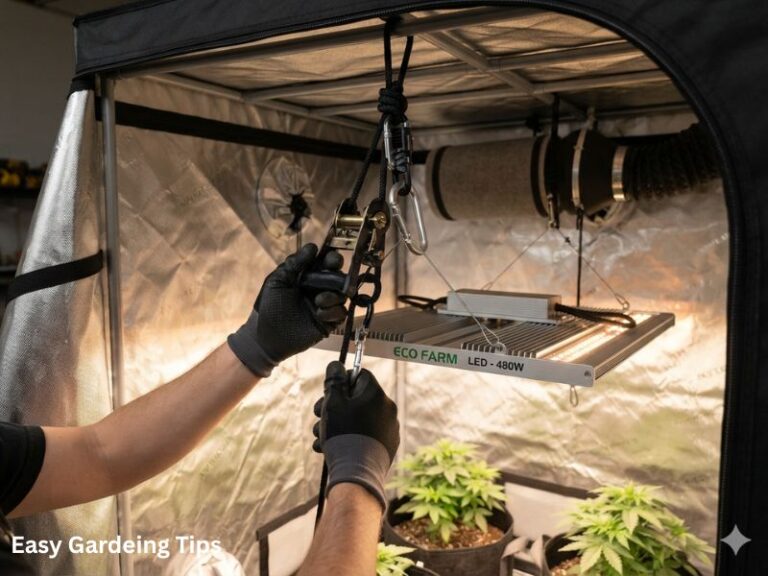
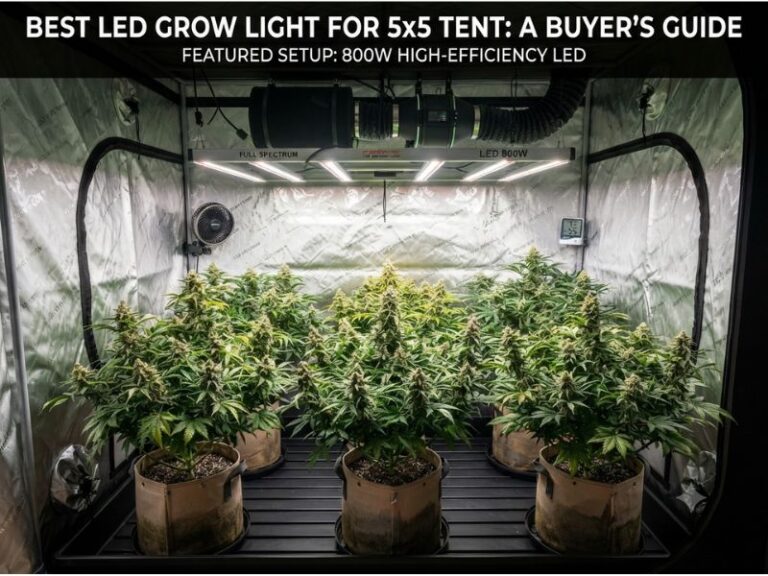
Best Pots for Grow Tent: 5 Fabric Options for Healthy Roots
The container inside a grow tent influences much more than how much growing medium fits around the roots. Pot material affects drainage, oxygen availability, root temperature, watering frequency, floor space, and the amount of runoff that must be managed after every irrigation.
For most soil, coco coir, and amended growing-medium setups, breathable fabric containers are among the most practical choices. Their porous walls allow excess moisture to escape and expose outward-growing roots to air. This process encourages roots to branch through the medium instead of circling repeatedly around a rigid plastic wall.
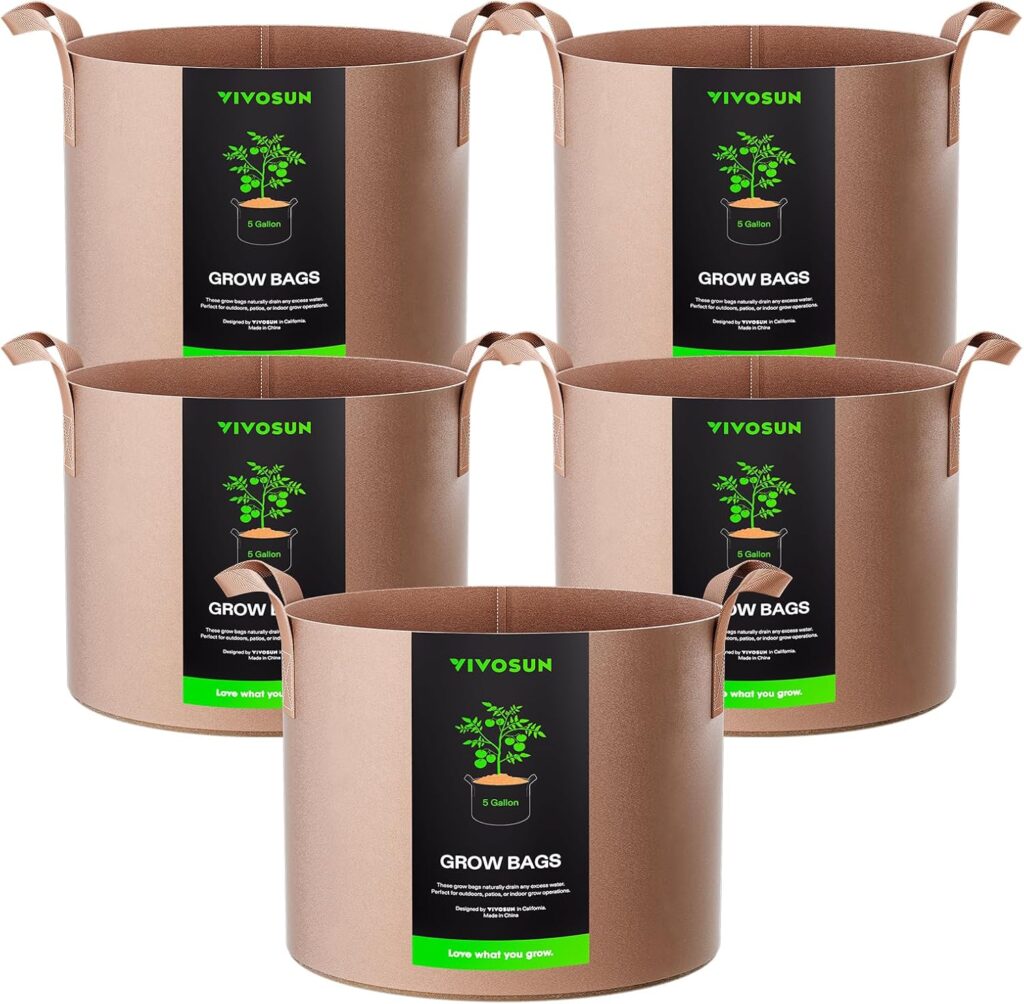
My primary recommendation is the VIVOSUN 5-Pack 5-Gallon Grow Bags because they combine a grow-tent-friendly five-gallon capacity, breathable fabric, reinforced handles, and a widely used multipack format.
The AC Infinity Heavy Duty 5-Gallon Fabric Pots are better suited to growers who want thicker material and built-in plant-training rings.
The Gardzen 10-Pack 5-Gallon Grow Bags provide a larger multipack with practical dimensions, while the JERIA 12-Pack 5-Gallon Grow Bags offer enough containers for several tents or repeated growing cycles.
The Jorvila 5-Pack 5-Gallon Grow Bags provide another thickened 300G option with reinforced handles.
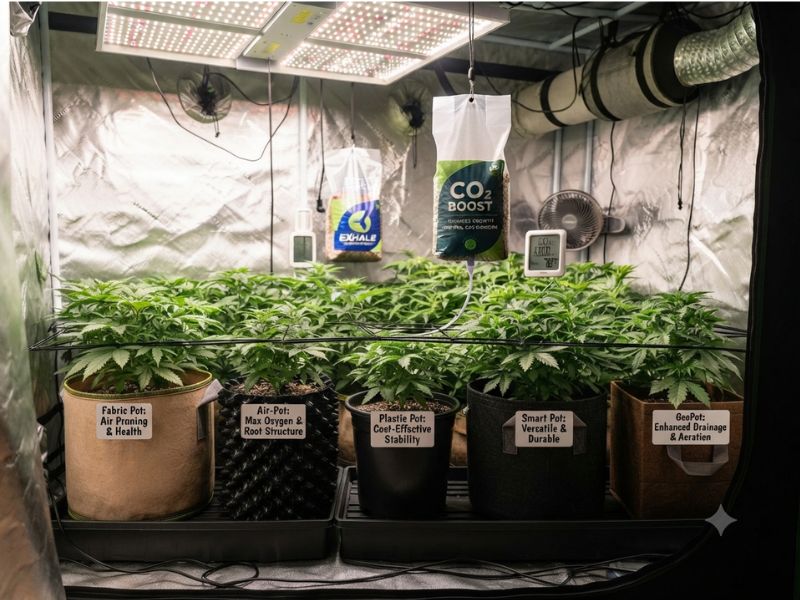
The best pots for grow tent use should match the tent footprint, plant size, irrigation method, growing medium, and runoff system. A larger pot is not automatically better when it restricts airflow, blocks access, or leaves insufficient space between plants.
5 Best Pots for Grow Tent Use
| Image | Product Name | Check Price |
|---|---|---|
Best Choice | VIVOSUN 5-Pack 5-Gallon Grow Bags | Check Price |
Second Best | AC Infinity Heavy Duty 5-Gallon Fabric Pots | Check Price |
Third Choice | Gardzen 10-Pack 5-Gallon Grow Bags | Check Price |
1. VIVOSUN 5-Pack 5-Gallon Grow Bags
Key Features
- Five fabric pots per pack
- 5-gallon capacity
- Thick nonwoven fabric
- Breathable sidewalls
- Reinforced carrying handles
- Flexible cylindrical construction
- Suitable for soil and coco-based media
- Washable and reusable
- Foldable for compact storage
- Appropriate for indoor and outdoor growing
The VIVOSUN five-gallon grow bags provide a useful balance between root-zone capacity and grow-tent floor-space efficiency. Five gallons is large enough for many full-cycle container plants without creating the bulk associated with ten- or fifteen-gallon fabric pots.
The nonwoven material allows air to pass through the sidewalls. When actively growing roots reach the fabric, exposure to air discourages them from continuing in a tight circular pattern. New lateral roots can then develop through the growing medium, creating a more distributed root structure.
Breathable fabric also improves drainage. Excess irrigation can escape through the bottom and sides instead of remaining trapped in the lowest section of a rigid container. This does not make overwatering impossible. A dense or constantly saturated growing medium can still deprive roots of oxygen.
The reinforced handles are useful when an empty or lightly filled pot needs to be repositioned. A fully saturated five-gallon container can become heavy, so both handles should be lifted evenly while supporting the lower portion of the bag when possible.
The flexible walls make filling and transplanting straightforward, but they do not maintain a perfectly rigid shape. Unevenly packed medium may cause the bag to lean or spread across more floor space than expected.
Inside a grow tent, each pot should sit on a saucer, elevated platform, drain tray, or compatible self-watering base. Placing fabric directly on the tent floor can restrict drainage and allow runoff to remain against the bottom.
What I Like
- Practical capacity for many grow-tent layouts
- Strong overall aeration
- Fast drainage
- Reinforced handles
- Simple multipack format
- Easy to fold and store
- Suitable for soil and coco
- Widely compatible with saucers and plant stands
What I Do Not Like
- Flexible sides can lose their shape
- Fabric dries faster than plastic
- Handles should not support the entire wet weight repeatedly
- Runoff can pass through the sidewalls
- Mineral residue may remain visible after repeated feeding
The VIVOSUN grow bags are a balanced choice for growers who need reliable five-gallon fabric containers without specialized accessories. They work particularly well in small and medium tents where airflow and drainage matter but floor space remains limited.
2. AC Infinity Heavy Duty 5-Gallon Fabric Pots
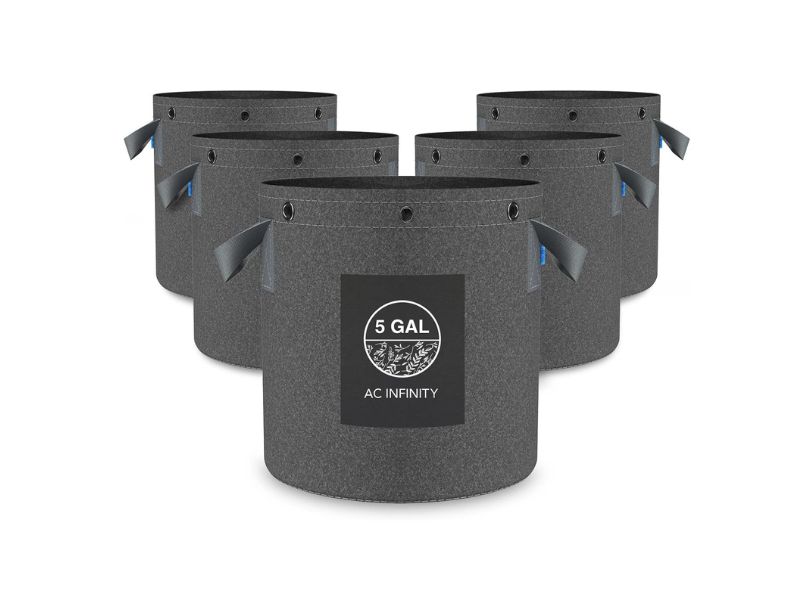
Key Features
- Five pots per pack
- Approximately 5.39-gallon true capacity
- Heavy 500G nonwoven fabric
- Reinforced nylon handles
- Integrated metal training rings
- BPA-free construction
- Breathable root-zone design
- Reinforced stitching
- Washable and reusable
- Compatible with low-stress plant training
The AC Infinity fabric pots are built around thicker material than many standard grow bags. The 500G nonwoven construction helps the container maintain its shape and provides additional durability when it is filled with wet growing medium.
The true capacity is slightly above five gallons, giving roots a little more usable space without moving into a physically larger seven-gallon category. This can be useful when a plant needs substantial root volume but the tent cannot accommodate several oversized containers.
The integrated metal rings are the defining feature. Soft plant ties can pass through the rings to hold trained branches without cutting holes into the fabric or attaching lines to the tent frame.
This makes the pots particularly relevant for low-profile indoor canopies. Training branches outward can improve the use of horizontal grow-light coverage while reducing excessive vertical growth.
The thicker walls may dry somewhat differently from thin fabric bags. They still provide aeration and drainage, but the material has more structure and may remain easier to handle between irrigations.
The reinforced handles are useful for rotation and repositioning. Even with heavy-duty construction, a saturated pot should be moved cautiously. Wet medium, roots, and water can create a substantial combined load.
These pots pair naturally with compatible bottom-watering bases, though they can also be used with ordinary drainage saucers or raised trays. When using wick-based irrigation, the lower fabric surface must maintain correct contact with the watering system.
What I Like
- Very thick fabric construction
- Better shape retention
- True five-gallon-plus capacity
- Built-in training rings
- Strong handles and stitching
- Useful for low-stress training
- Compatible with self-watering bases
- Suitable for repeated indoor use
What I Do Not Like
- Thicker material increases the pot’s initial cost
- Training rings are unnecessary for untrained plants
- Wet pots remain difficult to move
- Five containers may not be enough for large installations
- Fabric still requires runoff containment
The AC Infinity pots are the strongest option for growers who want durable containers that integrate directly with branch training and bottom-watering accessories. Their thicker construction is particularly useful in permanent grow-tent setups where the pots will be reused.
3. Gardzen 10-Pack 5-Gallon Grow Bags
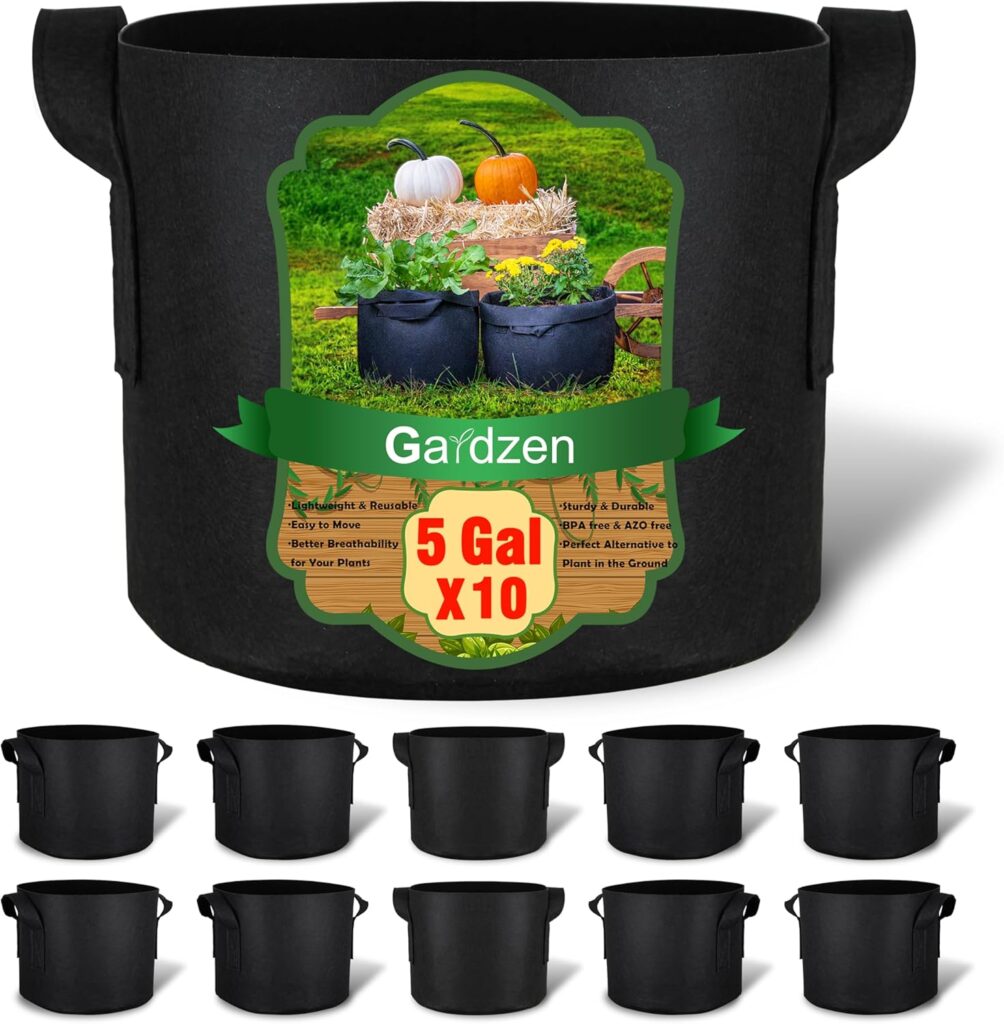
Key Features
- Ten grow bags per pack
- 5-gallon nominal capacity
- Approximately 300G nonwoven fabric
- Around 12.8-inch diameter
- Approximately 10-inch height
- Double-stitched carrying handles
- Breathable sidewalls
- Fast drainage
- Washable construction
- Suitable for several container sizes and plant types
The Gardzen ten-pack is appropriate for growers who need more containers than a standard five-pack provides. Ten bags can support several active plants, different growth stages, backup containers, or more than one grow tent.
The approximate 12.8-inch diameter and ten-inch height create a relatively stable shape. The wider base distributes the growing medium horizontally, which can be useful in tents where vertical clearance is more restricted than floor space.
The 300G fabric provides a reasonable balance between breathability and durability. It allows roots to reach oxygen at the container wall while maintaining enough structure to hold a full volume of medium.
The handles are stitched to the body of the pot for repositioning. As with every fabric container, moving a fully watered pot by one handle can place unnecessary stress on the stitching. Lift both sides together and support the base when practical.
A ten-pack can also simplify transplant planning. Smaller plants can be moved into their final containers at the same time, keeping pot dimensions consistent across the canopy.
Consistent pot size makes irrigation easier because containers with similar medium volume generally dry at more comparable rates. Plant size, root mass, airflow, and position under the light can still create different watering requirements.
What I Like
- Ten-container multipack
- Useful width-to-height ratio
- Thickened breathable fabric
- Strong drainage
- Reinforced handles
- Easy to standardize a grow-tent layout
- Washable and foldable
- Suitable for repeated cycles
What I Do Not Like
- Ten pots may exceed the needs of a small tent
- Handles remain vulnerable under excessive wet weight
- Fabric can collect nutrient staining
- Bags may spread when filled loosely
- Faster drying increases irrigation frequency
The Gardzen grow bags are a practical choice for growers who need a larger set of consistent five-gallon containers. Their proportions work well for organized tent layouts, provided each bag has an individual drainage or runoff solution.
4. JERIA 12-Pack 5-Gallon Grow Bags
Key Features
- Twelve fabric grow bags
- 5-gallon capacity
- Approximately 300G thickened material
- Reinforced handles
- Breathable nonwoven construction
- Strong drainage
- Reusable and foldable
- Approximately 12-inch diameter
- Approximately 10-inch height
- Plant labels included with common configurations
The JERIA grow bags emphasize quantity and straightforward functionality. A twelve-pack is useful for growers who maintain several containers, rotate plants between tents, or want spare bags available for transplanting.
The five-gallon size remains manageable inside common 2×4, 3×3, and 4×4 tents. The exact number that fits comfortably depends on canopy size, irrigation access, circulation fans, and the space required between containers.
The breathable material supports air exchange around the growing medium and allows excess water to escape. This can reduce the stagnant lower zone that sometimes develops inside rigid containers with limited drainage holes.
The pots include reinforced handles for movement. The handles are useful for sliding or rotating containers, but moving a mature plant while its medium is saturated can still stress the seams.
The large pack size can provide better value for a multi-plant grow, but it should not encourage overcrowding. Twelve five-gallon pots occupy a substantial area once they are filled and spread to their working diameter.
Crowded containers restrict access to runoff trays, reduce air circulation beneath the canopy, and make it harder to inspect the sides of every pot.
What I Like
- Large twelve-pot package
- Practical five-gallon capacity
- Breathable fabric
- Strong drainage
- Reinforced handles
- Useful for several tents or cycles
- Compact storage when empty
- Consistent container sizing
What I Do Not Like
- Pack size may encourage overcrowding
- Standard fabric is less structured than 500G material
- Every pot needs runoff management
- Frequent irrigation may be required in warm tents
- Handles should be used carefully when pots are wet
The JERIA multipack is best for growers who need several affordable fabric containers rather than one premium set. It provides the core benefits of aeration and drainage while keeping pot sizes consistent across a larger grow.
5. Jorvila 5-Pack 5-Gallon Grow Bags
Key Features
- Five pots per package
- 5-gallon capacity
- 300G thickened nonwoven fabric
- Approximately 11.8-inch diameter
- Approximately 10.6-inch height
- Widened reinforced handles
- X-pattern handle stitching
- Double-stitched sides and bottom
- Washable and reusable
- Foldable construction
The Jorvila grow bags use 300G fabric with reinforced handle and seam construction. Their slightly taller shape provides a balanced root zone without requiring a very wide footprint.
The widened handles and X-pattern stitching are intended to distribute lifting pressure more effectively. This can make the pots easier to reposition when the medium is relatively dry.
The breathable walls support root aeration and allow excess water to drain. In a coco-based system, that drainage can be useful for frequent fertigation, but an effective runoff tray or drainage table becomes essential.
The bags can be washed, dried, folded, and stored between cycles. Complete drying is important because storing damp fabric can encourage odors, microbial growth, or staining.
This five-pack is suitable for growers who want thickened standard pots without the training rings of the AC Infinity design. It offers straightforward functionality and a compact pack size.
What I Like
- Thickened 300G material
- Reinforced X-stitched handles
- Double-stitched construction
- Practical five-pot set
- Good air exchange
- Fast drainage
- Easy storage
- Suitable for soil and coco
What I Do Not Like
- Newer product history than established alternatives
- No integrated training rings
- Five-gallon fabric dries relatively quickly
- Flexible sides can shift during filling
- Requires saucers or a drainage tray
The Jorvila grow bags provide a solid alternative for growers who want reinforced handles and standard five-gallon capacity. They are most suitable for small and medium installations that do not need a large multipack.
Grow-Tent Pot Comparison Table
| Product | Pack Size | Capacity per Pot | Fabric Weight | Training Features | Main Strength | Main Limitation |
| VIVOSUN Grow Bags | 5 | 5 gallons | Thickened nonwoven | None | Balanced aeration, drainage, and value | Flexible shape |
| AC Infinity Fabric Pots | 5 | Approx. 5.39 gallons | 500G | Metal training rings | Durability and low-stress training | Higher material thickness and cost |
| Gardzen Grow Bags | 10 | 5 gallons | Approx. 300G | None | Large consistent multipack | More pots than small tents need |
| JERIA Grow Bags | 12 | 5 gallons | Approx. 300G | Plant labels in common sets | High container count | Can encourage overcrowding |
| Jorvila Grow Bags | 5 | 5 gallons | 300G | None | Reinforced handles and seams | Less specialized design |
The VIVOSUN pots provide the most balanced starting point. AC Infinity offers the strongest construction and training features. Gardzen and JERIA are better for larger container counts, while Jorvila provides a reinforced five-pack alternative.
Why Fabric Pots Work Well in Grow Tents
Fabric containers provide three major advantages in enclosed gardens:
- Root-zone aeration
- Rapid drainage
- Space-efficient storage
In a rigid plastic pot, roots can reach the interior wall and continue growing around its perimeter. Over time, this can create a dense circular root structure.
A breathable wall exposes the root tip to drier air. The tip stops extending outward, encouraging additional branching behind it. This process is commonly called air pruning.
A more branched root system can explore the growing medium more evenly. Water and nutrients still need to be distributed correctly; fabric alone cannot correct poor irrigation or unsuitable media.
The porous material also allows water to leave through more than a few drainage holes. This is useful in coco or highly aerated mixes where controlled runoff is part of the feeding strategy.
The disadvantage is faster drying. More surface area is exposed to moving tent air, so fabric pots may need more frequent irrigation than plastic containers of similar capacity.
Choosing the Correct Pot Size
One-gallon pots
One-gallon containers are useful for:
- Seedlings
- Young transplants
- Short vegetative periods
- Small herbs
- Temporary stages
They dry quickly and provide limited root volume.
Three-gallon pots
Three-gallon containers suit:
- Compact plants
- Small grow tents
- Short growth cycles
- High plant counts
- Coco systems with frequent irrigation
They save floor space but offer less moisture reserve.
Five-gallon pots
Five gallons is a versatile size for:
- Full-cycle indoor growing
- Soil and coco
- Medium plants
- 2×4, 3×3, and 4×4 tents
- Hand watering or automatic irrigation
This size provides useful root volume without becoming excessively heavy.
Seven-gallon pots
Seven-gallon containers provide more buffering for:
- Larger plants
- Longer vegetative periods
- Living soil
- Organic amended media
- Less frequent watering
They require more floor space and growing medium.
Ten-gallon and larger pots
Large pots are useful for:
- Long-cycle plants
- Large organic systems
- No-till media
- Fewer plants per tent
- High moisture capacity
They can dominate a small enclosure and are difficult to move after watering.
Matching Pot Count to Tent Size
Pot dimensions are more useful than gallon labels when planning the floor.
A nominal five-gallon fabric pot may occupy approximately 12 to 13 inches in diameter after filling.
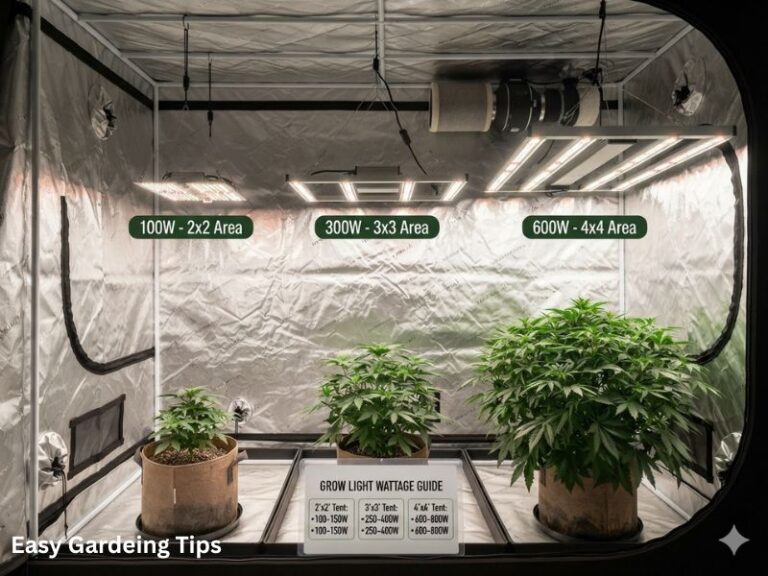
Two-by-two tent
A 2×2 tent can generally accommodate:
- One large container
- Two smaller containers
- Several compact nursery pots
Four full five-gallon pots may leave very little working space.
Two-by-four tent
A 2×4 tent can support:
- Two to four five-gallon pots
- Several three-gallon pots
- One or two larger living-soil containers
Access to the rear pots must be considered.
Three-by-three tent
A 3×3 layout can support:
- Four five-gallon pots in quadrants
- Several smaller containers
- One large central container
Corner access and circulation matter.
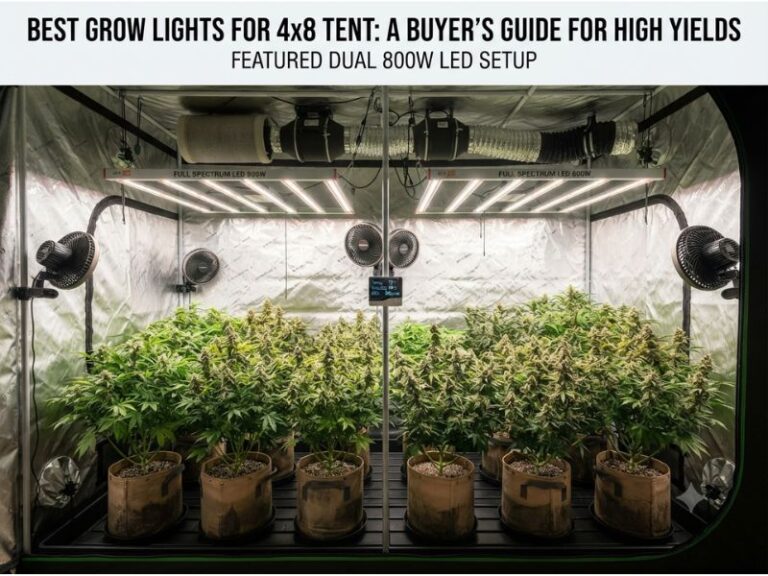
Four-by-four tent
A 4×4 tent provides more flexibility for:
- Four medium or large pots
- Six to nine smaller containers
- Automatic watering bases
- Drain trays and irrigation manifolds
Do not fill every available inch. Airflow and maintenance access remain necessary.
Fabric Thickness and GSM Ratings
Fabric weight may be described using ratings such as:
- 260G
- 300G
- 350G
- 500G
A higher rating generally indicates more material per unit area.
Thicker fabric can provide:
- Better shape retention
- Stronger seams
- Improved durability
- More support for training rings
- Greater resistance to repeated movement
Thinner fabric may provide:
- Lower cost
- Faster drying
- Easier folding
- Less empty-pot weight
- Strong airflow through the wall
A thicker pot is not automatically better for every system. Rapid-drying coco applications may work well with standard fabric, while a reusable organic-soil setup may benefit from heavier construction.
True Capacity vs. Nominal Capacity
A pot labeled five gallons does not always hold exactly five U.S. liquid gallons of growing medium.
Differences can result from:
- Manufacturer measurement methods
- Filled shape
- Fabric expansion
- Tapered construction
- Whether capacity is measured to the rim
- Settling of the growing medium
Compare the stated diameter and height when planning a tent layout.
A slightly oversized five-gallon pot may be useful for root volume, but it may also occupy more floor area than expected.
Drainage and Runoff Management
Fabric pots should not sit directly in uncontrolled runoff.
Use one of the following:
- Individual saucers
- Elevated plant stands
- Drain trays
- Sloped irrigation tables
- Self-watering bases
- Drain-to-waste systems
- Collection trays with pumps
Elevating the pot improves airflow beneath the fabric and allows runoff to move away from the root zone.
When growing in coco, runoff may occur several times per day. A drainage table is generally easier to manage than repeatedly emptying individual saucers.
For soil, runoff may be less frequent, but the floor still needs protection from spills and moisture.
Pot Spacing and Air Circulation
Leave space between fabric pots.
Crowding causes several problems:
- Reduced airflow around the fabric
- Slower drying on touching surfaces
- Difficult runoff access
- Hidden pests
- Limited inspection
- Uneven canopy spacing
- Greater humidity near the floor
Even a small gap allows circulation fans and intake air to move around the containers.
Do not direct a strong fan continuously at one pot. The exposed fabric can dry unevenly, causing one side of the root zone to lose moisture faster than the other.
Fabric Pots With Automatic Watering
Fabric containers work with several automated systems.
Drip irrigation
Drip emitters deliver water from the top.
Use multiple emitters in wide pots to avoid creating one narrow wet column.
Self-watering bases
Wicks draw water upward from a reservoir beneath the pot.
The bottom fabric must contact the wick system correctly.
Blumat-style sensors
Moisture-responsive ceramic sensors can regulate drip flow according to the medium.
The sensor must maintain firm contact with the growing medium.
Flood tables
Fabric pots can sit temporarily in shallow irrigation water when the system is designed for bottom feeding.
Do not leave them permanently submerged unless the method specifically requires it.
Fabric Pots vs. Plastic Pots
Fabric-pot advantages
- Better sidewall aeration
- Reduced root circling
- Faster drainage
- Lightweight construction
- Easy storage
- Flexible shapes
- Handles on many models
Fabric-pot limitations
- Faster drying
- More runoff leakage
- Mineral staining
- Less rigid support
- Harder cleaning
- Greater evaporation
- Difficult movement when saturated
Plastic-pot advantages
- Stable shape
- Slower moisture loss
- Easier cleaning
- Lower sidewall evaporation
- Predictable footprint
- Better compatibility with some automated systems
Plastic-pot limitations
- Limited sidewall aeration
- Root circling
- Dependence on drainage holes
- Bulkier storage
- Higher risk of stagnant lower zones
The better material depends on watering frequency, growing medium, automation, and environmental conditions.
Cleaning and Reusing Fabric Pots
After harvest:
- Remove the root ball and loose growing medium.
- Allow remaining material to dry.
- Brush away dried roots and residue.
- Rinse the fabric thoroughly.
- Wash according to the manufacturer’s guidance.
- Avoid heavily scented detergents.
- Rinse until no cleaner remains.
- Dry the pots completely.
- Inspect seams and handles.
- Fold and store in a dry area.
Small roots may remain embedded in the fibers. Remove as much material as practical before reuse.
A pot with torn seams, damaged handles, persistent odor, or heavy mineral buildup may be better replaced.
Common Grow-Tent Pot Mistakes
Choosing the largest pot that fits
A large container can reduce plant count, access, drainage space, and floor-level airflow.
Filling the pot unevenly
Loose sides and compacted centers create irregular water movement.
Moving saturated pots by one handle
The concentrated weight can damage the stitching.
Leaving fabric directly on the tent floor
Drainage becomes restricted, and runoff can remain against the container.
Using one watering volume for every plant
Plants with different root mass and canopy size may dry at different rates.
Allowing pots to touch continuously
Contact reduces sidewall airflow and hides moisture.
Assuming fabric prevents overwatering
Repeated irrigation can still keep the medium saturated.
Ignoring the extra evaporation
Fabric pots often dry faster than rigid plastic containers.
Reusing pots without cleaning
Old roots, salts, and organic residue can remain in the fibers.
Measuring by gallon label alone
Actual dimensions determine how many pots fit comfortably.
Frequently Asked Questions
What are the best pots for a grow tent?
The VIVOSUN 5-Pack 5-Gallon Grow Bags are my primary recommendation because they provide a practical capacity, breathable construction, reinforced handles, and broad compatibility with indoor growing systems.
The AC Infinity pots are better when thicker fabric and training rings are priorities.
Are fabric pots better for grow tents?
Fabric pots are often better when root aeration, drainage, and storage flexibility matter.
Plastic pots may be preferable when slower drying, rigid structure, and easy cleaning are more important.
What size pots should I use in a grow tent?
Three- to five-gallon pots suit many personal grow tents.
Larger seven- to ten-gallon containers are useful for long cycles, large plants, and organic media but require more floor area.
How many five-gallon pots fit in a 2×4 tent?
Two to four five-gallon pots can fit physically, depending on their actual diameter.
The final number should leave room for saucers, airflow, irrigation, and access.
How many five-gallon pots fit in a 3×3 tent?
Four five-gallon pots commonly fit in a quadrant arrangement.
More may fit physically, but the canopy and maintenance space can become crowded.
How many five-gallon pots fit in a 4×4 tent?
Four to nine may fit, depending on plant size and layout.
A lower pot count usually provides more room for large canopies and easier maintenance.
Do fabric pots need drainage holes?
No. The fabric itself allows water to pass through.
A saucer or drain tray is still required to collect runoff.
Do fabric pots prevent overwatering?
They reduce the likelihood of trapped water, but they do not eliminate overwatering.
A saturated growing medium can still remain low in oxygen.
Do fabric pots need saucers?
Yes, unless they sit on a dedicated drainage table or self-watering base.
Water can drain through the bottom and sidewalls.
Can fabric pots sit on the floor?
They can, but elevation usually improves drainage and bottom airflow.
Direct floor contact may keep the lower fabric wet.
Are five-gallon pots large enough?
Five gallons is sufficient for many indoor plants and full-cycle setups.
Long growth periods or large organic root zones may require more capacity.
Can fabric pots be reused?
Yes. Empty, clean, rinse, and dry them completely before storage or replanting.
Inspect handles and seams before every new cycle.
Are thicker fabric pots better?
Thicker pots generally provide better durability and shape retention.
Standard fabric may offer adequate performance at a lower cost and can dry faster.
Can fabric pots work with automatic watering?
Yes. They work with drip systems, moisture-responsive emitters, flood tables, and wick-based self-watering bases.
The correct method depends on the growing medium.
Why is the outside of my fabric pot white?
White residue is often dried mineral salt from water or nutrients passing through the fabric.
Adjust feeding, manage runoff, and clean the pots between cycles.
Should I place gravel in the bottom of a fabric pot?
A gravel layer is generally unnecessary.
Use a well-aerated growing medium and an elevated drainage system instead of reducing the usable root volume.
Conclusion
Selecting the best pots for grow tent use requires balancing root volume, drainage, aeration, floor space, irrigation frequency, and runoff management.
My primary recommendation is the VIVOSUN 5-Pack 5-Gallon Grow Bags. Their practical capacity and breathable construction make them suitable for many soil and coco-based grow-tent setups.
The AC Infinity Heavy Duty 5-Gallon Fabric Pots are more appropriate when thicker fabric, better shape retention, and plant-training rings are important.
The Gardzen 10-Pack 5-Gallon Grow Bags provide a larger consistent set, while the JERIA 12-Pack 5-Gallon Grow Bags suit growers managing several containers or repeated cycles. The Jorvila 5-Pack 5-Gallon Grow Bags provide reinforced construction in a smaller multipack.
Whichever product you select, plan the complete floor layout before filling the pots. Include room for saucers, drainage, irrigation lines, circulation, and access to every container. Correct pot spacing and watering management are more important than fitting the largest possible number of plants inside the tent.

I’m Maya L. Greenwood, a lifelong plant lover who believes anyone can grow something beautiful with the right guidance. After years of testing soil mixes, pruning methods, irrigation tricks, and pest-safe solutions, I started EasyGardenTips.com to turn hard-won lessons into step-by-step advice. From seed starting and container gardens to composting and seasonal checklists, my goal is to make gardening simple, sustainable, and fun.