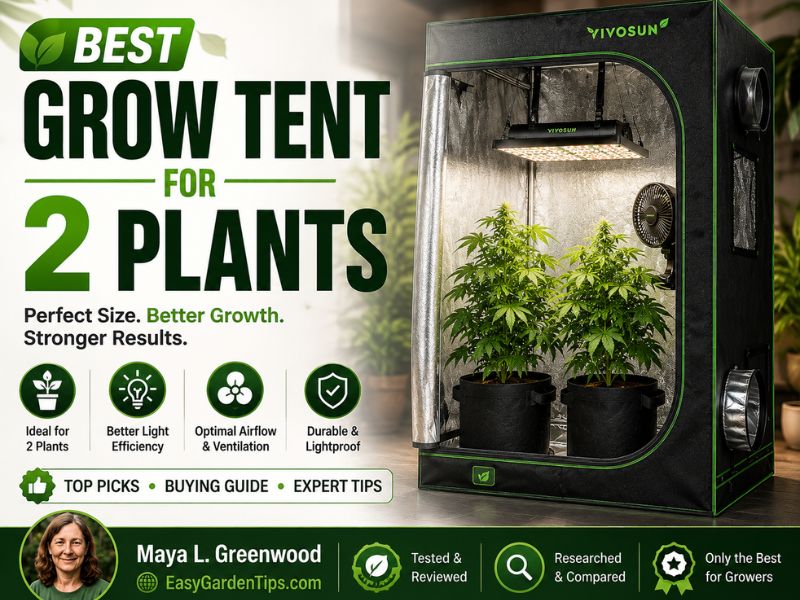
Best Grow Tent for 2 Plants: 3 Tents That Leave Room to Grow
Choosing the best grow tent for 2 plants sounds simple until you start comparing 2×2, 3×3, and 2×4 footprints. Two plants can technically fit inside a compact tent, but fitting pots is not the same as leaving enough room for healthy canopy development, airflow, a circulation fan, ducting, and basic maintenance.
For most two-plant indoor gardens, a 2×4 grow tent is the most balanced starting point. The rectangular footprint gives each plant its own side of the canopy, works naturally with many 200–300W-class bar or board-style LED fixtures, and is easier to place against a wall than a larger square tent.
My first recommendation is the AC Infinity CLOUDLAB 642 2×4 Grow Tent. It measures 48 × 24 × 72 inches and combines 2000D canvas with 22 mm steel framing, a controller mounting plate, double-cinching duct ports, and a frame designed to carry substantial hanging equipment. AC Infinity also uses this exact tent in one of its dedicated two-plant indoor growing systems.
The VIVOSUN PRO 2×4 Grow Tent is another strong option when thick canvas and additional structural support matter. The current PRO model uses 2000D Oxford fabric, 1-inch steel poles, a removable floor tray, controller-oriented cable management, and an included high-CFM support system on this size.
The third choice is slightly roomier than a standard 2×4. Spider Farmer’s 55 × 28-inch tent gives two plants more space for larger pots, low-stress training, fans, or environmental equipment without jumping all the way to a 4×4 footprint. Spider Farmer currently describes this general footprint as suitable for roughly two to four plants through a full growth cycle.
3 Grow Tents That Work Especially Well for Two Plants
| Image | Product Name | Check Price |
|---|---|---|
Best Choice | AC Infinity CLOUDLAB 642 2×4 Grow Tent | Check Price |
Second Best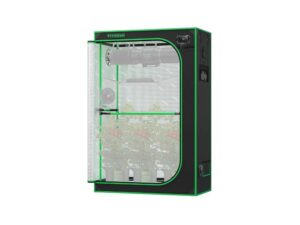 | VIVOSUN PRO 2×4 Grow Tent | Check Price |
Third Choice | Spider Farmer 4.6×2.3 Grow Tent | Check Price |
A two-plant tent should give you enough room to manage the plants, not simply squeeze two containers onto the floor.
For most growers, the priorities should be:
- Enough canopy width for two mature plants
- Adequate vertical clearance
- Strong poles for the light, fan, and carbon filter
- Good light sealing
- Proper duct and cable ports
- Easy plant access
- A removable or waterproof floor tray
- Enough unused space for airflow around the pots and foliage
The three tents below solve those needs slightly differently.
1. AC Infinity CLOUDLAB 642 2×4 Grow Tent
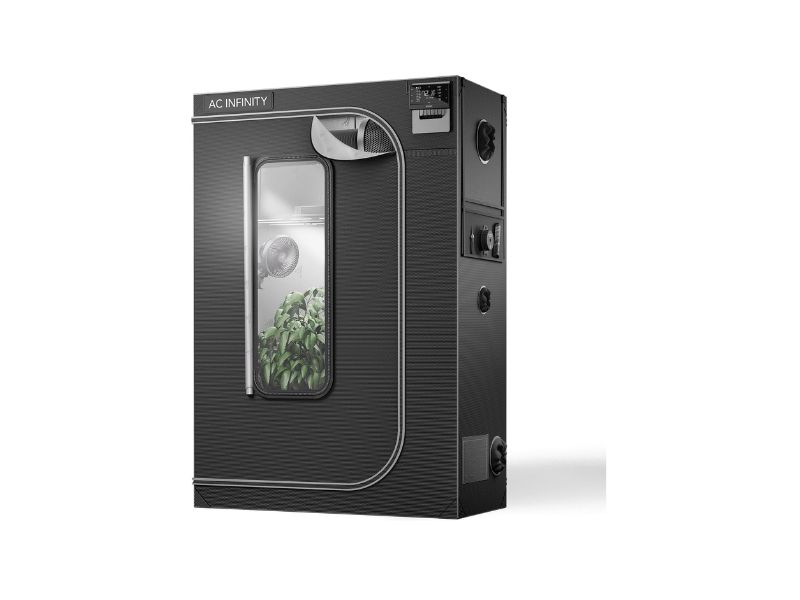
Key Features
- 48 × 24 × 72-inch interior footprint
- 2000D reflective canvas
- 22 mm steel frame
- Double-cinching duct ports
- Controller mounting plate
- Frame rated for substantial hanging equipment
The CLOUDLAB 642 gets the first position because its 2×4 footprint is almost ideal for a controlled two-plant layout.
At 48 inches long and 24 inches deep, you can place one plant on each half of the tent rather than forcing both canopies into a small square. The 72-inch height also leaves useful vertical room once the containers, plant height, light fixture, and required light-to-canopy distance are accounted for.
AC Infinity uses thick 22 mm steel framing, heavy canvas, double-cinching ventilation ports, and a dedicated exterior controller plate. Its documentation lists a frame capacity up to 150 pounds for compatible hanging equipment, which provides useful overhead margin for a light, carbon filter, inline fan, and accessories.
The biggest practical advantage is organization. The tent is designed around ventilation and environmental-control equipment rather than being just a reflective fabric box. AC Infinity even builds a dedicated two-plant system around the CLOUDLAB 642 footprint.
What I Like
- Excellent width for two separate plant canopies
- Strong frame for hanging equipment
- Thick canvas and thoughtful duct-port design
- Controller plate keeps controls accessible outside the tent
What I Do Not Like
- Takes more floor space than a compact 2×2
- Six feet of height can still become tight with very tall plants or large containers
For two medium-sized plants in a bedroom, basement, spare room, or indoor garden area, the CLOUDLAB 642 offers the strongest combination of usable space and equipment-friendly design.
2. VIVOSUN PRO 2×4 Grow Tent
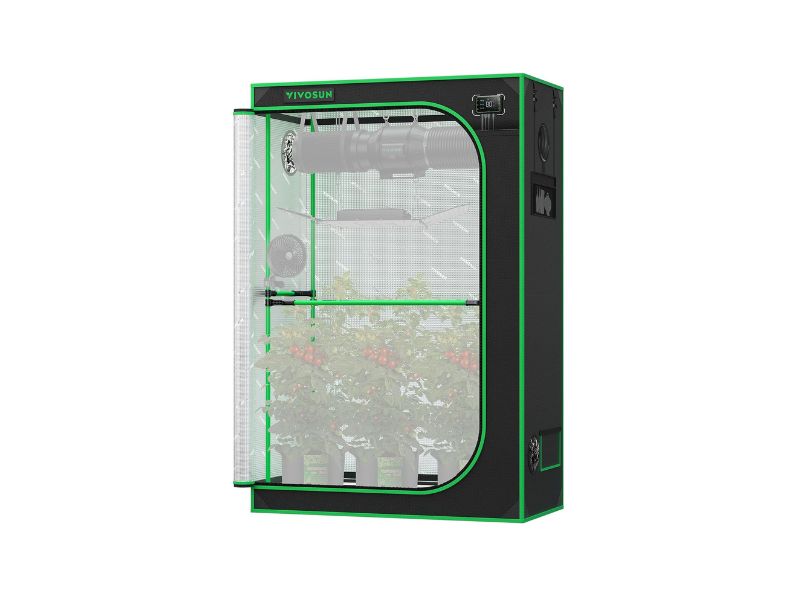
Key Features
- 48 × 24 × 72 inches
- 2000D Oxford canvas
- Reflective Mylar interior
- 1-inch steel poles
- High-CFM support bars
- Observation window and removable floor tray
The VIVOSUN PRO 2×4 follows the same useful 48 × 24-inch footprint but puts extra emphasis on structural reinforcement.
Its current PRO construction uses 2000D Oxford fabric and 22 mm-class, 1-inch steel poles. VIVOSUN also includes high-CFM support hardware with this model to reduce wall deformation from powerful ventilation systems and provide additional structural options inside the tent.
For two plants, that gives you enough width for separate containers while retaining space along the sides for airflow. The observation window can also reduce how often the main door needs to be opened just to check basic plant condition.
VIVOSUN describes its 2×4 tent platform as capable of housing roughly two to four plants, depending on plant size and growing style. For a two-plant setup, using the lower end of that range leaves more canopy and working room rather than maximizing plant count.
What I Like
- Thick 2000D fabric
- Reinforced frame works well with fan and filter equipment
- Good two-plant rectangular layout
- Cable-management and observation features are convenient
What I Do Not Like
- A reinforced PRO frame can be more than a very simple setup needs
- Like most 2×4 tents, rear access can be awkward if the tent is pushed tightly against walls
The VIVOSUN PRO is a strong alternative when you expect to hang a full ventilation system and want extra structure around the tent instead of choosing the lightest possible enclosure.
3. Spider Farmer 4.6×2.3 Grow Tent
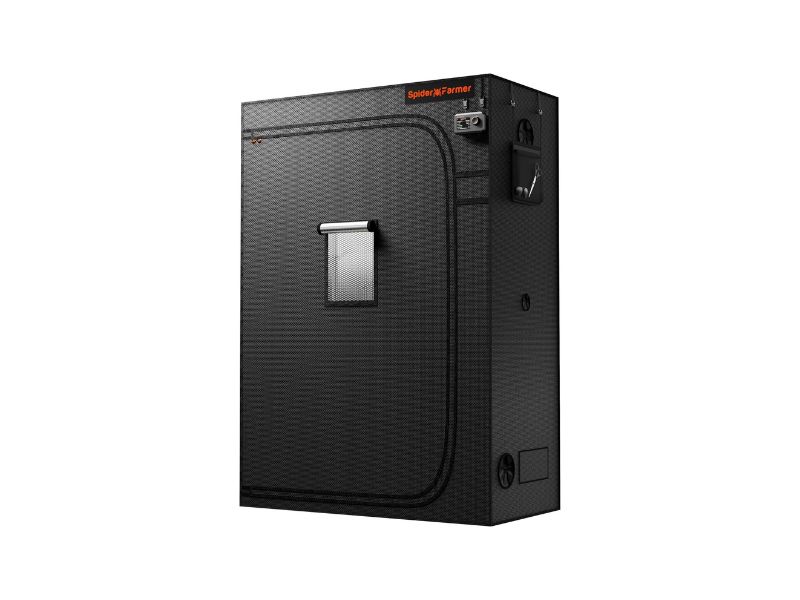
Key Features
- Approximately 55 × 28 × 80 inches
- 1680D Oxford canvas
- Reflective interior
- Reinforced steel poles
- Large observation window
- Removable waterproof floor tray
The Spider Farmer takes a different approach by giving two plants more breathing room.
Its approximately 55 × 28-inch footprint is larger than a conventional 48 × 24-inch tent, and its 80-inch height provides eight additional inches of vertical space compared with many standard 2×4 models. The current version uses 1680D Oxford fabric, reinforced poles, an enlarged viewing window, and a removable floor tray.
Spider Farmer describes this size category as suitable for roughly two to four full-cycle plants. Restricting it to two gives each plant considerably more canopy area and provides space for larger fabric pots, a humidifier, circulation fan, or training structure.
The extra height is particularly useful if you grow taller vegetables, fruiting plants, or other indoor crops where the light needs to stay well above the canopy.
What I Like
- More floor area than a conventional 2×4
- 80-inch height provides valuable headroom
- Two plants have plenty of space for training and airflow
- Large observation window and floor tray improve everyday usability
What I Do Not Like
- Requires a little more room in the house
- Larger footprint may be unnecessary for two naturally compact plants
For growers who have enough physical room, the Spider Farmer is the most comfortable option of the three. It sacrifices a little compactness in exchange for easier plant spacing and more vertical freedom.
Grow Tent Comparison for Two Plants
| Product | Interior Size | Canvas | Best Use | Main Advantage | Main Limitation |
| AC Infinity CLOUDLAB 642 | 48 × 24 × 72 in. | 2000D | Balanced two-plant setup | Strong frame and excellent equipment integration | Standard 6-ft height |
| VIVOSUN PRO 2×4 | 48 × 24 × 72 in. | 2000D | Equipment-heavy two-plant setup | Reinforced frame and High-CFM support | Can feel bulky for minimalist grows |
| Spider Farmer 4.6×2.3 | 55 × 28 × 80 in. | 1680D | Two larger plants | Extra width, depth, and height | Requires more floor space |
For most two-plant gardens, the first decision is really between compact efficiency and extra growing room.
A standard 2×4 is easier to fit into a room and supports a wide ecosystem of matching lights and ventilation equipment.
The larger Spider Farmer footprint gives up some of that compactness but makes plant maintenance easier when both plants develop broad canopies.
What Size Grow Tent Is Best for 2 Plants?
A 2×4 tent is usually the most versatile size for two medium plants.
Each plant effectively receives an area around 2 × 2 feet when the tent is divided lengthwise.
That is enough room for many indoor vegetables, herbs, ornamental plants, and other container-grown species when plant size is controlled appropriately.
But there are situations where another size makes sense.
2×2 Grow Tent
A 2×2 tent has only four square feet of floor area.
Two very small plants can fit, but space becomes tight once containers and foliage expand.
The tent may work for:
- Seedlings
- Herbs
- Compact ornamentals
- Small plants kept intentionally short
For two medium or large plants, a 2×2 usually prioritizes compactness over convenience.
2×3 Grow Tent
A 2×3 gives six square feet of floor area.
That is more workable for two plants, especially when the room cannot fit a 4-foot-wide tent.
It can be a smart apartment-friendly compromise.
2×4 Grow Tent
A 2×4 provides eight square feet.
For two plants, that means substantially more canopy and equipment room than a 2×2 without occupying the large square footprint of a 4×4.
This is why 2×4 tents are so commonly paired with two-plant systems. AC Infinity explicitly offers a two-plant kit based on its 24 × 48-inch CLOUDLAB 642, while Spider Farmer describes its 2×4 category as supporting two to four full-cycle plants.
3×3 Grow Tent
A 3×3 contains nine square feet—only one more square foot than a 2×4, but arranged as a square.
That can be useful if the plants develop round canopies or if you prefer working from several sides.
The drawback is placement.
A tent that extends three feet into a room may be less convenient than a 24-inch-deep 2×4 placed against a wall.
4×4 Grow Tent
A 4×4 gives two plants enormous space.
It can make sense for exceptionally large plants or when you want equipment inside the tent without crowding the canopy.
For ordinary two-plant use, however, much of that floor area may go unused while the lighting and ventilation requirements increase.
How Much Floor Space Does Each Plant Need?
There is no universal number because mature plant size varies dramatically.
A compact basil plant and a large indeterminate tomato plant are both “one plant,” but their space requirements are completely different.
Rather than buying a tent purely by plant count, consider:
- Mature canopy diameter
- Container diameter
- Plant height
- Training or support structure
- Space needed for airflow
- Whether equipment will sit on the floor
For many medium indoor plants, allowing roughly a 2×2 section of a 2×4 tent per plant creates a practical layout.
Why Rectangular Tents Work So Well for Two Plants
A 2×4 footprint naturally divides into two equal sides.
That creates a simple arrangement:
Plant 1 | Plant 2
Each plant can receive similar light coverage without one sitting directly behind the other.
Rectangular LED fixtures also pair naturally with this canopy shape.
The grower can reach both plants through the front door while running ducting and electrical cables toward the ends or top of the enclosure.
Grow Tent Height Matters More Than Beginners Expect
Floor area gets most of the attention, but height can become the limiting factor.
A 72-inch tent does not provide six full feet of usable plant height.
The vertical space also has to accommodate:
- Container height
- Plant structure
- Distance between light and canopy
- LED fixture thickness
- Hanging hardware
- Carbon filter or ducting
Imagine a 12-inch-tall pot and a light that hangs roughly 12 inches below the tent ceiling.
Before accounting for the required light-to-canopy distance, two feet of the tent’s height may already be occupied.
That is why an 80-inch tent can be noticeably easier to work with than a 60-inch model.
Spider Farmer’s current larger 2×4-class tent reaches approximately 80 inches, while the AC Infinity CLOUDLAB 642 and VIVOSUN PRO models are approximately 72 inches high.
How Tall Should a Grow Tent Be for Two Plants?
For most general indoor gardening, 72 inches is a useful minimum target if you want flexibility.
A 60-inch tent can work with compact plants but gives less room to raise the light.
An 80-inch tent provides considerably more flexibility for taller crops or large containers.
The correct choice depends on what you grow.
Canvas Thickness: Does 1680D vs 2000D Matter?
The D refers to denier, a measurement related to the fibers used in the fabric.
Higher-denier grow-tent material is generally associated with a heavier fabric structure, although construction quality also depends on stitching, coatings, seams, and zipper design.
AC Infinity and the current VIVOSUN PRO 2×4 both use 2000D-class canvas, while the selected Spider Farmer model uses 1680D Oxford fabric.
For a normal home setup, both 1680D and 2000D can be plenty substantial when the tent is constructed well.
Do not choose based on the denier number alone.
Zipper quality and seam design are equally important because those are common places for small light leaks to appear.
Why Reflective Mylar Is Used Inside Grow Tents
Grow tent interiors use reflective material so light that misses the leaves is redirected into the growing area rather than being absorbed by dark walls.
This improves light utilization around the edges of the canopy.
The tent does not create additional lamp output.
It simply helps manage light that would otherwise leave the useful growing area.
All three products in this guide use reflective interior surfaces as part of their enclosure design.
How Strong Should the Grow Tent Frame Be?
A tent frame may need to support much more than fabric.
Common hanging equipment includes:
- LED grow light
- Inline fan
- Carbon filter
- Ducting
- Circulation fan
- Sensors
- Trellis supports
That combined load can become substantial.
AC Infinity documents 22 mm steel tubes and support for hanging equipment up to 150 pounds in the CLOUDLAB series. VIVOSUN’s PRO line uses approximately 1-inch steel poles and additional structural support hardware.
You should still distribute equipment sensibly rather than concentrating everything on one crossbar.
What Grow Light Size Works in a 2×4 Tent?
Light selection should be based on the crop’s actual intensity requirement rather than plant count alone.
Many manufacturers pair their 2×4 tents with LED fixtures designed around a rectangular 2×4 footprint.
For example, AC Infinity’s two-plant CLOUDLAB 642 system uses an IONBOARD S24 2×4 fixture, while Spider Farmer commonly pairs its 2×4 footprint with the SF2000 or larger bar-style options depending on the desired intensity.
The key is uniform coverage.
Two plants benefit from light reaching both canopies evenly rather than one intense hotspot in the center.
Ventilation for a Two-Plant Grow Tent
A tent needs controlled air exchange to manage:
- Heat
- Humidity
- Stale air
- Odor where relevant
A common arrangement includes:
- Intake opening
- Inline exhaust fan
- Optional carbon filter
- Ducting
- Internal circulation fan
Both Spider Farmer and VIVOSUN identify 4-inch ventilation systems as common pairings for their 2×4-class tents, although actual airflow needs depend on heat load and duct resistance.
A larger fan is not automatically better if it needs to run at full speed and pulls the tent walls aggressively inward.
Variable-speed control is useful.
Why Internal Air Circulation Matters
Exhaust ventilation changes the air inside the tent, but it does not guarantee even airflow around every leaf.
A small circulation fan helps reduce stagnant pockets.
With two plants, position airflow so both canopies move gently rather than blasting one plant continuously.
Good circulation also helps prevent humid pockets from developing where leaves overlap.
How to Arrange Two Plants in a 2×4 Tent
The simplest setup places one container toward the left and the other toward the right.
Leave some distance between them.
As the canopy expands, the plants can fill the center naturally.
Avoid placing both containers tightly together from the beginning.
The point of a 2×4 tent is to use its width.
A basic layout could be:
Left side: Plant 1
Center: Shared canopy/airflow space
Right side: Plant 2
Keep floor equipment toward corners when possible.
Container Size Affects Tent Space
Large pots can consume floor area quickly.
Before buying a tent, measure the container diameter—not just its advertised volume.
Two large round containers may leave less room for a humidifier or circulation fan than expected.
Fabric pots can be useful because they are relatively easy to position, but any container still needs a drainage strategy.
The removable floor trays found in these tents help protect the enclosure from small spills.
Should You Choose 2×4 or 3×3 for Two Plants?
Choose 2×4 when:
- The tent will sit against a wall
- You want one plant on each side
- You prefer rectangular lighting
- Room depth is limited
Choose 3×3 when:
- You prefer a square canopy
- You can access the tent from multiple sides
- Room width is limited but depth is available
- Your plants develop broad circular canopies
Both provide roughly similar total floor space.
The shape is the real difference.
Is a 2×2 Grow Tent Too Small for Two Plants?
For two compact plants, no.
For two plants expected to become medium or large, it can become cramped.
A 2×2 gives each plant only about two square feet if divided evenly, whereas a 2×4 gives roughly four square feet per plant.
That extra room can make watering, pruning, airflow, and canopy management significantly easier.
Is a 4×4 Too Large for Two Plants?
Not necessarily, but it is larger than most people need.
A 4×4 may make sense when:
- Plants will become very large
- You use oversized containers
- Environmental equipment stays inside the tent
- You want substantial working room
- Future expansion is likely
For an ordinary two-plant setup, a 2×4 usually uses floor space and lighting more efficiently.
Observation Windows: Useful or Gimmicky?
A viewing window can be surprisingly useful.
It lets you check:
- Whether the light is on
- Whether plants are standing normally
- Whether a fan is operating
- Basic canopy condition
without opening the entire enclosure.
Both the current VIVOSUN PRO and Spider Farmer tents include large viewing windows.
You will still need to open the tent for meaningful plant inspection and maintenance.
Controller and Cable Management
Modern indoor gardens often contain several electrical devices:
- Grow light
- Inline fan
- Clip fan
- Humidifier
- Dehumidifier
- Heater
- Environmental controller
Messy cable routing can make a small tent frustrating.
AC Infinity uses an exterior controller mounting plate on the CLOUDLAB 642, while VIVOSUN and Spider Farmer provide controller-oriented cable-routing features on their current designs.
Keeping controllers outside the humid growing area is also more convenient for adjustments.
Where Should You Put a Two-Plant Grow Tent?
Good locations include:
- Spare bedroom
- Basement
- Indoor garden room
- Climate-controlled garage
- Utility area with suitable electrical service
The surrounding room matters because the tent eventually releases heat and moisture into that space unless the exhaust is routed elsewhere.
Avoid blocking doors, HVAC returns, or required household access.
Also leave enough clearance to open the grow-tent door fully.
Measure the Room Before Ordering
Do not use only the tent’s advertised floor dimensions.
You may need extra space for:
- Door movement
- Ducting
- Inline fan
- Power cords
- Controller
- Watering access
- Walking space
A 24-inch-deep tent placed against a wall may require significantly more than 24 inches of usable room once the door is open.
Common Mistakes When Buying a Grow Tent for Two Plants
Buying the Smallest Tent That Fits Two Pots
Two containers fitting on the floor does not mean mature canopies will fit comfortably.
Ignoring Height
A tall plant, large container, hanging light, and filter can quickly consume a 60-inch enclosure.
Buying a 4×4 Without Needing the Space
A larger tent requires more room and generally encourages a larger lighting and ventilation setup.
Choosing Only by Canvas Thickness
Pole strength, stitching, zippers, ports, and access are just as important.
Forgetting About the Carbon Filter
A filter and inline fan can occupy substantial overhead space.
Blocking Ventilation With Plant Canopies
Leave enough room for air to move around both plants.
Putting the Tent Against Three Walls
You may lose access to side ports or maintenance openings.
Ignoring the Door Direction
Check how the main access panel opens before deciding where the tent will sit.
Buying the Light Before Choosing the Tent
The light footprint should match the canopy footprint.
Overcrowding Because the Manufacturer Lists a Higher Plant Count
Plant-count recommendations depend heavily on plant size.
For a comfortable two-plant garden, more space per plant is often better than maximizing the number that can physically fit.
Frequently Asked Questions
1. What is the best grow tent for 2 plants?
A quality 2×4 tent is usually the most balanced choice for two medium plants. AC Infinity CLOUDLAB 642 is my first option for its strong frame and equipment-friendly design.
The 48 × 24-inch floor naturally divides into two sections, giving each plant more useful canopy area than a compact 2×2. AC Infinity also uses the CLOUDLAB 642 in a dedicated two-plant grow system.
2. Is a 2×4 grow tent good for 2 plants?
Yes. A 2×4 is one of the most practical footprints for two medium-sized indoor plants.
It provides eight square feet of floor area, allowing roughly half of the tent to be dedicated to each plant. The rectangular footprint is also easy to illuminate evenly and fits well against a wall.
3. Is a 2×2 grow tent enough for 2 plants?
It can work for two small plants, but it becomes crowded quickly as the canopies expand.
A 2×2 is better when floor space is extremely limited or the plants naturally remain compact. For more flexibility, a 2×4 gives twice the floor area.
4. Is a 3×3 grow tent good for two plants?
Yes. A 3×3 provides nine square feet and gives two plants plenty of canopy room.
Compared with a 2×4, it is one foot deeper but one foot shorter in width. Choose according to the shape of the room and how you want to arrange the plants.
5. Is a 4×4 grow tent too big for two plants?
No, but it is usually more space than two average plants require.
A 4×4 can be useful for very large plants, oversized containers, or future expansion. For a permanent two-plant garden, a 2×4 or 3×3 generally makes more efficient use of floor space.
6. How tall should a grow tent be for two plants?
Around 72 inches is a useful starting height, while 80 inches provides greater flexibility for taller plants and hanging equipment.
Remember that containers, lights, filters, and required canopy clearance all reduce usable plant height. The selected Spider Farmer tent offers 80 inches, while the AC Infinity and VIVOSUN options are 72 inches tall.
7. How much space does each plant get in a 2×4 tent?
Dividing a 2×4 evenly gives each plant approximately four square feet of floor area.
Actual usable canopy space depends on containers, fans, and equipment. This is why two plants usually feel much less crowded in a 2×4 than in a 2×2.
8. Can two large plants fit in a 2×4 grow tent?
Yes, if their canopy size and height are controlled appropriately, but very large plants can fill a 2×4 completely.
For plants expected to develop unusually wide canopies, a larger 55 × 28-inch tent or a 3×3 may be more comfortable.
9. What size light is best for a 2×4 grow tent?
Use a fixture designed to provide even coverage across a 2×4 canopy rather than choosing solely by wattage.
Manufacturers commonly pair rectangular 2×4 fixtures with this footprint; for example, AC Infinity’s two-plant 2×4 system uses its IONBOARD S24.
10. What size inline fan should I use for a 2×4 tent?
A 4-inch inline-fan system is commonly paired with 2×4 grow tents, although actual airflow needs depend on heat, ducting, and filter resistance.
Spider Farmer recommends a 4-inch fan for its 2×4-class tents, and VIVOSUN similarly pairs 4-inch ventilation with its 2×4 systems.
11. Do I need a carbon filter for a two-plant grow tent?
Not for every plant species. A carbon filter is mainly useful when odor control is necessary.
The filter also adds resistance to the exhaust system and occupies hanging space, so include it when planning fan capacity and tent height.
12. Is 2000D canvas necessary?
No. A well-made 1680D tent can also be durable and light resistant.
Canvas thickness is only part of tent quality. Zippers, stitching, seam construction, reflective lining, poles, and access design can matter just as much.
13. How many plants fit in a 2×4 tent?
Two medium plants are a comfortable layout, although some manufacturers describe their 2×4 tents as capable of housing up to four plants depending on plant size.
Using the tent for only two plants leaves more room for canopy development, airflow, equipment, and maintenance. Spider Farmer currently describes its 2×4-class footprint as suitable for two to four full-cycle plants.
14. Should I put both plants directly under the center of the light?
Arrange them so each canopy receives similar light intensity rather than stacking both plants into the same central hotspot.
A rectangular fixture and a 2×4 layout make it relatively easy to position one plant on each half of the light footprint.
15. Do two plants need an oscillating fan?
Internal circulation is useful even in a small two-plant tent because exhaust airflow alone may not move air evenly through both canopies.
Use gentle airflow rather than directing a powerful fan continuously at one plant.
16. Is an observation window worth having?
Yes, it is convenient for quick checks without opening the main tent door.
The window does not replace hands-on inspection, but it makes it easy to verify that lights and fans are operating and that the canopy looks normal.
17. Can I keep the grow tent in a bedroom?
A grow tent can physically fit in a bedroom if there is adequate electrical capacity, ventilation, temperature control, and access around the enclosure.
Remember that heat and humidity removed from the tent enter the surrounding room unless the exhaust is ducted elsewhere.
18. Which is better for two plants, a 2×4 or 3×3 grow tent?
A 2×4 is usually better against a wall, while a 3×3 is useful when you prefer a square canopy and have more room depth.
Their floor areas are similar—eight square feet versus nine—so room shape and access are often more important than the one-square-foot difference.
Conclusion
The best grow tent for 2 plants should give both plants enough space to develop without forcing you into a much larger indoor garden than you actually need.
For most setups, the 2×4 footprint is the sweet spot. It provides eight square feet of floor area, divides naturally between two plants, works well with rectangular lighting, and remains compact enough for a spare room, basement, apartment grow area, or climate-controlled garage.
AC Infinity CLOUDLAB 642 is the strongest overall choice here because its 48 × 24 × 72-inch dimensions are backed by a heavy frame, thick canvas, useful ventilation ports, and excellent controller integration. VIVOSUN PRO 2×4 follows closely with 2000D fabric, strong 1-inch poles, and additional frame reinforcement.
Spider Farmer’s 55 × 28 × 80-inch tent makes more sense when you have a little extra room and want two plants to spread out. Its additional width, depth, and height can make watering, training, airflow, and equipment placement noticeably easier.
Before choosing, measure the room as well as the plants. Account for the pots, mature canopy, grow light, carbon filter, inline fan, ducting, and the space required to open the tent door.
For most two-plant indoor gardens, a well-built 2×4 gives you enough growing room without wasting floor space—and leaves far more flexibility than trying to squeeze two mature plants into a compact 2×2.

I’m Maya L. Greenwood, a lifelong plant lover who believes anyone can grow something beautiful with the right guidance. After years of testing soil mixes, pruning methods, irrigation tricks, and pest-safe solutions, I started EasyGardenTips.com to turn hard-won lessons into step-by-step advice. From seed starting and container gardens to composting and seasonal checklists, my goal is to make gardening simple, sustainable, and fun.