
A grow tent is designed to create a controlled environment for indoor growing, but many people wonder if it can completely block smells. While grow tents help contain light, temperature, humidity, and airflow, they are not completely smell proof.
Most grow tents are made with durable fabric layers, reflective interiors, and sealed openings, but small gaps around zippers, seams, ventilation ports, and duct connections can allow odors to escape. In addition, grow tents require airflow exchange, which means air must leave the tent through an exhaust system.
The best way to control odors is not relying on the tent itself, but combining proper ventilation with equipment such as a correctly sized carbon filter, inline exhaust fan, and a negative pressure setup. These components work together to filter odors before air leaves the growing area.
In this guide, I’ll explain whether grow tents are smell proof, why odors escape, and the best methods to improve odor control and create a more contained growing environment.
Are Grow Tents Smell Proof?
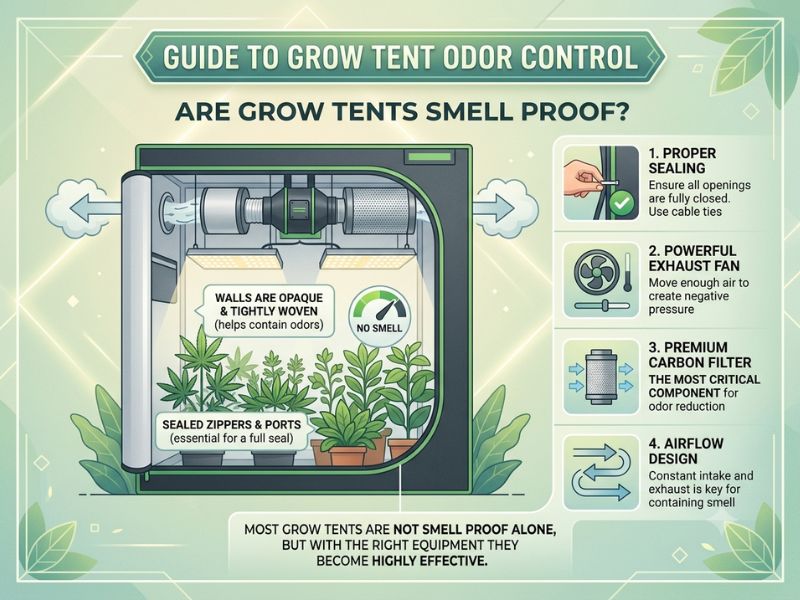
The short answer is no, grow tents are not completely smell proof. A grow tent can help contain odors, but it is not designed to create a 100% airtight or odor-blocking environment.
Most grow tents are built to control important growing conditions such as light exposure, temperature, humidity, and airflow. Their main purpose is environmental control, not eliminating smells completely.
A typical grow tent uses materials such as:
- Reflective inner lining
- Fabric outer layers
- Zippers
- Ventilation openings
- Duct ports
These materials can reduce odor movement, but they cannot completely prevent smells from escaping.
How Much Smell Does a Grow Tent Block?
The amount of odor a grow tent contains depends on several factors, including:
- Tent quality
- Odor intensity
- Ventilation setup
- Air pressure inside the tent
- Whether exhaust air is filtered
A high-quality grow tent with a properly installed carbon filter can significantly reduce odors. However, without proper filtration, smells can escape through ventilation openings and small gaps.
The tent itself provides some physical separation, but the ventilation system does most of the odor-control work.
Why Grow Tents Are Not Completely Smell Proof
Grow Tents Are Not Airtight
A grow tent needs some airflow exchange to maintain healthy growing conditions. Fresh air enters through intake openings, while warm air leaves through exhaust ports.
Because air needs to move:
- The tent cannot be fully sealed.
- Air must exit somewhere.
- Odors can escape if exhaust air is not filtered.
A completely airtight tent would also create problems with temperature, humidity, and air quality.
Zippers and Seams Can Allow Small Air Leaks
Zippers and stitched seams are common weak points in grow tents.
Even high-quality tents may have small openings around:
- Door zippers
- Stitching areas
- Ventilation sleeves
- Cable openings
These small gaps usually do not cause major odor problems when the ventilation system is properly designed, but they can allow some smells to escape.
Unfiltered Exhaust Releases Odors
The biggest source of odor problems is usually not the tent material but the exhaust air.
When an inline fan removes air from the tent, that air carries odors with it. If the exhaust passes directly outside without filtration, the smell can spread quickly.
This is why a carbon filter is one of the most important components for odor control.
What Makes a Grow Tent More Odor Resistant?
A grow tent becomes much better at controlling smells when combined with the right ventilation equipment.
Important factors include:
- Properly sized carbon filter
- Correct inline fan capacity
- Sealed duct connections
- Negative pressure inside the tent
- Quality tent construction
The goal is not to make the tent itself smell proof but to ensure all outgoing air passes through a filtration system before leaving the tent.
Bottom Line
Grow tents are not completely smell proof, but they can be highly effective at containing odors when paired with proper ventilation. The tent provides the enclosure, while the carbon filter and exhaust system provide the actual odor control.
A well-designed setup with a quality carbon filter, correct airflow, and negative pressure can greatly reduce smells and prevent most odor problems.
Why Grow Tents Are Not Completely Smell Proof
Many people assume that a grow tent works like a sealed container that blocks all odors, but that is not how grow tents are designed. A grow tent is an enclosed growing environment, not an airtight odor barrier.
Several design features that make a grow tent useful for growing also prevent it from being completely smell proof.
1. Fabric Walls Can Allow Some Odor Transfer
Most grow tents are made from multiple layers of fabric with a reflective inner lining. These materials are designed mainly for:
- Reflecting grow light
- Improving durability
- Helping maintain temperature
- Creating a controlled growing space
However, standard grow tent fabric is not a specialized odor-blocking material.
Over time, strong odors can:
- Build up inside the tent.
- Pass through tiny openings in materials.
- Escape through areas where the tent is not fully sealed.
The amount of odor transfer through the fabric is usually much smaller than odor escaping through ventilation openings, but the tent walls alone cannot guarantee complete odor containment.
2. Zippers and Seams Are Common Weak Points
The zipper system is one of the biggest areas where air can escape from a grow tent.
Most grow tents include:
- Large front doors
- Multiple access openings
- Cable ports
- Ventilation sleeves
These areas require flexible materials and moving parts, which means they cannot be perfectly airtight.
Small gaps around:
- Zipper teeth
- Door edges
- Stitching points
- Port openings
can allow small amounts of untreated air to escape.
High-quality tents usually have better zipper designs and overlapping fabric flaps, which help reduce leaks, but they still are not completely sealed.
3. Ventilation Requires Air to Leave the Tent
A grow tent needs continuous airflow to maintain a healthy environment. Plants and grow lights create heat and humidity, so an exhaust system removes warm air and brings in fresh air.
The problem is that exhaust air can carry odors.
Without proper filtration:
Grow Tent → Exhaust Fan → Outside
This setup simply moves odors from inside the tent to another location.
With proper filtration:
Grow Tent → Carbon Filter → Inline Fan → Outside
The carbon filter removes odor molecules before the air leaves the growing area.
4. Positive Pressure Can Push Odors Out
Air pressure inside the tent also affects odor control.
If more air enters the tent than leaves, the tent can develop positive pressure. This forces air outward through small openings.
Air may escape through:
- Zippers
- Seams
- Unused ports
- Small gaps
A properly designed exhaust system creates slight negative pressure, causing air to enter through controlled openings instead of leaking out.
5. Poor Ventilation Setup Reduces Odor Control
Even a high-quality grow tent can have odor problems if the ventilation system is not properly sized.
Common issues include:
- Carbon filter too small for the fan
- Weak exhaust fan
- Incorrect filter installation
- Loose duct connections
- Excessive airflow through a small filter
The tent enclosure alone cannot solve these problems.
Bottom Line
Grow tents are not completely smell proof because they are not designed to be airtight odor barriers. Fabric walls, zippers, seams, and ventilation openings all create possible escape points.
The best odor control comes from combining a quality grow tent with a properly sized carbon filter, efficient exhaust fan, sealed ducting, and negative pressure. Together, these components create a much more odor-resistant growing environment.
How to Make a Grow Tent More Odor Resistant
Although a grow tent is not completely smell proof, you can significantly improve odor control by designing the ventilation system correctly. The goal is to prevent untreated air from escaping and ensure that all exhausted air passes through a filtration system.
A combination of proper equipment, installation, and maintenance provides the best results.
Use a Properly Sized Carbon Filter
A carbon filter is the most important component for controlling odors in a grow tent. It uses activated carbon to trap odor molecules as air passes through the filter.
For effective odor control:
- Choose a filter that matches your inline fan size.
- Make sure the filter CFM rating meets your airflow requirements.
- Use a quality filter with enough activated carbon.
A filter that is too small may allow odors to pass through because air moves too quickly through the carbon.
Create Negative Pressure Inside the Tent
Negative pressure means your exhaust system removes slightly more air than your intake system supplies.
When a grow tent has negative pressure:
- The tent walls pull inward slightly.
- Air enters through controlled intake openings.
- Odor-containing air is less likely to escape through gaps.
This ensures that air leaving the tent is more likely to pass through the carbon filter first.
Install the Carbon Filter Correctly
Even a high-quality carbon filter will not work effectively if it is installed incorrectly.
The common setup is:
Grow Tent → Carbon Filter → Inline Fan → Exhaust Duct
Best practices:
- Place the filter near the top of the tent.
- Make sure airflow passes through the carbon.
- Secure all connections tightly.
- Follow the airflow direction of the fan.
Incorrect installation can reduce filtration performance and allow odors to escape.
Seal Air Leaks and Openings
Small air leaks can reduce odor control by allowing unfiltered air to escape.
Inspect areas such as:
- Door zippers
- Cable openings
- Unused ventilation ports
- Duct connections
Use:
- Duct clamps
- Aluminum foil tape
- Proper port covers
A well-sealed ventilation system improves overall efficiency.
Use the Correct Exhaust Fan Size
The exhaust fan must provide enough airflow for your grow tent while working with the carbon filter.
An undersized fan may cause:
- Poor air exchange
- Higher temperatures
- Humidity problems
- Reduced odor control
An oversized fan paired with a small filter can also create problems because air may move through the carbon too quickly.
The fan and filter should always be sized as a complete system.
Keep the Carbon Filter Maintained
A carbon filter loses effectiveness as the activated carbon becomes saturated.
To extend filter performance:
- Clean the outer pre-filter regularly.
- Keep humidity under control.
- Check duct connections.
- Replace the filter when odors return.
A dirty or exhausted filter cannot provide reliable odor control.
Exhaust Air Outside the Growing Area
Where you release exhaust air also affects odor control.
Avoid exhausting filtered air directly into:
- Small enclosed rooms
- Areas with poor ventilation
- Spaces where odors can accumulate
A properly routed exhaust system helps maintain a cleaner environment.
Choose a Higher Quality Grow Tent
While the ventilation system does most of the odor-control work, tent quality still matters.
Better tents often provide:
- Stronger fabric layers
- Better zipper construction
- Improved port covers
- More durable stitching
These features help reduce unwanted air leaks.
Bottom Line
A grow tent cannot become completely smell proof, but you can make it highly odor resistant. The most effective setup combines a quality carbon filter, correctly sized inline fan, negative pressure, sealed connections, and proper maintenance.
The tent provides the enclosure, but the ventilation system determines how effectively odors are controlled.
Does a Carbon Filter Make a Grow Tent Smell Proof?
A carbon filter is the most effective tool for controlling odors in a grow tent, but it does not make a grow tent completely smell proof. A properly installed carbon filter can remove a large amount of odor from exhaust air, but no filtration system can guarantee 100% odor elimination in every situation.
The effectiveness of a carbon filter depends on its size, quality, airflow rate, installation, and maintenance.
How a Carbon Filter Controls Odors
Carbon filters use activated carbon to capture odor molecules through a process called adsorption.
When air passes through the filter:
- The exhaust fan pulls air from the grow tent.
- Air moves through the activated carbon layer.
- Odor molecules become trapped on the carbon surface.
- Cleaner air leaves the ventilation system.
This process significantly reduces odors before air exits the tent.
Why a Carbon Filter Does Not Make a Tent 100% Smell Proof
Even with a good carbon filter, some odor problems can still occur due to other factors.
Air Leaks Around the Tent
A carbon filter only cleans the air that passes through it. If untreated air escapes through:
- Zippers
- Seams
- Open ports
- Damaged areas
the filter cannot remove those odors.
This is why maintaining negative pressure is important.
Incorrect Filter Size
A carbon filter must match the airflow requirements of the ventilation system.
A filter that is too small may cause:
- Faster airflow through carbon
- Less odor contact time
- Reduced filtration performance
Choosing the correct filter size improves odor removal.
Excessive Fan Speed
Running a powerful exhaust fan through a small carbon filter can reduce effectiveness.
If air moves through the carbon too quickly:
- Odor molecules have less time to attach to carbon.
- Filtration efficiency decreases.
- More smells may pass through.
A balanced fan and filter combination provides better results.
Saturated Carbon Filter
Activated carbon does not last forever. Over time, it fills with trapped odor molecules and becomes less effective.
Signs of a saturated filter include:
- Odors returning outside the tent.
- Reduced smell control.
- Long-term continuous use.
Replacing an exhausted filter restores odor control performance.
How Effective Is a Carbon Filter?
A properly sized and installed carbon filter can make a significant difference.
A good setup can:
- Reduce most exhaust odors.
- Prevent strong smells from spreading.
- Improve indoor air control.
- Maintain a cleaner growing environment.
However, the result depends on the entire ventilation system, not just the filter.
Best Setup for Maximum Odor Control
For the best results, use:
Grow Tent → Carbon Filter → Inline Fan → Exhaust Outside
Combine this with:
- Proper negative pressure
- Correct filter sizing
- Sealed duct connections
- Regular filter maintenance
This creates the most effective odor-control system for a grow tent.
Bottom Line
A carbon filter does not make a grow tent completely smell proof, but it is the most important component for reducing odors. When paired with proper ventilation, negative pressure, and a correctly sized filter, it can make a grow tent highly odor resistant.
The goal is not to make the tent airtight—it is to ensure that all outgoing air is filtered before leaving the growing area.
Common Mistakes That Cause Grow Tent Odor Problems
Even with a carbon filter and exhaust fan, odor issues can still happen if the ventilation system is not installed or maintained correctly. Many smell problems are caused by small setup mistakes rather than the grow tent itself.
Avoiding these common mistakes will help your odor-control system work more effectively.
Using a Carbon Filter That Is Too Small
One of the most common mistakes is choosing a carbon filter based only on price or tent size.
A filter that is too small for the exhaust fan may not be able to handle the airflow properly.
Problems include:
- Air moving through carbon too quickly.
- Less odor contact time.
- Reduced filtration performance.
- Faster carbon saturation.
The carbon filter should match the inline fan diameter and have enough CFM capacity for the ventilation system.
Choosing the Wrong Exhaust Fan Size
The exhaust fan and carbon filter must work together.
A fan that is too weak may cause:
- Poor air exchange.
- Higher humidity.
- Reduced odor control.
A fan that is too powerful for the filter may:
- Pull air through the carbon too quickly.
- Reduce filtration efficiency.
- Create unnecessary noise.
A balanced fan and filter combination provides better results.
Not Creating Negative Pressure
Negative pressure is one of the most important parts of odor control.
Without negative pressure, air can escape through small openings instead of passing through the carbon filter.
Signs of proper negative pressure:
- Tent walls slightly pull inward.
- Air enters through intake openings.
- Exhaust air leaves through the filtered system.
If the tent is inflating outward, the ventilation setup may need adjustment.
Installing the Carbon Filter Incorrectly
A carbon filter must be installed in the correct airflow direction.
The recommended setup is:
Grow Tent → Carbon Filter → Inline Fan → Exhaust Duct
Common installation mistakes:
- Installing the filter backward.
- Placing the filter too far from the exhaust path.
- Connecting ducting incorrectly.
- Allowing air to bypass the filter.
Incorrect installation reduces odor-removal performance.
Leaving Duct Connections Unsealed
Small leaks in the ventilation system can allow unfiltered air to escape.
Check areas such as:
- Filter-to-fan connection.
- Fan-to-duct connection.
- Duct joints.
- Exhaust ports.
Use duct clamps and aluminum foil tape to create tighter seals.
Running the Filter After the Fan
Some setups place the fan before the carbon filter:
Incorrect for many grow tents:
Inline Fan → Carbon Filter → Exhaust
Although this configuration can work in some situations, the common and preferred setup is:
Carbon Filter → Inline Fan → Exhaust
This allows the fan to pull air through the carbon filter more efficiently.
Ignoring Carbon Filter Maintenance
A carbon filter becomes less effective over time.
Common maintenance mistakes:
- Not cleaning the pre-filter.
- Ignoring reduced airflow.
- Using an old saturated filter.
- Allowing dust buildup.
Regular inspection helps maintain consistent odor control.
Poor Ducting Design
The exhaust system can lose efficiency when ducting is poorly installed.
Avoid:
- Long unnecessary duct runs.
- Too many sharp bends.
- Crushed flexible ducting.
- Incorrect duct diameter.
Smooth airflow helps the fan move air efficiently through the carbon filter.
Not Controlling Humidity
High humidity can reduce carbon filter performance and affect the overall ventilation system.
Problems caused by excessive humidity:
- Reduced odor absorption.
- Increased strain on exhaust equipment.
- Moisture buildup.
Maintaining proper humidity helps protect your carbon filter.
Bottom Line
Most grow tent odor problems come from ventilation mistakes, not from the tent itself. A correctly sized carbon filter, properly matched exhaust fan, negative pressure, sealed connections, and regular maintenance provide the best odor control.
A well-designed ventilation system ensures that air leaving the tent passes through the filter instead of escaping through uncontrolled openings.
Frequently Asked Questions
Can smell escape through a grow tent?
Yes, smell can escape through a grow tent. While grow tents help contain odors, they are not completely airtight or smell proof.
Odors can escape through:
- Zippers
- Seams
- Ventilation openings
- Unsealed duct connections
The biggest source of odor escape is usually unfiltered exhaust air. Using a properly sized carbon filter and maintaining negative pressure greatly reduces the chance of smells escaping.
Do grow tents block smell?
Grow tents can reduce the spread of smells, but they do not completely block odors.
The tent material provides some separation, but it is not designed as an odor-proof barrier. Effective odor control depends mainly on:
- Carbon filtration
- Proper ventilation
- Negative pressure
- Sealed airflow connections
How do I stop my grow tent from smelling?
To reduce grow tent odors, focus on the ventilation system rather than the tent material.
The most effective steps include:
- Install a correctly sized carbon filter.
- Use an inline exhaust fan.
- Create slight negative pressure.
- Seal duct connections.
- Replace old carbon filters when needed.
- Keep humidity under control.
A properly designed ventilation system can significantly reduce odors.
Does a carbon filter remove all odors?
No, a carbon filter does not remove 100% of odors in every situation.
A quality carbon filter can remove most odor molecules from air passing through it, but performance depends on:
- Filter size
- Carbon quality
- Airflow speed
- Installation quality
- Filter age
A saturated or incorrectly sized filter will not provide effective odor control.
Are expensive grow tents more smell proof?
More expensive grow tents may provide better construction quality, but they are still not completely smell proof.
Higher-quality tents may have:
- Stronger fabric layers
- Better zipper designs
- Improved stitching
- Better port covers
However, the ventilation system remains the most important factor for odor control.
Does a grow tent need a carbon filter?
A carbon filter is not required for every grow tent, but it is highly recommended when odor control is important.
A carbon filter is especially useful when:
- The tent is indoors.
- Odors could affect nearby areas.
- Exhaust air leaves the growing space.
Without a carbon filter, exhaust air may carry odors outside the tent.
Can a grow tent be completely airtight?
No. Grow tents are not designed to be completely airtight.
Plants require:
- Fresh air exchange
- Temperature control
- Humidity management
A completely sealed tent would create ventilation problems. Instead, growers use controlled airflow with exhaust fans and filtration systems.
Does negative pressure stop all grow tent odors?
Negative pressure helps prevent odors from escaping through small gaps, but it does not remove odors by itself.
Negative pressure works best when combined with:
- A properly sized carbon filter.
- A quality exhaust fan.
- A sealed ventilation system.
It ensures that air leaves through the filtered exhaust path instead of leaking through openings.
Conclusion
Grow tents are not completely smell proof, but they can become highly odor resistant with the right setup. The tent provides the enclosed environment, while the carbon filter, exhaust fan, and negative pressure system handle odor control.
For the best results, use a properly sized carbon filter, maintain good airflow, seal possible leaks, and replace the filter when its performance decreases. A well-designed ventilation system is the key to keeping grow tent odors under control.

I’m Maya L. Greenwood, a lifelong plant lover who believes anyone can grow something beautiful with the right guidance. After years of testing soil mixes, pruning methods, irrigation tricks, and pest-safe solutions, I started EasyGardenTips.com to turn hard-won lessons into step-by-step advice. From seed starting and container gardens to composting and seasonal checklists, my goal is to make gardening simple, sustainable, and fun.